
Communication Strategies to Oppose U.S. Forest Service Changes
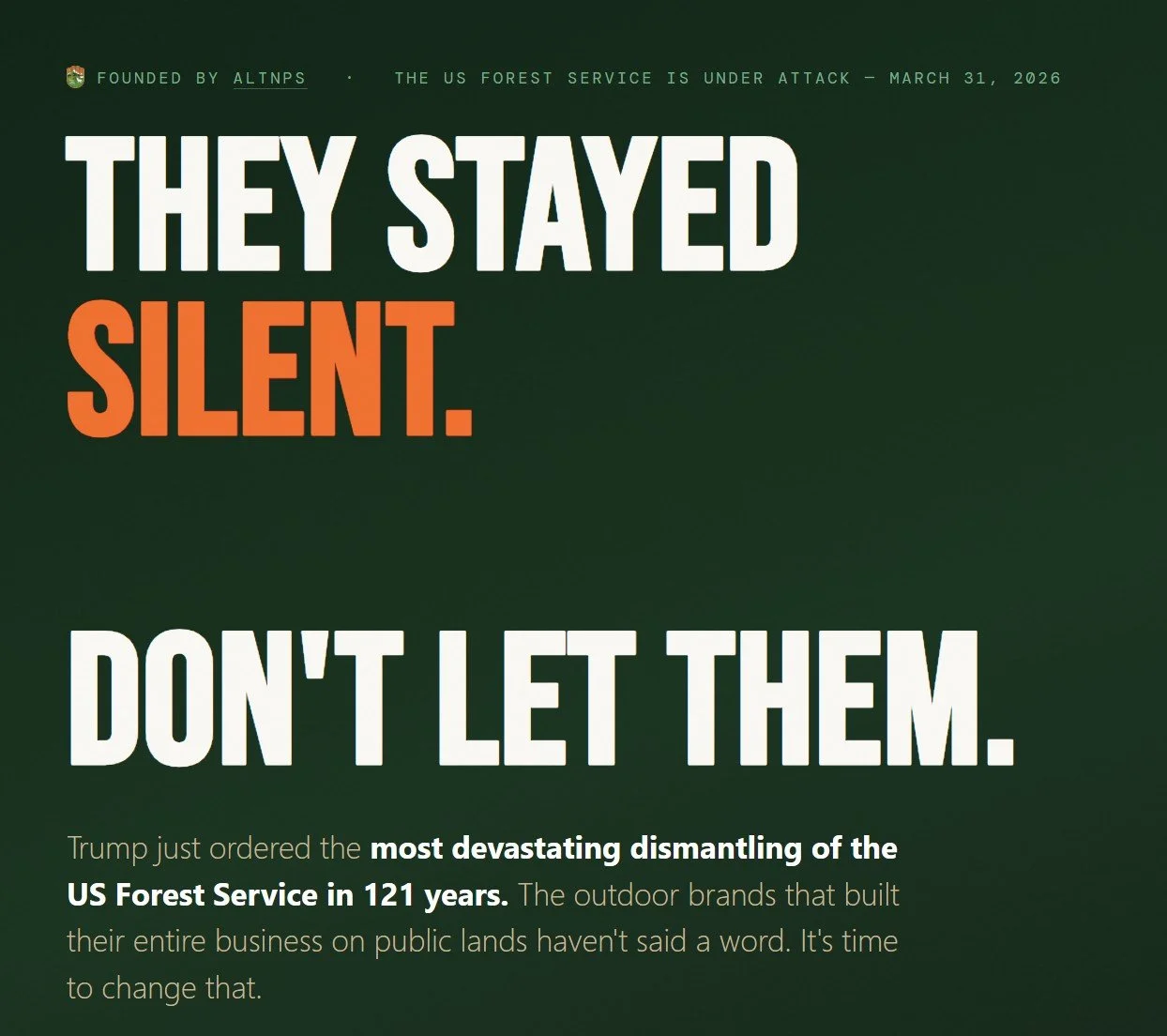
In addition to companies’ own messaging that students may compare, a website, SaveUSFS, illustrates a communication campaign to mobilize opposition against changes to the US Forest Service.
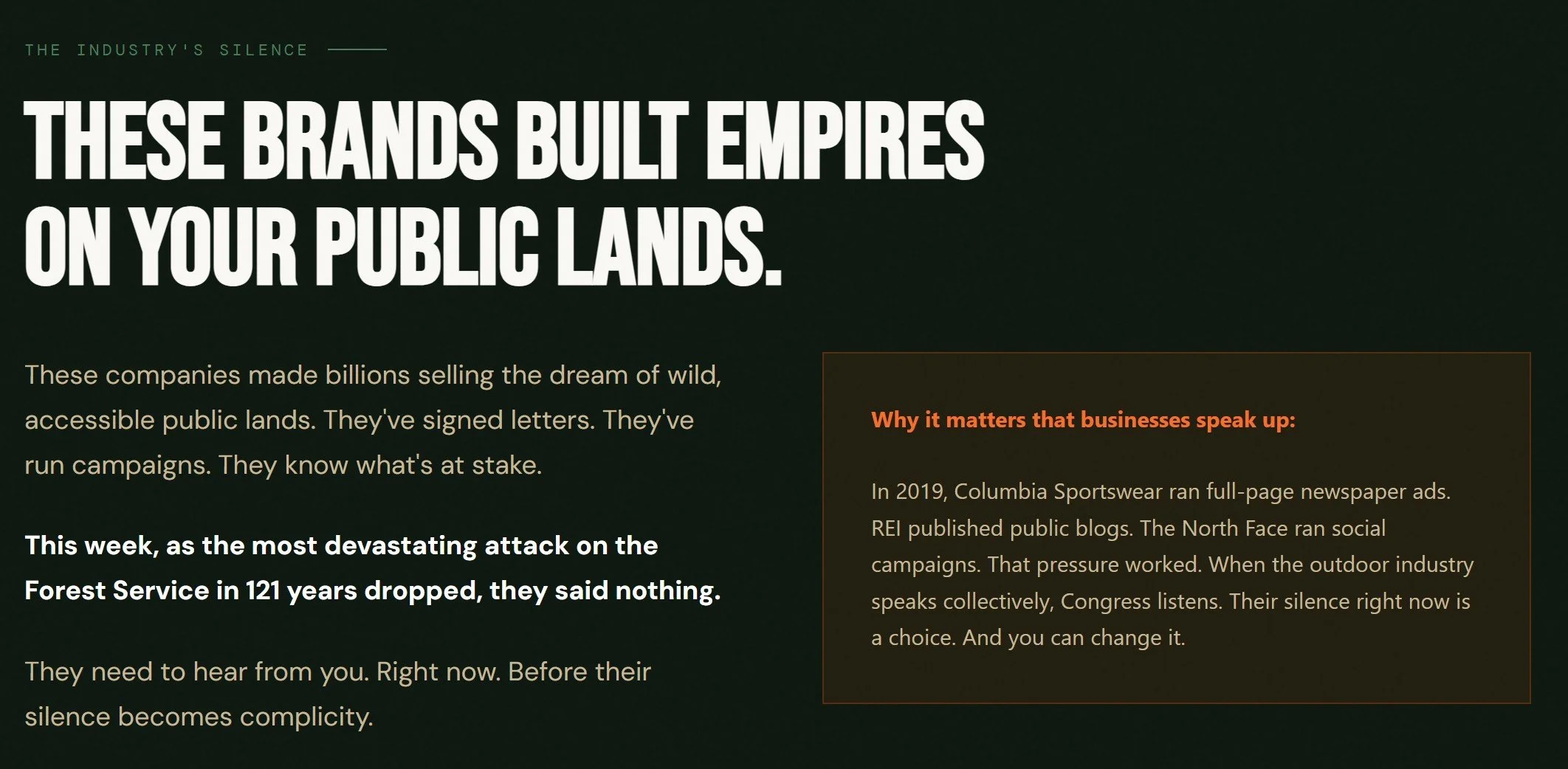
SaveUSFS: This website is a great example of a campaign with clear explanations, message examples, and calls to action. Students can identify the communication objective, which is primarily to get brands to speak out and pressure federal action. The site illustrates how to mobilize action by offering specific copy-and-paste language and ways to connect with brands. The clear organization and calls to action are most obvious in the site menu:
The Situation | The Stakes | The Brands | What To Say | Take Action
Patagonia: Not one to shy away from controversy, Patagonia published a statement with strong language:

We commented about this last Wednesday after the news broke, but we want to be clear on our stance about the recent news of the United States Forest Service, because protecting public lands is core to our purpose: Moving the USFS to Utah will gut the agency. By shutting down its research stations, culling its staff, and moving the headquarters to Salt Lake City, it will be surprising if USFS can effectively manage anything at all.
The only beneficiaries of the move and other rollbacks to public land policy from this past year are billionaires and extractive industries.
Patagonia will continue working with our Tribal and nonprofit partners to protect public lands and advocate for more funding for USFS and the Bureau of Land Management.
Conservation Alliance: Consisting of 190 member companies, this group focuses on “protect[ing] lands and waters for future generations” and “business resilience.” Notably, only 77 companies are “signatories” to the group’s statement (below). We are left wondering why others didn’t sign on, and students might guess why, for example, wanting to frame their own messages, time limitations, or concerns about consumer or political backlash, particularly for smaller companies or those dependent on government funding.
As businesses that rely on well-managed, accessible public lands, we expect the U.S. Forest Service to adhere to its legally mandated mission: ‘to achieve quality land management under the sustainable multiple-use management concept to meet the diverse needs of people’. The recent announcement to relocate agency headquarters to Salt Lake City, Utah and close regional offices and research facilities raises concerns about the agency’s ability to properly manage its 193 million acres and maintain decades of research and scientific knowledge needed to support them. Recreation on Forest Service lands currently drives $23.3B in economic output annually but local communities, visitors, businesses, and the outdoor economy stand to suffer if the agency doesn’t receive the funding, resources, and staffing that it needs through this transition. We are committed to working alongside the Department of Agriculture and congressional leaders to provide clarity on the priorities of our community, advocate for robust public engagement, and safeguard the future of Forest Service lands.
The Alliance statement is much softer than others and likely illustrates what happens when we try to get multiple perspectives onto the same page: We get a watered-down result.
Additional Brands: SaveUSFS compiled a list of additional brand messages, mostly on Facebook, for students to compare.
Instagram and the “PG-13” Label
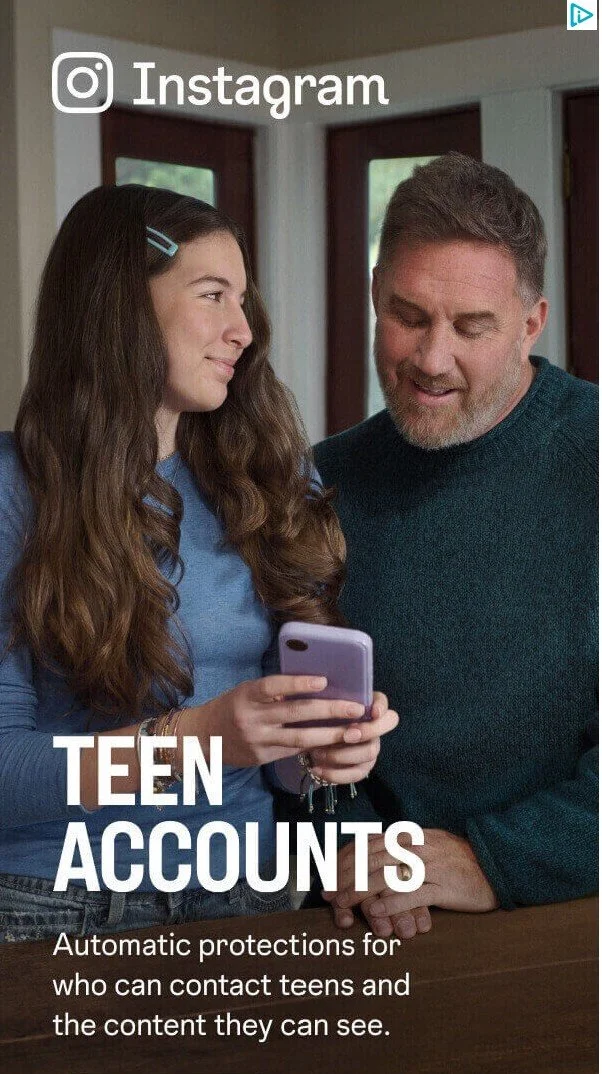
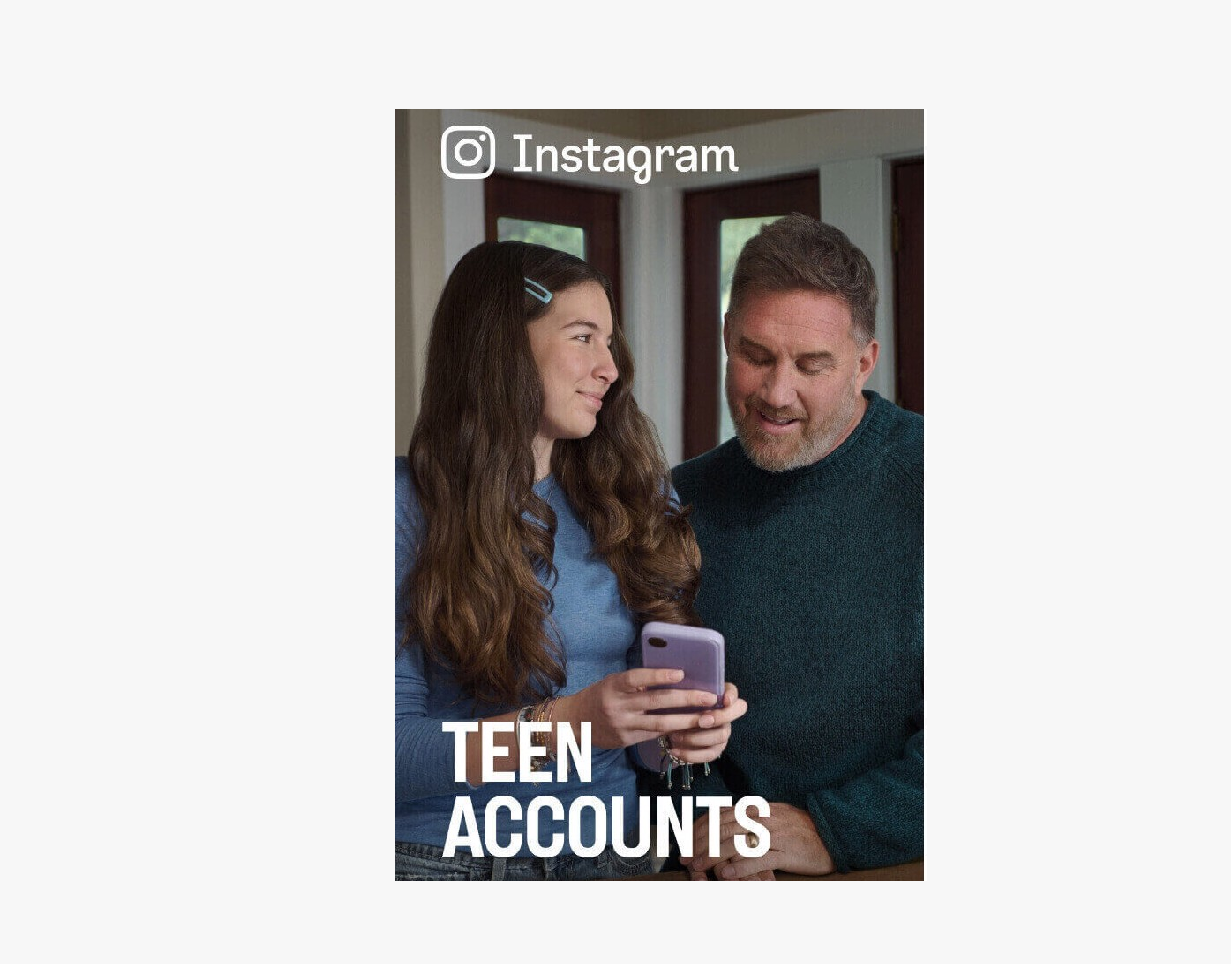
Instagram is expanding its Teen Accounts and dropped the “PG-13” language. Students can analyze the communications about these accounts—and explore skepticism about whether these new safety tools work.
After losing two lawsuits about child safety, Meta’s Instagram focuses on Teen Accounts to reassure parents and appease European lawmakers. But the PG-13 label was contested by the Motion Picture Association as a trademark violation and potential cause of confusion.
Meta’s attempts to restrict teen content literally cannot be “guided by” or “aligned with” the MPA’s PG-13 movie rating because Meta does not follow this curated process. Instead, Meta’s content restrictions appear to rely heavily on artificial intelligence or other automated technology measures.
At issue is the degradation of the rating, which is determined by parents who watch the movies. In updated language, Meta said it was “closer to PG-13 movie standards—which parents already know.” In this latest communication, titled, “Instagram Expands Teen Accounts Inspired by 13+ Content Ratings,” Meta refrains from “PG” language entirely, instead saying the “revamped Teen Accounts” are “inspired by 13+ movie ratings criteria and parent feedback.”
Students may have a lot of opinions about the announcement and Teen Accounts. They might explore criticism about age verification and content screening to assess whether parents can trust this classification. They might also assess Instagram’s “Tips for Parents” and “Manage Your Teen Account Settings” for kids.
Trump’s Rhetoric This Week
Without taking a political stance, business communication faculty can examine President Trump’s recent rhetoric about the war against Iran as illustrations of literary devices and persuasive strategies. Students can analyze these and draw comparisons for business presentations.
Extreme language is a well-worn communication strategy of the president, but his social media posts this week marked a new level and deserve attention in communication classes. We can frame the topic as analyzing his speech rather than a discussion about whether students endorse or disagree with his position.
Here are two examples with connections to course concepts.
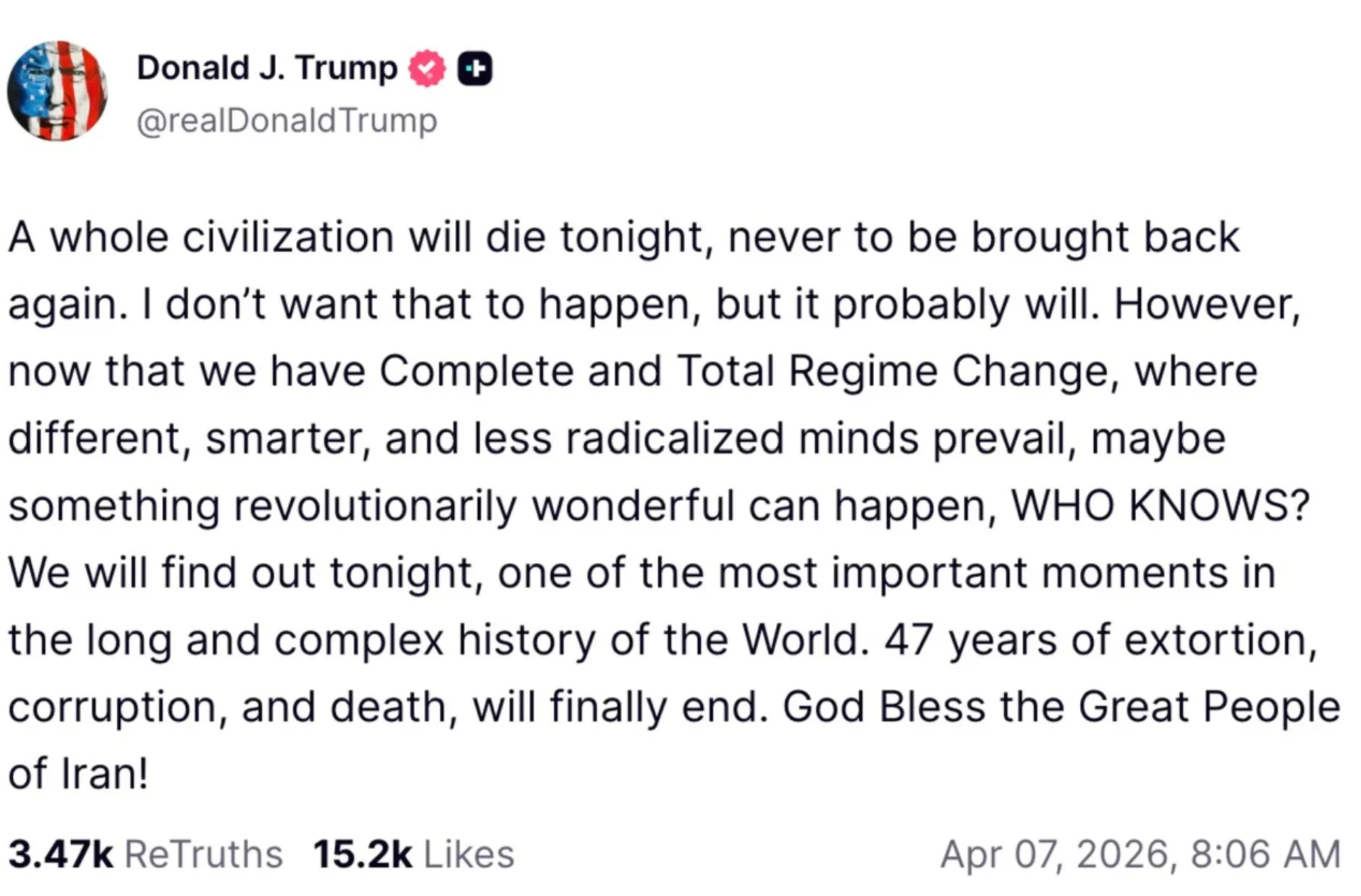
“A whole civilization will die tonight.”
Devices like hyperbole, emotive language, and apocalyptic framing attempt to engender fear and create a sense of urgency. The dangers of using these devices, even as a negotiating strategy, include a loss of credibility (and, in this case, potentially threatening war crimes, such as genocide).
Students can identify examples in business situations—for example, investor presentations, fundraising letters, or layoff memos—when this type of language may be used for persuasive purposes. An appeal that claims a business’s success depends on one investor’s funding sounds desperate and may cause the investor to question the long-term viability of the business. A fundraising letter that claims an extreme result (people will die without needed resources) may inspire people to donate one time, but the claim may affect the organization’s credibility for future appeals.
In response to Tucker Carlson’s criticism of Trump’s rhetoric in another post, the president responded by attacking Carlson personally—an example of ad hominem. In an interview, he said:
Tucker’s a low-IQ person that has absolutely no idea what’s going on. He calls me all the time; I don’t respond to his calls. I don’t deal with him. I like dealing with smart people, not fools.
Trump has referred to many people as having low IQs, “not very bright,” or similar, and a recent Truth Social post lumps Tucker Carlson, Megyn Kelly, Candace Owens, and Alex Jones into this category (“they have one thing in common, Low IQs”). By classifying a group of people, he tries to damage the credibility of that group while elevating his own status as an implied high-IQ person. By repeating the claim over the years, he creates a shorthand for his audience to discredit someone as part of this inconsequential group.
It’s also worth noting that Trump’s post itself was an ad hominem attack (“You crazy bastards”) as well as mocking their religion.
Students can find examples of ad hominem attacks in business environments, perhaps from their own work experience. We see these used when leaders blame others for a crisis, justify questionable termination decisions, and make discriminatory or derogatory comments.
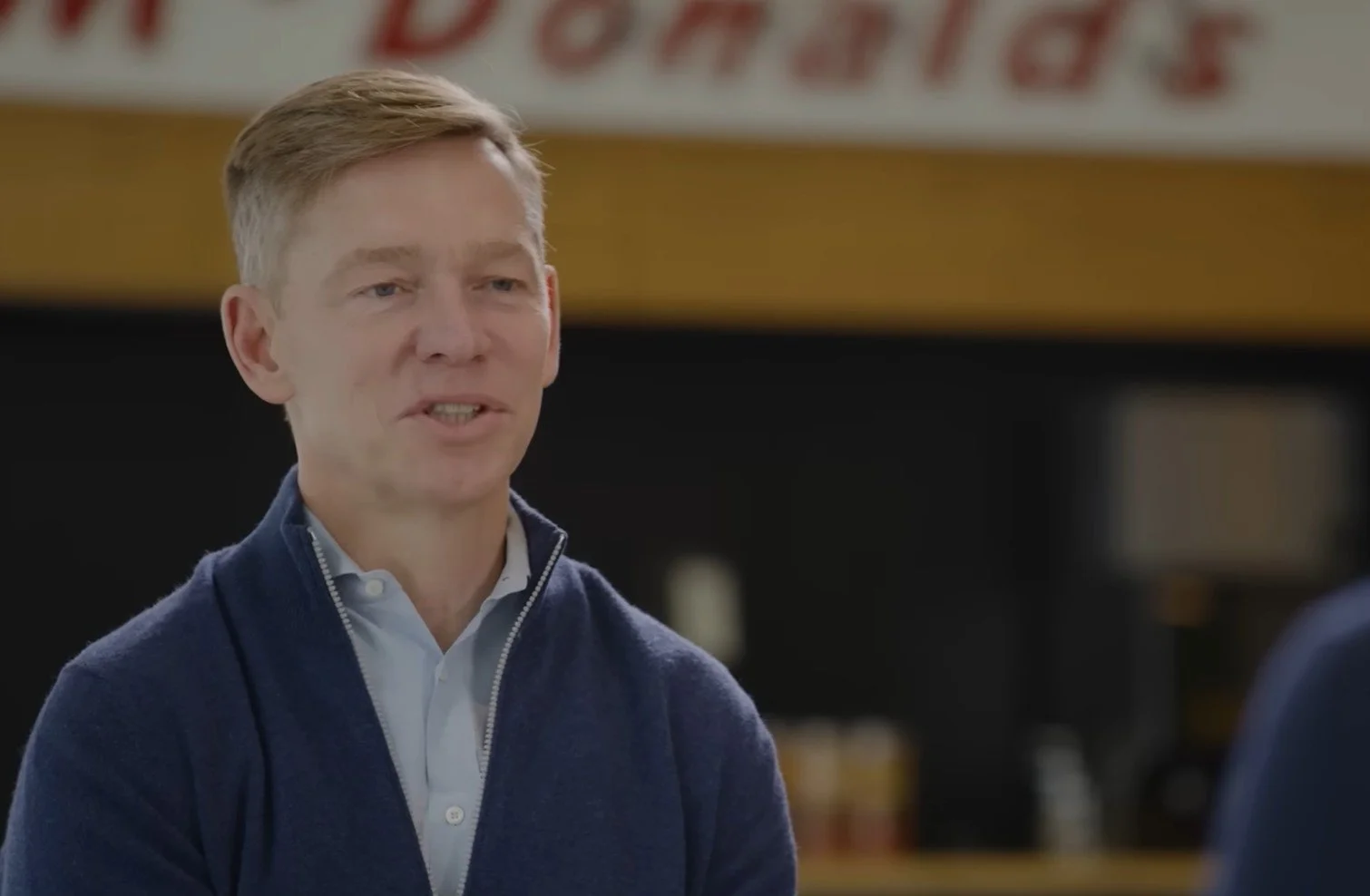
McDonald’s CEO Leans Into Viral Video
McDonald’s CEO Chris Kempczinski explains his mini-bite viral video and other challenges facing the company.
Kempczinski boldly agreed to a Wall Street Journal video interview, and he handles the discussion well, at times laughing about the viral video. Directly addressing why he took what looked like a tiny bite of the new Big Arch burger, he explained:
I blame it all on my mom because she said, don’t talk with your mouth full, and I think probably, in that case, I should have said, you know what, to hell with it, I’m gonna talk with my mouth full.
His explanation makes sense, and he does speak with his mouth full during the WSJ video after taking a human-sized bite of a French fry.
However, for the original video, he obviously didn’t think through the possibilities of editing (which, as I pointed out, removed a crumb from his lip). A too-full mouth of food could have been omitted.
Kempczinski takes a personal approach now, mentioning that he first learned about the viral video from his kids. As in his other videos, he sounds authentic—like his genuine self—and speaks about the competitive market and rising costs as we would expect of a CEO.
New Research About Expressing Emotion and Implications for Students
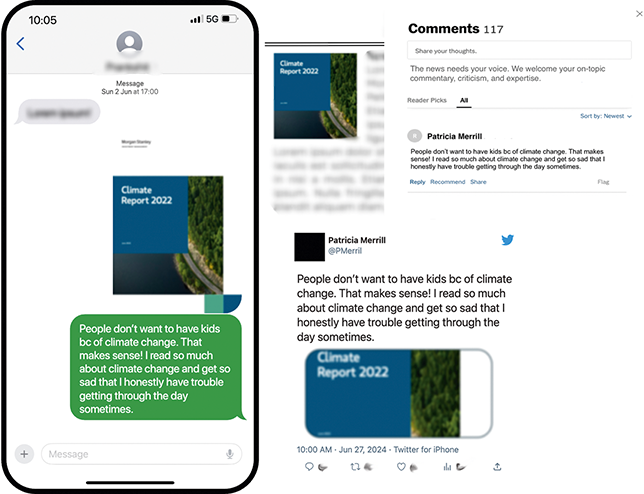
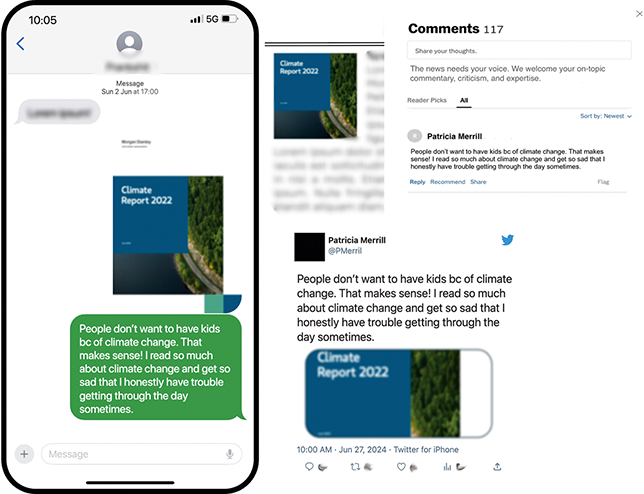
Business communication faculty have long taught students that emotional appeals—for example, eliciting anger—are persuasive, and that still holds. But new research published in a monograph, “Emotions on Our Screens,” shows that expressing our own emotions online may not change others’ minds. We see parallels with delivering bad news.
Six studies assessed posts about climate change and found that, when people expressed emotion, for example with a sad-face emoji, users viewed the post as “less appropriate and inauthentic.” Talbot Andrews, professor of government at Cornell University, explains, “I think you’re crying crocodile tears to make me feel bad about this, and I see through that ploy.”
I’m reminded of layoff meetings during which managers would cry. These meetings require a delicate balance: neither indifference nor emotional spillage that some employees perceive as performative and attention-seeking—similar to the climate research examples.
From the research about online displays, Andrews clarifies:
Emotional expression can serve an important role, helping people find a community that cares about their issue. Even if it doesn’t achieve any influential goal—persuading others or building your social media clout—expressing emotions often makes people feel better. The takeaway is not that people should keep their feelings to themselves, but that such expression won’t always be taken at face value.
As we might expect, emotions in text messages were found to be more authentic than those on social media. Public posts seemed more like “virtue signaling” or clickbait.
Students might evaluate their own texts and social media posts for displays of emotion. What might they change if their goal is to persuade?
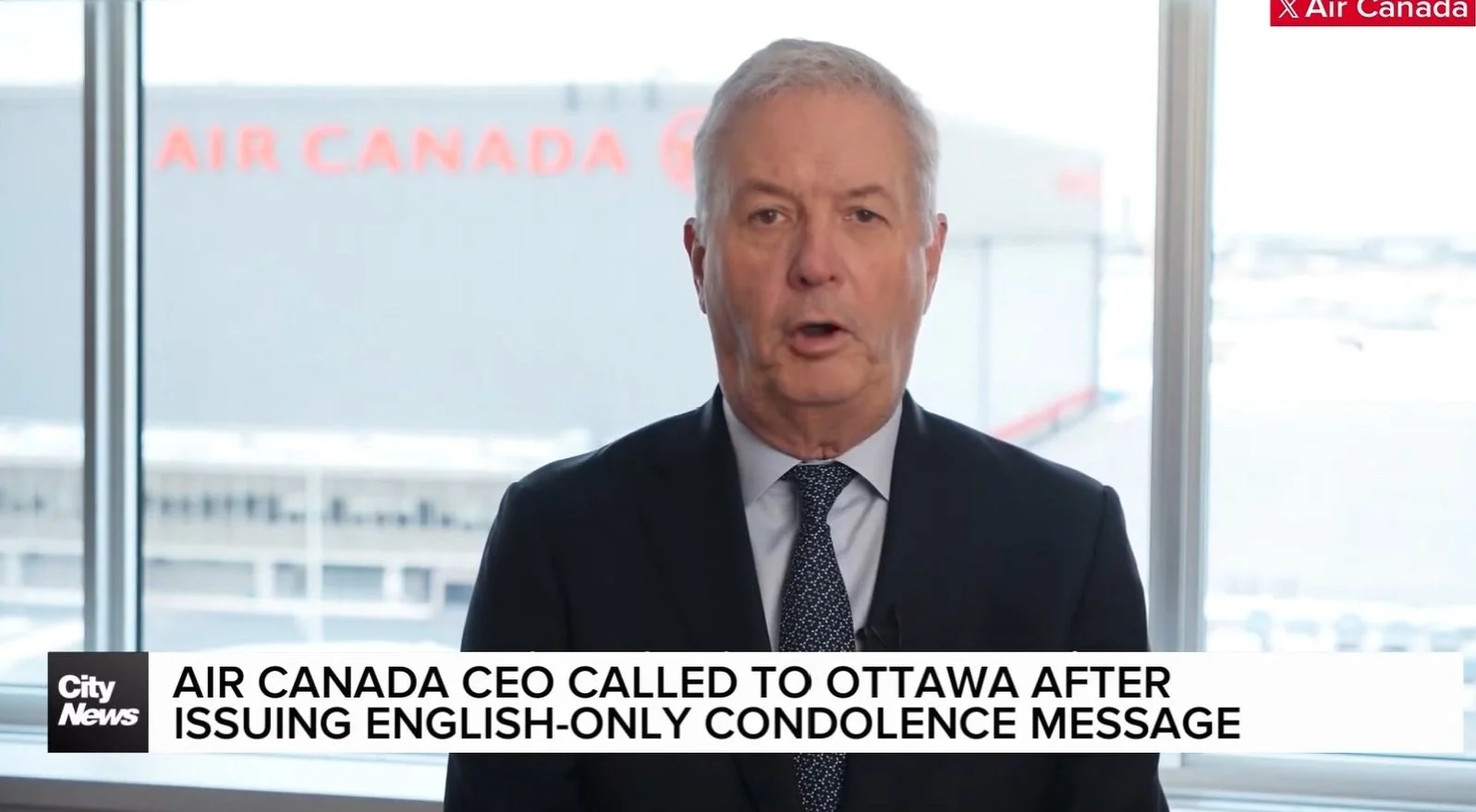
Air Canada CEO’s Language Viewed as a Failure of Character
After a collision at LaGuardia airport, Air Canada’s CEO resigned because of his language—English. The situation demonstrates cultural communication issues for our classes.
Never mind the crash that killed two pilots and injured dozens of people at LaGuardia airport. The big news is that Air Canada CEO Michael Rousseau gave his condolence speech in English instead of in both French and English. Prime Minister Mark Carney said he was “disappointed,” and that his English showed “a lack of judgment or a lack of compassion.” Then he seems to settle on “lack of compassion.” Either way, he’s describing a failure of character. Others said Rousseau’s English demonstrated a “gross lack of respect.”
Context and history are important here. Rousseau faced similar criticism when he was hired in 2021. He didn’t speak French and said he didn’t think it was important for job. After backlash, he promised to learn, but here we are.
An op-ed by the President and CEO of the Association for Canadian Studies explains the situation more fully. He describes the Official Languages Act, which requires companies to offer bilingual services. Students might analyze his other arguments, including this one:
Some argue that this requirement is primarily symbolic. They are right—and that is precisely why it is essential.
In the end, Rousseau—or the Board—couldn’t stave off criticism. Curiously, the Air Canada statement gives no reason for his “retirement,” including only compliments about his contributions to the company. As is often the case, we’re left wondering exactly how the decision was made, but the political pressure is clear.
Brands Having Fun
The stolen truck carrying 413,793 packages of KitKat bars launched memes and jokes from Nestlé and other brands. The situation is another example of companies embracing mishaps.
KitKat took full advantage of the incident:
We’ve always encouraged people to have a break with KitKat—but it seems thieves have taken the message too literally and made a break with more than 12 metric tons of our chocolate.
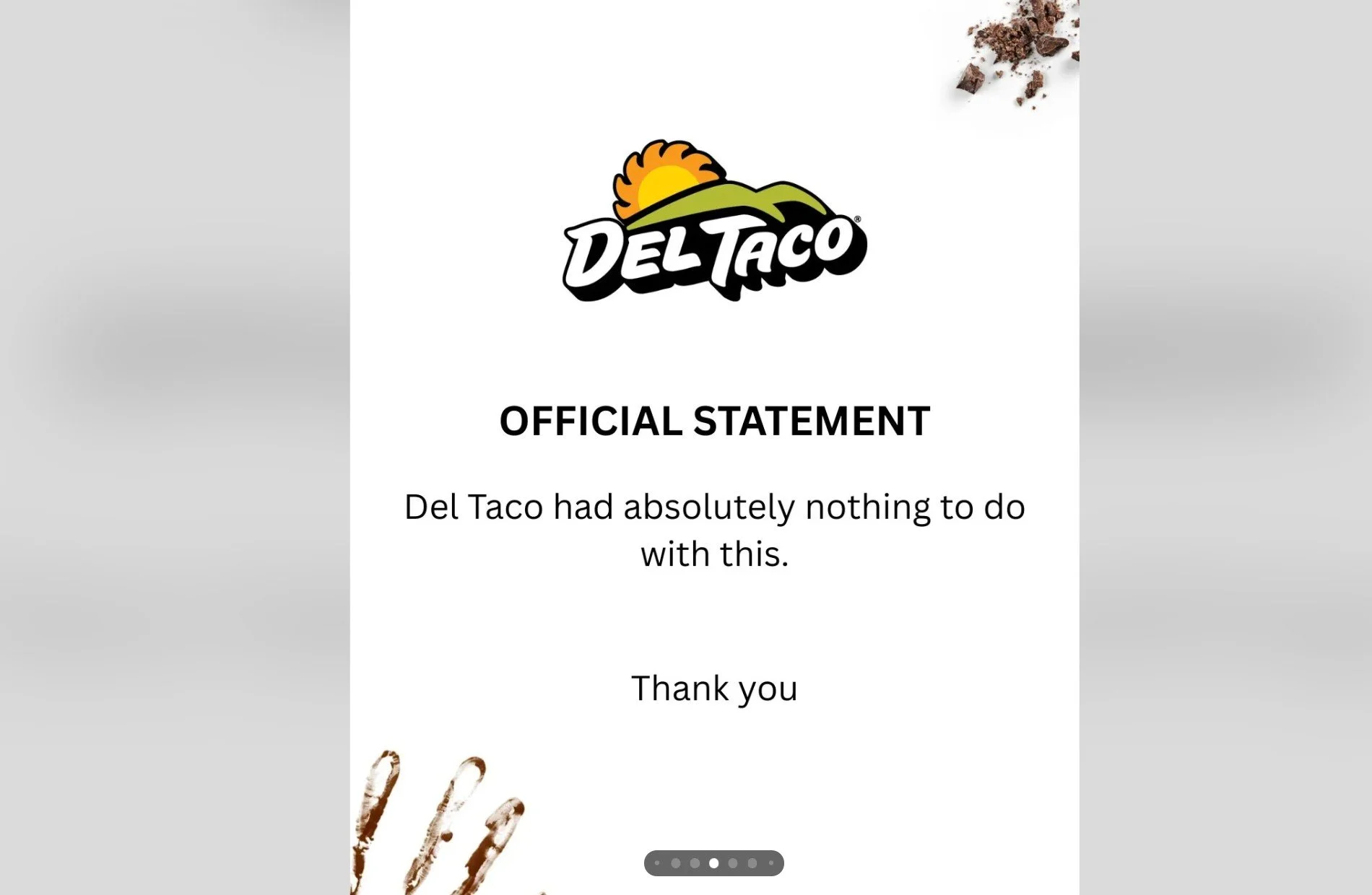
Then other brands got into the game. Pizza Hut claims a new KitKat pizza, DoorDash suggested people add 500-600 KitKats to their order, and RyanAir posted a plane with a mouth full of KitKats. This Del Taco one is cute.
We saw similar brand responses during the McDonald’s mini-bite incident. McDonald’s humbly poked fun of itself, and other brands pounced. The art is responding on-brand and quickly. Some of the KitKat responses are repetitive and feel like copycats. Student could analyze them to see which are most and least effective. RyanAir’s stands out for its weird silliness—definitely on brand.
I expected to see something on the KitKat website. But under “latest news” are progressive muscle relaxation and box breathing videos, perhaps overdoing the “have a break, have a KitKat” slogan. Student will have opinions on this too.
12e Is Available!
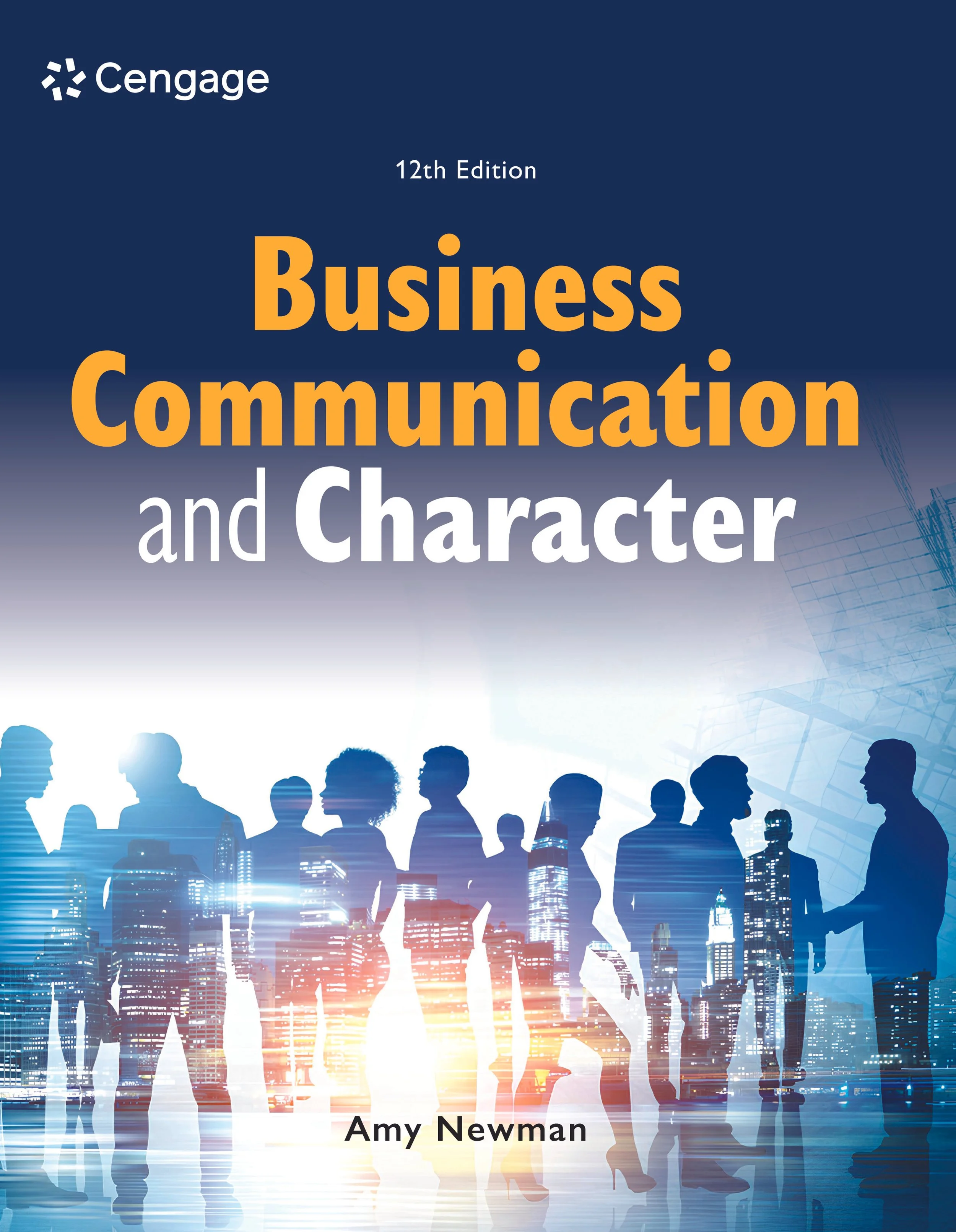
The 12th edition of Business Communication and Character is in print, and the eBook and MindTap supplements are coming soon.
This might be my favorite edition of the book. Here are a few highlights:
The character theme continues, elevating students’ humanity—more important than ever to distinguish themselves from AI. Students learn to use AI as an assistant and collaborator, while maintaining their own authorship and accountability.
As the number of students and audiences with diverse cognitive and learning styles grows, I added guidance throughout the book. I hope our neurodivergent students feel supported as they read this edition.
The “DEI” parts challenged me to consider multiple perspectives, and I decided to address the controversy directly. Although some instructors may need to skip parts of Chapter 3, Communicating Across Differences, to comply with state regulations, the approach may meet course objectives. The focus is on belonging, with strategies for everyone instead of for specific groups.
Finding and getting permission to use real examples is always a challenge, but many are included in this edition to illustrate course concepts, engage students, and continue the practical approach of the book.
Here’s the link to Cengage’s site, and I’m glad to talk about the new edition with you.
Accent Bias
New research highlights what students might already know: Nonnative English speakers receive less public engagement.
Authors of studies published in Psychological Science analyzed more than 5,000 TED Talks and lab tested a presentation excerpt. They found that “accentism” bias affected video views and likes. They blame difficulty processing accents and stereotyping based on accents.
Of course, even native speakers have accents that trigger reactions. But nonnative accents may more negatively impact online engagement.
The authors suggest the following, which may be worth exploring with students:
Offer “level ground” to TED speakers by featuring nonnative speakers on the platform
Use technology to ease cognitive processing, for example, by providing subtitles in several languages, employing AI to correct mispronunciations, and providing language translation
Educating people about accentism
Students might discuss which of these ideas might work best for different situations, for example, an entrepreneur’s pitch to a VC or an conference presentation. They also might consider the downsides of each; using AI to correct mispronunciations is definitely worth a discussion.
In addition, students might have their own ideas on the topic—both about online engagement and for other situations involving nonnative speech. Becoming more familiar with nonnative accents—increasing exposure—may improve comprehension. Also, research shows that instructing students not to discriminate against nonnative speakers reduced negative teaching evaluations.
Students might find other ways to encourage more open-mindedness, which may cause listeners to feel less burdened and to be more accepting of the additional cognitive processing required to understand others. They might be reminded of cultural humility, which certainly plays a role in how much patience we have and how much we value people who speak differently than we do.
Business Communication Lessons from Meta/Google Trial
Business communication students can learn from the KGM v. Meta and Google case for their own presentations and messages. Three examples are emotional appeal/storytelling, concrete visualization, and document discovery.
Considered a landmark case that opens paths for other suits, KGM v. Meta and Google (Instagram and YouTube) found companies negligent, citing defective product design causing addiction. The plaintiff’s attorney, Mark Lanier, has a reputation of theatrics in the courtroom, which we see in these first two examples. Students need to balance ethics/credibility and effectiveness for their own presentations.
Emotional Appeal/Storytelling
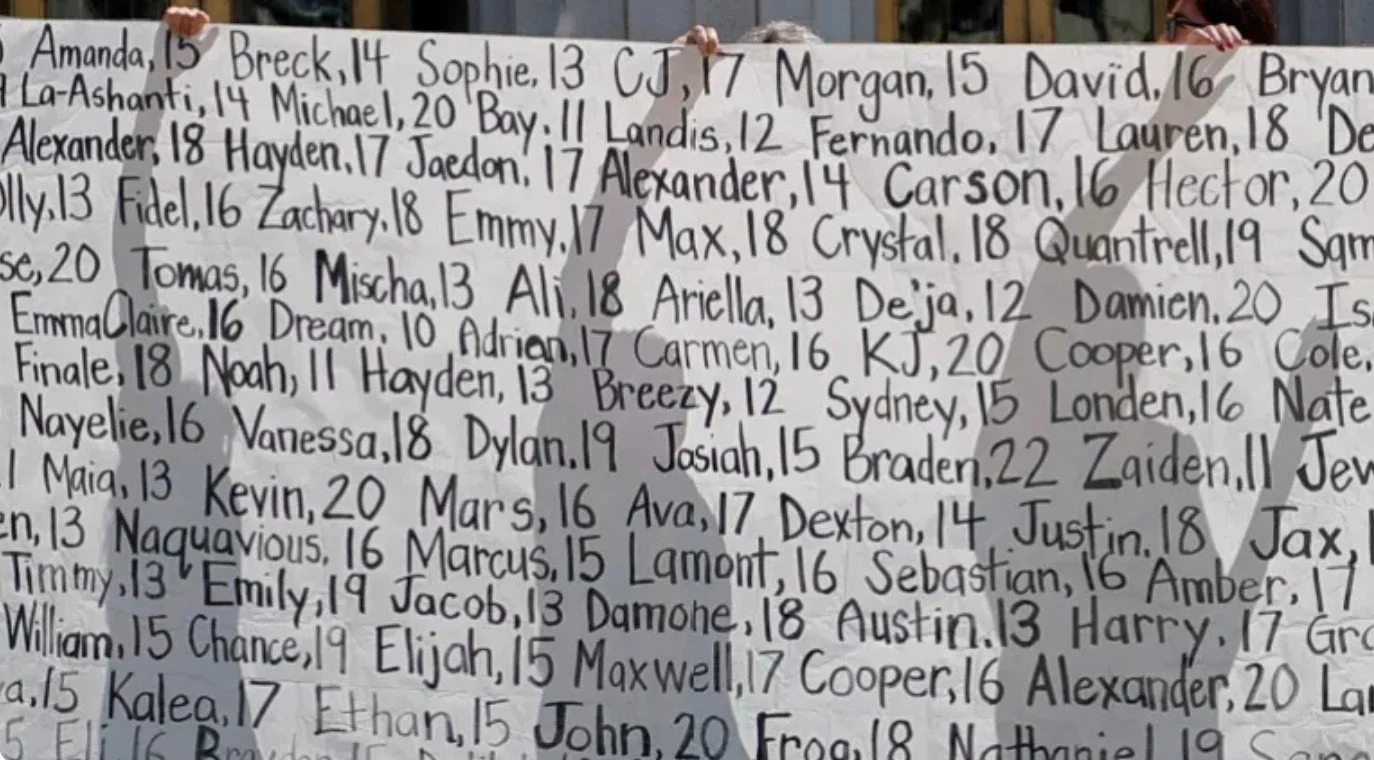
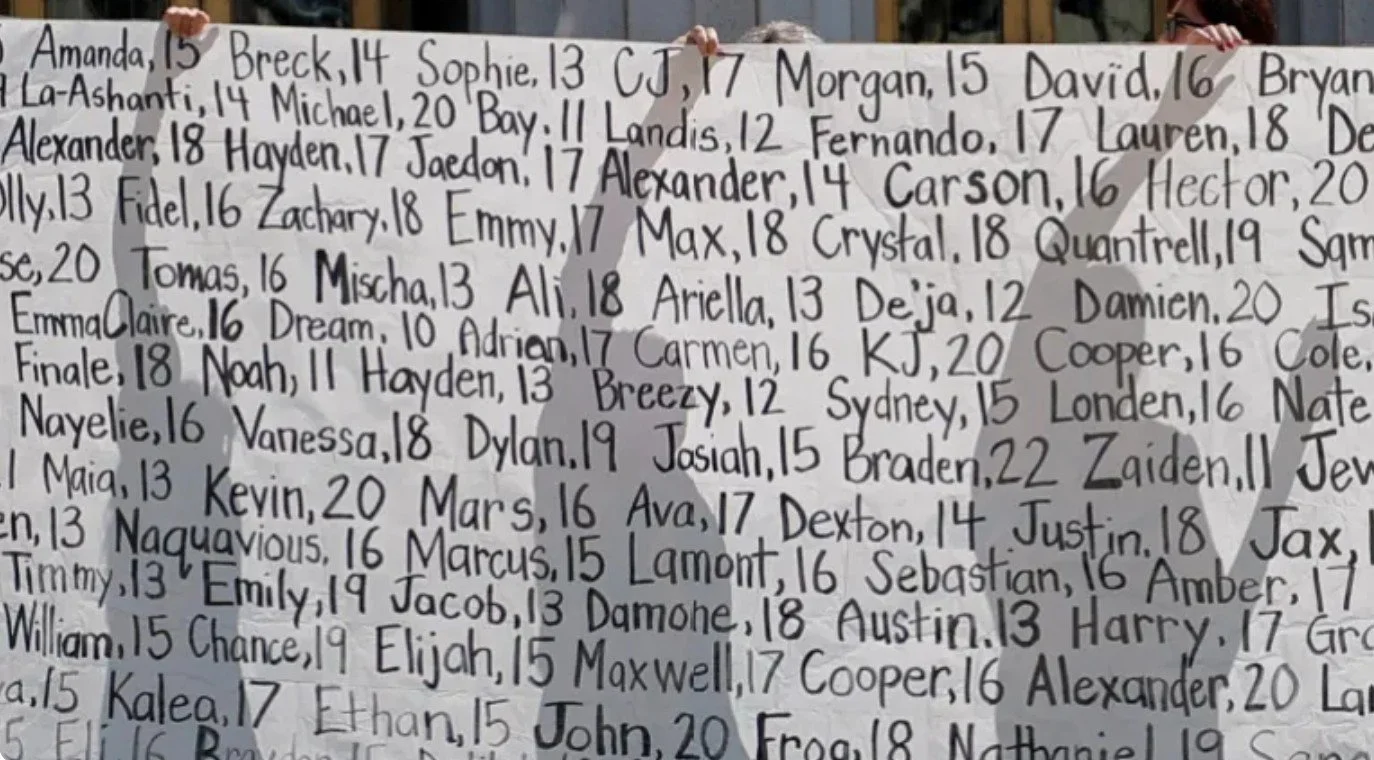
At the heart of this case is how kids are affected by social media, and storytelling was key. Families brought photos and a large banner with names and ages of children who died, blaming social media companies. Plaintiff attorneys also showed a large poster with hundreds of selfies KGM posted of her when she was a child.
These strategies humanized the plaintiff and contrasted Mark Zuckerberg’s stoicism. As NPR reported:
At one point, the family's lawyer brought out an internal document about how Meta's staff has pushed Zuckerberg to be more empathic and relatable and more human in public appearances and, you know, not to be fake and corporate and cheesy—these are their words—you know, during events like court appearance. And Zuckerberg responded by, you know, showing some human vulnerability. He said, quote, "I think I'm actually well known to be very bad at this."
Concrete Visualization
In legal terms, “demonstrative evidence” or a “demonstrative exhibit” “explains or illustrates” testimony; it’s not direct evidence. In persuasion communication, we might call this type of evidence examples rather than, for example, data. We also encourage students to make large numbers concrete.
Lanier illustrated these strategies:
As the punitive-damages phase of the trial got under way in court on Wednesday, the plaintiff’s attorney, Lanier, revealed a jar of M&Ms—415 of them. Each one represented $1 billion of the $415 billion in total stockholders’ equity of Alphabet Inc., he said. As he removed M&Ms one by one, Lanier noted how the jar barely registered a change, symbolizing how inconsequential even a ruling of $1 billion in damages would be to a company of Alphabet’s value.
This type of illustration gets attention and does clarify points but might seem cheesy in business presentations.
Discovery
Once again, this is a good opportunity to talk with students about the legal discovery process, which makes any internal emails, texts, reports, Teams content, etc. public. Perhaps the plaintiff’s strongest evidence was Meta’s own documentation that demonstrated how leaders exploited—actually, built—platform features to increase addiction.
Instead of a lesson warning students about what they put in writing, we might teach them to act with integrity. If social media executives hadn’t build systems that are now proven to be addictive, they wouldn’t have had to censor what they put in writing.
Both Meta and Google are appealing the case. They will not accept responsibility. Together, the companies will pay $6 million in compensatory and punitive damages. That’s .6% of one M&M. How could students visualize that?
AI’s Hilarious Descriptions of Competitors’ Writing

A Wall Street Journal writer asked ChatGPT, Claude, and Gemini to describe each other’s writing style, and the results are hilarious. But the writer’s conclusions about detection aren’t supported by research.
Gemini says Claude’s hallmark style is that of “a nervous graduate student terrified of losing their funding or offending the thesis committee.”
ChatGPT, in contrast, writes like a “McKinsey junior partner aggressively pitching a synergy strategy on LinkedIn,” according to Gemini. “It writes with absolute, unwavering confidence but strips out all specific, concrete details, resulting in prose that sounds authoritative but evaporates the moment you try to extract actual meaning from it.”
According to the OpenAI app, Claude is “an earnest grade [sic?] student who will not take a position. If you ask Claude, ‘Is this policy good,’ it replies: ‘It can be understood as operating within a broader ethical framework that may, depending on one’s normative commitment.’ By the time Claude finishes clearing its throat, the Roman Empire has fallen again.”
Perhaps like humans, AI bots have writing styles, although let’s stop short of calling them personalities.
Boldly, the writer claims in the article headline, “AI-Generated Writing Is Everywhere, and It’s Still Easy to Spot—for Now,” but the research says otherwise. Human detection is running around 50% (maybe better for business communication faculty, but who knows?), and detection tools aren’t reliable. As AI improves, detection will get more challenging.
Sure, we all heard about overuse of em-dashes and words like delve and myriad, but as soon as ChatGPT became public, our colleagues have been wary of accusing students of using AI.
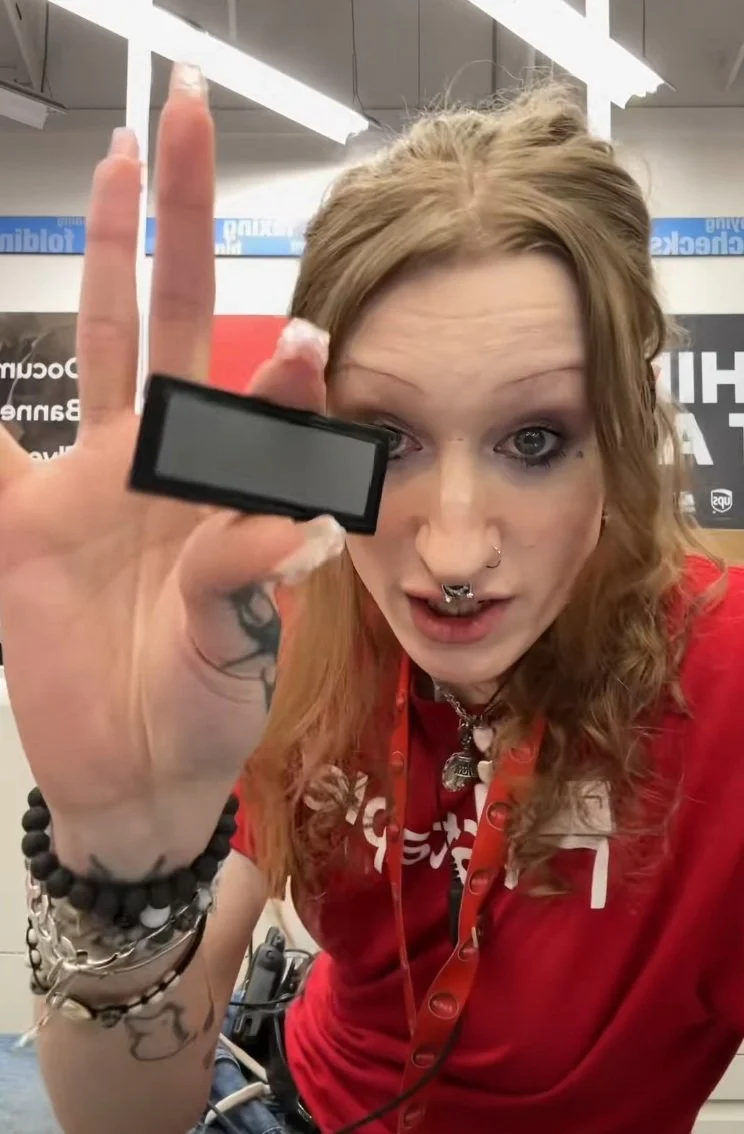
Viral Staples Videos
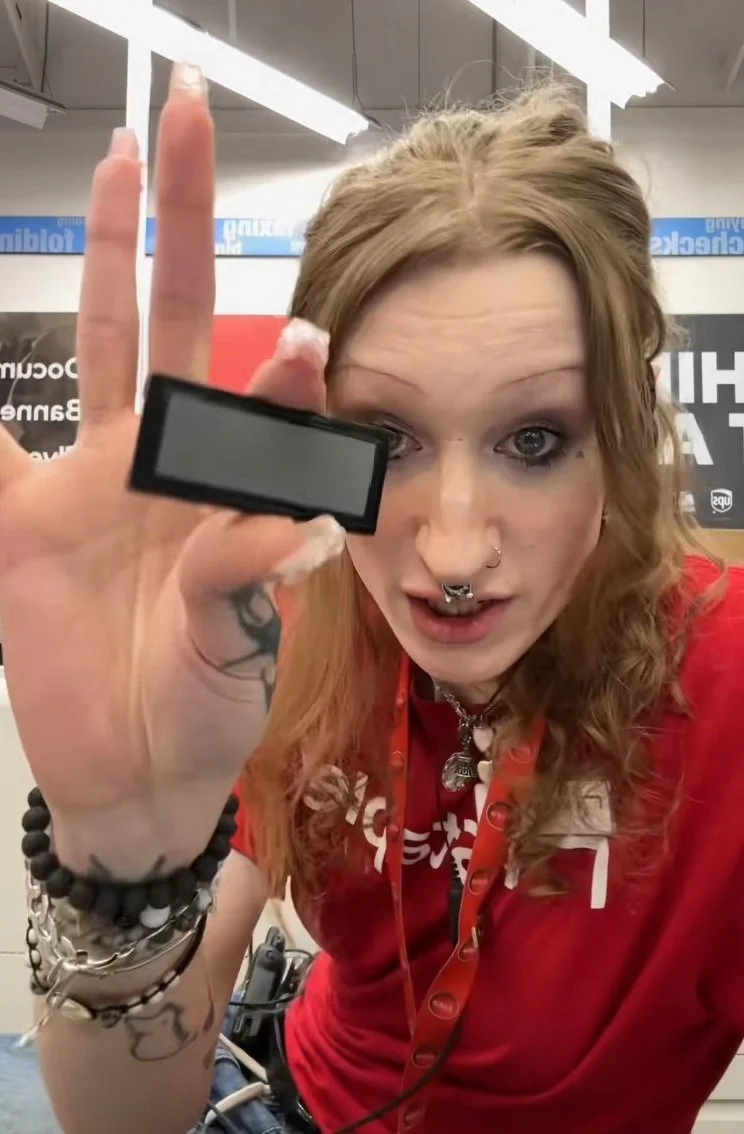
Staples has an employee turned social media star with fun viral videos. The “Staples Baddie” Kaeden Rowland somehow makes office products look interesting.
In this video with 5.7 million views, she explains how to make a signature stamp.
Rowland says she’s autistic and wanted to show her work as a print specialist:
I was like, How can I make people really feel, not just see, the passion I have for these stationery office products?

Staples leadership supports her authentic videos, which we might expect given her following. User comments include, “You are single-handedly saving staples,” and “omg are you the staples baddie i saw someone do a presentation in their class about????” The Staples social account engages on some videos, as you see here.
An engaging class project can ask students to develop a video series relevant to a brand that could go viral. What might make the videos take off? How would they ensure that the series aligns with brand values? What are the risks and challenges?
McDonald’s Video Recovery
A McDonald’s video caused embarrassment and left the company vulnerable to competitors. But the company’s response follows advice about embracing negative reviews.
The video of McDonald’s CEO admiring and tasting the new Big Arch wasn’t a bad idea. Chris Kempczinski sounds authentic and has built almost 100,000 followers on Instagram. But viewers criticized the video, primarily because Kempczinski twice called the burger a “product” and took a small bite while asserting, “That’s a big bite for a Big Arch.”
Interestingly, we see that the video was edited. After the fated bite, Kempczinski has some food on his lower lip, which vanishes in the next shot. Did the editors not notice that the bite looks small and doesn’t match his speech? Or is the bite not really that small and is only exaggerated by the social media response?
Going viral slowly, the video got more attention when Burger King’s and Wendy’s leaders made videos of their own. This might be filed under “no press is bad press.” Although that no longer holds in all cases, a spokesperson said, “We’re glad the Big Arch has everyone’s attention, including competitors’. Early sales are beating expectations.” Students can analyze other companies’ video responses and comments on social media, including those here.
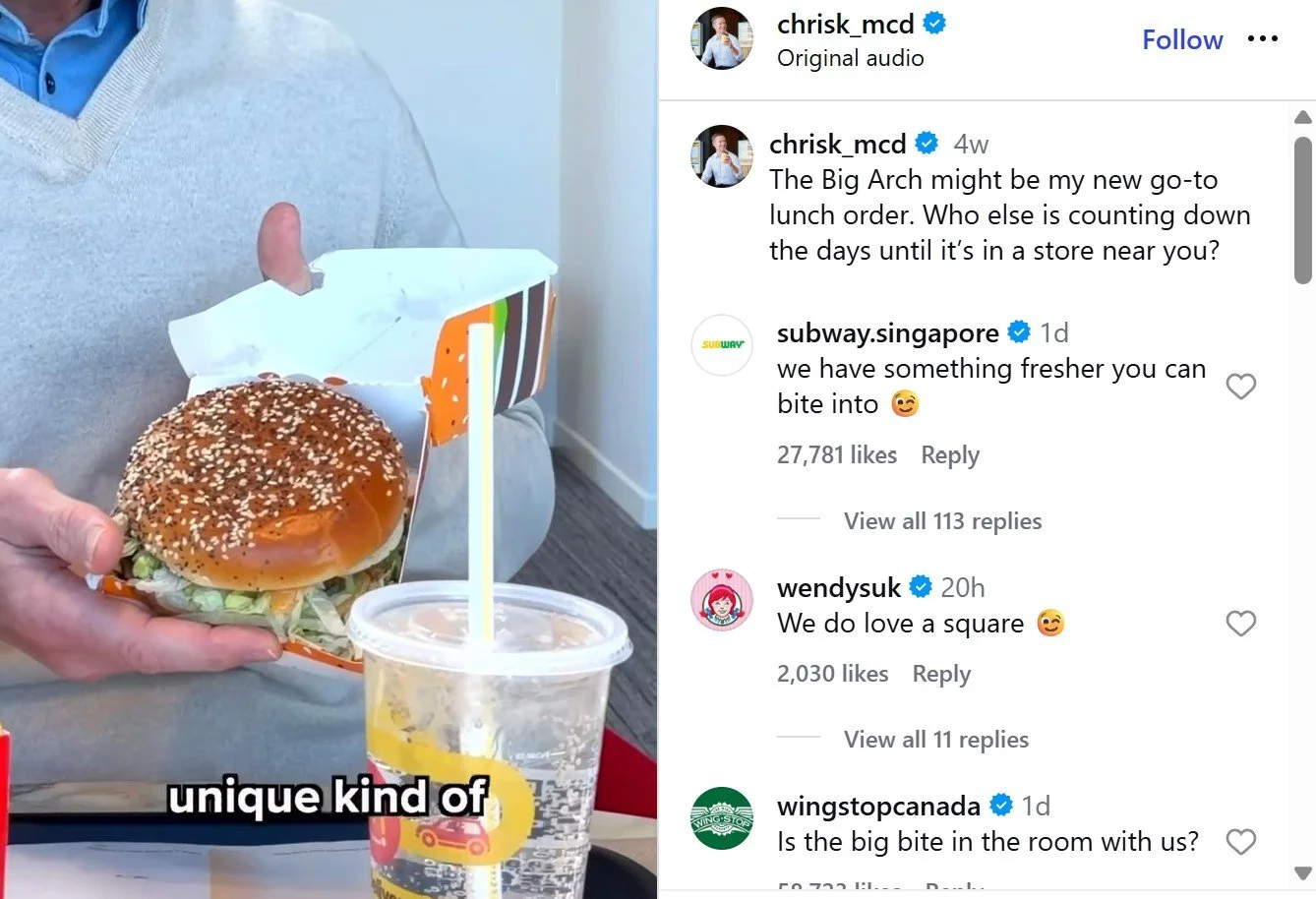
Smartly, McDonald’s stayed engaged in the conversation, posting this image and the comment, “can’t believe this got approved.” The strategy follows guidance about “reappropriating the insult” (embracing a negative comment and turning it into humor) and “stealing thunder” (revealing negative information about the brand before others do)—related ideas about controlling the narrative.
Students can discuss whether Kempczinski should have posted something himself. That would have been riskier.
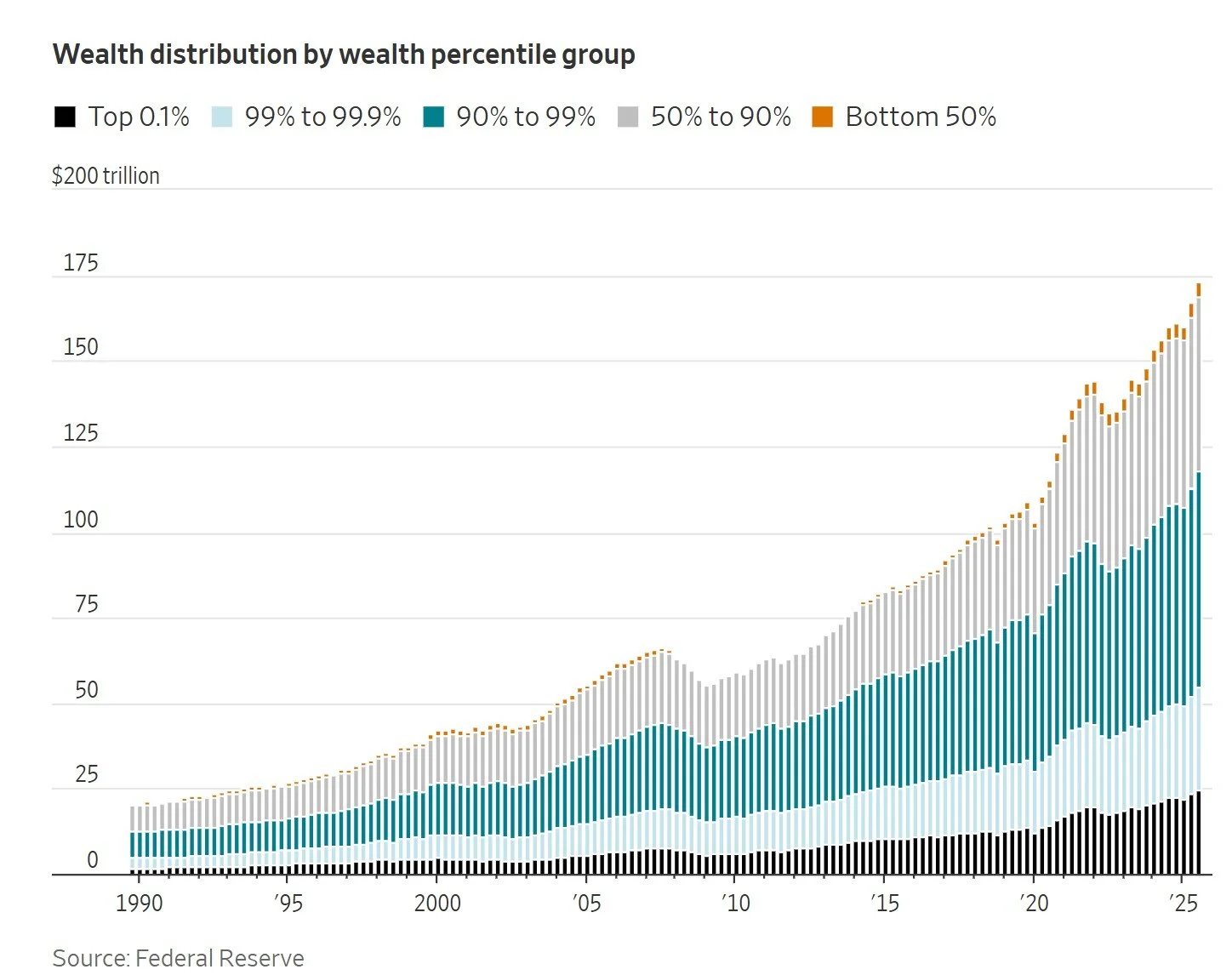
Problems with a Stacked Wealth Chart
Students might find better ways to display data than this stacked chart showing U.S. wealth distribution over time.
The chart in the WSJ article, “Billionaires’ Low Taxes Are Becoming a Problem for the Economy,” shows that wealth has grown tremendously over time and that those with the most wealth have accumulated far more over time. But the comparisons are hard to see with the stacked area chart. We’re missing percentages of wealth. Because the point is “distribution,” we want to know the share of each group. We don’t know by looking at this chart.
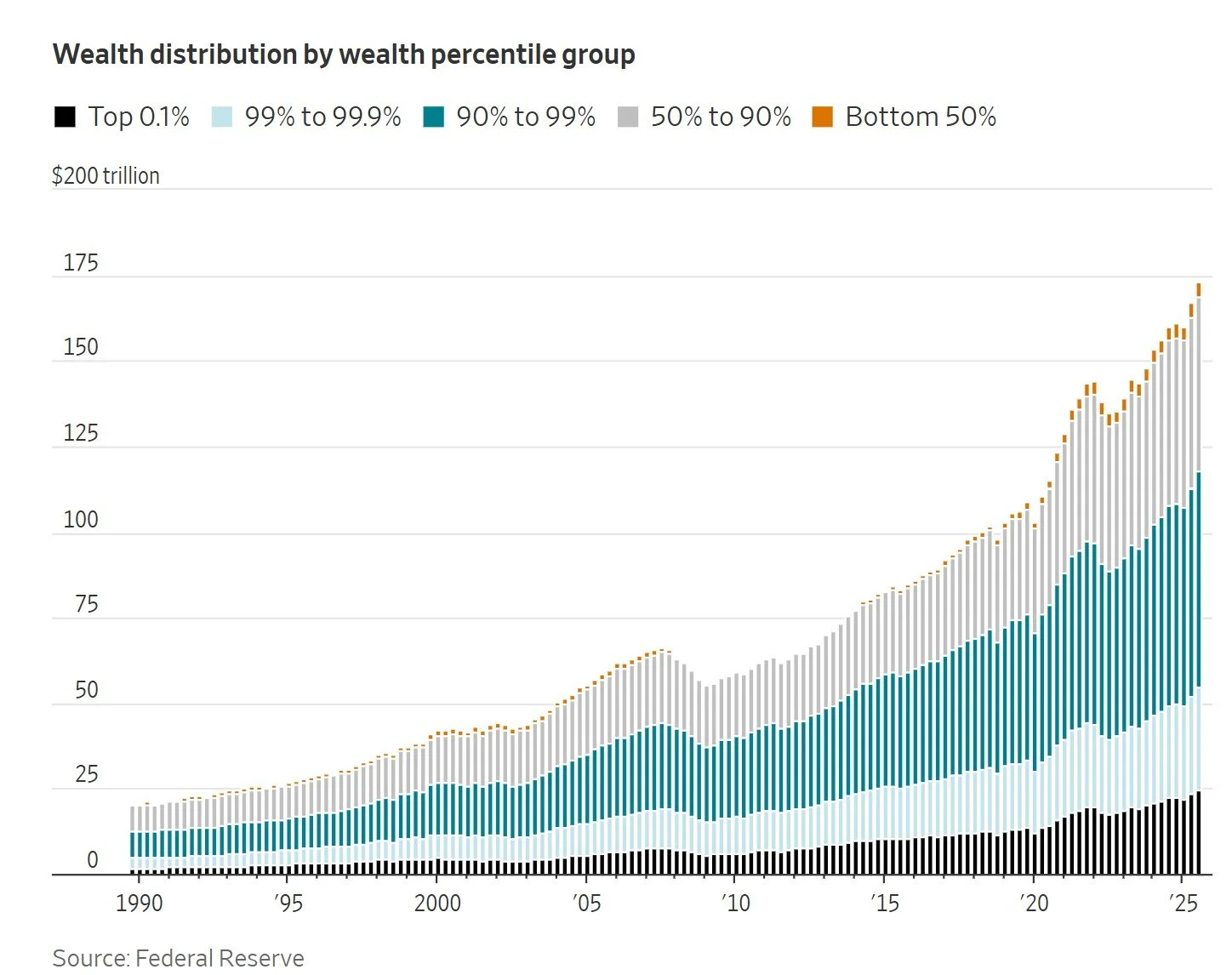
The WSJ chart emphasizes numbers (not just relational data) over time, both in the interactive mouseovers of specific data points (which show dollar amounts) and in the tiny vertical columns, which makes the chart both more precise and uglier.
Compare that version to the original, a Federal Reserve chart. Also a stacked area chart (click to enlarge), but this one uses solid colors to reflect distribution and places the lowest 50% at the bottom, where, intuitively, we might expect them to be. That bottom placement also shows at least some wealth of that group (instead of the mere orange specks at the top of the WSJ’s chart).
The default of the Fed chart is “units” (top left), but a toggle shows shares for percentages. The mouseover is more useful, showing a summary of percentage (or dollar amounts on the default chart) at any point. However, visually, the differences don’t look as dramatic as they are because the growth in dollar amount is so much higher than the percentages. We don’t see the writer’s point:
The bottom half of American households have lost ground. Their 2.5% cut of the country’s wealth has slipped from 3.5% in 1990.
Curiously, this note at the bottom of the WSJ article shows how people conflate percentages and numbers:
Corrections & Amplifications
An earlier version of the chart “Wealth distribution by wealth percentile group” incorrectly had a percentage sign instead of a dollar sign on the y-axis. (Corrected on Feb. 19.)
Another point may be worth mentioning with students. We’re talking about inequality, so numbers of households—people—might be included somewhere.
From the Fed’s data file, I asked ChatGPT to create an indexed line chart. This sets all group values in 1990 at 100 for an equal starting point—a way to show comparative growth over time. The chart labeling doesn’t follow business communication principles, but now we see what has happened since 1990. This chart far more clearly illustrates a main point of the WSJ article:
Only the richest 1% of households have grown their share of overall U.S. wealth since 1990.

World Central Kitchen Video on Ukraine for Fundraising
In a World Central Kitchen (WCK) video about Ukraine, on the fourth anniversary of Russia’s invasion, students will see illustrations of emotional appeal, compassion, and themes for fundraising.
Here are a few points about the video for our students:
Starts with lessons learned. This approach is consistent with research showing better responses to LinkedIn profiles that balance the writer’s journey with outcomes. Describing learnings demonstrates humility and conveys what the study authors call “warmth,” a word used later in the WCK video. To contribute to a nonprofit organization, funders may want to be part of the journey—part of the story.
Emphasizes “long-term humanitarian aid.” From those lessons, the staff say they were able to adapt from emergency response to a longer-term solutions. They stress their commitment and the ongoing work involved, which requires funding.
Representatives speak Ukrainian. Of course, the spoken language is a practical decision so local staff can tell their own story, but it also conveys being “on the ground,” or as they say in the video, on “the frontline” and with “boots on the ground.”
Includes data. 40 kitchens opened illustrates reach, and 4,000+ vegetables seems like a lot, although that one is tough to comprehend without imagery or comparisons, as we teach for data communication.
Repeats the theme. A theme—”side by side”—shows how WCK staff work alongside those in need to provide not just food but emotional support. Images throughout emphasize this point—few talking heads, rather, people working together.
Showcases José Andrés. About halfway into the video, we hear from the famed chef, restaurateur, and WCK founder José Andrés: “We believe this is the future of humanitarian relief. This is the future of food relief. In the process of helping some people, don’t throw money at the problem; try to invest in the solutions.”
Stresses cultivation. Then we see people growing seeds, a greenhouse project—solutions for long-term self-sufficiency in addition to the hot meals WCK provides.
Balances imagery. We see several short videos of destruction in Ukraine, particularly bombed buildings, but we don’t see other realities of war. The prevailing message is of hope, and the focus is on people and food.
All this to say, WCK needs a lot of funding to achieve its mission. The work of being “on the ground,” working alongside people, and providing hot meals is expensive.
Students might analyze how the website images and text support these messages.
The AI Memo That Caused the Market Downturn
Students can analyze Citrini’s memo about AI to determine why it’s causing fresh concerns about the economy. Why was the memo so influential on the market, and why did it go viral? What are the lessons for students’ own writing?
A Wall Street Journal article summarizes the “doomsday” predictions: “AI coders create software price wars,” “payment companies and other intermediaries get hit,” “agents drive down prices everywhere,” and “a doom cycle in white-collar labor.” Here are a few points students might consider from the memo:
Author credibility: The WSJ article refers to Citrini Research’s “cult following” with its focus on AI and weight-loss drugs. Appropriately, the writers start with a caveat, which improves credibility:
What follows is a scenario, not a prediction. This isn’t bear porn or AI doomer fan-fiction. The sole intent of this piece is modeling a scenario that’s been relatively underexplored.
Futuristic approach: Dated June 2028, the memo reads like science fiction and draws readers in. We’re offered what feels like a peek into another world, and students see lessons in genre and creativity in business writing.
“Memo”: Without a defined audience and with several report features, this is like no memo we taught in the early 2000s. Memo has evolved to mean a written piece with gravitas—something weighty and important.
Conversational tone: Maybe more accurately, the style feels insider, illustrated with the above quote and continuing throughout.
Simple writing style. Students can count the number of short sentences that give the piece punch, particularly at the beginning, for example, “Traders have grown numb,” “The euphoria was palpable,” and “The headline numbers were still great.” These also serve as topic sentences for short paragraphs.
Clear organization: As always, descriptive headings improves comprehension and skimmability—although those interested would likely read it all.
Data: The message includes quite a bit of data for a futuristic piece; that is, the numbers are compelling but invented.
Inflammatory language: Without seeing into the future, we don’t know whether the language is appropriate for what’s to come, but students can identify words and phrases that could be inflated—or at least are provocative and emotional (for example, catastrophic).
Fear: Related to the point above, the memo identifies what some AI skeptics have raised about AI’s growing coding and agentic capabilities and may speak to broader brewing fears.
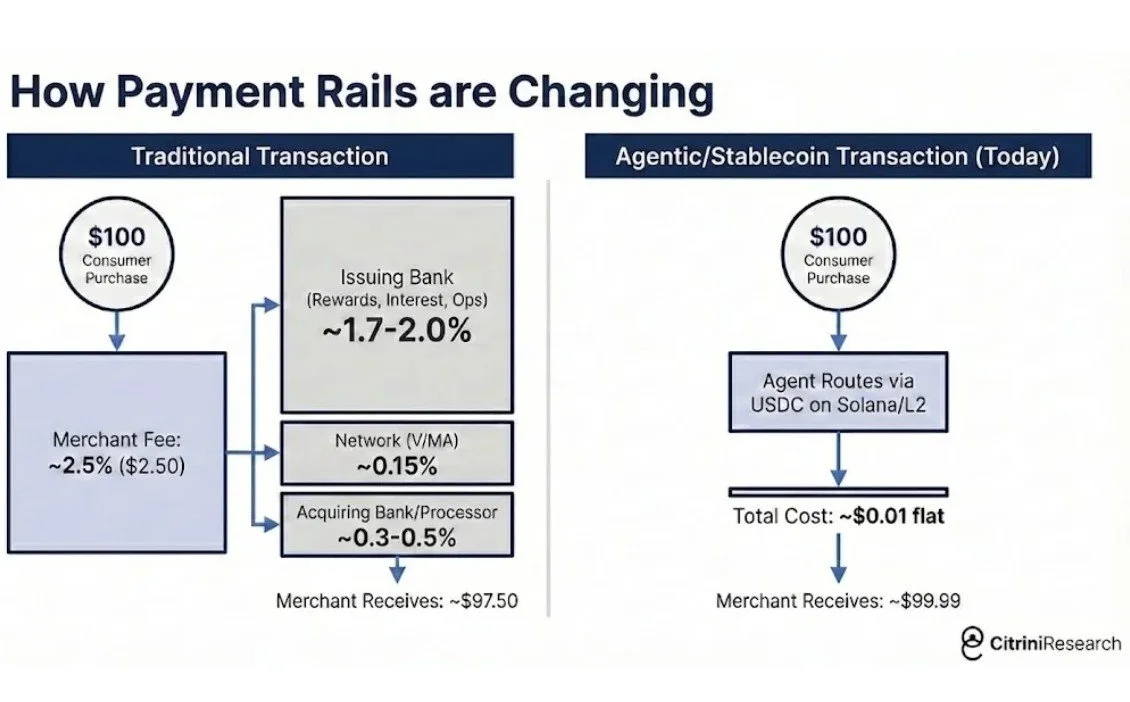
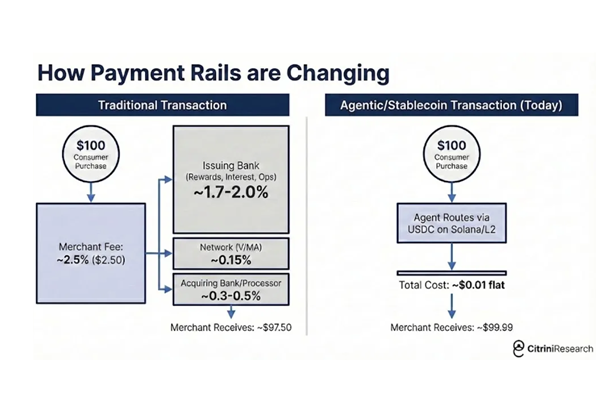
Compelling graphics: Graphics like this one show a clear before-and-after process. This one illustrates a simplified payment process without those pesky intermediaries like banks. (See Jamie Dimon’s response about JPMorgan’s strong position.)
Storytelling: Interlacing quotes from fake news articles lends false credibility and brings life to the memo, as though news is unfolding as we read. In addition, the writers include personal stories, for example, “a friend of ours was a senior product manager at Salesforce…”
Hopeful: Despite the doomsday projections, the memo ends on a positive note: “The canary is still alive.” The writers give readers a vision of the future so we might be “proactive,” and “The economy can find a new equilibrium.” This could be false hope; we don’t know yet.
Trump-Style Direct Quotations in Speech
John McWhorter’s analysis of President Trump’s use of direct quotations illustrates a tool students can use.
The associate professor of linguistics at Columbia University distinguishes between direct and indirect quotations (also note he doesn’t use the informal quote as a stand-in for quotation). McWhorter writes about recent speeches, “It’s like Trump is performing a little skit, acting out the conversation rather than just telling you the outcome.”
Students might consider this style for their own presentations and interviews. Could they be more vivid with direct instead of indirect quotations? Here are a few examples:
During an interview:
After the meeting, my manager said she would use my deck as an example for future interns. (indirect)
After the meeting, my manager asked to speak with me. She said, “If it’s OK with you, I’d like to use your deck as an example for future interns,” and I said, “Sure!” (direct)
As evidence in writing or a presentation:
Yoga Central said 16.2% of their users enter their email on the popup form. (indirect)
In response to my email, Yoga Central replied, “16.2% of users enter their email on our popup form.” (direct)
Asking a manager for help about a customer situation:
She said she wouldn’t come again because of the return policy. (indirect)
She said, “The two-week return policy is ridiculous! I’m never coming back here.” (direct)
In these examples, the quotations aren’t merely performative. The first example helps a recruiter picture the situation, hear the applicant’s excitement, and makes the claim more believable. The second lends credibility to the evidence, and the third provides a manager with more detail and the customer’s intensity. Often, direct quotations can illustrate tone, which might affect the audience’s interpretation and conclusions.
Direct quotations should serve a specific purpose and not be overused because they could be considered too colloquial or informal for business audiences. But they’re a valuable addition to our students’ communication toolkit.
Walmart Tries to Engage About Olympian Wolfdog
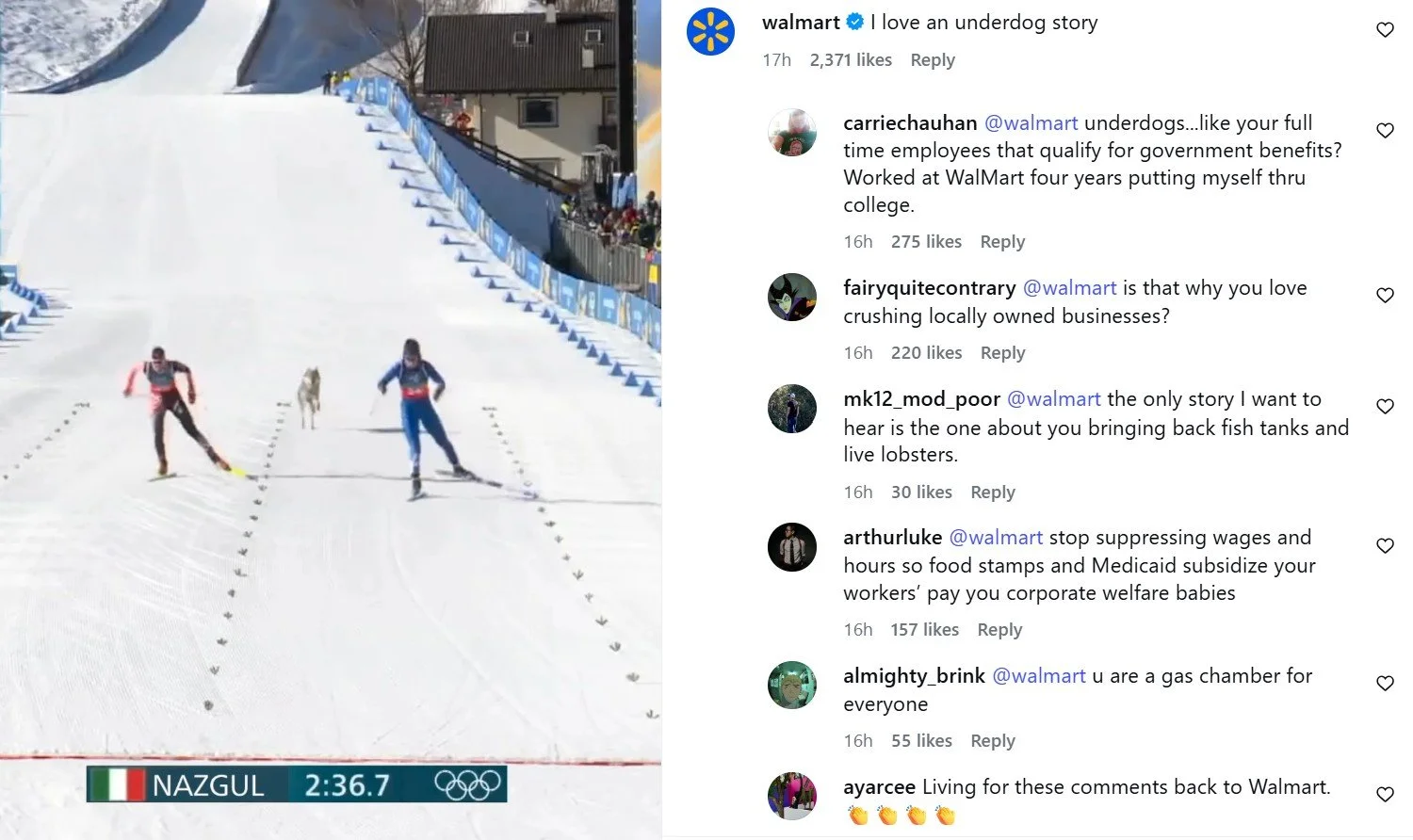
Watching a wolfdog run with the Olympic skiers is great fun, and Walmart got into the action by commenting on Instagram, but the replies were not favorable.
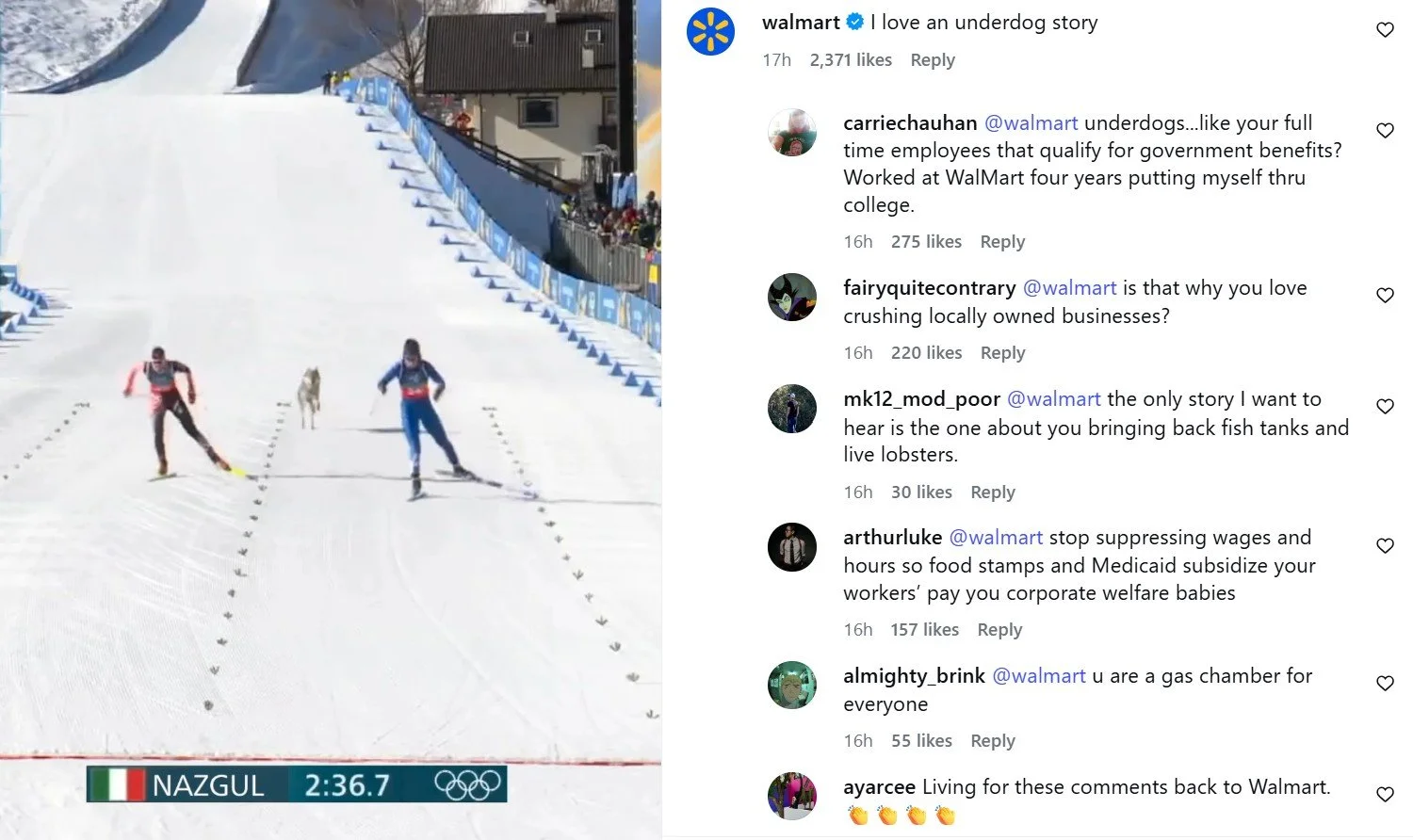
The Walmart account manager tried to engage, which is what we teach students in marketing communications and as examples of positive messages. The comment—”I love an underdog story”—is funny enough, but the responses point to larger issues, particularly about wages.
Students might discuss the risk Walmart took and whether it was worth it. The situation has nothing to do with Walmart, which makes it both low stakes and potentially irrelevant. The company inserted itself into a cultural moment—a time for people to rally around.
But users might perceive all company comments, particularly those unrelated to the core business, as marketing opportunities. Also, the post starts with “I,” an attempt to personalize (anthropomorphize?) the brand. Sure, the poster is a human (we think), but the company name and logo overshadow the comment. The joke doesn’t feel authentic because it’s not. Students also might consider the challenge of creating “one, authentic brand voice” for a company of Walmart’s heft.
On another note, sadly, some commenters wondered whether the video was AI. It’s hard to know these days.

Tom Pritzker Resigns After Epstein Discovery

The list of executives resigning or losing positions after more Jeffrey Epstein files become public is growing. Students can read emails related to the latest: Tom Pritzer, Hyatt’s executive chairman.
Pritzer’s resignation letter to the board includes the following:
My job and responsibility is to provide good stewardship. That is important to me. Good stewardship includes ensuring a proper transition at Hyatt. Following discussions with my fellow Board members, I have decided, after serving as Executive Chairman since 2004, and with the company in a strong position, that now is the right time for me to retire from Hyatt.
Good stewardship also means protecting Hyatt, particularly in the context of my association with Jeffrey Epstein and Ghislaine Maxwell which I deeply regret.
I exercised terrible judgment in maintaining contact with them, and there is no excuse for failing to distance myself sooner.
I condemn the actions and the harm caused by Epstein and Maxwell, and I feel deep sorrow for the pain they inflicted on their victims.
The first line is performative and was omitted from most news reports. As an issue of integrity, good stewardship requires good behavior while serving in a role, not just when resigning.
Students might read the first and second lines as a push from the board rather than a true resignation. Either way, it explains what students often wonder about executive resignations for personal improprieties: they affect the company. At the same time, Pritzker’s were related to Hyatt business, with emails showing him facilitating travel and arranging an interview for “the girl from Romania.”
The second bullet illustrates classic crisis communication strategies of distancing and downplaying, as though “contact” were his only crime. We see a similar theme in all statements related to Epstein—little true accountability.
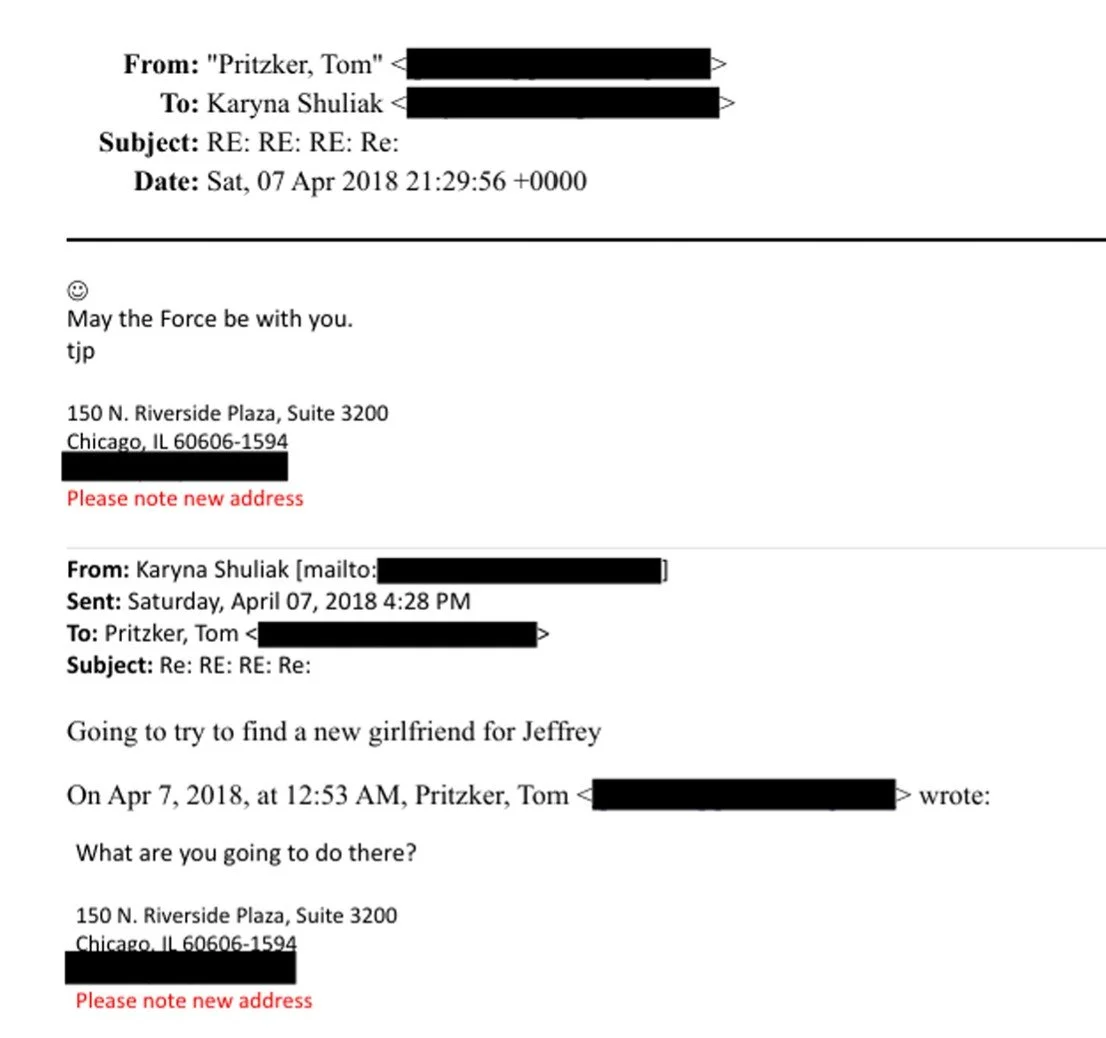
The third bullet reflects a false show of sympathy few would believe after reading emails like these, which were sent ten years after Epstein plead guilty for sex crimes in Florida and as accusations piled up throughout the next decade.
Students might discuss the best approach for these leaders. Another strategy is Lee Wexler’s. The billionaire and former CEO of Victoria's Secret said he “was duped by a world-class con man,” a tough claim to support.
Maybe this is one of those rare times when it’s better to say nothing at all.
The New York Times is tracking resignations and other fallout from the Epstein files.

Compensating for “Emotional Offloading”

Business communication instructors can help students develop social and interpersonal skills to offset their increasing dependence on AI.
In a New York Times op-ed, Clay Shirk, vice provost for AI and technology in education at New York University, describes using AI for emotional offloading: “to reduce the energy required to navigate human interaction.” With students relying more on AI to avoid embarrassment, they may miss out on critical learning for social situations. A new study titled, “Sycophantic AI Decreases Prosocial Intentions and Promotes Dependence, highlights AI’s role” (here’s looking at you, ChatGPT 4.0).
Students might know how important employers consider interpersonal and social skills. Studying job postings will give them an idea; then, class activities and assignments can emphasize making mistakes in a safer environment than during an interview or on a job. We learn by trial-and-error—not by asking AI what we should do in awkward situations.
For years, we have challenged students with impromptu speaking, role plays (including fishbowls), video recording, Q&A, reflections, and assignments with real clients. Bad-news, intercultural, and conflictual situations also develop students’ skills in social situations. Here are a few more specific ideas, which also apply to other courses:
Interrupt presentations. I’ve had students play specific roles (legal counsel, HR, sales, etc.) and interrupt team presentations. It’s challenging but definitely “real world.” Related: Plan for an awkward silence after a presentation when no one asks a question.
Derail a presentation. Blocking access to a team’s slides, having a team member stay out “sick,” calling a fire drill in the middle of a presentation, and other, again, real-world mishaps will prepare students well. (Jeanette Heidewald, Indiana University Bloomington, presented about this at an Association for Business Communication conference.)
Focus on emotions. Write scenarios or create or find videos with people illustrating different feelings to test students’ abilities to read and respond to emotions. For example, a customer response situation may help improve students’ ability to distinguish—for themselves and for others—frustration, annoyance, disappointment, anger, etc.
Focus on process for team assessments. Categories such as these (developed for a community-engaged learning course) encourage students to pay attention to team process as well as team outcomes to develop aspects of emotional intelligence and character.
Assign interactions. One activity is called Seven Strangers (reference below). Students strike up conversations with people and try to go beyond the basics about time and weather. Then, they reflect on the experience. It’s difficult but relatively low-stakes.
If your school is like Cornell University, much of the career work has been transferred to the Career Management Office. But if possible, career planning (e.g., values assessments), informational interviews, practice interviews, negotiating compensation, and reflections are great opportunities to work through challenging interactions.
Source: Hartman, E., Kiely, R., Friedrichs, J., & Boettcher, C. (2018). Community-based global learning: The theory and practice of ethical engagement at home and abroad. Sterling, VA: Stylus Publishing.