
The AI Memo That Caused the Market Downturn
Students can analyze Citrini’s memo about AI to determine why it’s causing fresh concerns about the economy. Why was the memo so influential on the market, and why did it go viral? What are the lessons for students’ own writing?
A Wall Street Journal article summarizes the “doomsday” predictions: “AI coders create software price wars,” “payment companies and other intermediaries get hit,” “agents drive down prices everywhere,” and “a doom cycle in white-collar labor.” Here are a few points students might consider from the memo:
Author credibility: The WSJ article refers to Citrini Research’s “cult following” with its focus on AI and weight-loss drugs. Appropriately, the writers start with a caveat, which improves credibility:
What follows is a scenario, not a prediction. This isn’t bear porn or AI doomer fan-fiction. The sole intent of this piece is modeling a scenario that’s been relatively underexplored.
Futuristic approach: Dated June 2028, the memo reads like science fiction and draws readers in. We’re offered what feels like a peek into another world, and students see lessons in genre and creativity in business writing.
“Memo”: Without a defined audience and with several report features, this is like no memo we taught in the early 2000s. Memo has evolved to mean a written piece with gravitas—something weighty and important.
Conversational tone: Maybe more accurately, the style feels insider, illustrated with the above quote and continuing throughout.
Simple writing style. Students can count the number of short sentences that give the piece punch, particularly at the beginning, for example, “Traders have grown numb,” “The euphoria was palpable,” and “The headline numbers were still great.” These also serve as topic sentences for short paragraphs.
Clear organization: As always, descriptive headings improves comprehension and skimmability—although those interested would likely read it all.
Data: The message includes quite a bit of data for a futuristic piece; that is, the numbers are compelling but invented.
Inflammatory language: Without seeing into the future, we don’t know whether the language is appropriate for what’s to come, but students can identify words and phrases that could be inflated—or at least are provocative and emotional (for example, catastrophic).
Fear: Related to the point above, the memo identifies what some AI skeptics have raised about AI’s growing coding and agentic capabilities and may speak to broader brewing fears.
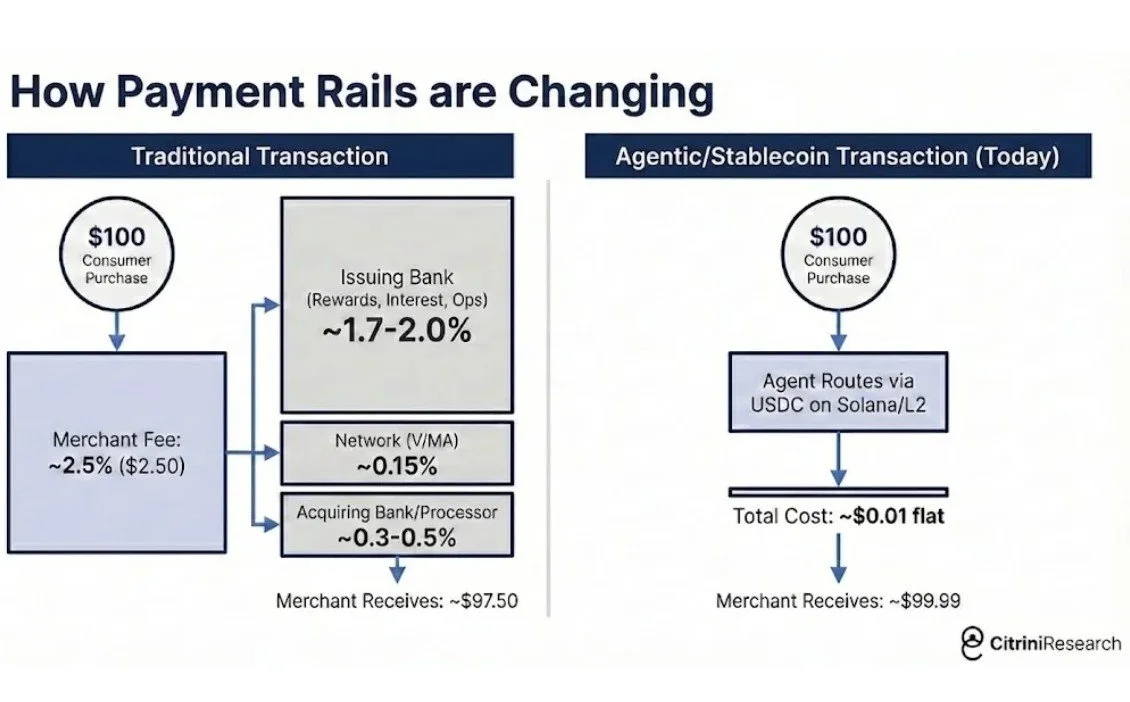
Compelling graphics: Graphics like this one show a clear before-and-after process. This one illustrates a simplified payment process without those pesky intermediaries like banks. (See Jamie Dimon’s response about JPMorgan’s strong position.)
Storytelling: Interlacing quotes from fake news articles lends false credibility and brings life to the memo, as though news is unfolding as we read. In addition, the writers include personal stories, for example, “a friend of ours was a senior product manager at Salesforce…”
Hopeful: Despite the doomsday projections, the memo ends on a positive note: “The canary is still alive.” The writers give readers a vision of the future so we might be “proactive,” and “The economy can find a new equilibrium.” This could be false hope; we don’t know yet.