
Trump’s Rhetoric This Week
Without taking a political stance, business communication faculty can examine President Trump’s recent rhetoric about the war against Iran as illustrations of literary devices and persuasive strategies. Students can analyze these and draw comparisons for business presentations.
Extreme language is a well-worn communication strategy of the president, but his social media posts this week marked a new level and deserve attention in communication classes. We can frame the topic as analyzing his speech rather than a discussion about whether students endorse or disagree with his position.
Here are two examples with connections to course concepts.
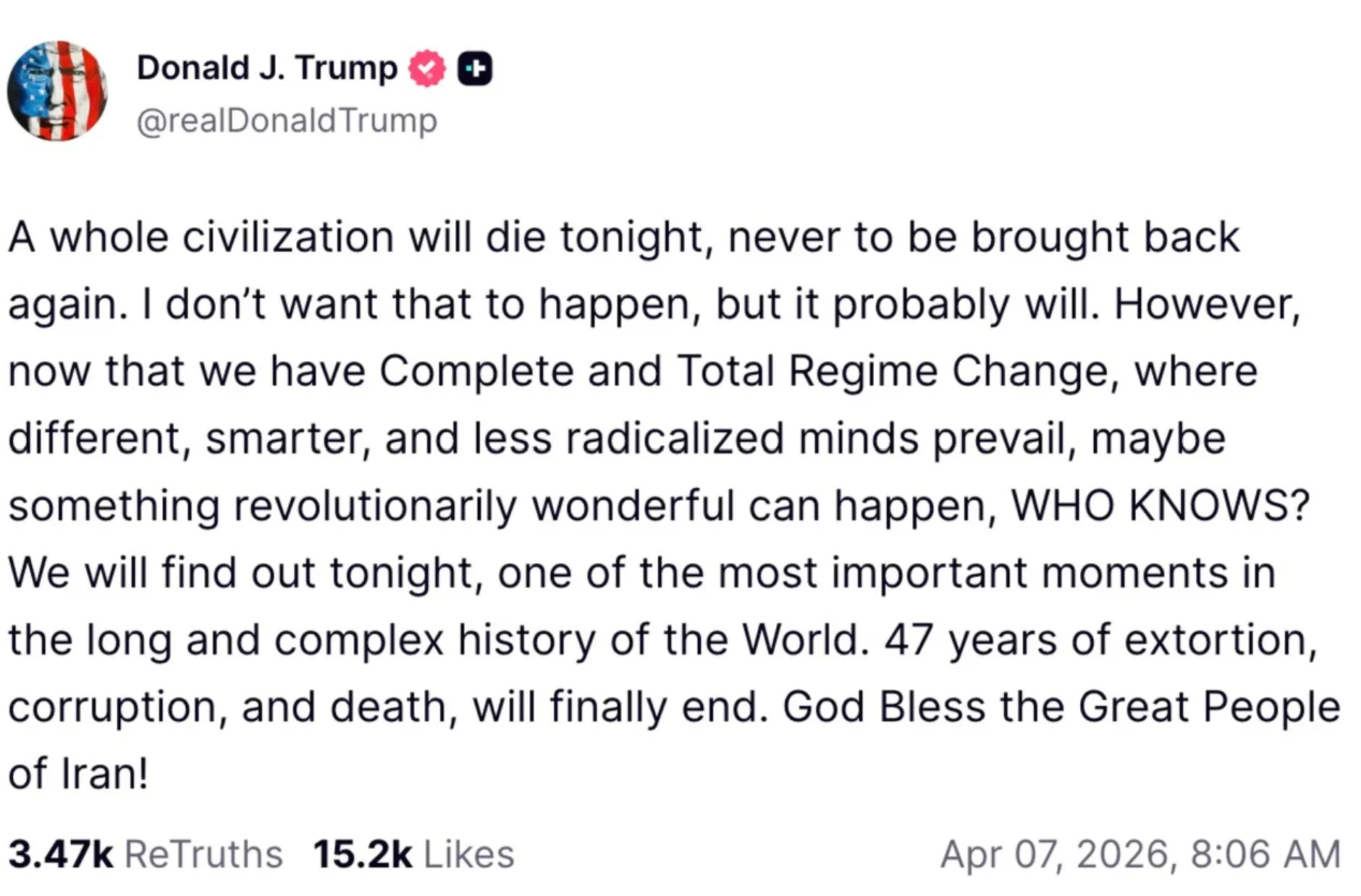
“A whole civilization will die tonight.”
Devices like hyperbole, emotive language, and apocalyptic framing attempt to engender fear and create a sense of urgency. The dangers of using these devices, even as a negotiating strategy, include a loss of credibility (and, in this case, potentially threatening war crimes, such as genocide).
Students can identify examples in business situations—for example, investor presentations, fundraising letters, or layoff memos—when this type of language may be used for persuasive purposes. An appeal that claims a business’s success depends on one investor’s funding sounds desperate and may cause the investor to question the long-term viability of the business. A fundraising letter that claims an extreme result (people will die without needed resources) may inspire people to donate one time, but the claim may affect the organization’s credibility for future appeals.
In response to Tucker Carlson’s criticism of Trump’s rhetoric in another post, the president responded by attacking Carlson personally—an example of ad hominem. In an interview, he said:
Tucker’s a low-IQ person that has absolutely no idea what’s going on. He calls me all the time; I don’t respond to his calls. I don’t deal with him. I like dealing with smart people, not fools.
Trump has referred to many people as having low IQs, “not very bright,” or similar, and a recent Truth Social post lumps Tucker Carlson, Megyn Kelly, Candace Owens, and Alex Jones into this category (“they have one thing in common, Low IQs”). By classifying a group of people, he tries to damage the credibility of that group while elevating his own status as an implied high-IQ person. By repeating the claim over the years, he creates a shorthand for his audience to discredit someone as part of this inconsequential group.
It’s also worth noting that Trump’s post itself was an ad hominem attack (“You crazy bastards”) as well as mocking their religion.
Students can find examples of ad hominem attacks in business environments, perhaps from their own work experience. We see these used when leaders blame others for a crisis, justify questionable termination decisions, and make discriminatory or derogatory comments.