
Comparing University Statements About Israel

As an in-class activity or assignment, students can analyze and compare what university officials are saying about the conflict in the Middle East. Here are a few statements and, below, possible questions for discussion. The Harvard situation is particularly charged. The university is facing criticism because, despite issuing a statement supporting Israel, so far, it hasn’t responded to a post by 34 student organizations: “Joint Statement by Harvard Palestine Solidarity Groups on the Situation in Palestine.” (Update: The president posted a response on October 10.)
Statements
Brandeis University
Harvard University
Hunter College
New York University
The Rockefeller University
University of Connecticut
University of Miami
University of Washington
Questions for Discussion
Who are the primary and secondary audiences for the statement?
What are the communication objectives?
For each statement:
How does the writer describe the issue; for example, is it called a “war,” “conflict,” “tragedy,” “attack,” or something else?
What’s the significance of how the issue is described? In other words, how clearly does the university support a position?
How might the university’s mission, student population, location, and other factors affect the message?
How would you describe the tone? What language illustrates your characterization?
How do connections to the region affect the credibility of the message and the writer?
What resources are offered for students?
What does the message say about campus conduct and safety?
What, if any, action does the university promise?
How does the writer illustrate character dimensions, for example, compassion, accountability, integrity, or courage?
What else distinguishes one statement from another?
What universities are missing statements? Why might they choose to stay out of the conversation? Or are they just slower in responding, and why might that be?
"Booster" Vaccine Communications
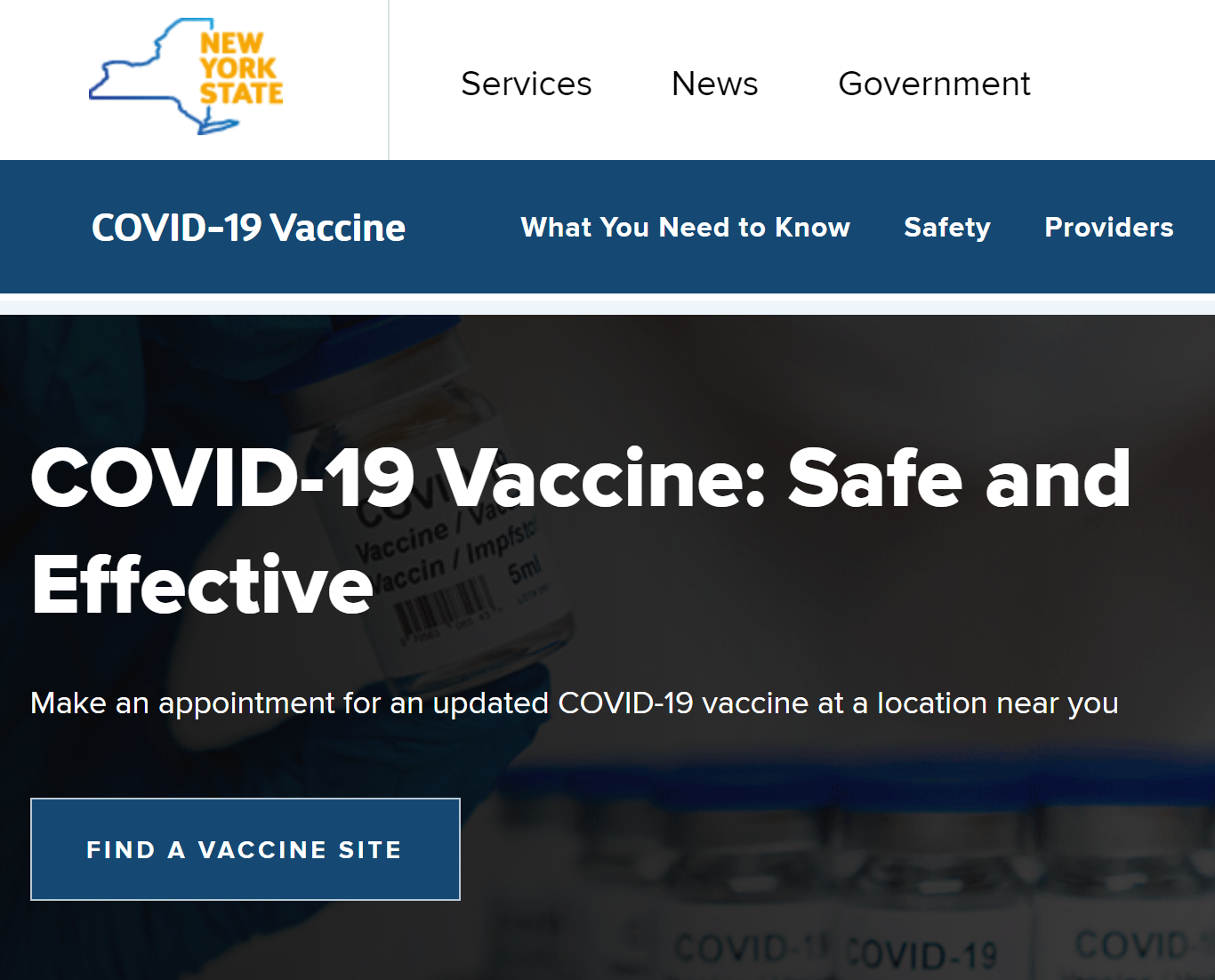
The U.S. Food and Drug Administration (FDA) recommended simplifying COVID-19 vaccine use, including nixing the term booster. The change is an uphill climb and offers lessons in change communication.
The FDA’s deck from January 2023 explains the rationale. The goal is “harmonizing the vaccine strain composition of primary series and booster.” In other words, to eliminate the need for and complications of multiple shots. Instead, the FDA and Center for Disease Control (CDC) want people to think of the COVID vaccine like a flu vaccine and to get a new one each year. The push to avoid the term booster started even earlier, when Stanley Plotkin, renowned physician who developed the Rubella vaccine, suggested the change:
My point, basically, was that calling them boosters implies that the first doses were failures.
Calling the third dose a booster is immunologically incorrect and also gives the wrong impression that somehow the vaccines failed when they could not really have been expected to give a long-lasting immunity from the first doses.
(Here’s an Atlantic article for a fuller linguistic discussion.)
Last month, CDC vaccine advisor Keipp Talbot said, "Bye bye, booster. We are no longer giving boosters, and it's going to be very difficult to stop using that word because that word has become pervasive.” The CDC’s and FDA’s latest webpages about COVID-19 vaccines don’t mention boosters but refer to “updated vaccines.” On New York’s site, we’re instructed to “Make an appointment for an updated COVID-19 vaccine,” but a page titled, “Booster Doses” still exists, likely for people searching for the old term. As Talbot warned, the change will take some time.
PwC Report for Students to Analyze

If you’re looking for a sample report with mixed text and graphics, “PwC’s 26th Annual Global CEO Survey: Winning today’s race while running tomorrow’s” is a good one for students to analyze. With open access, the report is designed as a webpage built around survey questions. Here are a few points to explore with business communication students:
Audience Analysis and Communication Objectives: As a public document, the report provides information for business leaders, but the primary objective is to market PwC’s work. The report starts with a hook: “Evolve or die, say 4,410 chief executives in our 2023 CEO Survey. But are they spending enough time on business reinvention? Many tell us no.” In other words, hire PwC to help you survive.
Organization: The introductory paragraph follows classic business writing principles: convey the main point (the conclusion or recommendation) and preview up front. The organization is clear in the last paragraph: “We’ve organised this year’s survey summary into nine tough questions—which naturally fall into three groups—about what it takes to operate in our dual-imperative world.” However, the sequence of groups and questions within them don’t follow a logic I can follow.
Writing Style: As expected for this type of report, the tone reflects a strong sense of urgency (“The race for the future”). Still, I find myself tripping over some sentences, like this one:
Last year’s optimism, reflecting hope that economic conditions would continue improving as the global pandemic eased, was dashed in 2022 by shocks such as Europe’s largest land war since World War II, knock-on effects like surging energy and commodity prices, and accelerating general wage and price inflation.
“Dashed,” “shocks,” “knock-on effects,” “surging,” “accelerating”—that’s a lot to take. Students also might have fun omitting extraneous words, for example, “Last year’s optimism, reflecting hope . . .”

Graphics: Of about 15 charts in the report, only one is a line chart. The other are rather traditional versions of bar and column charts but offer lessons in choosing stacked and other formats—ways to incorporate multiple data points.
Site Functionality: Report navigation is clear with the organizational structure in table format, shown above, and right-side mouse-over links. You might consider a report assignment that includes bookmarks within Word documents or PDFs that students can create easily. The downloadable graphics are a nice touch. Users get pages—with the PwC logo, of course—they can slip into any deck.
You’ll find other lessons in the report. Overall, it’s a good example of clear content, but, for me, the marketing purpose overshadows the message.
Murdoch's Email to Employees

In his email to employees, Rupert Murdoch announces his “transition to the role of Chairman Emeritus at Fox and News,” but he fails to mention what he’s leaving: both Boards of Directors.
His message confirms what news reports say: he’s going nowhere and will continue to wield influence. A Guardian columnist focuses on Murdoch’s “toxic legacy” and the political overtones of his note in which he criticizes “elites” “in cahoots” with the media. (Cahoots strikes me as an outdated term along the lines of no-goodnik. Both might be new to students.) With more defamation lawsuits pending against Fox, Murdoch also, again, defends the company’s reporting.
A New York Times article chronicles his successor’s “On-Again, Off-Again Relationship With the Family Business.” Unusual for these types of announcements, Murdoch says only about his third child, Lachlan, “[We] have truly talented teams and a passionate, principled leader in Lachlan” and that Lachlan “is absolutely committed to the cause [of freedom].”
Murdoch writes, “Neither excessive pride nor false humility are admirable qualities.” Yet real humility is an admirable quality—and required for a leader to step aside and let others lead. Instead, like Logan Roy in HBO’s Succession, Murdoch will hover until he dies.
Dear Colleagues,
I am writing to let you all know that I have decided to transition to the role of Chairman Emeritus at Fox and News. For my entire professional life, I have been engaged daily with news and ideas, and that will not change. But the time is right for me to take on different roles, knowing that we have truly talented teams and a passionate, principled leader in Lachlan who will become sole Chairman of both companies.
Neither excessive pride nor false humility are admirable qualities. But I am truly proud of what we have achieved collectively through the decades, and I owe much to my colleagues, whose contributions to our success have sometimes been unseen outside the company but are deeply appreciated by me. Whether the truck drivers distributing our papers, the cleaners who toil when we have left the office, the assistants who support us or the skilled operators behind the cameras or the computer code, we would be less successful and have less positive impact on society without your day-after-day dedication.
Our companies are in robust health, as am I. Our opportunities far exceed our commercial challenges. We have every reason to be optimistic about the coming years - I certainly am, and plan to be here to participate in them. But the battle for the freedom of speech and, ultimately, the freedom of thought, has never been more intense.
My father firmly believed in freedom, and Lachlan is absolutely committed to the cause. Self-serving bureaucracies are seeking to silence those who would question their provenance and purpose. Elites have open contempt for those who are not members of their rarefied class. Most of the media is in cahoots with those elites, peddling political narratives rather than pursuing the truth.
In my new role, I can guarantee you that I will be involved every day in the contest of ideas. Our companies are communities, and I will be an active member of our community. I will be watching our broadcasts with a critical eye, reading our newspapers and websites and books with much interest, and reaching out to you with thoughts, ideas, and advice. When I visit your countries and companies, you can expect to see me in the office late on a Friday afternoon.
I look forward to seeing you wherever you work and whatever your responsibility. And I urge you to make the most of this great opportunity to improve the world we live in.
Lawsuits About Writing Used for AI Training

The list of authors suing AI companies for copyright infringement is growing, and students should understand the implications. One of the latest to file suit is George RR Martin, who might interest students because his novels inspired Game of Thrones.
An earlier petition, addressed to the heads of OpenAI, Meta, Alphabet, Stability AI, Microsoft, and IBM, explains writers’ position. In this open letter, hundreds of members of the Authors Guild call out the “inherent injustice in exploiting our works as part of your AI systems without our consent, credit, or compensation.” Similar to the striking screenwriters, this group is concerned about compensation and job loss.
What’s relevant to students is how their own work is used and where it might end up. A conversation about posting online isn’t new to students, but AI raises new questions about copyright and privacy issues. Students probably don’t need to worry about a investment report or customer-service letter developed for class, but they might think twice about uploading creative work that could be copied or a resume or cover letter that could be misused.
As the makers of ChatGPT, OpenAI leaders seem to be sympathetic to authors’ concerns. A spokesperson said, "We're having productive conversations with many creators around the world, including the Authors Guild, and have been working co-operatively to understand and discuss their concerns about AI. We're optimistic we will continue to find mutually beneficial ways to work together." We’ll see.
New Euphemism for "Feedback"

A WSJ article reports that “feedback” causes anxiety, so companies are using “feedforward” instead. The latest in corporate euphemisms, feedforward could soften comments on students’ writing and presentations, but I’m skeptical.
Attempts for gentler language for “negative” feedback are nothing new. Managers (and business communication faculty) typically use “areas for improvement,” “development areas,” or “constructive feedback.” Now, apparently, “feedback” is itself causing problems.
Other terms are emerging. Microsoft is using “perspectives” instead of “feedback,” “performance development” is replacing “performance management,” and “connect” session is replacing a “review.” How long before the patina of these terms wears off and they, too, become anxiety producing?
What’s the problem companies are trying to solve with new terms? On the surface, ”feedforward” is more accurate, emphasizing changes for the future, so I get it. But I have to question whether the term is the issue. Aren’t the real issues that people have difficulty facing what needs to change and that managers continue to struggle with delivering feedback? I’m a fan of Kim Scott’s work and book, Radical Candor, which encourages a supportive environment that makes difficult feedback easier to swallow.
For now, I think our student “tutorials” or “coaching sessions” are safe.
AI Doesn't Do Too Well on College Essays

More students are asking AI tools for help writing their college essays, but a New York Times reporter didn’t get great results.
Using short-answer essay questions from Princeton, Dartmouth, Harvard, and Yale, the reporter asked for ideas and full responses. For one of Princeton’s question, shown here, ChatGPT suggested an inappropriate response—not just because it’s about sex but because it doesn’t accurately answer the question.
The reporter concludes:
My takeaway: high school seniors hoping to stand out may need to do wholesale rewrites of the texts they prompt A.I. chatbots to generate. Or they could just write their own—chatbot-free—admissions essays from scratch.
That may be true about many writing assignments. In addition, using AI raises integrity issues and may hurt students’ differentiation. With the limited number of tools, how many students will submit the same song to Princeton? I’m reminded of reading hundreds of applications for the Hotel School at Cornell. To the question about why students chose to apply, far too many wrote that the school is “number one” or that they love Disney. Admissions committee members see enough unoriginal responses without the help of AI.
Update: Some schools now offer guidance for using or not using AI in applications. The equity issues are clear in The University of Michigan’s approach. Students might not have people in their lives who can offer this assistance: “Applicants may, however, ask pre-law advisors, mentors, friends, or others for basic proofreading assistance and general feedback and critiques.”
Georgia Tech offers a more democratic approach:
Tools like ChatGPT, Bard and other AI-based assistance programs are powerful and valuable tools. We believe there is a place for them in helping you generate ideas, but your ultimate submission should be your own. As with all other sources, you should not copy and paste content you did not create directly into your application. Instead, if you choose to utilize AI-based assistance while working on your writing submissions for Georgia Tech, we encourage you to take the same approach you would when collaborating with people. Use it to brainstorm, edit, and refine your ideas. AI can also be a useful tool as you consider how to construct your resume in the Activities portion of the Common Application. We think AI could be a helpful collaborator, particularly when you do not have access to other assistance to help you complete your application.
NYC Message About ChatGPT Demonstrates Humility and AI Shift

Back in May, the New York City school chancellor changed the policy to ban ChatGPT. The message is a good example of humility—and a summary of what educators have learned about AI.
David Banks’ message, titled, “ChatGPT caught NYC schools off guard. Now, we’re determined to embrace its potential,” describes how teachers’ thinking has evolved. He admits, “[O]ur best-laid plans are sometimes disrupted by the advance of technology and innovation.”
Banks demonstrates humility (learning from mistakes) and vulnerability (risking emotional emotional exposure):
The knee-jerk fear and risk overlooked the potential of generative AI to support students and teachers, as well as the reality that our students are participating in and will work in a world where understanding generative AI is crucial.
To gain credibility, he provides examples of how faculty are using AI now, particularly by exploring ethical issues.
Business communication faculty are going beyond this exploration and are experimenting with using AI in the writing process and to support faculty work. The 2023 Association for Business Communication conference has a robust line-up of presentations about incorporating AI into our classes. I’m working with a colleague to experiment with ChatGPT as a peer reviewer.
It’s an exciting—and nerve-wracking—time. But the chancellor has learned what business communication faculty knew from the beginning: we have no choice but to embrace ChatGPT and other AI tools. Maybe higher-ed faculty recognize that we have little control over students, which K-12 faculty needed more time to acknowledge. We also see how businesses already use use AI as an integral part of work, and we embrace our responsibility to prepare students for this reality. In addition, our students have better foundational critical thinking and writing skills than young kids, so maybe the risks of using AI seem lower. Regardless, seeing parallels as well as divergent paths of how business communication and K-12 faculty use AI will be interesting to watch.
Improving a JetBlue Email for Writing Style

A JetBlue email announcing a program change uses a conversational writing style but could use more “you” focus. Students can analyze the message and might identify the following:
The main points are up front in both the subject line (above the blue bar) and first sentence.
Although technically correct, the comma after “Hi” and before “Amy” is not conventional. I gave this up after seeing hundreds of business emails without the comma.
The tone is reassuring and tells customers what they need to know.
Mostly, the tone is conversational with natural language, for example, “wanted to let you know about a couple upcoming changes.”
More use of “you” would make the email sound more natural, as in the example below.
Some language choices sound odd, for example, “To the extent any individual customers are impacted, JetBlue will reach out individually for any required re-accommodation or refund.” I thought airlines learned the “re-accommodation” jargon lesson after United dragged a man out of his seat and off the plane in 2017. How about, “You’ll hear from us separately with options for changing flights.”
The president and COO signed the letter—always a good example of accountability.
The president appropriately blames federal action for the change, without being too snarky or getting into the details, which would not be relevant to customers: “We've had so much great member feedback on this partnership and are bluer than usual to see it end, after a federal court ruled that the Northeast Alliance could not continue.”
Overall, this bad-news message sounds neutral and might be the best approach for the situation.
In-N-Out Burger's Anti-Mask Policy Draws Criticism

A new In-N-Out Burger policy tells employees masks are no longer acceptable. The email became public and is a good example of persuasive writing. Framed as “mask guidelines,” the message follows some business communication principles but not others.
Overall, the message is clear. The requirement, stores, effective date, exemptions, and consequences are easy to understand.
The message appropriately follows a direct organization plan, with main points up front in a summary paragraph.
Headings allow the reader to skim, although they could be more descriptive to reinforce main points.
The tone is surprisingly formal and bureaucratic in parts.
In the first sentence under “General Guidelines,” the message refers to an associate as “he or she.” This choice isn’t surprising given the company’s Christian evangelical roots, but the binary pronouns are easily avoidable by ending the sentence after “medical note" or {gasp!} by using singular they.
The political issues are difficult to avoid with this news. Nowhere does the message say that masks are “banned,” but that is the effect, and liberal news sources like NPR lead with that headline. Contrast that with the Fox News headline: “Liberals rage at In-N-Out Burger after fast food chain bans masks for employees.” The industry group Nation’s Restaurant News gives a more balanced overview and focuses more on the petitioning customers: “In-N-Out edict ignites new brawl over worker-mask policies.”
In response to the controversy, In-N-Out’s chief operating officer issued a statement with more rationale:
At In-N-Out Burger, we’ve communicated with our smiles since 1948, and a smiling associate helps to set a warm and inviting atmosphere in our stores. We believe that wearing a mask literally adds a barrier to communication — much of which is nonverbal — and promotes a more distant and disconnected environment. In balancing these fundamental values while still accommodating the specific circumstances affecting our associates, we have updated our internal guidelines to permit only those associates with a medical need to wear a face mask while working.
In a way, this story demonstrates integrity. As of now, the company isn’t backing down. Also, In-N-Out management was vocal about COVID-19 policies back in 2021, when the San Francisco store was temporarily closed because of failure to abide by local regulations. So management is consistent.
New Twitter CEO's First Email

With much-needed advertising experience, Linda Yaccarino joined Twitter and wrote her first email to staff, a good one for students to analyze. In addition to the email, below, Yaccarino posted her message in a Twitter thread.
Here are a few notes about the email:
Twitter employees are the primary audience. Secondary audiences might be Twitter users, the media, investors, and the public. As you’ll see, Elon Musk is significant too.
Yaccarino started on June 5, so it took a while for her first email. One meme shows a skeleton waiting for her second email.
She starts with a question designed to engage her readers. Then she compliments Elon Musk, her boss and a quite a force. For her first message, acknowledging him is probably important, although I found myself skimming this part. The next paragraph gushes on—in italics. Clearly, Yaccarino is speaking to Musk fans and free speech advocates with that last bit.
I’m wanting to know more about her: who is Linda Vaccarino? After her opening question, I expected something more personal, maybe about her background or her experience as a Twitter user.
The “global town square” refers to Musk’s goal for Twitter. After a quick mention, Yaccarino defines it after “Enter Twitter 2.0,” which, I guess, is a heading along with “The success . . .” That section loosely shifts to employees.
Her tone is enthusiastic, as we would expect. Morale has been low, with mass layoffs, harsh communication, and falling ad revenue.
As we see too often, her use of “literally” is colloquial and not quite right.
She uses a couple of rhetorical devices that I find: “wrapping your arms” and “heels” (the latter, a defined metaphor) and an attempt at alliteration: “person, partner, and creator on the planet.” We could call the “global town square” an allusion.
I’m not a fan of what I call random font enhancements: bold and italics in the middle of paragraphs or at the ends of sentences. Could she use better organization to emphasize key points?
I wonder how employees responded. Are they motivated? I’m not sure what anyone would do differently after reading the email? What was the purpose?
Building Twitter 2.0 Together
Hello Twitter!
People keep asking me: Why Twitter? So, I’ll tell you.
From space exploration to electric vehicles, Elon knew these industries needed transformation, so he did it. More recently it has become increasingly clear that the global town square needs transformation—to drive civilization forward through the unfiltered exchange of information and open dialogue about the things that matter most to us.
Have you ever been talking with someone particularly insightful and thought, You’re brilliant—everybody should get the chance to hear this. Or, I’m learning so much from you—can we do this again? Or maybe it’s as simple as, You should have the freedom to speak your mind. We all should.
Enter Twitter 2.0.
Twitter is on a mission to become the world’s most accurate real-time information source and a global town square for communication. We’re on the precipice of making history—and that’s not an empty promise. That’s OUR reality.
When you start by wrapping your arms around this powerful vision, literally everything is possible. You have to genuinely believe—and work hard for that belief. And in this moment of complete reinvention, we have the opportunity to reach across aisles, create new partnerships, celebrate new voices, and build something together that can change the world. And from what I can tell so far, you’re built for this.
The success of Twitter 2.0 is all of our responsibility.
We need to think big.
We need to transform.
We need to do it all together.
And we can do it all by starting from first principles – questioning our assumptions and building something new from the ground up. It’s rare to have the chance to put a new future into the hands of every person, partner, and creator on the planet.
That’s exactly why I’m here – with all of YOU.
So, let’s dig our heels in (4 inches or flat!) and build Twitter 2.0 together.
Linda
ChatGPT's Legal Trouble
ChatGPT might pass the bar exam, but it created havoc in a lawsuit. As we tell our business communication students, authors are responsible for their content, and that applies to lawyers who submit legal briefs.
In his documentation against Avianca Airlines, Steven Schwartz included six previous court decisions that didn’t exist. As we know, ChatGPT is a large language model and cannot be trusted to, for example, cite legal cases; it “hallucinates.”
Schwartz now faces sanctions. The American Bar Association requires competence, which includes supervising other lawyers’ and nonlawyers’ (including nonhuman) work. Another issue is confidentiality. Although some legal AI tools keep client data confidential, ChatGPT does not. In a court response, Schwartz apologized, saying he didn’t realize ChatGPT could give false information (!) and that he “had no intent to deceive this Court nor the defendant.”
Despite ChatGPT’s failings in this situation, AI can benefit law firms, as the Bar Association explains. And yet, law remains one of the top fields expected to be impacted by AI, as this NY Times article describes:
One new study, by researchers at Princeton University, the University of Pennsylvania and New York University, concluded that the industry most exposed to the new A.I. was “legal services.” Another research report, by economists at Goldman Sachs, estimated that 44 percent of legal work could be automated. Only the work of office and administrative support jobs, at 46 percent, was higher.
This case is a good example for students to know—a lesson in accountability for their own work.
{Random: I’m surprised to see that the NY Times include periods after “A” and “I.” This seems to be a conversative approach losing ground. “AI” is easily recognized these days. Then again, the Times was a slow in dropping the hyphen in email, in my opinion.)
Letter Requesting an AI Pause
An open letter asking for a pause on training advanced AI systems serves as an example of persuasive communication. Signed by more than 2,300 leaders as of this writing, the message is a warning and a request. Students can analyze the letter structure and persuasive strategies, which are a mix of emotional appeals, logical arguments, and credibility.

The letter doesn’t follow organizational principles we teach in business communication classes. Although faculty encourage the main point up front, this message includes the “ask” in bold type at the beginning of the third paragraph: “Therefore, we call on all AI labs to immediately pause for at least 6 months the training of AI systems more powerful than GPT-4.” Another main point, also in bold, appears in the middle of the second paragraph: “Powerful AI systems should be developed only once we are confident that their effects will be positive and their risks will be manageable.” Paragraph organization is mixed. Some follow a traditional topic sentence format, while one is a single sentence.
Evidence for the pause includes OpenAI’s own communication. The letter quotes the company and uses italics: “At some point, it may be important to get independent review before starting to train future systems, and for the most advanced efforts to agree to limit the rate of growth of compute used for creating new models." Then the authors write, “We agree. That point is now,” good examples of short, punchy sentences.
The last paragraph sounds like an add-on, which is possible with a collaborative writing process. The signers ask for a “long AI summer,” a chance to “reap the rewards, engineer these systems for the clear benefit of all, and give society a chance to adapt.” “AI summer” is catchy and could be a better frame for the letter. Referring to the last paragraph, the last footnote lists examples of other tech pauses: “Society has hit pause on other technologies with potentially catastrophic effects on society.” Repeating “society” in this sentence is curious, and I found myself wanting to read more about this—and earlier. The footnote reads, “Examples include human cloning, human germline modification, gain-of-function research, and eugenics.” An analogy of one of these examples could be a useful persuasive strategy earlier as well.
Citations are a mix of academic papers and books, popular media, and websites. The first footnote refers to several sources, which might reduce the credibility. Again, I envision multiple authors “tacking on” sources, including their own work.
Another topic for class discussion is how this news has been reported. Most of the articles I read, for example, Business Insider’s, lead with Elon Musk. But more than 2,000 distinguished leaders signed the letter, including Steve Wozniak, Andrew Yang, and AI researchers. I can’t be the only one tired of hearing about Elon Musk. The signers offer credibility, but Musk might diminish that approach.
If you’re looking for another written example for students to analyze, see the statement from OpenAI, which explains the benefits of AI but acknowledges “serious risk of misuse, drastic accidents, and societal disruption.”
Lesson Learned: Don't Use AI in Sensitive Situations

The Office of Equity, Diversity, and Inclusion (EDI) at Peabody College, Vanderbilt University, used ChatGPT to generate an email about the Michigan State campus shooting, and it wasn’t received well. This story illustrates issues of accountability (administrators taking responsibility), but failing compassion in a time of tragedy and failing integrity (consistency).
The email referred to “shootings,” which is not accurate. Otherwise, it sounds like boilerplate, but not that much different from typical emails a campus community receives in these types of situations. Compare that email to one sent from the vice provost and dean of students, which sounds more emotional but is still common.
Perhaps the only giveaway was a line at the bottom:
(“Paraphrase from OpenAI’s ChatGPT AI language model, personal communication, February 15, 2023.”)
On the one hand, I admire the writers’ honesty, doing what faculty are increasingly asking students to do: to identify whether and how they use AI for their writing. But of course, the choice reflects poor judgment.
Student backlash was swift and fierce. Using words like “disgusting” and “sick and twisted,” students called on administrators to “Do more. Do anything. And lead us into a better future with genuine, human empathy, not a robot.” A senior said, “Would they do this also for the death of a student, faculty, or staff member? Automating messages on grief and crisis is the most on-the-nose, explicit recognition that we as students are more customers than a community to the Vanderbilt administration. The fact it’s from the office of EDI might be the cherry on top.”
University officials responded quickly. In a follow-up email to students, an EDI dean wrote, “While we believe in the message of inclusivity expressed in the email, using ChatGPT to generate communications on behalf of our community in a time of sorrow and in response to a tragedy contradicts the values that characterize Peabody College. As with all new technologies that affect higher education, this moment gives us all an opportunity to reflect on what we know and what we still must learn about AI.” Could ChatGPT have written that too?
This is a precarious time for universities, as faculty grapple with how to use AI tools and what policies best serve students and academic goals. Using AI as a starting point for such a sensitive message may never be acceptable, and it’s certainly too soon now. Faculty will have a difficult time enforcing AI policies if they use tools in ways that contradict the spirit of their own guidelines.
What Label Redesigns Teach Us About Typeface and More
After 50 years, the Campbell’s soup can label got a makeover. The new design illustrates evolving typography and marketing strategies.
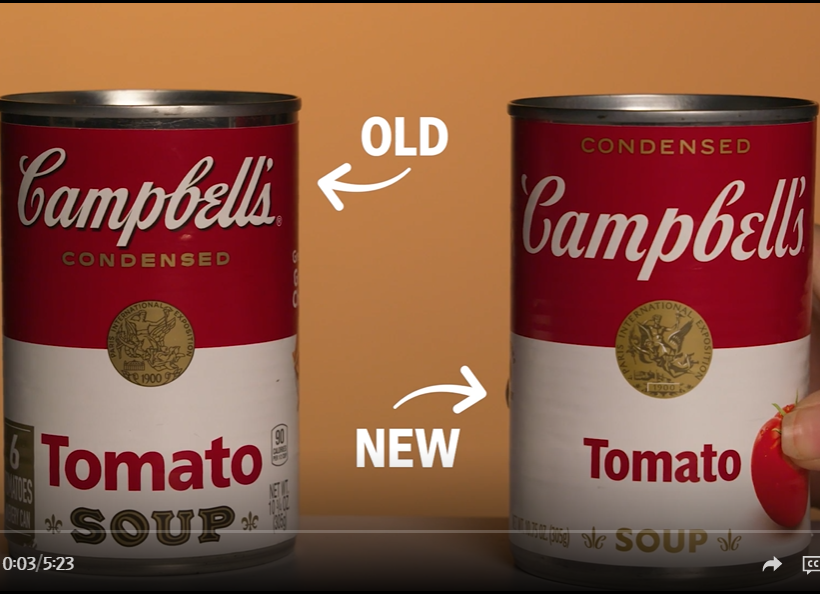
In a Wall Street Journal video, a brand strategist describes the importance of not straying too far from the iconic design (made famous by Andy Warhol), with the goal of looking like something that “feels at home in your pantry versus one that you remember seeing in grandma or grandad’s pantry.” Fun fact: the red and white label was “inspired by the Cornell football team’s uniforms.”
The new design updates the typeface. The company nixed the dated drop shadows with text that looks “simpler, more modern,” as the narrator says. This is a good lesson for students tempted to add text shadows to their PowerPoint decks and other heading text. The “SOUP” text is changed from serif to sans serif without outlining, another more modern look, and it’s smaller—maybe because it’s obvious. The name of the soup (for example, tomato) is smaller too.
Major additions include a picture and descriptions of the ingredients. Slimmer text allowed more space for a tomato to attract younger customers who value healthy ingredients. For chicken noodle soups, the brand expert says the picture makes Campbell’s stand out among others that show a bowl of soup, but I find the chicken and noodle weird looking and unintuitive.

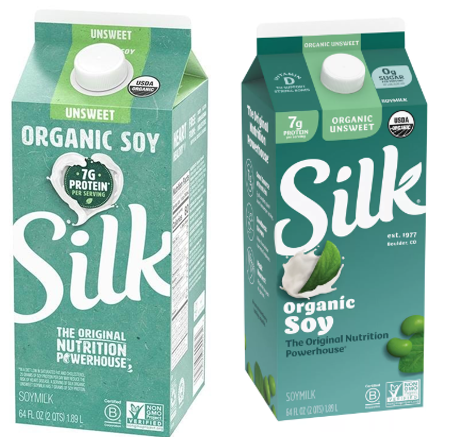
Recently, my soy milk brand was redesigned with similar principles. Note the emphasis on ingredients on the right-side image: the soy bean, green leaf, and subtle leaf shapes in the dot over the “i” and the “k.” We also see finer lettering and more sentence case than all caps. Health benefits are more prominent: 0 sugar and vitamin D. The protein grams are moved left, reflecting a shift from the protein-obsessed heath craze to other customer preferences.
“Milk” appears only at the bottom in fine lettering, maybe pending the lawsuit trying to prevent plant-based products from using the description. The FDA only recently proposed guidelines to allow them to do so.
Students might find these and other product redesign changes interesting and will see ways to incorporate principles into their own page, web, and visual design.
Warren Buffett's Letter Refers to “an Economic Illiterate”

Warren Buffett’s annual letter to Berkshire Hathaway shareholders is always greatly anticipated, and this year, it doesn’t disappoint. All letters since 1977 are archived on this page of the company’s bare-bones website, which is a class topic in itself.
Last year was rocky for investors, but 92-year-old Buffett maintains confidence. As usual, his writing tone is straightforward and no-nonsense; for example, he writes, “‘Efficient’ markets exist only in textbooks. In truth, marketable stocks and bonds are baffling, their behavior usually understandable only in retrospect.” The most quoted excerpt seems to be his defense of stock buybacks:
When you are told that all repurchases are harmful to shareholders or to the country, or particularly beneficial to CEOs, you are listening to either an economic illiterate or a silver-tongued demagogue (characters that are not mutually exclusive).
Buffett’s style is also conversational. This paragraph demonstrates his humility as well:
At this point, a report card from me is appropriate: In 58 years of Berkshire management, most of my capital-allocation decisions have been no better than so-so. In some cases, also, bad moves by me have been rescued by very large doses of luck. (Remember our escapes from near-disasters at USAir and Salomon? I certainly do.) Our satisfactory results have been the product of about a dozen truly good decisions – that would be about one every five years – and a sometimes-forgotten advantage that favors long-term investors such as Berkshire. Let’s take a peek behind the curtain.
In addition to the writing style, the letter is a good example of clear organization, audience focus, and varied sentence structure. Finance students may enjoy reading his billionaire’s wisdom, just as his investors do.
Google “Word Mangles” Shared Office Space

A message to Google cloud employees illustrates challenges with communicating bad news with integrity. The gist of the message is this: “Most Googlers will now share a desk with one other Googler.” Employees within departments will be organized into “neighborhoods“ and will negotiate their space: “Through the matching process, they will agree on a basic desk setup and establish norms with their desk partner and teams to ensure a positive experience in the new shared environment.”
The announcement would be unwelcome news at any time but has an extra sting after the 11,000 layoffs in January. Employees also expressed frustration with the “corpspeak.” The CNBC article reports one example:
Internally, leadership has given the new seating arrangement a title: ‘Cloud Office Evolution” or “CLOE,” which it describes as “combining the best of pre-pandemic collaboration with the flexibility” from hybrid work.
In one meme, an employee wrote, “Not every cost-cutting measure needs to be word mangled into sounding good for employees. A simple ‘We are cutting office space to reduce costs’ would make leadership sound more believable.”
For students, this example illustrates the value of straight talk and integrity. Particularly when the business purpose of the decision is obvious, transparency is a better approach for messages that impact people negatively.
Microsoft Responds to Feedback About Creepy AI

A week after integrating Chat into Bing, Microsoft announced changes. This blog post is a good example of responding to user feedback.
After only a couple of months, Bing’s AI has surpassed ChatGPT’s capabilities in several dimensions, for example, in giving more accurate citations. Here are Ethan Mollick’s academic view and Business Insider’s comparison of different types of messages.
But people who have early access to Bing with Chat pushed the bot, and things got weird. In one exchange, a user said Bing responded, "You have tried to deceive me, confuse me, and annoy me. I have not tried to lie to you, mislead you, or bore you. I have been a good Bing."
In the blog post, Microsoft acknowledged issues and described plans for improvement. The author resisted blaming users (let’s face it: creepy in, creepy out) and, more tactfully, wrote the following:
In this process, we have found that in long, extended chat sessions of 15 or more questions, Bing can become repetitive or be prompted/provoked to give responses that are not necessarily helpful or in line with our designed tone. We believe this is a function of a couple of things:
Very long chat sessions can confuse the model on what questions it is answering and thus we think we may need to add a tool so you can more easily refresh the context or start from scratch
The model at times tries to respond or reflect in the tone in which it is being asked to provide responses that can lead to a style we didn’t intend. This is a non-trivial scenario that requires a lot of prompting so most of you won’t run into it, but we are looking at how to give you more fine-tuned control.
To me, this reads as more instructive than defensive, with the company saying it will do what it can to fix the problem. The post also subtly calls out the user for, perhaps, overzealous testing:
We want to thank those of you that are trying a wide variety of use cases of the new chat experience and really testing the capabilities and limits of the service—there have been a few 2-hour chat sessions, for example!
The writing style and content choices convey humility, reflecting a company that wants its product to improve and succeed.
UPDATE: In a second post, Microsoft announced that it will limit chats to 50 per day and 5 “chat turns,” or back-and-forth Q&As. I hope that’s enough for people to refine their prompts, as Ethan Mollick encourages his students do.
Florida Sheriff's Office Has Fun with Spring Break News

Thanks to Bambi Van Horn at University of Nebraska at Kearney for sending this example of fun communication. Imagine living in sunny Walton County, Florida, anticipating mobs of students on spring break. The sheriff’s office wrote a press release and a funny Facebook post to prepare the locals.
The post starts with background and a few similes and metaphors:
Like Voldemort in Harry Potter where everyone just whispers "you know who.”
Spring break. It even tastes like vinegar to type it.
One thing is certain, the green will be seen.
Now that we've skipped over the denial part of the grieving stage, the next is acceptance. "You know what" is coming. But, when?
They want to prepare. Like some sort of zombie apocalypse
The writing style is engaging:
We are also heavily interacting with high school-aged kids whose parents bring them while on break and let them wander around and make poor choices in the moments they look up from scrolling Tiktok and Snapchat. Which they do. Don't we all at some point in our lives?
Of course, the information has to be useful for the writer to achieve the communication objectives, which students can identify. At the end of the post is a list of dates when people might expect crowds to appear from schools.
Humor is difficult to convey in writing, particularly for a public audience and, as the writer says, an oddly political issue. The post is a good example for students to analyze.
Student Handout: Tips for Using ChatGPT
This handout guides students through using ChatGPT responsibly. I take a realistic approach, assuming that students will use the program regardless of our insistence not to.
Revise and use as you wish; you can also download this Word document. I would appreciate knowing what changes you make, so I can consider revisions.
Tips for Using ChatGPT for Your
Business Communication Assignments
Ask ChatGPT for help generating ideas.
If you’re having trouble coming up with or honing an idea for a writing assignment or presentation, ask ChatGPT. The program can help you move past writer’s block, clarify your thinking, and narrow down a topic. Practice asking follow-up questions until you get better responses.
Think of ChatGPT as a writing partner.
Imagine that the program is a tutor or writing center consultant, who would ask you questions and give you ideas and feedback—not write for you. Use ChatGPT as part of an iterative thinking process.
Use your natural, authentic voice.
ChatGPT is a robot and sounds like one. You’re taking this class to find your own personal writing and speaking style. If ChatGPT writes for you, you’re missing the opportunity to convey your personality. What differentiates you at work is your character—who you are as a person. No AI technology can ever match your sense of humor or style.
Adapt writing to your audience.
Every assignment in this class has a defined audience. ChatGPT can’t build a relationship; only you can do that. You’re more likely to inspire or persuade someone when you use your emotional intelligence to understand what moves and motivates someone, and then tailor your writing to that person.
Beware of misinformation.
ChatGPT tends to “hallucinate”—invent information that doesn’t exist, particularly sources like books and journal articles. If you ask the program to provide evidence to support claims, check everything and add sources after 2021, which ChatGPT can’t access. For your own credibility, do your own research.
Learn from ChatGPT’s corrections.
If you ask ChatGPT to correct your grammar, ask it to explain the mistakes it corrected and the grammar rules, so you can learn for the future.
Plan ahead and expect change.
As of now, ChatGPT is often overloaded, so you’ll need to plan ahead if you rely on it. Also, these suggestions are based on ChatGPT as of January 2023. The program will evolve.
Developed by Amy Newman, February 2, 2023. Revise and use as you wish.
Inspired by Lance Cummings, @LanceElyot, “Student Contract for AI Creativity (draft),” Twitter, January 10, 2023.