
Recall Notices About Metal in Chicken Nuggets
Recalls about “foreign matter” in food can be tricky to communicate. Tyson and USDA notices illustrate accountability and bad-news messaging for students to compare.

Audiences and communication objectives are similar for all recall notices. For the company and government agency, the primary audience is customers, and both organizations want customers to avoid using affected products. Messages clarify which products have been affected (typically product types, distributors, and locations), and companies offer a refund for returned products. Companies have an additional objective—to maintain brand image.
In this case of the “Fun Nuggets” recall, the USDA message is straightforward, starting with “Tyson” as the actor recalling the product. The notice describes the recall issue this way:
The problem was discovered after the firm notified FSIS that it had received consumer complaints reporting small metal pieces in the chicken patty product.
There has been one reported minor oral injury associated with consumption of this product.
With clunky language, the Food Safety and Inspection Service (FSIS) subtly promotes itself by describing what the agency does to follow up:
FSIS routinely conducts recall effectiveness checks to verify recalling firms notify their customers of the recall and that steps are taken to make certain that the product is no longer available to consumers.
The Tyson message also starts with the main point up front but emphasizes the “voluntary recall,” which is typical but a bit strange. Would the company need to be convinced to recall the product in such a case? Still, the writer chooses “out of an abundance of caution,” a near-cliché to describe the decision:
A limited number of consumers have reported they found small, pliable metal pieces in the product, and out of an abundance of caution, the company is recalling this product.
At least two more differences between the messages are notable. “Pliable” does sound better, and of course, Tyson doesn’t mention the “minor oral injury.” Tyson also states, “a limited number” of customer complaints, as any company would in a crisis situation to contain the damage. Stating a specific number also might convey an unpleasant image, which I have in my head, of an 8-year-old screaming at a kitchen table.
The FSIS message states where products were distributed, which seems useful, while the Tyson message includes a product photo, which seems essential. I’m guessing the FSIS wouldn’t send an agent out to buy a bag to take a picture, but they could lift the image from Tyson.
Emotions Drove a Football Manager's Comments
A football writer offers a lesson for all business communicators: “Maybe managers shouldn’t give interviews straight after games.” Similar to other business situations, emotions run high, and people need to take a beat before they speak or write. Student athletes and fans will be particularly interested in this story, but the example is for anyone who reacts before thinking through the consequences.
Arsenal Football Club (soccer to Americans) manager Mikel Arteta took an interview after a disappointing game. He disputed a goal call:
We have to talk about the result because you have to talk about how the hell this goal stands up and it’s incredible. I feel embarrassed, but I have to be the one now come here to try to defend the club and please ask for help, because it’s an absolute disgrace that this goal is allowed. . . .It’s an absolute disgrace. Again, I feel embarrassed having more than 20 years in this country, and this is nowhere near the level to describe this as the best league in the world. I am sorry.
Critics called Arteta’s reaction “disproportionate.” Such language as “how the hell” and “absolute disgrace” reflect a far greater injustice. I’ll leave the analysis to sports enthusiasts, but it seems like a questionable call—not an outrage.
The trouble worsens when the Arsenal Football Club defends Arteta in a statement, which included unequivocal support: “Arsenal Football Club wholeheartedly supports Mikel Arteta’s post-match comments.” The Athletic describes what business communication faculty would conclude, comparing the response to a crisis situation:
But for a football club to release an “official statement,” once upon a time the sort of thing reserved for managerial dismissals and so forth, about a marginal refereeing decision they disagree with, is extraordinary.
Over-reactions are difficult to withdraw. Arsenal supported the manager, which generally is a good corporate practice, but doubling-down on exaggeration makes management look defensive and lacking humility, as if they know a wrong was committed but are stuck.
Of course, a better approach for Arteta is to have waited a bit, as the writer suggests. It’s the same for business communicators. Write an email while angry but don’t send it until a day or so later. During a difficult interaction, pause and step away if you need to. Most often, an immediate response, as this situation shows, isn’t needed.
DoorDash Delays Orders Without Tips
DoorDash is piloting a new screen warning customers that no tip could mean a delayed order. The messaging illustrates principles of persuasive communication.
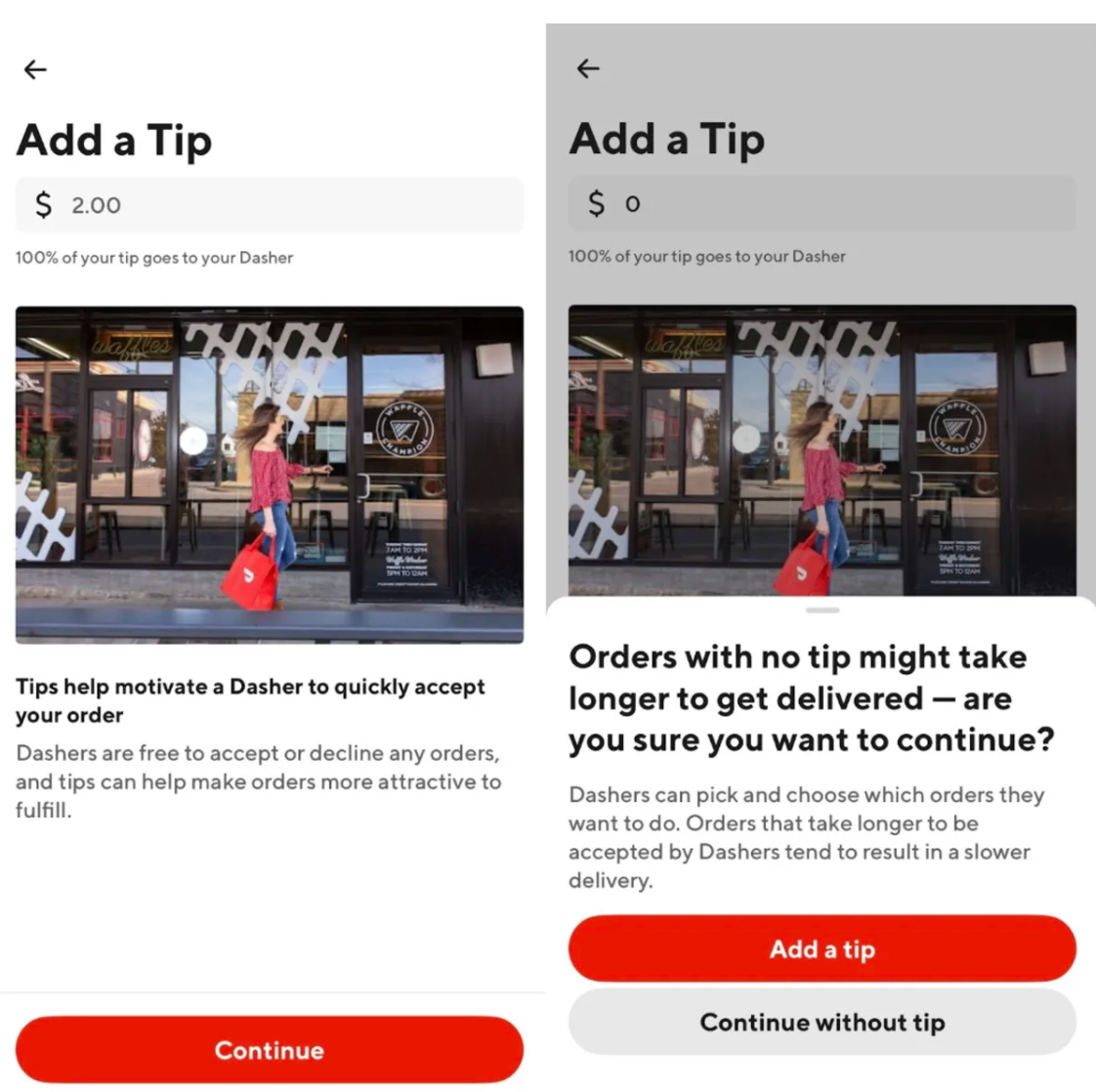
DoorDash’s message framing encourages tips, even though the process is punishing. In the statement title and subtitle, the company emphasizes “quality” and “the best possible experience for Dashers, consumers, and merchants.” These frames are clever alternatives to claims about pay fairness because that would reflect poorly on the company, which some customers call out in tweets about paying a living wage.
Another strategy DoorDash uses is deflecting responsibility, or blame, onto the drivers:
In the event that a consumer chooses to not leave a tip, we also let them know that their order may take longer to be accepted as a result. This is because—as independent contractors—Dashers have full freedom to accept or reject offers based on what they view as valuable and rewarding. Since launching this test, we’ve seen a meaningful decrease in no-tip orders.
In that last bit, DoorDash evokes peer influence, which also is used at the beginning of the statement: “That’s why we encourage consumers to show their appreciation by tipping—and the vast majority do.” The idea is for customers to get on board with the majority: if they hadn’t been tipping, as most do, then they should begin now, as more have.
The statement rambles a bit, and students might identify a contradiction towards the end:
The test does not impact DoorDash’s commitment to quality or how orders are fulfilled. Our goal is to deliver the best possible experience—regardless of the amount a consumer tips—on each and every order.
But isn’t the objective of the pilot—more tipping—to improve quality? For most people, a delayed order isn’t the best possible experience.
Customers point out another contradiction, which is tipping before service. But, as Michael Lynn, who has studied tipping for decades, says, “Ultimately, social approval’s the main reason we tip,” so DoorDash’s peer influence strategy should work. For more about the morality of tipping, David Brooks offers one perspective, which is that we should tip generously regardless of service.
"Open to Work" and Other Desperations

Although LinkedIn offers an “open to work” option, at least one recruiter says it’s the “biggest red flag" for employers. This reminds me of other ways students inadvertently appear desperate to recruiters.
LinkedIn explains the feature, which offers the option to show the banner to all LinkedIn members or only to recruiters. Users might select all members, thinking about networking strategies, but this might increase the look of desperation. LinkedIn also explains, “[W]e can’t guarantee complete privacy” because, if someone is still employed, recruiters at the company might find out from other recruiters that they’re on the market.
One recruiter compares job seeking to dating and encourages “exclusivity.” Business communication faculty may refer to Cialdini’s scarcity principle: people want what they can’t have.
We coach students to be more selective in their search. When a recruiter or hiring manager asks, “What’s your ideal job?,” students should have one in mind—not too narrow, but not too broad either. “I’ll do anything. I just want to work for xx” likely won’t inspire an offer. This reminds me of reading applications for the Cornell Nolan School of Hotel Administration. Many students would write that they applied because “it’s the best” program. That answer says little about the applicant’s decision process—or maybe the answer says it all.
On the other hand, students who lie about multiple job offers are playing a dangerous game. In addition to the obvious issues of integrity, college recruiters talk.
Networking requires more effort than a banner. Years of curating a network, which develops from supporting and being helpful to others, results in people who care about an applicant and want to see that person succeed. For students, this is more challenging but starts during school.
John Oliver Blasts McKinsey
Last Week Tonight produced a 26-minute segment criticizing management consultancy McKinsey. Students can decide whether John Oliver was fair in his conclusion that, “McKinsey’s advice can be expensive but obvious, its predictions can be deeply flawed, and it’s arguably supercharged inequality in this country.” He contrasts these conclusions with the CEO saying, “Our purpose is to create positive, enduring change in the world.”
Here are a few areas to explore, or you can just show the fake recruiting ad starting at 23:00, which is pretty funny.
Timing
I’m curious why Oliver created this segment now. McKinsey’s role in the opioid crisis, which he covers at around 12:00, was most highly litigated back in 2021 - 2022. He doesn’t point to anything specific since then.
Evidence
To make his points, Oliver uses a variety of evidence but mostly examples in the form of stories. If this were a serious rebuke of McKinsey, students might expect more data. I also question the many references to a 1999 film. Maybe things have changed since then? The inexplicable timing contributes to the segment feeling like the attack that it is, rather than a balanced piece. But I forget: This is “late-night news,” not actual news.
The Example of Eliminating Signatures
The example of identifying cost savings for an energy client is just silly (at 7:30). I wonder whether this is just a terrible example—or whether more information about the situation, or more examples in the original video, would make it less embarrassing. We don’t see the context.
Oliver’s Indignance
Oliver jokes about his British accent sounding “smug” (6:33), but his style is part of the reason I don’t watch him or other talk-show hosts. I’m guessing a lot of students find him funny because of his style. This might start an interesting discussion about delivery styles.
McKinsey’s Response
I don’t see any response from McKinsey, and I don’t think it would be wise. But it’s a worthy discussion point with students. Why wouldn’t the company respond? What are the arguments for responding? What, if anything, could the company say or do?
Other Perspectives
Business communication faculty—and journalism faculty—teach students to offer multiple, sometimes conflicting perspectives. At around 21:00, Oliver does present other sides. He acknowledges that other consulting firms sometimes act unethically or have questionable client relationships, which (sort-of) addresses criticism that he’s singling out McKinsey. Oliver also describes how McKinsey responded to an inquiry from the show a few days before airing and admits that he’s presenting examples, which McKinsey would say don’t represent their work. But he argues against these claims by saying that the harm McKinsey has done outweighs the good.
Character
Starting at around 22:30, Oliver calls out the character dimensions students will associate with this story. He calls for greater accountability and transparency, which I describe as part of integrity. That cues up the parody McKinsey recruiting video, which starts at 23:00 for students’ enjoyment.
Of course, the entire segment raises questions about Oliver’s own integrity. Then, again, the show is what it is intended to be: entertaining.
Hyatt's Bad-News Message to BCom Faculty

Association for Business Communication members woke up to a cold shower during the annual conference and later received a note from the director of operations. Naturally, we analyzed this message against principles for delivering bad news. I admit to “geeking out” on this one.
Strengths
The director of operations took responsibility for the issue and had a personal note delivered to every room. (I don’t know what time because I had left my room after getting what might have been the last warm shower at 6:20.)
Dietel mentions the news up front (despite older advice of using the indirect approach and putting bad news at the end), which is appropriate for the audience and situation.
He explains what happened (beyond the hotel’s control, so he won’t get blamed) and tells guests not to expect warm water for “several hours.”
He apologizes, noting, “this is very inconvenient.” (What else could he say?)
He provides staff contact information by phone and his direct email. He doesn’t shy away from customer complaints.
Areas for Improvement
The first sentence is confusing: Who is notified? The city steam plant? No, guests—or “you.”
To bring main points even more clearly up front, some version of the last sentence of the first paragraph—when guests can expect hot water—would work better.
The reason includes more detail than guests might care to know. I would make it more concise: “a disruption at the city steam plant.”
“Several hours” could be defined, but that might not be possible. Deitel says the disruption has been “restored,” and we’re waiting for “the necessary steam.”
Correct punctuation and proofreading are always appreciated; commas, hyphens, and “The city” instead of “They city” would increase credibility.
Maybe a text would have worked better to save paper and provide an easy way to notify people when the hot water returned. Otherwise, given the “several hours” prediction, guests would have to keep testing it. Don’t all guests provide a phone number when they check in? Or maybe the hotel favors paper for the appearance of more personalized service (like a handwritten thank-you note compared to an email).
Business communication faculty—including me—will dissect any message. But overall, the message is a good example of a director of operations leading: taking responsibility, communicating, and dealing with the repercussions. I hope no guests called or emailed. In a situation like this, the hotel staff can do very little.
Tools for Managing Through Interpersonal Conflict
As students protest across campuses, faculty can help them manage through conflict. Here are two tools from the text chapter, “Communicating Across Differences,” and a few thoughts about character.
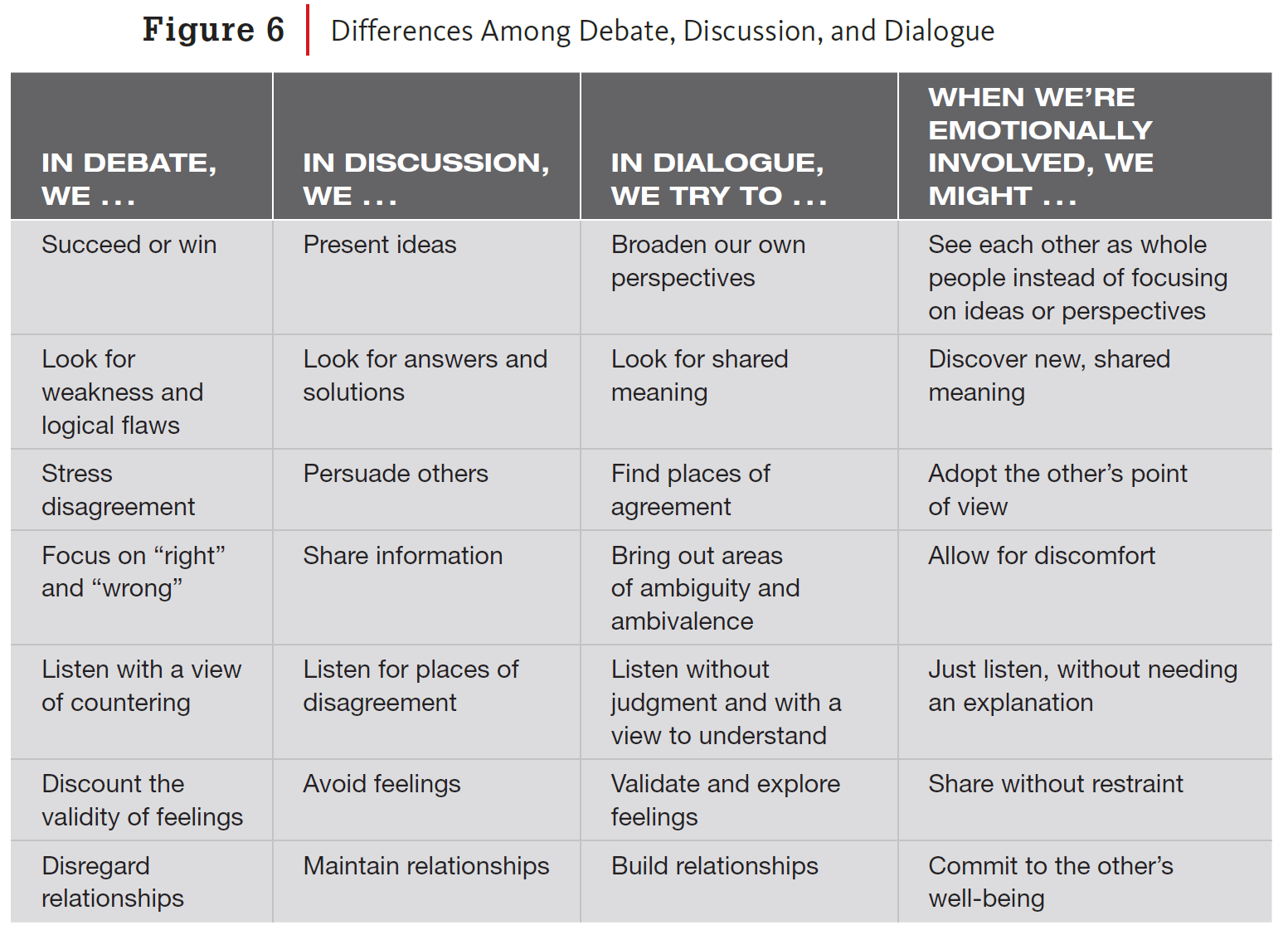
This matrix, adapted from other sources (see below), shows students how to move from debate to dialogue—and through emotional involvement, my addition for more personal and community conflicts.
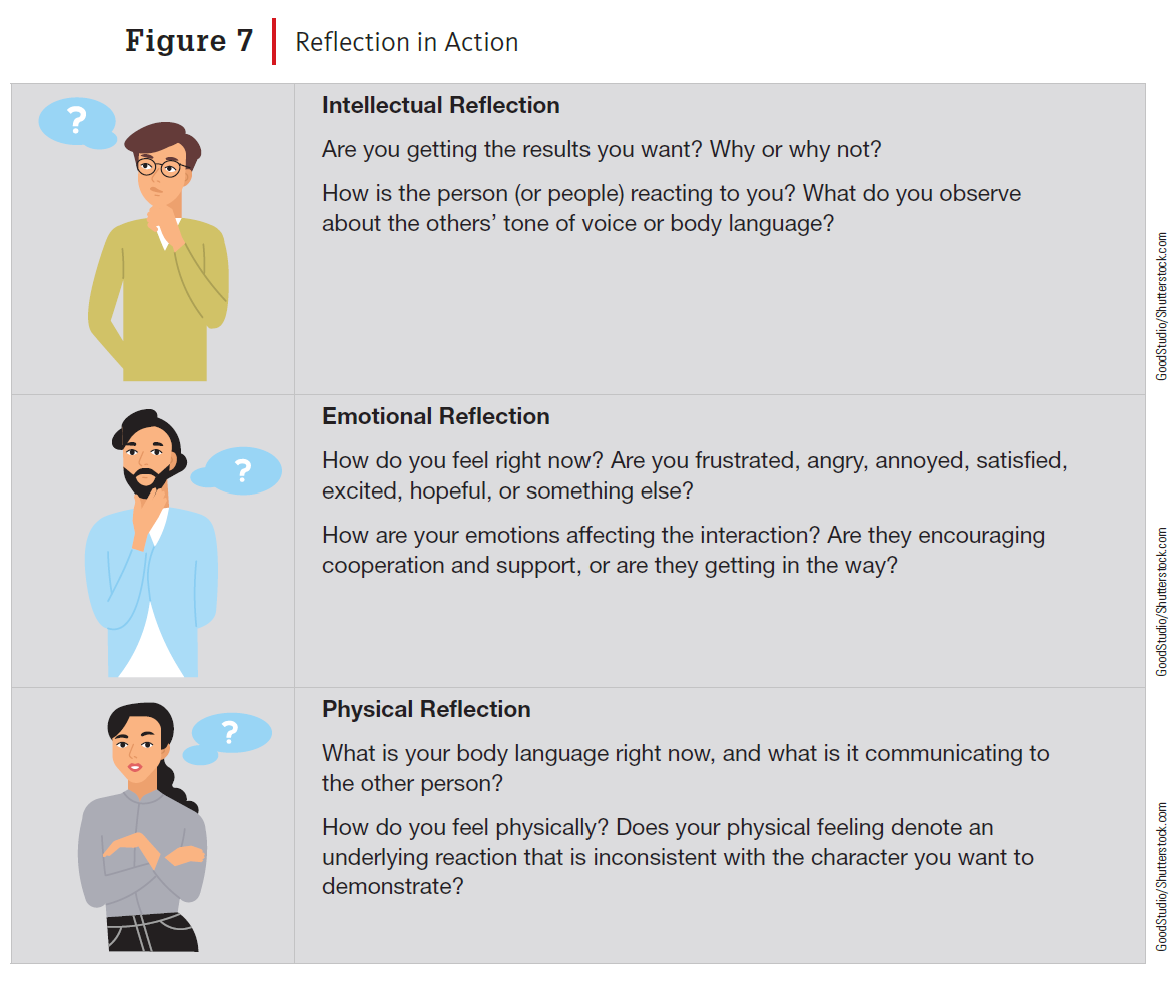
Students may practice reflection after presentations or activities, but reflecting “in action” is a way to zoom out and get perspective during an interaction that isn’t going well. Questions about emotional and physical reactions deepen students’ typical intellectual reflections in the classroom and encourage students to take action—even to support those who disagree with them.
Students also will learn from discussions about character. When they stand for their beliefs, they demonstrate courage, but changing their beliefs also takes courage (and humility). Protests also may veer from challenging injustice to self-righteousness, an extreme of courage that looks like moral superiority and absolute certainty.
Protesting demonstrates compassion for one side, but so does seeing the other side’s pain. In addition, students are vulnerable when they protest: they risk emotional exposure and being “doxxed,” identity exposure they might consider unbearable.
Figure 6 is adapted from “Creating Community Across Difference,” Intergroup Dialogue Project, Cornell University, 2018, which is adapted from University of Michigan Program on Intergroup Relations, 2008. Original source: Daniel Yankelovich, The Magic of Dialogue: Transforming Conflict into Cooperation (New York: Simon & Schuster, 1999). Adapted with Eric Clay, multi-faith and secular chaplain.
Visuals About SAT Disparities
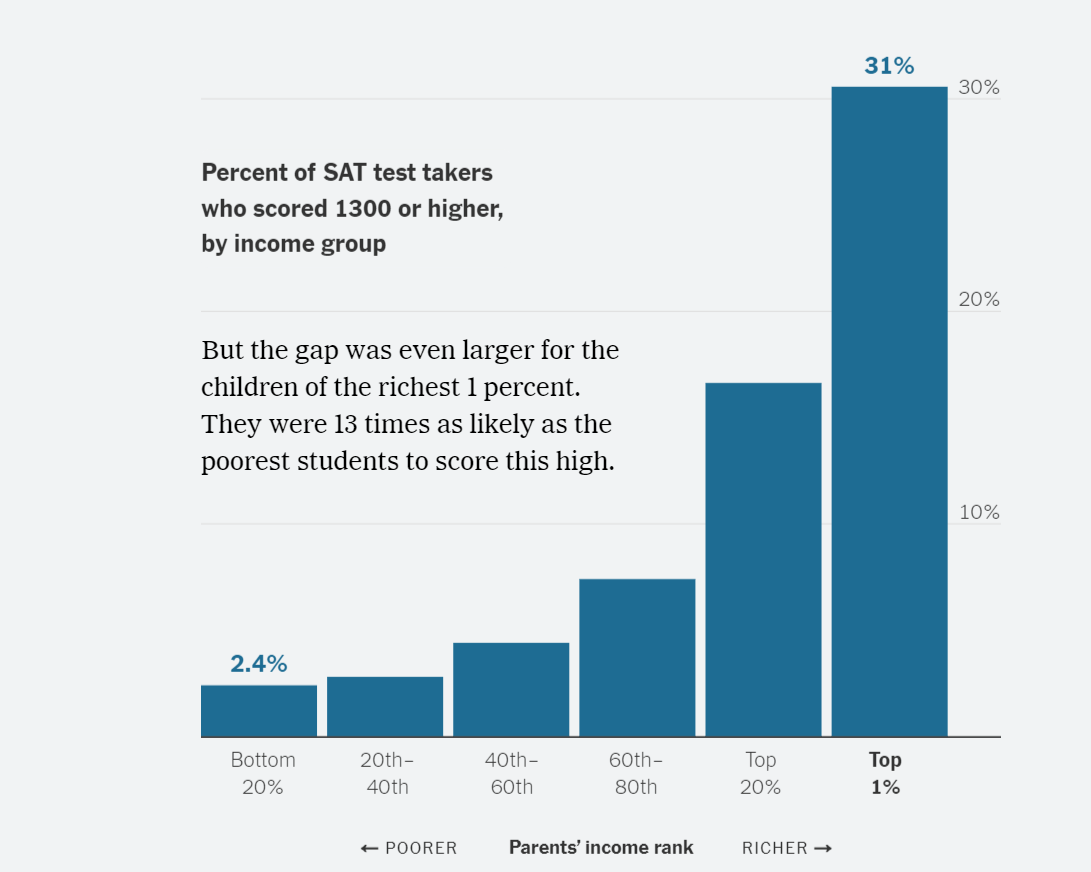
Charts showing SAT scores by family income provide useful data visualization examples for students to analyze. A New York Times report concludes, “New data shows, for the first time at this level of detail, how much students’ standardized test scores rise with their parents’ incomes—and how disparities start years before students sit for tests.”
Progressive column charts show the increasing likelihood that a student will earn an SAT score of 1300 or higher as family income increases. The first chart shows students in the top 20% of income earners, and the second shows those in the top 1%, with dramatically higher chances of scoring 1300 or above.
One topic for discussion is the visual itself. Is a column chart the best representation for the data? It works well and is clear. Untraditionally, the X-axis labels are on the right side, but we don’t see much “chart junk,” although the horizontal lines seem superfluous. The X-axis is truncated (maxing out at 30%), so differences are exaggerated, but the data labels are clear. Data labels would be useful above all columns for consistency but would interfere with the text—and the author’s point of comparing the highest to the lowest. The chart shown here follows a previous one identifying the top 20%; this one “compares apples to oranges” (1% to 20%), but makes more sense with the earlier one for comparison. You’ll see more charts in the article, showing greater disparities still.
Another topic is data collection. The Times cites the original source, which includes more extensive reporting worth evaluating.
Of course, the Big Topic for discussion with students is the cause of this disparity. The article provides several reasons: kids attend preschool, attend better-resourced schools, etc. Asked for their opinions, students might identify the same reasons—or they might have different ideas that they should be prepared to support with evidence.
University-Related Communications and the War
If you’re speaking with students about communications around the Israel-Hamas war, here are a few ideas, and students will probably have their own examples that didn’t make national news.
Protests and Free Speech
In addition to student protests at universities, a few well-publicized examples have raised questions about faculty and staff behavior—and about free speech. Students can analyze one or more of these situations and the university’s response. This is a particularly good activity to challenge students to evaluate their sources and to consider all the possible choices and repercussions for the university.
Yale: A professor of American studies, tweeted, “Settlers are not civilians. This is not hard.”
Cornell University: An associate professor of history says on video that the “challenge” by Hamas was “exhilarating” and “energizing.” (See his apology, which students can compare to criteria in Chapter 7 of Business Communication and Character.)
Stanford: A lecturer apparently separated Jewish students in class as an example of what Israel does to Palestinians and called an Israeli student a “colonizer.”
Criticism of Ivy League Statements
Some universities have revised or supplemented their original statements. Students can analyze messages to identify changes, for example, taking a clearer stand, including more emphatic language, adding personal reflections, more clearly distinguishing between Palestinian support and the Hamas attacks, etc. Students can discuss how effective the revisions or add-ons are and whether they satisfied critics. Students also may consider what character dimensions are illustrated, or not. Here are a few statements:
Stanford University
“Statement about support and resources for students as crises unfold worldwide” (Oct. 9)
“An update for the Stanford community” (Oct. 11)
Cornell University
”Response to the terrorism in Israel” (Oct. 10 and updated later that day)
”Supporting one another as we stand against hatred (Follow up on events in Israel)” (Oct. 16)
Harvard University
See the series of statements, including the original on Oct. 9, the follow-up on Oct. 10, and the president’s video on Oct. 12 (shown here).
Donors Pulling Funding
Related to the criticism of elite colleges, this article provides examples of donors pulling funding based on universities’ responses. Discussion questions could include the following: How do funders explain their decision? What reasoning or evidence do they provide? What do funders say they want in return? How effective do you believe this strategy will be?
Joint University Statement
Leaders of Yeshiva University, University of Notre Dame, United Negro College Fund, Baylor University, and others issued a joint statement, “We Stand Together with Israel Against Hamas.” Discussion questions could include an analysis of the statement (what’s said and what’s missing), why some leaders would choose to sign this statement and others would not, and how Baylor’s fuller response provides context for the university’s decision to sign.
Firms Denying Jobs
Pershing Square Capital Management CEO Bill Ackman called for Harvard students who signed the pro-Palestinian statement to be revealed, so he wouldn’t “inadvertently hire” them. The CEO of Sweetgreen and others agreed. A law firm rescinded job offers to three students who had signed statements. Discussion could include students’ thoughts about these decisions. What ethical questions are involved? What character issues are at play? What are the possible positive and negative consequences to leaders who make these public statements—and decide not to hire certain job applicants? Here’s one opinion on Ackman for students to discuss.
AI Peer Review Assignment

My colleague at Cornell University, Christy McDowell, and I created an assignment for students to practice using ChatGPT for peer feedback. We’ll present the results from her Persuasive Management Communication class at the Association for Business Communication Conference on October 26, 2023, in Denver. (Download the deck at right.)
Here’s the assignment if you would like to modify it for your class, and you may use it for any writing task.
The assignment included multiple parts:
Step 1: Submit Your Assignment 1 Draft Outline
Step 2: Review Two Students’ Outlines
Step 3: Ask ChatGPT for Feedback
Step 4: Reflect on Your Experience with ChatGPT
Step 5: Compare AI and Human Feedback
Step 6: Reflect on Peer Feedback
In written reflections and class discussions, most students:
Were surprised at how skilled ChatGPT was in providing feedback (65%)
Found the process more helpful than previous peer review activities (67%)
Indicated that peer feedback and in-person discussion were more useful than the anonymous peer feedback (71 reflections)
Confirmed they will use AI to structure and organize content for future assignments (in-class discussion)
If you use parts or all of the assignment in your class, let us know how it works for you and your students!
SBF's "Scoffing" Relates to Student Behavior
The Sam Bankman-Fried trial is getting dramatic, with the defendant’s behavior potentially affecting a witness. This situation raises questions about audience reactions during presentations.

Caroline Ellison, formerly the Alameda CEO and Bankman-Fried’s girlfriend, is testifying against him. Her attorney called out Bankman-Fried’s behavior while she was on the witness stand: “[T]he defendant has laughed, visibly shaken his head, and scoffed.” He claimed that this could have a negative effect on her, while Bankman-Fried’s attorney said his reactions are “for your honor and the jury to decide.” I can’t imagine his behavior reflects well on him.
I think about all those presentations I gave while working for companies and all those presentations I watched students deliver in class. The audience could certainly affect someone’s delivery—even if someone wasn’t involved romantically.
I also think of the “head-nodders”—those students, during presentations or regular class—who inspire the speaker (or the faculty member) to continue, believing the message is well received. At the same time, some students seem to nod reflexively (or maybe to keep themselves awake).
Students would benefit from a conversation about their nonverbals as audience members. What does a nod or a smile mean: support, encouragement, listening, or something else? To what extent are students aware of their behavior?
How do students giving presentations interpret behavior, for example, looking at the clock or writing notes? To what extent are students swayed by audience behavior? Students might reflect on their experiences during internships: have audiences affected their presentation delivery?
An interesting, but risky, question after a presentation would be to ask speakers what behaviors they observed and how, if at all, they were affected. As faculty, we need to be prepared to answer the same question about our observations and the affect on us. Are you highly sensitive, immune, or somewhere in between?
Tax Credits: Persuasive Comm and Ethics Case

The classic rhetorical triangle of logical argument (logos), emotional appeals (pathos), and credibility (ethos) examples:
Logos: “We make claiming the payroll tax refund easier.” (logical, step-by-step process for results)
Pathos: “The ERC offers a welcome cash infusion as owners struggle.” (appeal to emotion)
Ethos: Wall Street Journal quote and link to the IRS website. (credibility)
Robert Cialdini’s Seven Principles of Persuasion examples:
Reciprocity: With “no upfront costs,” the company inspires business owners to apply in return.
Scarcity: “Time is running out!” and “don’t let your business miss its chance to make a claim” convey a limited timeframe during which to apply.
Authority: “[O}ur team of independent tax attorneys and tax professionals” boasts the staff’s credentials.
Consistency: Users who complete the “check your eligibility” form are more likely to follow through.
Liking: The company presents its staff as likable and reliable—people business owners would want to work with: “Our team will guide you every step of the way, from eligibility to claiming and receiving refunds.”
Social Proof: Testimonials and the scrolling list of amounts and company logos show how others have succeeded in getting refunds.
Unity: I don’t see an example of unity, Cialdini’s additional principle, but maybe you or your students will.
Although the company denies wrongdoing, aggressive marketing tactics have resulted in far more claims—and much higher government costs—than expected.
Comparing University Statements About Israel

As an in-class activity or assignment, students can analyze and compare what university officials are saying about the conflict in the Middle East. Here are a few statements and, below, possible questions for discussion. The Harvard situation is particularly charged. The university is facing criticism because, despite issuing a statement supporting Israel, so far, it hasn’t responded to a post by 34 student organizations: “Joint Statement by Harvard Palestine Solidarity Groups on the Situation in Palestine.” (Update: The president posted a response on October 10.)
Statements
Brandeis University
Harvard University
Hunter College
New York University
The Rockefeller University
University of Connecticut
University of Miami
University of Washington
Questions for Discussion
Who are the primary and secondary audiences for the statement?
What are the communication objectives?
For each statement:
How does the writer describe the issue; for example, is it called a “war,” “conflict,” “tragedy,” “attack,” or something else?
What’s the significance of how the issue is described? In other words, how clearly does the university support a position?
How might the university’s mission, student population, location, and other factors affect the message?
How would you describe the tone? What language illustrates your characterization?
How do connections to the region affect the credibility of the message and the writer?
What resources are offered for students?
What does the message say about campus conduct and safety?
What, if any, action does the university promise?
How does the writer illustrate character dimensions, for example, compassion, accountability, integrity, or courage?
What else distinguishes one statement from another?
What universities are missing statements? Why might they choose to stay out of the conversation? Or are they just slower in responding, and why might that be?
Bruno Mars Is Quiet About Israel Concert Cancellation
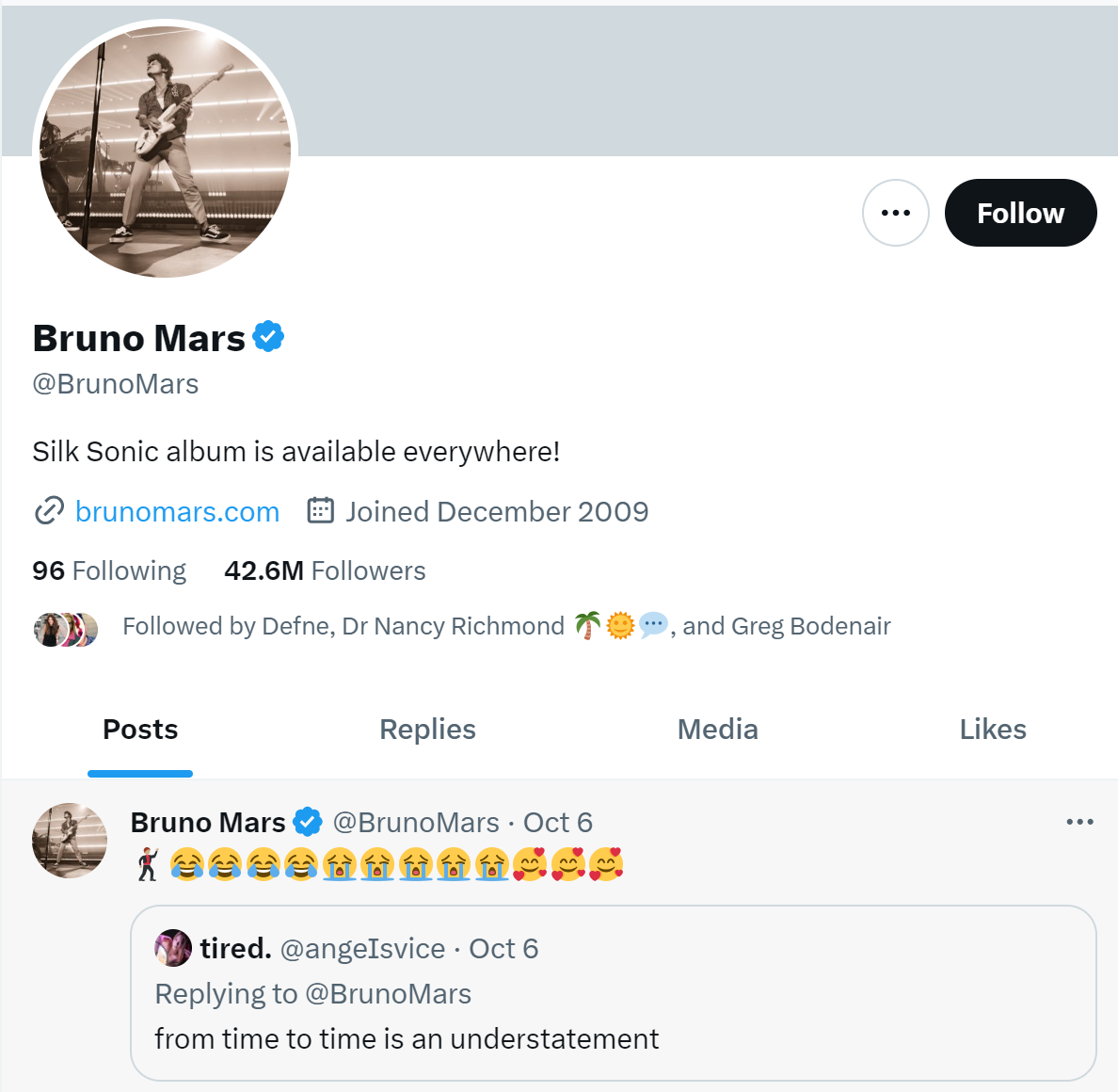
Not surprisingly, a Bruno Mars concert scheduled for Tel Aviv was cancelled because of the Israel-Gaza Conflict that already left hundreds dead. In times of tragedy, celebrities are often at a loss. Mars seems to be keeping quiet.
Live Nation posted an announcement in Hebrew, which translates roughly as follows:
Dear Customers,
Bruno Mars concert scheduled to take place tonight is cancelled. All ticket purchases to the show will receive an automatic refund to the credit card through which the purchase was made.
The concert schedule on his website shows the next performance on October 8, in Qatar, with no explanation for October 7, although this is as of 9:45 pm on October 7. The website is bare-bones and out of date, with only one promotional “news” item dating back to 2021, so we wouldn’t expect more to be written here.
However, Mars is active on X, with posts on October 5 and 6. This would be a place to say something.
His Instagram also shows a picture from the October 6 concert, and some fans are asking for his support. One wrote, “Please share to all your fans what is happening in Israel right now. We love you.”
Mars might not want to weigh in on the political situation, but he could simply express regret for not performing as planned. The previous night was his first concert in Israel, and the Tel Aviv location would have been his second. Would a statement of regret raise questions about why he doesn’t support one side or the other?
Compassion seems warranted. Maybe fans would like to hear Mars’ disappointment and some version of “thoughts and prayers.” How about, “I’m as disappointed as fans that I can’t perform in Tel Aviv. I wish for peace for all.” Or would that cause a social media firestorm?
Of course, he could express his opinion if he feels strongly about the situation. That would take courage—taking action despite the risks, in this case possible backlash and, eventually, loss of fans or endorsement agreements. Students will have opinions on this topic.
Small Talk Phrases

Matt Abrahams promotes his new book in an attention-grabbing CNBC headline: “The No. 1 phrase people who are good at small talk always use, says Stanford public speaking expert.” Of course, I was curious about the phrase, and it is . . . “Tell me more.”
Although the headline is hyperbolic (“No. 1” and “always”), Abrahams is encouraging what any business communication faculty member would encourage: use open-ended questions and phrases. He also recommends, “What excited you about that?” or “Wow, what happened next?” or “How did you feel when that happened?” Abrahams’ point is to avoid “shifting” the conversation to yourself. However, sometimes it’s useful to relate to a speaker by sharing your own experience. Also, these phrases are useful when, at times, you’re not sure what to say in response.
Students might choose phrases that feel more natural to them, for example, “I’d like to hear more about __,” “Say more about that,” or, simply, “Really?” I recently heard, “Can you take that thinking further along the track for me?” I liked that approach given the situation (a complex political idea). In similar situations, I’ve heard others offer a noncommittal “Interesting,” which felt like a polite, “Please stop talking now.”
In addition to “small talk” situations, students could practice these phrases during presentation Q&As.
"Booster" Vaccine Communications
The U.S. Food and Drug Administration (FDA) recommended simplifying COVID-19 vaccine use, including nixing the term booster. The change is an uphill climb and offers lessons in change communication.
The FDA’s deck from January 2023 explains the rationale. The goal is “harmonizing the vaccine strain composition of primary series and booster.” In other words, to eliminate the need for and complications of multiple shots. Instead, the FDA and Center for Disease Control (CDC) want people to think of the COVID vaccine like a flu vaccine and to get a new one each year. The push to avoid the term booster started even earlier, when Stanley Plotkin, renowned physician who developed the Rubella vaccine, suggested the change:
My point, basically, was that calling them boosters implies that the first doses were failures.
Calling the third dose a booster is immunologically incorrect and also gives the wrong impression that somehow the vaccines failed when they could not really have been expected to give a long-lasting immunity from the first doses.
(Here’s an Atlantic article for a fuller linguistic discussion.)
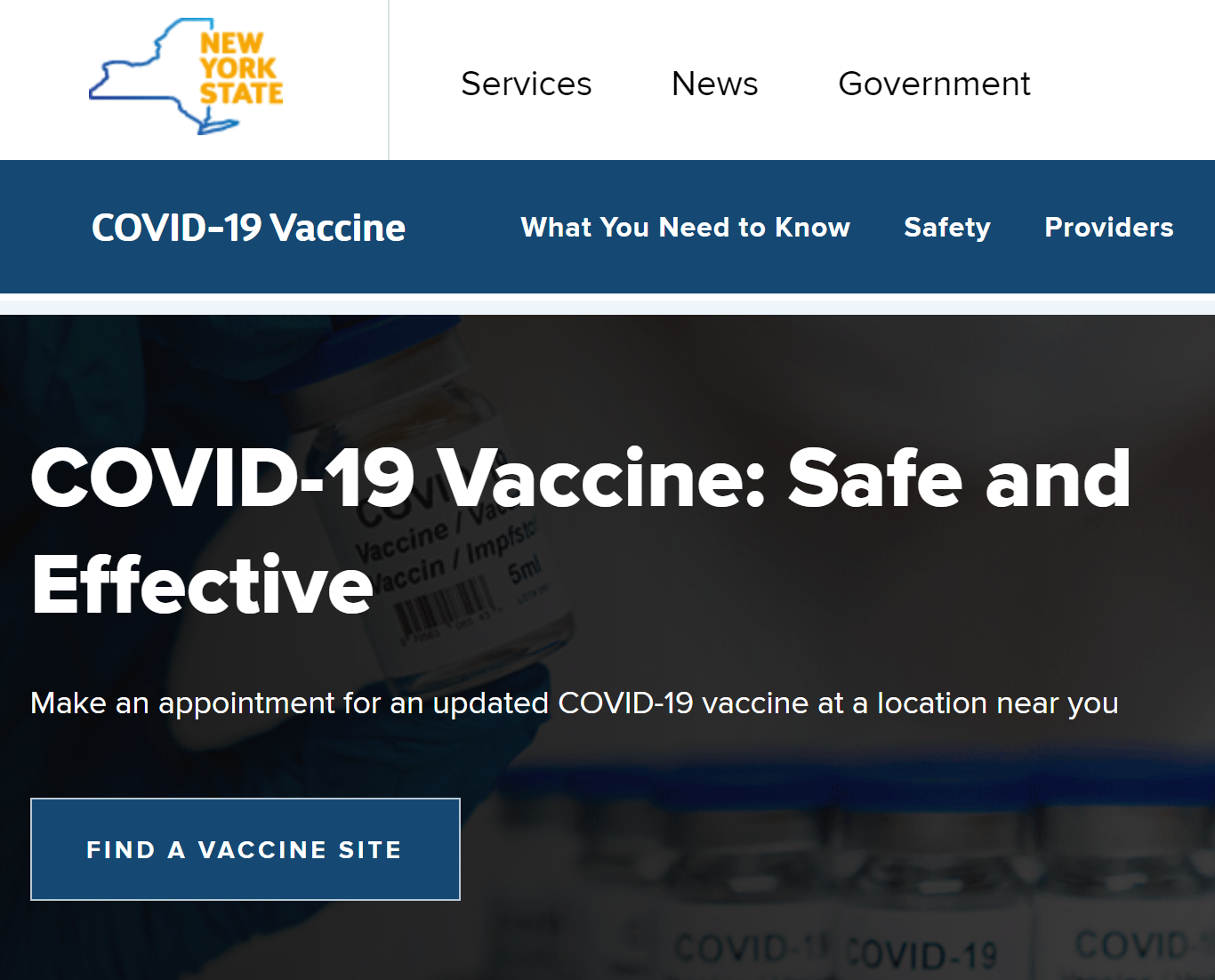
Last month, CDC vaccine advisor Keipp Talbot said, "Bye bye, booster. We are no longer giving boosters, and it's going to be very difficult to stop using that word because that word has become pervasive.” The CDC’s and FDA’s latest webpages about COVID-19 vaccines don’t mention boosters but refer to “updated vaccines.” On New York’s site, we’re instructed to “Make an appointment for an updated COVID-19 vaccine,” but a page titled, “Booster Doses” still exists, likely for people searching for the old term. As Talbot warned, the change will take some time.
PwC Report for Students to Analyze

If you’re looking for a sample report with mixed text and graphics, “PwC’s 26th Annual Global CEO Survey: Winning today’s race while running tomorrow’s” is a good one for students to analyze. With open access, the report is designed as a webpage built around survey questions. Here are a few points to explore with business communication students:
Audience Analysis and Communication Objectives: As a public document, the report provides information for business leaders, but the primary objective is to market PwC’s work. The report starts with a hook: “Evolve or die, say 4,410 chief executives in our 2023 CEO Survey. But are they spending enough time on business reinvention? Many tell us no.” In other words, hire PwC to help you survive.
Organization: The introductory paragraph follows classic business writing principles: convey the main point (the conclusion or recommendation) and preview up front. The organization is clear in the last paragraph: “We’ve organised this year’s survey summary into nine tough questions—which naturally fall into three groups—about what it takes to operate in our dual-imperative world.” However, the sequence of groups and questions within them don’t follow a logic I can follow.
Writing Style: As expected for this type of report, the tone reflects a strong sense of urgency (“The race for the future”). Still, I find myself tripping over some sentences, like this one:
Last year’s optimism, reflecting hope that economic conditions would continue improving as the global pandemic eased, was dashed in 2022 by shocks such as Europe’s largest land war since World War II, knock-on effects like surging energy and commodity prices, and accelerating general wage and price inflation.
“Dashed,” “shocks,” “knock-on effects,” “surging,” “accelerating”—that’s a lot to take. Students also might have fun omitting extraneous words, for example, “Last year’s optimism, reflecting hope . . .”

Graphics: Of about 15 charts in the report, only one is a line chart. The other are rather traditional versions of bar and column charts but offer lessons in choosing stacked and other formats—ways to incorporate multiple data points.
Site Functionality: Report navigation is clear with the organizational structure in table format, shown above, and right-side mouse-over links. You might consider a report assignment that includes bookmarks within Word documents or PDFs that students can create easily. The downloadable graphics are a nice touch. Users get pages—with the PwC logo, of course—they can slip into any deck.
You’ll find other lessons in the report. Overall, it’s a good example of clear content, but, for me, the marketing purpose overshadows the message.
Fake Fetterman and Intellectual Humility

Psychology research suggests that susceptibility to conspiracy theories is caused by a failure of analytical thinking—and intellectual humility. To some, Senator John Fetterman’s improved speech, altered facial hair, and concealed tattoo can mean only one thing: he has a body double (despite his hard-to-match six-foot-eight frame). The research behind conspiracy theories relates to business communication learning objectives about how people decide to believe or deny evidence.
Although people who tend to believe conspiracy theories pride themselves on being “unique” or “too special to be duped,” new research cited in an MSNBC article paints a different picture. From studies published last fall, authors conclude, “[P]eople may believe conspiracies partly because they fail to engage in analytic thinking and rely too much on their intuition.” More recent studies conclude:
[C]onspiracy believers not only relied more intuition, but also overestimated their performance on numeracy and perception tests (i.e. were overconfident in their own abilities).
When students scroll through their social feeds, do they generally believe what they read? This question also raises the idea of intellectual humility, a topic I discuss in Building Leadership Character. Psychologists developed this scale, which could be useful to share with students:
I question my own opinions, positions, and viewpoints because they could be wrong.
I reconsider my opinions when presented with new evidence.
I recognize the value in opinions that are different from my own.
I accept that my beliefs and attitudes may be wrong.
In the face of conflicting evidence, I am open to changing my opinions.
I like finding out new information that differs from what I already think is true.
The paradox is that conspiracy theorists believe they are going against conventional thinking—for example, disbelieving mainstream media reports. But partly because of arrogance, they too quickly and without enough evidence accept other ideas.
Murdoch's Email to Employees

In his email to employees, Rupert Murdoch announces his “transition to the role of Chairman Emeritus at Fox and News,” but he fails to mention what he’s leaving: both Boards of Directors.
His message confirms what news reports say: he’s going nowhere and will continue to wield influence. A Guardian columnist focuses on Murdoch’s “toxic legacy” and the political overtones of his note in which he criticizes “elites” “in cahoots” with the media. (Cahoots strikes me as an outdated term along the lines of no-goodnik. Both might be new to students.) With more defamation lawsuits pending against Fox, Murdoch also, again, defends the company’s reporting.
A New York Times article chronicles his successor’s “On-Again, Off-Again Relationship With the Family Business.” Unusual for these types of announcements, Murdoch says only about his third child, Lachlan, “[We] have truly talented teams and a passionate, principled leader in Lachlan” and that Lachlan “is absolutely committed to the cause [of freedom].”
Murdoch writes, “Neither excessive pride nor false humility are admirable qualities.” Yet real humility is an admirable quality—and required for a leader to step aside and let others lead. Instead, like Logan Roy in HBO’s Succession, Murdoch will hover until he dies.
Dear Colleagues,
I am writing to let you all know that I have decided to transition to the role of Chairman Emeritus at Fox and News. For my entire professional life, I have been engaged daily with news and ideas, and that will not change. But the time is right for me to take on different roles, knowing that we have truly talented teams and a passionate, principled leader in Lachlan who will become sole Chairman of both companies.
Neither excessive pride nor false humility are admirable qualities. But I am truly proud of what we have achieved collectively through the decades, and I owe much to my colleagues, whose contributions to our success have sometimes been unseen outside the company but are deeply appreciated by me. Whether the truck drivers distributing our papers, the cleaners who toil when we have left the office, the assistants who support us or the skilled operators behind the cameras or the computer code, we would be less successful and have less positive impact on society without your day-after-day dedication.
Our companies are in robust health, as am I. Our opportunities far exceed our commercial challenges. We have every reason to be optimistic about the coming years - I certainly am, and plan to be here to participate in them. But the battle for the freedom of speech and, ultimately, the freedom of thought, has never been more intense.
My father firmly believed in freedom, and Lachlan is absolutely committed to the cause. Self-serving bureaucracies are seeking to silence those who would question their provenance and purpose. Elites have open contempt for those who are not members of their rarefied class. Most of the media is in cahoots with those elites, peddling political narratives rather than pursuing the truth.
In my new role, I can guarantee you that I will be involved every day in the contest of ideas. Our companies are communities, and I will be an active member of our community. I will be watching our broadcasts with a critical eye, reading our newspapers and websites and books with much interest, and reaching out to you with thoughts, ideas, and advice. When I visit your countries and companies, you can expect to see me in the office late on a Friday afternoon.
I look forward to seeing you wherever you work and whatever your responsibility. And I urge you to make the most of this great opportunity to improve the world we live in.
Lawsuits About Writing Used for AI Training

The list of authors suing AI companies for copyright infringement is growing, and students should understand the implications. One of the latest to file suit is George RR Martin, who might interest students because his novels inspired Game of Thrones.
An earlier petition, addressed to the heads of OpenAI, Meta, Alphabet, Stability AI, Microsoft, and IBM, explains writers’ position. In this open letter, hundreds of members of the Authors Guild call out the “inherent injustice in exploiting our works as part of your AI systems without our consent, credit, or compensation.” Similar to the striking screenwriters, this group is concerned about compensation and job loss.
What’s relevant to students is how their own work is used and where it might end up. A conversation about posting online isn’t new to students, but AI raises new questions about copyright and privacy issues. Students probably don’t need to worry about a investment report or customer-service letter developed for class, but they might think twice about uploading creative work that could be copied or a resume or cover letter that could be misused.
As the makers of ChatGPT, OpenAI leaders seem to be sympathetic to authors’ concerns. A spokesperson said, "We're having productive conversations with many creators around the world, including the Authors Guild, and have been working co-operatively to understand and discuss their concerns about AI. We're optimistic we will continue to find mutually beneficial ways to work together." We’ll see.