
In-N-Out Burger's Anti-Mask Policy Draws Criticism

A new In-N-Out Burger policy tells employees masks are no longer acceptable. The email became public and is a good example of persuasive writing. Framed as “mask guidelines,” the message follows some business communication principles but not others.
Overall, the message is clear. The requirement, stores, effective date, exemptions, and consequences are easy to understand.
The message appropriately follows a direct organization plan, with main points up front in a summary paragraph.
Headings allow the reader to skim, although they could be more descriptive to reinforce main points.
The tone is surprisingly formal and bureaucratic in parts.
In the first sentence under “General Guidelines,” the message refers to an associate as “he or she.” This choice isn’t surprising given the company’s Christian evangelical roots, but the binary pronouns are easily avoidable by ending the sentence after “medical note" or {gasp!} by using singular they.
The political issues are difficult to avoid with this news. Nowhere does the message say that masks are “banned,” but that is the effect, and liberal news sources like NPR lead with that headline. Contrast that with the Fox News headline: “Liberals rage at In-N-Out Burger after fast food chain bans masks for employees.” The industry group Nation’s Restaurant News gives a more balanced overview and focuses more on the petitioning customers: “In-N-Out edict ignites new brawl over worker-mask policies.”
In response to the controversy, In-N-Out’s chief operating officer issued a statement with more rationale:
At In-N-Out Burger, we’ve communicated with our smiles since 1948, and a smiling associate helps to set a warm and inviting atmosphere in our stores. We believe that wearing a mask literally adds a barrier to communication — much of which is nonverbal — and promotes a more distant and disconnected environment. In balancing these fundamental values while still accommodating the specific circumstances affecting our associates, we have updated our internal guidelines to permit only those associates with a medical need to wear a face mask while working.
In a way, this story demonstrates integrity. As of now, the company isn’t backing down. Also, In-N-Out management was vocal about COVID-19 policies back in 2021, when the San Francisco store was temporarily closed because of failure to abide by local regulations. So management is consistent.
Quantitative Data Needs Context
A Wall Street Journal interview illustrates the importance of context when presenting quantitative data. The segment, “95,000 Hours Saved: Unique Ways Companies Are Tackling Worker Frustration,” describes several ways efficiency can be quantified, but some of them invite questions.
Two examples illustrate lessons from Chapter 9 of Business Communication and Character about comparing and explaining data. What do the numbers really mean? Why do they matter? To help students think more critically about data, consider discussing these examples from the WSJ story, posted as a podcast on YouTube:
1:58: To reduce meeting time, Shopify eliminated 12,000 events and saved 95,000 hours. I have questions, and students should too. What percentage of events does this represent? What types of events? What is the context for 95,000 hours: how many employees work how much time total? What was the result? What was gained? What was lost? Are employees doing something productive with their new-found time, or are they working fewer hours, or have jobs been eliminated? In other words, so what?
6:35: AT&T reduced time by eliminating a process that sounds insane: listing on an expense report everyone who came to an employee celebration (e.g., an anniversary). The company saved 28,500 hours. As of January 2023, AT&T had about 161,000 employees (down from 280,000 in 2017!). I’m curious about the number of parties and how much time people spent entering names. Also, with 161,000 employees working, let’s say, a 35-hour week for 50 weeks per year, that’s 281,750,000. 28,5000 represents 0.0101% of the total work hours. Is that significant? Maybe.
Regardless, the data point seems a bit silly when extrapolated, but the process was silly too. I wonder why the process existed and whether employees do similar tasks that might reflect management’s distrust. That seems to be a more useful question for the company to address.
Without a fuller picture of the “efficiencies,” these numbers seem more like sound bites than meaningful statistics for decision making. This is a news report, so let’s hope companies are clearer about why this matters when they communicate with employees and shareholders.
Affirmative Action Decision in Charts

The New York Times published two charts to support the opinion that “in practice, affirmative action mattered a great deal for very few and very little for most.”
The first graphic is an interactive bubble chart (which you can hover over online) to show selectivity. The more selective schools are most highly impacted by the U.S. Supreme Court decision to restrict affirmative action in admissions decisions. With the explosive number of schools at the bottom of the graphic, the designer illustrates how few schools currently use race in admissions decisions. As the article authors explain, “the ruling will make little difference for most college students.”

The second chart, below, is a classic column (or bar) chart, illustrating a related point: “Notice how relatively few Black and Hispanic students attend schools with an admission rate of 20 percent or less.” At a glance, we see the distribution of students, including the obvious divergence of Asian students, by level of selectivity.
Both charts work well for the purpose, but the authors’ main point, about educational justice, is more difficult to illustrate. Students might compare these charts to those of the Chronicle of Higher Education, which are simpler but not interactive or as easy to see at a glance.
Retracted Behavioral Science Studies
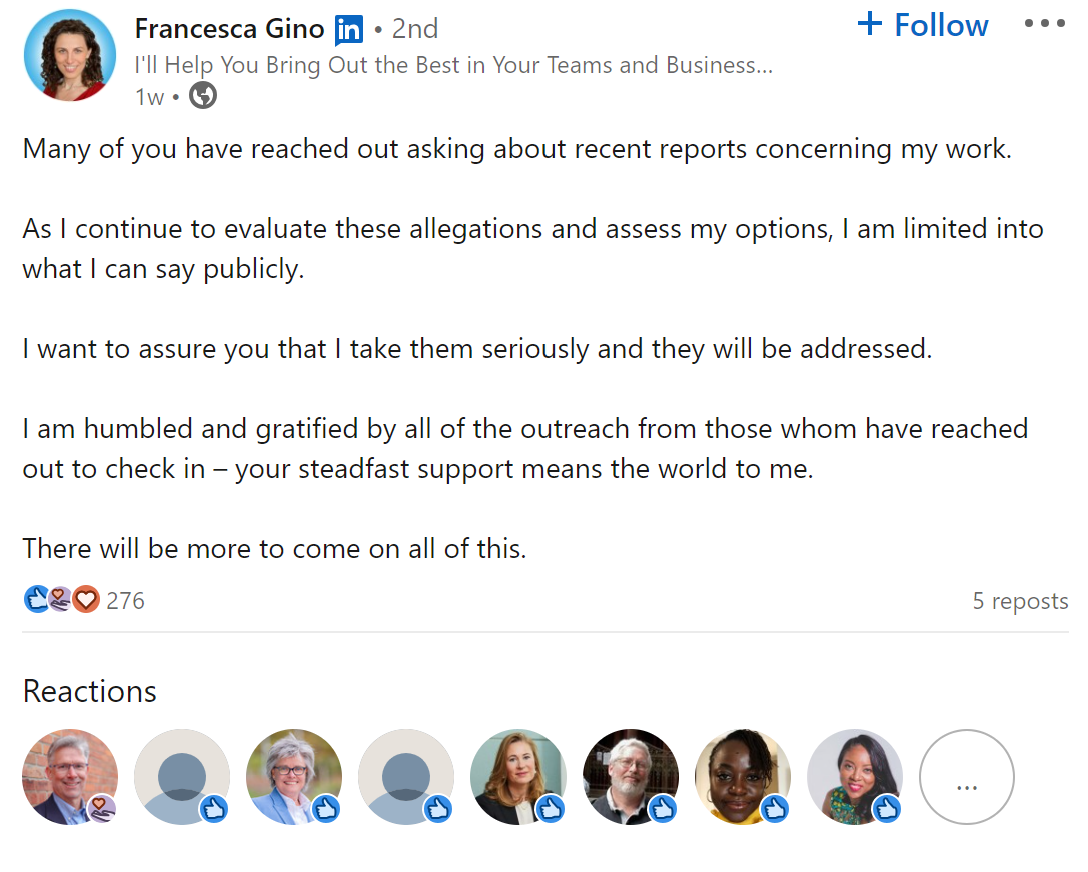
The process of discovering fraud—and the aftermath—in a Harvard Business School professor’s work is a lesson in evidence, data integrity, and ethics for business communication students. I’ve admired Francesca Gino’s work and cited her research on learning and authenticity in Building Leadership Character. But three of her studies are being retracted, and Harvard has placed her on administrative leave.
News outlets love headlines like NPR’s, “Harvard professor who studies dishonesty is accused of falsifying data,” and, this almost identical one from The Guardian, “Harvard professor who studies honesty accused of falsifying data in studies.” Fair enough, but her work is far broader—more about management decision making than honesty or ethics.
On their blog Data Colada, researchers describe how they discovered falsified data. Their sleuthing involves a fascinating dive into hidden Excel files that, the detectives say, proved that data was* moved and changed. Students might be interested to learn how much data Excel stores.
As examples of crisis communication, responses to the news are mixed. To date, Harvard hasn’t commented on reports or the decision to place Gino on leave. Announced in a blurb, at least one of her scheduled presentations has been cancelled. In a Chronicle article, collaborators and other behavioral scientists expressed their concern and/or defended their own work. Rational folks suggested waiting until more information is revealed, and work is ongoing to document the origins of all study data. Gino wrote nothing about the controversy on her own website, but she did post a short statement on LinkedIn. Her voice is reserved but clear, expressing humility and gratitude—both appropriate for the situation and early findings.
* Random: I use data as a singular noun, which is more common in business. This article explains my reasons well.
Chronicle Recommendation for Full Disclosure Raises Character Questions

A Chronicle of Higher Education article suggests that academic leaders practice full disclosure when applying for jobs. The recommendation is to avoid issues later in the hiring process, and the decision tests candidates’ character, particularly integrity, courage, and authenticity. Our students face similar decisions.
Here’s the search consultants’ advice:
Be forthcoming and candid about any sensitive or confidential information that may affect your candidacy. Search committees and hiring managers—and I can’t stress this enough—hate surprises. So it’s critical to disclose a potential roadblock as soon as possible once you’ve decided to become a candidate.
Hiring managers “hate surprises” for a few reasons. First, no one wants to waste time. If a candidate, even at an entry-level, will be ruled out, HR wants to know early on. Students with a criminal record of theft should not bother applying for an auditing position. Second, employers want to hire people with integrity, which includes being honest up front. This takes courage, a worthy topic of discussion with our students. Yes, students risk missing out on a job offer, but better to remove themselves from the process early than wait until the third interview or, worse, after they’re hired. When I worked in HR, terminating hired employees after a discovery was a painful process, and this only makes it harder for someone to find another job.
In their list of disclosures, the search professionals include legal issues, negative publicity, barriers to relocating, and leaving previous employers on bad terms. Students might want to discuss gaps in employment, negative social media posts, family obligations, and job terminations—not all at once, of course. Depending on the situation, job market, industry, and so many other factors, students have difficult decisions to make about whether, how, how much, and when to disclose issues that might negatively affect their candidacy. Some of the advice in Business Communication and Character is rooted in Chalice Randazzo’s work: "A Framework for Resume Decisions: Comparing Applicants’ and Employers’ Reasons” (BPCQ, 2020).
Here’s an inspiring story about a researcher at Intel who decided to talk about his history of addiction during his job interview. In the end, what students choose to reveal reflects on their character. They might find this discussion and handout about the Character, Audience, Message (CAM) Model useful.
Texts from 2012: Instagram Cofounder Considers Acquisition by FB

I feel like a voyeur reading texts between tech leaders, and this exchange doesn’t disappoint. In 2012 texts, we see Instagram cofounder Kevin Systrom and investor Matt Cohler navigating Mark Zuckerberg’s initial gesture to acquire the company, which happened just two months later.
At some point during these 30 back-and-forth texts, they could have picked up the phone, which would have avoided the messages becoming public as part of The House Judiciary Committee’s anti-trust investigation. Such an important conversation seems worthy of a call if not an in-person meeting. But I guess I’m old school: in addition to my propensity to worry about what might go public, I don’t like spending half my day texting.
I’m always surprised at the casual nature of texts among executives. To start, Cohler quotes Zuckerberg: "i'm not sure if this is a good idea yet, but i think maybe facebook should buy instagram, what do you think?" Then, in Systrom’s concern about the company he founded, we see Zuckerberg’s power:
Kevin Systrom
got it
you know him better than I do
a) will he go into destroy mode if I say no
b) will he understand if we choose to raise instead
c) will he understand that I don't want to shutter the product and that doesn't align with what FB does with companies
Matt Cohler
a) probably (and probably also if we just don't engage at all)
b) no, he'll go harder into destroy mode then
c) what i think he would most likely want to see is for instagram to turn into a stand-alone mobile facebook photos app, like beluga turned into facebook messenger
(re c he hasn't indicated anything to me at all there, i'm just speculating)
Later, we see these two planning to lie (I’ll be blunt here) about other potential suitors, as Systrom has a meeting scheduled with Jack Dorsey of Twitter.
The exchange is fascinating—a window into how M&A and other strategic decisions are made, or, how they just seem to happen despite what executives want for their company. Early in the exchange, Systrom writes, “I'm not interested really - even at the right price I don't think so,” but we know he sold anyway.
Untimely "Welcome to Hell" Ad

As orange haze was filling New York, a billboard appeared in the foreground: “Welcome to Hell, New York.” Creators of the “Diablo IV” video game ad didn’t realize the poor timing, and the coincidence may have worked in their favor. The launch date on the billboard is 6.6.23, the same day air quality alerts began. Of course, if marketers used the news of smoke from Canadian wildfires to promote the ad, that would have been in poor taste.
On Twitter, the EVP Corporate Affairs and CCO, Activision Blizzard, responded to questions:
I would like to clarify that Blizzard has no affiliation or partnership with the wildfires in Canada. In fact we are firmly against wildfires and condemn them in the strongest terms.
Funny? Maybe they could have done better. Some humor is acceptable in this situation because the smoke was eerie and could be harmful but didn’t cause widespread devastation, at least in New York. If that had been the case, for example, if the ad appeared in Quebec, the company response would need to be quite different.
This story reminds me of the adage (P. T. Barnum), no publicity is bad publicity, which is no longer true. But in this case, Activision Blizzard got recognition beyond the billboard.
PGA Commissioner Address Criticism Directly
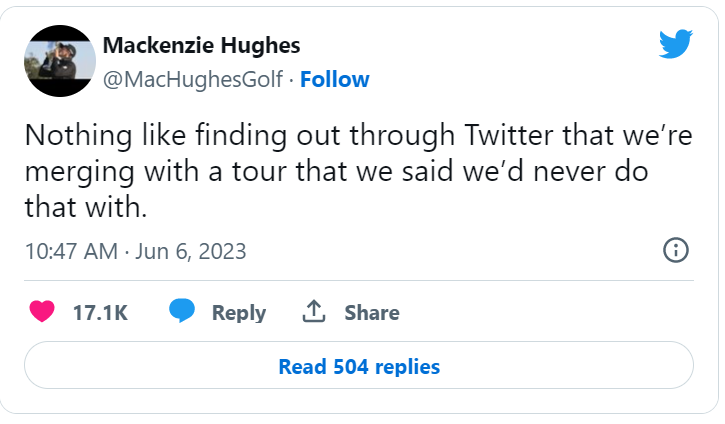
Golf tournaments PGA and LIV, which is backed by Saudi Arabia's Public Investment Fund, announced a merger and faced backlash. Part of the controversy is how the decision was communicated: primarily during a CNBC interview of LIV Governor Yasir Al-Rumayyan and PGA Commissioner Jay Monahan.

Players complained openly, shown here. As we teach business communication students, a thoughtful communication plan could prevent negative reactions—at least about how the news is delivered. Players should have been informed before any public announcement was made. Even in the CNBC video title, the news is called a “surprise deal.”
Monahan addressed personal criticism directly. In his statements, he demonstrates courage by acknowledging a perceived lack of integrity:
I recognize that people are going to call me a hypocrite, Anytime I said anything, I said it with the information that I had at that moment, and I said it based on someone that's trying to compete for the PGA Tour and our players. I accept those criticisms. But circumstances do change. I think that in looking at the big picture and looking at it this way, that's what got us to this point.
Monahan loosely acknowledged the impact on tour players, but he could have demonstrated more compassion, particularly for those who had turned down generous Saudi money to stick with the PGA:
This is an awful lot to ask them to digest, and this is a significant change for us in the direction that we were going down. We just realized that we were better off together than we were fighting or apart, and by thinking about the game at large and eliminating a lot of the friction that's been out there and doing this in a way where we can move forward and grow the PGA Tour.
Of course, Monahan’s explanation didn’t convince everyone that the merger is the right decision. A news release on the PGA website, which claims that the merger is “for the benefit of all stakeholders,” is another example for students to analyze.
Employees Protest RTO Policies

As companies push for employees to return to the office after working remotely during the pandemic, employees are pushing back. In their arguments, we see different approaches—some more effective than others.
Here are a few employee messages against return to office (RTO) plans:
Apple: This powerful message directly argues against points the executive team made to inspire people back to work. It’s a compelling persuasive example. One of the strongest arguments is that the RTO policy “will make Apple younger, whiter, more male dominated, more neuro-normative, more able-bodied, in short, it will lead to privileges deciding who can work for Apple, not who’d be the best fit.” Although the writers don’t provide a lot of evidence, the potential impact reflects reasons employees give for refusing to go back to an office. Less diversity as a result of RTO is clearly inconsistent with Apple’s inclusion and diversity mission, but the employees don’t mention that. This is a good lesson for our students who cite a company’s mission in their presentations; this approach may be too obvious and pedantic for internal arguments.
Starbucks: This message also disputes claims made by senior management and more explicitly identifies contradictions with the company mission, “One cup, one person, and one neighborhood at a time.” The logic is loose, and it sounds shallow. Later, employees hit hard: “Morale is at an all-time low, and the brand reputation and financial value of this publicly traded company are at risk.” Those are big, bold statements that might cause executives to be less, instead or more, sympathetic.
Black & Veatch: Writers of this petition for a construction engineering company use survey data as their primary source of evidence. The message cites the “Working in New Ways” policy that allowed for remote work. Employees use criteria reasoning (and question the executives’ integrity): “Positions were advertised and professionals hired with the expectation their positions would remain permanently virtual.” Sadly, this message highlights the dangers of an employee survey: the data could be used against the company.
I can’t find an employee statement, but Amazon made news this week when they resisted CEO Andy Jassey’s RTO message. Jassey makes the usual arguments about culture, collaboration, learning, and connection, relying on what he and the rest of the “s-team” (senior management team) has observed. Students can analyze his argument and may find weak evidence.
At Amazon, employee walkouts may or may not influence the decision, but solidarity among corporate and warehouse employees is refreshing. Although warehouse employees never had remote work options, they seem to support the corporate staff’s flexibility, with one explaining, “It’s just showing us that Amazon has a problem with workers and listening to us.”
Netflix Anti-Sharing Message

On its website and in an email, Netflix communicated what people already know: sharing passwords is not OK. Business communication faculty would consider these messages bad news, although users must have known this was coming, so the approach is straightforward and direct. On its website, under a clever, intentionally misleading heading, “Share Netflix with someone who doesn’t live with you,” the company says, actually, you can’t, even though sharing has been an open secret for years.
Netflix sent an email to people who share accounts outside their household, which tells us that they knew all the time and didn’t take action. In the message, the company offers alternatives. You can transfer your account, which is a nice way of saying boot someone off your plan and tell them how to get their own for full price. Or you can buy an extra member, which might be a good solution for family and close friends, who have been seeing each other’s lists for years. For $7.99, you can add one member, but that’s only if you pay $15.49/month for the standard plan; you can add two members if you pay $19.99 for the premium plan.
The “Plans and Pricing” page could be clearer. Compare that page to Max’s “Choose Your Plan” table (formerly HBO Max). Why have a separate category for prices? The language is an obvious sales tactic: the “standard” plan is now the third highest of four levels. Like other streaming services, what used to be the regular plan without ads is now sub-standard with ads. The 99-cent strategy is well worn, giving the impression that people are paying significantly less. However, this USA Today article rounded up.
For many years, Netflix has been losing subscriber revenue, an estimated 100 million use shared accounts. With increasing competition among streaming companies, this move isn’t surprising—and shouldn’t be to those who have benefited for so long.
Comms About Starbucks Unions and Store Closures

Three stores in my hometown, Ithaca, NY, have closed, about a year after they unionized, but Starbucks denies retaliation charges. Communications illustrate principles of persuasion.
The union filed a complaint citing a causal effect:
Ithaca was the first city in the United States with 100 percent unionized Starbucks locations, after the union won elections at all three locations by a combined total of 47-3 on April 8, 2022. On May 27, 2023, Ithaca will have no Starbucks locations due to the Employer’s heinous conduct in response to the union campaign.
In response, according to a local report, Starbucks cited “staffing, worker turnover, inability to retain management and worker absence” as the reasons for closing. When the Collegetown location closed, which was the first to unionize and the first to close, management cited maintenance issues. For the two additional stores, a company representative pointed to a quarterly results report that included this hollow, jargony explanation: “In support of our Reinvention Plan, and as part of our ongoing efforts to transform our store portfolio, we continue to open, close and evolve our stores as we assess, reposition and strengthen our store portfolio.”
The “optics,” as PR and crisis communicators say, are bad, and Starbucks may have an uphill climb to avoid a causal link between union efforts and store closings. Context also matters: a college town, Ithaca is a “very liberal” community, with the School of Industrial Labor Relations at Cornell University. Large corporations are not always appreciated locally.
Our local news came less than two weeks after Howard Schultz testified at a U.S. Senate hearing, “No Company Is Above the Law: The Need to End Illegal Union Busting at Starbucks.” His testimony began, as we might expect, with his humble upbringing, raised by a veteran father and without “adequate benefits.” He said he respects workers’ rights to unionize but describes unions as an impediment and criticizes their tactics. Most of his statement focuses on the good Starbucks has done in the world. Students will find a good mix of logical arguments, emotional appeals, and credibility throughout the statement.
Cornell students are taking action with a petition for Starbucks coffee to be removed on campus. The statement uses a few rhetorical devices that students can spot (e.g., anaphora, chiasmus, rhyming). They’ll also see emotional, accusatorial language typical for a student petition.
Example for Creating a Graphic from Text
A Business Insider article about U.S. airline rankings could make a useful class assignment. Each airline is presented in a separate paragraph with data, like this list about Southwest, the lowest ranked airline:

Delays: 3.49/18
Denied boardings: 2.95/15
Price: 2.79/10
Total score: 23.39/100
Students can get creative in how they visualize the data. With your instructions about what to include, they can create an at-a-glance chart or interactive graphic, maybe incorporating it into a short deck or slide for a defined audience.
Related topics could be how the ranking is determined and how customer communication factors into the list. The source, WalletHub, provides additional data to include. Unlike Business Insider, WalletHub drew charts, some of which are interactive, so data is more easily parsed, but I still find them cramped, like the one I posted here.
Tense NBA Player Interview About "Failure"
A reporter asked NBA Milwaukee Bucks pro Giannis Antetokounmpo whether he considers the season a “failure,” and his response offers lessons for business presentations. First, Antetokounmpo said the reporter asked the same “odd question” the previous year. He pushed back, asking the reporter whether he gets a promotion every year and drawing an analogy to Michael Jordan’s success: “Michael Jordan played 15 years, won six championships. The other nine years was a failure?” Antetokounmpo put the losses in greater context, as crisis communicators do.
Reactions to his response are generally positive, and some are debating whether the question, also asked of another player, was “fair.” Generally, public reaction approved of the question, although some viewed it as “unprofessional” or a “gotcha.” This raises a good discussion topic for class: what is an “unfair” question?
Students might think about questions for business presentations. What questions do they consider out of bounds for their own topics, and what would they avoid asking of others? At the same time, how can they prepare for the inevitable “unfair” question? For bad-news presentations, I have planted and encouraged a few from class. Although difficult to address, students gained confidence with more practice.
Antetokounmpo’s response is also emotional, and students will have opinions on what’s “appropriate” for business presentations. When I Googled to find his interview, this video appeared from 2019, titled, “Giannis Antetokounmpo EMOTIONAL SPEECH.”
Avoiding Email Scams: Amazon's Message

Although not traditionally part of business communication courses, I wonder whether faculty should help students identify scams. This past week, I received a message impersonating the president of our professional organization, the Association for Business Communication. The writer said she didn’t have WiFi access and asked me to pay a bill via Zelle. I’m the Finance Committee chair, but still, this made no sense, so I ignored it and let her know someone is using her name.
Also this week, a friend got roped into a fake call from her insurance company. The “agent” got personal with her, saying she was distressed and needed funds to pay rent in the Philippines. My friend was ready to send her cash, but the scammer insisted on a bank transfer, and then, fortunately, she refused.
Amazon sent an email including suggestions, shown here, specific to Amazon orders. The U.S. Federal Trade Commission has a webpage, “How to Recognize and Avoid Phishing Scams,” with examples of what scammers do, ways to avoid getting these messages, and what to do if you receive one—or respond to one. This is useful information to know.
Another "I Wish You Well" Moment
Gwyneth Paltrow ended her headline-grabbing lawsuit with a whisper: “I wish you well.” Paltrow was sued by a retired optometrist for crashing into him on a ski slope. She defended herself, saying, “I felt that acquiescing to a false claim compromised my integrity.”
After the quick verdict in her favor, Paltrow leaned in and said quietly to her accuser: “I wish you well.” He responded, “Thank you, dear.”
I’ve been curious about this expression, which former President Trump said of Jeffrey Epstein’s partner, Ghislaine Maxwell. Trump defended his statement: “I'm not looking for anything bad for her. . . . I wish a lot of people well.” In other words, it’s just a nice thing to say.
But a Guardian article refers to Paltrow’s words as a “memorable kiss-off.” Urban Dictionary explains, “This is what privileged people say when they want you to forget you knew them. ‘I am sorry I have not responded. I have been very busy. I wish you well.’” A Quora user writes, “I use it only with people I never want to communicate with again. It's a hope they change, but I'm not going to stick around for it. It's a nice way of saying, ‘F#%# off.’”
Of course, tone and context matter. We don’t hear Paltrow’s voice, and the exchange is so short. Regardless, her accuser took it positively, as he described the exchange to reporters: “She said, ‘I wish you well.’” Then he said, “Very kind of her.”
We may never know whether she meant it a sincere wish for well-being. We do know that Paltrow was an actress before she started making Goop.
If you have nothing better to do today, you can read “The 9 Most Bizarre Moments” of the trial from The Hollywood Reporter.
Treemap Shows S&P Index
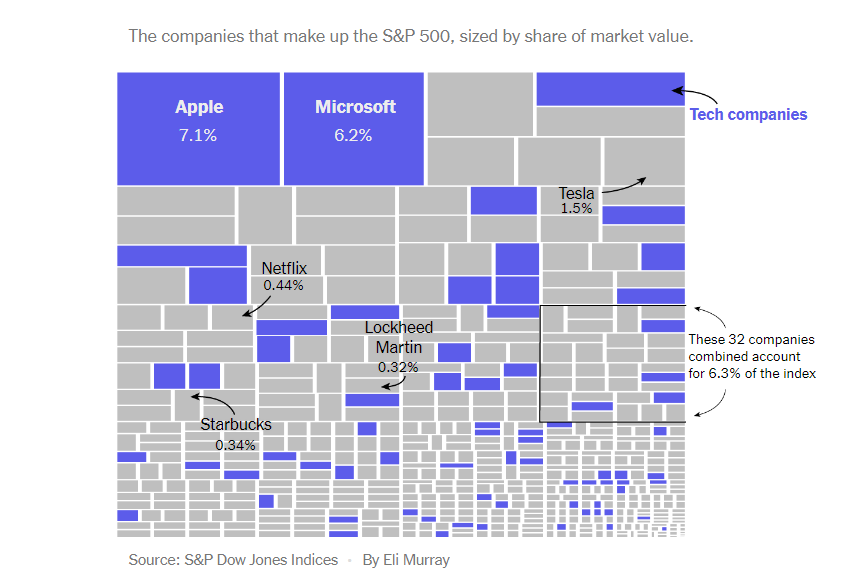
The New York Times uses a treemap to show how the stock market is dominated by two companies. The article, titled, “How Big Tech Camouflaged Wall Street’s Crisis,” warns that concerns about the market aren’t always as they appear.
The article encourages us to temper reports about financial conditions based only on the S&P 500. The first paragraph of the article says it well: “The fate of the S&P 500 index—used by investors as a barometer for the health of corporate America, and cited by presidents as a measure of their handling of the economy—often comes down to just two companies: Apple and Microsoft.”
The treemap is a good choice to display large amounts of data, with each box or rectangular sized proportionately. In this case, the results are dramatic. We see how Apple and Microsoft stocks can sway the entire index. With text callouts, authors identify well-known companies and a group of 32 for comparison.
Students will find a treemap among standard Excel charts. This one is a good example of how they can be used—with additional comments.
Letter Requesting an AI Pause
An open letter asking for a pause on training advanced AI systems serves as an example of persuasive communication. Signed by more than 2,300 leaders as of this writing, the message is a warning and a request. Students can analyze the letter structure and persuasive strategies, which are a mix of emotional appeals, logical arguments, and credibility.

The letter doesn’t follow organizational principles we teach in business communication classes. Although faculty encourage the main point up front, this message includes the “ask” in bold type at the beginning of the third paragraph: “Therefore, we call on all AI labs to immediately pause for at least 6 months the training of AI systems more powerful than GPT-4.” Another main point, also in bold, appears in the middle of the second paragraph: “Powerful AI systems should be developed only once we are confident that their effects will be positive and their risks will be manageable.” Paragraph organization is mixed. Some follow a traditional topic sentence format, while one is a single sentence.
Evidence for the pause includes OpenAI’s own communication. The letter quotes the company and uses italics: “At some point, it may be important to get independent review before starting to train future systems, and for the most advanced efforts to agree to limit the rate of growth of compute used for creating new models." Then the authors write, “We agree. That point is now,” good examples of short, punchy sentences.
The last paragraph sounds like an add-on, which is possible with a collaborative writing process. The signers ask for a “long AI summer,” a chance to “reap the rewards, engineer these systems for the clear benefit of all, and give society a chance to adapt.” “AI summer” is catchy and could be a better frame for the letter. Referring to the last paragraph, the last footnote lists examples of other tech pauses: “Society has hit pause on other technologies with potentially catastrophic effects on society.” Repeating “society” in this sentence is curious, and I found myself wanting to read more about this—and earlier. The footnote reads, “Examples include human cloning, human germline modification, gain-of-function research, and eugenics.” An analogy of one of these examples could be a useful persuasive strategy earlier as well.
Citations are a mix of academic papers and books, popular media, and websites. The first footnote refers to several sources, which might reduce the credibility. Again, I envision multiple authors “tacking on” sources, including their own work.
Another topic for class discussion is how this news has been reported. Most of the articles I read, for example, Business Insider’s, lead with Elon Musk. But more than 2,000 distinguished leaders signed the letter, including Steve Wozniak, Andrew Yang, and AI researchers. I can’t be the only one tired of hearing about Elon Musk. The signers offer credibility, but Musk might diminish that approach.
If you’re looking for another written example for students to analyze, see the statement from OpenAI, which explains the benefits of AI but acknowledges “serious risk of misuse, drastic accidents, and societal disruption.”
Comms About TikTok Testimony

TikTok CEO Shou Chew’s testimony provides examples of persuasive communication. U.S. House Energy and Commerce Committee members called on Chew to address concerns about safety and security, but lawmakers were not convinced by his answers and are taking steps against the company.
The Committee webpage lists members’ comments under non-parallel, but descriptive headings. The page is self-promotional: congressional members are proud of grilling the CEO, and we see only pithy, unattributed statements—none of Chew’s responses.
Chew’s opening statement is his attempt to convince the committee that TikTok is sufficiently American and will become more so. To establish credibility—and to distance himself from the Chinese government—Chew starts with his brief background: born in Singapore, attended college in the U.K. and business school in the States, and married a Virginian. Chew describes “Project Texas,” the company’s plan to move data to the United States where it will be fully controlled by Americans. Students can analyze his persuasive strategies and delivery skills. He is clear but nods quite a bit.
During the five-hour testimony, as these hearings go, some representatives invested more in their questions than in wanting legitimate answers, while others never got their questions answered. Some sticking points were around 55 minutes into the video and then around the one-hour mark, when Chew evaded questions repeatedly. What made headlines is Chew’s admission that the Chinese government may be able to access some data—or he wasn’t clear enough: “After Project Texas is done, the answer is no,” and “Today, there is still some data that we need to delete.” Several times, Chew tried to put TikTok in context of the tech industry, saying the company is no worse than any others and may be doing more, for example, to protect kids and reduce misinformation.
After the testimony, a TikTok spokesperson tweeted: "Shou came prepared to answer questions from Congress, but, unfortunately, the day was dominated by political grandstanding that failed to acknowledge the real solutions already underway through Project Texas or productively address industry-wide issues of youth safety. Also not mentioned today by members of the Committee: the livelihoods of the 5 million businesses on TikTok or the First Amendment implications of banning a platform loved by 150 million Americans.”
Regardless, Chew’s testimony didn’t seem to impress lawmakers. We’ll see what happens next.
"Love Letters" to Home Sellers Are Out

Letters to home sellers illustrate problems with bias and insincere persuasive communication. Home buyers try to increase their chances of landing a house by writing letters to sellers, but they cause problems. These persuasive communications seemed like a good idea in a tight housing market. In addition to offering a high price, often above asking, buyers would make emotional appeals, for example, by telling sellers about themselves, how much they loved the house, and how they would care for it.
These letters teach lessons about communication ethics, particularly integrity. One buyer lied by omission, failing to mention a pending divorce that would change the buyer’s ability to get a mortgage. Other problems include revealing race, religion, and other facts that a seller can use—consciously or unconsciously—to discriminate against a buyer, which violates the U.S. Fair Housing Act.
This “Barbie House” letter, written to sellers of a pink house, may have landed the deal (although the buyers also offered $25,000, so who knows). Maybe not in this case, but in others, letters appeal so much to emotions that vulnerable sellers are duped into taking lower offers.
The California Association of Realtors has since published these guidelines for letters, which discourage them entirely.
Four Charts About SVB Don't Tell the Whole Story
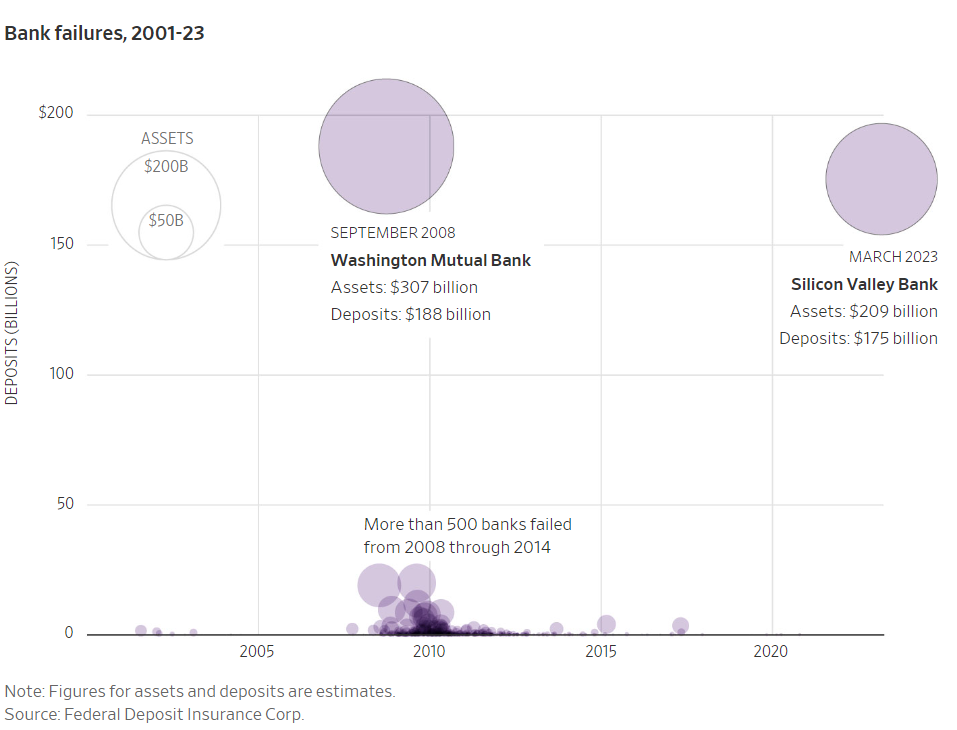
WSJ visuals illustrate the failure of Silicon Valley Bank and how four chart types are used for different purposes.
The first is this bubble chart comparing SVB to the next largest bank implosion since 2001: Washington Mutual Bank. The chart—and the article title, “Here is what the second-largest bank failure in U.S. history looks like in graphics”—might exaggerate the issue. Yes, the data and title are accurate, but SVB’s customer base was limited to “a very exclusive group of companies: tech startups and venture-backed health care companies,” as my friends at The Strebel Planning Group explain well. In other words, large, more diversified, and more cautious banks are not likely to fail, despite dramatic headlines.

The second visual, a bar chart (technically a column chart because the bars are vertical), effectively shows when inflows of money turned to outflows. The purple shows the steep, immediate decline, ending in $42 billion—hence, the “run on the bank” that SVB couldn’t cover.
The third graphic is a 2D, stacked area chart, which is used to show the magnitude of a change, something the WSJ clearly wants to emphasize. Again, the chart looks bad, and it is, but a joint statement by the Treasury, Federal Reserve, and FDIC promised to cover all loses, even those not covered by FDIC insurance.

With a simple line chart, the last graphic (not shown here) illustrates how much SVB depended on bonds, which have lost value over time. The chart type is a good choice for showing a change, including a steep incline in 2021.
All these charts illustrate different types well but, at-a-glance, don’t tell the full story. Perhaps one or two more visuals that puts SVB in greater context of other banks would give a more complete picture of the banking industry’s potential exposure. This could ease public concern and maintain confidence in the system.