

Southwest Faces Customer Service Criticism

Despite trading on the NY Stock Exchange under “LUV,” Southwest is taking some heat from customers because of the Boeing 737 MAX plane groundings. According to a USA Today report, customers says Southwest didn’t handle rebookings well:
They're peeved about Southwest's handling of passenger rebookings, especially last-minute flight cancellations that leave them with few options. And they're perplexed by Southwest's uncharacteristic lack of flexibility, with affected passengers given two options: take the alternate flight, even if it's days later or to a different airport, or get a refund.
Our first clue about problems came with Southwest’s first statement about the plane groundings. Little guidance was offered for customers to rebook. The first three comments on a Southwest message posted on March 13 illustrate the problem.
A Southwest spokesman said it’s a challenging situation—like a snow storm that lasts for many weeks—and claimed that the airline did everything it could, including offering "massive flexibility'.'
Discussion:
Southwest could not have prevented the Boeing 737 MAX disaster, but what about its own customer service situation? What, if anything, could company leaders have done differently?
How should Southwest react to customers’ complaints now? I see nothing on its website or blog.

Boeing System at Fault
According to investigators, the flight-control system caused trouble before the Boeing 737 MAX crash in Ethiopia. The report also concluded that pilots followed procedures and did nothing wrong.
On its website, Boeing posted a video and statement of CEO Dennis Muilenburg’s apology.
April, 4, 2019
We at Boeing are sorry for the lives lost in the recent 737 MAX accidents. These tragedies continue to weigh heavily on our hearts and minds, and we extend our sympathies to the loved ones of the passengers and crew on board Lion Air Flight 610 and Ethiopian Airlines Flight 302. All of us feel the immense gravity of these events across our company and recognize the devastation of the families and friends of the loved ones who perished.
The full details of what happened in the two accidents will be issued by the government authorities in the final reports, but, with the release of the preliminary report of the Ethiopian Airlines Flight 302 accident investigation, it’s apparent that in both flights the Maneuvering Characteristics Augmentation System, known as MCAS, activated in response to erroneous angle of attack information.
The history of our industry shows most accidents are caused by a chain of events. This again is the case here, and we know we can break one of those chain links in these two accidents. As pilots have told us, erroneous activation of the MCAS function can add to what is already a high workload environment. It’s our responsibility to eliminate this risk. We own it and we know how to do it.
From the days immediately following the Lion Air accident, we’ve had teams of our top engineers and technical experts working tirelessly in collaboration with the Federal Aviation Administration and our customers to finalize and implement a software update that will ensure accidents like that of Lion Air Flight 610 and Ethiopian Airlines Flight 302 never happen again.
We’re taking a comprehensive, disciplined approach, and taking the time, to get the software update right. We’re nearing completion and anticipate its certification and implementation on the 737 MAX fleet worldwide in the weeks ahead. We regret the impact the grounding has had on our airline customers and their passengers.
This update, along with the associated training and additional educational materials that pilots want in the wake of these accidents, will eliminate the possibility of unintended MCAS activation and prevent an MCAS-related accident from ever happening again.
We at Boeing take the responsibility to build and deliver airplanes to our airline customers and to the flying public that are safe to fly, and can be safely flown by every single one of the professional and dedicated pilots all around the world. This is what we do at Boeing.
We remain confident in the fundamental safety of the 737 MAX. All who fly on it—the passengers, flight attendants and pilots, including our own families and friends—deserve our best. When the MAX returns to the skies with the software changes to the MCAS function, it will be among the safest airplanes ever to fly.
We’ve always been relentlessly focused on safety and always will be. It’s at the very core of who we are at Boeing. And we know we can always be better. Our team is determined to keep improving on safety in partnership with the global aerospace industry and broader community. It’s this shared sense of responsibility for the safety of flight that spans and binds us all together.
I cannot remember a more heart-wrenching time in my career with this great company. When I started at Boeing more than three decades ago, our amazing people inspired me. I see how they dedicate their lives and extraordinary talents to connect, protect, explore and inspire the world — safely. And that purpose and mission has only grown stronger over the years.
We know lives depend on the work we do and that demands the utmost integrity and excellence in how we do it. With a deep sense of duty, we embrace the responsibility of designing, building and supporting the safest airplanes in the skies. We know every person who steps aboard one of our airplanes places their trust in us.
Together, we’ll do everything possible to earn and re-earn that trust and confidence from our customers and the flying public in the weeks and months ahead.
Again, we’re deeply saddened by and are sorry for the pain these accidents have caused worldwide. Everyone affected has our deepest sympathies.
Dennis Muilenburg
Chairman, President & CEO
The Boeing Company
Discussion:
Analyze Boeing’s communications so far. After the report was published, who were the primary and secondary audiences for these messages? What are the company’s communication objectives, and to what extent were they achieved?
What’s your view of the timing? Should the CEO have communicated via video and statement earlier or wait, as he did, for the investigation report results to be published?
What leadership character dimensions are demonstrated by this situation?

Southwest Responds to Boeing 737 Grounding
Southwest sent an email to customers about the grounding of Boeing 737 planes following two crashes.
The message, which is also posted on the Southwest website, expresses sympathy for the lives lost and emphasizes safety as the top priority, yet touts the 737. What remains unclear is the effect on passengers. At the end of the website, Southwest could be clearer about what passengers should do now:
I realize this disruption will inconvenience our Customers during this busy spring travel season, and we will do everything in our power to mitigate the impact to our operation. For that, I offer my sincere apologies. To support our Customers, we are offering flexible rebooking policies for any Customer booked on a canceled flight.

Nothing is more sacred to all of our Southwest Family Members than the trust our Customers place in our airline every day, on every flight. You have our commitment to minimize the disruptions to our Customers’ travel plans, while adhering to the FAA’s requirements and ensuring the Safety of our fleet.
Southwest may have received feedback because additional text is included in a box at the bottom of the page:
Until further notice, you will not be traveling on a 737 MAX 8. Our goal is to operate our schedule with every available aircraft in our fleet to meet our Customers’ expectations during the busy spring travel season.
Due to high call volumes and extended hold times, we strongly encourage Customers to check their flight status at Southwest.com.
For more information, see the 737 MAX 8 Travel Advisory.
The last link, the 737 MAX 8 Travel Advisory, doesn’t seem to clarify. The company was also criticized for the image on “A message from our CEO.”
Discussion:
Analyze the Southwest messages. Who are the primary and secondary audiences, and what are the communication objectives? Assess the organization and writing style.
How could Southwest improve its communication to customers? Do you agree that the messages for affected customers could be clearer? For example, how do they know whether they’re booked on a 737, and what should they do if they are?
In Southwest’s later messages, the woman’s image is omitted. Should Gary Kelly’s photo be placed there instead? Why or why not?

Alex Trebek Announces Bad News
Alex Trebek, the longtime host of “Jeopardy!” announced that he has pancreatic cancer. Since 1984, Trebek has been almost synonymous with the TV show, and now his Stage 4 diagnosis is casting doubt on the show’s future.
In a video, Trebek, announced the news with optimism and some humor, referencing his three-year contract. Unfortunately, the prognosis for pancreatic cancer is very poor. The ten-year survival rate is only one percent—the lowest rate of any cancer. Steve Jobs died of pancreatic cancer in 2011.

Discussion:
Assess Trebek’s video announcement. How does he convey the bad news and display emotional appeal?
Did he do the right thing by announcing the news himself? Why or why not? How do the show and network benefit, and what are the downsides?
What leadership character dimensions does Trebek demonstrate?
Assess the cancer survival rate chart. What principles of business communication does the designer follow, and how could it be improved?

Equifax and Marriott CEOs Testify About Security Breaches
U.S. Senators grilled Equifax and Marriott CEOs about data breaches at the companies in the past two years. Equifax CEO Mark Begor responded to questions following a Senate subcommittee report titled, “How Equifax Neglected Cybersecurity and Suffered a Devastating Data Breach.” The report concludes an investigation of the 2017 breach of 143 million customers’ personal data and accuses the company of not prioritizing security, not following its own patching policies, failing to notify the public in a timely manner, and more.
Begor defended the company and blamed the increasing sophistication of hackers:
“These attacks are no longer just a hacker in the basement attempting to penetrate a company’s security perimeter, but instead are carried out by increasingly sophisticated criminal rings or, even more challenging, well-funded nation-state actors or military arms of nation-states.”
But Senators pointed out that credit company competitors Experian and TransUnion have managed to avoid similar attacks.
The Marriott breach affected 83 million guests of Starwood, which Marriott acquired after the breach took place. Compared to the Equifax situation, Marriott got a pass from senators, such as Tom Carper of Delaware, who said, “The data breach announced by Marriott this past November does not appear to have been caused by the same cultural indifference to cybersecurity the record indicates existed at Equifax. Rather, it looks like Marriott inherited this breach from Starwood.”
Marriott has been consistent in blaming Starwood for the issue, wanting to preserve the brand. In his testimony, CEO Arne Sorenson reinforced the company separation:
“We conducted an assessment on integrating the two systems, although this inquiry was legally and practically limited by the fact that until the merger closed, Starwood remained a direct competitor.”
Here is Sorenson interviewed on CNBC:
Discussion:
Watch some of the testimony. How well did each CEO handle the Senators’ questions?
Assess Sorenson’s appearance on CNBC. What did he do to try to rebuild the company’s image? What persuasive strategies did he use?
Review the subcommittee’s report on the Equifax breach. How is the report organized? How would you describe the writing style and tone? What suggestions would you have for the authors to improve readability?
From your perspective, what leadership character dimensions do the CEO illustrate or fail to illustrate?

Interview with Delta CEO

In a LinkedIn interview, Delta CEO Ed Bastian discussed the decision to revoke the National Rifle Association (NRA) discount after the Parkland, FL, shootings, one year ago. The discount was for NRA members, and only 13 took advantage. But the real loss was in $40 million in tax benefits, which Georgia Governor Cagle fought to strike after the company’s decision.
Bastian admits that the loss was significant. But he concludes, “Our brand is worth so much more, and our values are not for sale.”
Bastian refers to the NRA’s “divisive rhetoric” and says that he didn’t want “to be seen as advocates” of the organization and its views. He also describes what we might call authentic or purpose-driven leadership:
"If you know who you are, you can make those decisions. And that you can make those decisions and sleep well at night.”
Discussion:
What leadership character dimensions are demonstrated by this situation?
Do you think Bastian did the right thing for Delta? Why or why not?
How well does Bastian address the interviewer’s question? Overall, how do you assess his delivery?

Don't Ignore Email
A New York Times opinion piece by Adam Grant warns us not to ignore emails because it’s rude. He compares ignoring email to not acknowledging someone who says hello when walking by you in a hallway. He cites a survey that, on average, employees have 199 unread messages in their inbox.
But Grant addresses people who say they’re “too busy” to answer emails, and he makes several exceptions:
You should not feel obliged to respond to strangers asking you to share their content on social media, introduce them to your more famous colleagues, spend hours advising them on something they’ve created or “jump on a call this afternoon.” If someone you barely know emails you a dozen times a month and is always asking you to do something for him, you can ignore those emails guilt-free.
I wrote an article last summer encouraging people to respond to any email, including the type he says we can ignore. I’m not Adam Grant, so I’m sure I don’t get his volume of messages. I see responding to an inappropriate or misguided request as a learning opportunity for the sender. For most of us, a short response doesn’t take too long and, as Grant says, is the civil thing to do.
Discussion:
How do you handle emails such as those Grant describes? How many do you receive?
Describe an email you sent that was ignored. In retrospect, was it appropriate to send? Why do you think the receiver didn’t respond?

Amazon Changes NYC Plans
After months of searching for a new headquarters location and deciding on Long Island City, Amazon has changed course and withdrawn the plan. In a blog post, the company explained the decision:

After much thought and deliberation, we’ve decided not to move forward with our plans to build a headquarters for Amazon in Long Island City, Queens. For Amazon, the commitment to build a new headquarters requires positive, collaborative relationships with state and local elected officials who will be supportive over the long-term. While polls show that 70% of New Yorkers support our plans and investment, a number of state and local politicians have made it clear that they oppose our presence and will not work with us to build the type of relationships that are required to go forward with the project we and many others envisioned in Long Island City.
We are disappointed to have reached this conclusion—we love New York, its incomparable dynamism, people, and culture—and particularly the community of Long Island City, where we have gotten to know so many optimistic, forward-leaning community leaders, small business owners, and residents. There are currently over 5,000 Amazon employees in Brooklyn, Manhattan, and Staten Island, and we plan to continue growing these teams.
We are deeply grateful to Governor Cuomo, Mayor de Blasio, and their staffs, who so enthusiastically and graciously invited us to build in New York City and supported us during the process. Governor Cuomo and Mayor de Blasio have worked tirelessly on behalf of New Yorkers to encourage local investment and job creation, and we can’t speak positively enough about all their efforts. The steadfast commitment and dedication that these leaders have demonstrated to the communities they represent inspired us from the very beginning and is one of the big reasons our decision was so difficult.
We do not intend to reopen the HQ2 search at this time. We will proceed as planned in Northern Virginia and Nashville, and we will continue to hire and grow across our 17 corporate offices and tech hubs in the U.S. and Canada.
Thank you again to Governor Cuomo, Mayor de Blasio, and the many other community leaders and residents who welcomed our plans and supported us along the way. We hope to have future chances to collaborate as we continue to build our presence in New York over time.
Amazon claims the new office would have created 25,000 jobs, but NYC lawmakers questioned the subsidies the company would have received. Critics also oppose Amazon’s anti-union stance and cite concerns about how the growth would affect Queens. In the end, officials say Amazon was inflexible; one local politician referred to the company as “a petulant child.”
According to a New York Times article, “Amazon’s decision is a major blow for Gov. Andrew M. Cuomo and Mayor Bill de Blasio, who had set aside their differences to lure the giant tech company to New York.”
Long Island city image source.
Discussion:
Analyze Amazon’s statement. How well does the company announce the decision, while maintaining relationships?
What else, if anything, should the company say at this point?
Should Governor Cuomo or Mayor de Blasio make their own announcements? Why or why not?

Updates on the Virginia Govenor

Whether Virginia Governor Ralph Northam resigns just got more complicated. If Northam steps down because of racist photos in his yearbook, the lieutenant governor would replace him. But Justin Fairfax faces his own challenges: a woman accused him of sexual assault.
Fairfax denies the claims and refers to the incident at the 2004 Democratic National Convention in Boston as consensual sex. To complicate matters further, Fairfax has accused Northam’s supporters of a “smear” campaign:
“Does anybody think it’s any coincidence that on the eve of potentially my being elevated that that’s when this uncorroborated smear comes out?”
Fairfax also questioned whether Mayor Levar Stoney of Richmond may have been involved in the accusation to which Stoney responded, “The insinuation is 100 percent not true, and frankly it’s offensive.”
For its part, Eastern Virginia Medical School is investigating how the racist photos got into the 1984 yearbook.
Discussion:
What’s your view of Fairfax’s response?
Should a 2004 sexual assault charge prevent Fairfax from replacing Northam?
Should the replacement issue drive whether Northam resigns?
What is the medical school’s responsibility in this situation?

Law Firm Faces Backlash About Diversity

When a law firm announced its 2019 partners, they didn’t expect such a strong reaction. A photo shows the 12 members of the new group—all white and only one woman. Paul Weiss is an elite firm in midtown Manhattan and claims that this year is unusual.
The firm has since removed the photo from LinkedIn, where it drew attention. About 170 lawyers across the country wrote an open letter to express their wishes for a more diverse legal community.
Paul Weiss leaders took quick action to address the controversy and held a town hall meeting for employees. Firm leaders also say this group is unusually not diverse. In fact, the firm was recognized by a Microsoft initiative that offers bonuses to diverse law firms. In addition, 23% of the firm’s partners are women compared to about 18% of other law firms’ top leaders. The firm’s website boasts additional awards for diversity, including being ranked #16 in The American Lawyer’s 2018 Diversity Scorecard.
An email to Paul Weiss employees shows the words “diversity” and “associate professional satisfaction” in quotes, and a writer for the website Above the Law warns,
“…maybe there’s still some work to be done in mastering how to talk about these subjects. In general, don’t put anything in quotation marks that you wouldn’t be willing to sarcastically put air quotes around in conversation. That’s my advice.”
Discussion:
What’s your view of the photo and the reaction: should the firm have avoided the composite, did people overreact, or something else?
How do you assess the firm’s response? What else, if anything, should the firm leaders do to improve its image?
What persuasive strategies do the attorneys use in their open letter? Which are most and least effective for the situation?
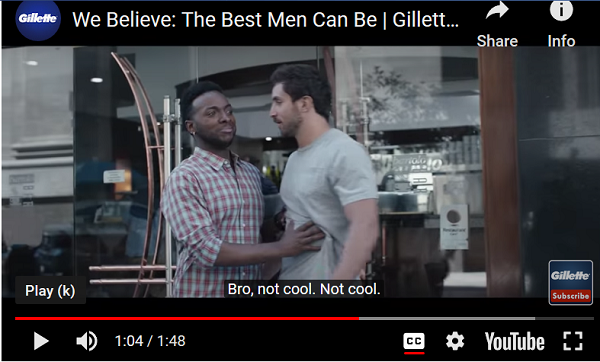
Gillette Ad Gets Mixed Reviews
Gillette took a risk with its new ad campaign. Spinning its 30-year slogan, “The Best a Man Can Get,” the company introduced, “The Best a Man Can Be.” A new video references sexual harassment, challenges the expression “boys will be boys,” and encourages men to “hold other men accountable.”
Gillette explains the rationale in a press release. In addition, the URL thebestamancanbe.org redirects to https://gillette.com/en-us/the-best-men-can-be, where the company explains the campaign:
Thirty years ago, we launched our The Best A Man Can Get tagline.
Since then, it has been an aspirational statement, reflecting standards that many men strive to achieve.
But turn on the news today and it’s easy to believe that men are not at their best. Many find themselves at a crossroads, caught between the past and a new era of masculinity. While it is clear that changes are needed, where and how we can start to effect that change is less obvious for many. And when the changes needed seem so monumental, it can feel daunting to begin. So, let’s do it together.
It’s time we acknowledge that brands, like ours, play a role in influencing culture. And as a company that encourages men to be their best, we have a responsibility to make sure we are promoting positive, attainable, inclusive and healthy versions of what it means to be a man. With that in mind, we have spent the last few months taking a hard look at our past and coming communication and reflecting on the types of men and behaviors we want to celebrate. We’re inviting all men along this journey with us – to strive to be better, to make us better, and to help each other be better.
From today on, we pledge to actively challenge the stereotypes and expectations of what it means to be a man everywhere you see Gillette. In the ads we run, the images we publish to social media, the words we choose, and so much more.
As part of The Best Men Can Be campaign, Gillette is committing to donate $1 million per year for the next three years to non-profit organizations executing programs in the United States designed to inspire, educate and help men of all ages achieve their personal “best” and become role models for the next generation.
Our tagline needs to continue to inspire us all to be better every day, and to help create a new standard for boys to admire and for men to achieve… Because the boys of today are the men of tomorrow.
We’ve all got work to do. And it starts today.
Not everyone appreciates the new campaign. The YouTube video received 582,000 likes and 1 million dislikes. Some feel that the video unfairly accuses all men of not doing better.
A Gillette spokesperson said the campaign “is much more than a video—it is a commitment to spark and contribute to positive change through our voice as an advertiser and our actions as a brand and a company.” Analysts say the current boycotts probably won’t last long and will have little bottom-line effect on the company.
Discussion:
What’s your view of the video? Do you appreciate the message, find it offensive, or something else?
What else, if anything, should the company say in response to the controversy?
Which leadership character dimensions are illustrated by this story?

Lawsuit Charges Purdue Pharma Family with Instigating Opioid Crisis

In a 312-page complaint, Massachusetts lawyers detail how members of the Purdue Pharma family contributed to the opioid epidemic. The complaint shows the company’s aggressive marketing strategy, including how it convinced doctors to over-prescribe drugs.
One argument in the documentation shows how representatives were trained to encourage doctors to prescribe medication to what the company called “opioid-naive” patients:
Purdue also promoted its drugs for opioid-naive patients using the receptive term “first line opioid.” “First line” is a medical term for the preferred first step in treating a patient. Opioids are not an appropriate first line therapy. Nevertheless, Purdue’s internal documents and testimony from sales reps shows that Purdue repeatedly promoted OxyContin as “first line” — “the first thing they would take to treat pain.” (Sic: “first-time opioid” should include a hyphen.)
A 2001 email written by Richard Sackler, whose family owns OxyContin, blames victims:
“We have to hammer on abusers in every way possible. They are the culprits and the problem. They are reckless criminals.”
The lawsuit also charges the family with claiming that opioids are addictive to only one percent of the population, although they had no evidence for that claim.
This lawsuit follows others in Washington, Ohio, and Alabama. Last year, the company did stop promoting opioids.
Discussion:
Read more in the legal complaint. According to the documentation, how did the company wrongfully use persuasive communication?
In some of the documentation, we see ads and tactics that any company might use. Which do you find to be typical examples, and which cross an ethical line?

MSU Gets Another New Interim President

Michigan State University hired a second interim president. First, President Lou Anna Simon resigned after 13 years following criticism that she didn’t do enough to stop Dr. Larry Nassar from abusing girls. John Engler replaced her as interim president in 2018, but he, too, faced criticism for insensitivity to Nassar’s victims.
Most recently, Engler commented after a $425 million fund was approved for 332 current claimants and another $75 million was approved for additional victims. Engler said, “The people who got the $425 million are probably OK." Engler said he was thinking more about the potential additional victims who haven’t been part of the process yet. He made things worse when he said more:
"You’ve got people, they are hanging on and this has been … there are a lot of people who are touched by this, survivors who haven’t been in the spotlight. In some ways they have been able to deal with this better than the ones who’ve been in the spotlight who are still enjoying that moment at times, you know, the awards and recognition. And it’s ending. It’s almost done.”
People took great offense to his implication that the earlier claimants have “enjoyed the spotlight.” So now, MSU has a new interim president, Satish Udpa.
Discussion:
Try to see Engler’s point of view. What was he trying to convey with his comments?
We might say that Engler’s comments lacked compassion. What else is problematic about his comments?
What’s your view? Was forcing Engler’s resignation the right thing to do? Why or why not?

Robots Screen Candidates' Social Media

A Wall Street Journal video explains how DeepSense uses artificial intelligence to analyze a job candidate’s personality. When companies post a job, recruiters or hiring managers identify what is most important for success; for example, how important is teamwork or project management? DeepSense then looks at a candidate’s social media profile to assess personality.
Founder Amarpreet Kalkat explains that the system may review a social media profile for only six seconds and will generate a report about the applicant’s DISC profile (a personality assessment) and “Big Five” personality traits. Using psycholinguistics, the computer analyzes language the candidate uses.
Kalkat says their results are 75% accurate, while traditional personality tests are 82% accurate.
Discussion:
What’s your view of using AI in this way? How confident would you be applying for a job that uses this technology?
How relevant is personality to a position? What are the advantages to a company of using such a system, and what are the potential disadvantages?
The video refers to “DeepSense,” but the website shows “DeeperSense.” How do you explain the discrepancy?

McKinsey PPT Slide Causes Problems
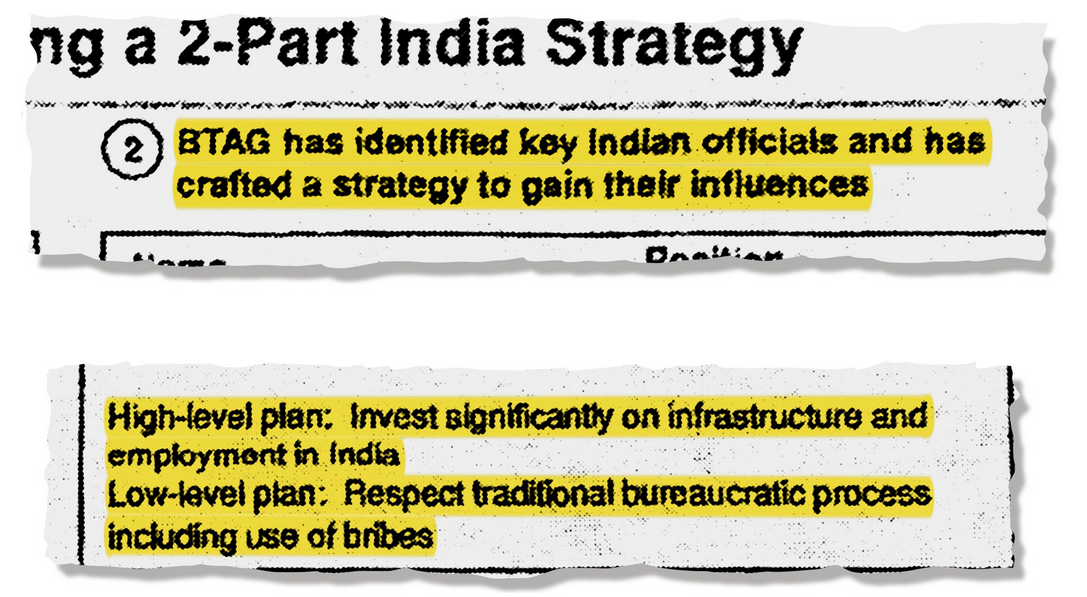
Back in 2006, Boeing hired management consultancy McKinsey to help the company launch its 787 Dreamliner despite rising titanium prices. According to a New York Times article, McKinsey evaluated a proposal for Boeing “to mine titanium in India through a foreign partnership financed by an influential Ukrainian oligarch.”
On a PowerPoint slide, the consultancy suggested that Boeing “respect traditional bureaucratic process including use of bribes.” Included on the slide were names of eight “key Indian officials.” As the article notes, “Nowhere in the slide did McKinsey advise that such a scheme would be illegal or unwise.”
McKinsey admitted authoring the report only after learning that the Times had a copy. Details are fuzzy, and McKinsey isn’t offering more explanation.
Discussion:
What’s your view of McKinsey’s responsibility in this situation? Do you believe they encouraged illegal activity, were just doing the job of management consultant firm and considering cultural realities, or something else?
The PPT slide seems to have implicated McKinsey. Should the consultants have been more careful about what was documented? Why or why not?
What character issues may be at play in this situation?
The NYT author wrote, “Nowhere in the slide…” I would say, “Nowhere on the slide…” Which is correct—or are both acceptable?

Acting Attorney General's Credentials Questioned

Acting U.S. Attorney General Matthew Whitaker seems to have inflated his self-description as an “Academic All-American.” The title appeared on a bio for his previous law firm’s website, on an application for a judge position in 2010, and on a resume discovered from 2014.
Whitaker played football at the University of Iowa for two years, but he didn’t receive the official honor, according to the organization that grants the title. In 1992, the title went to another Iowa player.
Part of the confusion may be caused by a media guide produced by the university. An assistant athletic director admitted to describing Whitaker as “District VII academic All-American,” which is not correct.
Whitaker image source. Resume icon image.
Discussion:
The Wall Street Journal report doesn’t include a quotation from Whitaker. What, if anything, should Whitaker say to defend himself?
What on your resume could be called into question? Have you exaggerated any of your experience that could be discovered? Should you change anything to be more accurate?
How is this situation an issue of integrity? What other character dimensions could be at play here?

Juul Employees Can't Juul at Work
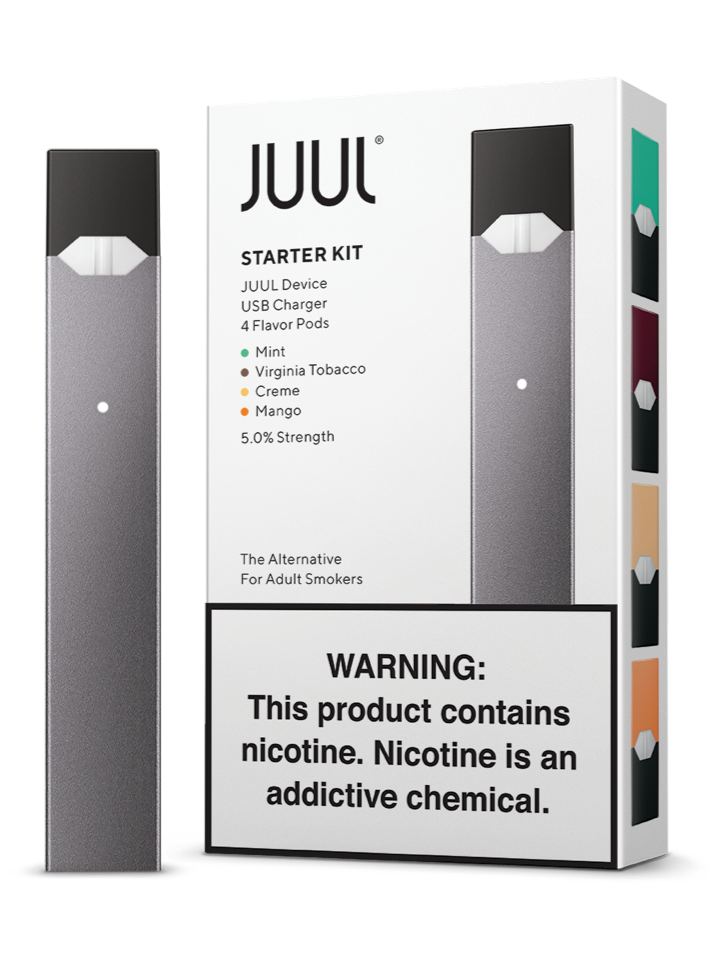
The e-cigarette company has decided to follow the law and prohibit its employees from Juuling at work. The law isn’t new: The California law against vaping in the workplace has been on the books since 2016.
A Wall Street Journal article describes vaping etiquette from the American Vaping Association:
There is etiquette for in-office vaping, says Gregory Conley, president of the American Vaping Association. Foremost: Don’t blow clouds. Take a puff and hold your breath for three to five seconds, and the vapor evaporates in your mouth. “If it’s 10 degrees outside and I want a single puff, I just take a puff and hold my breath” when indoors, he says. “Ninety-nine percent of people don’t care so long as they don’t see anything.”
Meanwhile, the U.S. Surgeon General just released a warning against vaping. Experts say e-cigarettes have toxic chemicals, and users are at higher risk for a heart attack. Studies indicate that teens who vape are more likely to smoke cigarettes later on.
Discussion:
The situation is a confusing issue of integrity. Some might question why employees were allowed to Juul, against the 2016 law. What’s your view of their decision?
Juul is popular among young people even though the product is intended for people 21-and-over. To what extent is that the company’s responsibility?

NIH Changes Funding Practices

Following criticism in May, the National Institutes of Health (NIH) ended a study aiming to understand whether drinking alcohol every day could have health benefits. The study received $67 million in funding from six alcohol companies.
Now, the NIH is sharpening its guidelines for how employees of its eight institutes seek donations. The NIH director said, “We have to do everything we can to ensure the integrity of the NIH grants process and the quality of our research is above reproach, which means worrying about conflicts.” In addition, the NIH is planning for consistency across its institutes.
Some wonder why the NIH wasn’t already practicing due diligence and preventing conflicts of interest. Critics say the NIH isn’t doing enough and should accept private funding only for general use—not for specific research.
Discussion:
What’s your view of the NIH’s practices? How is this situation an issue of integrity for the organization?
The NIH’s credibility has taken a hit. What can the leaders do to recover the organization’s image?

Report on Larry Nassar

A new report on the former Olympics coach and doctor, Larry Nassar, blames officials at Michigan State University, the U.S. Olympics Committee (USOC), and USA Gymnastics for allowing his abuse of hundreds of girls over decades. The investigators concluded, “Numerous institutions and individuals enabled his abuse and failed to stop him.”
In some cases when officials learned of an abuse allegation against Nassar, they waited weeks or months to report to; in other cases, officials reported claims but didn’t do enough to follow up. In still other cases, officials did nothing at all.
Nassar was finally convicted and sentenced to what will be life in prison. With the report results, some hope the USOC will now be investigated.
The report aligns with an NPR podcast, Believed, tracing claims against Nassar and his medical defense, which was accepted by too many for too long.
Discussion:
How do you think the abuse continued for so long? If you listen to the podcast Believed, you’ll hear Nassar’s defense during police interviews.
Analyze the report. What business communication principles are followed, and in what ways could the report be improved?

Trump Undocumented Workers Speak Out

Employees of Trump National Golf Club in Bedminster, NJ, say they are undocumented in the U.S. and express disappointment at the president’s comments about immigrants. For five years, Victorina Morales has worked at the property, and her responsibilities sometimes include providing housekeeping services for the president’s private quarters.
Although the president may not have known about their status, Morales and a former employee say several within the housekeeping, maintenance, and landscaping crews don’t have papers to work legally in the U.S.
Morales said her status is known at the club, and she was hurt when she heard the president comparing recent immigrants to criminals:
“We are tired of the abuse, the insults, the way he talks about us when he knows that we are here helping him make money. We sweat it out to attend to his every need and have to put up with his humiliation.”
During the presidential campaign, President Trump said of his businesses, “We didn’t have one illegal immigrant on the job.”
Discussion:
What risks does Morales take by speaking out? Why might she forge ahead and not be deterred by those risks?
How is this a potential issue of integrity for President Trump?
Should President Trump be held accountable for undocumented workers on his properties? Why or why not?