

Wells Fargo Reaches Settlement Agreement
 Wells Fargo is taking action after the discovery that bank employees opened millions of fake checking and credit card accounts. Employees opened accounts in unsuspecting customers' names so they could earn credit for the sale. The bank benefited from fees people paid on accounts they never used.
In addition to paying a $100 million settlement fee to the Consumer Financial Protection Bureau, the bank has fired 5,300 employees over the past few years.
The company issued two major communications related to the situation:
In addition, Jim Cramer interviewed CEO John Stumpf on Mad Money:
Discussion Starters:
- Compare the two Wells Fargo statements. How well does the company tailor these messages to primary and secondary audiences?
- How can customers miss paying fees? What is their responsibility, and what is the company's? Consider visual displays of bank statements in your response.
- How well does Stumpf respond to Jim Cramer's questions? Which are his strongest and weakest arguments?
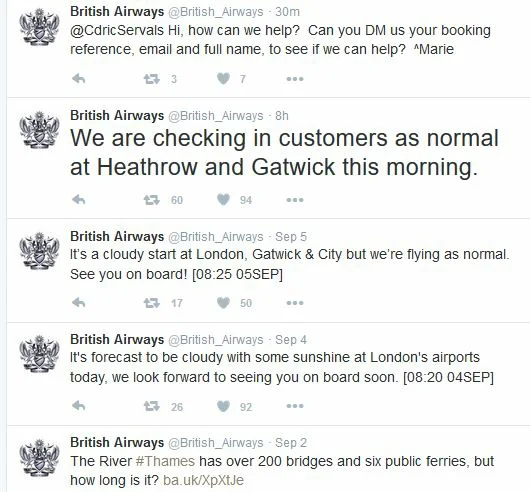
British Airways Apologizes for Delays
 Computer issues plagued Delta recently, and now British Airways is feeling the pain. Tens of thousands of customers have been delayed while checking in, dropping off luggage, and waiting to take off. Frequent fliers may remember similar delays in July, when the airline was upgrading its check-in system. This time, an IT issue shut down some systems, causing staff to hand write boarding passes.
The airline apologized for the delays, admitting that processes have been "taking longer than usual": "We are sorry for the delay to their journeys." Although passengers were actively complaining on Twitter, the company had little to say online. The Twitter page has only one reference to the delays-after the issues were resolved.
But some customers did receive a letter, posted in an NBC article.

Discussion Starters:
- Assess the letter to customers. What principles of letter writing and bad-news messages does the airline follow in this communication? What would improve the letter?
- What word choices and other aspects of the letter tell you it's British? Why did the airline chose this method of communication?
- What else, if anything, should the airline have communicated on social media?
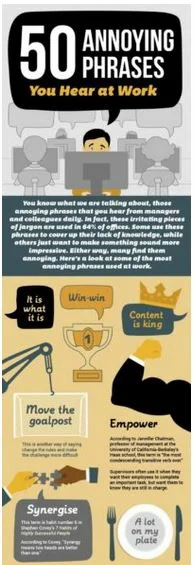
More Jargon to Banish
 Once a year or so, I write about business clichés and jargon. This infographic, generated by GoToMeeting is a good summary of perhaps the worst examples heard in companies recently.
Here are some of my favorites (to avoid, that is):
- Content is king (Who's the queen?)
- Game change, par for the course, and other sports references I don't understand
- With all due respect, which usually indicates no respect at all
- Do more with less, a.k.a. work harder for less pay
- Open the kimono, which has both sexual and racial overtones.
Discussion Starters:
- What's the value of business jargon? It's not all bad.
- Compare these 50 to those in Chapter 5 of the textbook. Which are most and least familiar to you?
- Do you find any of the terms offensive?
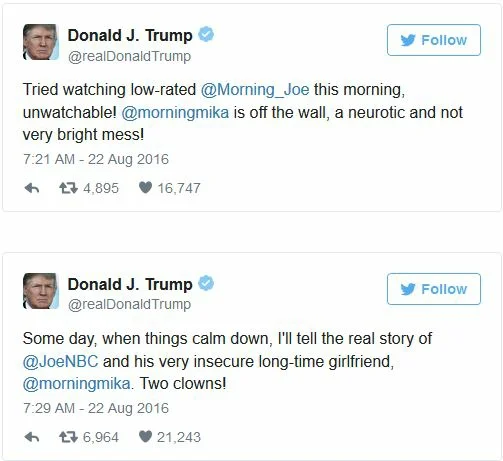
Trump Vs. Morning Joe
Now, Donald Trump is feuding with the hosts of MSNBC's Morning Joe, Mika Brzezinski and Joe Scarborough. Earlier this month, Scarborough wrote a scathing piece in The Washington Post, "The GOP Must Dump Trump." He ended by encouraging Republicans to withdraw their support and find a new candidate:
"A bloody line has been crossed that cannot be ignored. At long last, Donald Trump has left the Republican Party few options but to act decisively and get this political train wreck off the tracks before something terrible happens."
Escalation of the debate has continued, as Brzezinski said he sounded as if "he's had a lot to drink" during a campaign rally speech in Fredericksburg, VA.
Trump did not enjoy that comment and struck back with a series of tweets matched by Scarborough, who shot back, "Neurotic and not very bright? Look in the mirror."
 The tweets came a few hours after Trump's campaign manager said he doesn't insult people. This is from Huffington Post:
"I don't like when people hurl personal insults," Kellyanne Conway told ABC News' "This Week." "That will never be my style, I'm a mother of four small children, it would be a terrible example for me to feel otherwise ... [Trump] doesn't hurl personal insults."
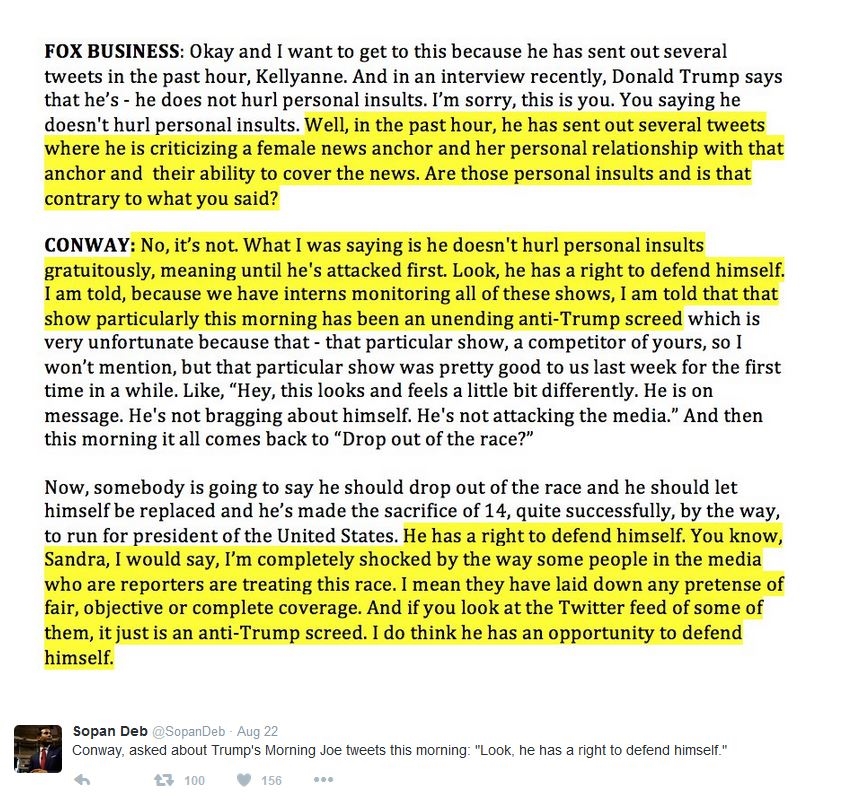
And yet Conway told Fox Business, "He has a right to defend himself."
Discussion Starters:
- When you watch the clip from Morning Joe, what do you notice about Brzezinski's delivery of the comment? How do others on the show react? Do you think she may regret her comment?
- How should Trump have reacted? And how should Scarborough have responded? As always, all players in the situation had several choices throughout these exchanges.
Time's Layoff Jargon
 I'd like to see a layoff announcement without "realignment," "leverage," and "content creation." Time Inc. couldn't manage it in the recent statement about laying off about 110 of its 7,200-person team:
"Over the last couple of weeks, we have been realigning our organizational structure to better leverage our content creation, sales and marketing and brand development operations. Our primary objective has been to better position ourselves to operate with greater agility and optimize the growth areas of our operation. As a result, there will be some job eliminations. That is always painful but an unfortunate reality in today's business climate."
According to AdAge, employees aren't surprised, based on recent memos announcing new management and a new editorial structure. CEO Joe Ripp also admitted, "We're always looking at costs."
Part of the restructuring includes new ad teams for technology and telecommunications, pharmaceuticals, and automotive.
Discussion Starters:
- What's the harm in using jargon in a layoff announcement? What are some alternatives?
- Time representatives won't say when the layoffs will take place. How does this strategy affect employees? What are the factors involved in the timing decision?

Sample HR Posting
 The Equal Employment Opportunity Commission (EEOC) has published a draft notice to help employees to understand their rights. Employers that offer wellness programs are expected to communicate a new law that requires them to collect certain information about employees; however, they must still comply with the Americans with Disabilities Act.
The notice is long and, in my opinion, confusing. The EEOC could use principles of business communication, such as including "you" to make it more readable and conversational. Also, this is an opportunity for employers to promote their wellness programs, and this notice does little. Although it says the program is voluntary, it doesn't include how employees will benefit. Yes, the focus is on the information collection, but most employees will care more about the program itself.
The EEOC includes an FAQ for employers that explains how the notice could be distributed.
Discussion Starters:
- What business writing principles are used in the notice? What other principles would improve the message?
- Would another format work better for the notice? How about an FAQ for employees? What are the advantages and downsides of this type of message?
Bad Advice from Grammarly
 After clicking "Skip Video" about a dozen times on YouTube, I finally watched the Grammarly ad and tried the product. In a 15-page document, the tool identified nine "critical issues," only two of which were errors, and I would hardly call them "critical": a missing serial comma (from a CNN quote) and an unnecessarily hyphenated word.
The other seven were not mistakes; if I make the recommended corrections, I will have far more grammatical problems than when I started.
The original document is a case study, "SeaWorld Responds to the Movie Blackfish."
Here are the items marked as errors:
| My Original Version | Grammarly's Correction | My Comment |
| SeaWorld, a theme-park operator | Possibly confused word. Did you mean theme park? | No, I meant to hyphenate the compound adjective. |
| several other groups cancelled performances | Cancelled is British spelling. | Technically correct, but either spelling is acceptable in the United States. |
| debate over orcas continues | Change to the plural form, continue. | No, continues follows debate, not orcas, which is part of a prepositional phrase. |
| The November 6, 2013, article | Article usage (The) is incorrect. | No, it's not: "The...article..." |
| Nowhere does the article mention SeaWorld's response. | Consider replacing the period with a question mark. | No, it's a statement, not a question. |
| The revenue up-tick may have been | Did you mean uptick? | OK! You got me. Uptick is acceptable without the hyphen. |
| Dawn Brancheau's family, friends and colleagues | Insert a comma. | This is a quotation from CNN, and yes, I should add the serial comma after friends. |
| literally millions of safe interactions | Change to million because it's modifying a noun. | No, this is a tweet quotation, and it is correct as is. |
| Also in February, SeaWorld sponsored ads on Facebook | Add a hyphen: SeaWorld-sponsored ads. | No, sponsor is a verb here, not a noun modified by SeaWorld-sponsored. |
In addition to these markings, Grammarly says I have 38 "advanced issues" that I can see if I pay for an upgrade. The upgrade also gives me access to the plagiarism checker, which sounds like a teacher's nightmare: if students change a few words, will they circumvent tools like Turnitin?
Discussion Starters:
- After reading this, would you use or recommend Grammarly? It could be useful for international students, but I worry that it gives bad advice.
- Try the product on one of your own documents. How does it work for you?
Email Clouds Our Judgement
 Hasn't email ruined enough vacations, marriages, and careers? Will it now steal a chance at the presidency? Hillary Clinton's server issue is a symptom of a deeper problem: email causes us to make bad decisions. Several times, she admitted that she wished she had acted differently. We have all made mistakes on email: sent it to the wrong person, replied all, or sent a half-drunk, angry message in the middle of the night.
Millennials take blame for being constantly connected, but the Boomers are just as guilty, and we should know better. We know that email lives forever: on the sender's server, on the receiver's server, in print, posted on social media sites-in countless crevices. And double deleting doesn't save us from legal discovery software.
We assume a level of privacy because email has driven us to communicate quickly, often without any sense at all. We accept privacy policies without reading them, manage 122 emails a day, and "shoot" each other emails. As mobile use increases, email joins IM and texts, for which people expect an immediate response.
Advice and tools abound to reduce email dependence and volume. We should check email less often, use triage tools, and stop sending so damn many of them.
But these behavioral approaches miss the point: we love email. The immediacy and volume feed the micromanager's feelings of disconnection and lack of trust, making us dependent on email to function. We risk reputational and relational damage to maintain our addiction.
Clinton has experienced on a large scale what we have all come to realize about email: it owns us, and we are to blame.
Everyone needs a private cave like Fitzgerald Grant's on Scandal, and perhaps Clinton will get one. In the meantime, let's remember that no email message-nor any written communication that travels via the web or satellite-is truly private.
Geek Squad's Confusing Email
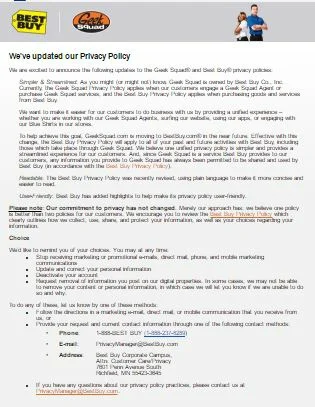
 Geek Squad's email, with the subject line, "IMPORTANT NOTICE: We've updated our Privacy Policy," is a confusing mess. After reading the email, I have no idea what the changes are and why they're important to me.
The main points of the email seem to be that the website is going to be combined with Best Buy's, and Geek Squad customers will now follow Best Buy's privacy policy. As usual, the email focuses on what's important to the company instead of what's important to customers.
The tone is "excited" with references to simpler, streamlined, easier experiences for customers, but it's not clear what those are-or how they're different from Geek Squad's current process.
Of course, we're referred to Best Buy's privacy policy, also a fun read. At least the top part of the page summarizes the most important information, and the full legal policy is below, with this note:
We want you to read the whole policy. This highlights section provides a summary of Best Buy's privacy practices, and is not the whole policy. The highlights and full privacy policy apply to Best Buy retail stores, our Web site at www.bestbuy.com, our mobile app, and other locations where we may collect personal information.
The company should probably update this blurb to include Geek Squad.
Discussion Starters:
- What do customers most need to know?
- How could Geek Squad have approach this differently?
Personality and Grammar
A PLOS One study tells us that people who are less agreeable, according to a Big Five Personality assessment, judge paragraphs with typos and grammatical errors more harshly. Researchers at The University of Michigan asked 80 participants to take the personality test and then respond to a paragraph that had two typos and two grammatical errors.
According to the authors,
"Summarizing the results, three out of the Big Five personality traits interacted with only one type of error, either grammos (agreeability) or typos (openness, conscientiousness). One trait (extraversion) interacted with both types of errors, and one trait (neuroticism) interacted with neither. This pattern is consistent with our speculation that typos and grammos carry different evaluative weight and potentially different social meanings."
The results aren't as interesting to me as how the study is getting spun. The article is appropriately titled: "If You're House Is Still Available, Send Me an Email: Personality Influences Reactions to Written Errors in Email Messages." However, a Mashable article reads, "People obsessed with grammar aren't as nice as everybody else, study suggests."
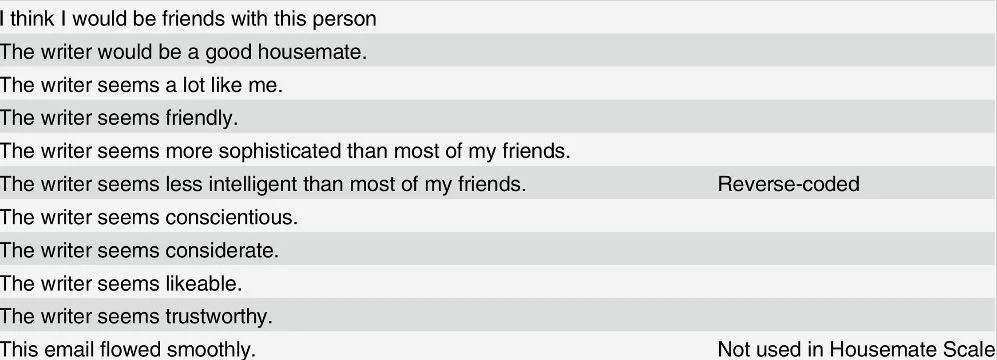
This seems to be a bold conclusion: is identifying four mistakes in a short paragraph considered an obsession? In answering the questions about the writer, shown here, I'm not sure how the respondents could be called obsessive.

Discussion Starters:
- Do I sound defensive? I am, but do I have a point?
- Do the study results surprise you? Read more detail about the influence of the five personality types in the PLOS One article.
Students Remember More with Handwritten Notes
A Wall Street Journal report discusses several studies that encourage handwritten instead of typed notes. In one study, students watched a PowerPoint presentation and took notes one of the two ways. After the lecture, students who had taken notes on their laptop had done slightly better in "recalling facts"; however, longer term, after the opportunity to review their notes, students who had handwritten their notes performed better. This group's notes were longer and included images, which could have contributed to their more robust responses. According to one researcher, the hand writers have an advantage to "grasp ideas" and "hold onto new concepts."
The actual writing process doesn't seem to be at play; instead, it's about the "focused attention that handwriting requires." Also, handwriting is slower, which makes the note-taking process more intentional.
Other research supports laptop bans in classrooms. One study found that "students with open laptops remembered less lecture content than those with closed laptops." Several faculty have made the decision for this reason and because of other distractions. An assistant professor at Columbia University cited more reasons in a Washington Post op-ed about his decision to ban laptops:
- Since most students can type very quickly, laptops encourage them to copy down nearly everything said in the classroom. But when students stare at the screen of their laptops, something is lost. The students shift from being intellectuals, listening to one another, to being customer-service representatives, taking down orders. Class is supposed to be a conversation, not an exercise in dictation.
- Clay Shirky, a professor at New York Univeristy, recently asked his students to stop using laptops in class. Another recent study convinced him to do so. The title: "Laptop multitasking hinders classroom learning for both users and nearby peers." A research team in Canada found that laptops in the classroom distracted not only the students who used them, but also students who sat nearby. Meaning, not only do the laptop-using students end up staring at Facebook, but the students behind them do, as well.
Discussion Starters:
- How do you prefer to take notes? Does this research influence your process?
- What about this research rings true for you, and what aspects do you question?
GS and Barclays Emails to Staff
A Goldman Sachs partner wrote an email to junior staff that was intended to be motivational. BusinessInsider writes, "every young person on Wall Street should read it.
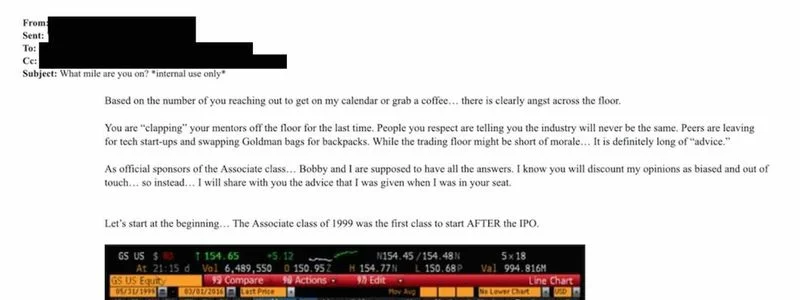
Presumably, the impetus was a lot of unhappy people because of the market conditions and several recent employee departures. The email includes big pictures and few words. This is the first screen of it, and here's the rest.
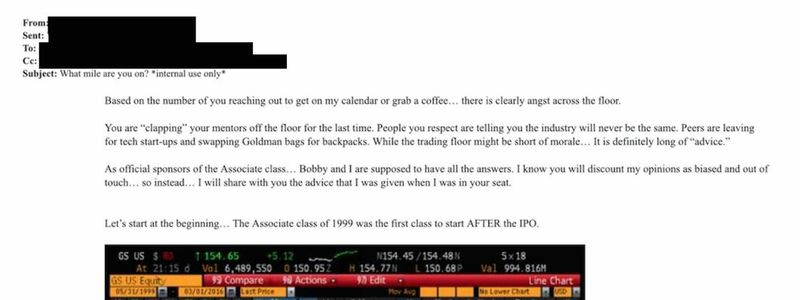
According to BusinessInsider, "We're told that the associates love it and they're passing it around internally."
When Googling to find the email, I came across this Barclays email to interns from last summer. I'm not sure how I missed it, but it's an incredible example of Wall Street culture and communication.
The Washington Post published the email, calling it "the latest cringeworthy Wall Street memo to interns." It included "Ten Commandments" for new interns, such as bringing a spare tie for associates, wearing a bow tie, being the last one to leave at night "no matter what," and bringing a pillow to work for sleeping under the desk. The second commandment sounded overriding: "Remember: this is a summer internship for a full-time offer. It won't be easy. If you can't handle the heat, get out of the kitchen."
The Post received this response from Barclays management:
"This email communication was in no way authorized by Barclays. Barclays is fully committed to creating an environment where both our bankers and our business can thrive. We have implemented policies and training guidelines to enable employees to gain valuable experience while at the same time maintaining a healthy work-life balance."
Discussion Starters:
- Do you agree with BusinessInsider's assessment of the GS email? Why or why not?
- What's your view of the large pictures? Do these help or detract from the written message?
- How do you find the Barclays' "Ten Commandments" email? Does it match with your experience as an intern?
- Discuss what may have happened internally at Barclays after The Washington Post published the email. Should intern managers have leeway in what they communicate to interns, or should their communication be held more tightly?
The Perfect Email Is 50 - 125 Words
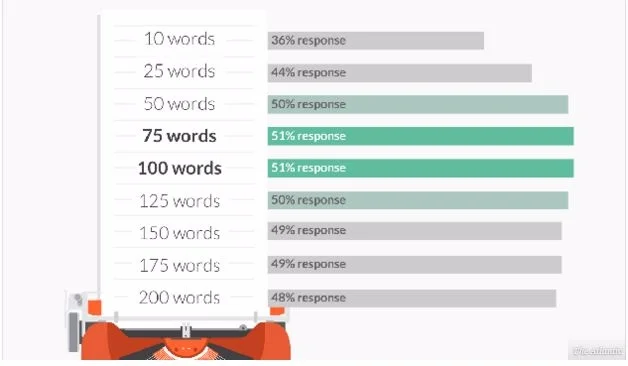
 The email productivity company Boomerang researched which emails are most likely to get quick responses, and the winners are between 50 and 125 words. According to the study, "a 25-word email works about as well as a 2000-word one, with only a 44% chance of getting a response."
By analyzing more than 5.3 million messages, Boomerang identified other features of successful emails. The company does acknowledge that these guidelines may not be best in every situation. Of course, your audience and the context always trump averages, but when in doubt...
- Write at a third-grade reading level. Use simple words and short sentences.
- Use a tone that's slightly negative or positive, rather than neutral.
- Use 3- or 4-word subject lines.
- Include 1-to-3 questions for a 50% higher response rate.
- Send your email early in the morning or during lunch.
The company experimented with interesting versions of emails for dating and criticism. See whether you can guess which were most successful.
Boomerang can be useful in managing messages. You can schedule when emails go out and receive reminders from the software.
Discussion Starters:
- How does this research match your own experience? Does anything surprise you?
- How would emails to your manager, for example, differ from these guidelines?
Uber Pays $28M and Adjusts Safety Language
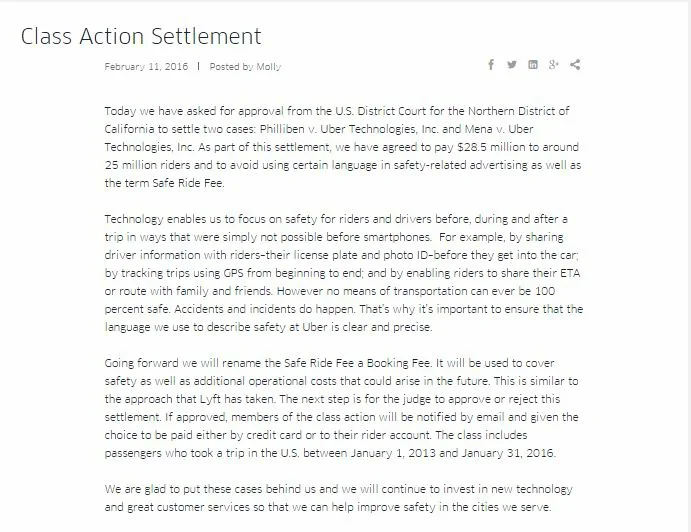
Uber has settled two lawsuits claiming the company misled consumers about safety. Charging a $2.30 fee, Uber promised to do background checks of its drivers, but the company failed to do the type of fingerprinting required for taxi drivers.
As part of the settlement, Uber will change some language in its promotions: the "Safe Ride Fee" will now be called a "Booking Fee."
In a statement, Uber reinforces its rationale for assuring passengers of safety but admits, "no means of transportation can ever be 100 percent safe. Accidents and incidents do happen."

Discussion Starters:
- How, if at all, will the language change and financial settlement affect passengers?
- How well does Uber explain the settlement? Of course, the company tries to spin the news positively. Does it succeed?
University President: "Drown the Bunnies"
 In yet another case of an email plaguing a leader, Simon Newman, president of Mount St. Mary's U. of Maryland, says his words were taken out of context. The president announced an objective to retain freshmen: "My short-term goal is to have 20-25 people leave by the 25th. This one thing will boost our retention 4-5%. A larger committee or group needs to work on the details, but I think you get the objective."
Although this sounds harsh, an assistant professor of history recalled a conversation with Newman saying something worse: "This is hard for you because you think of the students as cuddly bunnies, but you can't. You just have to drown the bunnies … put a Glock to their heads."
On the face of it, we can understand Newman's intent: to improve the university's 75% retention rate and reduce the current loss of 70 students after their first semester at school. Newman wants to catch students who will likely fail as early as possible-perhaps in time to get a tuition refund: "It's moral to at least have the conversation and say, You know, you can get all of your money back if this isn't the place for you. I'd rather you be happy." The university also has programs in place to check up on students who, for example, miss classes, and try to support them. Longer term, the university is trying to get out of debt and wants to increase its admission standards.
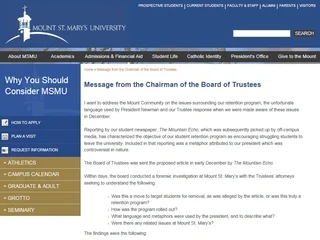
Despite the controversy, in a letter, the university's board of trustees supports the president and condemns faculty and alumni working against him. The board also passed "a unanimous resolution of full confidence."
Discussion Starters:
- One issue is how the student paper, The Mountain Echo, handled the story. Read more about this in The Chronicle article and discuss your perspective.
- Assess the board of trustees' letter. How well does it support the president and put the issue to rest?
"Reply All" Trouble
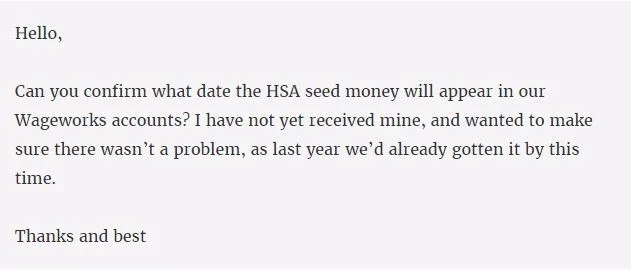
We can take a lesson from Time Inc.: check before hitting "Reply All." At the largest magazine publishing company in the United States, an employee asked a benefits question that went to thousands of employees. A photo editor inquired about the heath savings plan:

The funny thing is, after reading more, we learn that this is an IT issue, which sent a response email back to the listserv (the entire company). Maybe some of the criticism was unfair. Still, we should check to see where our email goes before sending it. A listserv in the "To" line could be dangerous..
Of course, Time employees made the situation far worse by replying back to everyone with snarky comments:

This brings us to the second lesson: if you get an email like this by mistake, just delete it.
Discussion Starters:
- Have you experienced something similar at work or school? How did you or the company handle the situation?
- What other advice would you offer people before they "hit send"?
T-Mobile Letter: "Binge On!"
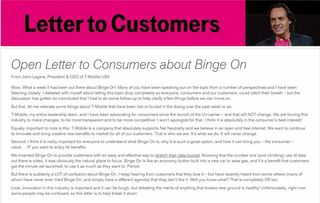 T-Mobile announced "Binge On," a new program for consumers to "stretch their data bucket." The service allows customers to watch videos at lower resolutions (which the company says doesn't matter on small screens) and not count the time against their high-resolution data minutes. In addition, consumers can watch videos from partner sites for free.
Not all responses to Binge On have been positive. The Electronic Frontier Foundation (EFF) has questioned whether the program affects streaming in addition to bandwith. In a video tweet response, CEO John Legere shot back a response including the F-bomb. Legere later apologized.
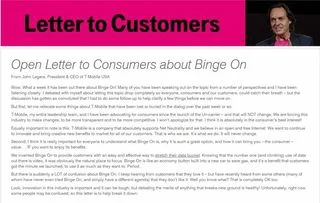
In a letter to customers, Legere clarifies that the service is "opt-in" (a big concern) and explains the program in more detail. This paragraph is an example of Legere's usual, casual style:
But there is suddenly a LOT of confusion about Binge On. I keep hearing from customers that they love it – but have recently heard from some others (many of whom have never even tried Binge On, and simply have a different agenda) that they don't like it. Well you know what? That is completely OK too.
My sister sent me the letter and didn't appreciate the casual tone or the "creepy" picture of the CEO. She also noted that the letter isn't dated, so it's unclear when all of this happened.
Consumers can find more information on T-Mobile's FAQs about Binge On.
Discussion Starters:
- What's your view of Legere's writing style? Partly, it fits with the T-Mobile image, but is it too much for customers?
- Could T-Mobile have avoided some of the controversy with clearer communications during the rollout? What do you think happened, and how could the messaging have been handled differently?
Words in Email Subject Lines
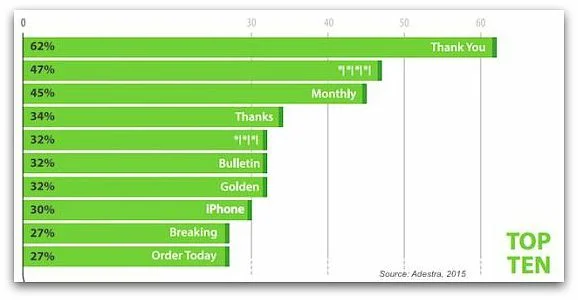
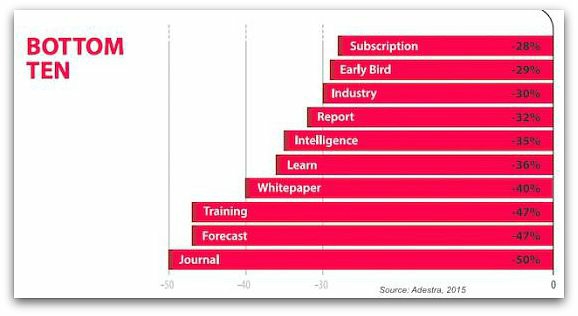
A study analyzed more than 3 billion emails in four industries to determine which words were most and least effective. The industries included retail & B2C, conferences & events, media & publishing, and B2B/professional services & financial.
The authors warn that the words don't guarantee success and depend on the brand, but we can draw some conclusions about the results.
PR Daily summarizes the findings and shows two relevant charts:
Overall, email subject lines that include the words "thank you" have the highest above-average engagement levels (+62 percent)-perhaps because many automated, transactional messages include this phrase, such as email receipts sent by brands after customers complete online purchases.
Subject lines that separate topics with vertical pipes (e.g., "Sale now on | New lines added | Win trip to Dubai | Share your pics with #summer2015rules") also perform significantly above average (+47 percent).
Timeliness also tends to work well in email subject lines, with words such as "bulletin" (+32 percent), breaking (+27 percent), and "order today" (+27 percent) all boosting engagement.
The second and fifth bars are "vertical pipes" described above (four and three, respectively).

Discussion Starters:
- In Chapter 4, you read about catchy subject lines. How do these survey results match what you learned?
- Look at your 50 most recent emails. Which subject lines stand out to you? How many include successful words above?
- Practice writing a few subject lines with the successful words and vertical pipes.
eBay Updates User Agreement
eBay sent an email to its customers to announce new terms and posted the revised agreement on its website. In June, when eBay spun off PayPal, both companies changed their user agreements-and heard from the New York attorney general. They wanted to make automated calls to collect payments or get feedback, but such "robocalls" could be illegal in New York State.
This time, the guidelines aren't making many waves. One highlighted change is about contacting users by phone: eBay says it "updated some of the language." Another indicates that reductions in fees won't be communicated in advance. Other changes focus on listings and international shipping arrangements.
 |
 |
|
|
|
|
|
|
|
|
|
Discussion Starters:
- Assess the message organization. How does eBay use bullets, and do you find them effective?
- What's your view of the other changes? Which do you think could upset users?
"Gawker Grows Up"
 After big executive news last week, Gawker CEO Nick Denton wrote a long message to staff. Gawker's executive editor and the editor-in-chief of Gawker.com resigned after an article, which revealed that a high-ranking magazine executive was texting a gay escort, was removed from the site after a board vote. Denton explained the decision in a post, including, "The point of this story was not in my view sufficient to offset the embarrassment to the subject and his family."
The executives' perspective, reflected partly in a message from Max Read (editor-in-chief) to Gawker writers, was about the faulty separation between editorial freedom and business (my paraphrase):
"On Friday a post was deleted from Gawker over the strenuous objections of Tommy and myself, as well as the entire staff of executive editors. That this post was deleted at all is an absolute surrender of Gawker's claim to 'radical transparency'; that non-editorial business executives were given a vote in the decision to remove it is an unacceptable and unprecedented breach of the editorial firewall, and turns Gawker's claim to be the world's largest independent media company into, essentially, a joke."
In his message to staff, CEO Denton discussed these issues and announced management team changes. Part of his post addressed controversy about the removed story:
"My professional life is committed to a free press and open discourse. While the reputation of our media brands remains a proper concern of the company, we do not and will not make story decisions based on advertiser feedback. Our credibility with both readers and advertisers depends on strong, incisive and independent journalism.
"I will put the company on the line rather than cave to legal pressure from the subject of a story, no matter how powerful. I will preserve Gawker Media's reputation for fighting press freedom cases that other media companies would settle.
"In regards to the recent story about a media executive blackmailed by an escort, I've explained extensively I ordered this misjudged exposé removed because it was not in line with the editorial standards I believe Gawker.com should maintain. And yes, it was also damaging to the brand of Gawker.com and the reputation of the company that shares the same name."
Denton ended his message, "Gawker grows up."
Discussion Starters:
- Explain the executives' and the CEO's positions on the removed story in your own words.
- How is this story relevant to business communicators?
- Assess Denton's message to staff. What works well, and what could be improved in the organization, tone, writing style, and so on?