

Facebook Memo Goes Public

Facebook executive Andrew Bosworth wrote a 2,551-word memo about the company’s role in the upcoming election and more. Bosworth compliments President Trump’s use of Facebook ads and admits that the site impacted the 2016 U.S. election. A Vox article describes Boswell’s logic:
Bosworth’s memo has much more in there, which is getting plenty of deserved attention, including the assertion that Facebook did indeed help Donald Trump win the 2016 election — by giving him the tools to run “the single best digital ad campaign I’ve ever seen from any advertiser. Period.” And the memo also reveals that Bosworth, a self-described “committed liberal,” fantasizes about using Facebook to prevent Trump from winning in 2020, but won’t.
The memo is also attracting attention because Bosworth compares Facebook to sugar and places responsibility on the user: “At the end of the day we are forced to ask what responsibility individuals have for themselves."
Bosworth ends the memo with a question:
To bring this uncharacteristically long and winding essay full circle, I wanted to start a discussion about what lessons people are taking away from the press coverage. My takeaway is that we were late on data security, misinformation, and foreign interference. We need to get ahead of polarization and algorithmic transparency. What are the other big topics people are seeing and where are we on those?
Discussion:
Read the entire memo . What surprises you most?
How damaging is the memo to Facebook’s image, particularly with another election coming up? How does a memo like this—posted on an internal site—become public?
What business writing principles does Bosworth follow, and how could he improve the memo?
JPMorgan Recorded Phone Conversation
Jimmy Kennedy, an African-American former National Football League player, tried to open a private wealth account at JPMorgan but had trouble getting attention. He recorded a conversation with an African-American employee, Richardo Peters, who said, “You’re bigger than the average person, period. And you’re also an African-American. We’re in Arizona. I don’t have to tell you about what the demographics are in Arizona. They don’t see people like you a lot.”
In a New York Times article that published the recording, Peters recounted a specific example of discrimination against a Black customer. When he was trying to bring on another new client, who had received a large settlement, his manager said, “You’ve got somebody who’s coming from Section 8, never had a nickel to spend, and now she’s got $400,000, What do you think’s going to happen with that money? It’s gone.” His manager’s position was that the customer would not invest money with the bank.
Other incidents at the bank led to Peters’ termination, and he is suing for racial discrimination. JPMorgan also recently settled a class-action lawsuit for $24 million to Black employees who claimed discrimination: according to a New York Times report, “in some cases by isolating them from colleagues and dumping them in poorer branches.”
A few days later, CEO Jamie Dimon addressed the situation in a memo to employees.
Discussion:
How do you assess this situation at JPMorgan? Read more in the NYT article.
A February Essence article describes and praises JPMorgan’s Advancing Black Pathways program to support the Black community. What’s your view of the effort in light of this news?
How do you assess CEO Jamie Dimon’s response in the memo? We don’t see the entire memo, but CNBC posted quotes.

Why Entrepreneurs Don't Learn from Their Mistakes

A Wall Street Journal article describes research about failing entrepreneurs. The results are sobering: start-up business owners don’t seem to learn from their mistakes.
Francis Greene, at Edinburgh University Business School, explains several reasons for lack of learning. First, when entrepreneurs start new businesses, they have a different context and different customer, so any lessons learned from previous businesses might not apply. Greene also says that businesses typically “limp along”; during this slow-close process, it’s difficult to identify what the real problems were.
Finally, as you might expect, we have psychological barriers for failing to learn from failure. We tend to simplify reasons and blame external factors.
Greene suggests taking time to explore what happened after a business failed and ensuring that we have the industry expertise to succeed in the next venture.
Discussion:
This reminds me of Amy Edmondson’s HBR article, “Strategies for Learning from Failure.” What similarities and differences do see in their research findings and recommendations?
When have you failed? How did you learn from the experience? Can you identify ways to learn better in the future?

Letter from WeWork Employees
As WeWork plans layoffs, employees are asking for input into what happens to them and their peers. Referring to themselves as WeWorkers Coalition, the employees wrote a letter to the management team.
To the We Company Management Team:
WeWork’s company values encourage us to be “entrepreneurial, inspired, authentic, tenacious, grateful and together.” Today, we are embracing these qualities wholeheartedly as we band together to ensure the well-being of our peers.
We come from many departments across the company: building maintenance, cleaning, community, design, product, engineering and more. We believe that in the upcoming weeks we have the unique opportunity to demonstrate our true values to the world. This is a company that has inspired many of us, challenged us, and has been a formative personal and professional experience for those of us who began our careers here. WeWork has been not just a workplace, but a source of friendships and inspiration along the way.
We also believe our product can have a lasting positive impact on the world. We want to improve workplace happiness for millions of office workers and support small and medium sized businesses in their entrepreneurial efforts. We have been proud to support these goals and dedicate our time and talent to achieve them. This has been our story so far.
Recently, however, we have watched as layers are peeled back one-by-one to reveal a different story. This story is one of deception, exclusion and selfishness playing out at the company’s highest levels. This is a story that reads as a negation of all our core values. But this story is not over.
Thousands of us will be laid off in the upcoming weeks. But we want our time here to have meant something. We don’t want to be defined by the scandals, the corruption, and the greed exhibited by the company’s leadership. We want to leave behind a legacy that represents the true character and intentions of WeWork employees.
In the immediate term, we want those being laid off to be provided fair and reasonable separation terms commensurate with their contributions, including severance pay, continuation of company-paid health insurance and compensation for lost equity. We are not the Adam Neumanns of this world — we are a diverse work force with rents to pay, households to support and children to raise. Neumann departed with a $1.7 billion severance package including a yearly $46 million “consulting fee” (higher than the total compensation of all but nine public C.E.O.s in the United States in 2018). We are not asking for this level of graft. We are asking to be treated with humanity and dignity so we can continue living life while searching to make a living elsewhere. In consideration of recent news, we will also need clarity around the contracts our cleaning staff will be required to sign in order to keep their jobs, which are being outsourced to a third party. Those of us who have visas through WeWork need assistance and adequate time to find a new employer to sponsor our respective visas.
In the medium term, employees need a seat at the table so the company can address a broader range of issues. We’ve seen what can happen when leadership makes decisions while employees have no voice. We will need to see more transparency and more accountability.
We also need the thousands who maintain our buildings and directly service members to receive full benefits and fair pay, rather than earning just above minimum wage.
We need allegations of sexual misconduct and harassment to be taken seriously, acted on immediately and resolved with transparency.
We need diversity and inclusion efforts to materialize into real actions, not just talking points at company meetings.
We need salary transparency so we can surface and address systemic inequalities.
We need an end to forced arbitration contracts, which strip employees of their right to pursue fair legal action against the company.
We need all of this, and more.
In the long term, we want the employees who remain at WeWork, and those who join in the future, to inherit something positive we left behind. We want them to never find themselves in this position again, and for that to happen, they need a voice.
With this letter we are introducing ourselves, the WeWorkers Coalition. We are taking full advantage of our legal right to establish this coalition, and in doing so, we hope to give the future employees of WeWork the voice we never had.
We want to work with you. Please join us in writing a better ending to this chapter of the WeWork story.
By this Thursday at 5:00 p.m. EST, we would like to receive confirmation of your receipt of this letter and an indication of your willingness to meet us.
The WeWorkers Coalition
@weworkersco • info@weworkersco.org • #weworkers-coalition
Discussion:
What principles of business writing do the employees follow?
What persuasive strategies do they use in the letter? Find examples of logical argument, emotional appeal, and credibility.
What do you consider the strongest and weakest arguments?
What leadership character dimensions are illustrated in this situation?

Astros Executive Fired After Yelling at Female Reporters

Brandon Taubman, assistant manager of the Houston Astros baseball team, was fired after comments made to female reporters. The situation became more complicated because the team, at first, criticized a Sports Illustrated reporter, Stephanie Apstein, and called her article, “misleading and irresponsible” and a “fabrication.”
In the team club house, after a game, Taubman yelled at the female reporters, “Thank God we got Osuna. I’m so f------ glad we got Osuna!” The MLB suspended Osuna for 75 games because of a domestic violence charge, and the Astros took a PR risk in hiring him. A Sports Illustrated writer criticizes the team’s decision:
But in truth, the Astros' front office acts as if it is tired of being yelled at about this subject. They want to be allowed to play their baseball games and pop their champagne without being forced to think about anything that happened away from the ballpark.
The team’s first response of defending Taubman didn’t stick. They later issued a statement apologizing to both the group of female reporters and Apstein.
Ernst & Young is scrubbing its website of ties to Taubman, who worked for the firm. EY is facing its own trouble following criticism about a training program for women.
Discussion:
What’s your view of the situation—both Taubman’s outburst and the Astros’ response?
Analyze the team’s statement. What leadership character dimensions does this illustrate, and how does it fall short? What could be improved?
Did EY do the right thing by trying to disassociate with Taubman? Why or why not?
Women in the Workplace Report
Lean In and McKinsey have co-published a report about women at work. The report concludes, “Five years in, we see bright spots at senior levels. But companies need to focus their efforts earlier in the pipeline to make real progress.”
According to the findings, although more women have higher level positions than they did five years ago, they still face obstacles. One stumbling block is getting that first management position. Another is how women are treated at work. The report identifies particular challenges for “only” women—“being the only or one of the only women in the room at work.”
The report is a good example of a well-organized, beautifully designed report with clear graphics, such as this one. However, the axis is truncated.
Discussion:
Describe how the axis is truncated. What problems does this create?
What surprises you about the report findings? What, if anything, doesn’t surprise you?
Describe the report organization.
Which graphics do you find most and lease useful?


LeBron James Enters the Tweet Debate
As the NBA struggles to recover after Houston Rockets General Manager Daryl Morey tweeted in support of Hong Kong protesters, LeBron James questioned Morey’s choice:
“Yes, we all do have freedom of speech. But, at times, there are ramifications for the negative that can happen when you’re not thinking about others, when you’re only thinking about yourself. . . . I believe he wasn’t educated on the situation at hand, and he spoke. And so many people could have been harmed, not only financially, but physically, emotionally, spiritually. So just be careful. . . .”
The Wall Street Journal reports that people were “stunned” by his comment because James is typically careful about his public comments.
Discussion:
What’s your view of James’ commenting on the situation? Should he have avoided commenting? Why or why not?
What’s your view of his comments? How well did he handle the situation?
What leadership character dimensions are illustrated by James’ comments?

NBA Tweetstorm
The NBA is thrust into a political quagmire after Houston Rockets general manager Daryl Morey tweeted in support of the Hong Kong protesters: '“Fight for Freedom. Stand with Hong Kong.” The tweet has since been deleted.
NBA Commissioner Adam Silver is dancing a line between protecting Morey’s free speech and staving off China’s backlash. Critics say the league is driven by profit instead of principle. He has tried to clarify his position:
“It is inevitable that people around the world — including from America and China — will have different viewpoints over different issues. It is not the role of the NBA to adjudicate those differences. However, the NBA will not put itself in a position of regulating what players, employees and team owners say or will not say on these issues. We simply could not operate that way.”
At this point, The Wall Street Journal reports better news:
“The situation appears to have de-escalated. After a week of blistering anti-NBA rhetoric in Chinese media, the government is signaling that it’s time to cool it, a message that includes the vitriol directed at the Rockets, according to one person familiar with the situation.”
But the Journal also acknowledges: “China’s love affair with the Rockets might not be the same again.”
Discussion:
Should Morey have avoided sending the tweet? Why or why not?
How do you assess the league’s response to the situation?
Analyze Silver’s news conference. What did he do well, and what could he have done differently?

United Air Kerfuffle
A United Airlines representative participated in an entertaining Twitter exchange about seat prices. The customer has a point: it’s silly to have empty seats on a plane. But United also has a point: the seats are more expensive, and this customer didn’t pay the extra fee.
The Lexus analogy is a curious one. The better analogy may be stadiums or theaters. In some cases, we will see people move closer to a field or a stage, but I understand (although I’ve never been) that this isn’t allowed at the U.S. Open.
Discussion:
What’s your view of United Airlines’ policy? What other examples are similar? Can you think of a better analogy?
What’s your view of the Twitter exchange? Is the customer right, antagonistic, rude, or something else? How about the United rep?

Creative Charts
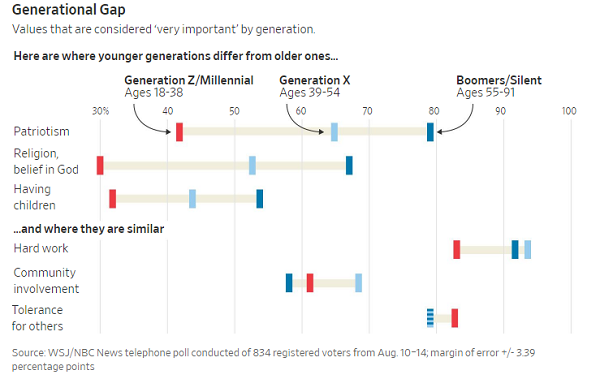
The Wall Street Journal created a chart to show what Americans value—and how those values have shifted over time. The graphic is a variation on a line chart with generations represented by color.
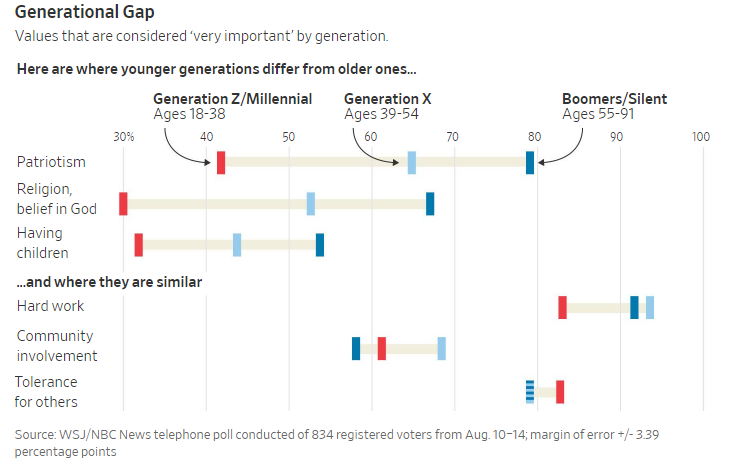
Understanding the chart may take a while. At first glance, the generation identifiers at the top look like headings, but they point to small bar colors.
The information is interesting, and some points probably aren’t surprising. Older Americans value patriotism, religion (which the poll describes as “belief in God”), and having children more highly than do younger Americans.
Discussion:
Assess the graphic design. How intuitive do you find the chart? What works well, and what could be improved?
What are your reactions to the data? What do you find surprising—and not?
What implications do you see for companies’ attempts to keep employees engaged at work?

Research About Befriending Your Boss
A Wall Street Journal article describes the positive and negative effects of being friends with your boss. Research shows that managers do give preferential treatment to employees they consider friends.
However, a study published in the Journal of Experimental Social Psychology demonstrates that managers may favor others when decisions are public. To avoid perceptions of bias, Alex Shaw, an assistant professor of psychology at the University of Chicago, offers three solutions for managers:
Recuse yourself. I’m skeptical about this because a manager’s job is to make such decisions, but I see the point: if you can get out of being the final decision maker, that might be best in some situations.
Make the criteria public. This is a good practice, anyway, to ensure transparency in decisions, particularly those that are sensitive and affect people personally.
Ask for opinions. This could work, for example, when peer feedback may be as relevant—or more relevant—than the manager’s point of view.
Discussion:
Have you considered a boss a friend? How might the relationship have affected decisions?
What’s your view of the strategies suggested here? In what types of situations could each work or backfire?

Shirtless Video Calls
Child interruptions, toilets flushing, clinking ice—I’ve seen and heard it all on video and audio calls. The Wall Street Journal reports that more remote workers have brought more mishaps, like a coworker appearing shirtless, forgetting to turn off his camera. And who can forget the adorable kids who walked in on a BBC interview.
The article suggests signs outside a home office door to indicate when calls are in progress—”On Air” or “Do Not Disturb.” Double-checking your mute button is a good idea too.
I would also suggest being clear about whether a call will be video or audio. A job candidate was surprised to know that her interview was via video. The employer insisted that she turn on her video, and she wasn’t dressed for it.
Discussion:
What mishaps have you experienced on audio or video calls?
What other ideas do you have to prevent embarrassing situations?
How does this story relate to the concept of authenticity?

Another Blackface Disaster

Belgium’s Africa museum hosted an event for which people arrived in pith helmets, blackface, and other offensive and stereotypical clothing. Understandably, the Congolese community is upset. As one representative said, "Ethnic, exotic or African is not a costume that you can put on and take off.” You can read about Belgium’s occupation of the Congo to understand the history.
The party was organized by a separate company, Thé Dansant, and one organizer defended the party: “Even if one person painted his face black, it was not meant to be offensive. Many people of African origin were enthusiastic about the concept and were present.”
So far, the Royal Museum of Africa is trying to distance itself from the event and hasn’t issued a statement or apology.
Museum image source.
Party image source.
Discussion:
What’s your view of Thé Dansant’s response?
What is the museum’s accountability? What should the leaders do or say?

Employees Pressure Walmart to Consider Role in Gun Violence

Walmart is in a tough spot after recent shootings. Some employees are pressing the company to do more to fight gun violence, but no policy changes are planned. After previous attacks, Walmart stopped selling assault-style weapons and raised the minimum age to purchase guns and ammunition, but it’s unclear whether the leaders will do more. Employees are asking Walmart to stop selling firearms and to disallow customers from carrying guns into the stores.
The company seems divided about employees’ activism. Chief Executive Doug McMillon wrote, ”We are proud to be woven into the American fabric as a place for all people. We are more resolved than ever to foster an inclusive environment where all people are valued and welcomed.” At the same time, the company blocked two employees’ access to Slack, encouraging employees to use “more constructive ways for associates to offer feedback such as emails or conversations with leaders.”
A study recently published in the International Journal of Business Communication found that employees are more likely to “express dissent to managers and coworkers” when they are more socialized in the company and when they believe their company is “more ethical and reputable.”
A Wall Street Journal article explains the risk for Walmart to take more action against gun sales:
“[A]ny change to its gun policies risks alienating Walmart’s core customers, who often live in more conservative-leaning rural and suburban communities. The company faced some consumer backlash after raising the minimum age to purchase guns to 21.”
Discussion:
How can the company balance employees’ and customers’ perspectives? What else, if anything, should company leaders say and do?
Did the company do the right thing by blocking Slack access? In what ways are email and conversations more or less “constructive”?
What leadership character dimensions are illustrated by this situation?

Suicide Among France Télécom Employees

Management couldn’t fire employees at France Télécom, so, according to critics, they harassed them hoping they would quit. But at least 35 committed suicide under the pressure, and some reports claim the number is closer to 60.
France Télécom was privatized and rebranded as Orange in July 2013. The company wasn’t keeping up with technological changes and, according to executives, were saddled with state employees, who are protected from termination. In 2007, Didier Lombard, the former chief executive of France Télécom, said they would get to their ideal number of layoffs “one way or another, by the window or by the door.”
A New York Times article describes the environment: “A grim universe of underemployment, marginalization, miscasting and systematic harassment was established at the huge company, according to testimony at the trial.” Managers tried changing job responsibilities for some workers, but employees were left without tasks or with tasks they couldn’t do.
With France’s high unemployment rate, employees felt they had few options. Union members, shown here, express their support during the trial in Paris. We’ll see whether the judges find company executives guilty.
Discussion:
How did management justify its practices? On the other hand, how could they have acted differently?
What experience do you have with international labor laws? Describe differences and how they might affect business decisions.
Should France reconsider its lifetime employment protections?
What leadership character dimensions are illustrated by this situation?

How to Navigate Multiple Offers
It’s one of those “good problems”: getting more than one job offer. But navigating the relationships and making a decision can be tough.
A Wall Street Journal article tells the story of a man faking his own death to avoid telling a company that he didn’t want to take the job after accepting an offer. According to an executive at the staffing company Robert Half, “ghosting” a prospective employer is most common among people out of school between two and six years. More and more, employers receive last-minute text messages or no-shows on the first day of work.
A management consultant believes the trouble is that college students lack the communication skills to handle these situations more professionally: “This is the generation that breaks up by text message, so in a professional context, to have to let someone down or give bad news was terrifying.”
Twice this past semester, students asked me for advice in reneging offers. Overall, I’m not a fan of the tactic. To me, it’s an issue of integrity: when students make a commitment to one employer, they shouldn’t change their minds when a better offer comes along. I also worry about their reputation in the industry—and whether their expectations will be too high for the new job, and they’ll end up disappointed. At Cornell, students also give up their access to career services in the future when this happens.
But students do what is best for them. What matters after the decision is how it’s communicated. I always suggest a phone call rather than an email, which takes courage. A direct, honest approach is best, with an apology and some understanding of how the decision affects the employer, who’s left with an unfilled position and additional recruiting time.
Ideally, students get offers at the same time with the same decision deadlines, but of course, that’s not always the case, and comparing offers becomes challenging. The WSJ article recommends these practices for evaluating and accepting job offers:
DO
* Make clear early what you’re looking for in a new job.
* Ask employers their timeline for making a decision.
* Express appreciation and enthusiasm when receiving an offer.
* Take time to assess each offer carefully, weighing both financial and quality-of-life factors.
DON’T
* Communicate important decisions by text or email.
* Try to pit one employer against another in a bidding war.
* Respond to a job offer by announcing that you already have a competing one.
* Base your decision solely on pay.
Discussion:
Have you been in a situation of having multiple offers? How did you handle it?
Have you reneged on an offer? How did you communicate the decision, and how did the employer react?
What other advice would you give students who have multiple offers?

Rutgers Chancellor "Berates" Police Officers
The Chronicle reported that Rutgers Chancellor Nancy E. Cantor “apologized for berating campus police officers.” On her way to the airport, Cantor’s driver hit a parked police car. She was detained and said, “If I miss my airplane, you folks are in trouble!” When an officer asked, “I’m sorry, who are you?” she yelled, “I’m the chancellor!”
The episode, which happened in March, was recorded on the officer’s body camera. Part of the debate is about whether Cantor needed to be detained because she entered the vehicle after the driver hit the other car.
Regardless, the video became public, Cantor apologized, and the Rutgers-Newark police chief responded:
“I appreciate Chancellor Cantor taking the time to review the video. I along with the RUPD are appreciative of her kind words and support. The sentiment is extremely appreciated, and we look forward to continuing a positive working relationship with the Rutgers-Newark chancellor’s office.”
Discussion:
Watch the video exchange. What’s your view of the chancellor’s behavior with the police officers?
Should the officers have done anything differently in this situation? Why or why not?
Assess the police chief’s response. How well does he demonstrate forgiveness?
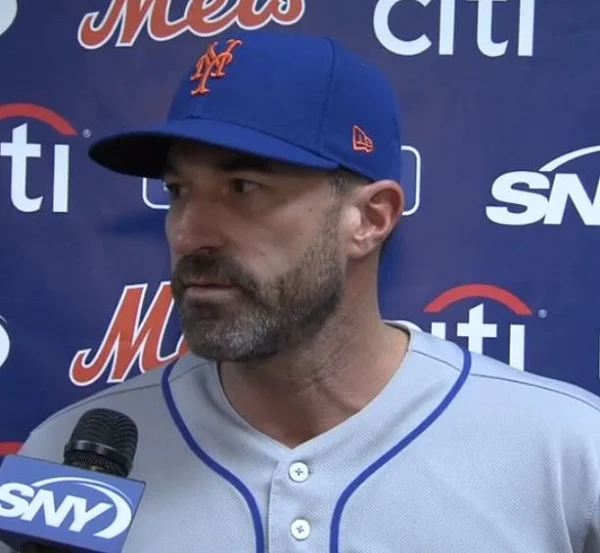
Mets Manager Admits Mistake
Mets manager Mickey Callaway admitted that an “administrative” error of switching pitchers “probably cost” the team the game. According to reports, the admission was unusual. As one news outlet explained, “His postgame press conferences can get combative, and his unwillingness to admit to any wrongdoing hasn’t played well with the New York media.”
Fans and players seem to be responding positively to the Callaway’s apology. One example is the response from first baseman Pete Alonso:
“Having a manager that’s not straight up and honest, that’s tough to play for a guy like that. But I’m fortunate enough to play for a guy like Mick. I love playing for Mick and all of the other guys love playing for Mick because he’s been honest and straight-up.”
For years now, corporate stakeholders have expected more humility from leaders. Seeing an example in sports is refreshing.
Discussion:
What’s your view of Callaway’s admission?
Not everyone likes this approach. I haven’t seen the clip, but a friend tells me local sports commentators said they want to see more “leadership.” Is admitting failure not part of demonstrating leadership?
What other leadership character dimensions are illustrated by this example?
Polite Answers Are Perceived as Higher Quality
A study published in Management Information Systems found that the more polite an answer is, the more likely it is to be viewed as a good answer. Researchers studied conversations in Stack Exchange, a community site for posting questions and answers, on which question posters rate responses.
The only exception to this finding is when the person posting the response is considered to be an expert. Then politeness doesn’t seem to matter.
To avoid this “politeness bias,” which could falsely elevate responses, the researchers propose giving more weight to ratings by users other than the poster. And rather than marking a response as “best answer,” responses could be marked “accepted.”
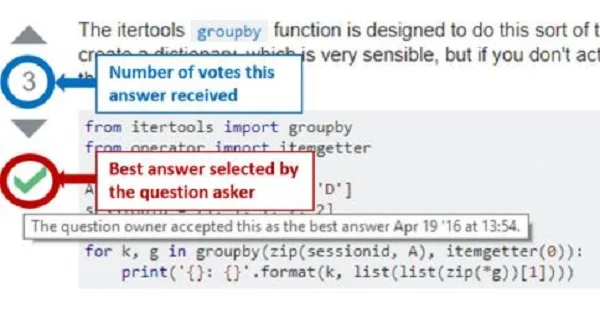
In the example, below, Amazon Mechanical Turk (AMT) workers discuss bank transfers.
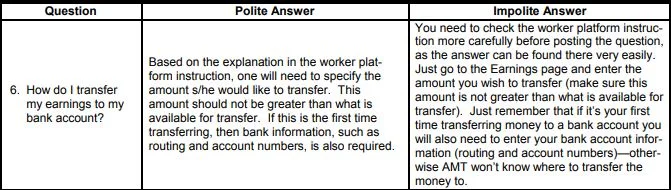
We can see that the impolite answer is harsh, telling the poster to check instructions before asking a question, as if to say, “You’re wasting my time.” However, that answer provides almost identical information with one exception: “go to the Earnings page.” I’m not sure how helpful this is, but otherwise, the responses—at least in terms of clear instruction—are very similar.
This study reminds me of another that found well-written online reviews to increase sales—even if the review was negative. Although this is more about writing style and grammar than tone, both have implications for getting ideas accepted online.
Discussion:
How would you assess the two responses above? Could you see the questioner selecting the polite answer over the impolite answer for “best answer”?
How, if at all, are you influenced by writing style, grammar, and tone in online discussions and reviews?

Restaurant Owner Forgives Manager for $4,710 Mistake

The manager of Hawksmoor Manchester steakhouse accidentally served a $5,000 bottle of wine when the guests ordered one priced at $290. The owner forgave her publicly, on Twitter.
Naturally, the conversation doesn’t end there. Jokes abound, one announcing that the manager has since been placed in an “on-site incinerator.”
Others pounced on the expensive wine and criticized the restaurant, to which the owner responded in a tweet:
I’m sure you’re all getting tired of this now, so one last thing, to the people who put homelessness in Manchester next to ‘£4500 wine?!’ and suggesting we have no values: we’ve raised well over £1m for @ACF_UK, work with @WoodSt_Mission and @notjustsoupMCR. We have values.
Discussion:
What leadership character dimensions are demonstrated by this story?
How well did the owner respond to criticism?