

Penn Removes Several Recognitions of Steve Wynn

For the first time in more than 100 years, the University of Pennsylvania has revoked an honorary degree. Following accusations of sexual misconduct against Steve Wynn, the trustees announced the revocation in addition to plans for removing Wynn's name from "Wynn Commons" and from a scholarship fund.
The message, sent by email and posted on the school's website, explained the decision and announced that an honorary degree for Bill Cosby also will be revoked. University leaders were careful to describe their decision process as well as the delay in revoking Cosby's degree. This is a good example of anticipating and addressing potential criticism.
Judging by comments on Twitter, reactions to the university's decision to take a stand seem to be neutral or positive.
Discussion:
- Did UPenn make the right decision? Why or why not?
- Analyze the message. What principles of business are followed, and how can the message be improved? Consider the audience analysis, organization, tone, and so on.
- How is this an example of courage? What risks does the university face?

Call for Gymnastics Board to Resign

As female athletes are recognized in a full-page newspaper ad for their courage in telling their stories of abuse, the U.S. Olympics CEO is calling for the entire USA Gymnastics board to resign by Wednesday.
In an open letter to Team USA Athletes, CEO Scott Blackman apologized and identified four next steps:
1. We Must Change the Culture of the Sport.
2. We Must Change the Governance Structure of the NGB.
3. We Must Know Who Knew What and When.
4. We Must Support Safe Sport Victims and Survivors.
Three members of the board already resigned, but critics say that is not enough. Blackman doesn't accuse any board members of knowing about abuse, but he says the culture must change and this is the best way to achieve that change.
Discussion:
- What is the value of asking for the entire board's resignation? What, perhaps, are the limitations?
- What should the board do?
- How else can Blackman and the rest of the Olympics Committee make athletes feel safe again?

Fudging Numbers to Make the NYC Subway Look Better

New York Governor Andrew Cuomo's staff is criticized for inflating power-related issues as the cause of subway failures. Transit officials apparently broadened the definition of power issues so that Con Edison, the local utility company, would be given more of the blame when subways aren't running. Emails were discovered before Governor Cuomo was scheduled to give a breakfast talk, during which he said the number of outages due to power failures was 32,000 in the past year, while the actual number was more like 8,000:
When you we're a kid and you had a train set you had to plug it in. We have to plug in the MTA every morning and the MTA does not control the power supply to the MTA. Over the last 12 months, 32,000 delays because of power related issues and they can either be a power surge or power shortage, but 32,000 delays. The MTA doesn't control the power, Con Edison does. Con Edison has a duty to safely, prudently and effectively provide electricity that powers the subway system. Con Ed is a regulated utility under the state's Public Service Commission. April 21 after the last outage I ordered an investigation of the Con Ed infrastructure after a particularly devastating failure. The investigation goes on but PSC has already found that Con Ed must make immediate and significant improvements in this system because the reliability depends on it.
The chief of staff of the transit agency wrote in an email that they were "looking for a higher delay number for power." The expanded definition was that ConEd "caused or contributed to" delays. One example is when a person jumps or falls onto the tracks; ConEd will shut off the power for safety. With the new definition, the delay becomes ConEd's fault.
Discussion:
- We certainly can use numbers to our advantage when trying to persuade others. How does this situation "cross a line"?
- What should Governor Cuomo do now? What, if any, statement would be appropriate?
- Do you remember "Bridegate" in New Jersey? How is this situation similar or different?

Morgan Stanley Clarifies a Termination

In December, a female reporter accused a former congressman who was hired as a managing director at Morgan Stanley of sexual harassment. Morgan Stanley fired Harold Ford Jr., and he lost his gig as a frequent commentator on MSNBC.
Ford had maintained his innocence, and now, the company is saying Ford was not terminated for sexual harassment but was let go because of other misconduct:
" Morgan Stanley would like to clarify the circumstances of Mr. Ford’s departure. We take allegations of inappropriate conduct seriously, The press has reported that Mr. Ford was terminated for sexual misconduct. He was not. We have not received any internal allegations of sexual harassment or misconduct involving him either before or after his separation became public. As previously stated, his separation was based on corporate policy.”
The statement is curious because it mentions only internal allegations—or maybe I'm reading into it too much.
Discussion:
- How do you read the statement and possible distinction between internal and external?
- Why would Morgan Stanley issue such a statement two months after Ford's termination?
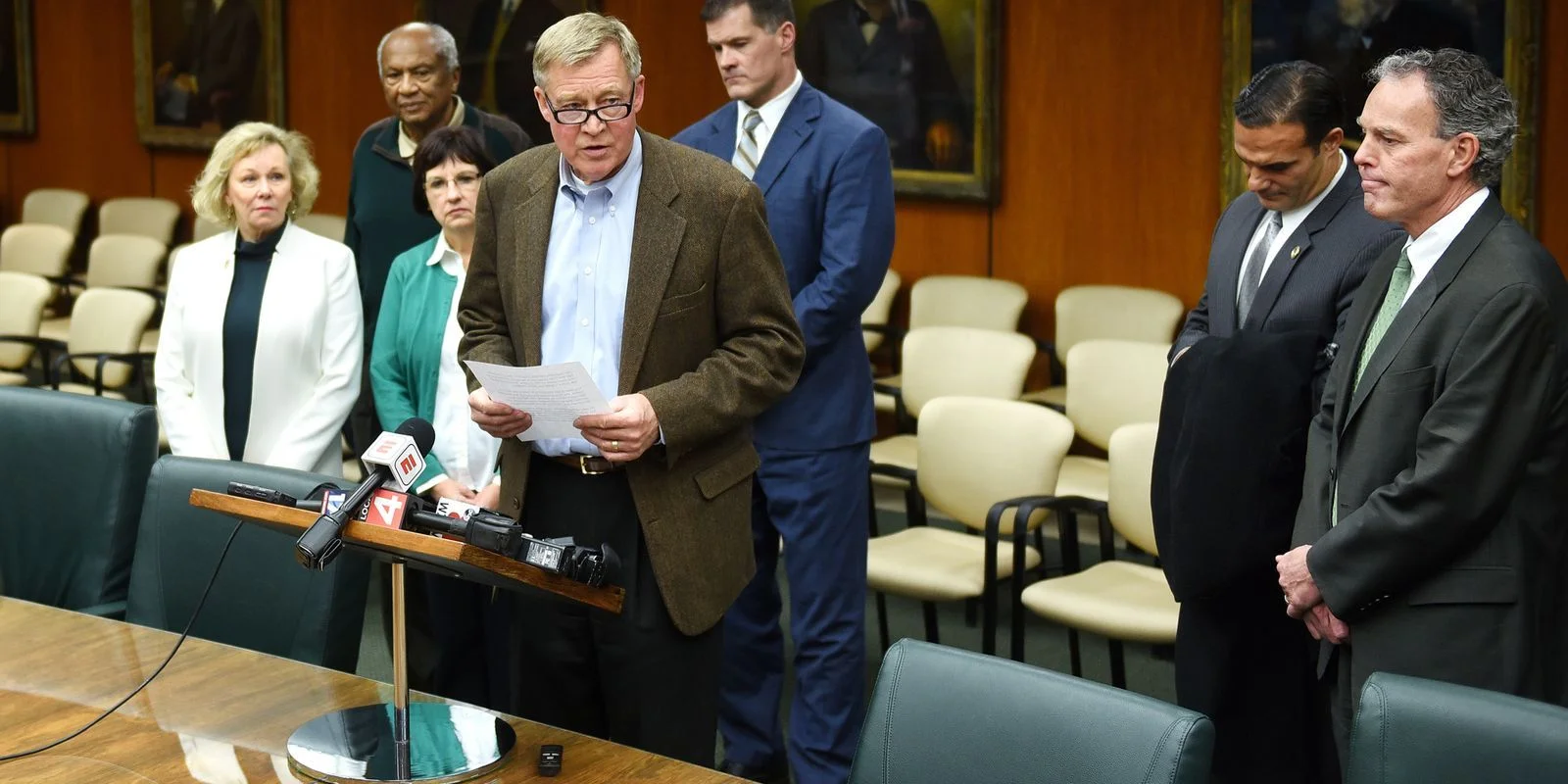
Calls for Michigan State President to Resign
Some believe it's a matter of integrity and accountability; others believe this will start the healing process. In addition to public demands, one Michigan State trustee says it's time for the university president to resign over Dr. Lawrence G. Nassar's sexual abuse of dozens of female athletes.
The rest of the university trustees have shown public support for the president, Lou Anna Simon. In a statement, they said, "President Simon is the right leader for the university, and she has our support." But the sole trustee, Mitch Lyons, disagrees:
“I don’t feel that President Simon can survive the public outcry that has been generated by this tragedy. I feel that our best recourse is for President Simon to resign immediately in order to allow the healing process to begin."
According to a Detriot News story, several university officials, including the president, heard complaints about Nassar. Simons admits, “I was informed that a sports medicine doctor was under investigation. I told people to play it straight up, and I did not receive a copy of the report. That’s the truth.” People question her judgment in not seeing the final report, particularly given the recent explosive case at Penn State University. We will see what happens next.
Discussion:
- Should Simon resign? Why or why not?
- What does it take for Lyons to break rank with the rest of the trustees? How would you describe the possible dynamics on the board?
- How does such abuse go on for so long? About 140 women complained about Nassar when he was working with Olympic athletes, and at least eight students came forward at the Michigan State.
- At the end of the trustees' statement, a reporter asks, "Why no questions?" But the board leaves the room without saying anything. Should they have taken questions? Why or why not?
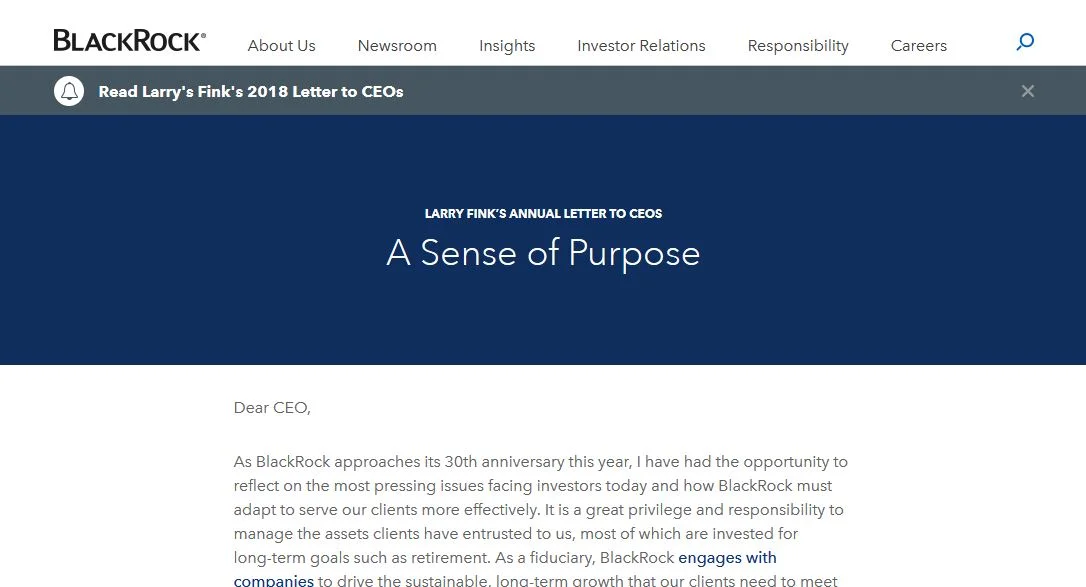
BlackRock Encourages "A Sense of Purpose"
BlackRock CEO Larry Fink is encouraging companies to be more socially responsible. In his annual letter, the investment firm CEO describes the increasing wealth disparity in the United States:
"We are seeing a paradox of high returns and high anxiety. Since the financial crisis, those with capital have reaped enormous benefits. At the same time, many individuals across the world are facing a combination of low rates, low wage growth, and inadequate retirement systems. Many don’t have the financial capacity, the resources, or the tools to save effectively; those who are invested are too often over-allocated to cash. For millions, the prospect of a secure retirement is slipping further and further away – especially among workers with less education, whose job security is increasingly tenuous. I believe these trends are a major source of the anxiety and polarization that we see across the world today."

Fink is encouraging more engagement of shareholders and a focus on creating long-term value:
"Companies must ask themselves: What role do we play in the community? How are we managing our impact on the environment? Are we working to create a diverse workforce? Are we adapting to technological change? Are we providing the retraining and opportunities that our employees and our business will need to adjust to an increasingly automated world? Are we using behavioral finance and other tools to prepare workers for retirement, so that they invest in a way that that will help them achieve their goals?"
But critics say Fink is overstepping. On Squawk Box, Sam Zell said, "I didn't know Larry Fink had been made God."
Discussion:
- What's your view of Fink's position? Is this a good idea, or should he keep his thoughts to himself?
- What are Fink's communication objectives, and how well does he meet them?
- Assess the letter in terms of organization and writing style.
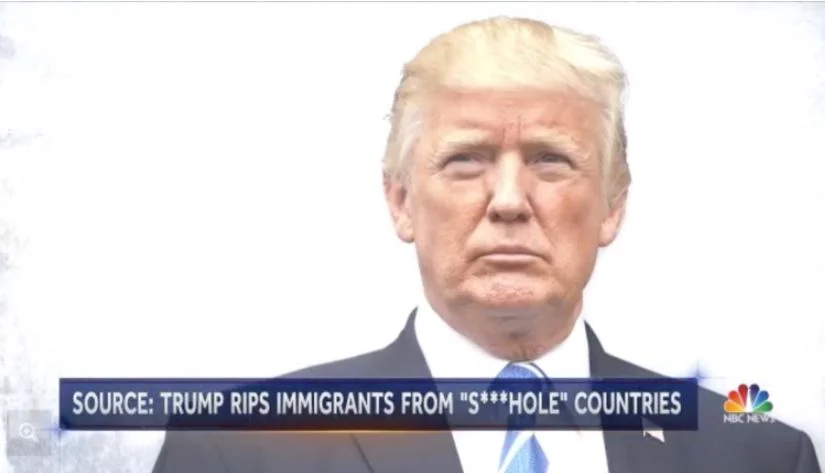
President Trump Refers to "S---hole" Countries

During a meeting about immigration policy, lawmakers heard President Trump ask why the U.S. would admit people from "s---hole" countries like African countries and Haiti instead of places like Norway.
I have refrained here as have some TV news stations (NBC, shown here), but the major print news outlets—NY Times, Washington Post, and Wall Street Journal—all printed the actual profanity. The New York Times explains the decision:
But several media executives said on Thursday that the news value of Mr. Trump’s remarks, which the White House did not dispute, was undeniable.
“It would be futile to mask the word when the language itself, in reference to Haiti and African countries, was so extraordinary,” said The A.P.’s vice president for standards, John Daniszewski.
Discussion:
- Why would some media outlets use the word, while others avoid it? What does the decision involve?
- Some take issue with the reporting about "vulgar," "crude," or "profane" language, calling for the press to call the president a "racist" instead. What are your thoughts? First, does the comment indicate that he is a racist? Second, should the news agencies report this differently?
- An argument could be made that the president is just being himself, authentic. What do you think of this view?

Intel CEO Warns of Vulnerability, a Little Late

The CEO of Intel has bad news: a patch for a chip vulnerability will slow down computer operations. In an interview with Bloomberg, a technology analyst explains the typical process when finding security issues: companies find a bug and solve it before going public. However, this time, an issue known for perhaps a year went unsolved and was kept quiet—until now.
Bloomberg says chip makers had downplayed the effects of the patch, but CEO Brian Krzanich has finally described the issue:
“We believe the performance impact of these updates is highly workload-dependent. As a result, we expect some workloads may have a larger impact than others. As of now we have not received any information that these exploits have been used to retrieve customer data.”
In other words, the patch works but will slow down operations.
A technology analyst says this is the first time chip makers like Intel have gotten caught needing to admit a potential vulnerability, and it's unclear why it hasn't been fixed before this point.
Bloomberg reports on the secrecy and implications:
“Our first priority has been to have a complete mitigation in place,” said Intel’s Parker. “We’ve delivered a solution.”
Some in the cybersecurity community aren’t so sure. Kocher, who helped discover Spectre [a bug], thinks this is just the beginning of the industry’s woes. Now that new ways to exploit chips have been exposed, there’ll be more variations and more flaws that will require more patches and mitigation.
"This is just like peeling the lid off the can of worms," he said.
Discussion:
- In what ways did Intel avoid accountability? How did the avoidance affect the company? What would have been a more appropriate response to finding the bugs?
- Distinguish between this computer vulnerability and vulnerability in interpersonal relationships. One is good; the other is not.
- Read the Intel CEO's quote, above. It sounds jargony but was presented at CES, a conference of IT professionals. Did he use appropriate language, or does his word choice demonstrate a lack of transparency? What do you think?
NBC's Integrity Called Into Question
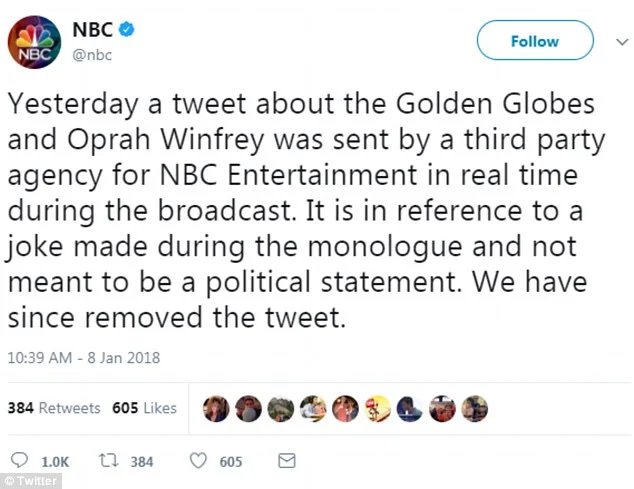
NBC's Twitter account manager overstepped when posting about Oprah at the Golden Globes.

The company tweeted a correction and removed the post:
"Yesterday a tweet about the Golden Globes and Oprah Winfrey was sent by a third party agency for NBC Entertainment in real time during the broadcast. It is in reference to a joke made during the monologue and not meant to be a political statement. We have since removed the tweet."
Donald Trump Jr. didn't miss the chance to reinforce his father's criticism of mainstream media as "fake news."

Discussion:
- How well did NBC handle the situation? What else, if anything, should the company do?
- How damaging do you think this tweet is for NBC and for mainstream media?
- To what extent did NBC demonstrate accountability?
- What are the other dangers of outsourcing a Twitter account? (Hint: authenticity)
Banned Words for the CDC?
The Washington Post may have "mischaracterized" a report that the Centers for Disease Control (CDC) was "banned" from using certain words in its budget documents. Reports claimed that the Trump Administration would prevent the CDC from using these seven words: vulnerable, entitlement, diversity, transgender, fetus, evidence-based, and science-based.
But in a Facebook post, CDC Director Brenda Fitzgerald denied such restrictions. She is upholding the integrity of the organization.

What really transpired between the CDC and the Trump Administration? The Human Rights Commission, an LGBTQ organization, wants to know. In addition to projecting the seven words boldly across a Trump hotel in Washington, D.C., in protest, the organization has asked for more information:
"In conjunction with the enormous light display, HRC has filed a Freedom of Information Act (FOIA) with the Department of Health and Human Services (HHS) for any and all records, including communications with the CDC, relating to the banned words from November 2016 onward."
Discussion:
- How is this an issue of integrity for the CDC? What do you think actually transpired between the CDC and the Trump Administration?
- Where do you think the Washington Post went wrong—or did it?
- Assess the CDC director's response. How well did she handle the issue and rebuild the agency's image?
Should You Leave a Company Involved in a Scandal?
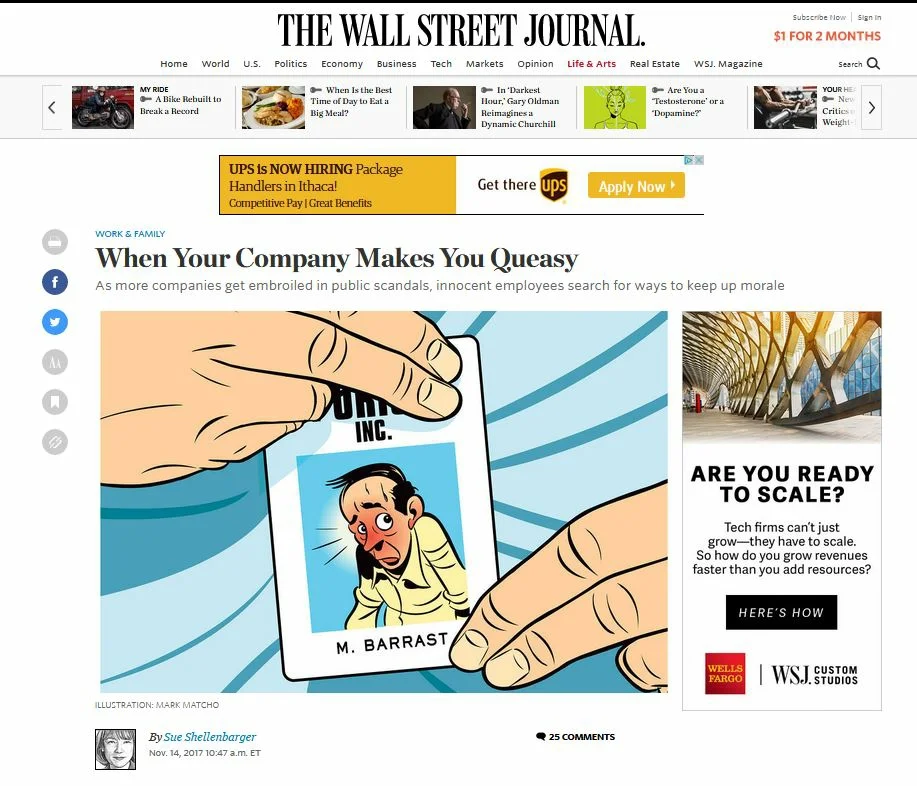
 A Wall Street Journal article explores the impact on employees whose company embarrasses them. When mired in a scandal, the company no longer reflects our values, and we may want to end the association.
An employee at Uber, for example, left after news about sexual harassment became public. Her family questioned her affiliation and, as she describes, "staying there would have meant going against what I believe in." Employees who want to live their values may feel better leaving. Of course, this assumes that people have opportunities elsewhere, which isn't the case for everyone.
The article warns against making a rash decision and suggests alternatives:
WHEN YOUR EMPLOYER'S IMAGE STRESSES YOU OUT
- Take time to calm feelings of stress or anxiety.
- Consider other options before quitting.
- Spend more time on job tasks that are meaningful to you.
- Find something to love in your company's mission.
- Try to fix some part of the company's problem that you can control.
- Strengthen relationships with people at work you enjoy.
- Mentor and encourage subordinates who show promise.
- Work on building skills that will help you in the future.
Discussion:
- Have you been a part of organization that didn't align with your values? How did you handle the situation?
- Which of the article's suggestions do you find most and least useful? Which have you used in the past?
TripAdvisor Identifies Issues at Hotels
 TripAdvisor has decided to identify hotels where issues about "healthy, safety, and discrimination" have been reported. Given the increasing conversations about sexual harassment, the company is stepping up, but the notice raises serious concerns for hotels.
Related to this move, TripAdvisor has apologized for removing a post reporting a rape by a hotel security guard. Turns out, other women posted similar reports, and there is a pattern. In a statement, the company also explained its plan to use badges:
NEEDHAM, Mass., Nov. 1, 2017
The following is the official statement from TripAdvisor concerning the article by Raquel Rutledge of the USA Today network:
"TripAdvisor's site includes more than 535 million reviews and opinions from global travelers who write about their experiences at hotels, with airlines, restaurants and local attractions. Like any other content business, we work to adhere to publishing guidelines that are in place to ensure the accuracy and integrity of those reviews.
TripAdvisor has always maintained - since our founding - a strict separation between our commerce and content businesses. Despite assertions and statements made by a recent USA Today article, there is no tie between commercial relationships with our partners and how our content guidelines are applied to reviews or forum posts published on the site.
We apologize to the sexual assault victim reported on in the article, who had her forum post removed seven years ago on TripAdvisor. At the time, we had a policy whereby we judged content to be in breach of our guidelines if it did not adhere to family-friendly language. More than seven years ago that meant all language needed to be G-rated. A few years ago, we changed that policy to allow more descriptive reviews on the site about first-hand accounts of serious incidents like rape or assault. We recognized then that our previous guidelines went too far in preventing information like this from being shared.
Over the last several years, this policy change has yielded many first-hand accounts of serious incidents being published on the platform. A simple search of TripAdvisor will show numerous reviews from travelers over the last several years who wrote about their first-hand experiences that include matters of robbery or theft, assault and rape. We believe any first-hand experience should be posted to our site as a means to communicate to other consumers looking for information on where they should travel.
When we were made aware that this post had been removed under our previous guidelines, we republished it in line with our revised policy.
We are horrified that this victim experienced this assault on her vacation in Mexico, and other travelers should be aware of this incident.
In order to better inform consumers and provide them with even more information about their travels, TripAdvisor is creating a "badge" notification to apply to businesses to alert consumers of health and safety or discrimination issues at that business reported on within the media or other credible sources of information.
We will continue to work to improve and evolve our moderation and publishing guidelines as we work to provide the most accurate information in the travel industry available online."
The new badge will read as follows:

Discussion:
- What ethical issues and communication challenges are raised by this decision? Consider perspectives of hotel guests, managers, and staff. What are the potential advantages and potential negative implications?
- If you owned a hotel that received this badge, what would you do?
- In what ways does TripAdvisor's statement demonstrate compassion? Where does it fall short?
Air Force Admits Failure
The U.S. Air Force admits it didn't properly report Devin P. Kelley's history to federal law enforcement. The error is critical because Kelley's violent past may have prevented him from buying guns he used to kill 26 people in a Texas church. Kelley spent 12 months in prison and left the Air Force with a "bad conduct" discharge after harming his wife and child.
Air Force spokeswoman Ann Stefanek said, "Initial information indicates that Kelley's domestic violence offense was not entered into the National Criminal Information Center database." This omission led to Kelley's passing the background check before he could purchase guns at a firearms retailer.
Of course, the incident raises bigger questions about how often relevant background information is not reported about former service members. U.S. Air Force Sec. Heather Wilson appeared on MSNBC's Squawk Box to admit the failings during a televised interview. When asked whether she was concerned about possible liability from victims' families, she said, "No, I'm more interested in responsibility. And we've taken responsibility, and we're going to find out what happened and fix it.”
Discussion:
The Air Force has readily admitted a critical failing, which could have led to 26 deaths. Why would the organization choose this disclosure?
Describe how Wilson is demonstrating vulnerability. What are the potential downsides?
Pizza Hut and Papa John's Jump into NFL Controversy

Should CEOs get involved in political controversies? While some applaud "brand activism," others criticize business leaders who don't agree with their views.
Papa John's CEO has been vocal about the business impact of NFL players not standing during the national anthem. When explaining same-store sales, John Schnatter blamed NFL leadership:
"We are totally disappointed that the NFL and its leadership did not resolve the ongoing situation to the satisfaction of all parties long ago. This should have been nipped in the bud a year and a half ago."
Schnatter also said, "Leadership starts at the top, and this is an example of poor leadership." Schnatter contributed $1,000 to President Trump's election campaign and is aligned with the president's views on the subject. He blamed the "polarizing" actions of team members for causing declining viewership and fewer pizza orders.
But others say NFL viewership was declining long before this political controversy, and Pizza Hut jumped into the conversation. Greg Creed, CEO of Yum! Brands, Pizza Hut's parent company, said the NFL hasn't affected its sales at all.
Daniel Roberts tweeted stock comparisons on Yahoo to show that Papa John's (in red) has been declining for some time. Yum Brands is in blue. But we should be careful about comparing "apples and oranges" here.

Discussion:
- How is the stock comparison flawed? (Hint: What companies are compared?)
- What do you think of Papa John's CEO's statements? Should he stay out of it, or is he right to express his views?
- How is this story an issue of leader integrity?
Voice Program Makes for a Funny Comment
 A comment posted on The New York Times website turned out to be gibberish. The replies were almost as funny as the post. People referred to political parties and Waiting for Godot. One reader understood what happened: a voice-to-text program interrupted the writer.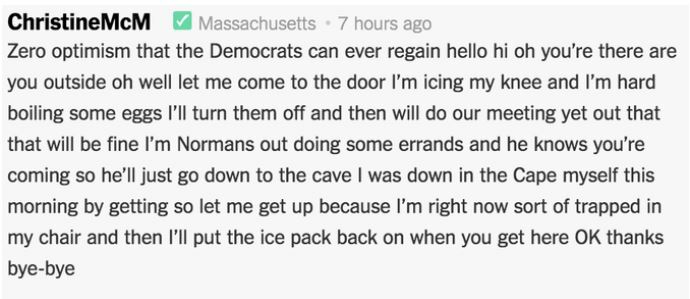
In response, Christine explained that someone came to her door in the middle of her writing the post. She didn't turn off the program, so whatever she said got translated and posted for all to read. As she describes,
"I was composing a message using the autospeak, and a friend arrived early to my house," she wrote in a reply further down the thread. "I had no idea all that drivel was being recorded - there are even errors in the drivel! And then to be a pick, with about 15 emails announcing such, meant that my email went rogue."
Discussion:
- How have you used voice-to-text programs? What are the benefits?
- This examples gives us one obvious downside of using transcription services. What are some others?
Tarantino Admits to Knowing More
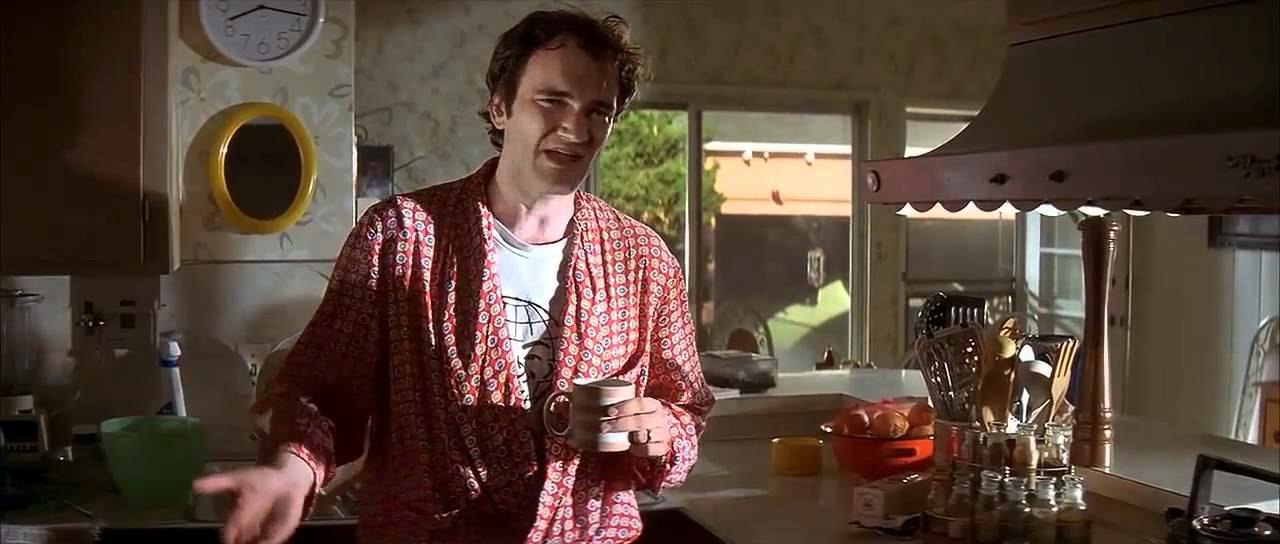 As more female victims come forward to describe Harvey Weinstein's sexual harassment behavior, one male celebrity admits to knowing and doing not enough about it at the time. Director Quentin Tarantino said, "I knew enough to do more than I did," and "There was more to it than just the normal rumors, the normal gossip. It wasn't secondhand. I knew he did a couple of these things."
Tarantino cited incidents with women including his former girlfriend Mira Sorvino and also said, "I wish I had taken responsibility for what I heard," and "If I had done the work I should have done then, I would have had to not work with him."
The director regrets not seeing the larger pattern of abuse and demonstrates vulnerability when he admits, "Anything I say now will sound like a crappy excuse," and "I chalked it up to a '50s-'60s era image of a boss chasing a secretary around the desk," he said. "As if that's O.K. That's the egg on my face right now."
Unsurprisingly, Tarantino says others close to Weinstein also knew and did nothing to stop the abuse.
Above is a picture of Tarantino in the movie Pulp Fiction.
Discussion:
- What's your reaction to Tarantino's statements?
- In what ways is Tarantino demonstrating vulnerability?
- Why do you think he's coming forward now? Why haven't other Hollywood men come forward? Should they?

Harvey Weinstein's Plea
 Harvey Weinstein may have worsened his case by sending emails to friends asking for their defense. After several allegations of sexual harassment and at least two charges of assault over decades, the Hollywood producer's board of directors was getting ready to fire him from the company. Not willing to go quietly, Weinstein emailed people, including Jeffrey Katzenberg, the chairman of Walt Disney Studies. But he didn't get the response he was expecting.
Weinstein's email is below. He demonstrates some vulnerability but fails to take full responsibility, instead saying "a lot of the allegations are false as you know":
My board is thinking of firing me. All I'm asking, is let me take a leave of absence and get into heavy therapy and counseling. Whether it be in a facility or somewhere else, allow me to resurrect myself with a second chance. A lot of the allegations are false as you know but given therapy and counseling as other people have done, I think I'd be able to get there.
I could really use your support or just your honesty if you can't support me.
But if you can, I need you to send a letter to my private gmail address. The letter would only go to the board and no one else. We believe what the board is trying to do is not only wrong but might be illegal and would destroy the company. If you could write this letter backing me, getting me the help and time away I need, and also stating your opposition to the board firing me, it would help me a lot. I am desperate for your help. Just give me the time to have therapy. Do not let me be fired. If the industry supports me, that is all I need.
With all due respect, I need the letter today.
Instead, Katzenberg emailed Weinstein and made his response public. In part, he says, "You have done terrible things to a number of women over a period of years," yet Katzenberg calls him a friend and offers his help.
An interesting part of this story is the criticism of men who have come forward with a preface such as, "As a father of two daughters." A writer for Vulture explains this perspective.
Discussion:
- What's your view of Weinstein's letter to his friends? What other approaches could he take knowing his board is planning to fire him?
- How do you assess Katzenberg's response and his choice to make the email public? Is he a bad friend? What is he trying to accomplish for himself and for Weinstein in his response?
- Finally, what's your view of people referencing their wives and daughters? Is the Vulture writer's perspective spot on, too harsh, or something else?
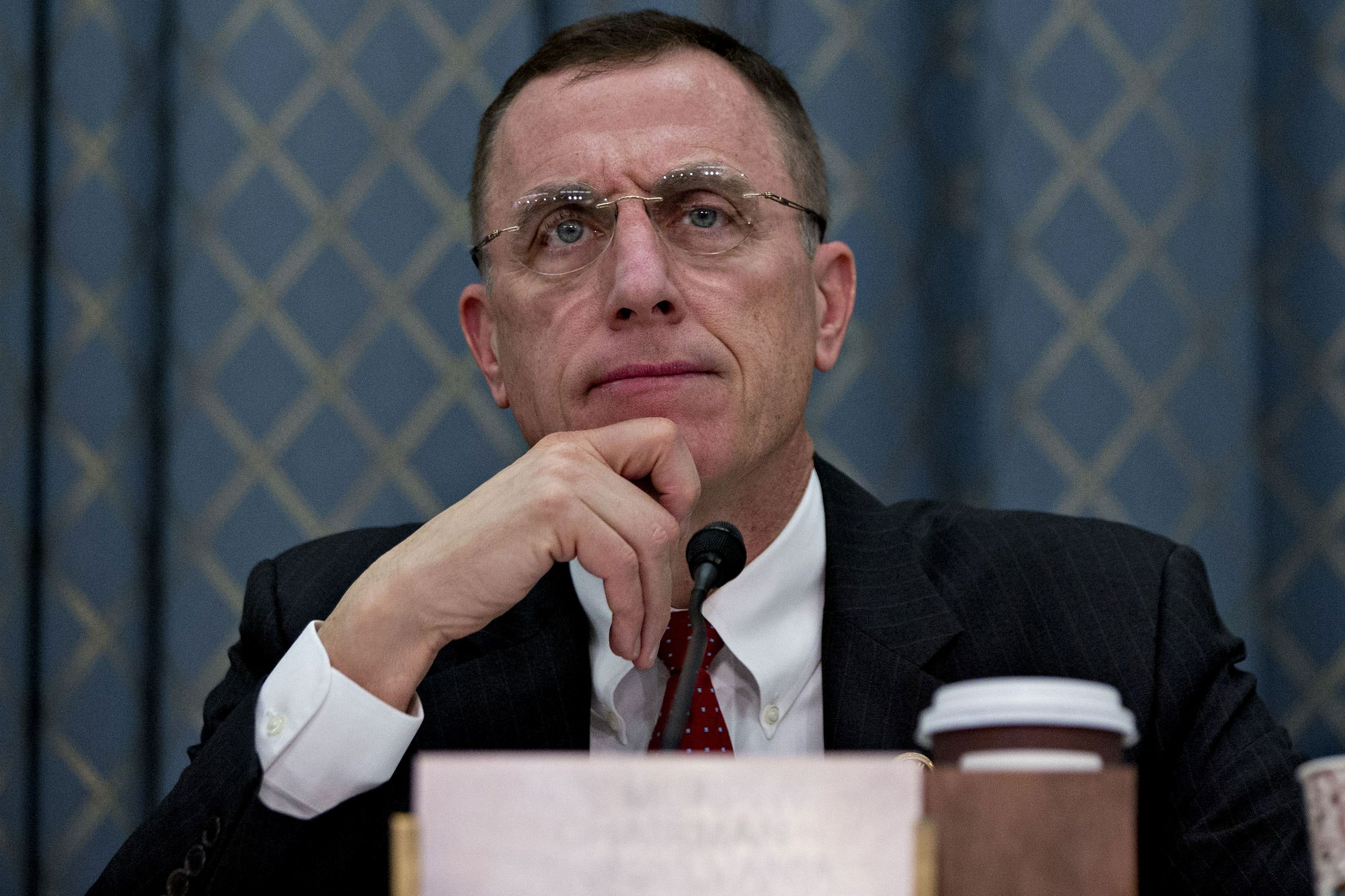
Pro-Life Congressman Resigns
 We might expect a congressman who serves on the U.S. government's House Pro-Life Caucus to be against abortion in his personal life. But Representative Tim Murphy reportedly suggested that his girlfriend get an abortion if she is pregnant.
A women who says she was having an affair with Murphy went public with text messages:
She: "...zero issue posting your pro-life stance all over the place when you had no issue asking me to abort our unborn child just last week when we thought that was one of the options."
He: "I've never written them. Staff does them. I read them and winced. I told staff don't write any more."
Curiously, he didn't dispute her allegation about the abortion request. Pro-life advocates criticized Murphy for his "hypocrisy."
Although the woman wasn't pregnant, Murphy resigned from his position. House Speaker Paul Ryan announced the decision, saying "I think it's appropriate he move on to the next chapter in his life." Murphy said he'll "take personal time to seek help as my family and I continue to work through our personal difficulties."
Murphy also posted a statement on his website:
Statement From Congressman Tim Murphy
For Immediate Release: October 4, 2017
Contact: Carly Atchison 202.225.2301
WASHINGTON, DC - Today Congressman Tim Murphy (PA-18) released the following statement:
"After discussions with my family and staff, I have come to the decision that I will not seek reelection to Congress at the end of my current term.
"I plan to spend my remaining months in office continuing my work as the national leader on mental health care reform, as well as issues affecting working families in southwestern Pennsylvania.
"We have accomplished much in the past year through the Helping Families in Mental Health Crisis Act and there is much work yet to be done.
"In the coming weeks I will take personal time to seek help as my family and I continue to work through our personal difficulties and seek healing. I ask you to respect our privacy during this time."
Discussion:
- Assess Murphy's statement. How well does his address the situation? What else, if anything, could he say, or what could he say differently?
- In what ways is this situation an issue of integrity? Do you see a contradiction, or do you believe Murphy's political stance and personal stance may differ?

Equifax Visits Congress
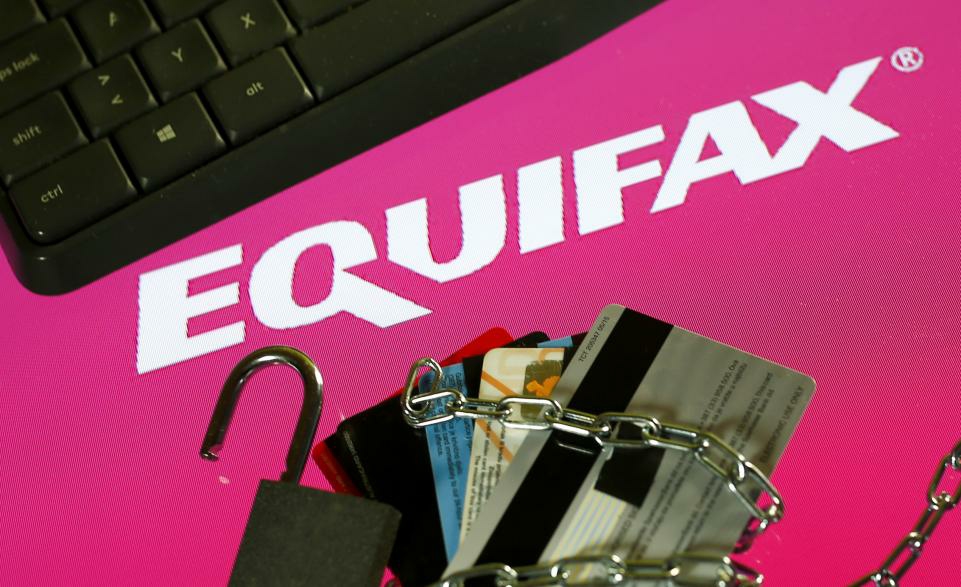 Former Equifax CEO Richard Smith admitted failures during a House Energy and Commerce Committee hearing. Smith had already apologized in a video statement, but during the hearing, he mentioned his personal accountability:
"The criminal hack happened on my watch. I am truly and deeply sorry for what happened."
Yet critics say that Equifax is still not taking full responsibility. A TechCrunch article highlights Smith's testimony blaming one person:
"The human error was that the individual who's responsible for communicating in the organization to apply the patch, did not."
The TechCrunch writer seems to think this is ridiculous:
"The notion that just one person didn't do their job and led to the biggest breach in history is quite an amazing claim and shows a fundamental lack of good security practices. But that's what Smith says led to this disaster."
Smith and Equifax's CIO retired from the company after the news became public, which took a while: executives apparently knew about a software issue back in March, but the company didn't announce the breach until September.
A Wired article cites "6 Fresh Horrors from In addition to the delayed admission, the article attack's Equifax's technology, including inadequate patching, failure to encrypt data, limited security reviews, and insufficient website capabilities.
Another twist is this case is why three top people in the company sold $1.8 million in stock around the time they would have learned of the breach. Smith denies questions of integrity:
"I've know these individual for up to 12 years. They're men of integrity. I have no indication that they had any knowledge of the breach when they made this sale."
Discussion:
- Assess Smith's testimony. What parts do you find most and least convincing?
- What else, if anything, should Equifax do now to rebuild trust?
- In what ways is this case an issue of integrity?

Wells Fargo on the Hot Seat Again
 Again, Wells Fargo executives faced angry lawmakers, and again, Senator Elizabeth Warren encouraged the CEO to leave. This time, she told CEO Timothy Sloan, "You should be fired." Last year, around this time, she told former CEO John Stump, "You should resign." She also referred to Stumpf's actions as "gutless leadership."
Senator John Neely Kennedy had tough words for the CEO too:
What in God's name were you thinking? I am not against big, but with all due respect, I am against dumb. I am against a business practice that has puts Wells Fargo first and customers second.
Sloan defended the board and his leadership by saying that a "throughout, independent investigation" has been made public. He said that he's "been making change at this company for 30 years," his actions have resulted in "fundamental change at the company," and that he has "the support of 270,000 people."
Discussion:
- How convincing do you find Sloan's testimony? Should he continue at Wells Fargo or leave the company?
- Analyze Elizabeth Warren's arguments. Do you find her criticism too harsh, on point, or something else?
- From this longer video segment, do you believe Sloan is holding himself accountable? What tells you he takes responsibility, or what else would he need to do to convince you?