
SoftBank's Vague WeWork Slides
SoftBank already took a financial hit because of its investment in WeWork. Now, the company is facing criticism about its data analysis and presentation.
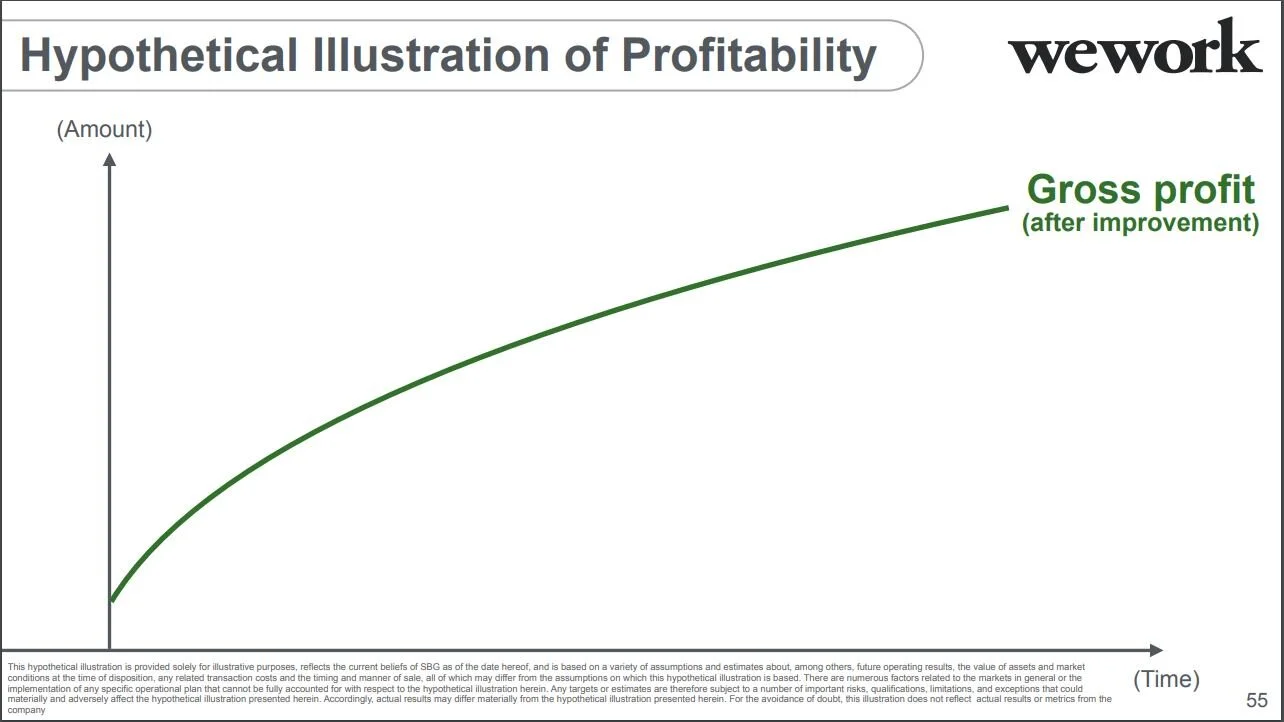
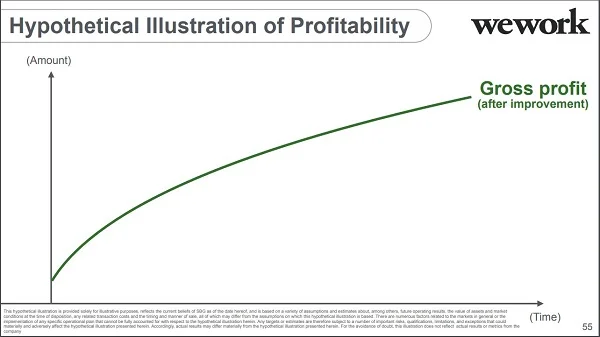
A deck SoftBank Group (SBG) used to justify its WeWork investment includes several “hypothetical” and vague slides, like this one.
If you’re having trouble reading the footnote, here it is:
This hypothetical illustration is provided solely for illustrative purposes, reflects the current beliefs of SBG as of the date hereof, and is based on a variety of assumptions and estimates about, among others, future operating results, the value of assets and market conditions at the time of disposition, any related transaction costs and the timing and manner of sale, all of which may differ from the assumptions on which this hypothetical illustration is based. There are numerous factors related to the markets in general or the implementation of any specific operational plan that cannot be fully accounted for with respect to the hypothetical illustration herein. Any targets or estimates are therefore subject to a number of important risks, qualifications, limitations, and exceptions that could materially and adversely affect the hypothetical illustration presented herein. Accordingly, actual results may differ materially from the hypothetical illustration presented herein. For the avoidance of doubt, this illustration does not reflect actual results or metrics from the company.
The slide title is also odd: the illustration isn’t hypothetical, but the profitability is.
Discussion:
How might this chart affect SoftBank’s credibility?
What other examples in the SoftBank deck are problematic?
What leadership character dimensions are illustrated by this situation?

Letter from WeWork Employees
As WeWork plans layoffs, employees are asking for input into what happens to them and their peers. Referring to themselves as WeWorkers Coalition, the employees wrote a letter to the management team.
To the We Company Management Team:
WeWork’s company values encourage us to be “entrepreneurial, inspired, authentic, tenacious, grateful and together.” Today, we are embracing these qualities wholeheartedly as we band together to ensure the well-being of our peers.
We come from many departments across the company: building maintenance, cleaning, community, design, product, engineering and more. We believe that in the upcoming weeks we have the unique opportunity to demonstrate our true values to the world. This is a company that has inspired many of us, challenged us, and has been a formative personal and professional experience for those of us who began our careers here. WeWork has been not just a workplace, but a source of friendships and inspiration along the way.
We also believe our product can have a lasting positive impact on the world. We want to improve workplace happiness for millions of office workers and support small and medium sized businesses in their entrepreneurial efforts. We have been proud to support these goals and dedicate our time and talent to achieve them. This has been our story so far.
Recently, however, we have watched as layers are peeled back one-by-one to reveal a different story. This story is one of deception, exclusion and selfishness playing out at the company’s highest levels. This is a story that reads as a negation of all our core values. But this story is not over.
Thousands of us will be laid off in the upcoming weeks. But we want our time here to have meant something. We don’t want to be defined by the scandals, the corruption, and the greed exhibited by the company’s leadership. We want to leave behind a legacy that represents the true character and intentions of WeWork employees.
In the immediate term, we want those being laid off to be provided fair and reasonable separation terms commensurate with their contributions, including severance pay, continuation of company-paid health insurance and compensation for lost equity. We are not the Adam Neumanns of this world — we are a diverse work force with rents to pay, households to support and children to raise. Neumann departed with a $1.7 billion severance package including a yearly $46 million “consulting fee” (higher than the total compensation of all but nine public C.E.O.s in the United States in 2018). We are not asking for this level of graft. We are asking to be treated with humanity and dignity so we can continue living life while searching to make a living elsewhere. In consideration of recent news, we will also need clarity around the contracts our cleaning staff will be required to sign in order to keep their jobs, which are being outsourced to a third party. Those of us who have visas through WeWork need assistance and adequate time to find a new employer to sponsor our respective visas.
In the medium term, employees need a seat at the table so the company can address a broader range of issues. We’ve seen what can happen when leadership makes decisions while employees have no voice. We will need to see more transparency and more accountability.
We also need the thousands who maintain our buildings and directly service members to receive full benefits and fair pay, rather than earning just above minimum wage.
We need allegations of sexual misconduct and harassment to be taken seriously, acted on immediately and resolved with transparency.
We need diversity and inclusion efforts to materialize into real actions, not just talking points at company meetings.
We need salary transparency so we can surface and address systemic inequalities.
We need an end to forced arbitration contracts, which strip employees of their right to pursue fair legal action against the company.
We need all of this, and more.
In the long term, we want the employees who remain at WeWork, and those who join in the future, to inherit something positive we left behind. We want them to never find themselves in this position again, and for that to happen, they need a voice.
With this letter we are introducing ourselves, the WeWorkers Coalition. We are taking full advantage of our legal right to establish this coalition, and in doing so, we hope to give the future employees of WeWork the voice we never had.
We want to work with you. Please join us in writing a better ending to this chapter of the WeWork story.
By this Thursday at 5:00 p.m. EST, we would like to receive confirmation of your receipt of this letter and an indication of your willingness to meet us.
The WeWorkers Coalition
@weworkersco • info@weworkersco.org • #weworkers-coalition
Discussion:
What principles of business writing do the employees follow?
What persuasive strategies do they use in the letter? Find examples of logical argument, emotional appeal, and credibility.
What do you consider the strongest and weakest arguments?
What leadership character dimensions are illustrated in this situation?

Boeing CEO Responds to Questions
This week, Boeing CEO Dennis Muilenburg answered lawmakers’ questions about the two Max 737 plane crashes in the past year. Facing families of deceased passengers, Muilenburg began his testimony with an apology:
“I’d like to begin by expressing my deepest sympathies to the families and loved ones of those who were lost in the Lion Air Flight 610 and Ethiopian Airlines Flight 302 accidents, including those who are here in the room today. I wanted to let you know, on behalf of myself and all of the men and women of Boeing, how deeply sorry I am. As we observe today the solemn anniversary of the loss of Lion Air Flight 610, please know that we carry the memory of these accidents, and of your loved ones, with us every day. They will never be forgotten, and these tragedies will continue to drive us to do everything we can to make our airplanes and our industry safer.”
One of the most tense moments was when Senator Ted Cruz questioned Muilenburg (see video). Muilenburg also faced criticism as he was leaving. The mother of a victim of the second crash responded to his invoking his Iowa farm background:
“Go back to Iowa. Do that.” She also said, “I don't feel like you understand. It's come to the point where you're not the person anymore to solve the situation."
Discussion:
Watch more of Muilenburg’s testimony. What are some examples of questions he addressed well, and how could he have done better?
How well does Muilenburg balance emotional appeals, logical arguments, and credibility in his testimony?
What leadership character dimensions are illustrated by this situation and by Muilenburg’s testimony?
Muilenburg’s interaction with the mother is a difficult situation for anyone to handle, and we can certainly understand her grief and anger. How would you have responded?
CNN reports:
“In response, Muilenburg said he respects her viewpoint. "But I want to tell you the way I was brought up. And I'm just being honest here about it. I learned from my father in Iowa ... when things happen on your watch you have to own them and you have to take responsibility for fixing them," he said.

Plain Language from Financial Advisers

A Wall Street Journal writer asks financial advisers to speak to us in plain English. A new Securities and Exchange Commission rule—described in 564 pages—calls for simpler writing. But the author wants advisers to go further, for example, to use more visuals and categories: “color-coded from red to green, for instance, or arrayed on a scale from 1 to 10.”
Fortunately, the rule includes a summary, although students of business communication will find problems:
The Securities and Exchange Commission (the “Commission” or the “SEC”) is adopting new rules and forms as well as amendments to its rules and forms, under both the Investment Advisers Act of 1940 (“Advisers Act”) and the Securities Exchange Act of 1934 (“Exchange Act”) to require registered investment advisers and registered broker-dealers (together, “firms”) to provide a brief relationship summary to retail investors. The relationship summary is intended to inform retail investors about: the types of client and customer relationships and services the firm offers; the fees, costs, conflicts of interest, and required standard of conduct associated with those relationships and services; whether the firm and its financial professionals currently have reportable legal or disciplinary history; and how to obtain additional information about the firm. The relationship summary will also reference Investor.gov/CRS, a page on the Commission’s investor education website, Investor.gov, which offers educational information to investors about investment advisers, broker-dealers, and individual financial professionals and other materials. Retail investors will receive a relationship summary at the beginning of a relationship with a firm, communications of updated information following a material change to the relationship summary, and an updated relationship summary 2 upon certain events. The relationship summary is subject to Commission filing and recordkeeping requirements.
Plain language in government documents started as an initiative in the 1990s, and the group highlights before-and-after examples.
Discussion:
How could you rewrite the summary, above, for easier reading?
Review the Plain Language website. What are your impressions of the group’s work?

Business Leaders Sign Letter to Top Officials

Fifty CEOs and business school leaders signed a letter to President Trump and other top-ranking politicians urging action to allow for more international applications. The letter comes after a report by the Graduate Management Admissions Council showing declining applications.
Report conclusions follow:
[A]llowing top talent to study and work in the country of their choice helps create jobs, not take them. It offers insight into changing trends for historically talent-attracting and talent-supplying countries. Business school applications are a powerful metric—and forecast—of the success of individual economies in prioritizing talent and therefore leading innovation and growth. A survey of these latest metrics shows change in our midst—and for certain economies, warning signs for the future.
In their letter, the business leaders write that the U.S. is “needlessly capping our growth and can do better.” They urge U.S. politicians to allow more movement by taking the following action:
Removing “per-country” visa caps, modernizing our visa processing system, and reforming the H-1B visa program to make it possible for the most talented people to have a reasonable chance of gaining entry to the United States.
Creating a “heartland” visa that encourages immigration to the regions of the United States that could most use the vitality of these talented individuals.
Discussion:
Analyze the letter. Who are the primary and secondary audiences? What are the communication objectives? How do you assess the organization and writing style?
What persuasive communication strategies do the writers use? Which are most and least effective?
Analyze the report using the same questions.
How well does the infographic summarize the report conclusions? What could be improved?
Reciprocity in the News
Students of persuasion likely learned about reciprocity. In my class, we discuss reciprocity as a logical reasoning type and as one of Cialdini’s six principles of persuasion. We also talk about quid pro quo, meaning “this for that,” as a type of sexual harassment.
Steven Pinker, a cognitive scientist at Harvard, wrote an opinion piece in the New York Times titled, “A Linguist’s Guide to Quid Pro Quo,” referring to the discussions between President Trump and Ukrainian President Volodymyr Zelensky.
President Trump and his supporters have gone to the heart of the issue, denying any quid pro quo. Senator Lindsey Graham of South Carolina tweeted, “What a nothing (non-quid pro quo) burger.” Defenders also say that this type of reciprocity is common for political leaders.
Pinker believes that an explicit “if,” “then” construction isn’t necessary for a quid pro quo agreement:
It’s true that the transcript of the reconstructed conversation does not reveal a smoking sentence with an “if” and a “then.” But to most readers, Mr. Trump’s claim that he was merely musing about his druthers does not pass the giggle test. That is because people in a social relationship rarely hammer out a deal in so many words but veil their offers in politeness and innuendo, counting on their hearers to listen between the lines.
More typically, we see politeness in reciprocal transactions. During the call, President Trump said, “I would like you to do us a favor though.”
This article also raises issues about a “transcript,” which he describes as a reconstructed conversation. The summary isn’t verbatim, and it’s unclear whether a recording exist.
Discussion:
Describe reciprocity as a method of influence. What is the value to business relationships, and what dangers should be avoided?
Talk about a time when you practiced reciprocity, but it felt imbalanced—either for you or for the other person? How did it feel? How can avoid this in the future?
In this case, do you think President Trump crossed a line, or do you believe his statement, “There was no quid pro quo”?

LeBron James Enters the Tweet Debate
As the NBA struggles to recover after Houston Rockets General Manager Daryl Morey tweeted in support of Hong Kong protesters, LeBron James questioned Morey’s choice:
“Yes, we all do have freedom of speech. But, at times, there are ramifications for the negative that can happen when you’re not thinking about others, when you’re only thinking about yourself. . . . I believe he wasn’t educated on the situation at hand, and he spoke. And so many people could have been harmed, not only financially, but physically, emotionally, spiritually. So just be careful. . . .”
The Wall Street Journal reports that people were “stunned” by his comment because James is typically careful about his public comments.
Discussion:
What’s your view of James’ commenting on the situation? Should he have avoided commenting? Why or why not?
What’s your view of his comments? How well did he handle the situation?
What leadership character dimensions are illustrated by James’ comments?

NBA Tweetstorm
The NBA is thrust into a political quagmire after Houston Rockets general manager Daryl Morey tweeted in support of the Hong Kong protesters: '“Fight for Freedom. Stand with Hong Kong.” The tweet has since been deleted.
NBA Commissioner Adam Silver is dancing a line between protecting Morey’s free speech and staving off China’s backlash. Critics say the league is driven by profit instead of principle. He has tried to clarify his position:
“It is inevitable that people around the world — including from America and China — will have different viewpoints over different issues. It is not the role of the NBA to adjudicate those differences. However, the NBA will not put itself in a position of regulating what players, employees and team owners say or will not say on these issues. We simply could not operate that way.”
At this point, The Wall Street Journal reports better news:
“The situation appears to have de-escalated. After a week of blistering anti-NBA rhetoric in Chinese media, the government is signaling that it’s time to cool it, a message that includes the vitriol directed at the Rockets, according to one person familiar with the situation.”
But the Journal also acknowledges: “China’s love affair with the Rockets might not be the same again.”
Discussion:
Should Morey have avoided sending the tweet? Why or why not?
How do you assess the league’s response to the situation?
Analyze Silver’s news conference. What did he do well, and what could he have done differently?
WeWork: "Humbler"
Several articles in the past few weeks have scolded WeWork CEO Adam Neumann and the investors who followed his story.
The Wall Street Journal was the first to describe Neumann’s odd behavior and published another article, “WeWork Investors Turned Off by ‘Sloppy’ IPO Filings.” The recent article explains one problem in the filings (shown below):
“A section headed ‘illustrative annual economics’ that assumed 100% workstation utilization vanished, for example, as did two graphs portraying a typical location going from ‘-$’ to ‘+$,’ with no y-axis showing the actual dollar amounts being depicted.”
A New York Times article, “Was WeWork Ever Going to Work?” criticizes investors for missing obvious problems with the company’s initial business plan, such as the reliance on start-up revenue when most entrepreneurial ventures fail. According to this report, it took people finally looking at the data to realize how much We is losing and how hard it will be for the company to succeed.

The article includes other examples of investors’ blind exuberance:
“It is not merely money that separates the ruling class from the rest of the country. Often it seems as if it is the gaping difference in the application of common sense. Ultimately, it was the bankers, technocrats, statesmen and acolytes of the data-junkie class who were willing to believe that Elizabeth Holmes, a 19-year-old college dropout who thought a black turtleneck would make her Steve Jobs, was going to revolutionize blood-testing. It didn’t seem to matter that she could not deliver any real evidence to prove it.”
An Inc. article, “The Future of WeWork: Leaner, Humbler, and Duller,” suggests a new path for We. The author suggests less hype, fewer employees, and more discipline for the company to survive.
Discussion:
Who do you blame for WeWork’s failed IPO?
If you believe the New York Times article, investors are gullible. Do you agree with this assessment? If so, why might this be the case?
Read the “Note”—the fine print—under the table, shown above. How do you interpret this information?
What should We do now to build credibility and save the business?
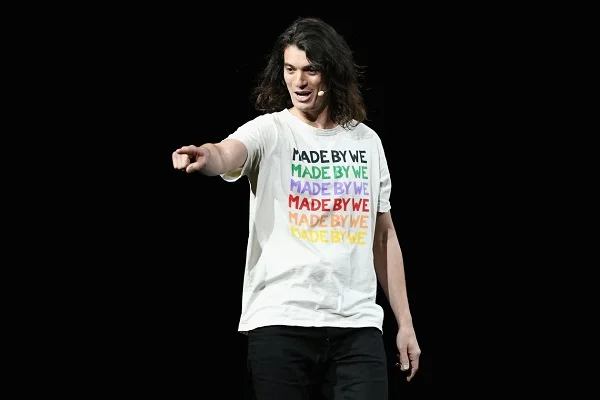
WeWork Co-Founder and CEO Steps Down

WeWork announced that Adam Neumann will leave his position after controversy about the company’s financial situation and the co-founder and CEO’s behavior. Within a week, the company went from preparing for an IPO to facing criticism that led to this ouster and a delayed public offering.
The company valuation has been reduced from about $47 to $15 billion based on governance issues and what the Wall Street Journal calls “ballooning losses.” The Journal also reported on Neumann’s “eccentric behavior,” including a heavy-party lifestyle that recently involved bring marijuana on a plane to Israel and saying that he might like to be the prime minister.
In its news release, WeWork provided scant information and a few quotations, including this from Neumann:
“As co-founder of WeWork, I am so proud of this team and the incredible company that we have built over the last decade. Our global platform now spans 111 cities in 29 countries, serving more than 527,000 members each day. While our business has never been stronger, in recent weeks, the scrutiny directed toward me has become a significant distraction, and I have decided that it is in the best interest of the company to step down as chief executive. Thank you to my colleagues, our members, our landlord partners, and our investors for continuing to believe in this great business.”
Discussion:
Compare the company’s news release to others announcing CEO departures. How does this one differ, and why would the company take this approach?
What are the communication objectives of Neumann’s statement? How well does his quote meet those objectives? What else, if anything, should Neumann say or do?
Amazon Response to Employee Walkout
Like many around the world during the Global Climate Strike, hundreds of Amazon employees walked out of their offices yesterday. Employees have been urging Amazon leaders to take more steps to reduce fossil fuel dependency and wrote an open letter back in April. The pressure seems to be working.
On Thursday, CEO Jeff Bezos announced The Climate Pledge, with the following commitments:
Commits to net zero carbon by 2040 and 100% renewable energy by 2030
Orders 100,000 fully electric delivery vehicles, the largest order ever for electric delivery vehicles
Invests $100 million in reforestation projects around the world to begin removing carbon from the atmosphere now
Launches new sustainability website to report progress on commitments
The Pledge encourages other businesses to sign on, with Amazon leading the way. Bezos said, “We’re done being in the middle of the herd on this issue — we’ve decided to use our size and scale to make a difference.” Amazon employees reacted positively.
Discussion:
Analyze the employees’ open letter. What persuasive strategies do they use? Look for examples of logical argument, emotional appeal, and credibility. What organizational strategies do the writers use?
The Amazon announcement doesn’t mention employees’ influence in the decision, although news articles and employees make the connection. Should Bezos include this recognition? Why or why not?
Describe a CEO’s dilemma in situations like these. When is it appropriate for leaders to meet their employees’ demands, and when should they resist? Did Bezos take the best course of action?

The Purpose of the Corporation

The Business Roundtable published a statement, The Purpose of the Corporation, signed by 181 of its 193 members. The Roundtable, a corporate lobbying group, includes CEOs of the largest U.S. companies.
In essence, the CEOs write that they have responsibilities beyond shareholders—to customers, employees, suppliers, and communities (including the environment). The statement is a step to improving the perception of businesses as solely driven by creating shareholder value through short-term profits.
Skeptics abound. A writer for the Washington Post called the statement a “truism”:
“What’s significant about the statement is what it does not say. The corporate signatories do not suggest in any way weakening the fiduciary duties of the boards and managers of ordinary for-profit shareholder corporations to manage such companies’ affairs for shareholders’ benefit.”
The CEO of Allstate and head of the U.S. Chamber of Commerce wrote an opinion piece in the New York Times encouraging businesses to pay people more if they’re serious about serving more stakeholders.
A writer for Forbes argued that these companies are multinationals and have global responsibilities as well. He also accused the executives of being self-serving, warding off criticism about executive compensation.
Others noted company CEOs who didn’t sign, for example, Alcoa, Blackstone, GE, NextEra, Parker Hannifin, and Wells Fargo (whose representative said the CEO is interim and wasn’t asked to sign). Some companies, for example, Kaiser and State Farm, say they didn’t sign because they don’t have shareholders.
Discussion:
What’s your view of the statement: significant, placating, diverting, or something else?
Assess the statement itself. Consider the audience, purpose, writing style, organization, and so on. What works well, and what could be improved? What’s extraneous and what’s missing?

Overstock CEO Resigns
Overstock CEO Patrick Byrne resigned after admitting to a relationship with Russian agent Maria Butina. Butina is serving prison time because of her attempts to gain political access during the 2016 U.S. presidential election.
Byrne announced his decision in a letter to shareholders. He begins with the news:
“In July I came forward to a small set of journalists regarding my involvement in certain government matters. Doing so was not my first choice, but I was reminded of the damage done to our nation for three years and felt my duty as a citizen precluded me from staying silent any longer. So, I came forward in as carefully and well-managed fashion as I could. The news that I shared is bubbling (however haphazardly) into the public. Though patriotic Americans are writing me in support, my presence may affect and complicate all manner of business relationships, from insurability to strategic discussions regarding our retail business. Thus, while I believe that I did what was necessary for the good of the country, for the good of the firm, I am in the sad position of having to sever ties with Overstock, both as CEO and board member, effective Thursday August 22.”

Byrne’s letter then describes his thinking about Overstock, including blockchain technology, retail, and strategy.
This announcement came 10 days after Byrne wrote a news release titled, “Overstock.com CEO Comments on Deep State, Withholds Further Comment.” In that post, he refers to “Men in Black” and his “Omaha Rabbi,” reinforcing perceptions that Byrne is a controversial figure.
MarketWatch shows the stock performance during this period.
Discussion:
What’s your view of Byrne’s decision to resign? Consider his history with Overstock, company performance, and the company trajectory.
CNN referred to Byrne’s first news release as “strange.” Do you agree?

Backlash After President Trump Fundraiser

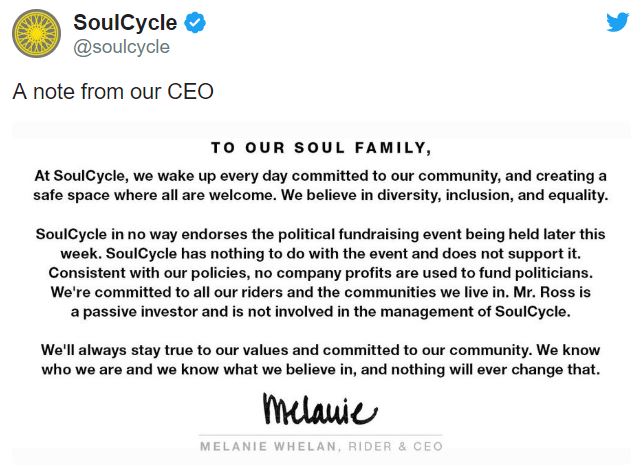
Equinox and SoulCycle customers are not happy about a fundraiser for President Trump sponsored by the companies’ owner, the chairman of a real estate firm. Threats of boycotts and cancelled memberships provoked quick responses from both companies.
SoulCycle CEO Melanie Whelan also said, “SoulCycle has nothing to do with the event and does not support it. … We know who we are and we know what we believe in, and nothing will ever change that.”
Capitalizing on the brands’ distress, other fitness companies are offering discounts and free trials to try to win business.
Discussion:
More company executives feel inspired towards political activism. What are the advantages and risks?
Did the real estate company owner, Stephen Ross, act inappropriately by hosting a fundraiser? Why or why not?
Analyze the companies’ statements. What persuasion strategies do they use to rebuild each brand?
Compare the statements. Does one work better than the other? What criteria do you use to compare them?

Another Blackface Disaster

Belgium’s Africa museum hosted an event for which people arrived in pith helmets, blackface, and other offensive and stereotypical clothing. Understandably, the Congolese community is upset. As one representative said, "Ethnic, exotic or African is not a costume that you can put on and take off.” You can read about Belgium’s occupation of the Congo to understand the history.
The party was organized by a separate company, Thé Dansant, and one organizer defended the party: “Even if one person painted his face black, it was not meant to be offensive. Many people of African origin were enthusiastic about the concept and were present.”
So far, the Royal Museum of Africa is trying to distance itself from the event and hasn’t issued a statement or apology.
Museum image source.
Party image source.
Discussion:
What’s your view of Thé Dansant’s response?
What is the museum’s accountability? What should the leaders do or say?

Employees Pressure Walmart to Consider Role in Gun Violence

Walmart is in a tough spot after recent shootings. Some employees are pressing the company to do more to fight gun violence, but no policy changes are planned. After previous attacks, Walmart stopped selling assault-style weapons and raised the minimum age to purchase guns and ammunition, but it’s unclear whether the leaders will do more. Employees are asking Walmart to stop selling firearms and to disallow customers from carrying guns into the stores.
The company seems divided about employees’ activism. Chief Executive Doug McMillon wrote, ”We are proud to be woven into the American fabric as a place for all people. We are more resolved than ever to foster an inclusive environment where all people are valued and welcomed.” At the same time, the company blocked two employees’ access to Slack, encouraging employees to use “more constructive ways for associates to offer feedback such as emails or conversations with leaders.”
A study recently published in the International Journal of Business Communication found that employees are more likely to “express dissent to managers and coworkers” when they are more socialized in the company and when they believe their company is “more ethical and reputable.”
A Wall Street Journal article explains the risk for Walmart to take more action against gun sales:
“[A]ny change to its gun policies risks alienating Walmart’s core customers, who often live in more conservative-leaning rural and suburban communities. The company faced some consumer backlash after raising the minimum age to purchase guns to 21.”
Discussion:
How can the company balance employees’ and customers’ perspectives? What else, if anything, should company leaders say and do?
Did the company do the right thing by blocking Slack access? In what ways are email and conversations more or less “constructive”?
What leadership character dimensions are illustrated by this situation?

Capital One's Response to the Breach

A hacker got access to 140,000 Capital One customers’ credit information and social security information, and about 106 million people were affected by other leaked information. Officials arrested Paige A. Thompson, who goes by “erratic” and was a former Seattle technology company software engineer.
In a bar chart, a BBC article puts this breach in context of others. Capital One’s press release describes the company’s quick response:
“Capital One immediately fixed the configuration vulnerability that this individual exploited and promptly began working with federal law enforcement.”
The release also includes a statement from Chairman and CEO Richard Fairbank:
"While I am grateful that the perpetrator has been caught, I am deeply sorry for what has happened. I sincerely apologize for the understandable worry this incident must be causing those affected and I am committed to making it right."
In addition, as expected, the release includes information for customers, offers free credit monitoring, and provides an FAQ.
Discussion:
Analyze the press release. Consider the audiences, objectives, organization, tone, and so on.
How well does Fairbanks demonstrate humility in the press release? What other leadership character dimensions are illustrated? How well does he inspire confidence in Capital One?
Analyze the BBC chart shown here. What works well about the chart, and what else would be helpful to understand these breaches in context?

Noncompete Agreements for Interns

A Wall Street Journal article reports that college interns are increasingly asked to sign agreements that restrict their job choices in the future. “Noncompete, nondisclosure and forced arbitration agreements,” which have been common for senior-level employees, have made their way down the ranks.
Now, interns are asked to sign agreements on their first day with a company, and they don’t always understand what they’re signing. An agreement can prevent a new grad from, for example, accepting an offer with a competitor within a geographic region.
Some agreements are important for companies to protect their intellectual property and preserve confidentiality, but critics say they go overboard. Also, such agreements may not hold up in court, particularly when they affect low-skilled workers.
Bottom line: interns should be careful about what they sign. An agreement may be more of a deterrent and might not inspire legal action, but students shouldn’t have to feel as though their choices are limited right after graduation.
Signing image source.
Noncompete image source.
Discussion:
What’s your experience with these employment agreements?
What would you do if asked to sign one?
What should companies do differently to protect themselves?

How to Navigate Multiple Offers
It’s one of those “good problems”: getting more than one job offer. But navigating the relationships and making a decision can be tough.
A Wall Street Journal article tells the story of a man faking his own death to avoid telling a company that he didn’t want to take the job after accepting an offer. According to an executive at the staffing company Robert Half, “ghosting” a prospective employer is most common among people out of school between two and six years. More and more, employers receive last-minute text messages or no-shows on the first day of work.
A management consultant believes the trouble is that college students lack the communication skills to handle these situations more professionally: “This is the generation that breaks up by text message, so in a professional context, to have to let someone down or give bad news was terrifying.”
Twice this past semester, students asked me for advice in reneging offers. Overall, I’m not a fan of the tactic. To me, it’s an issue of integrity: when students make a commitment to one employer, they shouldn’t change their minds when a better offer comes along. I also worry about their reputation in the industry—and whether their expectations will be too high for the new job, and they’ll end up disappointed. At Cornell, students also give up their access to career services in the future when this happens.
But students do what is best for them. What matters after the decision is how it’s communicated. I always suggest a phone call rather than an email, which takes courage. A direct, honest approach is best, with an apology and some understanding of how the decision affects the employer, who’s left with an unfilled position and additional recruiting time.
Ideally, students get offers at the same time with the same decision deadlines, but of course, that’s not always the case, and comparing offers becomes challenging. The WSJ article recommends these practices for evaluating and accepting job offers:
DO
* Make clear early what you’re looking for in a new job.
* Ask employers their timeline for making a decision.
* Express appreciation and enthusiasm when receiving an offer.
* Take time to assess each offer carefully, weighing both financial and quality-of-life factors.
DON’T
* Communicate important decisions by text or email.
* Try to pit one employer against another in a bidding war.
* Respond to a job offer by announcing that you already have a competing one.
* Base your decision solely on pay.
Discussion:
Have you been in a situation of having multiple offers? How did you handle it?
Have you reneged on an offer? How did you communicate the decision, and how did the employer react?
What other advice would you give students who have multiple offers?

Rutgers Chancellor "Berates" Police Officers
The Chronicle reported that Rutgers Chancellor Nancy E. Cantor “apologized for berating campus police officers.” On her way to the airport, Cantor’s driver hit a parked police car. She was detained and said, “If I miss my airplane, you folks are in trouble!” When an officer asked, “I’m sorry, who are you?” she yelled, “I’m the chancellor!”
The episode, which happened in March, was recorded on the officer’s body camera. Part of the debate is about whether Cantor needed to be detained because she entered the vehicle after the driver hit the other car.
Regardless, the video became public, Cantor apologized, and the Rutgers-Newark police chief responded:
“I appreciate Chancellor Cantor taking the time to review the video. I along with the RUPD are appreciative of her kind words and support. The sentiment is extremely appreciated, and we look forward to continuing a positive working relationship with the Rutgers-Newark chancellor’s office.”
Discussion:
Watch the video exchange. What’s your view of the chancellor’s behavior with the police officers?
Should the officers have done anything differently in this situation? Why or why not?
Assess the police chief’s response. How well does he demonstrate forgiveness?