
Boarding School Admits Responsibility in Suicide
In a written statement one year after a student’s death by suicide, a New Jersey boarding school took responsibility for its role and committed to action. Some call the admission “rare,” which is true, and “courageous,” or taking action despite risks, and I disagree. The statement announces a settlement with Jack Reid’s parents, so its liability is already determined. In other words, administrators suffer few risks by confessing what is obvious.

Statements at the time of his death are typical. After a trigger warning pop-up, we see condolences, vigils, counseling, and other support, and a separate message to alumni.
The recent message, under a tab labeled “Anniversary Statement,” describes a clearer picture about the circumstances surrounding Reid’s death. He was bullied, the victim of a false rumor. News reports say he was called a rapist and was subjected to cruelty as a result.
Providing specific examples of how the school failed Reid and the community is rare in settlement messages and a big step forward. Although the statement isn’t signed by anyone in particular, which would have been a nice touch, the school identifies specific missed opportunities in the third and fourth paragraphs.
The statement is a good model. During the bullying, school officials lacked both accountability and compassion for what was happening to Reid, and they admit this failure. The school is already vulnerable, so why not allow leaders to admit vulnerability. The statement also expresses humility by identifying wrongdoings and the willingness to learn from mistakes.
But is it courageous? The specific examples may open opportunities for more criticism, which is a risk, but the lack of action at the time is fairly obvious. Despite Reid’s complaints, little or nothing was done. A lead bully was suspended but for unrelated reasons. Then, all students saw him return to school—back to Reid’s same dorm. Reid died by suicide that night.
We experienced the tragic loss of Jack Reid on April 30, 2022 and through great sorrow, came together in meaningful ways as a community. The Special Oversight Committee of the Board of Trustees conducted a five-month review of the circumstances surrounding Jack’s death by suicide, and produced a summary of findings that were shared with the community in December 2022.
April 30, 2023
The Lawrenceville School and William and Elizabeth Reid, parents of Jack Reid, have reached an agreement in the wake of the tragic loss of Jack, a Fourth Former in Dickinson House, who died by suicide on April 30, 2022. Jack was universally regarded as an extremely kind and good-hearted young man, with an unwavering sense of social and civic responsibility and a bright future. We continue to mourn this loss.
As we seek to improve as a community, we have examined our role and take responsibility for what we could have done differently. Lawrenceville’s top priority is the physical, social, and emotional health, safety, and wellbeing of our students. We recognize that in Jack’s case, we fell tragically short of these expectations.
Jack was a victim of bullying and other forms of cruel behavior at Lawrenceville over the course of a year, including in the form of false rumors in person and online. When these behaviors were brought to the attention of the School, there were steps that the School should in hindsight have taken but did not, including the fact that the School did not make a public or private statement that it investigated and found rumors about Jack that were untrue. There also were circumstances in which the involvement of an adult would have made a difference.
In addition, on April 30, when the student who previously had been disciplined for bullying Jack was expelled for an unrelated violation of School rules, the School allowed him to return to Dickinson House largely unsupervised where students gathered, including some who said harsh words about Jack. School administrators did not notify or check on Jack. That night, Jack took his life, telling a friend that he could not go through this again. The School acknowledges that bullying and unkind behavior, and actions taken or not taken by the School, likely contributed to Jack’s death.
In the ensuing months, the School undertook an investigation of the circumstances leading up to Jack's death. Reflecting on those findings, and discussing them with the Reid family, we acknowledge that more should have been done to protect Jack.
Today's multi-faceted settlement with the Reids is aimed at honoring Jack, taking appropriate responsibility, and instituting meaningful changes that will support the School’s aspirations of becoming a model for anti-bullying and student mental health.
Over the past year, we have focused on four broad lines of action: training and educational programs, House culture and healthy socializing, the structure of our Dean of Students office and disciplinary protocols, and general health and wellness. In addition to efforts undertaken over the past 12 months, we are planning the following:
Lawrenceville will contract with a specialist on school bullying to help construct policies and training to identify and effectively address the behaviors that lead to bullying and cyberbullying.
Lawrenceville will contribute to the Jack Reid Foundation, a foundation established by the Reid family focused on education and prevention of bullying.
Lawrenceville will hire a Dean of Campus Wellbeing. This will be an endowed position focused on the variety of student mental health issues educational institutions face.
Lawrenceville faculty, professional staff, and students will participate in trainings and workshops to raise awareness and promote better understanding of adolescent mental health.
Consulting with outside experts as needed, Lawrenceville will continue to review and make improvements to its emergency response protocols and crisis response plans; it similarly will review the safety training it provides to faculty and staff to assure it aligns with best practices.
Lawrenceville will make a recurring gift to a mental health organization to support research and best practices for suicide prevention in school environments.
There is, of course, nothing that will ever make up for the tragedy of losing this promising and beloved young man. But it is the hope of all of us that Jack's memory is honored.
Bed Bath & Beyond Communicates Bankruptcy

After years of closing stores, Bed Bath & Beyond communicated its decision to file for bankruptcy and what it means for customers. Messages follow typical bad-news announcements.
A short message on its website, shown here, thanks loyal customers. Perhaps the most important part is that stores are still open: the company needs to sell its remaining inventory.
An email to customers, below, conveys the news upfront, expresses appreciation, and answers questions customers might have. In three of the four bullets, we see “we expect,” communicating uncertainty that might be off-putting to customers with outstanding merchandise, gift cards, or orders. But bullets are clear (use those coupons fast!), and the separate section for registries make sense for worried brides and grooms and shower planners.
This is a sad ending for a former Fortune 500 company with 1,530 stores in 2019. Despite changing consumer preferences and other issues, critics say the company’s demise was caused, in part, by bad management decisions. But none of that matters now; the time for accountability is long gone. Instead, as they should, messages focus on the nostalgia that, for better or worse, kept Bed Bath afloat longer than some expected.
To Our Valued Customers:
Earlier today, Bed Bath & Beyond Inc. filed for voluntary Chapter 11 protection.
We appreciate that our customers have trusted us through the most important milestones in their lives – from going to college, to getting married, to settling into a new home, to having a baby – and we wanted to reach out to you to explain what this means.
Our stores are open and serving customers. However, we have initiated a process to wind down operations.
What This Means for Our Customers
We wanted to make you aware that several of our programs and policies may be changing soon. As of today:
• We expect to process returns and exchanges in accordance with our usual policies until May 24, 2023, for items purchased prior to April 23, 2023
• We expect Gift Cards, Gift Certificates, and Loyalty Certificates will be accepted through May 8, 2023
• We will no longer accept coupons or Welcome Rewards+ discounts beginning April 26, 2023
• We expect all in-stock orders placed online both prior and after our bankruptcy filing to be fulfilled at this time
Registry
Your registry data is safe. You can still view your registry at this time. We expect to partner with an alternative platform where you will be able to transfer your data and complete your registry. We will provide details in the coming days.
We Are Here for You
For Frequently Asked Questions (FAQs) and additional information, please visit
https://restructuring.ra.kroll.com/bbby. Stakeholders with questions can email
BBBYInfo@ra.kroll.com or call at (833) 570-5355 or (646) 440-4806 if calling from outside the U.S. or Canada.
Thank you for your loyalty and support.
Bed Bath & Beyond | buybuy BABY
PRIVACY POLICYUNSUBSCRIBEVIEW ONLINE
Please add bedbathandbeyond@email.bedbathandbeyond.com to your address book.
Please do not reply to this email. Contact us here.
©2022 Bed Bath & Beyond Inc. and its subsidiaries. All rights reserved.
Corporate Headquarters - 650 Liberty Avenue, Union, New Jersey 07083
Southwest Comms and Disruption


After technical issues that caused outsized delays in December, Southwest communicated little, trying to downplay more service disruptions yesterday. The first tweet, shown here, responded to a customer complaint. The second tweet accurately describes the issue as a “pause,” a term a New York Times article repeats, based on the time period. But the impact on passengers was significant: 1,820 flights (43% of the airline’s daily flights) were delayed. A silly gif with moving clip art appeared in the second message for no reason.
On the Southwest website, a short “Operational Update” tries to shift blame to a supplier: “a vendor-supplied firewall went down and connection to some operational data was unexpectedly lost.” Later, a “Travel Advisory” apologized to customers and gave options for no-fee rebooking and standing by—and a list of phone numbers for assistance.
Critics say Southwest’s “outdated” technology might cause more problems until a systemwide upgrade is possible. One communication strategy is to manage customer expectations in the meantime. Telling people to expect delays might ease some pain; of course, that could lead to fewer bookings, but that may likely happen anyway. Passengers will need to be reminded about other benefits of traveling with Southwest.
Fox News Takes Little Responsibility in Settlement Statement

Before the trial began, Fox News settled the Dominion Voting Systems defamation lawsuit and published the vaguest possible statement, below. In few words, the company made no apology and took little responsibility for making false statements about Dominion’s role in rigging machines during the 2020 election.
The settlement doesn’t require an apology or admission of making false claims, but a PBS NewsHour reporter said that the settlement amount, $787.5 million, might convey both. A large sum for a defamation case, the amount is just under half the ask, presumably so Fox can report that the company settled for “less than half.”
Fox’s statement refers to “this dispute with Dominion,” as if the two companies simply disagreed, and Fox wasn’t the one sued. The company also emphasizes the public value of the settlement: “instead of the acrimony of a divisive trial, [it] allows the country to move forward from these issues.” Maybe, but companies settle lawsuits for one primary reason: they believe they will lose.
By this evening, the Fox News website showed no sign of the decision—only the stories shown here. One short news story focused on the agreement and the judge’s positive comments about the attorneys. I found a statement at the bottom of the website under links for About, Media Relations, Press Releases. Overall, the company scarcely demonstrates accountability and humility—or learning from its mistakes. One interpretation of its “continued commitment to the highest journalistic standards” is that nothing will change.
Students might be interested in this story and can discuss whether Fox should have done anything differently from an ethical perspective or, perhaps, from a PR perspective.
Although far from perfect, one comparison is McKinsey’s statement about its involvement with Purdue Pharma and the opioid crisis.
NEW YORK – April 18, 2023 — FOX News Media announced today that a settlement was reached in the Dominion Voting Systems lawsuit.
In making the announcement, the network said, “We are pleased to have reached a settlement of our dispute with Dominion Voting Systems. We acknowledge the Court’s rulings finding certain claims about Dominion to be false. This settlement reflects FOX’s continued commitment to the highest journalistic standards. We are hopeful that our decision to resolve this dispute with Dominion amicably, instead of the acrimony of a divisive trial, allows the country to move forward from these issues.”
FOX News Media operates the FOX News Channel (FNC), FOX Business Network (FBN), FOX News Digital, FOX News Audio, FOX News Books, the direct-to-consumer streaming services FOX Nation and FOX News International and the free ad-supported television service FOX Weather. Currently the number one network in all of cable, FNC has also been the most watched television news channel for more than 21 consecutive years, while FBN ranks among the top business channels on cable. Owned by Fox Corporation, FOX News Media reaches nearly 200 million people each month.
###
Miami Beach Tries to Curtail Spring Break

Students might be interested in analyzing a video of the mayor of Miami Beach instituting a midnight curfew. Dan Gelber’s message comes after two fatal shootings, which he puts into broader context: “As is the case with most serious crime in our city, both shootings were between visitors to Miami Beach and did not involve residents.” Using anaphora as a rhetorical device, he also said, “We don’t ask for Spring Break in our city. We don’t want Spring Break in our city.”
The mayor describes the rapid police response but says police action would never be enough considering “the volume [sic] of people in our city, the unruly nature of too many, and the presence of guns.” He demonstrates accountability and courage with a clear plan despite the risks: a midnight curfew on South Beach within a defined area. The rules are clear, and the mayor refers to the city website for more details.
Mayor Gelber wards off criticism by saying they are within their legal rights. He apologizes for the “disruption and inconvenience” but could acknowledge more specifically the potential negative impact on businesses and residents.
Students may find his delivery interesting, for example, his impassioned speech, word emphasis, and gestures. The setting, his attire, and his choosing to reach a script also reflect on the mayor’s credibility and are worthy discussion topics.
Allbirds Admits Mistakes
Allbirds provides a good example of accountability and humility. No executive likes to discuss disappointing quarterly results, but Joey Zwillinger, co-founder and co-CEO, admitted mistakes, which could improve his credibility for future plans.
On the Q4 2022 earnings call, Zwillinger acknowledged “missteps”:

However, in this journey, we also made some missteps:
1) We overemphasized products that extended beyond our core DNA, and as a result, some products and colors have had narrower appeal than expected.
2) Because we were spending significant time and resources on these new products that did not resonate well, we under-invested in our core consumers’ favorite products.
3) Finally we did not increase our brand awareness to the level that we anticipated.
These communications aren’t quite “bad-news message” because they aren’t announcements, which is why Zwillinger is smart to discuss problems openly: they are already quite obvious to investors. One of my favorite lines is, “As we made those adjacent product development decisions, we unfortunately lost a bit of sight of what our core consumer fell in love with us for in the first place and what they continue to want from us.”
With Zwillinger’s humility—his willingness to admit and learn from mistakes—he inspires confidence that Allbirds can get back to its core products and customers. Zwillinger makes the mistakes sound fixable; they sound like an over-reach that didn’t work out, a bad color choice that can be painted over. Other brands might have a tougher time communicating failure if problems are insurmountable or decisions are irreversible.
Lesson Learned: Don't Use AI in Sensitive Situations

The Office of Equity, Diversity, and Inclusion (EDI) at Peabody College, Vanderbilt University, used ChatGPT to generate an email about the Michigan State campus shooting, and it wasn’t received well. This story illustrates issues of accountability (administrators taking responsibility), but failing compassion in a time of tragedy and failing integrity (consistency).
The email referred to “shootings,” which is not accurate. Otherwise, it sounds like boilerplate, but not that much different from typical emails a campus community receives in these types of situations. Compare that email to one sent from the vice provost and dean of students, which sounds more emotional but is still common.
Perhaps the only giveaway was a line at the bottom:
(“Paraphrase from OpenAI’s ChatGPT AI language model, personal communication, February 15, 2023.”)
On the one hand, I admire the writers’ honesty, doing what faculty are increasingly asking students to do: to identify whether and how they use AI for their writing. But of course, the choice reflects poor judgment.
Student backlash was swift and fierce. Using words like “disgusting” and “sick and twisted,” students called on administrators to “Do more. Do anything. And lead us into a better future with genuine, human empathy, not a robot.” A senior said, “Would they do this also for the death of a student, faculty, or staff member? Automating messages on grief and crisis is the most on-the-nose, explicit recognition that we as students are more customers than a community to the Vanderbilt administration. The fact it’s from the office of EDI might be the cherry on top.”
University officials responded quickly. In a follow-up email to students, an EDI dean wrote, “While we believe in the message of inclusivity expressed in the email, using ChatGPT to generate communications on behalf of our community in a time of sorrow and in response to a tragedy contradicts the values that characterize Peabody College. As with all new technologies that affect higher education, this moment gives us all an opportunity to reflect on what we know and what we still must learn about AI.” Could ChatGPT have written that too?
This is a precarious time for universities, as faculty grapple with how to use AI tools and what policies best serve students and academic goals. Using AI as a starting point for such a sensitive message may never be acceptable, and it’s certainly too soon now. Faculty will have a difficult time enforcing AI policies if they use tools in ways that contradict the spirit of their own guidelines.
FDA Suggests Less Lead in Baby Food
The U.S. Food and Drug Administration (FDA) issued guidance for baby food manufacturers, and the messages serve as good examples of reports and persuasion:

Action Levels for Lead in Food Intended for Babies and Young Children: Draft Guidance for Industry. This is a text report that students could analyze for organization, writing style, evidence, data visualization (or lack there of), etc.
Federal Register Notice. This legal-sounding document explains how to submit comments, either by “electronic submission” or “written/paper submission,” an archaic-sounding process. People also can order paper copies of the draft guidance, something you might do in 1970: “Send two self-addressed adhesive labels to assist that office in processing your request.”
Several times, on the website and within in each document, the agency reminds us, “Contains Nonbinding Recommendations Draft-Not for Implementation.” The agency further describes the “guidance”:
In general, FDA’s guidance documents do not establish legally enforceable responsibilities. Instead, guidances describe FDA’s current thinking on a topic and should be viewed only as recommendations, unless specific regulatory or statutory requirements are cited. The use of the word should in FDA guidances means that something is suggested or recommended, but not required.
The approach attempts to involve industry and consumer groups, who likely have a lot to say about the FDA’s data and recommendations. In the introductory website text, the agency says it considers the goals “achievable by industry when control measures are taken to minimize the presence of lead.” We’ll see whether others agree. Already, one consumer group weighed in, saying the guidance “doesn’t go far enough,” while Gerber and other companies are “reviewing” the proposal.
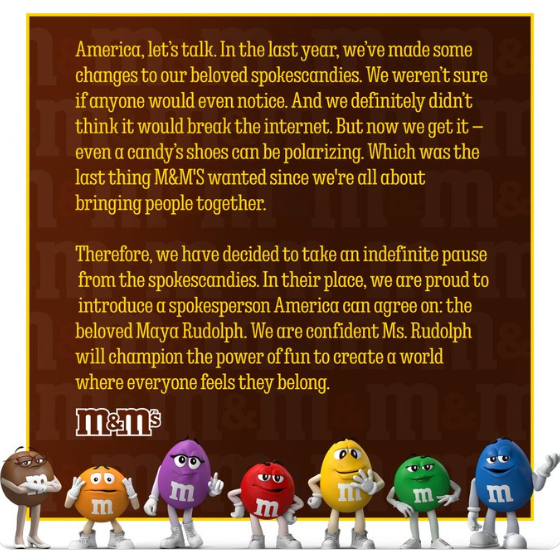
M&M Acknowledges "Polarizing" Spokescandies
M&M explained the decision to eliminate “spokescandies”—cartoon images of the candy. The situation is delicate: Fox News anchors criticized the company’s “woke” M&Ms, and Tucker Carlson seemed particularly offended by Purple, which a Mars Wrigley spokesperson explained in September:
“We’re really excited about Purple because she’s designed to represent acceptance and inclusivity. We want her to be known for her earnest self-expression, keen self-awareness, authenticity, and competence.”
The company acknowledged but didn’t quite strike back against the controversy—or criticism of the previous push for inclusivity in January (see press release). This tweet downplays the original campaign (“We weren’t sure if anyone would even notice”) and jokes, “even a candy’s shoes can be polarizing.”
After backlash from the initial campaign, the spokeperson also tried to shake off the controversy: “We were thrilled to a large extent because it reminded us how iconic our brands are—that people care so deeply about M&M’s and the characters.”
I’m curious how students assess these comments. The company took a stand—and then seemed to back off. After the initial push for “fun,” the tweet reads formally in parts (“take an indefinite pause from the spokescandies”). Maybe students can think of a more creative way to retire the candies, one that demonstrates more accountability and courage. Could Maya Rudolph have done something funny?
Or maybe the company didn’t have to say or do anything differently, as a Forbes writer suggests? Or maybe a candy company should just make great, classic candy and not try to “bring people together”?
Messages About FAA Outage
A Federal Aviation Administration (FAA) outage delayed flights Wednesday morning. As we might expect, the agency posted minimal web communication. With the heading FAA NOTAM Statement, we see a series of updates that apparently only I read: they don’t seem to have any particular audience. But the last message addresses the main concern—that the outage was not caused by a cyberattack.
For his part, Pete Buttigieg went public. In an MSNBC interview, he reassured the public that systems were back online. He also said, "When there's an issue on the government side of the house, when there's an issue with FAA, we're gonna own it, we're gonna understand it, and we're gonna make very clear what's needed in order to fix it and go after that plan." In case you were wondering, he said, “Our number 1 priority is safety.” I was hoping for something a bit more original.
Airlines were left to communicate with their customers. Students could compare airline messages to see how they handle the bad news and how easily customers can find information about flights.
United: I found this message under the tab “Travel Issue” at the top of the page. The following paragraph began that page, with more links and resources following.

“The FAA has lifted their nationwide ground stop and United has resumed operations. Customers may continue to see some delays and cancellations as we work to restore our schedule and should check the United app or united.com for the latest information about their individual flight. United has activated a travel waiver for any customers who need to change their plans, including offering refunds for customers who no longer want to travel. Customers who would like to receive a refund can visit united.com/refund to submit their request.”

American: I clicked on “Travel Information” and scrolled half-way down the page to find this “Travel Alerts” tab. But the link led to issues other than the FAA outage.
Delta: I see no information about the outage. Maybe if I searched for a scheduled flight, I would get a targeted message, but nothing is apparent on the website. However, I do see this generic message at the top of the homepage, which might be an established part of the site.

For how long should airlines keep issue-specific information prominently on their site? Why did United choose to call out the FAA? These and other topics about airline flight communications would make good class discussions.
Steve Jobs Email Blast from the Past

We get a window into executive decision making with Internal Tech Emails. This 2005 thread starts with Google Co-Founder Sergey Brin telling his team that Steve Jobs called, angry about Google “recruiting from the safari team.” Without ever hitting the caps key, Brin described Jobs as “agitated” about at least one potential hire away from Apple. In addition to losing staff, Jobs was concerned about Google developing a search engine to compete with Safari, but Brin assured Jobs that this wasn’t in the works.
The email thread includes other Google execs jumping in to explain that they were, in fact, trying to recruit a high-profile employee from the search team—and that the hire might bring additional employees as well. At some point, an HR leader, Arnnon Geshuri, weighs in: “We are careful to adhere to non-compete agreements if we have established these with any company. However, it is the staffing organization's practice to aggressively pursue leads that come from our employees and bring the best talent onboard.”
But, as the conversation continued (and after few more calls from Jobs), we see the team shift. They agree not to pursue more candidates without pre-approval from Apple if the prized employee came on board.
Southwest Communications

This week’s debacle will make a great case study. As other airlines recovered from the storms, Southwest lagged. Here are a few communications for students to analyze and compare. For an assignment, students could act as consultants advising the company on their messaging or assessing the ethics and character issues demonstrated throughout this time.
CEO Bob Jordan’s video message. Students have a lot to analyze in this example: the apology, explanation of what went wrong, audience perspective, communication objectives, plans for the future, delivery style, etc. The persuasive video raises questions of accountability, compassion, humility, vulnerability, and other character dimensions. Students can identify which Jordan demonstrates and which are lacking.
Southwest webpage. A link to this page is prominent on the Southwest homepage. Customer can find “Travel disruption information,” including how to request a refund and locate baggage. Students can analyze how well the site is organized and how easily users can find what they need.
Employee interview on Democracy Now! What are the character and ethical issues associated with an employee defending staff yet speaking out against the company? The interviewed employee blames Southwest’s technology and says union employees have been asking for changes for years. This raises integrity issues for airline management.
U.S. Secretary of Transportation Pete Buttigieg interview. Buttigieg gave several interviews distinguishing Southwest’s performance from other airlines that struggled but recovered. He defended the Department of Transportation’s recent push for airlines to do right by customers. Critics say the secretary is using the moment for political gain.
Justin Bieber and H&M Dispute

Justin Bieber claimed—on Instagram—that H&M created and was selling products without his approval. In addition to the post shown here, he wrote, “The H&M merch they made of me is trash and I didn’t approve it,” and “Don’t buy it.”
H&M pulled the products and explained the decision in a statement: “H&M has followed all proper approval procedures, as we have done in this case, but out of respect for the collaboration and Justin Bieber, we have removed the garments from selling.”
This story raises questions about integrity: what exactly was the process, and was it followed as agreed? I also question Bieber’s medium choice. Why did he make such a public statement? Did he already reach out to H&M privately and not get the response he wanted? We might question both parties’ accountability: how did they agree to resolve differences?
Misleading College Financial Aid Letters
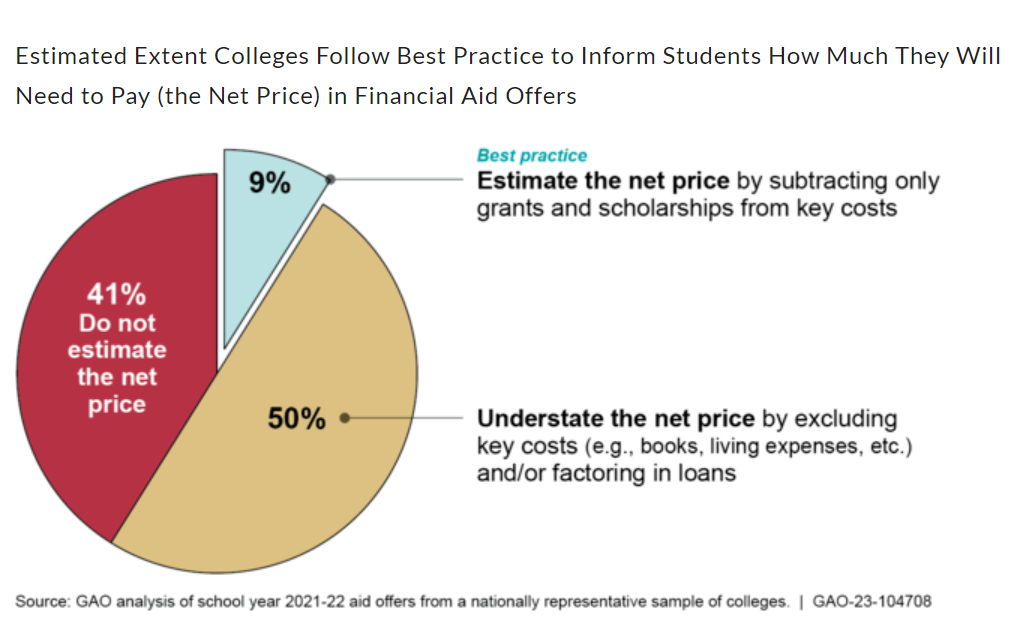
A lively class discussion is almost guaranteed if you introduce the topic of college financial aid letters. A U.S. Government Accountability Office (GAO) report found that 91% of colleges either underestimate net prices or fail to include the net price entirely.
In their offer letters, the GAO recommends that colleges subtract only grants and scholarships that students will receive but include ancillary costs like “tuition, fees, housing and meals, books, and living expenses.” Any parent with a college-age student—or any student paying their own way—know that these expenses add up.
The GAO report is also a good example for students to analyze. It follows some principles we teach in business communication classes: a clear structure and detailed table of contents (with hyperlinks); a mix of text, tables, and other graphics (with callouts); and an executive summary. Some design features are a bit curious, for example, left-column headings and squiggly lines around tables.
Overall, best practices are clear, and I hope that colleges take the GAO’s advice. The news raises issues of integrity and accountability. I find it interesting that the GAO was renamed the Government Accountability Office from the Government Accounting Office in 2004. The name does seem to better fit the organization’s mission.
FTX Founder Plays the Innocent
Sam Bankman-Fried’s interview about the collapse of FTX tells us a lot about him, about investors, and about regulation. Bankman-Fried chose to tell his story to New York Times columnist Andrew Ross Sorkin via video from the Bahamas. (See transcript.) Starting with a discussion of the many people were “hurt” by the business failing, Sorkin tried to hold Bankman-Fried responsible for billions of losses. He offers two divergent views of what happened to the company: that Bankman-Fried is a “young man who made series of terrible, terrible, very bad decisions,” or that he “committed a massive fraud—that this is a ponzi scheme, a manipulation of the system.”
Business communication students might see this as a false dichotomy. Bankman-Fried claimed that his goal was to “do right” by people and that he made mistakes. He said, “Look, I screwed up. I was C.E.O. I was the C.E.O. of FTX. And I say this again and again that it means I had a responsibility, and I was responsible ultimately for us doing the right things and didn’t. We messed up big.” But he denied setting out to commit fraud. Ross read a letter from someone who says he lost $2 million—his life savings—and that Bankman-Fried used his money to fund his hedge fund. Maybe both narratives are true, and Bankman-Fried isn’t seeing or admitting it.
Students might benefit from a class discussion or assignment about the investor perspective. Not to the blame the victim, but what accountability do investors have in this situation? What were they hoping to achieve compared to other investors—or compared to the general public who do not have $2 million to invest? Depending on how far you want to take this story, a discussion about regulation is certainly relevant, and students, particularly if they or they families have benefitted from crypto investments, might have a lot to say about it.
Otherwise, the video serves as a good example to analyze for delivery, persuasion, character, and interview skills. How is Bankman-Fried as a presenter? How does he balance logical arguments, emotional appeals, and credibility? What character dimensions are at play? Was it the best decision, going against his lawyers’ advice, to do this interview—and from his penthouse in the Bahamas? How well did he respond to questions? Overall, are students more—or less—favorable about Bankman-Fried after watching the interview?
Disney Comms About Ousted CEO

Students might enjoy comparing internal and external messages from Disney about Bob Iger’s return just 11 months after his retirement. Lagging investor confidence and profits ended the current CEO’s short tenure in the position, which the board skirts in the press release.
As we might expect, the public statement includes typical quotes from the incoming leader (Iger) and board chair. Missing are comments from the outgoing CEO, Bob Chapek, although the chair thanks him “for his service to Disney over his long career, including navigating the company through the unprecedented challenges of the pandemic.” Iger is positioned as “uniquely situated to lead the Company through this pivotal period.” Here’s Iger’s quote for the release:
“I am extremely optimistic for the future of this great company and thrilled to be asked by the Board to return as its CEO,” Mr. Iger said. “Disney and its incomparable brands and franchises hold a special place in the hearts of so many people around the globe—most especially in the hearts of our employees, whose dedication to this company and its mission is an inspiration. I am deeply honored to be asked to again lead this remarkable team, with a clear mission focused on creative excellence to inspire generations through unrivaled, bold storytelling.”
In an email to employees, below, Iger mentions “gratitude and humility” and focuses on his audience—”cast members” who have probably struggled in many ways during the past couple of years. He says nothing about Chapek, but really, what is there to say? It might just sound false.
Dear Fellow Employees and Cast Members,
It is with an incredible sense of gratitude and humility—and, I must admit, a bit of amazement—that I write to you this evening with the news that I am returning to The Walt Disney Company as Chief Executive Officer.
When I look at the creative success of our teams across our Studios, Disney General Entertainment, ESPN and International, the rapid growth of our streaming services, the phenomenal reimagining and rebound of our Parks, the continued great work of ABC News, and so many other achievements across our businesses, I am in awe of your accomplishments and I am excited to embark with you on many new endeavors.
I know this company has asked so much of you during the past three years, and these times certainly remain quite challenging, but as you have heard me say before, I am an optimist, and if I learned one thing from my years at Disney, it is that even in the face of uncertainty—perhaps especially in the face of uncertainty—our employees and Cast Members achieve the impossible.
You will be hearing more from me and your leaders tomorrow and in the weeks ahead. In the meantime, allow me to express my deep gratitude for all that you do. Disney holds a special place in the hearts of people around the globe thanks to you, and your dedication to this company and its mission to bring joy to people through great storytelling is an inspiration to me every single day.
Bob Iger
Public Talk of Layoffs

I remember when people where ashamed of being laid off. Old movies show men leaving for “work” months after they no longer had a job.
Today, people find community in discussing their fate, and they use their favorite platform—sometimes their former employer—to share their stories. Partly, the shame is lifted because of the numbers: 11,000 at Meta; 10,000 at Amazon; 3,700 at Twitter; 950 at Salesforce; and many others. In a colorful, but mostly unreadable chart, TrueUp logged 192,997 so far in 2022. (Maybe the logos could be scalable?)
The unfortunately named Blind app connects employees in several industries, particularly tech (95% of Twitter employees signed up). Students can review comments for an inside scoop just as they do on Glassdoor.
I feel encouraged by the public postings. In addition to the obvious compassion and vulnerability, the stories—good and bad about the layoff process and communication—keeps employers on their toes. Also, people are finding new jobs, and this will get easier as the market, once again, opens up.
Meta's Well-Timed Layoff Message

How clever for Meta to announce 11,000 layoffs as we watch the news for election results. Still, the news ranked highly, with a big headline on the WSJ home page.
Unlike Elon Musk’s curt email to Twitter employees last week, Mark Zuckerberg’s note is longer and posted publicly, which is smart since it would likely hit the press anyway. He follows business communication guidelines by placing the main point up front, and he demonstrates accountability and compassion in the introduction:
I want to take accountability for these decisions and for how we got here. I know this is tough for everyone, and I’m especially sorry to those impacted.
His explanation of what went wrong also demonstrates accountability—and humility: “I got this wrong, and I take responsibility for that.”
Zuckerberg describes severance and other benefits in bullets, and he expresses optimism in the future. Employees will question whether they’re affected, but I’m not sure he can say anything differently in the message because cuts are across the board. Still, people might appreciate a bit more information about how decisions were made.
People must be on edge. Zuckerberg wrote, “Everyone will get an email soon letting you know what this layoff means for you.” How soon? He also offers the chance to “speak with someone to get their questions answered and join information sessions.” The goal seems to be communication by email and mass meetings. In-person meetings are best for delivering bad news, but given remote work and scale, this method is probably the only practical way to go
Twitter Layoff Messages
Perhaps the best example of a bad-news message is a layoff memo (below), and Elon Musk’s Twitter email doesn’t disappoint. Just days after the purchase went through and after a deafening silence, the new CEO sent a short message confirming what employees expected.

The email is classic Musk: direct and decisive, without a lot of compassion. He makes the news extra painful by expressing his distrust: cutting people off from offices and systems and reminding people not to share confidential information (which at least one person did by sharing the internal email).
Layoff messages are typically softer, with more specific reasons for the decision, a rationale for who goes and who stays, more gratitude to those leaving, more information about what people can expect, and more optimism about the future of the company. They are also a chance for leaders to demonstrate their own humility and vulnerability. But that’s not Elon Musk. (That describes Brian Chesky, whose Airbnb layoff message—posted publicly—is still one of my favorites.)
The actual layoffs the next day didn’t go much better. “Confusion” prevailed as 50% were laid off, some losing access in the middle of meetings. Now Musk is left with what he called a “massive drop in revenue” and class-action lawsuits from employees.
Team,
In an effort to place Twitter on a healthy path, we will go through the difficult process of reducing our global workforce on Friday. We recognize that this will impact a number of individuals who have made valuable contributions to Twitter, but this action is unfortunately necessary to ensure the company's success moving forward.
Given the nature of our distributed workforce and our desire to inform impacted individuals as quickly as possible, communications for this process will take place via email. By 9AM PST on Friday Nov. 4th, everyone will receive an individual email with the subject line: Your Role at Twitter. Please check your email, including your spam folder.
If your employment is not impacted, you will receive a notification via your Twitter email.
If your employment is impacted, you will receive a notification with next steps via your personal email.
If you do not receive an email from twitter-hr@ by 5PM PST on Friday Nov. 4th, please email xxxxxxxx.
To help ensure the safety of each employee as well as Twitter systems and customer data, our offices will be temporarily closed and all badge access will be suspended. If you are in an office or on your way to an office, please return home.
We acknowledge this is an incredibly challenging experience to go through, whether or not you are impacted. Thank you for continuing to adhere to Twitter policies that prohibit you from discussing confidential company information on social media, with the press or elsewhere.
We are grateful for your contributions to Twitter and for your patience as we move through this process.
Thank you.
Research About "Low-Response" People

Research about persuading people to pay NYC parking tickets has implications for business communicators—and raises questions of character. The study, published in American Economic Journal: Economic Policy, found that reminder letters get more people to pay fines, but this approach doesn’t work for everyone.
People who respond least to the “nudges,” including notices about greater fines, happen to be those least likely to pay in the first place. Referred to as “low-response” types, these folks need sterner warnings. As one author says, “It’s only when they get this legal-looking letter that says, ‘We are in default judgment against you; you may get towed.’” Most interesting, people in the “low-response” groups tend to be from historically “disadvantaged populations—lower income, less education, and higher proportions of Black or other racial groups.”
The authors acknowledge that their recommendations ”would not be based on individual characteristics (e.g., income, race, neighborhood) but only on past behavior–while statistically helping traditionally underserved populations to avoid penalties with a nonintrusive nudge. We further note that, in proposing this policy, we are not assuming that the low baseline response rates of the LRs are suboptimal. Rather, we are pointing out a lower-cost policy that could induce more timely payments from the LRs without imposing larger penalties on them.”
Still, this study raises questions about character, for example, compassion, integrity, and accountability. Am I the only one cringing at the term “low-response type” and use of “LRs”? Is it right to threaten one group but not another, even if it’s based on past behavior? True, people should pay fines, but we have deeper societal issues and inequities to consider. How do people in these groups view rules and law enforcement? Are people in lower-income neighborhoods or with cars in greater disrepair more likely to get tickets in the first place?
If, as the authors say, their proposed policy is helpful to avoid “imposing larger penalties,” why not simply eliminate fines that some people can’t afford to pay? Our local library has stopped charging late fees so they don’t discourage reading and cause a disparate impact. The authors do propose eliminating later, greater fines that have little impact and most affect people in historically disadvantaged populations. Theoretically, data can also be used for a sliding fee scale according to income level—or perhaps the value of one’s car.
The simpler takeaway for business communication students is the relevance of knowing your audience. As study authors say, NYC already has the data and can customize approaches. We do teach analyzing an audience and tailoring a message. But students may discuss the ethics of using data and taking different approaches in these types of situations.