

Wells Fargo Former CEO Banned

In what the Wall Street Journal calls “unprecedented” and “an extraordinary sanction for a top executive at a large bank,” former CEO John Stumpf has been barred from the banking industry. The decision—and a $17.5 million fine—were part of a settlement between Stumpf and the Office of the Comptroller of the Currency (OCC) for millions of fake bank accounts created at Wells Fargo.
The OCC concluded that Stumpf should have known of the systemic problems and that “there was a culture in the Community Bank that resulted in systemic violations of laws and regulations.” When the scandal became public, employees complained of extreme stress because of pressure to sell more bank products. This pressure led employees to create fake accounts for customers.
Other Wells Fargo executives have been fined and charged, but none have been banned from the industry.
Discussion:
Do you think the decision is fair? Why or why not?
This decision represents a shift from the 2008/2009 financial crisis, when banks paid significant fines but very few individuals were charged. What’s your view of the change?

Communications About Kobe Bryant
NBA superstar Kobe Bryant, his daughter, and seven others died in a helicopter crash, and many are mourning the loss. At the Emmy’s, celebrities paid tribute to his life, and the NBA postponed a Lakers—Clippers game.
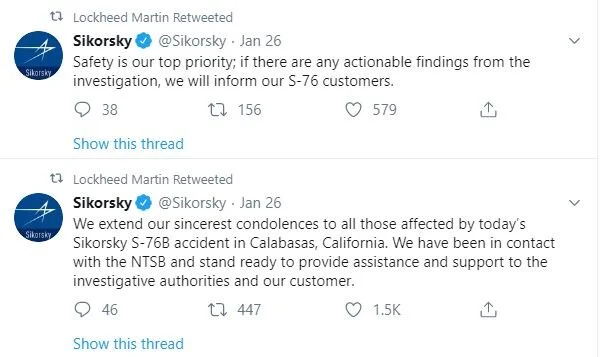
The helicopter company, Sikorsky, owned by Lockheed Martin, posted two tweets and a short statement on its website:
We extend our sincerest condolences to all those affected by the January 26th Sikorsky S-76B accident in Calabasas, California. We have been in contact with the NTSB and stand ready to provide assistance and support to the investigative authorities and our customer. Safety is our top priority; if there are any actionable findings from the investigation, we will inform our S-76 customers.
Discussion:
Analyze the Sikorsky messages. Who are their primary and secondary audiences? What are the communication objectives, and how well did the company achieve them?
Have you seen other communications from Sikorsky? Should the company do or say more? If so, what?
Wells Fargo Earnings Call

The Wells Fargo scandal of creating fake accounts became public in 2016, and the company is still suffering the repercussions. Profit is down 53%, and stock performance is lagging.
On an earnings call, Charles Scharf, who has been the CEO since October 2019, explained the bank’s current position:
I was honored to be chosen to lead Wells Fargo because I believe this is an extraordinary company that plays an important role in this country. We came out of the financial crisis as the most valuable and most respected bank in the US, but as you know, we made some terrible mistakes and have not effectively addressed our shortcomings. These circumstances have led to financial underperformance, but we have one of the most enviable financial services franchises in the world and employees that want to do what's necessary to again be one of the most respected and successful banks in the US.
Discussion:
Read the earnings call transcript. What’s your view of how Scharf and John R. Shrewsberry, EVP and CFO, addressed concerns?
How well has the bank recovered its image since 2016? What examples of their communications can you cite?
What could bank executives have done differently in the past four years?
How well does the line chart work to compare Wells to other leading banks? What could be improved?

Boeing Internal Documents Don't Reflect Well on Safety

The lead article in today’s The Wall Street Journal is titled, “Internal Boeing Documents Show Cavalier Attitude to Safety.” In 150 pages of emails and other documentation, employees worry that they don’t have enough time to correct safety issues and refer to regulators as “morons” and “stupider.”
In February 2018, one employee wrote, “Would you put your family on a MAX simulator trained aircraft? I wouldn’t.” A pilot wrote, “I still haven’t been forgiven by god for the covering up I did last year. Can’t do it one more time. Pearly gates will be closed.” Still another employee wrote, “This airplane is designed by clowns, who in turn are supervised by monkeys.”
A defense attorney argues that employees were just “blowing off steam” in their emails.
In the past few months, Boeing’s culture has come to light—once lauded as a place where people felt proud to work but now a place where people feel stressed and remorseful. CEO Doug Muilenberg has since been terminated and replaced temporarily by CFO Doug Smith.
Discussion:
Read more about the internal communications. What lessons can employees and their managers take away from this story?
What’s your view of the emails? Do they indicate big problems at the company, or is the attorney right that employees are just venting to each other? How does the concept of “cherry picking” come into play?
What should Boeing do to manage this situation? Consider this news in light of the company’s crisis communication planning you read about in another post.

Facebook Memo Goes Public

Facebook executive Andrew Bosworth wrote a 2,551-word memo about the company’s role in the upcoming election and more. Bosworth compliments President Trump’s use of Facebook ads and admits that the site impacted the 2016 U.S. election. A Vox article describes Boswell’s logic:
Bosworth’s memo has much more in there, which is getting plenty of deserved attention, including the assertion that Facebook did indeed help Donald Trump win the 2016 election — by giving him the tools to run “the single best digital ad campaign I’ve ever seen from any advertiser. Period.” And the memo also reveals that Bosworth, a self-described “committed liberal,” fantasizes about using Facebook to prevent Trump from winning in 2020, but won’t.
The memo is also attracting attention because Bosworth compares Facebook to sugar and places responsibility on the user: “At the end of the day we are forced to ask what responsibility individuals have for themselves."
Bosworth ends the memo with a question:
To bring this uncharacteristically long and winding essay full circle, I wanted to start a discussion about what lessons people are taking away from the press coverage. My takeaway is that we were late on data security, misinformation, and foreign interference. We need to get ahead of polarization and algorithmic transparency. What are the other big topics people are seeing and where are we on those?
Discussion:
Read the entire memo . What surprises you most?
How damaging is the memo to Facebook’s image, particularly with another election coming up? How does a memo like this—posted on an internal site—become public?
What business writing principles does Bosworth follow, and how could he improve the memo?
Boeing's Crisis Communication Plan

During the holiday break, several news items about Boeing were relevant to business communication and character. In one article, the New York Times revealed internal Boeing documents showing a company trying to rebuild its image after two MAX crashes within a year..
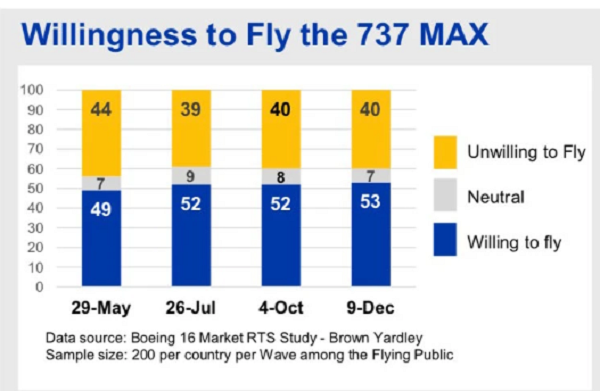
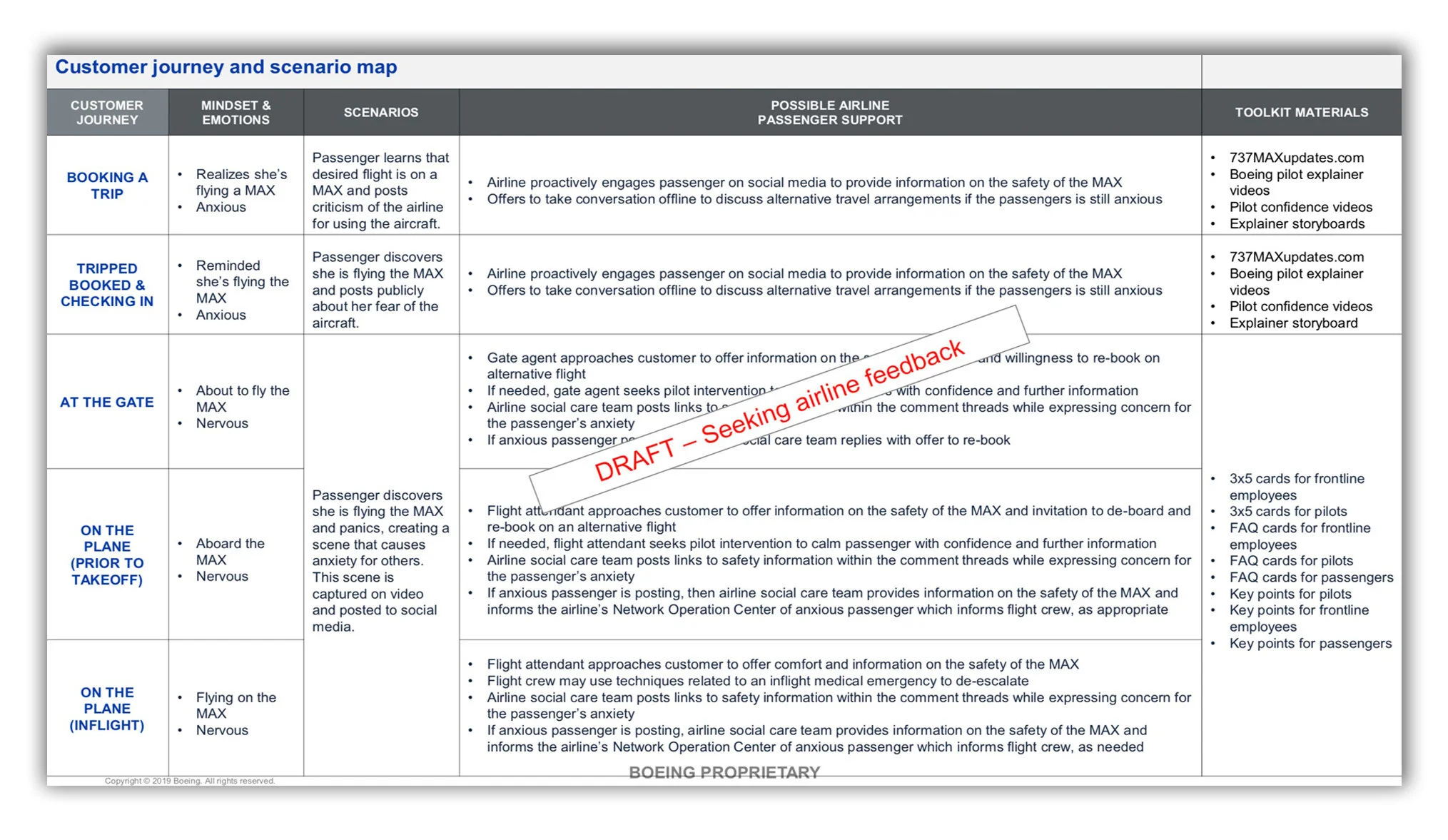
The documents give us an inside view of how the company plans to use persuasive strategies to win back customers. In one graphic, we see customers’ willingness to fly. In another, we see customer concerns and ways Boeing can address them, for example, with FAQ cards, “pilot confidence videos,” or personal connections (for example, “Flight attendant offers comfort and information on the safety of the MAX”).
Discussion:
What persuasive strategies does the company plan? Try to find examples of logical argument, emotional appeal, and credibility.
What are the consequences of this information becoming public? Does it likely endear the public to the company’s concerns, embarrass the company, or something else?
JPMorgan Recorded Phone Conversation
Jimmy Kennedy, an African-American former National Football League player, tried to open a private wealth account at JPMorgan but had trouble getting attention. He recorded a conversation with an African-American employee, Richardo Peters, who said, “You’re bigger than the average person, period. And you’re also an African-American. We’re in Arizona. I don’t have to tell you about what the demographics are in Arizona. They don’t see people like you a lot.”
In a New York Times article that published the recording, Peters recounted a specific example of discrimination against a Black customer. When he was trying to bring on another new client, who had received a large settlement, his manager said, “You’ve got somebody who’s coming from Section 8, never had a nickel to spend, and now she’s got $400,000, What do you think’s going to happen with that money? It’s gone.” His manager’s position was that the customer would not invest money with the bank.
Other incidents at the bank led to Peters’ termination, and he is suing for racial discrimination. JPMorgan also recently settled a class-action lawsuit for $24 million to Black employees who claimed discrimination: according to a New York Times report, “in some cases by isolating them from colleagues and dumping them in poorer branches.”
A few days later, CEO Jamie Dimon addressed the situation in a memo to employees.
Discussion:
How do you assess this situation at JPMorgan? Read more in the NYT article.
A February Essence article describes and praises JPMorgan’s Advancing Black Pathways program to support the Black community. What’s your view of the effort in light of this news?
How do you assess CEO Jamie Dimon’s response in the memo? We don’t see the entire memo, but CNBC posted quotes.

Should We Call Climate Change Something Else?

An AdAge writer wonders whether renaming climate change would change perceptions. Reframing is a common strategy for influencing behaviors, thoughts, and feelings. Already, climate change seems to be the evolution of global warming, a less convincing idea, in part, because sometimes it’s quite cold, as President Trump says.
A brand team pondered the following new names:
Global Meltdown, Global Melting
Climate Collapse, Climate Chaos
Boiling Point, Melting Point
Scorched Earth
Discussion:
The author identifies “parameters and guideposts” for the new name: audience, reach, and message. What is important for each of these categories?
What’s your view of the proposed new names? Which do you like best and least, and why?

Fabricated Letters to the SEC

The U.S. Securities and Exchange Commission is planning a policy change that, as a Bloomberg article describes, “would shift power from investors to corporate boards” and “limit[s] the power of dissenting shareholders.” Unfortunately, when Chairman Jay Clayton announced the change, he cited several fabricated letters of support to the SEC.
The SEC failed to recognize that many letters followed a similar template and included a random line in the mailing address—“A Coalition of Growth Companies.”
Clayton was impressed that the SEC heard from such a variety of people, such as veterans and retired police officers, but people contacted said they didn’t write the letter or agreed to having their name on a letter without understanding the implications.
The Bloomberg article reports Clayton’s response:
The SEC declined to comment on any irregularities with the letters. In a Tuesday interview, Clayton sidestepped a question about how the agency ensures comment letters are genuine. He did emphasize that the regulator’s potential revamp of shareholder voting rules are proposals, adding that there will be ample time for people on both sides to weigh in before any changes are finalized.
“We welcome input in all ways,” Clayton said in the interview with Bloomberg Television’s David Westin. “On this issue, where there are a lot of different views and a lot of different interests, we encourage people to come in and talk to us, send us their comments.”
Discussion:
How does something like this happen? Who is responsible?
Assess Clayton’s response. How well is he handling the situation? What, if anything, should he do differently?
What leadership character dimensions are illustrated by this situation?
Microsoft's Diversity and Inclusion Report

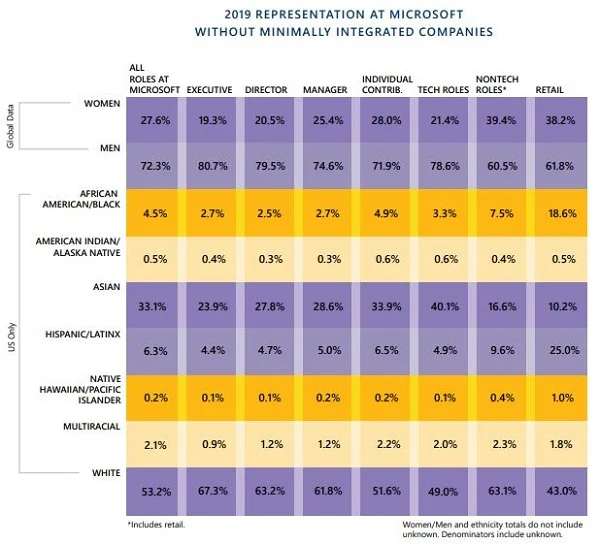
Microsoft’s 2019 Diversity and Inclusion report is the company’s sixth since 2014.
In the introductory letter, we learn about positive changes in demographic data:
In technical roles alone, we have 49% more women, 48% more Hispanic/Latinx, and 67% more African American/Black employees than we did three years ago. And beyond population growth, this year’s snapshot shows diversity representation has risen in every demographic category we track.
The report includes a few dazzling graphics, such as the one shown here.
Discussion:
Read the entire report. What principles of business communication are followed?
What suggestions for improvement would you suggest to the report authors?
What’s your view of the graphic shown here? What is the main point? How else could the data be shown?
Although the report writers acknowledge that some of the diversity increase in technical roles is attributed to employee growth, what other questions might a skeptic ask?
SoftBank's Vague WeWork Slides
SoftBank already took a financial hit because of its investment in WeWork. Now, the company is facing criticism about its data analysis and presentation.
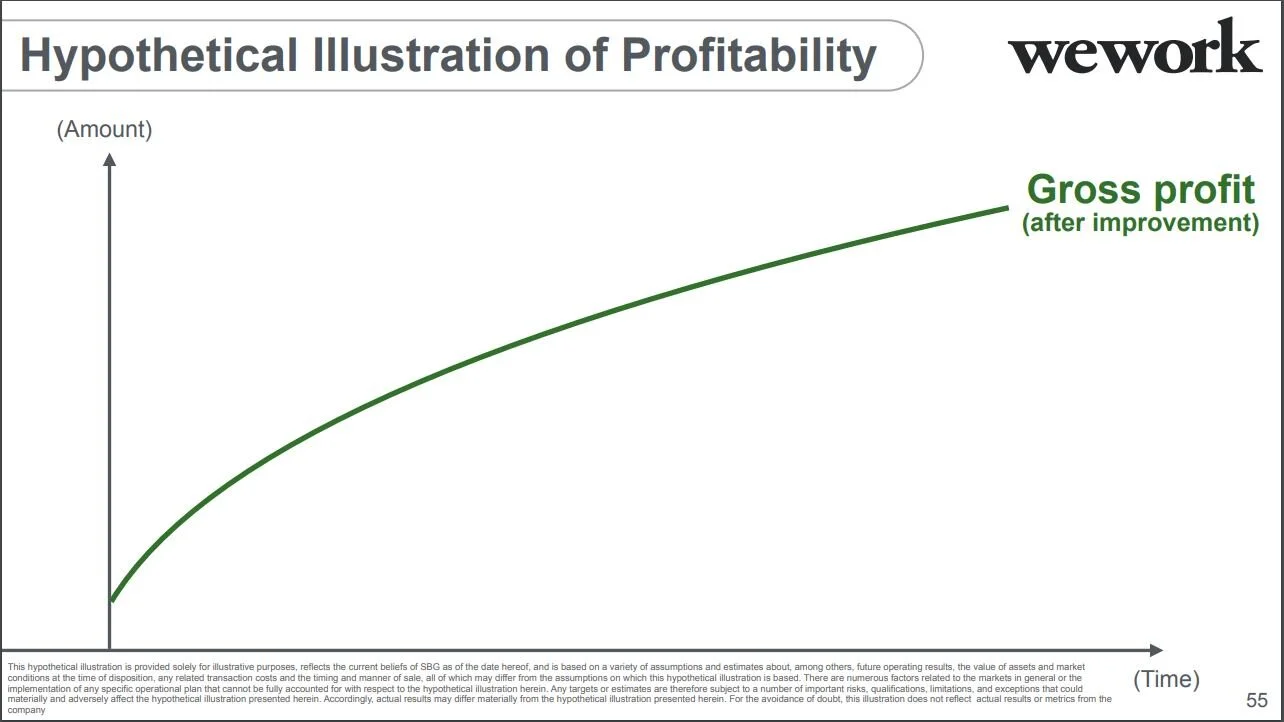
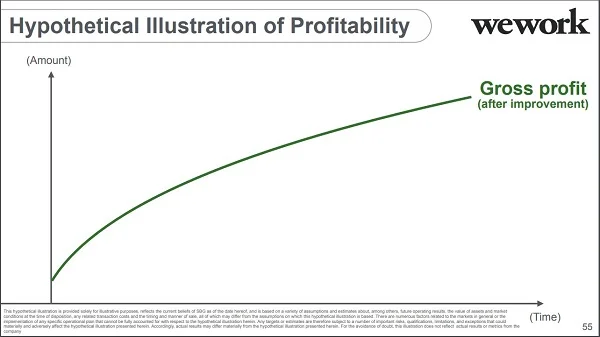
A deck SoftBank Group (SBG) used to justify its WeWork investment includes several “hypothetical” and vague slides, like this one.
If you’re having trouble reading the footnote, here it is:
This hypothetical illustration is provided solely for illustrative purposes, reflects the current beliefs of SBG as of the date hereof, and is based on a variety of assumptions and estimates about, among others, future operating results, the value of assets and market conditions at the time of disposition, any related transaction costs and the timing and manner of sale, all of which may differ from the assumptions on which this hypothetical illustration is based. There are numerous factors related to the markets in general or the implementation of any specific operational plan that cannot be fully accounted for with respect to the hypothetical illustration herein. Any targets or estimates are therefore subject to a number of important risks, qualifications, limitations, and exceptions that could materially and adversely affect the hypothetical illustration presented herein. Accordingly, actual results may differ materially from the hypothetical illustration presented herein. For the avoidance of doubt, this illustration does not reflect actual results or metrics from the company.
The slide title is also odd: the illustration isn’t hypothetical, but the profitability is.
Discussion:
How might this chart affect SoftBank’s credibility?
What other examples in the SoftBank deck are problematic?
What leadership character dimensions are illustrated by this situation?

Boeing CEO Responds to Questions
This week, Boeing CEO Dennis Muilenburg answered lawmakers’ questions about the two Max 737 plane crashes in the past year. Facing families of deceased passengers, Muilenburg began his testimony with an apology:
“I’d like to begin by expressing my deepest sympathies to the families and loved ones of those who were lost in the Lion Air Flight 610 and Ethiopian Airlines Flight 302 accidents, including those who are here in the room today. I wanted to let you know, on behalf of myself and all of the men and women of Boeing, how deeply sorry I am. As we observe today the solemn anniversary of the loss of Lion Air Flight 610, please know that we carry the memory of these accidents, and of your loved ones, with us every day. They will never be forgotten, and these tragedies will continue to drive us to do everything we can to make our airplanes and our industry safer.”
One of the most tense moments was when Senator Ted Cruz questioned Muilenburg (see video). Muilenburg also faced criticism as he was leaving. The mother of a victim of the second crash responded to his invoking his Iowa farm background:
“Go back to Iowa. Do that.” She also said, “I don't feel like you understand. It's come to the point where you're not the person anymore to solve the situation."
Discussion:
Watch more of Muilenburg’s testimony. What are some examples of questions he addressed well, and how could he have done better?
How well does Muilenburg balance emotional appeals, logical arguments, and credibility in his testimony?
What leadership character dimensions are illustrated by this situation and by Muilenburg’s testimony?
Muilenburg’s interaction with the mother is a difficult situation for anyone to handle, and we can certainly understand her grief and anger. How would you have responded?
CNN reports:
“In response, Muilenburg said he respects her viewpoint. "But I want to tell you the way I was brought up. And I'm just being honest here about it. I learned from my father in Iowa ... when things happen on your watch you have to own them and you have to take responsibility for fixing them," he said.

Astros Executive Fired After Yelling at Female Reporters

Brandon Taubman, assistant manager of the Houston Astros baseball team, was fired after comments made to female reporters. The situation became more complicated because the team, at first, criticized a Sports Illustrated reporter, Stephanie Apstein, and called her article, “misleading and irresponsible” and a “fabrication.”
In the team club house, after a game, Taubman yelled at the female reporters, “Thank God we got Osuna. I’m so f------ glad we got Osuna!” The MLB suspended Osuna for 75 games because of a domestic violence charge, and the Astros took a PR risk in hiring him. A Sports Illustrated writer criticizes the team’s decision:
But in truth, the Astros' front office acts as if it is tired of being yelled at about this subject. They want to be allowed to play their baseball games and pop their champagne without being forced to think about anything that happened away from the ballpark.
The team’s first response of defending Taubman didn’t stick. They later issued a statement apologizing to both the group of female reporters and Apstein.
Ernst & Young is scrubbing its website of ties to Taubman, who worked for the firm. EY is facing its own trouble following criticism about a training program for women.
Discussion:
What’s your view of the situation—both Taubman’s outburst and the Astros’ response?
Analyze the team’s statement. What leadership character dimensions does this illustrate, and how does it fall short? What could be improved?
Did EY do the right thing by trying to disassociate with Taubman? Why or why not?

Business Leaders Sign Letter to Top Officials

Fifty CEOs and business school leaders signed a letter to President Trump and other top-ranking politicians urging action to allow for more international applications. The letter comes after a report by the Graduate Management Admissions Council showing declining applications.
Report conclusions follow:
[A]llowing top talent to study and work in the country of their choice helps create jobs, not take them. It offers insight into changing trends for historically talent-attracting and talent-supplying countries. Business school applications are a powerful metric—and forecast—of the success of individual economies in prioritizing talent and therefore leading innovation and growth. A survey of these latest metrics shows change in our midst—and for certain economies, warning signs for the future.
In their letter, the business leaders write that the U.S. is “needlessly capping our growth and can do better.” They urge U.S. politicians to allow more movement by taking the following action:
Removing “per-country” visa caps, modernizing our visa processing system, and reforming the H-1B visa program to make it possible for the most talented people to have a reasonable chance of gaining entry to the United States.
Creating a “heartland” visa that encourages immigration to the regions of the United States that could most use the vitality of these talented individuals.
Discussion:
Analyze the letter. Who are the primary and secondary audiences? What are the communication objectives? How do you assess the organization and writing style?
What persuasive communication strategies do the writers use? Which are most and least effective?
Analyze the report using the same questions.
How well does the infographic summarize the report conclusions? What could be improved?
WeWork: "Humbler"
Several articles in the past few weeks have scolded WeWork CEO Adam Neumann and the investors who followed his story.
The Wall Street Journal was the first to describe Neumann’s odd behavior and published another article, “WeWork Investors Turned Off by ‘Sloppy’ IPO Filings.” The recent article explains one problem in the filings (shown below):
“A section headed ‘illustrative annual economics’ that assumed 100% workstation utilization vanished, for example, as did two graphs portraying a typical location going from ‘-$’ to ‘+$,’ with no y-axis showing the actual dollar amounts being depicted.”
A New York Times article, “Was WeWork Ever Going to Work?” criticizes investors for missing obvious problems with the company’s initial business plan, such as the reliance on start-up revenue when most entrepreneurial ventures fail. According to this report, it took people finally looking at the data to realize how much We is losing and how hard it will be for the company to succeed.

The article includes other examples of investors’ blind exuberance:
“It is not merely money that separates the ruling class from the rest of the country. Often it seems as if it is the gaping difference in the application of common sense. Ultimately, it was the bankers, technocrats, statesmen and acolytes of the data-junkie class who were willing to believe that Elizabeth Holmes, a 19-year-old college dropout who thought a black turtleneck would make her Steve Jobs, was going to revolutionize blood-testing. It didn’t seem to matter that she could not deliver any real evidence to prove it.”
An Inc. article, “The Future of WeWork: Leaner, Humbler, and Duller,” suggests a new path for We. The author suggests less hype, fewer employees, and more discipline for the company to survive.
Discussion:
Who do you blame for WeWork’s failed IPO?
If you believe the New York Times article, investors are gullible. Do you agree with this assessment? If so, why might this be the case?
Read the “Note”—the fine print—under the table, shown above. How do you interpret this information?
What should We do now to build credibility and save the business?

Juul CEO Steps Down
With new reports about the dangers of vaping, Juul is replacing its CEO, Kevin Burns, with former Altria tobacco executive K.C. Crosthwaite.

Following several deaths and worrying data about increasing numbers of young people vaping, the company also announced a pause in all advertising. The decision comes after major media companies and networks banned e-cigarette advertising. Juul had already stopped marketing and selling its flavored products.
The company’s news statement is typical for a CEO announcement with confidence expressed about the departing CEO (Kevin Burns), the new leadership, and the direction of the company. Below is the Kevin Burns’ quote:
“Working at JUUL Labs has been an honor and I still believe the company’s mission of eliminating combustible cigarettes is vitally important. I am very proud of my team’s efforts to lead the industry toward much needed category-wide action to tackle underage usage of these products, which are intended for adult smokers only. Since joining JUUL Labs, I have worked non-stop, helping turn a small firm into a worldwide business, so a few weeks ago I decided that now was the right time for me to step down. I am grateful to be able to confidently hand the reins to someone with K.C.’s skill set, which is well-suited to the next phase of the company’s journey.”
Discussion:
What are the communication objectives of the news statement? How well does it meet those objectives?
Assess Burns’ quote. What are the objectives of his statement, and how well does it meet those?
Altria had bought a 35% stake in Juul, so the CEO decision makes sense, and Crosthwaite is an industry insider. How do you view the decision?
Amazon Response to Employee Walkout
Like many around the world during the Global Climate Strike, hundreds of Amazon employees walked out of their offices yesterday. Employees have been urging Amazon leaders to take more steps to reduce fossil fuel dependency and wrote an open letter back in April. The pressure seems to be working.
On Thursday, CEO Jeff Bezos announced The Climate Pledge, with the following commitments:
Commits to net zero carbon by 2040 and 100% renewable energy by 2030
Orders 100,000 fully electric delivery vehicles, the largest order ever for electric delivery vehicles
Invests $100 million in reforestation projects around the world to begin removing carbon from the atmosphere now
Launches new sustainability website to report progress on commitments
The Pledge encourages other businesses to sign on, with Amazon leading the way. Bezos said, “We’re done being in the middle of the herd on this issue — we’ve decided to use our size and scale to make a difference.” Amazon employees reacted positively.
Discussion:
Analyze the employees’ open letter. What persuasive strategies do they use? Look for examples of logical argument, emotional appeal, and credibility. What organizational strategies do the writers use?
The Amazon announcement doesn’t mention employees’ influence in the decision, although news articles and employees make the connection. Should Bezos include this recognition? Why or why not?
Describe a CEO’s dilemma in situations like these. When is it appropriate for leaders to meet their employees’ demands, and when should they resist? Did Bezos take the best course of action?

CEOs Advocate for Gun Safety
CEOs are encouraging senators to pass stricter gun regulations, such as background checks and a “Red Flag” law that allows guns to be taken from someone who poses a threat. The leaders of 145 companies sent a letter asking for the following:
“That’s why we urge the Senate to stand with the American public and take action on gun safety by passing a bill to require background checks on all gun sales and a strong Red Flag law that would allow courts to issue life-saving extreme risk protection orders.”
The Trump Administration has implemented a ban on bump stock devices, which allows a shooter to fire in more rapid succession, and President Trump has supported more thorough background checks for gun buyers.
Discussion:
What’s your view of CEOs taking on this activist role? What is driving them, and what are the potential risks?
What observations do you have about the companies that are represented—and perhaps about those that are not?
Analyze the letter by considering the audience, communication objectives, organization, writing style, and so on. What works well, and what could be improved?

The Purpose of the Corporation

The Business Roundtable published a statement, The Purpose of the Corporation, signed by 181 of its 193 members. The Roundtable, a corporate lobbying group, includes CEOs of the largest U.S. companies.
In essence, the CEOs write that they have responsibilities beyond shareholders—to customers, employees, suppliers, and communities (including the environment). The statement is a step to improving the perception of businesses as solely driven by creating shareholder value through short-term profits.
Skeptics abound. A writer for the Washington Post called the statement a “truism”:
“What’s significant about the statement is what it does not say. The corporate signatories do not suggest in any way weakening the fiduciary duties of the boards and managers of ordinary for-profit shareholder corporations to manage such companies’ affairs for shareholders’ benefit.”
The CEO of Allstate and head of the U.S. Chamber of Commerce wrote an opinion piece in the New York Times encouraging businesses to pay people more if they’re serious about serving more stakeholders.
A writer for Forbes argued that these companies are multinationals and have global responsibilities as well. He also accused the executives of being self-serving, warding off criticism about executive compensation.
Others noted company CEOs who didn’t sign, for example, Alcoa, Blackstone, GE, NextEra, Parker Hannifin, and Wells Fargo (whose representative said the CEO is interim and wasn’t asked to sign). Some companies, for example, Kaiser and State Farm, say they didn’t sign because they don’t have shareholders.
Discussion:
What’s your view of the statement: significant, placating, diverting, or something else?
Assess the statement itself. Consider the audience, purpose, writing style, organization, and so on. What works well, and what could be improved? What’s extraneous and what’s missing?

Overstock CEO Resigns
Overstock CEO Patrick Byrne resigned after admitting to a relationship with Russian agent Maria Butina. Butina is serving prison time because of her attempts to gain political access during the 2016 U.S. presidential election.
Byrne announced his decision in a letter to shareholders. He begins with the news:
“In July I came forward to a small set of journalists regarding my involvement in certain government matters. Doing so was not my first choice, but I was reminded of the damage done to our nation for three years and felt my duty as a citizen precluded me from staying silent any longer. So, I came forward in as carefully and well-managed fashion as I could. The news that I shared is bubbling (however haphazardly) into the public. Though patriotic Americans are writing me in support, my presence may affect and complicate all manner of business relationships, from insurability to strategic discussions regarding our retail business. Thus, while I believe that I did what was necessary for the good of the country, for the good of the firm, I am in the sad position of having to sever ties with Overstock, both as CEO and board member, effective Thursday August 22.”

Byrne’s letter then describes his thinking about Overstock, including blockchain technology, retail, and strategy.
This announcement came 10 days after Byrne wrote a news release titled, “Overstock.com CEO Comments on Deep State, Withholds Further Comment.” In that post, he refers to “Men in Black” and his “Omaha Rabbi,” reinforcing perceptions that Byrne is a controversial figure.
MarketWatch shows the stock performance during this period.
Discussion:
What’s your view of Byrne’s decision to resign? Consider his history with Overstock, company performance, and the company trajectory.
CNN referred to Byrne’s first news release as “strange.” Do you agree?