

Backlash After President Trump Fundraiser

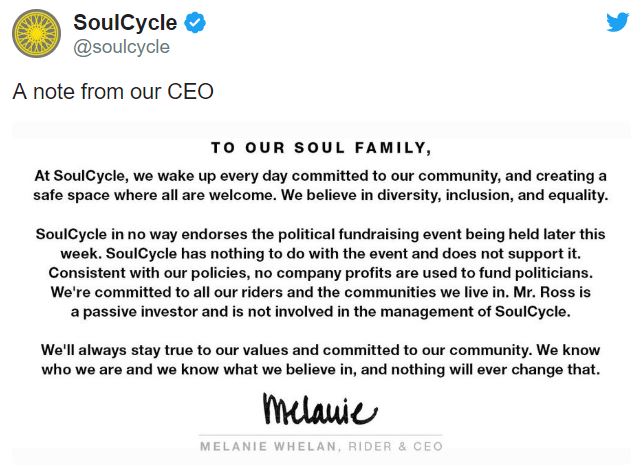
Equinox and SoulCycle customers are not happy about a fundraiser for President Trump sponsored by the companies’ owner, the chairman of a real estate firm. Threats of boycotts and cancelled memberships provoked quick responses from both companies.
SoulCycle CEO Melanie Whelan also said, “SoulCycle has nothing to do with the event and does not support it. … We know who we are and we know what we believe in, and nothing will ever change that.”
Capitalizing on the brands’ distress, other fitness companies are offering discounts and free trials to try to win business.
Discussion:
More company executives feel inspired towards political activism. What are the advantages and risks?
Did the real estate company owner, Stephen Ross, act inappropriately by hosting a fundraiser? Why or why not?
Analyze the companies’ statements. What persuasion strategies do they use to rebuild each brand?
Compare the statements. Does one work better than the other? What criteria do you use to compare them?

Another Blackface Disaster

Belgium’s Africa museum hosted an event for which people arrived in pith helmets, blackface, and other offensive and stereotypical clothing. Understandably, the Congolese community is upset. As one representative said, "Ethnic, exotic or African is not a costume that you can put on and take off.” You can read about Belgium’s occupation of the Congo to understand the history.
The party was organized by a separate company, Thé Dansant, and one organizer defended the party: “Even if one person painted his face black, it was not meant to be offensive. Many people of African origin were enthusiastic about the concept and were present.”
So far, the Royal Museum of Africa is trying to distance itself from the event and hasn’t issued a statement or apology.
Museum image source.
Party image source.
Discussion:
What’s your view of Thé Dansant’s response?
What is the museum’s accountability? What should the leaders do or say?

College Applications Controversy

A Wall Street Journal article reports that colleges are making few changes to how they review applications despite the recent admissions scandal. University officials say they are overburdened by reading applications, which have increased dramatically in the past few years, shown here.
University leadership also argue that they should not distrust all applicants because of the few who misrepresent themselves. Other than school transcripts and test scores, as a spokesperson at Dartmouth said, “The rest of a student’s file is reviewed on an honor-code assumption that a student’s work is a student’s work. It is not our policy to suspect every student of falsifying records.”
On the other hand, some universities have implemented additional checks, for example, of athletes. Some hire outside firms to verify information, and admissions staff do check for inconsistencies, but the article concludes that “almost none have a formal audit process in which they select a random sample of applications to independently verify.”
Discussion:
Should universities do more to verify the accuracy of students’ applications? Why or why not?
Analyze the line chart at right. How does the chart skew the data? How could this affect the arguments presented in the WSJ article? What recommendations would you make to the designer?

Capital One's Response to the Breach

A hacker got access to 140,000 Capital One customers’ credit information and social security information, and about 106 million people were affected by other leaked information. Officials arrested Paige A. Thompson, who goes by “erratic” and was a former Seattle technology company software engineer.
In a bar chart, a BBC article puts this breach in context of others. Capital One’s press release describes the company’s quick response:
“Capital One immediately fixed the configuration vulnerability that this individual exploited and promptly began working with federal law enforcement.”
The release also includes a statement from Chairman and CEO Richard Fairbank:
"While I am grateful that the perpetrator has been caught, I am deeply sorry for what has happened. I sincerely apologize for the understandable worry this incident must be causing those affected and I am committed to making it right."
In addition, as expected, the release includes information for customers, offers free credit monitoring, and provides an FAQ.
Discussion:
Analyze the press release. Consider the audiences, objectives, organization, tone, and so on.
How well does Fairbanks demonstrate humility in the press release? What other leadership character dimensions are illustrated? How well does he inspire confidence in Capital One?
Analyze the BBC chart shown here. What works well about the chart, and what else would be helpful to understand these breaches in context?

How to Deal with Being "Ghosted"
Too often, employers stop responding to candidates. Even after an in-person interview, candidates never hear back. The CEO of a job search platform advises people to follow up in a few ways:

Send one email a week. Be thoughtful about your messages to express interest; maybe share new research about the company .
Try different channels. For example, send a LinkedIn message instead of email, but only once.
Reach out to others. Contact another recruiter or the hiring manager directly.
All of these actions come with risk, but the writer argues, and I agree, that the risk is worth it. None of these follow-ups are too annoying, and you may turn the tide in your favor.
Discussion:
Why do you think employers ghost applicants? Consider what incentive they have to follow up.
What’s your view of these follow-up approaches? Which are you more or less comfortable doing?

Suicide Among France Télécom Employees

Management couldn’t fire employees at France Télécom, so, according to critics, they harassed them hoping they would quit. But at least 35 committed suicide under the pressure, and some reports claim the number is closer to 60.
France Télécom was privatized and rebranded as Orange in July 2013. The company wasn’t keeping up with technological changes and, according to executives, were saddled with state employees, who are protected from termination. In 2007, Didier Lombard, the former chief executive of France Télécom, said they would get to their ideal number of layoffs “one way or another, by the window or by the door.”
A New York Times article describes the environment: “A grim universe of underemployment, marginalization, miscasting and systematic harassment was established at the huge company, according to testimony at the trial.” Managers tried changing job responsibilities for some workers, but employees were left without tasks or with tasks they couldn’t do.
With France’s high unemployment rate, employees felt they had few options. Union members, shown here, express their support during the trial in Paris. We’ll see whether the judges find company executives guilty.
Discussion:
How did management justify its practices? On the other hand, how could they have acted differently?
What experience do you have with international labor laws? Describe differences and how they might affect business decisions.
Should France reconsider its lifetime employment protections?
What leadership character dimensions are illustrated by this situation?

Rutgers Chancellor "Berates" Police Officers
The Chronicle reported that Rutgers Chancellor Nancy E. Cantor “apologized for berating campus police officers.” On her way to the airport, Cantor’s driver hit a parked police car. She was detained and said, “If I miss my airplane, you folks are in trouble!” When an officer asked, “I’m sorry, who are you?” she yelled, “I’m the chancellor!”
The episode, which happened in March, was recorded on the officer’s body camera. Part of the debate is about whether Cantor needed to be detained because she entered the vehicle after the driver hit the other car.
Regardless, the video became public, Cantor apologized, and the Rutgers-Newark police chief responded:
“I appreciate Chancellor Cantor taking the time to review the video. I along with the RUPD are appreciative of her kind words and support. The sentiment is extremely appreciated, and we look forward to continuing a positive working relationship with the Rutgers-Newark chancellor’s office.”
Discussion:
Watch the video exchange. What’s your view of the chancellor’s behavior with the police officers?
Should the officers have done anything differently in this situation? Why or why not?
Assess the police chief’s response. How well does he demonstrate forgiveness?

Boeing at the Paris Air Show
After two fatal plane crashes involving its 737 Max jet, Boeing is trying rebuild its image, and the company made some headway at the Paris Air Show, an international aircraft sales event.
Company leaders are coming closer to admitting mistakes more directly. CEO Dennis Muilenburg said, “We clearly had a mistake in the implementation of the alert.” Muilenburg also admitted that company communications were “inconsistent” and “unacceptable.” Kevin McAllister, the company’s head of commercial aircraft, said, “We are very sorry for the loss of lives as a result of the tragic accidents...our thoughts and our prayers are with their families," and "Our priority is doing everything to get this plane safely returned to service. It is a pivotal moment for all of us.”
At right is a video of McAllister discussing future plans.
Illustrating confidence in the plane, IAG, which owns British Airway, ordered 200 new 737 Max jets, worth about $24 billion at list price. Airbus wants a chance to bid, and we’ll see whether the request is granted.
Discussion:
Based on this and other news reports, how well is Boeing recovering from its crisis? Read more about reactions to the IAG order to help inform your conclusion.
Analyze Kevin McAllister’s communication in the video. Compare his style and approach to Dennis Muilenburg’s. What similarities and differences do you observe?

VW's New Ad
Volkswagen is still trying to rebuild its image after the emissions scandal in 2015. A new advertising campaign tackles the issue directly, beginning with audio news reports from that time. But the focus, described on YouTube, is on the future: “Every negative has a positive. Learn more about our all-electric vehicles and our plans to help make a better tomorrow at vw.com #drivefortomorrow #vw.”
With an emphasis on innovation, the ad is set to Simon and Garfunkel’s classic song, “The Sound of Silence.” Viewers can imagine company engineers during the past few years creating a new line of electric cars— while VW executives said little about the controversy.
The senior VP of marketing for VW of America acknowledged that the ad is risky but explains the rationale:
“[w]ithout mentioning the past...we would never have the credibility or authenticity to move forward with the brand. Through the last three-and-a-half years or so we kind of operated as usual in the consumers [sic] eye. We kept a very consistent message in the marketplace but didn’t really have a powerful point-of-view as a brand.”
Discussion:
What’s your view of VW’s new ad campaign? Did the company make the right decision by invoking the scandal?
Other companies facing scandals, such as Uber and Wells Fargo, placed large apology ads, but VW didn’t take this approach. Why do you think that may be the case? Compare VW’s strategy to other recent recovery campaigns.

Carnival Responds to New Charges
Again, Carnival Cruises is accused of polluting and cover-ups. In 2016, the company paid a $40 million settlement because of actions by its Princess Cruise Lines, including dumping oil-contaminated waste. Now, the company has admitted to violating the 2016 agreement and will pay an additional $20 million.
The Justice Department’s statement identifies violations of probation terms, such as falsifying training records, preparing ships before inspections, and discharging plastic into the water. The plastic discharge was from another Carnival Cruise ship, the Carnival Elation.
In response to the charges, company chairman Arnold W. Donald said, “I do take responsibility for the problems we have. I am extremely disappointed that we’ve had them. I know you have reservations about our commitment and who we are. I want you to know we are fully committed.”
The company also posted a response on its website: corrective actions, information about water treatment, and FAQs. The short press statement, at the top, includes the company’s commitment:
“Carnival Corporation remains committed to environmental excellence and protecting the environment in which we live, work, and travel. Our aspiration is to leave the places we touch even better than when we first arrived.”

Discussion:
Assess Carnival’s response. What persuasive strategies does the company use on its website? What works well, and what could be improved?
The chairman said, “I know you have reservations about our commitment and who we are.” Do you have reservations? Why or why not? How can the company change perception? Consider dimensions of leadership character.

OpenTable Announces Privacy Changes
An email from OpenTable summarizes changes to the privacy policy and directs readers to the entire policy on the website. The company is using a lighthearted approach to convey what information is shared and how users will have better control over what they are willing to share.
We can view this as a positive message, although it uses some persuasive strategies. Overall, the company is trying to simplify a complex issue—and the email simplifies the far more complex policy.

Discussion:
Analyze the message. Who is the primary audience, and what are the communication objectives? How would you describe the tone and writing style? What organizational strategies are used?
What persuasive strategies does the message use?
Overall, how effective is the message in meeting its communication objectives? What, if anything, could OpenTable do differently?
Typo on Australian Banknote

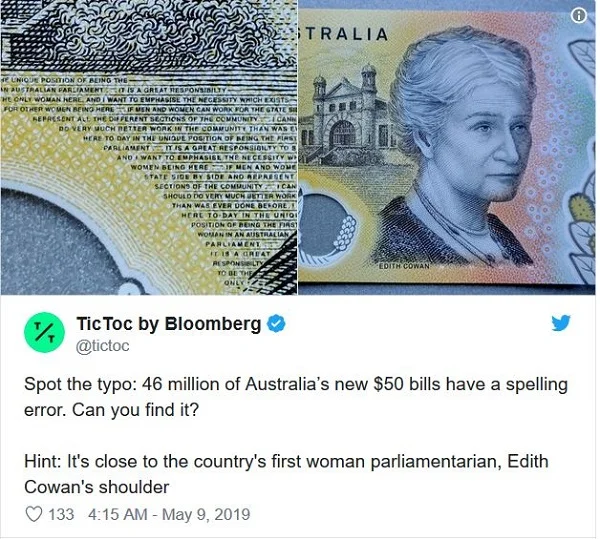
Australia printed 400 million $50 bills with a typo, and about 46 million of them are in use.
On the front of the bill, we see a picture of Edith Cowan, who was a social reformer and Australia’s first female parliamentarian. Near her shoulder, we also see a transcript of her first speech to the the Western Australian Parliament. In tiny print, but clear when it’s enlarged, is a misspelling of “responsibility,” missing the third “i.” The bills were in circulation for about six months before discovered by a radio station.
The Reserve Bank of Australia has since confirmed the mistake, saying it will correct the error in the next print run. A spokesperson explained the error:
“The process of designing and printing a banknote is complex and iterative. We have strict quality assurance processes, but like any manufacturing process, errors can occur. We have reviewed our processes to remove the likelihood of such an error occurring in the future.”
Discussion:
How does an error like this happen? How could it have been prevented?
How do you assess the bank’s response? Who is the audience, and what are the communication objectives? What, if anything, should the bank say or do differently now?

Facebook Announces Plans for Privacy
After several scandals and escalating criticism, Facebook CEO Mark Zuckerberg announced new products and several new features to move from public posting to private conversations. The new Facebook design focuses on groups instead of the newsfeed and adds interactivity, such as posting jobs. Some of these features, of course, compete with existing social platforms, such as LinkedIn.
In a post, Facebook described the focus of its two-day conference: “how we’re building a more privacy-focused social platform — giving people spaces where they can express themselves freely and feel connected to the people and communities that matter most.”
Communication, friends, and community are themes in the message. Zuckerberg’s keynote is titled, “The Future Is Private.”
Discussion:
Assess Zuckerberg’s keynote. Who are his primary and secondary audiences? What are his communication objectives? To what extent does he meet them? How would you describe his delivery skills? Does he convince you that Facebook is addressing criticism? Do you think Facebook is moving in the right direction?
Zuckerberg opens his keynote by saying, “Privacy gives us the freedom to be ourselves.” How does this relate to concepts of authenticity? Do you agree with his conclusion?
Also assess the post announcing changes for Facebook and other apps. Which features or new products most and least excite you?

Whistleblowers at Boeing
On The Daily podcast, a former quality manager at Boeing describes safety concerns and efforts to report them. He is one of more than 12 employees the New York Times reporter interviewed who had raised issues internally and with the Federal Aviation Administration (FAA) before the 737 MAX crashes—and dating back to the 787 Dreamliner, which was introduced in 2007.
Employees complained about debris left inside aircrafts, even as planes were going on test flights and getting ready for delivery, and about missing and doctored defective parts. The reporter describes a company under pressure taking serious safety shortcuts.
According to U.S. Department of Labor data, whistleblowers have little success. This chart shows a very small percentage of government-reported cases considered of “merit,” although in the table below the chart, the author tells us that cases that are “settled” or “settled other” (a nonstandard procedure) should also be considered winners. Still, it’s a small percentage in light of what it takes to come forward to file a complaint.

Discussion:
What’s your view of Boeing? Some employees say they felt proud when they first worked at the company, and now they are embarrassed. How, if at all, does this news change your perception of the company?
What does it take to be a whistleblower? What is at stake, and what are the potential rewards?
Assess the chart. Who is the audience, and what are the communication objectives? How could you change the chart to improve readability? For example, consider how the 3D effect might change how we interpret the data.

Boeing's Crisis Response
At a shareholder’s meeting, Boeing CEO Dennis Muilenburg addressed 737 Max safety concerns following two fatal crashes. He started, as predicted, with an apology and sympathy for the “loss of life,” acknowledging the “devastation.” He contrasted these losses with the many Boeing flights that run safely—”roughly every 1.5 seconds.”
Muilenburg didn’t explicitly address issues raised in the past couple of days, particularly a Wall Street Journal article the previous day accusing Boeing of failing to report the safety feature shut-off to airlines (including pilots) and the FAA.
When asked during the Q&A about accountability, Muilenburg spoke mostly about plans going forward. When asked whether he would resign, he talked about his and his employees’ commitment to safety.
At about 9:00 on the video, a reporter asks about whistle-blowers at Boeing, referring to recent reports that employees tried to alert senior management and the Federal Aviation Administration (FAA). Muilenburg says the question is “fair” but doesn’t quite respond to the accountability issue. At about 14:15, a reporter asks, “Can you admit that the design was flawed?” This is after Muilenburg skirts the previous question, blaming a “chain of events.” Still, he would not admit to a design flaw.
And then he ends the news conference, as a reporter shouts, “Sir, 346 died. Can you answer a few questions here about that?” Earlier, another reporter noted that this was the first time they had a chance to meet with him to ask questions.
Discussion:
Assess Muilenburg’s delivery skills. What does he do well, and what suggestions would you have for his future news conferences?
How well did Muilenburg address reporters’ questions? What, if anything, could he have said differently?
What leadership character dimensions are illustrated by this story? How well did Muilenburg demonstrate them?

Carlos Ghosn Responds to Charges
The former CEO of Nissan, Carlos Ghosn, who has been arrested four times on charges related to financial misconduct, responded in a video message. The key point: “I’m innocent of all the charges.” Ghosn also claims that accusations are “all biased, taken out of context, twisted.”
Ghosn was a celebrated business executive in Japan. His success in growing Nissan is “incontrovertible,” according to a New York Times podcast. He gained a reputation as a serious cost-cutter ("Le Cost Killer"), a strategy that was questioned at the time but brought about great profits for the company, placing it second in the list of Japanese automakers behind Toyota and ahead of Honda. Ghosn was CEO from 2001 - 2017, when he became chairman. He was then removed from the board in 2018, after his first arrest.
Charges against Ghosn include using company funds for multiple personal residences, hiding about half of his compensation, shifting $16.6 million in person losses to the company, and other accounting issues.
Nissan management responded to Ghosn’s video message:
“The sole cause of this chain of events is the misconduct led by Ghosn and Kelly. Aside from any criminal matters, Nissan's internal investigation has uncovered substantial evidence of blatantly unethical conduct. This resulted in a unanimous board vote to discharge Ghosn and Kelly as chairman and representative director, followed by a shareholder vote to discharge them from the board. Further discoveries related to Ghosn’s misconduct continue to emerge. The company's focus remains on addressing weaknesses in governance that failed to prevent this misconduct.”
Discussion:
What persuasive communication strategies does Ghosn demonstrate in his video message?
What are the most and least convincing statements?
Assess his Ghosn’s delivery skills.
Which leadership character dimensions are illustrated by this situation?

Fisher-Price Recall
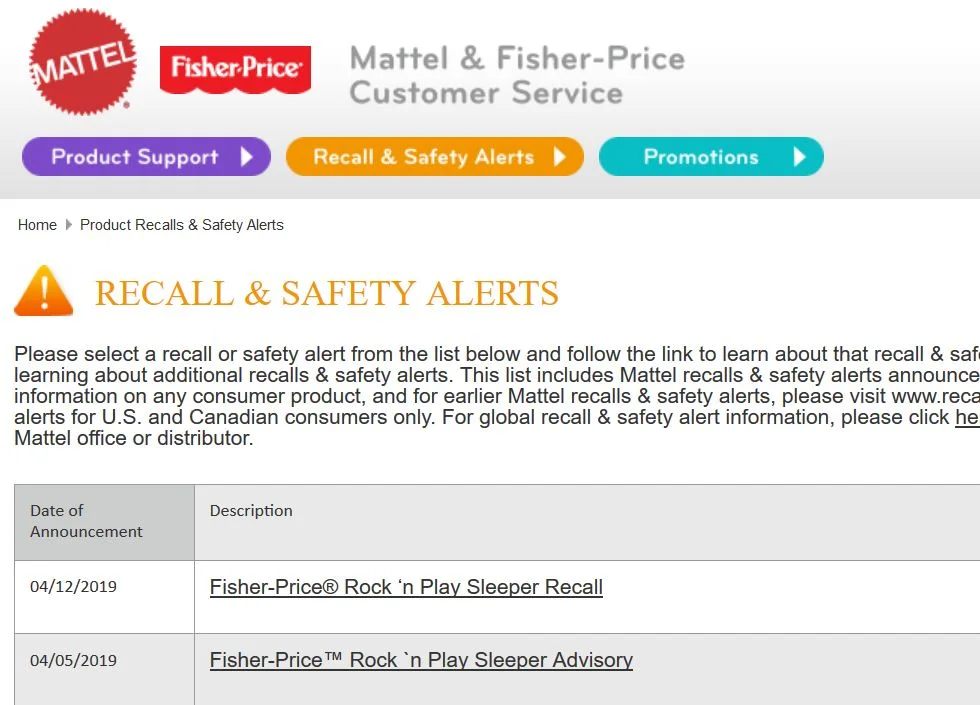
At first, the company stood by their product, but after 10 infant deaths since 2015, Fisher-Price voluntarily recalled its Rock ‘n Play sleeper. The decision affects 4.7 million products, and the notice is now prominently displayed on the Fisher-Price homepage. When you follow the link, you see the page at right, which lists all “Recall & Safety Alerts.”
The announcement on April 5 points to a Consumer Product Safety Commission (CPSC) alert, which suggests that customers stop using the product for infants more than three months old, when they can turn over and suffocate.
The announcement on April 12 is a full recall, which urges customers to “immediately stop using the product” and return it for a refund.
Discussion:
Analyze the communication situation. Who are the primary and secondary audiences of Fisher-Price’s messages? What information do those audiences need? How might they react emotionally? What are the company’s communication objectives?
Product recall messages typically follow a particular structure and provide specific content. What do you observe from this message?
Should Fisher-Price have issued the recall earlier? Why or why not?

Boeing's Apology Dilemma

A Yahoo Finance article describes Boeing CEO Dennis Muilenburg’s decision to apologize for the 737 MAX tragedies and speculates that he may open the company up to lawsuits. However, for crisis communication, his apology is the right decision.
After a report found the planes to blame, Muilenburg admitted, “but with the release of the preliminary report of the Ethiopian Flight 302 accident investigation, it is apparent that in both flights, the Maneuvering Characteristics Augmentation System, known as MCAS, activated in response to erroneous angle of attack information." He’s not telling us anything we don’t already know, and Boeing will likely get sued anyway.
He also apologized: “We at Boeing are sorry for the lives lost in the recent 737 accidents and are relentlessly focused on safety to ensure tragedies like this never happen again.” The apology is critical—and too late in my opinion. Research on apologies indicate that they often reduce lawsuits, time to agree on settlements, and settlement pay.
Discussion:
Do you agree with the assessment that the CEO did the right thing by apologizing?
How does this situation illustrate vulnerability as a positive leadership character dimension?
What other character dimensions are illustrated by this situation?

Views About Social Media
Is social media influencing over lives positively or negatively? A Wall Street Journal/NBC poll found that Americans see more problems than benefits to society, although 70% of respondents use social media sites every day.


Respondents also don’t have high trust in technology companies, rating the federal government as more trustworthy, with Facebook getting particularly low grades. This is tough news for the tech firms considering Gallup’s research on confidence in institutions. Given a list of 15 institutions, including small business, the police, and the military, Americans have consistently rated Congress last.
Discussion:
Do these survey results surprise you? Why or why not?
The Gallup question is different, asking about “confidence” rather than “trust.” Could the wording make a difference in responses? Why or why not?
Evaluate these Wall Street Journal graphics. How well do they convey the information? What could be improved?

Southwest Faces Customer Service Criticism

Despite trading on the NY Stock Exchange under “LUV,” Southwest is taking some heat from customers because of the Boeing 737 MAX plane groundings. According to a USA Today report, customers says Southwest didn’t handle rebookings well:
They're peeved about Southwest's handling of passenger rebookings, especially last-minute flight cancellations that leave them with few options. And they're perplexed by Southwest's uncharacteristic lack of flexibility, with affected passengers given two options: take the alternate flight, even if it's days later or to a different airport, or get a refund.
Our first clue about problems came with Southwest’s first statement about the plane groundings. Little guidance was offered for customers to rebook. The first three comments on a Southwest message posted on March 13 illustrate the problem.
A Southwest spokesman said it’s a challenging situation—like a snow storm that lasts for many weeks—and claimed that the airline did everything it could, including offering "massive flexibility'.'
Discussion:
Southwest could not have prevented the Boeing 737 MAX disaster, but what about its own customer service situation? What, if anything, could company leaders have done differently?
How should Southwest react to customers’ complaints now? I see nothing on its website or blog.