
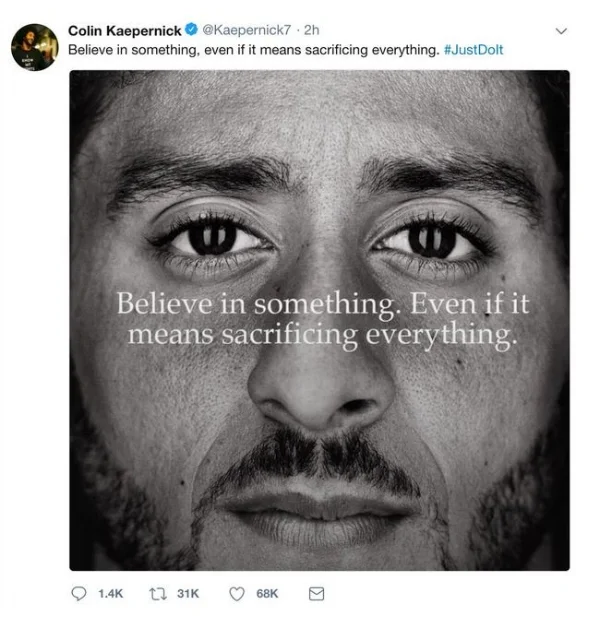
Nike Takes a Chance on Kaepernick
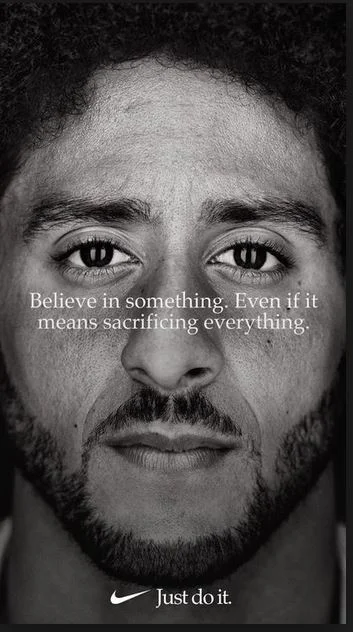
Former National Football League quarterback Colin Kaepernick will be the new celebrity face of Nike's "Just Do It" campaign. Kaepernick was the center of controversy when players were both complimented and criticized for "taking a knee" to protest racism and promote social justice.
Nike and Kaepernick already had a sponsorship deal, but this new contract extends it. The deal may be "awkward," to use The New York Times's phrase, because the NFL has not been able to stop player protests, to the dismay of President Trump and others.
Also, Kaepernick hasn't played in the league since 2016 and has an active grievance, accusing the league of conspiring to prevent him from playing.
But neither Nike nor Kaepernick are shying away from the message. The first ad shows Kaepernick with the caption, "Believe in something. Even if it means sacrificing everything."
As part of the deal, Nike will contribute to "Know Your Rights," Kaepernick's foundation to "fight oppression of all kinds globally, through education and social activism.
Discussion:
What risks is Nike taking with this contract? Do you believe the campaign will be well received, divisive, or something else?
Nike didn't respond to The New York Times for comment about the story. Should the company include a comment or make a statement? Why or why not?
What leadership character dimensions are illustrated by this story?
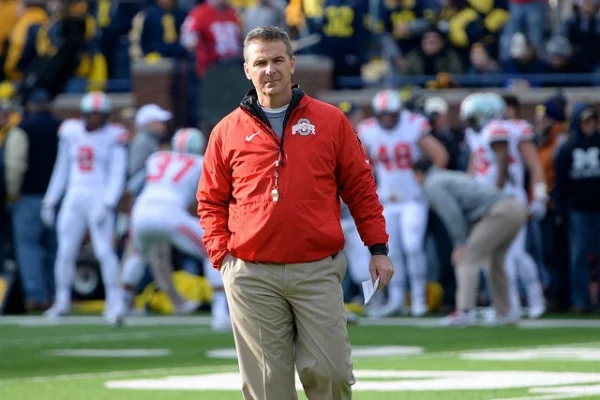
Ohio Football Coach: Another Case of Deleted Messages
Ohio State football coach Urban Meyer will forgo pay and the ability to coach three games because of his failure to appropriately handle a staff member's misconduct. A New York Times article chronicles issues with Zach Smith's behavior, including paying $600 at a strip club during a recruiting event, a domestic violence charge, and an affair with a staff member.
During a press conference, Meyer apologized, saying, "I should have done more, and I am sorry for that," and "I followed my heart and not my head."
The Times article also describes a conversation between Meyer and Smith about deleting text messages. I should count the number of stories on this blog since 2010 illustrating that deleting texts and emails fail to get the desired result. These messages are almost always recoverable, and the act of deletion makes the accused look even more guilty.
In addition, in this situation, Ohio State officials at first failed to produce messages requested by the school newspaper. Worse, several staff knew about the request, but no one even approached Coach Meyer to retrieve them.
Discussion:
- Once again, where are the many places deleted messages may be stored? How else can they be retrieved?
- What's your view of the strip club visits? Could Meyer reasonably argue that this is just part of the recruiting process? After all, no students were invited—only university and high school coaches.
- Assess the press conference. How well did university officials, including Meyer, respond to reporters' questions? Did the team appropriately take accountability?

What Is "Dehumanizing" Speech?
The New York Times reports Twitter's struggle to define what constitutes "dehumanizing" speech. Apparently, the only agreement among Twitter's team members is that the decision is "incredibly complex."

Categorization is critical, as the company has a reputation as a sometimes dark place of trolls and harassment. Yet this week, Apple, Facebook, YouTube have expunged content from Alex Jones's Infowars, which is known for spreading misinformation, including that the shooting at Sandy Hook was a hoax. You can imagine how this angered families of lost children.
In a tweet, CEO Jack Dorsey explained Twitter's decision to keep Infowars content, but employees, particularly, have not responded positively.
Twitter is in a difficult spot because, on the other hand, sites have been criticized for censoring conservative views. Del Harvey, the company's VP of Trust and Safety, wrote an email to employees further explaining the company's rationale.
Discussion:
- How would you define "dehumanizing" speech? What character dimensions are involved?
- What persuasive strategies does Harvey use in her email to employees? Which are most and least convincing and why?
- What is your view about Infowars content? Should Twitter remove it from the site as other social media companies have done? How might your own political views factor into your thinking?

Airline CEOs Defend Seat Size

American and Delta Airlines CEOs sit in small plane seats to explain the rationale and defend shrinking seat sizes. Doug Parker and Ed Bastian, both 6' 3" tall, agreed to talk to a WSJ writer, while United CEO Oscar Munoz declined.
Both CEOs say they fly coach for short trips. Bastian started a policy that Delta directors must fly coach when traveling less than three hours. Of course, as the article points out, suffering three hours in a small seat isn't quite the same as 24.
The executives say that flight amenities, such as WiFi, make up for any discomfort from smaller seats. American's Parker says that customers don't complain and that the airline hasn't "done anything that makes the main cabin product less desirable than it was before." The airlines are also focused on providing larger seats for higher fares.
Another WSJ article explains what airlines consider when making seats comfortable.
Discussion:
- How does this story illustrate character dimensions such as compassion, vulnerability, and humility?
- Did the CEOs do the right thing by agreeing to participate in the article? What are the risks and benefits?
- Why would United CEO Oscar Munoz decline? Was this the right decision for him and the airline?
- What persuasion tactics do the CEOs use to convince us that flying coach is not so bad?
- Do you agree with the CEOs' assessments about small seats? What has been your experience?

Cold Email Examples
The CEO of Mapistry, a start-up software company for storm water compliance, posted and analyzed her past emails to VCs, venture capitalists who could invest in her company. Allie Janoch disputes the claim that you need an introduction to a VC; she has had some success in sending cold emails.
Her first email, Janochs admits, says little about her company and undermines the message with self-deprecation.

She didn't get a response. Her second email, when her company had more traction, includes a specific subject, focuses on problem solving, uses bullets for important data points, and is personal.

Discussion:
- What do you consider the strength's of Janoch's second email?
- What improvements could she make?
- How does each email demonstrate humility? The first, as Janoch says, is self-deprecating. What's the potential problem with this approach? How does the second email demonstrate humility as well as confidence? How well does Janoch balance the two?
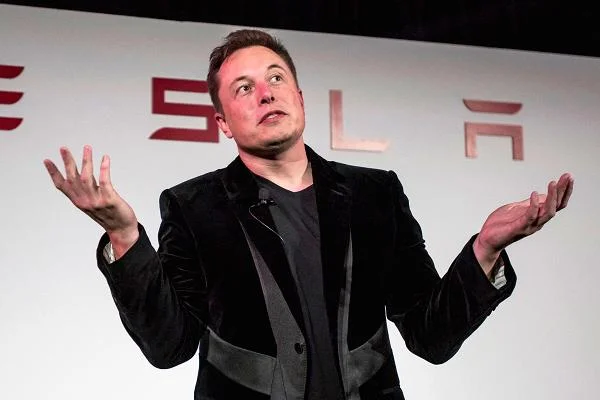
Tesla's Contentious Conference Call
Called "the most unusual call...in 20 years," "bizarre"—and "the best call I've heard in a long time," Tesla's earnings call is a popular news item. On balance, as one analyst said, “Needless to say, the call didn’t go well," and the evidence is in the stock price, which dropped 7.9% (5% within 20 minutes).
Here are a two highlights of CEO Elon Musk's responses to questions:
Sanford Bernstein's Toni Sacconaghi: "And so where specifically will you be in terms of capital requirements?"
Musk: "Excuse me. Next. Boring, bonehead questions are not cool. Next?"
RBC's Joseph Spak: "The first question is related to the Model 3 reservations, and I was just wondering if you gave us a gauge as maybe some of the impact that the news has had. Like, of the reservations that actually opened and made available to configure, can you let us know, like, what percentage have actually taken the step to configure?
Musk: "We're going to go to YouTube. Sorry. These questions are so dry. They're killing me."
At one point, Musk, frustrated by a question, said, "Please sell our stock and don't buy it." Candor is one thing, but I'm not sure a CEO wants to alienate investors.
CNBC host Jim Cramer is one of the opposing voices, who complimented Musk on his directness and telling the truth. He said that many CEOs are thinking what Musk said out loud. At the same time, Cramer acknowledged that this might be Musk's last call.
Discussion:
- What's your view of Musk's responses during the call? What factors into your assessment?
- Watch Cramer's analysis. To what extent do you agree with his assessment?
- What are the risks of Musk's approach (in addition to the short-term stock price drop), and what are the potential rewards?
- Some might say Musk is being authentic. How do you see it?
Narrative Alternatives to PPT at Amazon and Google
In his annual letter, Amazon CEO Jeff Bezos wrote that he has banned PPT:
"We don’t do PowerPoint (or any other slide-oriented) presentations at Amazon. Instead, we write narratively structured six-page memos. We silently read one at the beginning of each meeting in a kind of 'study hall.'"
Nancy Duarte describes the value of a narrative or storytelling approach: "storytelling in presentations is a powerful way to grab attention, hold attention, and to change beliefs." She gives examples from our favorite books and movies, which build suspense over time. Stories are also a good way to inspire empathy and other emotional reactions. This is difficult to achieve with traditional PowerPoint bullets.
A Harvard Business Review article, "Structure Your Presentation Like a Story," provides more guidance and summarizes the approach with a graphic:

For Bezos, the narrative style means that points are connected and organized in a logical sequence with some resolution, conclusion, or outcome. GeekWire created this six-page memo in Amazon's style as an example.
At Google, CEO Sundar Pichai also emphasizes storytelling with pictures:
"Since stories are best told with pictures, bullet points and text-heavy slides are increasingly avoided at Google."
Both executives are warning against the type of communication that is overly concise and missing context, connections, and cohesiveness. A ZDNet article summarizes some of the issues with PowerPoint and describes the now-infamous role of PPT in a U.S. disaster:
"'[B]ulletized' thinking contributed to the Challenger disaster, where 7 crew members died and a multi-billion dollar craft destroyed due to an O-ring failure. The big problem was that NASA management wasn't really listening to the engineers—and breaking issues up into bullets helped them do that."
Pichai's design approach aligns with PPT trends over the past few years. We're seeing much less text, fewer bullets, and more images, and this style follows the evolution of web design. On websites, we see many more background videos and photos and not much text, particularly on consumer websites.
Discussion:
- What are the advantages and downsides to the narrative memo? For what types of situations do you think this approach would work well? For what situations might PPT be a better choice?
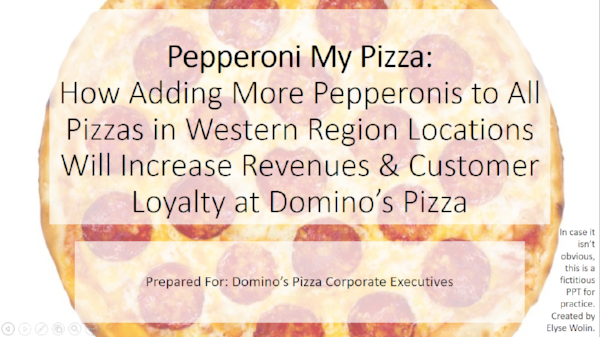
- For practice, try to convert this terrible PPT presentation to one with less text and more meaningful images. Clean up the design, add charts to help your audience visualize data, and of course, correct the grammar.

Chipotle CEO Generates Excitement

After a dismal three years of food-safety issues, Chipotle saw a strong first quarter, and CEO Brian Niccol is confident about the company's future. Since the outbreaks, part of Chipotle's turnaround plan was to introduce new menu items, but they did not prove successful.
In an interview, Niccol described new plans, which may include drive-thrus, longer hours, mobile ordering, or menu items that are more thoroughly tested. But Niccol resists offering deals and breakfast, despite what Bill Ackman, Chipotle's largest shareholder, advises:
“I’ve been very clear with him: Not now, Bill and I have had a couple of really good conversations. He may have some ideas that I don’t think are the right ones now.”
Here's the earnings call webcast. In the press release, Niccol further explained the company's plans:
"While the company made notable progress during the quarter, I firmly believe we can accelerate that progress in the future. We are in the process of forming a path to greater performance in sales, transactions, margins and new restaurants. This path to performance will be grounded in a strategy of executing the fundamentals while introducing consumer-meaningful innovation across the business. It will also require a structure and organization built for creativity, action and accountability. Finally, Chipotle will have a culture that is centered on running great restaurants, putting the customer first, innovating for today and tomorrow, supporting each other, and delivering on commitments. The future will be meaningful at Chipotle."
(Disclosure: I own a modest amount of Chipotle stock.) Image source.
Discussion:
- Assess the earnings call or press release. What business jargon do you identify? Is it too much, or is it appropriate for the situation and audience?
- Niccol is challenging Ackman's ideas, which is risky for a new CEO. How do you interpret his statement? Again, is what he says appropriate for the situation, or should he present his views differently?
- Would you say that Niccol is demonstrating courage in his statement about Ackman? Why or why not?
MTA Criticized for Lack of Transparency

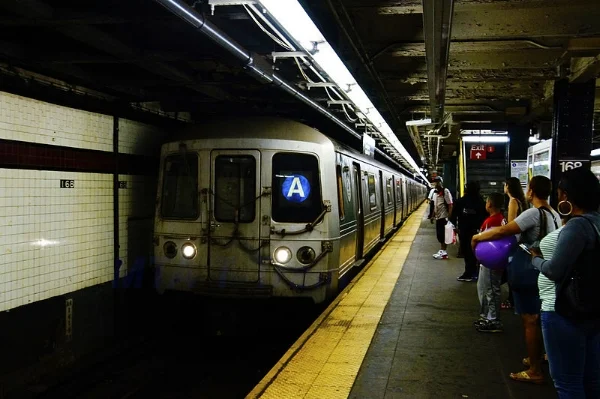
Commissioners at the New York Metropolitan Transportation Authority (MTA) questioned increasing costs and whether the agency has been transparent. Of particular concern are additional costs of about $1 billion and cost overruns for a project that resulted in 19 instead of 32 subway stations getting renovated. One commissioner said, “It is indefensible that we did not receive this information prior to it being reported in the press." The governing body discovered the information from a Wall Street Journal article.
Chairman Joe Lhota, who was appointed last summer, acknowledged that the agency has been working on being more transparent:
“Not a second in a day goes by when I don’t think about transparency at this agency and what we need to do to provide information to all of you."
NY Mayor Bill de Blasio and New York City Council Speaker Corey Johnson requested more transparency about spending and service improvement measurements and asked for monthly briefings and an "evaluation of efficacy."
Discussion:
- How would you define transparency, and how does it relate to accountability?
- After reading more about the situation, how would you assess the agency's actions? Do you agree with the commissioners' assessment? If you believe a lack of transparency exists, do you think it's intentional? Does it matter if it is?
- Why do organizations lack transparency? What do they potentially gain and lose?
- What do you think an "evaluation of efficacy" means?
More About the Starbucks Bias Situation
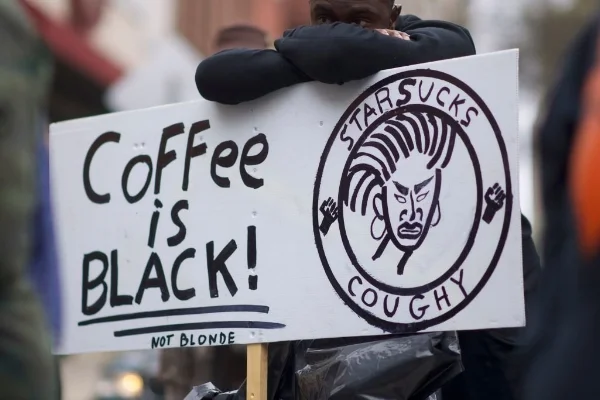
After the arrest of two black men in a Philadelphia store, Starbucks announced that 8,000 stores will close on May 29 for racial-bias training. But are some skeptical about the impact that one day of training will have, and the company seems to be imitating Chipotle's decision to close stores for food safety training. On the other hand, the company could have blamed the employee who called the police, a crisis communication strategy we have seem in many other situations.

An article in the New York Times describes racial bias research in hospitality customer service and may tell us more about the incident in Philadelphia. In one study, researchers sent emails to hotels using different names that reflected gender and race, asking for restaurant recommendations. Responses indicated racial bias, as the authors describe: "Hotel employees were significantly more likely to respond to inquiries from people who had typically white names than from those who had typically black and Asian names."
In addition, researchers analyzed "politeness," for example, whether employees wrote "best" or "sincerely" before signing their name. They were more likely to use such words when responding to guests with names that sounded white, and the authors describe another finding for this group:
They were three times as likely to provide extra information — even when the initial inquiry was just about restaurants — to white than to black or Asian people.
In addition to training, the authors suggest periodic customer service audits and consistent scripts and policies.
In a turn, Philadelphia Police Commissioner Richard Ross has apologized to the two men who were arrested. In his original video, Ross defended the officers actions and said, based on a sergeant's experience at Starbucks, "they are at least consistent in their policy." But in the news conference, Ross says, "shame on me" and "I have to do better."
Discussion:
- What's your view of the research about customer service at hotels? What does the research potentially say about the situation at Starbucks?
- Have you experienced bias in a customer service setting? What was the situation, and how did you handle it?
- How well does Ross handle the apology in the news conference? How does his identity factor into his response? How does he demonstrate authenticity, vulnerability, and other leadership character dimensions?
Uber CEO Compares Self-Driving Cars to Student Drivers
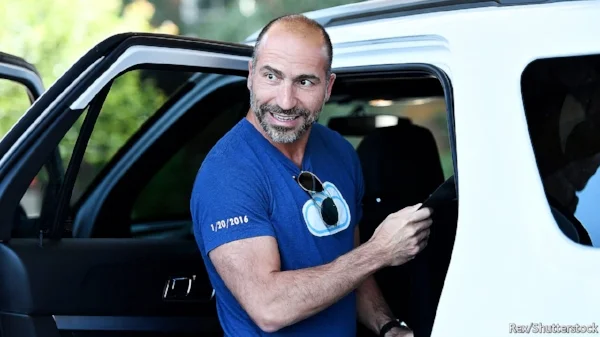
In defense of autonomous cars, Uber CEO Dara Khosrowshahi said, "Ultimately, self-driving cars will be safer than humans. But right now self-driving cars are learning. They’re student drivers.” On NBC's Today Show, Khosrowshahi confirmed that the company will continue its self-driving program despite a fatal crash last month in Arizona.
In the interview, when asked about Facebook and other technology companies facing privacy and safety issues, Khosrowshahi said he considers, "the challenges of technology getting into everyday life and the responsibilities that come with it." He repeated "responsibility" twice more within about the first minute of the interview. Like Mark Zuckerberg during the recent hearings on Capitol Hill, he said, "I welcome regulation," and "we're partnering with regulators."
Also as Zuckerberg clarified with lawmakers, Khosrowshahi said they don't sell data; however, he also said they don't "monetize data," which Facebook cannot say with its business model to sell ads.
Discussion:
- What principles of persuasion does Khosrowshahi demonstrate in this interview? Consider logical argument, emotional appeal, and credibility.
- What principles of leadership character does he demonstrate?
- What do you consider the strengths of this interview? What could Khosrowshahi improve?
Zuckerberg Testifies Before Congress

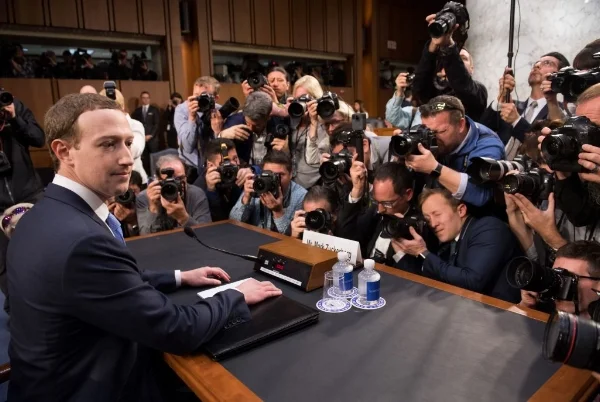
In many hours of testimony, Facebook CEO Mark Zuckerberg did his best to address lawmakers' questions about data privacy and, surprisingly, how Facebook works. Senators and Members of Congress asked questions about texting, about how the company makes money without a subscription model (Zuckerberg: "We sell ads."), whether Facebook owns users' data, whether Facebook sells data, how many "data categories" Facebook collects, and so on. This video compilation does not reflect well on our lawmakers.
Zuckerberg himself seemed surprised by some of the questions and wasn't fully prepared to answer them. A reporter captures a photo of Zuckerberg's notes, which are what we would expect, but it's fun (in a voyeuristic way) to see them.
On the second day of testimony, questions improved, and many focused on Facebook's treatment of conservative political views. These were fair questions, and Zuckerberg admitted they had made mistakes in screening some content as inappropriate. But several representatives seemed to ask similar questions about this and about the consent agreement with the FCC, as if the question hadn't been asked just moments earlier.
In a New York Times Daily Podcast, reporters discussed Zuckerberg's continued references to starting Facebook in his dorm room. They believed the strategy was a good one for demonstrating his humanity (emotional appeal) but was potentially damaging for his credibility because it reminded lawmakers that he is only 33 years old. A seat chair, which internet trolls called a "booster seat," didn't help.
Wall Street responded well to Zuckerberg's testimony, with the stock price rising both days.
Discussion:
- What's your view of Zuckerberg's testimony? Watch as much as you can tolerate.
- Should lawmakers have a better understanding of Facebook? What is their level of responsibility?
- Identify a few specific questions and Zuckerberg's answers. What leadership character dimensions does he demonstrate, and how could he have improved?
- Watching the testimony, how would you assess his authenticity? Do you know more about him as a person? Should we?
An Interview with Sheryl Sandberg

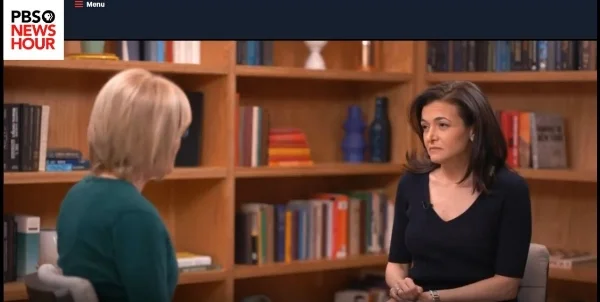
During an interview with Judy Woodruff on PBS NewsHour, Facebook COO Sheryl Sandberg admitted mistakes and discussed plans for improving users' privacy. Sandberg didn't shy away from tough questions about Facebook's role in protecting users' information and admitted that the site had an important role during the 2016 presidential election, at least to get people to register to vote.
On whether Cambridge Analytica still has data, Sandberg admitted, "We were given assurances by them years ago that they deleted the data. We should’ve followed up. That’s on us. We are trying to do a forensic audit to find out what they have." She also said the company had "under-invested" in ways to protect users' information.
Viewers may notice that Sandberg repeatedly says versions of "That's a very good question." This could be a tactic to delay responding, or it could be that Woodruff asks good questions! Sandberg would be the first to acknowledge that many of the questions are ones the company leaders are asking themselves at this point. As pioneers, Facebook executives are reconsidering how people use the site and for what purpose.
Discussion:
- Assess Sandberg's presentation skills. How well does she deliver her ideas and address questions?
- What principles of persuasion does Sandberg demonstrate in the interview?
- What else, if anything, could Sandberg have said during this interview to rebuild trust in the company?
Defense for Rudeness: "I'm French"

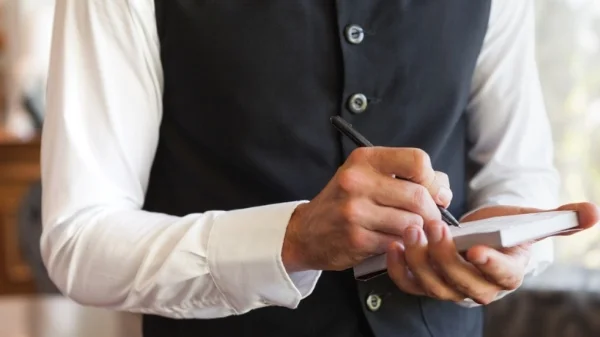
A waiter in at Milestones Bar + Grill in Vancouver, British Columbia, was fired for being rude. Guillaume Rey doesn't argue the point, but he has filed a lawsuit claiming his termination is discriminatory.
As part of the suit against the parent company, Rey said the decision was "discrimination against my culture," which “tends to be more direct and expressive." On the other hand, Rey signed documentation with the restaurant that states, “intentionally speaking to a Guest or Associate in a rude or unfriendly manner" may be cause for termination.
The restaurant tried to get the case dismissed but failed. A judge explains the ruling:
Given that there is at least some evidence supporting an inference that Mr. Rey’s ancestry was a factor in the termination, and given how little other information I have about what happened, I cannot find that the Restaurant has met its burden on this application.
Discussion:
- Read the court's findings. What were the restaurant's arguments? What are Rey's arguments?
- Do you agree with the judge's decision at this point? Why or why not?
- How does this situation demonstrate humility or a lack of humility?

FB Admits Mistakes and Makes Promises

After five days of silence, Facebook CEO Mark Zuckerberg is addressing new criticism about privacy issues. Recent reports describe how Cambridge Analytica used data from about 50 million FB users without their permission, possibly to influence voters during the 2016 presidential campaign. Although some users gave permission for their information to be shared, their "friends" didn't, and this gave developers enormous amount of data about people's preferences. In addition, Cambridge claimed it had deleted data in 2014, but new reports indicate it did not.
Now Zuckerberg is visible in the media and has issued a statement that included the company's responsibility and failings:
We have a responsibility to protect your data, and if we can’t then we don’t deserve to serve you. I’ve been working to understand exactly what happened and how to make sure this doesn’t happen again. The good news is that the most important actions to prevent this from happening again today we have already taken years ago. But we also made mistakes, there’s more to do, and we need to step up and do it.
He also told CNN, "I'm really sorry that this happened." He promised to limit developers' access to data in the future.
Facebook also published a full-page newspaper ad in the New York Times on March 25.
Discussion:
- How does this situation represent issues of integrity and trust?
- Read Zuckerberg's full statement. Which parts do you find most and least convincing?
- How is the statement organized? Is this the best approach, or could other organizational strategies have worked better?
- Assess Zuckerberg's writing style. Which principles of business writing are followed, and which are not?

Turnaround for Martin Shkreli
We see a different Martin Shkreli from the one criticized for smirking during a congressional hearing on Capitol Hill in 2016. Shkreli ran Turing Pharmaceuticals when the company was accused of raising drug prices 5,000% in 2015. At the time, he was only 28 years old and was called "the most hated man in America."
Last week, Shkreli was sentenced to seven years in prison for fraud committed while he was a hedge fund manager and while running another drug company, Retrophin.
Shkreli pleaded for leniency. According to a CNBC report, he "broke down in tears." Another article summarizes his statements in court:
"The one person to blame for me being here today is me," a choked-up Shkreli told a judge before she imposed the prison term in Brooklyn, New York, federal court.
"Not the government. There is no conspiracy to take down Martin Shkreli."
"I took down Martin Shkreli with my disgraceful and shameful actions."
"This is my fault. I am no victim here," Shkreli said, before breaking down into tears as he promised not to let his lawyer Benjamin Brafman down in his efforts to contribute to society.
"Do not feel bad for me," Shkreli told a packed courtroom that included supporters and family members, many of whom had written letters asking Judge Kiyo Matsumoto to spare him from a harsh sentence.
And he had a message for the investors he duped: "I am terribly sorry I lost your trust. ... You deserve far better."
"I was never motivated by money," Shkreli said. "I wanted to grow my stature and my reputation."
"I am here because of my gross, stupid and negligent mistakes I made."
Discussion:
- Let's assume Shkreli's statements are sincere. How could you explain Shkreli's smirking in 2015 at such as serious hearing and his behavior more recently?
- Do you believe Shkreli's statements are sincere? Why or why not?

More Companies Take Action to Curb Gun Sales

Dick's Sporting Goods has taken a strong stance on gun control. In a statement, the company announced it will no longer sell assault-style rifles and will no longer sell firearms to people under 21 years of age. The statement dances the fine line between both sides of the gun control debate:
We support and respect the Second Amendment, and we recognize and appreciate that the vast majority of gun owners in this country are responsible, law-abiding citizens. But we have to help solve the problem that’s in front of us. Gun violence is an epidemic that’s taking the lives of too many people, including the brightest hope for the future of America – our kids.
Walmart also announced it will no longer sell to people under 21 years of age. The company ended some firearm sales in 2015, so this policy further restricts what people can purchase when.
Companies are in a tough spot. Dicks, Walmart, Delta, and other companies have suffered backlash for their decisions, including people promising to boycott.
Discussion:
- Compare Dick's and Walmart's statements. How do they differ? Which is more effective and why?
- Describe Dick's choices. What are the risks and rewards of the announcement?
- Should other CEOs jump into the controversy? How might the decision depend on industry, customer base, or the leader him- or herself?

Companies Distance Themselves from the NRA

Following the school shooting in Florida, several companies are distancing themselves from the National Rifle Association. The organization lists many member benefits on its website, including travel and insurance discounts, but these are shrinking as more companies are discontinuing services.
For example, several major car rental companies—Enterprise Rent-A-Car, Alamo Rent a Car, National Car Rental, Avis, Budget, and Hertz—and major airlines, such as United Air Lines and Delta, will eliminate discounts for NRA members.
The NRA posted a statement on its website to deflect blame, reinforce its mission, and deny the impact of these companies' actions:
FAIRFAX, VA – The more than five million law-abiding members of the National Rifle Association have enjoyed discounts and cost-saving programs from many American corporations that have partnered with the NRA to expand member benefits.
Since the tragedy in Parkland, Florida, a number of companies have decided to sever their relationship with the NRA, in an effort to punish our members who are doctors, farmers, law enforcement officers, fire fighters, nurses, shop owners and school teachers that live in every American community. We are men and women who represent every American ethnic group, every one of the world’s religions and every form of political commitment.
The law-abiding members of the NRA had nothing at all to do with the failure of that school’s security preparedness, the failure of America’s mental health system, the failure of the National Instant Check System or the cruel failures of both federal and local law enforcement.
Despite that, some corporations have decided to punish NRA membership in a shameful display of political and civic cowardice. In time, these brands will be replaced by others who recognize that patriotism and determined commitment to Constitutional freedoms are characteristics of a marketplace they very much want to serve.
Let it be absolutely clear. The loss of a discount will neither scare nor distract one single NRA member from our mission to stand and defend the individual freedoms that have always made America the greatest nation in the world.
Discussion:
- Did these companies make the right decision? Some NRA members are boycotting them as a result.
- In its statement, the NRA refers to companies' "shameful display of political and civic cowardice." Do you see their actions as cowardice, courageous, or something else? What is the difference?

Students Fight for Gun Control

After the school shooting that killed 17 people in Florida, students across the country are protesting for tighter gun control laws. High schoolers left their classes to confront politicians on their failure to change laws and for taking money from the National Rifle Association. Delaney Tarr was one of the vocal students:
"We've had enough of thoughts and prayers. ... If you supported us you would have made a change long ago and you would be making change now. So this is to every law maker out there. No longer can you take money from the NRA ... because we are coming after you."
Adding fuel to the controversy, some GOP members have accused students of being hired actors. Rep. Daryl Metcalfe criticized the protests:
“This morning I was working out and listening to the news about ‘students’ being bussed in to the Florida Capitol. The hypocrisy of the left struck me! They expect lawmakers to listen to the policy advice of 18 year old and younger ‘students’ who are advocating for gun control, but they do not believe 18 year olds who are old enough to serve on the battlefields of Afghanistan are old enough to purchase a rifle.”
Other Republicans, such as Marco Rubio, contradicted such messages, calling claims that students are actors “the work of a disgusting group of idiots with no sense of decency.”
Discussion:
- In what ways are students demonstrating courage? What obstacles do they face as they protest for greater gun control?
- Assess students' messaging. How do they balance emotional appeals and logical arguments? Which are most effective in this situation?
- What do Republicans want from this controversy? In other words, what are these lawmakers' interests? How do their criticisms of the students help or hurt their case?

Adam Rippon Demonstrates Authenticity and Questions Pence
U.S. Olympic figure skater Adam Rippon has been public about being gay and having a history of an eating disorder. Rippon says he felt pressure to fit a particularly body image and sometimes starved himself to achieve it.
In January, Rippon said he would refuse a meeting with Vice President Mike Pence because of his support of "conversion" therapies, attempts to change someone's sexual orientation or gender identity. Pence denied the claim and expressed support for all athletes:
“The accusation is totally false with no basis in fact," Alyssa Farah, Pence's press secretary, stated. "But despite these misinformed claims, the Vice President will be enthusiastically supporting all the U.S. athletes competing next month in Pyeongchang.”
However, an NBC article identifies a message on Pence's website that supports Rippon's claim:
Under the headline "Strengthening the American Family" and just below his stated opposition to same-sex marriage and anti-discrimination laws protecting "homosexuals," Pence's platform advocates that resources "be directed toward those institutions which provide assistance to those seeking to change their sexual behavior."
Discussion:
- What's your view of Rippon's statement?
- Explain VP Pence's statement given his documented platform? How do you reconcile the claims?
- In what ways does Rippon demonstrate authenticity?