

Communication Implications of AI-Generated Models
As the fashion industry increases use of AI-generated models, students can explore whether communication can play a role in preventing the perpetuation of body-image ideals.
PBS News Hour reports how the industry is deploying AI to reduce costs. One concern is whether viewers will feel increased pressure to achieve a perfect body. Some argue that AI images decrease body-image pressure because viewers know they are not real and, therefore, are unattainable. But, at a minimum, that would require disclosure—clear labeling—that images are AI-generated.
We have no standard, requirement, or means of enforcement for such messages today. However, we do see similar regulations from the Federal Trade Commission (FTC) for product endorsements, with influencers admitting “paid partnership” or identifying sponsorships. Similarly, the FTC requires companies to add “actor portrayal” or “dramatization” labels on commercials when people provide testimony, for example, for a pharmaceutical drug.
Students might explore whether something similar could work for the fashion industry. Still—even with the clearest messaging—could AI models do harm? The potential for comparison may still exist, as it does today. We know models’ images are Photoshopped, but that doesn’t seem to reduce young people’s aspiration or their self-harm to achieve ideals. There’s just so much communication can do.

“Rigged” Data Questions in Business Communication
Without getting too political, we could talk with students about what “rigged” data might look like in a business setting. President Trump used the term to explain his firing of the Bureau of Labor Statistics (BLS) commissioner.
Students might first review the BLS report, “The Employment Situation.” Then, they might read an interview with Cornell University Economist Erica Groshen, who was the BLS commissioner for four years during President Obama’s administration.
Data integrity refers to its accuracy, completeness, and consistency over time. In the interview, Groshen disputes claims by highlighting the BLS’s rigor (choreographed, specific roles) and repetition (consistency):
With regard to allegations of altering the data, the process is highly, highly choreographed, with tight deadlines. BLS does this every month, and everybody knows who needs to do what job on what day to get this out on time.
Without getting into the details of the jobs report, students might explore potential “rigged” data in other contexts. What does “rigging” mean? Although a colloquial term, we could interpret it to mean falsifying or manipulating inputs or presenting results to intentionally mislead.
Some examples are obvious, but others are not so clear-cut. For example, at what point could apple polishing, cherry picking, or comparing apples to oranges legitimately be labeled rigging data? If one month of weak sales data during a product recall is omitted from a line chart, is that rigging the data? How about if a rural location is compared to an urban location? On a dating app profile, if someone claims to be 5’ 11” when they are 5’ 10”, is that rigging data? What if they’re 5’ 10.2'“?
Students might consider the consequences of data reporting. Manipulating drug testing results is clearly different from exaggerating customer feedback about a food truck start-up. Students might discuss plans to ensure accuracy in their own data reports—and the consequences of inaccuracies or omissions.

Google’s Defense of AI Search
A blog post by VP, Head of Google Search, Liz Reid illustrates persuasive strategies and data interpretation to deny the negative impact of AI search features on website traffic.
Although reports find that Google AI search summaries reduce clicks to news and other sites, the company argues that is not the case. In a blog post, Reid writes, “user trends are shifting traffic to different sites, resulting in decreased traffic to some sites and increased traffic to others.” A TechCrunch writer describes the rhetoric well:
That word “some” is doing heavy lifting here, as Google doesn’t share data about how many sites are gaining or losing. And while chatbots like ChatGPT have certainly seen traffic increase in recent months, that doesn’t mean online publishers aren’t suffering.
In business communication, we encourage students to find more precise words than “some” and “very.” Here we see Google hiding behind vague references and aggregate data to mask the impact on publishers. Reid also wrote, “overall traffic to sites is relatively stable.“
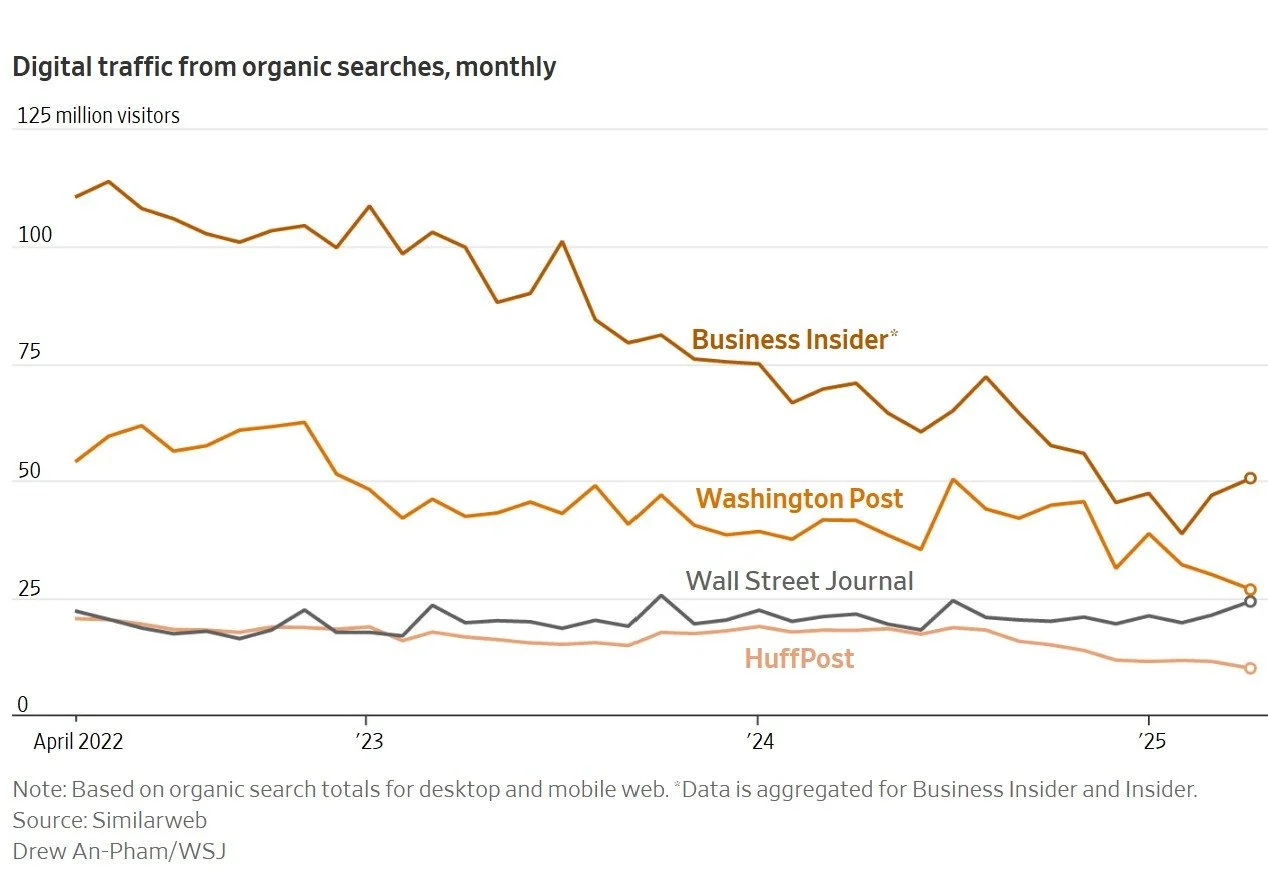
Reid claims, “AI in Search is driving more queries and higher quality clicks.” Google argues that click “quality” is improving, meaning people are more purposeful, engaging longer on sites they choose for a reason instead of responding to clickbait. That may be, but organic searches (from unpaid sources) is still down for “some” news outlets already hurting because of declining print and digital subscriptions.
If users get their questions answered from the AI summary, why go to the original source? Students might discuss what, if any, responsibility Google bears for compensating content creators.

Advice for Taking Time Off

A Financial Times article offers advice for those hesitant about taking time away from work, particularly time away from email. The suggestions from company executives may be useful to new graduates and others starting a career.
Here’s my summary with character dimensions that may be illustrated by each action:
Set clear expectations with friends and family about work commitments. (accountability, courage)
Empower people to respond for you and have a plan for emergencies. (humility)
Model vacationing without email for coworkers. (accountability)
Respond only during set times during the day, for example, in the morning, if you must. (integrity/consistency)
Write an OOO message that discourages emails waiting for your return. (integrity/transparency)
Resist the temptation to check email! (courage, integrity)

Lessons from Delta Comm Failures
A passenger describes a “total communication breakdown” before, during, and after an emergency Delta flight landing. Following are lessons for students from both the incident and from how the reporter addressed the passenger’s complaint.

On a flight from Madrid to New York City, an engine failed, requiring the plane to land on the island of Azores, a stunning place to visit but perhaps not following an emergency landing. After researching the situation, a New York Times reporter confirmed that “Delta’s crisis communications strategy failed badly.”
Lesson 1: Customers have more credibility when they report what happened accurately and objectively.
The reporter called out a few inaccuracies and generalizations in the passenger’s telling. Here’s one example:
“It is also not exactly true that Delta had no ‘ground support or personnel.’”
The reporter found that the airline contracted with locals who were lauded by other passengers. Delta doesn’t fly to that airport, so they can’t be expected to have their own staff.
As another example, the reporter refines the passenger’s note about compensation:
Marc, you called Delta’s approach “shady and evasive.” I would go with “incomplete and maladroit.”
“Shady and evasive” are character judgments, yet we have no idea whether malintent existed. The reporter sticks with behaviors: a failure of good practice and a lack of skill.
Lesson 2: Overcommunicate (within reason) during a crisis and ensure that all customers get the same message at the same time.
The reporter confirms that the wait for information, particularly whether passengers would have hotel rooms, was long and caused stress. Some got messages, while others did not.
Passengers also saw flight staff “whisked off” to a hotel with no explanation or communication. Turns out, rest was mandatory so the crew could fly the next day. But as business communication faculty know, frequent communication is essential. Passengers felt “in the dark.”
Lesson 3: Crisis situations are not the time for humor.
This next bit sounds outrageous from a crisis communication perspective. Passengers heard “loud, scary noises from the left side of the plane” and estimate that it wasn’t until 10 minutes later—10 minutes!—when they heard an announcement recalled this way (commentary is from the reporter):
“The pilot just woke up from his nap and is going to look into what is happening.” If true, wrote Mr. Durrant [a Delta spokesperson], the nap reference was “likely referring to planned rest periods for flight crew.”
Even if the pilot was napping for legitimate reasons, why share it with passengers? If it was a joke, passengers did not seem to find it funny.
Lesson 4: Demonstrate integrity (consistency, accuracy, and transparency) in all communications.
The pilot announced that another plane would arrive in 6 hours. Any reasonable, hopeful passenger would assume this means they would be leaving in 6 hours, but that wasn’t the case because of rest requirements. Passengers had to spend the night.
In addition, passengers seemed to be compensated different amounts at different times, despite an EU law regulating the amount. Some garnered more after writing a “measured” complaint letter.
In the end, this situation reflected poorly on Delta. A few simple changes would not have made the situation less scary or frustrating but could have reduced the reputational hit.

McDonald's Quarterly Earnings Report and Comm Strategies

McDonald’s had a good second quarter, with global sales up 6%. Students could analyze the report formats and communication strategies executives used during the earnings call.
One lesson for students is the multiple communication channels and report formats McDonald’s published to communicate its quarterly earnings. The press release, quarterly report in four formats (PDF, Zip files, HTML, and Excel), and recorded Webcast earnings call (and transcript) are all open to the public and convey a consistent message, which is upfront in the press release:
Our 6% global Systemwide sales growth this quarter is a testament to the power of compelling value, standout marketing, and menu innovation—proving again that when we stay focused on executing what matters most to our customers, we grow. Our technology investments and ability to scale digital solutions at speed will continue to elevate the McDonald's experience for customers, crew, and our global System.
Any question and answer during the earnings call provides examples of communication strategies. For example, executives use what we might teach as hedging or tentative language (“I think”); however, students can see these responses employed strategically. They persuade the audience by demonstrating humility and credibility—qualifying responses to show a cautious approach and, in effect, saying, “I don’t know everything.” This language also protects an executive whose prediction turns out wrong, and it conveys a conversational tone to build trust.
Although the news is good, the first question challenged the company’s reliance on “value,” particularly in the United States, where families are under increasing financial pressure. Here are the first question and answer as an example from the transcript (my notes in green italics):
David Palmer, Analyst, Evercore: Thank you, and thanks for all of your, comments. Sounds like you’re still exploring ways to bolster value perception in The US. Ahead of anything there, you know, could you just speak to where you think McDonald’s value and affordability scores are today in The US? You know, perhaps before and after Snack Wrap and your recent McValue menu changes. You know, where is the consumer perception today versus McDonald’s in the past and versus near end competitors and maybe even fast casual competitors?
And and if there’s a difference between The US perception in terms of value versus other key IOM markets, would love to hear about that as well. Thanks so much.
Chris Kemczynski, Chairman and Chief Executive Officer, McDonald’s Corporation: Hi, David. It’s Chris [builds trust with first names and a friendly tone]. Thanks for the question. I think [demonstrates conversational style and humility with hedging language] when we talk about value, it’s important that we we really break it down and and get very specific about the different consumer segments. And I’ll start with, our most loyal consumers, and these are the ones who are on our loyalty program [previews content].
Roughly a quarter of our business in The US is on our loyalty program [frames the response and emphasizes return business]. And what we see is if you [conversational style] are a loyalty member at McDonald’s, we have we have exceptional value and affordability scores amongst those consumers. And probably that’s most evidenced by what I shared in in the prepared remarks, which is the uptick that you see in terms of frequency when we have a loyal consumer in our loyalty program going from 10 roughly 10 visits to 26 visits. So I think [again] with our loyalty members, our most ardent McDonald’s customers, we’re in a really good position as it relates to value [reinforces “value” throughout] and affordability perception. If you move then to the McValue program, McValue is working.
And if you think about what we have with McValue, we have the $5 meal deal, which is the anchor for that. That continues to perform very well for us. And then we also have the buy one, add one for a dollar program. What’s interesting is [highlights what’s important] those two programs are very complementary. If you look at consumers who are using both, it’s only about 8% or so who are actually using both.
So they’re going after two very different occasions, two very different users, but compelling to both. So I feel good about the loyalty program. I feel good [uses anaphora to emphasize his confidence] about where we are with McValue. But the issue or the opportunity is if you add those two up, that’s, call it, roughly 50% of the business. And we know there’s the other 50% that today isn’t coming into our restaurant, isn’t using McValue, isn’t using the loyalty program [anaphora again], and that’s where we have the opportunity, which is around core menu pricing that we talked about in our prepared remarks [transitions to an “opportunity”—is more direct in the next section].
Today, too often, if you’re that consumer, you’re driving up to the restaurant and you’re seeing combo meals could be priced over $10 and that absolutely is shaping value perceptions and is shaping value perceptions in a negative way. So we’ve got to get that fixed [addresses concern directly]. As I mentioned in my remarks, we’re having, I think [again], very active and productive conversations with the franchisees. But the single biggest driver of what shapes a consumer’s overall perception of McDonald’s value is the menu board. And it’s when they drive up to the restaurant and they see the menu board, that’s what’s shaping the that’s the number one driver. [Could be clearer, but the gist is that the low-priced meals are good sellers, but pricier menu items negatively affect consumer perception.]
So we’ve got more work to do on that in The US. I’d say on the IOM [international operational markets—insider abbreviations for the audience] side of the business, we’re in a better position on that. Part of it is, as I mentioned in in the remarks [Fourth time he refers to the remarks—could demonstrate consistency/integrity] as well, we have a really strong EDAP program in all of our markets. So these are essentially $1 $2.03 dollars $4 euro pound whatever the currency is. But that is proving to be a very strong addition to the value programs in the IOM market.
And then also, as I mentioned, our operators there have been very prudent and I think [again] are doing the right things to make sure that our core menu pricing continues to be at leadership levels in the market. I would just note [tentative language], also on our international side, it’s not as competitive a market as it is in The U. S. There’s a lot of different players in The U. S.
We don’t face the same breadth of those players or competitors in our international markets. And so I think it’s a little bit easier for us to stand out and represent good value in international.
Columbia President's Resignation

Columbia University President Katrina Armstrong’s resignation statement serves as a worthy example for analysis. The political situation is extremely controversial, and she avoids direct references.
Her emphasis is on the “interim” nature of her position. In other words, she wasn’t planning to stay long, anyway. She mentions this early in her short statement and reinforces her “few months” of service at the end. She also emphasizes up front that she will return to her former role at the university.
Armstrong speaks well of Columbia and subtly refers to the controversy, using words like “healing” and “moving forward.” At the end, she hints at having a bigger voice: “The world needs Columbia University, and you can be assured that I will do everything I can to tell that story.”
It’s difficult to think of what else she could reasonably say, given the university’s precarious situation with the government and with all its many constituents. She may have said just enough.
This is one of those messages that could be classified as positive or negative news, depending on the receiver’s perspective. But appointing yet another interim president is not great, for sure.
Comparing Stock Charts for Perspective
This was a bad week for the U.S. stock market, but graphics make the news look worse than it is. Students can compare charts to see how truncated axes affect perception.

Yahoo!’s monthly chart has a short range: 41,000 to 44,000 for this monthly line chart. With the red line and shading, the results look awful. Noting the 6.87% drop is helpful—it’s not great but not devastating either. For the 62% of Americans (varying largely by demographic group) who own stock in some way, their portfolios are unlikely to be invested 100% in DJIA stock, so their personal losses are probably smaller.

This one year chart, also Yahoo!’s, shows a more complete view of the market. Over a year, stocks were still in positive territory—green(!)—and the recent dip is in clearer perspective. Not that short-term investors and perhaps retirees shouldn’t be concerned, and we might be headed into a recession, but this chart recognizes the extraordinary gains in the past year as well as the recent losses.
Students can find longer-term charts to see an even fuller picture of U.S. stock market returns. They might also find, or need to create, charts with a Y-axis starting at 0.
As always, the data visualization depends on the audience and purpose. If your audience is television viewers, and your purpose is to engender fear, then short time frames and truncated axes do the trick. If you’re a financial advisor, and your audience is a client who is a long-term investor with a balanced portfolio, you would probably not show these charts at all and instead focus on their portfolio returns over time.
Musk Email Lands in Italy
Elon Musk’s five-bullet-points email didn’t go over well in the U.S., but the reaction is worse in Italy, raising questions about intercultural communication for students to discuss. The email asks government workers to list five accomplishments in the past week.
With the subject, “What did you do last week?,” these emails were met with mixed reactions in the U.S., with some agencies instructing their employees not to respond. But when Italian workers at Aviano Air Base received the email, the negative reaction was stronger.
Students can explore cultural differences. One framework to explain the different reactions is Hofstede’s model, particularly the dimension of individualist / collectivist society. As one Italian union representative said, Italy “is not the Wild West like the U.S.” This country comparison tool website describes individualism as follows:
The fundamental issue addressed by this dimension is the degree of interdependence a society maintains among its members. It has to do with whether people's self-image is defined in terms of “I” or “W.” In Individualist societies, people are supposed to look after themselves and their direct family only. In Collectivist societies people belong to “in groups” that take care of them in exchange for loyalty.

The differences, shown here according to the comparison tool, aren’t as great as we might think, but Italian unions represent a higher percentage of the population, are more highly centralized, and provide broader protections than U.S. unions do.
Students may find other differences driving these reactions. For example, this past week, Italian President Sergio Mattarella declined a meeting with Musk about a potential $1.5 billion deal for Starlink, the satellite internet service. The request raised concerns about a public institution negotiating with a private entity. All this might be intensified by Europe’s reaction to the U.S. political situation at the moment.
Southwest's Failed Attempt at Humor
When affecting people’s pocketbooks, use humor cautiously. This is a lesson Southwest learned this week after announcing bag fees for this first time in the airline’s history.

The message communicating the bad news is vague. This Instagram post describes what the company will do—offer free bags for certain customers—but omits the obvious change, a significant one for the company that always touted “bags fly free.”
Investors responded well, lifting the stock price in a show of support for potentially greater profits. But customers, as expected, are unhappy.
Although Southwest is known for its folksy way (the stock symbol is LUV), maybe now was not the best time for jokes. The post downplaying the news by comparing it to the NBA trade that outraged fans didn’t go well.
We might see this as a failing of character in two ways. First, a lack of compassion minimizes the impact on customers and, in a way, takes advantage of their loyalty. Second, although consistent with the brand, humor detracts from the bad news and seems like a lack of integrity—inconsistency with the message.
We’ll see how the change affects flying decisions, particularly whether loyalty extends beyond this perk.
Kroger Is Vague About CEO Departure

Kroger’s CEO is leaving the company, but the reason is unclear. The official statement—and no word from the outgoing CEO—leaves us wondering what happened, which could conjure even worse stories.
The statement says Rodney McMullen, who started his career as a stock clerk while in college in 1978, left because of “his personal conduct that, while unrelated to the business, was inconsistent with Kroger's Policy on Business Ethics.” We’re told that an investigation happened, and we’re told what the conduct was not: “not related to the Company's financial performance, operations or reporting, and it did not involve any Kroger associates.”
Naturally, I’m curious. This sounds like a sad ending for a distinguished career. Unlike other leader-departure statements, we see no acknowledgement of McMullen’s long tenure at the company. Other issues might contribute to the traditional missing quotes about a leader’s contribution: McMullen led an attempted acquisition of Albertsons, which failed because of regulatory issues, and now Albertsons is suing the company for failing to do enough.
My imagination is going wild. I wonder whether it’s worse to keep the “conduct” a secret, although I’m guessing the decision protects McMullen’s privacy and dignity. The company’s objective is to assure investors that the behavior hasn’t affected business—although of course it does. Shares fell after the news, compounded by sales falling below expectations.
As usual in these situations, what’s called a “resignation” probably isn’t—at least not in the way you or I would resign from a job. This, too, preserves McMullen’s dignity.
Mattel Communicates Tariff Response

Mattel communicated its plans as tariffs go into effect. Companies are in a tough spot. As a Financial Times writer explains, “Public companies have been reluctant to make concrete predictions over the effects of tariffs, as they struggle to keep up with rapid policy changes or seek to avoid antagonising Washington.”
Mattel depends on 40% of its production from China and 10% from Mexico. In the company’s fourth quarter financial report, guidance for 2025 includes the following:
Guidance includes the anticipated impact of new U.S. tariffs on China, Mexico and Canada imports announced on February 1st, and mitigating actions we plan to take, including leveraging the strength of our supply chain, and potential pricing.
Reading between the lines, students might understand that Mattel plans to reduce sourcing outside the United States (a CNBC article confirms plans to reduce the amount from 50% to 25% by 2027) and will try to absorb increased costs. In other words, Mattel is saying, we’ll be fine, but we might raise prices. In the end, as CNBC reports, Mattel, like Chipotle and many others, may have “consumers pay the rest.”
A New York Post headline is more blunt: “Mattel shares spike 15% after toy giant says it will raise Barbie prices because of China tariffs.” The article explains how toy companies, although vulnerable because 80% of their products are made in China, produce 80% new toys each year and have a captive audience: kids who want the latest toys and parents who will pay for them.
Price increases are one of those situations that is good or bad news depending on the audience. Either way, we could see it as an issue of integrity: Mattel’s language isn’t quite transparent (clear and accurate), although it’s appropriate for the primary audience of investors.

Grammy CEO Models Crisis Recovery
Recording Academy CEO Harvey Mason Jr. delivered a surprising speech during the 2025 Grammy Awards, directly addressing criticism of the awards and explaining actions taken.
He described the situation when he became CEO in 2020. He said some artists were “pretty vocal in their complaints” and described reading about the Weeknd’s boycott in the newspaper. This approach gives us a window into the personal impact and might engender compassion:
I remember waking up to the headlines that the Weeknd called out the Academy for lack of transparency in our awards. He went so far as to announce he was boycotting the Grammys. That made for some interesting reading over breakfast. But you know what? Criticism is, okay. I heard him. I felt his conviction.
Next, Mason described the Recording Academy’s “transformation,” including new initiatives and a more diverse voting body. As he ends this segment, he promises, “I firmly believe we’re on the right path,” but he says there’s still work to do.
Finally, he transitions to introduce the Weeknd!
As we've seen tonight, music is a powerful force for good. It heals us, it unites us, and we need that in this city right now. With that in mind, on a truly special night, what better way to bring us together than this next artist? Someone who has seen the work the Academy has put in. I'm so honored to leave you with a sentence that I wasn't sure would ever be said on the Grammy stage again. My friends, my fellow music makers, please join me in welcoming back none other than four-time Grammy-winning artist and global superstar, The Weeknd.
This is a preventable (not victim or accidental) crisis situation, so the Academy had to take responsibility and do better. In their book, Communicating in Extreme Crises: Lessons From the Edge, Elina R. Tachkova and W. Timothy Coombs might call this an “extreme crisis,” which requires more significant actions in response. Mason described them well, and his delivery is appropriate for the awards ceremony: scripted but conversational. This is a good example for students to analyze.
New AI Copyright Ruling and My Book Guidance

Students may want to know about the U.S. Copyright Office’s new ruling: AI-assisted works can be copyrighted if enough human creativity contributed to the product.
With 207 citations, the 52-page report clarifies what AI output can be copyrighted, challenging previous thinking that no output can carry the protection. The ruling is most relevant to people in creative fields who use AI to produce music, film, artwork, etc., but has implications for all of us. The National Law Review summarized the latest:
The Office reiterated its position that copyright protection may currently be available for: (a) human-created works of authorship used as inputs/prompts that are perceptible in AI-generated outputs; (b) creative selection, coordination, or arrangement of material in the outputs (i.e., compilations); (c) creative modifications of the outputs; and (d) the prompts themselves if they are sufficiently creative (but not the outputs created in response to the prompts).
The last point is perhaps the most relevant: prompts alone do not constitute human intervention into AI results. Additional human creativity and authorship are essential.
With a reference to Paula Lentz’s article on ethical authorship, here’s what I included in the upcoming 12th edition of Business Communication and Character on the topic:
Regardless of how you use AI, you are always the author of your work. Maintain your own authorship, including your authority and authenticity, over your writing—in other words, yourself. You want your writing to represent you and your character—not whatever content GenAI generates from existing sources; that output isn’t necessarily original work. Depending on the task, think of AI as a collaborator, an assistant, or a coach—but never a replacement for you.
With this guidance, AI output can certainly be copyrighted. For example, inputting a curated dataset or rearranging or changing results could be enough human creativity. But what is sufficient to reach this threshold remains to be seen.
Analyzing an Argument: Institutional Neutrality for Corporations

A New York Times opinion encourages corporate leaders to “keep your mouth shut.” Students can analyze the argument in light of research about public opinion.
The authors, professors at the University of Chicago Law School, point to their article published in The University of Chicago Business Law Review. They compare corporate leaders’ choices to universities increasingly adopting institutional neutrality, including Chicago, which adopted guidelines back in 1967. The authors suggest that corporate leaders do the same—avoid statements as well as political activity—particularly regarding President Trump and his policies.
The authors argue that corporate leaders cave to pressure, which creates a swell of demand for other corporate leaders to chime in. The resulting statements are either “vanilla” and meaningless or “veer away from the mainstream,” which causes backtracking.
Students might evaluate the opinion against counterarguments. One example is this Forbes opinion, which suggests three reasons for leaders to speak out: aligning with stakeholder values, enhancing brand reputation, and driving position change. Much of the University of Chicago researchers’ article describes notable exceptions to the rule, for example, mission- or values-driven reasons or significant stakeholder views, so these opinions aren’t entirely contradictory.
Students also might bring public opinion into the argument. A recent University of Iowa study confirms what the Chicago researchers suggest.
Ending by focusing on courage and, implied, integrity, the authors highlight two character dimensions for all leaders:
In both the business and university contexts, silence often takes courage and a commitment to institutional modesty. For a corporation, a general policy of silence can remind stakeholders that the business of the business is, well, business.
Coors Typo and Response
Coors is going all-in on a typo on billboard and full-page newspaper ads—or they planned it all along. One of only three words in the giant ad is misspelled: refershment.

It’s hard to imagine how designers and copyeditors would miss the typo. Ready to respond, the company sent a press release and posted a clever explanation on social media platforms: “a case of the Mondays.” In addition to the obvious typo, the response rings false. On the Instagram post shown here, Mondays is written three times, including in the caption. The repetition could be a persuasive strategy, or it could be cloying for a reaction.
Now, a new campaign renames the beer to Mondays Light, which will be available, in a case, of course, for a limited time. A Superbowl ad connects a Case of the Mondays to “the worst Monday of all. The Monday after the big game.” Social tags, a contest, even a hat are converging into a grand campaign.
ChatGPT tells me the campaign is lauded, but even AI is confused. The response starts by calling the misspelling “intentional” and ends by saying Coors is “leveraging a potential mishap.” It all feels silly to me, but I don’t drink beer or watch football.
Meta's “Non-regrettable Attrition”
Another year, another euphemism for layoffs. Downsize, rightsize, smartsize, rationalize, amortize, reduce, redeploy, reallocate, reorganize, restructure, offshore, outsource, outplace—and now “non-regrettable attrition,” which has no ready verb form, as though it’s something beyond a company’s control.

A Forbes writer sums up the issue:
There’s also nothing wrong with categorizing turnover into desired (company-initiated) and undesired (employee-initiated) attrition.
But the term "non-regrettable attrition" that Meta used is a poor choice of words.
It’s not just tone-deaf—it comes across as dismissive and arrogant.
The writer explains the damage the label does to an individual who might find more suitable employment elsewhere. It’s a good point: a poor performer in one job can be quite successful in another.
We also see an issue of integrity, or inconsistency, in the company’s messaging. Although Zuckerberg’s memo to staff, below, doesn’t mention the term, Hillary Champion, Meta's Director of People Development Growth Programs, separately, said the goal is for 10% non-regrettable attrition: “This means we are aiming to exit approximately another 5% of our current employees [in 2025] who have been with the company long enough to receive a performance rating.”
I thought the term also lacked accountability because “attrition” typically is used to mean people leaving an organization voluntarily. But I was wrong: Gartner defines attrition as both voluntary and involuntary.
Still, another character dimension worth mentioning is compassion. “Non-regrettable attrition” communicates some combination of “We don’t care about you,” and “Don’t let the door…”
The full memo is below from Mark Zuckerberg to staff follows:
Meta is working on building some of the most important technologies in the world — Al, glasses as the next computing platform, and the future of social media. This is going to be an intense year, and I want to make sure we have the best people on our teams.
I’ve decided to raise the bar on performance management and move out low-performers faster. We typically manage out people who aren’t meeting expectations over the course of a year, but now we’re going to do more extensive performance-based cuts during this cycle — with the intention of backfilling these roles in 2025. We won’t manage out everyone who didn’t meet expectations for the last period if we’re optimistic about their future performance, and for those we do let go we’ll provide generous severance in line with what we’ve provided with previous cuts.
We’ll follow up with more guidance for managers ahead of calibrations. People who are impacted will be notified on February 10 — or later for those outside the US.
Letting people go is never easy. But I’m confident this will strengthen our teams and help us build leading technology to enable the future of human connection.
Starbucks Union Example of Persuasive Communication
Starbucks Workers Union messaging illustrates several persuasive communication strategies. Students can analyze the website, Instagram posts, Tiktok videos, and other content to determine which are most and least effective.
Students will have no trouble finding communication examples during the strike that workers promise will last through Christmas in Seattle, Los Angeles and Chicago. Cialdini’s Seven Principles of Influence, Topoi, rhetorical appeals (logos, pathos, ethos), or other frameworks can be used for analysis.
The website and a video offer a few examples of rhetorical appeals, with connections to other frameworks.
Logical Argument (Logos)

A video shows an employee talking about pride flags that hadn’t been put up this year—the first in the 5 or 6 years since she has worked at the store. The employee claims this is inconsistent with Starbucks’ “claims to care about LGBTQ+ employees.” Students might find Starbucks’ messaging about LGBTQ+ support and analyze her argument—and that of Starbucks. Is not having a ladder a legitimate safety issue? If it is, does that mean Starbucks doesn’t care about LGBTQ+ employees? How could union activity affect this situation?
Emotional Appeal (Pathos)
This statement is an appeal based on emotions, particularly what Starbucks partners consider as poor working conditions. They hope this will inspire people to support their cause. The reference to Starbucks profits could be an example of Topoi, comparison—comparing low salaries (although it’s not mentioned explicitly here) to money “raked in” by the company.
How We Got Here
As partners at Starbucks stores across the country, we have long experienced understaffing, overwork, and a lack of say in our workplace. Meanwhile, Starbucks has raked in record, billion-dollar profits.
Credibility/Trust (Ethos)
Referring to themselves beyond their Starbucks role suggests credibility. This is also an example of Cialdini’s social proof: others acting similarly, which could inspire the reader to follow suit if they identify with the partners.
Meet Us
We’re not just baristas—we’re students, parents, forward-thinkers, and coffee fans united by the simple idea that we think Starbucks can be so much better when workers have a say in company and store operations.
Messaging is also about character, of course. In this quote, the employee questions the company’s integrity—promising but not delivering on that promise:
Nobody wants to strike. It’s a last resort, but Starbucks has broken its promise to thousands of baristas and left us with no choice. In a year when Starbucks invested so many millions in top executive talent, it has failed to present the baristas who make its company run with a viable economic proposal. This is just the beginning. We will do whatever it takes to get the company to honor the commitment it made to us in February.
Fake Firing of Stressed Employees as a PR Move

YesMadam, an Indian home salon company, faced criticism for what may have been a PR campaign. Reports showed the owner firing employees for responding, on a survey, that they’re stressed.
According to a three-page statement on LinkedIn, no one was actually fired. The original message was part of “a planned effort to highlight the serious issue of workplace stress.” People are skeptical about whether that’s true—or whether employees had been fired, and then the company changed course. To me, the original message sounds false and, after all, YesMadam promotes wellness, including reduced stress. So the “joke” fits the brand.
Either way, the incident doesn’t reflect well on the company. This doesn’t seem like one of those, any-press-is-good-press-situations. The three-page statement is clearly promotional and includes language as though the company is considered a leader with “India’s first-ever De-Stress Leave Policy for employees.”
A marketing consultant told BBC:
It's crucial for brands to prioritise ethical marketing practices and avoid using people's emotions as a tool for self-promotion. While attention-grabbing tactics may work in the short term, they ultimately erode trust and damage brand reputation.
Here’s a related topic for student discussion: rage-baiting. Apparently, you get more clicks for rage than for joy.
Communication Implications of "Love Is Blind" Ruling
The National Labor Relations Board (NLRB) ruled that contestants on the popular Love Is Blind Netflix show are employees, not cast members. This story clarifies the definition and contractors’ rights, which could be important for students in their job search.

What could go wrong on a reality show that asks people to commit to marry each other without seeing each other, with millions of people watching? One thing is that cast members are unhappy and are speaking out about how they’re treated.
Love Is Blind contestants claimed “inhumane working conditions,” including low pay, not enough food or sleep, and too much alcohol. In other words, too much control over the cast members, which implies that they are employees. Show producers argue that contestants make their own decisions:
We document the independent choices of adults who volunteer to participate in a social experiment. Their journey is not scripted, nor is it filmed around the clock.
The IRS, Department of Labor, Fair Labor Standards Act, and some states all have definitions of an employee when compared to an independent contractor, and they all include level of control over the work. Another issue is whether cast members can speak out about their negative experiences. In at least one case, the company started arbitration proceedings after a cast member talked about the show in a televised interview. The NLRB says confidentiality agreements and other contract provisions are illegal.
Uber and Lyft drivers have argued that they are employees of their companies. Although courts have decided that they are not, this situation may be different.
This will be an interesting case to follow, particularly for reality TV fans whose other favorite shows may be affected. Students should carefully consider contract employment agreements before they sign.