
Worries About ChatGPT
ChatGPT is getting a lot of attention, including a Chronicle article about the effect on student writing. (See a writing prompt I submitted and ChatGPT’s response—and why I’m not worried about business communication classes.)
The biggest worry about this AI tool is exactly what the developers promise:

We’ve trained a model called ChatGPT which interacts in a conversational way. The dialogue format makes it possible for ChatGPT to answer followup questions, admit its mistakes, challenge incorrect premises, and reject inappropriate requests. ChatGPT is a sibling model to InstructGPT, which is trained to follow an instruction in a prompt and provide a detailed response.
What’s to become of our assignments if students can simply paste in a prompt and get a computer-generated response? How will students learn to write? The Chronicle article challenges us to reevaluate our assignments: “Assignments and assessments are so formulaic that nobody could tell if a computer completed them.”
Ideas from the article to prevent cheating (which seems to be a primary concern) include showing students why writing is important and, “Flip your teaching so that seminal pieces of work are done in class. Focus more on multimedia assignments or oral presentations. Double down on feedback and revision. Ask students to write about topics of genuine interest to them, in which their voices come through and their opinions are valued.” The author cites problems with adjuncts and large class sizes and suggests that instructors need more time to create meaningful work for students.
I feel optimistic about our business writing courses. How well does AI write to a defined audience, with emotional nuance and appropriate jargon? We don’t teach five-paragraph essays. We teach audience analysis, critical thinking, data integrity, and emotional intelligence, and these topics need more attention. Maybe we use ChatGPT to start arguments, but students verify and build on them. Business communication faculty have always excelled at valuing our students, as a sociologist suggests:
The way forward is not to just lament supplanted skills, as Plato did, but also to recognize that as more complex skills become essential, our society must equitably educate people to develop them. And then it always goes back to the basics. Value people as people, not just as bundles of skills.
One tech writer believes ChatGPT “can be excessively verbose and overuse certain phrases.” That is certainly something our students can fix.
Interview Advice from a CTO

Deloitte CTO Leo Alexandru offered interview advice in a Twitter thread. Most of it is common sense, but the examples could inspire a good class discussion, including why tech has trouble attracting more women. Here are his (non-parallel) main points in bold, with some commentary:
Honesty. Of course, but he recommended admitting concepts that you “never heard of, haven't used in a while, and want to learn more about.” Students would do well to prepare for the last two.
The right attitude, which Alexandru describes as “positive, trustworthy, and solution-oriented.”
Don't talk s**t about their previous job. This is a good one, and students should prepare for questions about their internships. Even if they were disappointed, how can they describe the experience in a balanced way?
Chemistry. This one worries me and reminds me of other assessments about “fit.” Sometimes, this is a veil for “just like me” and leads to a homogenous team.
Communication skills. Alexandru writes, “So I am very interested in how well you express a point of view. Without being aggressive.” His perspective could be a difficult balance for women, who, in one study of performance reviews, were far more likely than men to be criticized for being “too aggressive.”
Don’t be a “yes man.” See above!
Preparation. This is always a good reminder for students: know the job description and research the company ahead of time. The bigger challenge might be integrating what they know into the conversation.
Asking questions. Alexandru suggests asking about challenges in the job, what success looks like, and why a previous person left. A colleague told me that she starts an interview by asking what questions the candidate has. Other hiring managers prefer most of the interview to be led by the candidate. An interactive discussion is usually best, and students need to be on their toes.
Passion. This is a good reminder for students to show enthusiasm and prepare reasons for wanting the job other than, “Apple is the best company in the world.”
Proven track record. Alexandru wants candidates to “show” not just “tell” results. An ePortfolio or other documented work will help.
FTX Founder Plays the Innocent
Sam Bankman-Fried’s interview about the collapse of FTX tells us a lot about him, about investors, and about regulation. Bankman-Fried chose to tell his story to New York Times columnist Andrew Ross Sorkin via video from the Bahamas. (See transcript.) Starting with a discussion of the many people were “hurt” by the business failing, Sorkin tried to hold Bankman-Fried responsible for billions of losses. He offers two divergent views of what happened to the company: that Bankman-Fried is a “young man who made series of terrible, terrible, very bad decisions,” or that he “committed a massive fraud—that this is a ponzi scheme, a manipulation of the system.”
Business communication students might see this as a false dichotomy. Bankman-Fried claimed that his goal was to “do right” by people and that he made mistakes. He said, “Look, I screwed up. I was C.E.O. I was the C.E.O. of FTX. And I say this again and again that it means I had a responsibility, and I was responsible ultimately for us doing the right things and didn’t. We messed up big.” But he denied setting out to commit fraud. Ross read a letter from someone who says he lost $2 million—his life savings—and that Bankman-Fried used his money to fund his hedge fund. Maybe both narratives are true, and Bankman-Fried isn’t seeing or admitting it.
Students might benefit from a class discussion or assignment about the investor perspective. Not to the blame the victim, but what accountability do investors have in this situation? What were they hoping to achieve compared to other investors—or compared to the general public who do not have $2 million to invest? Depending on how far you want to take this story, a discussion about regulation is certainly relevant, and students, particularly if they or they families have benefitted from crypto investments, might have a lot to say about it.
Otherwise, the video serves as a good example to analyze for delivery, persuasion, character, and interview skills. How is Bankman-Fried as a presenter? How does he balance logical arguments, emotional appeals, and credibility? What character dimensions are at play? Was it the best decision, going against his lawyers’ advice, to do this interview—and from his penthouse in the Bahamas? How well did he respond to questions? Overall, are students more—or less—favorable about Bankman-Fried after watching the interview?
Raphael Warnock Is My New Bestie
So far, I’ve tracked 56 emails from Reverend Raphael Warnock since November 10 (average = 5.6 per day). I’ve saved all of them, so contact me if you would like to read them—or assign them to students to analyze.

The sheer volume is fascinating. I could have stopped the flow by unsubscribing if had I opened any of them and seen this grey box. I retrieved them from my trash after talking to a friend and deciding they would make an interesting blog post and repository.

The subject lines alone are worth a class discussion. I’m old fashioned and still use title case, but the Warnock team rarely hits the shift key at all. He also calls me “friend” more than feels comfortable. Clearly, he’s striving for authenticity, but it feels forced, along with his many family photos.
Research shows that emails are effective for political campaigns, partly because they’re so inexpensive, as authors of this 2011 Journal of Political Marketing article explain:
Given the very low cost associated with using email to communicate with supporters, it appears to be an effective means for harvesting small contributions and of providing opportunities for large numbers of voters to elevate their level of participation in the electoral process.
The approach didn’t work for me, but maybe others responded well.
Handwritten Thank-You Notes

About once a year, I read an article reminding us that handwritten notes are still appreciated. The rarer they get, the more meaningful they are. One etiquette coach explains:
Handwritten notes are a differentiator. They show the person you’re thanking that you made a sincere effort to acknowledge their act of kindness or generosity.
I haven’t seen new evidence supporting these thank-you notes, but they certainly can’t hurt as long as they’re sincere. Students also shouldn’t forgo a thank-you email, for example, after an interview: an email within 24 hours of an interview is still expected, while a postal note can take a few days—perhaps after a call-back or hiring decision is made.
Experts suggest just three sentences:
Thank the giver for the gift or act.
Say what it means to you: how you’ll use it or how it affects you.
Say thanks again and write something forward-looking, for example, what you’re looking forward to and how you’ll reconnect with them.
Trevor Noah Announces Leaving The Daily Show
At the end of the show and the middle of a bunch of jokes, Trevor Noah announced that he’s leaving The Daily Show after seven-years. The video is an example of bad news, although I’m surprised at how he delivered the message (and I missed it last month).
His decision seemed to surprise his boss, who had lunch with him the day before and thought he would stay for at least the 2023-24 season. Even more surprising is that people at the media company would admit this to The Hollywood Reporter, which quoted a “high-ranking insider” (debatable?) as saying, “We were completely shocked.”
Noah’s five-minute video started with his gratitude for the seven-year experience. About two minutes in, he said, “My time is up. Yeah, but in the most beautiful way, honestly.” Then he described what he enjoyed about the show and what he misses, including traveling. All of it sounded unscripted, which of course, is consistent with his style and sounded authentic.
His approach is understandable partly because he didn’t have a set departure date at the time. He joked, “I’m not disappearing. Don’t worry. If I still owe you money. I’ll still pay you.”
Otherwise, it felt awkward. He did say, “I’ve never been good at, uh, goodbyes.” That much is clear.
Accommodations and Persuasion in the PA Debate
The Pennsylvania Senate Debate between John Fetterman and Dr. Mehmet Oz illustrates several interesting points for business communication students. One is the art of not answering questions, perhaps best illustrated by the first question, an opportunity to describe the candidates’ own qualifications, which they spent criticizing their opponent.
Another example is how the debate was structured to accommodate John Fetterman’s auditory processing issues, five months after he suffered a stroke. Fetterman kicked off the debate by admitting his illness and saying, “I had a stroke. He’s never let me forget that.” His speech was sometimes halting and repetitive, and he confused a few words. Repeating his doctor’s clearance, he tried to persuade voters that he is fit to serve.
Hot topics about abortion and fracking were discussed at length, with candidates balancing their party affiliations and ideals. At some point, Dr. Oz said, “I want women, doctors, local political leaders, letting the democracy that’s always allowed our nation to thrive to put the best ideas forward so states can decide for themselves.” This inspired jokes and “Inside Amy Schumer” segments that I won’t link (because they’re NSFW).
Students will find more to discuss about the candidates’ presentation skills, responses to questions, and persuasive communication.
Comparing Company Statements About Kanye West
Since his anti-semitic posts and after pressure from consumers and industry leaders, companies are dropping ties with Kanye West. Here are several statements for students to compare. These messages could be considered positive or bad news, but they are all persuasive. Which demonstrate more courage and compassion?

MRC Entertainment: Company leaders wrote a personal note about their decision to stop distribution of a Kanye West documentary. They explain his flawed logic about Jewish people and call out others for being silent.
Balenciaga: The fashion company gave only a short statement to WWD: “Balenciaga has no longer any relationship nor any plans for future projects related to this artist.”
CAA: Similarly, CAA Talent Agency reportedly dropped West as a client but gave no statement.
United: This talent agency’s CEO, Jeremy Zimmer, was more vocal. In an email, he encouraged staff to boycott Kanye West.
Adidas: After much pressure, including a dropping share price and a tweet and petition from the Anti-Defamation League, Adidas finally announced an end to their partnership. The Adidas statement identified what Kanye (“Ye”) did: “[H]is recent comments and actions have been unacceptable, hateful and dangerous, and they violate the company’s values of diversity and inclusion, mutual respect and fairness.” But the rest of the statement focuses on the financial impact. Fun fact: Adi Dassler, the founder of Adidas, was a member of the Nazi party.
Gap: In as short statement, Gap announced the end of its Yeezy partnership. Posted the same day as Adidas’s announcement, the message doesn’t mention that West ended the relationship in September for breach of contract. The current decision is to stop selling products that were in the pipeline.
CAM Communication Model

At the 2022 ABC Conference, I presented with colleagues about the CAM communication model. Useful for deciding whether, what, and how to communicate, the model walks students through three steps:
Character Check: What drives me to communicate? To what am I reacting, and what is my purpose? What impact do I want to have? How do I want others to perceive me? How can I demonstrate good character?
Audience Analysis: How can I tailor my communication to my audience? What context should I consider? How does communication travel within the organization? What barriers might get in the way?
Message and Medium: What is the content of my message, and how will I convey that message?
You’re welcome to download and use this handout, which provides generic questions and then a sample activity for students to apply the model when deciding whether to include something potentially controversial or perceived negatively during the job search.
The King's Speech
Although not a business presentation, King Charles III’s first address after Queen Elizabeth’s passing teaches communication lessons. His objectives are to pay deep respects to his mother, while reassuring the British citizens (and the world) by establishing his leadership.
Although, news reports show people “shocked” by the Queen’s death, this time was inevitable, and The King had plenty of time to prepare. He tackles difficult subjects, for example, the family split, in expected fashion—by alluding to them without addressing them directly. Another example is the extraordinary inflation that Britain has suffered. He mentioned “charities and issues for which I care so deeply” that will now be taken up by the new Prince of Wales.
The Guardian identifies a few examples of “expressions of open emotion.” One was “I want also to express my love for Harry and Meghan as they continue to build their lives overseas.” The couple’s leaving royal life after experiencing racist comments from the family has been painful and a public scandal. Other examples follow, as The Guardian reports:
“I count on the loving help of my darling wife, Camilla” and finished with an emotional sign off to his “darling Mama” when he wished: “May ‘flights of angels sing thee to thy rest’,” a quote from the ending of Shakespeare’s Hamlet.
From an American perspective—and other cultures—the speech may be considered flat. He is sitting and reading from a script, and his pace is slow and deliberate. But the speech is certainly appropriate for the difficult situation that the King faces, just one day after a new Prime Minister shook hands with the beloved Queen.
Honest Email Auto-Responses

The New York Times published a series of automated email responses that let senders know why the receiver will take a while to reply or will not replay at all. Each explains a mental-health reason, for example, vacationing or recovering from a miscarriage. Some are funny, like this one:
Thanks for your email—but unfortunately, I’m rocking in a corner somewhere trying to find my inner peace. As soon as I’ve found it, I’ll be back at work, so please bear with me.
Alain Sobol, Sharm el-Sheikh, Egypt
Generally, I like the idea. The responses are honest and demonstrate integrity, vulnerability, and authenticity. A few of the examples might be “TMI” (too much information), but that’s for each receiver to decide.
Students can draft their own responses, but I’ll add a word of caution: these shouldn’t be overused. How much senders will tolerate depends on the situation and relationship. If an email is important, the sender needs alternatives, which I don’t see in the NYT examples. A time estimate or someone else to contact would be appreciated.
Boris Johnson's Resignation Speech
British PM Boris Johnson’s resignation speech is a lesson in delivery skills. Johnson reads a script and yet sounds natural—he uses conversational language and comes across as authentic.
Johnson resisted calls for his resignation, both at this point and previously, when lawmakers believed other transgressions were cause for him to leave office, for example, holding parties that violated Covid guidelines. The “final straw" was when Johnson hired someone who faced sexual misconduct charges. Although Johnson denied knowing about the claims, he later admitted that he did know. Two high-ranking officials resigned, followed by several others.
The speech, 6.5 minutes long, begins with his decision and the “will of the Parliamentary Conservative Party” that a new leader should be instated. He then highlights successes during his tenure, including Brexit, Covid actions, and supporting the Ukrainian people during the war. Expressing regret, he concedes that “no one is indispensable.” At the same time, he acknowledges that some people will be “relieved” and, with colloquial language says, “Them’s the breaks.”
Ending with gratitude for the job, lawmakers, and the public, Johnson leaves on a positive note about the future of the United Kingdom. Despite issues of integrity throughout his time as PM, Johnson does the right, if not obvious, thing in the end.
Lizzo Apologizes for Ableist Slur

Singer and songwriter Lizzo apologized to fans and critics, many of them on TikTok, offended by the term “spaz” in her new song, “GRRRLS.” One tweet explained the controversy:
@lizzo please re-release “grrrls” without the ablist [sic] slur. That word is not kind to disabled people. Your music is global and you have a voice folks listen to. We are trusting and asking you to release it without the slur.
Others mentioned their surprise because the singer “champions women, plus size people and others whom society treats poorly, Lizzo preaches inclusivity and should do better.”
Lizzo responded with an apology that demonstrates accountability and authenticity. She admitted the mistake, announced a new version, and highlighted her own identity. The apology could have been improved by recognizing how the term is offensive and harmful. Regardless, fans seemed to appreciate the response and, overall, the apology was effective.
Musk's Meeting with Twitter Employees

A summary of Elon Musk’s meeting with Twitter staff gives us a window into a typical “all-hands meeting.” Employees who ask questions demonstrate courage—and humility.
Of course, in this case, employees are most concerned about their jobs if/when Musk’s acquisition of the company is final. A Wall Street Journal article describes his stance:
Regarding layoffs, Mr. Musk said anyone who is a significant contributor shouldn’t have anything to worry about, according to people who viewed the meeting. “Right now, costs exceed revenue,” he said, according to the people. “That’s not a great situation.”
Likewise, this isn’t a great response for worried staff. How do they know whether they are “a significant contributor”? Doesn’t everyone believe that they are? As one person tweeted, “still not sure if I need to start packing my bags.” The company might lose good people in the meantime—people who don’t want to stick around to see what happens.
As expected, Musk was asked how he views freedom of speech. Musk distinguished between freedom of speech and “freedom of reach,” giving the example of “walk[ing] into the middle of Times Square and deny[ing] the Holocaust" but not allowing that to be promoted. "So I think people should be allowed to say pretty outrageous things that are within the bounds of the law, but then that doesn’t get amplified. It doesn’t get, you know, a ton of reach."
A lot of uncertainty remains for Twitter employees. It’s difficult to know how sincere the meeting was. As this employee cartoon suggests, employees expected that the meeting, although billed as confidential, would be leaked. Still, the format was probably useful for employees to hear directly from Musk, which is the point of these meetings, whether in person or virtual.
Twitter's New Privacy Notice

Like most people, I ignore privacy notices, those jumbles of legalese in small print with too few headings. But Twitter’s latest is well designed and written in an authentic voice with conversational language. I can’t say whether previous notices were similar, but this one covers what users might care about and walks the reader through each part.
The notice starts with an engaging introduction that speaks to the reader: “Before you scroll, read this.” Six main points are up front, and each section leads with a user’s question, for example, “Seriously — what happens with my data?”
I wish more companies would write privacy notices this way. But then, people might actually read them.
Business Attire Trends

A New York Times article describes new approaches to what people wear to work, which could influence what students wear on interviews and on their first day at the office. Since the pandemic, new language has emerged: “business comfort,” “workleisure,” and “power casual.” Dress is more relaxed, with more elastic waistbands and stretchier fabrics. The article author says that trends follow the economy: in bad times, people dress up to impress recruiters and managers, while in good times (tight labor markets like today), people tend to dress down.
This advice for recent grads seems reasonable for now:
J.T. O’Donnell, a former human-resources executive and founder of the career coaching platform Work It Daily, said she would not recommend that job applicants or recent graduates automatically buy interview suits these days. While that may work for some industries, like banking and consulting, she said, job candidates should research potential employers on social media to get a sense of how people at the company dress, then “dress slightly higher than what their proclaimed style is.”
“It can be very easy to say right now that they’re lucky to even have me walk through the door, so I just don’t care about my appearance right now,” Ms. O’Donnell said. But “you do want to not be wrinkly, have stuff tucked in, look like you made an effort.” She advises job hunters to wear clothing suitable for visiting their grandmothers.
In addition to reducing stress, the new attire may reflect students’ authenticity—who they are and what they like to wear. Both are good results of new clothes instead of the black/gray/navy suit-costumes of the past.
Boeing's Scant Statement on Crash
As we wait for details about the plane crash in China, Boeing has issued a statement. The plan was a Boeing 737—not the Max that caused two crashes in 2019 and 2020. Still, the company has suffered greatly, taking longer than expected fixing problems and doing PR damage control in the meantime. This latest situation doesn’t help the company’s reputation.
At the same time, this crash is highly unusual, taking place during descent, during which only 3% of plane crashes occur. In addition, this plane had been operating for six years without issue. Both black boxes were found, so investigators will find more information. But, sadly, knowing the reason for the crash won’t change the fate of 132 victims and their loved ones.
Boeing’s statement is the bare minimum. The company follows its typical communication protocol, saying as little as possible and coming from no one in particular. I understand not taking responsibility at this point, but how about a little more compassion and authenticity? I wonder what lessons company leaders learned in the past two years about communication and character.
Boeing Statement on China Eastern Airlines Flight MU 5735
CHICAGO, March 26, 2022 – Boeing today released the following statement:
“We extend our deepest condolences for the loss of those on board China Eastern Airlines Flight MU 5735. Our thoughts and prayers are with the passengers and crew, their families and all those affected by this accident. Boeing will continue to support our airline customer during this difficult time. In addition, a Boeing technical team is supporting the NTSB and the Civil Aviation Administration of China who will lead the investigation.”
Contact
Boeing Communications
media@boeing.com
Will Smith's Apology
The 2022 Academy Awards ceremony was eventful, with Chris Rock referencing Jada Smith’s appearance and her husband, Will Smith, hitting Rock on stage. Jada Smith has spoken openly about having alopecia, a hair loss condition. Rock’s joke clearly hit a nerve with her husband.
From the audience, Smith cursed at Rock, who continued with his presentation. Later, Smith gave a tearful acceptance speech for Best Actor in a Leading Role, comparing himself to the character he played, Serena and Venus Williams’ father: they both protected their family. He apologized to his fellow nominees and the Academy but not to Rock. The next day, he posted a fuller apology on Instagram, mentioning Rock first.
The Academy tweeted a pat response, “The Academy does not condone violence of any form. Tonight we are delighted to celebrate our 94th Academy Awards winners, who deserve this moment of recognition from their peers and movie lovers around the world.” I don’t see any response from Rock yet.
The rest of the ceremony was awkward, and host Amy Schumer made a joke, “Did I miss something? There's like, a different vibe in here....” Her idea was probably to call out what was obvious.
Everyone seems to have an opinion on the situation. Was Rock’s joke about “G.I. Jane 2” over the top? Was Smith’s response appropriate? Should he have been prevented from speaking after that point? Should the Academy do more?
The situation is complex and calls us to explore issues of character, for example, compassion, courage, authenticity, accountability, and vulnerability.
LinkedIn Gives Options for Employment Gaps
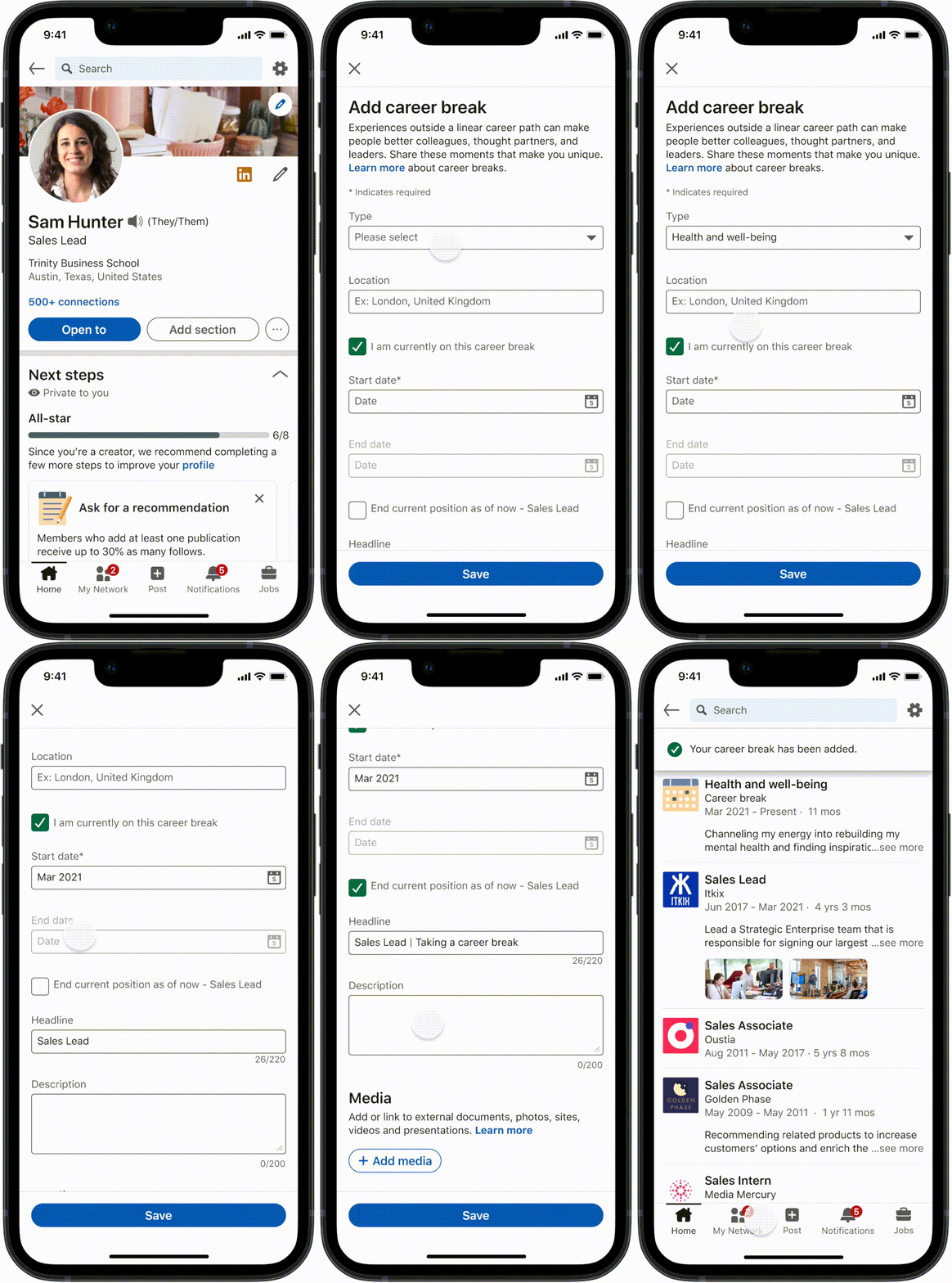
In a new feature, LinkedIn gives users 13 ways to describe reasons for employment gaps. In a blog post, a senior product manager at LinkedIn explained the rationale:
“According to a recent survey, more than half of professionals have taken a career break. Yet for far too long, the possibility of embarking on a career break has been overshadowed by stigma, which 60% of people believe still exists. . . . 46% of hiring managers believe candidates with career breaks are an untapped talent pool.”
Recruiters have business reasons to be more open-minded about time away from work. The “Great Resignation” and tight labor market left openings that employers need to fill.
LinkedIn’s survey found that 51% of employers are more likely to contact candidates who “provides context” about a gap. Of course, what LinkedIn doesn’t say is that 49% may be less likely or just as likely to follow up. Still, we may be seeing more compassion about personal challenges, including breaks for mental health reasons, family responsibilities, and illness.
If this feature is used widely, it could normalize work breaks and reduce the stigma of taking time off. Personal reasons are personal, but revealing them may encourage applicants to be more vulnerable and authentic—to trust that employers won’t judge them harshly and to present themselves genuinely, “warts and all.”
To explain a gap is to take a risk but so is not explaining a gap. In this case, an employer may think the worst, and applicants have no chance to include their own voice.
Advice for Resignation Emails

A Wall Street Journal article suggests ways to resign from your job gracefully. With a wave of post-pandemic departures, we’re seeing all sorts of resignation messages, some more appropriate than others. The string of emails can be disheartening for people who decide to stay, and leavers should be mindful of burning bridges they may want to walk across in the future.
A law career coach advises that people “Let it rip. Let everything out”—in a document that you don’t send. Then, send an email that respects the workplace and the people you’ll leave behind:
“For the real deal, be gracious and express gratitude. Include up to three career highlights. (Any more and you risk being seen as a braggart.) And skip the passive-aggressive jabs.”
I hadn’t thought about including career highlights, and I wonder whether coworkers would appreciate reading them. Instead, I suggest observing what other resignation emails include and following suit. Every workplace has its own norms around these types of messages.
I do agree with this advice:
“By giving your notice, ‘the power dynamic has been leveled.’ Use that new sense of control and confidence to share more authentically about yourself, not torpedo your relationships on the way out the door.”
The coach is right: you made your decision and are burdening your manager and coworkers who will pick up the slack. Now’s the time to demonstrate humility instead of rubbing it in and causing more hurt feelings.