
Surgeon General's Report Example
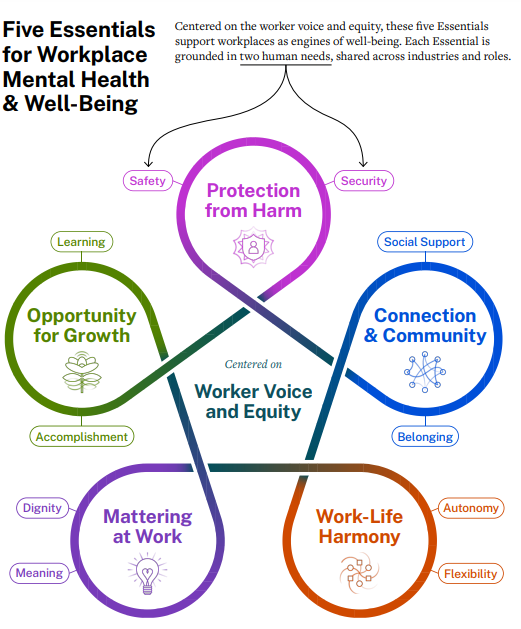
The U.S. surgeon general’s report, Framework for Workplace Mental Health & Well-Being, offers several discussion points for business communication students. The report itself is unusual, the first time a surgeon general has weighed in on what the media is framing as “toxic workplaces.” Coupled with over-reporting about “quiet quitting,” the report highlights problems at work.
An obvious discussion with students is about the report format and organization. It serves as a good example of a primarily text-based report, with few graphics except for the visual summary, which serves as an organizational cue throughout the 46 pages. We see some data and plenty of footnotes but no charts.
The report content—and how the U.S. surgeon general presented the findings on PBS NewsHour, for example—is worth exploring. First, of course, we want our workplaces to be more positive places. The recommendations presented are sound and perhaps obvious; in addition, as Vivek Murthy says, organizations have better outcomes when they are healthier places to work.
Second, what strikes me is the lack of accountability for organizational leaders and the challenges they face. Not once in the PBS interview does Murthy mention “leaders” or “managers”—actual people responsible for putting his recommendations in place. Murthy’s opening letter in the report is personal—about his immigrant parents—but his content summary is not. He blames the pandemic and uses impersonal subjects, for example, “organizations,” “we,” and “workplaces.” In the accompanying deck, titled “Reflection Questions,” “I” is never used, and “leaders” is used as the subject only once in the 20 questions; “we,” “workplace,” and “workers” prevail.
In the report, leaders, managers, and supervisors are called to action, sometimes in vague ways, for example, having the “opportunity” to do better. But the HR department gets no mention at all. A Wall Street Journal article summarizes, “The surgeon general’s guidance on the role of the workplace in well-being comes as many workers report work stress and difficulty concentrating.” I wonder how “workplaces” will respond.
Communications About Fast Company Breach

Fast Company is suffering embarrassment because of a data breach during which hackers sent racist messages through Apple News on iPhones. The offensive comments reflect poorly on Apple as well, which a Washington Post article describes as an otherwise “walled garden.”
In addition to posting the message shown here on its website homepage, Fast Company sent this message by email:
Fast Company’s Apple News account was hacked on Tuesday evening. Two obscene and racist push notifications were sent about a minute apart. The messages are vile and are not in line with the content of Fast Company. We are investigating the situation and have suspended the feed and shut down FastCompany.com until we are certain the situation has been resolved.”
A similar white-text-on-black-background message plasters Inc.’s home page: “As a result of the FastCompany.com breach, Mansueto Ventures (which also owns Inc.) is temporarily shutting down Inc.com out of an abundance of caution while the investigation is underway.”
Without further comment to news organizations, Apple posted this tweet: “An incredibly offensive alert was sent by Fast Company, which has been hacked. Apple News has disabled their channel.” Apple is doing its best to stay out of the fray, letting Fast Company take the blame.
AT&T Missing "You"

AT&T customer communication about Hurricane Ian is missing the customer—particularly “you.” Students could rewrite these bad-news (and persuasive) messages to address customers directly. The “you attitude,” or focus on the audience, would convey more empathy, give residents more confidence in the company, and make reading easier.
AT&T’s Hurricane Ian webpage is odd. The beginning doesn’t have a defined audience, so it’s likely written for anyone who might be interested in the company’s work to restore power. Most sentences start with “we,” “our,” or “FirstNet.” Company leaders also seem proud of their vehicles: four photos in the middle of the page include a link to “download” each.
The next section, with black text on a blue background, is titled, “Supporting Our Customers.” Updates include fees waived and other customer benefits. But students can easily revise paragraphs like this one to make them more audience-focused:
As Hurricane Ian moves through additional states, we are assisting our wireless customers who may be impacted by the storm. To do this, we’re waiving talk, text and data overage charges for AT&T Postpaid & PREPAID customers with billing addresses in zip codes* across areas in Georgia and South Carolina from September 29, 2022 through October 8, 2022.
Overreliance on Annual Performance Reviews
Before and during the pandemic, several companies stopped doing annual employee reviews, but many have brought back the practice. Reports show that slowed hiring and increased layoffs are causing more pressure for employees to perform; managers want more ways to track and document performance. Without reviews, managers could appear to have lax standards, failing to hold employees accountable for outcomes.
The annual documentation, meeting, and goal-setting are not the real problems. Managers are uncomfortable giving feedback and rely only on once-a-year conversations. Employees need to know, ongoing, how their performance measures up to expectations so they have a chance to improve. When done well, annual reviews are a summary of what employees already know about where they stand. Ongoing feedback encourages self-accountability, holding oneself accountable without relying on external approval.

A Bloomberg Businessweek article (with simplistic, nonparallel charts) offers alternatives to the annual review, which could supplement the annual meeting. The recommendations are in line with good business communication: check in regularly, encourage the employee to reflect, focus on the future instead of the past, collect multiple opinions, etc.
Uber's Response to Hack

What sounds like a major security breach is getting minimal response from Uber so far. A hacker, possibly 18 years old, apparently posed as a colleague to get IT access through an employee. An embarrassment to the company, the breach could include “full access to the cloud-based systems where Uber stores sensitive customer and financial data.” But Uber communications are trying to minimize the impact.
Three days after the breach, the only message I can find is a “Security Update,” copied below, on Uber’s Newsroom page. Company leaders are likely scrambling to lock down and protect information, but more communication is important. Criticism is harsh because of how easily the hacker appears to have duped an employee through social engineering and because of the unfortunate timing: Uber’s former chief security officer is currently on trial for paying hackers $100,000 to avoid disclosing a breach back in 2016.
The communication and situation are challenging, but people are watching and waiting, as we see in these tweets. This situation raises issues of several character dimensions, for example, accountability, humility, integrity, and courage. With more transparency, the company might be less vulnerable now, not more, as the leaders might fear.
September 16, 10:30am PT
While our investigation and response efforts are ongoing, here is a further update on yesterday’s incident:
We have no evidence that the incident involved access to sensitive user data (like trip history).
All of our services including Uber, Uber Eats, Uber Freight, and the Uber Driver app are operational.
As we shared yesterday, we have notified law enforcement.
Internal software tools that we took down as a precaution yesterday are coming back online this morning.
September 15, 6:25pm PT
We are currently responding to a cybersecurity incident. We are in touch with law enforcement and will post additional updates here as they become available.
U.S. DOT Airline Dashboard
The U.S. Department of Transportation (DOT) created what it calls a “dashboard” for passengers to know what to expect when their flight is delayed or cancelled. This work results from ongoing debate about airlines’ responsibility, particularly given the many issues travelers have experienced since the pandemic. Transportation Secretary Pete Buttigieg has pushed the airlines to offer at least free meals for 3-hour or longer delays and free hotel stays when passengers need to wait at an airport.

Although some airlines say they already offered these accommodations, DOT Deputy Secretary Polly Trottenberg said this is about enforcement: “Now that it’s in the customer service plans, it’s not something in discretion. It’s something we can enforce. And I think this dashboard is really going to kind of raise the state-of-the-art for consumers.”
As a visual, the dashboard works well. Looking across the rows, we see clearly what to expect from each of the airlines. Categorizing the actions by cancellations (shown here) and delays makes sense from the passenger’s perspective. However, the graphic is skewed right on the page because of the left-side column.

In addition, when I hear “dashboard,” I think of a more complex, interactive spreadsheet. The only functionality seems kind-of silly. The dropdown menu at top doesn’t add value because we can just as easily scan across to see what any airline provides. Also, I’m not sure why anyone would want the ability to “keep only” or “exclude” specific items—or to see repetitive text when they mouseover the markings. Finally, I chose “view data” and got the following in a pop-up window, which communicates nothing relevant.
I would call the visual a table, matrix, or grid. But I don’t want to disregard the good news: airlines are communicating what customers can expect, can be held accountable and, in some cases, are providing better service.
Calm App Layoff Email

Even meditation apps get bad news. Although the Calm app grew quickly during the COVID lockdowns, the company is now laying off 90 of its 400 employees—more than 20%.
I can’t find the full email online, but the Wall Street Journal posted these quotes:
Regrettably, today we are reducing our overall workforce by 20%. While some of you will be impacted, all of you will be affected. I can assure you that this was not an easy decision, but it is especially difficult for a company like ours whose mission is focused on workplace mental health and wellness.
“We did not come to this decision lightly, but are confident that these changes will help us prioritize the future, focus on growth and become a more efficient organization.”
The article also describe what’s missing:
Mr. Ko’s memo didn’t elaborate on the reasons for the layoffs but promised employees “a more in-depth discussion on the future of the business” at an all-hands meeting scheduled for Friday. A Calm spokeswoman declined to make Mr. Ko available for an interview.
Typically, layoff memos explain reasons, which we know helps employees understand and accept bad news, as I describe in Chapter 8 of Business Communication and Character. More transparency and accountability might be useful.
Maybe Ko doesn’t want the reasons publicized, knowing that the email would be circulated. I also wonder whether the reasons are dire, and despite having a $2billion valuation, the company doesn’t yet have a solid plan for regrowth.
Cracker Barrel’s Minimal Response to Burger Criticism

Cracker Barrel added the plant-based Impossible Burger to its menu and faced more backlash than expected. An executive explained the change:
"Our new breakfast menu innovations provide a personalized experience with delicious breakfast choices to satisfy every taste bud—whether guests are nostalgic for homestyle food, hungry for a nutritious plant-based option or have a craving for a sweet treat. At morning, noon or night, we want guests to enjoy craveable breakfast favorites at a compelling value.”
But many customers responded negatively:
"Don't ever try to push that crap in my direction. Stick to the basics that made your franchise a success,"
"Are you kidding me? Who do you think your customer base is? I still order the double meat breakfast, and it's not even on the menu anymore."
"You just lost your customer base. Congratulations on being woke and going broke..."
I don’t see much in response from Cracker Barrel, except the picture above on Twitter. A company spokesperson did release this statement to NBC News:
"We appreciate the love our fans have for our all-day breakfast menu. At Cracker Barrel, we’re always exploring opportunities to expand how our guests experience breakfast and provide choices to satisfy every taste bud—whether people want to stick with traditional favorites like bacon and sausage or are hungry for a new, nutritious plant-based option like Impossible Sausage."
Maybe the company gave fuller responses on other social sites, or leaders may have decided to stay out of the fray and let people decide what to order. They did enough testing—in 50 restaurants—to know the market. With the hand-shaking image, they accept responsibility and invite people to just get along. This could be an example of a minority group of outliers making noise, but ultimately, going back to their favorite restaurant as always.
Robinhood Layoff Message

Robinhood attracted retail investors during the pandemic but is facing losses as users leave the platform. In Business Communication and Character, I criticized Robinhood’s aggressive marketing tactics to lure inexperienced investors. Now, the company is doing its second round of layoffs: 9% of staff in April and another 23% in August. Lucky for us, the message to staff is posted on the Robinhood blog—a smart move because notes like are typically leaked, anyway.
Overall, CEO Vlad Tenev’s message meets criteria for bad-news communications. The main point is upfront, as I suggest for layoff messages because employees should know the news already. According to this message, they do: Tenev refers to All-Hands meetings before and after the written message. We get the sense that internal communication has been ongoing and that decisions have been transparent.
The message tells employees what’s next and that they will hear the news quickly: “Everyone will receive an email and a Slack message with your status—with resources and support if you are leaving. We’re sending everyone a message immediately after this meeting so you don’t have to wait for clarity.” The better approach would be individual, in-person (or Zoom) meetings, but this isn’t always practical.
Tenev described part of the reasons for the reductions but omitted a recent $30 million fine and increased regulatory pressure. Yet he demonstrated accountability and humility by admitting bad decisions. He wrote, “As CEO, I approved and took responsibility for our ambitious staffing trajectory—this is on me.” In addition, on a press call, Tenev admitted, “The reality is that we over-hired, in particular in some of our support functions.”
Tenev also demonstrated compassion. He sounds human, saying goodbye to people who will leave and encouraging people who will stay, without being too positive, which could be off-putting.
In sum, this isn’t the best layoff message example we have, but it’s certainly not the worst. I would share this with students as a positive example.
Instagram Responds to Criticism About Video Strategy
When the Kardashians are unhappy on Instagram, everyone is unhappy (apparently). Called the Tiktokification of Instagram (owned by Meta), the company added videos and is suffering backlash from users.

Instagram CEO Adam Mosseri responded to critics—on video. The author of a Vanity Fair article, “Mark Zuckerberg and Adam Mosseri Need You All to Stop Being Big Babies,” called the leaders “uncharacteristically unapologetic.”
We do see and hear pushback. Mosseri said the “full-screen experience” was only a test and needs work. But he also said, “I need to be honest. I do believe that more and more of Instagram will become video over time.” He acknowledged “a lot of change,” while trying to reassure people that photos will always be supported.
Mosseri provides evidence based on what people prefer online (not necessarily what they say they want in this moment). Mosseri demonstrates accountability for the changes but not a lot of compassion.
Clearly, Meta isn’t backing off its strategy to compete with TikTok. In the meantime, we’ll see how well company leaders persuade users to stick with the app.
Blame Game for United Airlines

United Airlines CEO Scott Kirby apologized for blaming regulators for contributing to the airline’s flight delays. In a memo to employees, COO Jonathan Roitman, who has been removed from his role, indicated that FAA actions caused half of the delays:
“We estimate that over 50% of our delay minutes and 75% of our cancels in the past four months were because of FAA traffic management initiatives—those have been particularly acute in Newark and Florida. These ATC challenges can not only disrupt the schedule, but they also cause us to burn crew time throughout the month.”
The FAA responded by blaming the airline for mismanaging operations during weather conditions. After that, on an earnings call, Kirby said, “I apologized to [Transportation Secretary Pete] Buttigieg because that is not what we intended.”
All this comes after Buttigieg criticized the airlines for cancelling flights and not offering refunds. This is a complicated issue, likely caused by several factors, including staffing issues on both sides. Although Kirby didn’t take full responsibility, he demonstrated some humility and vulnerability in admitting that attacking regulators is not a useful argument, particularly when an internal memo goes public, which is always to be expected.
Recall Notice

Every so often, I post a recall notice—an example of a bad-news message. These warnings often follow a template, and we see how the company handles the communication in both a government announcement and for its customers.
The U.S. Food and Drug Administration (FDA) posted an official announcement from Natierra about high levels of lead in its organic freeze-dried blueberries. As expected, the statement includes which packages are affected, what effects the lead could have, how to get a refund, and what the company is doing to correct the situation. The ending reassures company stakeholders:
First and foremost, we remain focused on the health and welfare of our employees, customers, and partners. We are committed to taking the appropriate steps to ensure our network and services continue to operate seamlessly for our customers.
Contrasting this message with one posted on Natierra’s website, we see some similar language, but the website message is a bit more conversational and customer focused. The ending varies only with an introductory phrase, including “you”:
To continue to be the brand you trust and enjoy, we remain focused on the health and welfare of our employees, customers, and partners. We are committed to taking the appropriate steps to ensure our network and services continue to operate seamlessly for our customers.
Customers can expand headings under “FAQ—VOLUNTARY RECALL QUESTIONS” that provide the same information as in the FDA statement but in a friendlier format.
In both statements, we see the company taking responsibility and acting with integrity: being accountable for the problem and demonstrating transparency in the communication.
Starbucks Message About Store Safety

Responding to employee concerns about crime, drug use, and other challenging incidents in several stores, Starbucks announced 16 store closings. The company promised to redeploy partners in those locations and reassured all workers that safety is a priority.
As usual, Starbucks posted a message on its public blog. The title, “Message to Starbucks partners: Safety in our stores,” starts with empathy, acknowledging that employees’ concerns have been heard. Two senior VPs of operations wrote, “We read every incident report you file—it’s a lot.”
The message provides eight ways the company will ramp up safety protections for store employees. Training, policies, alarm systems, counselors, health benefits, etc. demonstrate accountability and compassion.
Of course, this communication comes on the heels of increased union activity in Starbucks stores. Still, the company does seem to be "doing the right thing” for its employees, and the message is clear, well organized, and audience focused. One example of audience focus is mentioning the possibility of closing stores but not announcing the specific closures, which affect some employees but not all, as this message is intended.
Twitter Is Silent About Outage

Timing for a Twitter outage is unfortunate today, as the company is suing Elon Musk, trying to prevent him from backing out of his $44 billion purchase bid. During the 40 minutes when users worldwide reported access issues, Twitter’s own status page claimed “all systems operational,” according to Verge.
More than an hour after the app was back online, the company was still quiet quiet on the issue. “Twitter did not immediately respond to a request for comment,” according to Reuters, and I see nothing on the blog or the communications or main company Twitter accounts. Even Elon Musk’s account is silent.
Seems as though the company leaders should say something—or maybe I’m missing it?
New Uber Document Leaks

Internal Uber documents from 2013 - 2017 prove what many have thought about the company under the leadership of founder and former CEO Travis Kalanick. More than 124,000 illustrate how Uber, according to a Guardian article, “louted laws, duped police, exploited violence against drivers and secretly lobbied governments during its aggressive global expansion.” Company executives admitted to acting like “pirates.” One wrote, “We’re just f—ing illegal.”
In Building Leadership Character, I profiled Kalanick’s leadership as a example of failing humility. As a dimension of character, humility is being “rightsized”—believing you’re neither below nor above others. Bragging about skirting the law is an obvious illustration of a lack of humility.
A spokesperson for Kalanick responded to what is called the “Uber files.” The message itself demonstrates failing humility, including an inability to learn from mistakes. (Of course Kalanick may face legal in addition to image challenges.) Instead of taking responsibility, the spokesperson questions the authenticity of the documents and tries to distance Kalanick from them:
In pressing its false agenda that Mr Kalanick directed illegal or improper conduct, the ICIJ [International Consortium of Investigative Journalists] claims to have documents that Mr Kalanick was on or even authored, some of which are almost a decade old.
As a crisis communication strategy, distancing is often effective. Uber employs the same strategy in its statement, for example, “When we say Uber is a different company today, we mean it literally: 90 percent of current Uber employees joined after Dara became CEO.” The company admits mistakes and uses that fact as the impetus for change: “It’s also exactly why Uber hired a new CEO, Dara Khosrowshahi, who was tasked with transforming every aspect of how Uber operates.”
Business communication students can analyze both responses as crisis and persuasive communications. Which is more effective in restoring image?
Meta Bad-News Email to Staff
Facebook Chief Product Officer Chris Cox is direct in telling employees that “serious times” are ahead. The press reports contents of a “memo,” which appears to be a formal email or perhaps post on an intranet.
Organized by six “investment priorities,” the memo starts neutrally: “Every six months, we take stock of our product portfolio and investment plans across the company to assess how we are doing and chart the way forward.” But the tone and recommendations clearly represent tough decisions ahead that affect staff.
With no specific plans for layoffs, warnings come at the end of the memo:
I have to underscore that we are in serious times here and the headwinds are fierce. We need to execute flawlessly in an environment of slower growth, where teams should not expect vast influxes of new engineers and budgets. We must prioritize more ruthlessly, be thoughtful about measuring and understanding what drives impact, invest in developer efficiency and velocity inside the company, and operate leaner, meaner, better exciting teams.
Business communication students will notice lots of jargon, for example, “These are the areas where we see the biggest opportunities for angle-changes in the value we can deliver for people, or businesses, or for our own business, by investing disproportionately relative to our current baseline.” Out with the old; in with the new?
The memo echos a recent meeting CEO Mark Zuckerberg held with staff. Demonstrating vulnerability, he said that Meta is facing the “worst downturns that we’ve seen in recent history” and that hiring will slow. He also gave staff permission to leave:
I think some of you might decide that this place isn’t for you, and that self-selection is OK with me, [and]“Realistically, there are probably a bunch of people at the company who shouldn’t be here.
These warnings are helpful to manage employees’ expectations and to get them on board for the type of belt-tightening company leaders want. Meta might lose people, but this is an attrition strategy that could work in the company’s favor—opening up positions for new people with skills Meta needs going forward.
TikTok Tries to Reassure Senators

Two letters illustrate persuasive communication for students to analyze. The first is a letter from nine republican U.S. senators following a BuzzFeed article, “Leaked Audio From 80 Internal TikTok Meetings Shows That US User Data Has Been Repeatedly Accessed From China.”
The second is TikTok’s response. After a few introductory paragraphs (which say very little, in my opinion), CEO Shou Zi Chew tackles each question in sequence.
As we might expect, some responses are clearer than others. In a fairly obvious obfuscation, Chew doesn’t respond to sub-questions (a, b, c, etc.) individually. Question 9, about Beijing parent company ByteDance and a newly named subsidiary, is particularly confusing.
Despite company efforts, at least one senator believes TikTok should testify before Congress.
Lizzo Apologizes for Ableist Slur

Singer and songwriter Lizzo apologized to fans and critics, many of them on TikTok, offended by the term “spaz” in her new song, “GRRRLS.” One tweet explained the controversy:
@lizzo please re-release “grrrls” without the ablist [sic] slur. That word is not kind to disabled people. Your music is global and you have a voice folks listen to. We are trusting and asking you to release it without the slur.
Others mentioned their surprise because the singer “champions women, plus size people and others whom society treats poorly, Lizzo preaches inclusivity and should do better.”
Lizzo responded with an apology that demonstrates accountability and authenticity. She admitted the mistake, announced a new version, and highlighted her own identity. The apology could have been improved by recognizing how the term is offensive and harmful. Regardless, fans seemed to appreciate the response and, overall, the apology was effective.
Airbnb Announces Party Ban
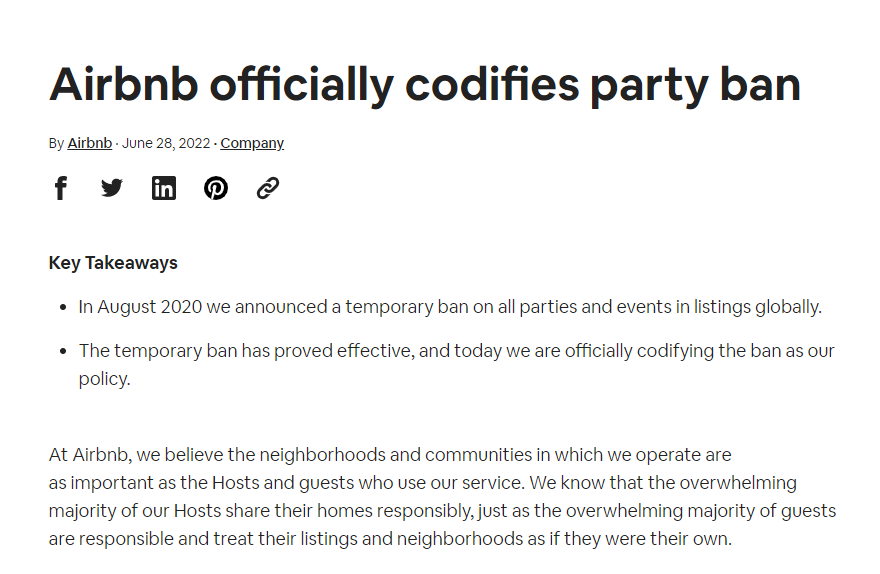
Airbnb’s message banning parties could be considered good news or bad, depending on your perspective. The company’s decision follows a temporary ban during the pandemic, when public gathering spots shut down and parties in rental homes increased. At the time, the rationale was to prevent COVID-19 spread and to reduce the negative impact on neighborhood, a common complaint about Airbnb even before the pandemic.
The decision is easier now—a continuation of the ban rather than a new announcement. As the company wrote in the statement, “It’s been working.” The rationale is clear, and the message is well organized with “Key Takeaways” at the beginning and message titles as headings. Points address concerns of three likely audiences: hosts, neighbors, and guests.
Whether you consider the news good or bad, the statement is an example of a persuasive message. The goal is to stop parties and to win favor of neighbors and municipalities frustrated with noise and other negative effects of short-term rentals, for example, diminished housing inventory and higher home prices. In this regard, the company is demonstrating accountability, although, of course, some would like Airbnb to do more.
BBB's Balanced Executive Change Announcement

On the day that Bed Bath & Beyond posted dismal first-quarter results, the company announced two leadership departures. Like most of these types of news releases, the statement includes quotes from the board chair complimenting the outgoing leaders.
But in this case, the statement starts with a clear acknowledgment of issues and plans to change:
“Bed Bath & Beyond Inc. (NASDAQ: BBBY) today announced significant changes to the Company's senior leadership to focus on reversing recent results, addressing supply chain and inventory, and strengthening its balance sheet. Sue Gove, an Independent Director on the Company's Board of Directors and Chair of the Board's Strategy Committee, has been named Interim Chief Executive Officer, replacing Mark Tritton, who has left his role as President and Chief Executive Officer and as a member of the Board.”
Interim CEO Sue Gove also reinforced the company’s turnaround strategy: "We must deliver improved results. Our shareholders, Associates, customers, and partners all expect more.”
The quote highlighting Tritton’s accomplishments, and those of the merchandising VP, who is also leaving, comes later, under the heading, “Executive Changes.”
Comparing Bed Bath’s statement to similar messages, organization and accountability are probably the most obvious differences. The message sequencing illustrates the company’s primary purpose of reassuring shareholders—prioritizing financial performance over outgoing leader relationships. Although this strategy is sound, the stock fell 20.6% so far today to 5.18, a dramatic fall from its 2013 high of more than 80.