
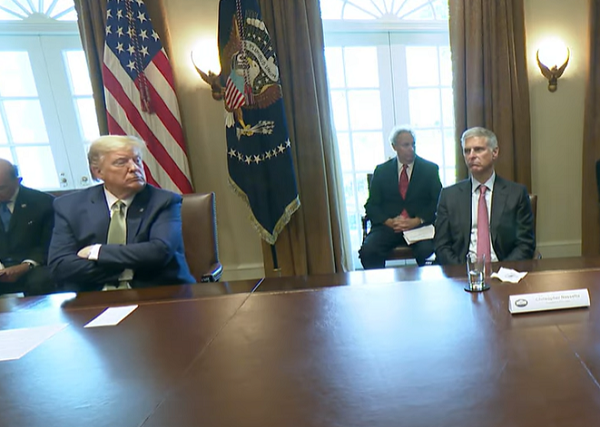
Tourism CEOs Meet with President Trump
President Trump invited CEOs of major tourism companies to discuss the COVID-19 response.
Hilton CEO Christopher Nassetta began by highlighting issues in the industry:
“Hilton’s been around 100 years -- we’ve never closed a hotel that wasn’t going to be demolished or rebuilding, The bulk of our hotels in the major cities are closing as we speak.”
Nassetta was also complimentary to President Trump and Vice President Pence and said that he wanted to protect employees. The president reassured him that they’ll be up and running soon, although both said the situation is currently a “disaster” “all over the world.”
Discussion:
How would you describe the purpose of this gathering? What are President Trump’s objectives?
Assess each of the CEOs during the meeting. How well did they represent their brand?

Governor Cuomo's Press Conference
In his second news conference about Coronavirus, New York Governor Andrew Cuomo announced new cases, provided resources, and answered questions.
Discussion:
Assess the news conference. What does Governor Cuomo do well, and what suggestions would you have for him to improve his communication?
What strategies for answering questions does the Governor demonstrate?
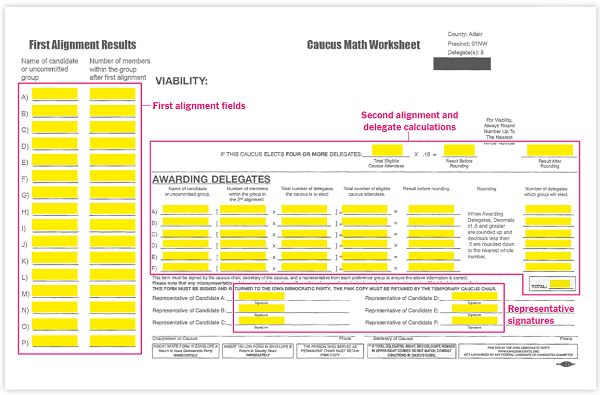
Apologies About the Iowa App
The New York Times published “everything that went wrong at the Iowa Caucases,” and it’s a long list about the app. The technology was untested and unfamiliar to volunteers, and connection problems prevented accurate data submission and reporting.
An opinion writer blamed “techno-utopianism and laziness” for the trouble: “The two fuel each other: The overarching belief that software will fix everything leads to slapdash engineering, procurement and deployment.”
Troy Price, the Iowa Democratic Party Chair, apologized for the “multiple reporting challenges.” He explains the decision to delay reporting to ensure “accuracy and integrity.”
The CEO of Shadow, the app company, also apologized:
“We sincerely regret the delay in the reporting of the results of last night's Iowa caucuses and the uncertainty it has caused to the candidates, their campaigns, and Democratic caucus-goers. As the Iowa Democratic Party has confirmed, the underlying data and collection process via Shadow's mobile caucus app was sound and accurate, but our process to transmit that caucus results data generated via the app to the IDP was not. Importantly, this issue did not affect the underlying caucus results data. We worked as quickly as possible overnight to resolve this issue, and the IDP has worked diligently to verify results. Shadow is an independent, for-profit technology company that contracted with the Iowa Democratic Party to build a caucus reporting mobile app, which was optional for local officials to use. The goal of the app was to ensure accuracy in a complex reporting process. We will apply the lessons learned in the future, and have already corrected the underlying technology issue. We take these issues very seriously, and are committed to improving and evolving to support the Democratic Party's goal of modernizing its election processes."
Discussion:
Analyze each of these apologies: the audiences, communication objectives, writing style, organization, delivery choice, etc. Each message has distinct purposes.
What works well in these statements, and what could be improved?

Boeing CEO Responds to Questions
This week, Boeing CEO Dennis Muilenburg answered lawmakers’ questions about the two Max 737 plane crashes in the past year. Facing families of deceased passengers, Muilenburg began his testimony with an apology:
“I’d like to begin by expressing my deepest sympathies to the families and loved ones of those who were lost in the Lion Air Flight 610 and Ethiopian Airlines Flight 302 accidents, including those who are here in the room today. I wanted to let you know, on behalf of myself and all of the men and women of Boeing, how deeply sorry I am. As we observe today the solemn anniversary of the loss of Lion Air Flight 610, please know that we carry the memory of these accidents, and of your loved ones, with us every day. They will never be forgotten, and these tragedies will continue to drive us to do everything we can to make our airplanes and our industry safer.”
One of the most tense moments was when Senator Ted Cruz questioned Muilenburg (see video). Muilenburg also faced criticism as he was leaving. The mother of a victim of the second crash responded to his invoking his Iowa farm background:
“Go back to Iowa. Do that.” She also said, “I don't feel like you understand. It's come to the point where you're not the person anymore to solve the situation."
Discussion:
Watch more of Muilenburg’s testimony. What are some examples of questions he addressed well, and how could he have done better?
How well does Muilenburg balance emotional appeals, logical arguments, and credibility in his testimony?
What leadership character dimensions are illustrated by this situation and by Muilenburg’s testimony?
Muilenburg’s interaction with the mother is a difficult situation for anyone to handle, and we can certainly understand her grief and anger. How would you have responded?
CNN reports:
“In response, Muilenburg said he respects her viewpoint. "But I want to tell you the way I was brought up. And I'm just being honest here about it. I learned from my father in Iowa ... when things happen on your watch you have to own them and you have to take responsibility for fixing them," he said.

NBA Tweetstorm
The NBA is thrust into a political quagmire after Houston Rockets general manager Daryl Morey tweeted in support of the Hong Kong protesters: '“Fight for Freedom. Stand with Hong Kong.” The tweet has since been deleted.
NBA Commissioner Adam Silver is dancing a line between protecting Morey’s free speech and staving off China’s backlash. Critics say the league is driven by profit instead of principle. He has tried to clarify his position:
“It is inevitable that people around the world — including from America and China — will have different viewpoints over different issues. It is not the role of the NBA to adjudicate those differences. However, the NBA will not put itself in a position of regulating what players, employees and team owners say or will not say on these issues. We simply could not operate that way.”
At this point, The Wall Street Journal reports better news:
“The situation appears to have de-escalated. After a week of blistering anti-NBA rhetoric in Chinese media, the government is signaling that it’s time to cool it, a message that includes the vitriol directed at the Rockets, according to one person familiar with the situation.”
But the Journal also acknowledges: “China’s love affair with the Rockets might not be the same again.”
Discussion:
Should Morey have avoided sending the tweet? Why or why not?
How do you assess the league’s response to the situation?
Analyze Silver’s news conference. What did he do well, and what could he have done differently?
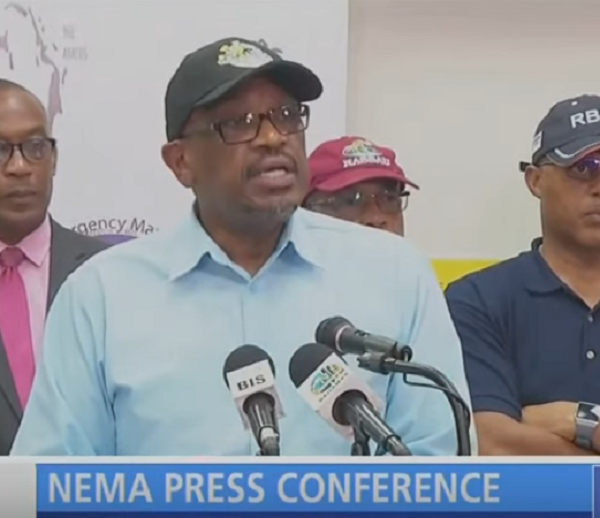
Dorian News Conferences
Local officials are holding news conferences about the impact of Hurricane Dorian.
Miami Mayor Francis Suarez announced mostly good news for the city, but he also addresses the terrible impact on the Bahamas.
Bahamas Prime Minister Hubert Minnis announced worse news: five fatalities. Since then, the number has risen to 30.
Discussion:
Compare these two presentations, particularly the content and tone. What differences do you notice?
How effectively did each government official convey the news?
What leadership character dimensions did they demonstrate?

Facebook Announces Plans for Privacy
After several scandals and escalating criticism, Facebook CEO Mark Zuckerberg announced new products and several new features to move from public posting to private conversations. The new Facebook design focuses on groups instead of the newsfeed and adds interactivity, such as posting jobs. Some of these features, of course, compete with existing social platforms, such as LinkedIn.
In a post, Facebook described the focus of its two-day conference: “how we’re building a more privacy-focused social platform — giving people spaces where they can express themselves freely and feel connected to the people and communities that matter most.”
Communication, friends, and community are themes in the message. Zuckerberg’s keynote is titled, “The Future Is Private.”
Discussion:
Assess Zuckerberg’s keynote. Who are his primary and secondary audiences? What are his communication objectives? To what extent does he meet them? How would you describe his delivery skills? Does he convince you that Facebook is addressing criticism? Do you think Facebook is moving in the right direction?
Zuckerberg opens his keynote by saying, “Privacy gives us the freedom to be ourselves.” How does this relate to concepts of authenticity? Do you agree with his conclusion?
Also assess the post announcing changes for Facebook and other apps. Which features or new products most and least excite you?

Boeing's Crisis Response
At a shareholder’s meeting, Boeing CEO Dennis Muilenburg addressed 737 Max safety concerns following two fatal crashes. He started, as predicted, with an apology and sympathy for the “loss of life,” acknowledging the “devastation.” He contrasted these losses with the many Boeing flights that run safely—”roughly every 1.5 seconds.”
Muilenburg didn’t explicitly address issues raised in the past couple of days, particularly a Wall Street Journal article the previous day accusing Boeing of failing to report the safety feature shut-off to airlines (including pilots) and the FAA.
When asked during the Q&A about accountability, Muilenburg spoke mostly about plans going forward. When asked whether he would resign, he talked about his and his employees’ commitment to safety.
At about 9:00 on the video, a reporter asks about whistle-blowers at Boeing, referring to recent reports that employees tried to alert senior management and the Federal Aviation Administration (FAA). Muilenburg says the question is “fair” but doesn’t quite respond to the accountability issue. At about 14:15, a reporter asks, “Can you admit that the design was flawed?” This is after Muilenburg skirts the previous question, blaming a “chain of events.” Still, he would not admit to a design flaw.
And then he ends the news conference, as a reporter shouts, “Sir, 346 died. Can you answer a few questions here about that?” Earlier, another reporter noted that this was the first time they had a chance to meet with him to ask questions.
Discussion:
Assess Muilenburg’s delivery skills. What does he do well, and what suggestions would you have for his future news conferences?
How well did Muilenburg address reporters’ questions? What, if anything, could he have said differently?
What leadership character dimensions are illustrated by this story? How well did Muilenburg demonstrate them?

Carlos Ghosn Responds to Charges
The former CEO of Nissan, Carlos Ghosn, who has been arrested four times on charges related to financial misconduct, responded in a video message. The key point: “I’m innocent of all the charges.” Ghosn also claims that accusations are “all biased, taken out of context, twisted.”
Ghosn was a celebrated business executive in Japan. His success in growing Nissan is “incontrovertible,” according to a New York Times podcast. He gained a reputation as a serious cost-cutter ("Le Cost Killer"), a strategy that was questioned at the time but brought about great profits for the company, placing it second in the list of Japanese automakers behind Toyota and ahead of Honda. Ghosn was CEO from 2001 - 2017, when he became chairman. He was then removed from the board in 2018, after his first arrest.
Charges against Ghosn include using company funds for multiple personal residences, hiding about half of his compensation, shifting $16.6 million in person losses to the company, and other accounting issues.
Nissan management responded to Ghosn’s video message:
“The sole cause of this chain of events is the misconduct led by Ghosn and Kelly. Aside from any criminal matters, Nissan's internal investigation has uncovered substantial evidence of blatantly unethical conduct. This resulted in a unanimous board vote to discharge Ghosn and Kelly as chairman and representative director, followed by a shareholder vote to discharge them from the board. Further discoveries related to Ghosn’s misconduct continue to emerge. The company's focus remains on addressing weaknesses in governance that failed to prevent this misconduct.”
Discussion:
What persuasive communication strategies does Ghosn demonstrate in his video message?
What are the most and least convincing statements?
Assess his Ghosn’s delivery skills.
Which leadership character dimensions are illustrated by this situation?

Boeing System at Fault
According to investigators, the flight-control system caused trouble before the Boeing 737 MAX crash in Ethiopia. The report also concluded that pilots followed procedures and did nothing wrong.
On its website, Boeing posted a video and statement of CEO Dennis Muilenburg’s apology.
April, 4, 2019
We at Boeing are sorry for the lives lost in the recent 737 MAX accidents. These tragedies continue to weigh heavily on our hearts and minds, and we extend our sympathies to the loved ones of the passengers and crew on board Lion Air Flight 610 and Ethiopian Airlines Flight 302. All of us feel the immense gravity of these events across our company and recognize the devastation of the families and friends of the loved ones who perished.
The full details of what happened in the two accidents will be issued by the government authorities in the final reports, but, with the release of the preliminary report of the Ethiopian Airlines Flight 302 accident investigation, it’s apparent that in both flights the Maneuvering Characteristics Augmentation System, known as MCAS, activated in response to erroneous angle of attack information.
The history of our industry shows most accidents are caused by a chain of events. This again is the case here, and we know we can break one of those chain links in these two accidents. As pilots have told us, erroneous activation of the MCAS function can add to what is already a high workload environment. It’s our responsibility to eliminate this risk. We own it and we know how to do it.
From the days immediately following the Lion Air accident, we’ve had teams of our top engineers and technical experts working tirelessly in collaboration with the Federal Aviation Administration and our customers to finalize and implement a software update that will ensure accidents like that of Lion Air Flight 610 and Ethiopian Airlines Flight 302 never happen again.
We’re taking a comprehensive, disciplined approach, and taking the time, to get the software update right. We’re nearing completion and anticipate its certification and implementation on the 737 MAX fleet worldwide in the weeks ahead. We regret the impact the grounding has had on our airline customers and their passengers.
This update, along with the associated training and additional educational materials that pilots want in the wake of these accidents, will eliminate the possibility of unintended MCAS activation and prevent an MCAS-related accident from ever happening again.
We at Boeing take the responsibility to build and deliver airplanes to our airline customers and to the flying public that are safe to fly, and can be safely flown by every single one of the professional and dedicated pilots all around the world. This is what we do at Boeing.
We remain confident in the fundamental safety of the 737 MAX. All who fly on it—the passengers, flight attendants and pilots, including our own families and friends—deserve our best. When the MAX returns to the skies with the software changes to the MCAS function, it will be among the safest airplanes ever to fly.
We’ve always been relentlessly focused on safety and always will be. It’s at the very core of who we are at Boeing. And we know we can always be better. Our team is determined to keep improving on safety in partnership with the global aerospace industry and broader community. It’s this shared sense of responsibility for the safety of flight that spans and binds us all together.
I cannot remember a more heart-wrenching time in my career with this great company. When I started at Boeing more than three decades ago, our amazing people inspired me. I see how they dedicate their lives and extraordinary talents to connect, protect, explore and inspire the world — safely. And that purpose and mission has only grown stronger over the years.
We know lives depend on the work we do and that demands the utmost integrity and excellence in how we do it. With a deep sense of duty, we embrace the responsibility of designing, building and supporting the safest airplanes in the skies. We know every person who steps aboard one of our airplanes places their trust in us.
Together, we’ll do everything possible to earn and re-earn that trust and confidence from our customers and the flying public in the weeks and months ahead.
Again, we’re deeply saddened by and are sorry for the pain these accidents have caused worldwide. Everyone affected has our deepest sympathies.
Dennis Muilenburg
Chairman, President & CEO
The Boeing Company
Discussion:
Analyze Boeing’s communications so far. After the report was published, who were the primary and secondary audiences for these messages? What are the company’s communication objectives, and to what extent were they achieved?
What’s your view of the timing? Should the CEO have communicated via video and statement earlier or wait, as he did, for the investigation report results to be published?
What leadership character dimensions are demonstrated by this situation?

New Zealand Announces Weapons Ban
Following a shooting at a mosque in Christchurch that left 50 people dead, New Zealand Prime Minister Jacinda Ardern announced a ban on certain types of weapons:
“Today, I’m announcing New Zealand will ban all military-style semiautomatic weapons. We will also ban all assault rifles. We will ban all high-capacity magazines. We will ban all parts with the ability to convert semiautomatic or any other type of firearm into a military-style semiautomatic weapon. We will ban parts that cause a firearm to generate semiautomatic, automatic or close-to-automatic gunfire,” she added. “In short, every semiautomatic weapon used in the terror attack on Friday will be banned in this country.”
She said the decision would accomplish one goal: “to prevent an act of terror from happening in our country ever again.” In a press conference three days prior, the prime minister had promised that the Cabinet planned to take action.
The New York Times compares the process for buying a gun in 16 countries, showing the United States as having the fewest steps.
Discussion:
What’s your view of the decision and how Prime Minister Arden communicated it to the public?
What leadership character dimensions does the Prime Minister demonstrate in this situation?
Watch Prime Minister Arden’s press conference and one or two others. How would you describe her delivery style?

Alex Trebek Announces Bad News
Alex Trebek, the longtime host of “Jeopardy!” announced that he has pancreatic cancer. Since 1984, Trebek has been almost synonymous with the TV show, and now his Stage 4 diagnosis is casting doubt on the show’s future.
In a video, Trebek, announced the news with optimism and some humor, referencing his three-year contract. Unfortunately, the prognosis for pancreatic cancer is very poor. The ten-year survival rate is only one percent—the lowest rate of any cancer. Steve Jobs died of pancreatic cancer in 2011.

Discussion:
Assess Trebek’s video announcement. How does he convey the bad news and display emotional appeal?
Did he do the right thing by announcing the news himself? Why or why not? How do the show and network benefit, and what are the downsides?
What leadership character dimensions does Trebek demonstrate?
Assess the cancer survival rate chart. What principles of business communication does the designer follow, and how could it be improved?

Equifax and Marriott CEOs Testify About Security Breaches
U.S. Senators grilled Equifax and Marriott CEOs about data breaches at the companies in the past two years. Equifax CEO Mark Begor responded to questions following a Senate subcommittee report titled, “How Equifax Neglected Cybersecurity and Suffered a Devastating Data Breach.” The report concludes an investigation of the 2017 breach of 143 million customers’ personal data and accuses the company of not prioritizing security, not following its own patching policies, failing to notify the public in a timely manner, and more.
Begor defended the company and blamed the increasing sophistication of hackers:
“These attacks are no longer just a hacker in the basement attempting to penetrate a company’s security perimeter, but instead are carried out by increasingly sophisticated criminal rings or, even more challenging, well-funded nation-state actors or military arms of nation-states.”
But Senators pointed out that credit company competitors Experian and TransUnion have managed to avoid similar attacks.
The Marriott breach affected 83 million guests of Starwood, which Marriott acquired after the breach took place. Compared to the Equifax situation, Marriott got a pass from senators, such as Tom Carper of Delaware, who said, “The data breach announced by Marriott this past November does not appear to have been caused by the same cultural indifference to cybersecurity the record indicates existed at Equifax. Rather, it looks like Marriott inherited this breach from Starwood.”
Marriott has been consistent in blaming Starwood for the issue, wanting to preserve the brand. In his testimony, CEO Arne Sorenson reinforced the company separation:
“We conducted an assessment on integrating the two systems, although this inquiry was legally and practically limited by the fact that until the merger closed, Starwood remained a direct competitor.”
Here is Sorenson interviewed on CNBC:
Discussion:
Watch some of the testimony. How well did each CEO handle the Senators’ questions?
Assess Sorenson’s appearance on CNBC. What did he do to try to rebuild the company’s image? What persuasive strategies did he use?
Review the subcommittee’s report on the Equifax breach. How is the report organized? How would you describe the writing style and tone? What suggestions would you have for the authors to improve readability?
From your perspective, what leadership character dimensions do the CEO illustrate or fail to illustrate?

Interview with Delta CEO

In a LinkedIn interview, Delta CEO Ed Bastian discussed the decision to revoke the National Rifle Association (NRA) discount after the Parkland, FL, shootings, one year ago. The discount was for NRA members, and only 13 took advantage. But the real loss was in $40 million in tax benefits, which Georgia Governor Cagle fought to strike after the company’s decision.
Bastian admits that the loss was significant. But he concludes, “Our brand is worth so much more, and our values are not for sale.”
Bastian refers to the NRA’s “divisive rhetoric” and says that he didn’t want “to be seen as advocates” of the organization and its views. He also describes what we might call authentic or purpose-driven leadership:
"If you know who you are, you can make those decisions. And that you can make those decisions and sleep well at night.”
Discussion:
What leadership character dimensions are demonstrated by this situation?
Do you think Bastian did the right thing for Delta? Why or why not?
How well does Bastian address the interviewer’s question? Overall, how do you assess his delivery?

Google CEO Faces Congress
Google CEO Sundar Pichai responded to U.S. lawmakers’ concerns about misinformation, bias, and other issues resulting from Google search algorithms.
Pichai answered questions about how Google search works. For example, Rep. Zoe Lofgren of California asked why bias exists is search results: when you type in “idiot,” he said, you get images of President Trump. Here is Pichai’s response:
"We provide search today for — anytime you type in a keyword, we as Google, we have gone out and crawled and stored copies of billions of webpages in our index. We take the keyword and match it against webpages and rank them based on over 200 signals, things like relevance, freshness, popularity, how other people are using it. And based on that, at any given time, we try to rank and find the best results for that query. Then we evaluate them with external raters to make sure, and they evaluate it to objective guidelines, and that's how we make sure the process is working."
Pichai then assured lawmakers, “We don't manually intervene on any particular search result." He also confirmed their attempts to improve information credibility:
"We are constantly undertaking efforts to deal with misinformation. We have clearly stated policies and we have made lots of progress in many of the areas . . . over the past year — so, for example, in areas like terrorism, child safety, and so on.”
As we saw when Mark Zuckerberg testified to lawmakers earlier this year, some representatives had fairly basic questions and misunderstandings about technology. At one point, a representative asked why certain images appeared on his granddaughter’s iPhone, and Pichai had to clarify, “Congressman, iPhone is made by a different company."
Discussion:
How well did Pichai address the search result question about President Trump?
When Pichai said that Apple made the iPhone, laughter erupted. Should he have handled this question differently?
Watch excerpts of Pichai’s testimony. Assess his delivery skills, persuasive strategies, and so on.
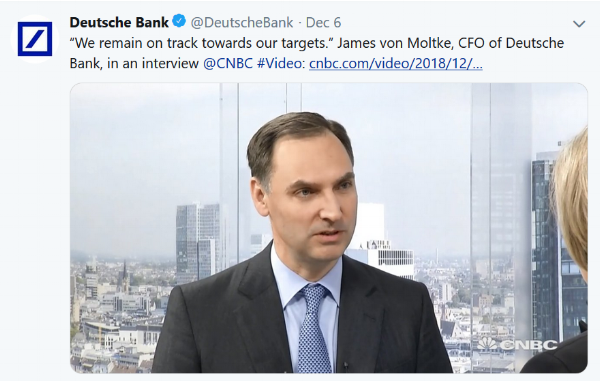
Deutsche Bank on the Defense

With stock at an all-time low and a German government raid last week, Deutsche Bank is trying to reassure customers and shareholders. Finance chief James von Moltke said on CNBC, “To date, we’re not aware of any wrongdoing on our part.” The investigation relates to the Panama Papers, which are documents made public in 2016 that revealed tax havens for individuals from more than 200 countries.
Throughout the CNBC interview, von Moltke tries to put the issue into perspective. He says the investigation involves a small, trust services business that the bank sold earlier this year. However, some of the money laundering accusations involve current managers. Still, von Moltke claims that new precautions are in place today.
Deutsche Bank stock fell further on the news, losing 51% of its value this year.
Discussion:
Assess the CFO’s video interview with CNBC. What persuasive communication strategies do you observe?
Which are his strongest and weakest arguments?
Also assess his delivery skills: tone, rapport, volume, pace, and so on.

Nissan Chairman Is Arrested
Nissan’s chairman was arrested for financial misconduct, including under-reporting his income in securities fillings. Carlos Ghosn may have been engaging in improprieties for years.

The news came as a surprise to many. Ghosn is a popular business figure, credited with turning around Nissan, Renault, and Mitsubishi by forming an alliance and directing cost-cutting and layoffs. According to a Wall Street Journal article, the shock is felt particularly at Renault; a union leader described the reaction as “a feeling of stupefaction and a lot of anger.”
The French government has a 15% state in Renault, so President Emmanuel Macron also weighed in: “As a shareholder, the French state will remain extremely vigilant regarding the stability of the alliance.” At this point, officials are still trying to sort out the news and determine leadership going forward.
Nissan CEO Hiroto Saikawa delivered a news statement, translated in English on Bloomberg. The company also issued this matter-of-fact statement.
Nissan image source. Ghosn image source.
Discussion:
Why would a successful business executive engage in financial misconduct? What leadership character dimensions are lacking?
How does financial impropriety go on for years in a situation like this? Who should be accountable for the misconduct?
Assess Saikawa’s news statement. What works well to improve brand image, and what could be improved?
News Conference About Shooting
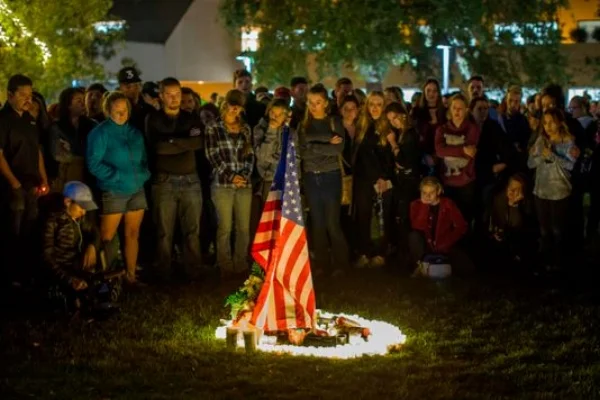
A former marine shot 12 people in a California bar, and local officials delivered a news conference. Ventura County Sheriff Geoff Dean spoke first (about 5:00 on the video) to explain officers’ response and what they knew at the time.
We see the sheriff get emotional when answering questions about his deputy, Sergeant Ron Helus, who also died.
The shooting was particularly painful for people at the bar who also survived the Las Vegas shooting about a year ago. One young man, Telemachus Orfanos, survived the earlier incident but not this one.
Discussion:
Assess Sheriff Dean’s statement for content, organization, and delivery. What worked well, and what, if anything, could be improved?
Assess how well Sheriff Dean responded to media questions.
Students Protest Required Presentations
Middle and high school students want to ban in-class presentations because some students experience speech anxiety. These students argue that speeches put undue pressure on teens, particularly those with anxiety disorders. One student said, “Nobody should be forced to do something that makes them uncomfortable.” This is quite a statement.
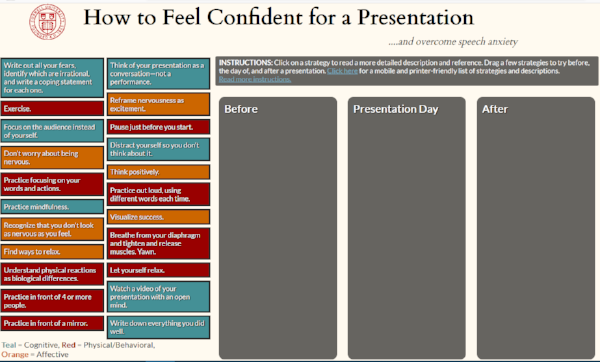
I agree that students with severe anxiety may be at risk and certainly need additional support. But most people can easily overcome speech anxiety. A couple of years ago, I developed a web-based tool with strategies to use before, during, and after a speech:
URL: speaking.amynewman.com
User: email
Password: Statler65
Employers will not likely tolerate employees who aren’t comfortable presenting in front of others. School is the time to practice and develop these skills.
Discussion:
What’s your experience with giving speeches in middle and high school?
What have you done in your life to feel more comfortable giving presentations?
What’s your view of the students’ position?

Disneyland Employees Speak Out

Disney employees are on screen in a New York Times op-ed video, "I Work at the Happiest Place on Earth. Why Can’t I Pay My Rent?" A 30-year concierge and a cosmetologist are featured more prominently. One is currently living in her car, and another says, tearfully, that she has spent time in her car. Both say they love their jobs, but along with 75% of Disneyland employees, they can't afford to pay "basic expenses every month." Data comes from a questionnaire and report, "Working for the Mouse."
The argument is for Disney to pay a living wage, and the call is for citizens to vote for an Anaheim proposal that affects Disneyland employees and some local hotel workers. In the video, one claim is that real wages have declined because of inflation—what $15 per hour bought seven years ago isn't the same today.
Business leaders who are fighting the measure say that the increase would hurt jobs. One local Chamber of Commerce member argued, "We estimate 3-4,000 jobs lost over next year or two by companies having to absorb this new increased cost. They're going to reduce hours and reduce jobs."
Senator and former presidential candidate Bernie Sanders is also featured in the video. He is proposing a bill he calls "Stop BEZOS" to tax Amazon and other large companies for public assistance received by their employees. The idea is for companies with 500 or more employees to pay the government back for support paid to their employees who cannot survive on earned wages.
Discussion:
- How well does the video make the case for higher wages? Which are logical and which are emotional appeals? What evidence is presented?
- Assess the credibility of the questionnaire and report, "Working for the Mouse." From your assessment, what makes the report both credible and questionable? In what ways does the report reflect business communication standards, and in what ways does it fall short?
- Research the impact of raising wages on industry, for example, this Cornell report. What's your view of this argument? It's a complicated question because of different industries, locations, labor supply, rates, etc.
- In what ways do the employees featured in the video demonstrate courage? What risks did they take in appearing on screen?