
The Debate and BCom Principles

The U.S. Presidential Debate is ripe with topics to discuss in class. Without getting into political alignments, students can analyze the following:
The initial greeting: VP Harris approached former President Trump to shake his hand. Was this a good choice? How did the greeting appear?
Voice: VP Harris’s voice was unsteady at the beginning but improved during the debate. How did that affect her message?
Presence and nonverbals: How did the candidates’ appearance affect their positions? Some commenters wondered how they would appear on stage because of their height difference—and cited evidence about past election winners. How did they compare?
VP Harris’s “baiting”: Analysts said VP Harris baited Trump, for example, by talking about people leaving his rallies. They said this was intentional to rattle him, and that it worked—he became more emotional and said things that hurt his position. Did students detect this strategy when it happened?
Gun ownership: VP Harris said that she and Governor Walz own guns. How would students verify this? What are they used for—and does that make a difference? What was the purpose of this statement?
CNN verification: A couple of times, reporters contradicted claims on the spot (e.g., about pets and abortion extended beyond birth). How did students perceive these moderator interruptions? Did they seem fair or biased?
Answering questions: VP Harris was asked about changing her positions, for example, on fracking. She evaded the question. How did her approach work?
Audience: The debate was held in Pennsylvania. How did that audience affect what the candidates said? Did they adapt their message? Was that appropriate, given that no audience response was allowed and the program was televised nationally?
Memes: What memes have students seen after the debate? How do they react to them? Are they funny? Do students believe they influence voters?
Taylor Switch endorsement: How do students perceive Taylor Swift’s endorsement? Why did she choose the timing, approach, and signature line? What could be the effect?
Winner: Who “won” the debate? What does it mean to win the debate? Will it matter for the voters who already have a preferred candidate—or for those who were undecided?
My hope is that these questions are neutral, but my own political views may have seeped in—and I understand this is a challenging class discussion. The Southeast region of the Association for Business Communication hosted a Teaching Circle for faculty to explore whether and how to discuss election communications in our classes. I presented with my Cornell colleague, David Lennox, and we’ll present at the Annual International Conference in October with Christy McDowell. More to come.
Is Print Back? The J.Crew Catalog Is.

Inc. calls the return of J.Crew’s print catalog after seven years “old school” and “banal.” Students might relate to nostalgic brands and could expand their thinking about communication media choices.
Print rarely comes to mind as a go-to communication channel, but J.Crew is bucking a trend, hoping to attract new consumers. After filing for bankruptcy in 2020, sales are up, and the company is hoping they aren’t a fad like disposable cameras and vinyl records. The Inc. article explains the sales value of a catalog:
In 2023, direct mail advertising had the highest return on investment compared to other ad campaign mediums, including email and paid search. And increased privacy restrictions have made it harder—and therefore more expensive—for brands to see payoff from paid social campaigns.
Can students think of other ways to use print as a stand-out communication method? An interesting class exercise could invite students to observe print messages around campus: flyers, table cards, newspapers, etc. What is their value compared to online messages? How can print be part of a presentation—handouts, note cards, etc.?
The J.Crew catalog looks more like a magazine. Featuring people from the 80s like Demi Moore (do students know who she is?), it has a classic feel, which seems “old money” and attractive to young consumers. One page is titled, “At Home on the Coast,” and a collection is called “Sussex.” Sort-of related: This reminds me of the social media trend, “I’m looking for a man in finance, trust fund, 6’5”, blue eyes.” (More here.)
Poppi Soda's Prebiotic Claims

Students can analyze Poppi’s claims to see whether they pan out. Spoiler alert: You can find better ways of getting fiber into your diet than drinking soda.
Poppi’s marketing campaign embraces the "soda” label. If we believe the ads, Poppi has “none of the bad stuff.” Previously, the can label read, “Be Gut Happy (and) Be Gut Healthy.”
A lawsuit argues that Poppi is essentially sugary water. According to the plaintiffs, with only a few grams of prebiotics in each can, someone would need to drink multiple cans to get the dietary benefit. The sugar content, which is unhealthy and causes digestive issues for some people, offsets any potential benefits. To be fair, 5 grams of sugar is much better than the 39 grams in a Coke, but it’s still 5 grams more than, say, water.
The company responded:
We are proud of the Poppi brand and stand behind our products. We are on a mission to revolutionize soda for the next generation of soda drinkers, and we have diligently innovated to provide a tasting experience that millions of people have come to enjoy. We believe the lawsuit is baseless, and we will vigorously defend against these allegations.
Notice no mention of gut benefits in this statement—or in the ad, which is post-lawsuit. The suit is still pending, and Poppi may be downplaying previous claims, focusing instead on the taste, which is good. After all, it’s soda.
Bud Light Ad, Demographics, and Visual
An AdAge article describes a new Bud Light ad and references a movie from the 70’s, raising questions about the target demographic.
The scene is a dean’s office, with a student being accused of plagiarism. The joke is that others admit to failings just to get a cold bottle of Bud Light.
The AdAge writer describes “a scene recalling Dean Wormer admonishing the Deltas in Animal House.” Although the movie is of my generation, I have no memory of that scene and wonder whether others do. It was a cult film at the time, but still, the cohort is in their 60s now. Maybe students know the movie—or think the ad is funny regardless.

Bud Light’s target demographic is younger, according to this report:
While among Baby Boomer beer drinkers Bud Light has a brand popularity score around 30 percent, it’s almost 40 percent among Gen Z consumers. Similarly, around 40 percent of Millennials have consumed Bud Light in the past 12 months, as compared to 24 percent of Baby Boomer respondents.
According to this Statista chart, Baby Boomers consume less Bud Light than the other demographic groups. Students might redesign the chart. To be fair, the main point isn’t about consumption but is about all key performance indicators (KPIs) of the brand. Still, one obvious problem with the chart is the similarity of colors, which makes them difficult to distinguish in the legend. We’re also missing the total, which is greyed out in the legend. In addition, students might question the order of the KPIs on the x-axis, which, at first glance, appear to be in rough numerical order, but that doesn’t hold when we see the Buzz group. Maybe a radar or bubble chart would work better—or at least a horizontal bar.
Proposed New Rules on Political Robocalls and Texts
The Federal Communications Commission is proposing tighter guidelines for AI-generated political campaign messages. Students can identify the objectives and assess whether they think the plan will work.

With the U.S. presidential election three months away, candidates are sending more robocalls and robotexts. According to FCC rules, these require consent, but messages sent manually do not.
New proposed FCC guidelines include the following areas:
The proposal seeks comment on the definition of AI-generated calls, requiring callers to disclose their use of AI-generated calls and text messages, supporting technologies that alert and protect consumers from unwanted and illegal AI robocalls, and protecting positive uses of AI to help people with disabilities utilize the telephone networks.
Of particular interest to the FCC are technologies used to mislead, for example, voice cloning and caller ID spoofing, which falsifies a caller’s origin.
Citizens can eliminate (or maybe just reduce) unwanted calls:
Reply “STOP”
Forward texts to 7726 (or "SPAM")
Silence unknown callers
Report texts as junk
I’ve been doing the latter on political texts to no avail. I imagine that robotext comes from a different source, so my efforts are equal to deleting each without the “report junk” part.
Students might have other ideas and their own experiences to share. Do they get a barrage of messages? Are they concerned about election misinformation?
Ingrid Andress's Apology

Country singer Ingrid Andress promises to go to rehab after her off-key national anthem rendition at a Major League Baseball event. Are her apology and commitment enough?
Andress’s statement came quickly on Instagram. Looking at the criteria for apologies, students will see that Andress hit many of them—briefly: showing remorse (for example, saying, “I’m sorry” or “I apologize” instead of “I regret”), accepting responsibility (for example, saying, “It’s my fault,” or “I failed to”), saying what you did wrong, explaining what happened, acknowledging the impact, offering to fix it, saying what you’ll do differently, and requesting forgiveness.
She uses conversational language, which is probably appropriate in this situation. A legalistic statement never goes over well, and Andress sounds authentic. However, “that wasn’t me” isn’t typically well received. In a sense, this is the classic crisis communication strategy of distancing oneself, as we saw Microsoft do in the CrowdStrike situation this week. We could say that someone inebriated “isn’t herself,” but this part weakens her apology.
In response to Andress’s post, we see the expected, mean comments questioning her singing ability without alcohol and criticizing her quip about rehab being fun. Does the joke at the end diminish the seriousness of her message? I don’t think so, but students may have a different view.
Crisis Comms After CrowdStrike Failure
Tech outages affected businesses worldwide, and students can analyze responses by CrowdStrike, which caused the issue.
CrowdStrike begins its statement by including what has not been affected:
CrowdStrike is actively working with customers impacted by a defect found in a single content update for Windows hosts. Mac and Linux hosts are not impacted. This was not a cyberattack.
The message is designed to be helpful and reduce worries—and to limit the scope of the crisis. Using a similar crisis communication strategy, Microsoft limits its role in the crisis by blaming the third party and mentioning its name twice:
We are aware of a scenario in which customers experience issues with their machines causing a bug check (blue screen) due to a recent CrowdStrike update. We recommend customers to follow guidance provided by CrowdStrike.
The “blue screen of death” that people saw during this outage evokes bad memories from early Microsoft days. Although Microsoft isn’t to blame, the software and the company are likely taking a reputational hit.
CrowdStrike President and CEO George Kurtz posted on X:
CrowdStrike is actively working with customers impacted by a defect found in a single content update for Windows hosts. Mac and Linux hosts are not impacted. This is not a security incident or cyberattack. The issue has been identified, isolated and a fix has been deployed. We refer customers to the support portal for the latest updates and will continue to provide complete and continuous updates on our website. We further recommend organizations ensure they’re communicating with CrowdStrike representatives through official channels. Our team is fully mobilized to ensure the security and stability of CrowdStrike customers.
Users responded by asking, “Where’s the apology to users, George?” and by calling it “corporate speak.” They have a point, and Kurtz got the memo later, appearing on the Today Show and immediately saying, “We are deeply sorry.” At that time, later in the day, his main purpose was to assure people that they fixed the problem and that systems are coming back.
Kurtz emphasized the importance of CrowdStrike’s work, focusing on how updates like the one that caused the outage are essential to safety—to prevent cyberattacks. Still, how a bug in a minor update wreak such havoc? He doesn’t quite quell concerns about future issues, although he does take responsibility for the outage. Then again, he has little choice.
PNC Bets on "Boring”
PNC Bank is betting on boring to attract customers. The campaign illustrates persuasive strategies, and a CEO interview is on-brand.
With an ad labeled “Boring Is Essential,” PNC is appealing to customers living in turbulent times. Given the recent inflation, tight housing market, political uncertainty, and climate change, it’s a compelling message.
During a Bloomberg interview, Chairman and CEO Bill Demchak said, “Banking shouldn’t be drama for our clients. It ought to be predictable, consistent, stuff works, their money’s safe. . . .” Although he also says, “I don’t necessarily like to think of myself as a boring person,” his office setting and demeanor might communicate otherwise—and maybe that’s not a bad thing these days.

PNC is not alone. During the interview, we see a chart showing the number of times bank management used the word “boring” during calls in the past couple of years.
Students will draw connections with business communication course concepts, for example, credibility and trust. PNC is selling its history and stability, ensuring customers that their money will be safe.
Zuckerberg's July 4 Video

On July 4, Mark Zuckerberg posted the perfect video of himself as a proud American, a reprise of one from 2022. Hydrofoiling, holding an American flag, and wearing a tux, he set the video to Bruce Springsteen’s “Born in the USA.” The video has it all. In 2022, he was in shorts, without the beer, and the song was John Denver’s “Take Me Home, Country Roads.”
Instagram comments look positive. Apparently, “Bro is the coolest billionaire CEO ever,” a “badass,” and “gangsta.” Some question whether AI generated the video, but others scoff at the idea.
Maybe Zuckerberg is shoring up his image after the many government hearings and social media criticism, or maybe the videos illustrate his political aspirations. Rumors around 2017 and 2020 had Zuckerberg running for president. He is decades younger and certainly more fit than our current candidates. Business communication students can guess his goals, but I’m filing this under Chapter 7 of the textbook, “persuasive messages.”
Boeing CEO's Rough Senate Hearing and Safety Plan
Boeing CEO Dave Calhoun faced lawmakers during the senate committee hearing bluntly titled, “Boeing’s Broken Safety Culture.” The investigation offers lessons in answering difficult questions and demonstrating compassion, humility, integrity, and accountability. In addition, students can see a sample report: “Boeing’s Safety and Quality Plan.”
Taking a page from Mark Zuckerberg’s impromptu facing of families during the senate hearing about social media harm, Calhoun began his opening statement by turning around and addressing families who lost people in Boeing plane crashes dating back to 2018. Like Zuckerberg, who was prompted by Senator Hawley, Calhoun had little choice. He was in room full of people holding photos of lost loved ones, with several shouting as we see and hear cameras flash. The pain is palpable, and Calhoun is visibly shaken, playing with his glasses, until the hearing is called into session.
Senator Richard Blumenthal begins by acknowledging families and asking them, by name, to stand with their photographs. He also acknowledges the family of the Boeing whistleblower who died by suicide. I cried. I believe we’re seeing a more compassionate approach to these hearings, keeping the focus on the impact of wrongdoing and on the responsibilities of our corporate and political leaders. But I wonder whether the face-the-victims’-families apology will become routine in these types of hearings and at what point—maybe already—it feels perfunctory.

Blumenthal had harsh words for Boeing, saying the “once iconic” company has “lost its way,” having put “stock price over people.” He said he’s pursuing prosecution and that Calhoun hasn’t kept the company’s promises. Predictable questions were about Calhoun’s salary and his decision not to resign. Throughout the hearing, Calhoun tried his best to convince lawmakers (and families, investors, airlines, and passengers) that they are making changes. Lawmakers didn’t seem to buy it.
Character was on display throughout the hearing. For example, demonstrating an issue with integrity, or inconsistency, at around 26:00, Blumenthal challenged Boeing’s nonretaliation policy with recent charges of threats and harassment against several whistleblowers. Calhoun said that he listens to people and that “something went wrong” [in these cases]. Without specific action on specific cases, his response sounded hollow. The follow-up question about firings based on retaliation elicits no specific information. Calhoun might have prepared this information, knowing it would be a major line of questioning.
Blumenthal’s criticism of Boeing’s data submission and Calhoun’s response, starting around 30:30, are worth watching. He asks whether Calhoun can make sense of the information—a page without any formatting—and he says, “No, sir,” and agrees when the senator says, “complete gobbledygook.” It’s shocking that Calhoun didn’t review what was sent. At first, he said not “line by line,” but it wasn’t clear he reviewed any of the documentation. One explanation is the stress and challenge of preparing for such a hearing, and I acknowledge that. But business communicators, both those preparing the documents and those standing up for them, can do better.
Analyzing the U.S. Surgeon General's Argument
Business communication students might be interested in analyzing the U.S. surgeon general’s argument for putting warning labels on social media platforms. His persuasive message uses several strategies faculty teach, and students can assess whether his approach and the proposal will achieve his goals.
Vivek H. Murthy conveyed his ideas in an opinion letter in The New York Times, also posted on X and explained during a PBS NewsHour interview (starting around 7:52). The audience is the public, and he has ideas for parents, schools, tech companies—and mostly congress, whose approval is required for his proposed warning label. His frustration is evident, as he points to recommendations made “a year ago.”
Murthy begins with a caveat up front, warding off criticism about the harm of social media, with Jonathan Haidt’s research at the current center. Murthy calls the moment an “emergency,” allowing for decisive action despite imperfect information. We could view Murthy’s proposal as a demonstration of accountability. As the surgeon general, he is responsible for the health and well-being of U.S. citizens, and in this sense, he must act, even as he acknowledges the controversy.
As part of his logical argument, he provides data with links to supporting research: “Adolescents who spend more than three hours a day on social media face double the risk of anxiety and depression symptoms, and the average daily use in this age group, as of the summer of 2023, was 4.8 hours. Additionally, nearly half of adolescents say social media makes them feel worse about their bodies.”
He offers analogies, which is where the PBS interview starts. When Amna Nawaz asks why he thinks a warning will work, he draws on tobacco labels, which he also writes in his article: “Evidence from tobacco studies show that warning labels can increase awareness and change behavior.” He conjures another analogy in the article: “There is no seatbelt for parents to click, no helmet to snap in place, no assurance that trusted experts have investigated and ensured that these platforms are safe for our kids.” In the last two paragraphs, Murthy asks biggest questions about society and morality: “Why is it that we have failed to respond to the harms of social media when they are no less urgent or widespread than those posed by unsafe cars, planes or food?” Here, too, he draws on analogies for common agreement.
Students can assess the validity of these comparisons. For example, a print label is quite different from a pop-up, box, or other type of website display, and like seatbelts, parents do control their kids’ physical devices, at least theoretically.
He provides personal information, demonstrating his own investment and using emotional appeals. He writes, “As a father of a 6- and a 7-year-old who have already asked about social media, I worry about how my wife and I will know when to let them have accounts.” A short story about a mother whose daughter “took her life after being bullied on social media” also elicits emotion.
Is Murthy’s idea practical? He provides no specifics about how warnings might work and no evidence other than his analogies. But he might inspire congress to do something after years of tech company hearings and little movement.
Lawyer Speaks Out Against Musk Pay

A lawyer who spoke against Elon Musk’s Tesla salary claims he was ousted by the company as a result. The situation illustrates persuasive communication and character.
Retired law professor of corporate governance Charles Elson of the University of Delaware planned to submit a legal brief to dispute a $56 billion package for Musk. Students can analyze the legal brief, which the judge referred to as “persuasive.” For a legal document, it’s an unusually fun read, including the footnotes, the first of which clarifies, “Musk did not actually found Tesla, but he was a very early investor and its fourth CEO.”
Here’s an excerpt:
Elon Musk is not unique. Musk is an archetype that we have seen before and will see again: a confident, charismatic founder1 with world-class sales ability and a “reality distortion field”2 that inspires outsized enthusiasm in customers and employees alike. Musk is very special, but he is not a one of a kind.
Bill Gates. Jeff Bezos. Mark Zuckerberg. Larry Brin. Sergey Page. Not one was an “ordinary executive” or “typical CEO.”3 Each was “intimately involved in all aspects of [their companies’] operations,” and “instrumental in transforming” it.4 Each had “a proven track record of visionary, transformational leadership[.]”5
None was paid like Elon Musk.
Elson says that Tesla threatened to drop him as a legal consultant if he filed the opposing letter. Elson struck back, calling the move “extraordinary and appalling” and “a fig leaf for Musk, acting through Tesla, to try to bully a law professor by making a serious economic threat to a law firm with which the professor had a consulting relationship.” He also said, “I was shocked by the whole thing,” but if you have to choose between your job and your integrity, you choose your integrity every time.” The law firm denies being pressured by Tesla to remove Elson, instead staying that his views were “inconsistent with the firm’s obligations to its client.”
For his part, Musk threatened to move the business to Texas if his compensation isn’t approved. Musk is not known for his humility.
Bumble Apologizes for Celibacy Joke

Dating app Bumble apologized for ads that offended women. Students can assess the company’s response against principles for apologies.
In addition to the billboard shown here, an ad tells women, “Thou shalt not give up on dating and become a nun.” Women are not amused, with some feeling as though their choice of celibacy is being mocked and their autonomy questioned. Others question why the ad targets women’s behavior and not men’s.
Bumble responded on Instagram (text below). The company hits several of the marks for an effective apology identified in Chapter 7 of Business Communication and Character, 11e. Although they didn’t explicitly write, “We’re sorry,” they take responsibility upfront (“We made a mistake”). They also identified what they did wrong in the first paragraph and humbly list the reactions—how people were affected—in the second paragraph. Pulling the ads is the only rational thing to do.
For me, the donation seems patronizing and trivial, particularly without knowing whether the amount is significant and without evidence of a previous relationship with the organization. Offering the billboard space is at least relevant to the situation.
Students might speculate on how this happened. Did an external ad agency get carried away? If so, Bumble, appropriately, doesn’t blame them. Did they fail to test the ads with focus groups? We may never know, but Bumble seems to have learned the lesson and, overall, responded well.
TO OUR BELOVED BUMBLE COMMUNITY:
We made a mistake. Our ads referencing celibacy were an attempt to lean into a community frustrated by modern dating, and instead of bringing joy and humor, we unintentionally did the opposite.
Some of the perspectives we heard were: from those who shared that celibacy is the only answer when reproductive rights are continuously restricted; from others for whom celibacy is a choice, one that we respect; and from the asexual community, for whom celibacy can have a particular meaning and importance, which should not be diminished. We are also aware that for many, celibacy may be brought on by harm or trauma.
For years, Bumble has passionately stood up for women and marginalized communities, and their right to fully exercise personal choice. We didn't live up to these values with this campaign and we apologize for the harm it caused.
So, here's what we're doing:
We're removing these ads from our global marketing campaign. Bumble will be making a donation to the National Domestic Violence Hotline, among other organizations, as a part of our ongoing efforts to support the work being done around the world to support women, marginalized communities, and those impacted by abuse.
We will also be offering these partners this billboard space to display an ad of their choice for the duration of our reserved billboard time.
Please keep speaking up and telling us how we can be better. We care about you and will always be here for you.
With love and sincere appreciation,
Bumble
Nutrition Labels as Visual Persuasion
As the U.S. government considers new labels on packaged food, students can analyze arguments about this visual communication.
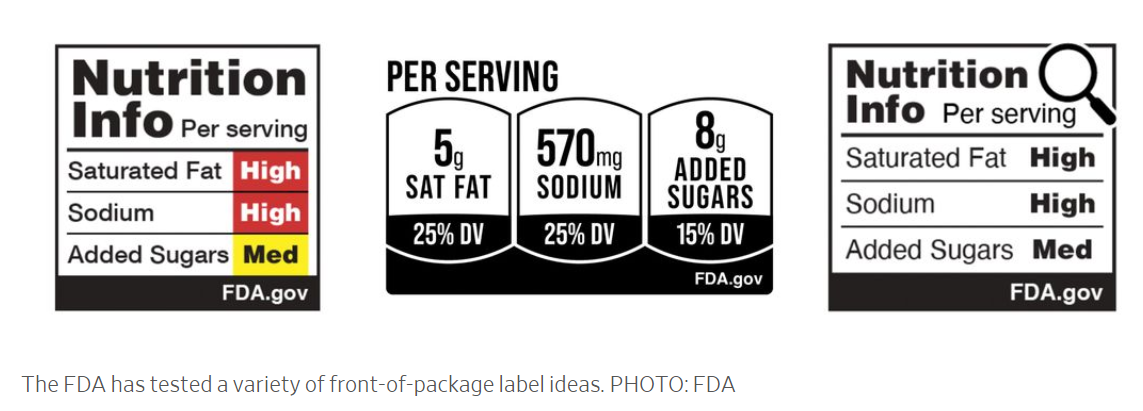
The latest idea is to show large, front-of-package (FOP) labels, possibly without the numbers and percentages we’re used to seeing. Consumers would see information more easily, albeit with some interpretative descriptions (options shown here). The goal is for consumers to make healthier choices.

Students could research arguments about the change. For example, one study showed household reductions in sugar, fat, and sodium after Chilean policies mandated front-side labels. Tony the Tiger was banned from this “Frosties” (Frosted Flakes) box. The Food and Drug Administration also describes focus groups and experimental studies in favor of the change.
The food industry argues that FOP labeling won’t have the desired effect, removes responsibility from consumers, and could infringe on products’ trademarks because of changes to the packaging. One older study showed mixed results of front-of-package labeling, including in a “halo effect” for “vice products,” for which any label—even one showing excessive sugar—made the product look more credible. Students will find more research on both sides and might consider how new weight-loss drugs could affect consumer choice.
Comms About USC Cancelling Valedictorian Commencement Speaker
In another difficult situation for university administrators, University of Southern California (USC) rescinded its plan for commencement speaker valedictorian Asna Tabassum, a first-generation South Asian-American Muslim.
In a statement, the university defends its decision. Administrators admit that the decision was based on fear of the “alarming tenor”:
The intensity of feelings, fueled by both social media and the ongoing conflict in the Middle East, has grown to include many voices outside of USC and has escalated to the point of creating substantial risks relating to security and disruption at commencement. We cannot ignore the fact that similar risks have led to harassment and even violence at other campuses.

The statement emphasizes “unprecedented risks we are seeing at other campuses and across the world” and advice from the university department of public safety as factors leading to the decision. In the middle of the statement, we read the decision: “After careful consideration, we have decided that our student valedictorian will not deliver a speech at commencement.” Administrators preempt criticism: “To be clear: this decision has nothing to do with freedom of speech. There is no free-speech entitlement to speak at a commencement. The issue here is how best to maintain campus security and safety, period.” The statement includes an FAQ and a link to the commencement selection process.
We could say that administrators lack courage, although they also demonstrate courage by, as they see it, protecting the 65,000 people who will attend the event—and, of course, the university’s reputation, possibly preventing bad press.
A student group’s statement refers to Tabassum’s writings as “antisemitic bigotry,” including, in quoted text, the “‘complete abolishment’ of Israel.” The USC statement doesn’t mention these specifics and, instead, focuses on safety.
Yet, in her statement, Tabassum denies hearing about “any specific threats against me or the university.” She defends her work and calls for courage: “And I urge us to see past our deepest fears and recognize the need to support justice for all people, including the Palestinian people.” The cancellation has an extra sting for Tabassum, who was the valedictorian of her high school but didn’t get to make a speech because of COVID-19.
Moral courage means accurately assessing risks and walking through fears. University administrators have made their assessment. The executive director of the Greater Los Angeles Area Office of the Council on American-Islamic Relations (CAIR-LA) expressed his disappointment, calling the decision “cowardly”:
USC cannot hide its cowardly decision behind a disingenuous concern for “security.” Asna is an incredibly accomplished student whose academic and extracurricular accomplishments made her the ideal and historic recipient of this year’s valedictorian’s honor. The university can, should and must ensure a safe environment for graduation rather than taking the unprecedented step of cancelling a valedictorian’s speech.
I don’t envy university leaders, who may be trying to do the right thing but are finding it difficult to know exactly what that is.
UPDATE: USC has cancelled all commencement speakers, or as they say, they will “release our outside speakers and honorees from attending this year’s ceremony.” Four high-profile people had been invited. Another character dimension at play is integrity: withdrawing a commitment.
Activist Investor Letter and Railroad's Response
As activist investor Ancora tries to change Norfolk Southern railroad’s leadership, students can analyze persuasive communications from both sides.
The Ancora letter to shareholders itemizes what they consider “failures of governance” and "the Board’s poor judgment.” Many of the points relate to the hiring of a new COO—the third in the past two and a half years—whom they think is unsuitable, partly because of accusations about his “abusive behavior and serious misconduct.” The activists say the railroad held an insufficient search and overpaid the chosen candidate. Students can analyze the letter in terms of organization (main points in the introduction?), formatting (excessive underlining!), and evidence.
In an interview on CNBC’s Mad Money with Jim Cramer, Norfolk Southern CEO Alan Shaw defended the decision. Cramer challenges him a bit about the COO but, overall, the interview is favorable. Clearly, he’s a fan, supporting what Shaw says about delivering on promises during his short time with the company. As any CEO would, Shaw minimized the February 2023 train derailment in Ohio, which released toxic chemicals. He said, “Yeah, we had a challenge last year, but we met that challenge head on.” Later, he refers to it as “East Palestine” (typonym rhetorical device?), which makes the incident feels unspeakable.
Cramer is indignant when he learns that the railroad offered Ancora two board seats, and the activists didn’t accept them. Ancora doesn’t mention this in its letter. The activists want what Shaw describes as “wholesale change,” which he believes would be too disruptive. Cramer compares the situation to Disney, which students also can research.
For more, see this “fireside chat” with Shaw, another interview ahead of the shareholders meeting on May 9.
Letter from Founder of World Central Kitchen

I’m posting this hoping it’s not perceived as “political” but as a beautifully written letter by an organization leader about his work and his staff. I know that the facts in the letter are disputed.
José Andrés is the founder of World Central Kitchen, whose seven aid workers were killed while trying to deliver food to the people in Gaza. His letter was published in The New York Times with the title, “Let People Eat,” and in ynetnews, an Israeli news source, with the title, “The Probe Into Death of WCK Volunteers Needs to Start From the Top.”
This is a persuasive message, as we define it in business communication, but to me, it’s more usefully viewed as an example of leader integrity and compassion. Andrés demonstrates integrity by focusing on his own and the organization’s mission and values, which he says transcend particular groups or situations. He demonstrates compassion by giving names to those lost and describing his personal connections and appreciation of them and their work.
Chick-fil-A's New "Chicken Commitment"
Chick-fil-A had a difficult announcement to make, changing its No Antibiotics Ever (NAE) policy to some antibiotics. Students can analyze the message for its audience focus, persuasive strategies, and issues of integrity.
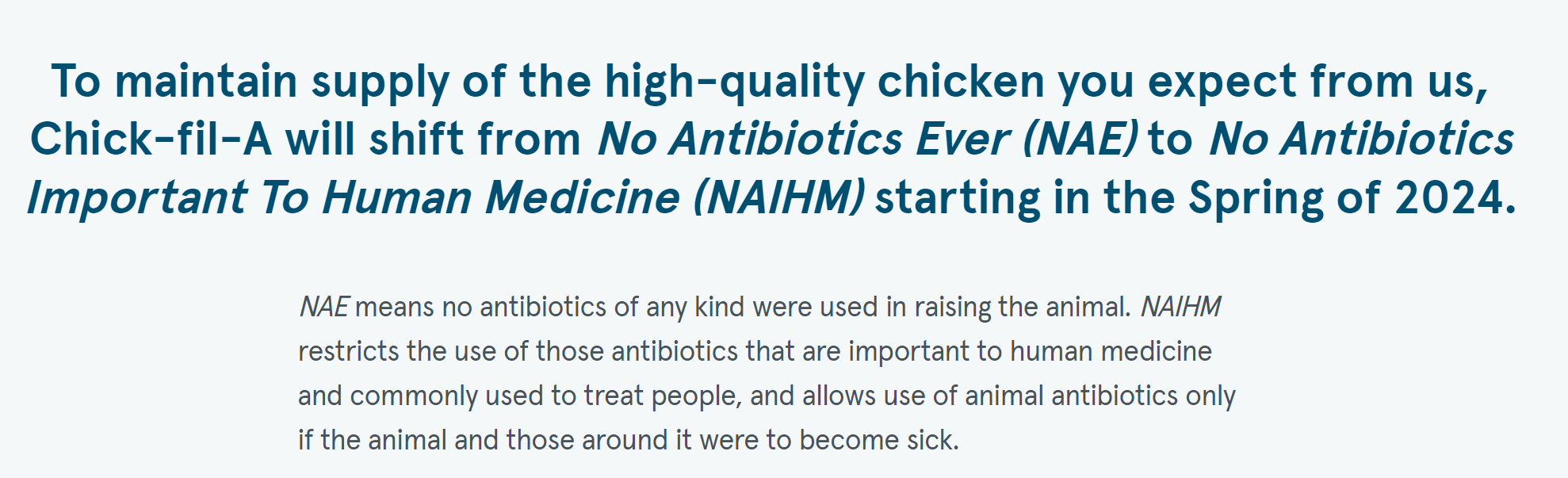
The message begins with the reason: “To maintain supply of the high-quality chicken you expect from us.” The opening implies that, without this new strategy, consumers might not get good chicken, setting the reader up to agree with whatever the company needs to meet that standard.
The change is right up front: from no antibiotics to some. Although this is jarring at first—“No Antibiotics Ever (NAE)” is quite a “commitment”—the message is clear. Chick-fil-A admits and focuses on the change. Maybe the NAE plan wasn’t realistic to begin with. They could say more explicitly that NAE was established in 2014, and new threats require reevaluating the policy.
But the message audience is likely not consumers. The acronyms NAE and NAIHM mean something only to Chick-fil-A and industry insiders. I wonder how much consumers even care about the decision. Do they choose Chick-fil-A because they don’t (or haven’t until now) used antibiotics in the chicken, or do they go because it tastes good, and they like the service, speed, or fries and other sides?
Regardless, the frame is now about “restricting the use of those antibiotics that are important to human medicine”; in other words, only the necessary kinds for chicken. The focus is on limiting, and the message downplays that yes, they will now use antibiotics. They also don’t explain the difference between human medicine and other animal antibiotics. In this Northeastern University article, a food expert describes concerns about using any antibiotics and calls the move a “dangerous precedent for other food companies to follow.” He also challenges Chick-fil-A’s focus on supply and says the decision is, no surprise, really about profits:
They’re saying that the availability of the supply is not there; it is there, apparently. It’s just the availability at the price point they’re willing to pay is not there to maintain their profit margins. When they’re trying to defend their actions, they’re not talking about science and medicine and health.
The message raises issues of integrity because of what’s missing—lying by omission. Without more explanations, the company fails to acknowledge the potential downsides of the decision and focuses on restrictions instead of actual use. And yet, this is what we expect companies to do: to present themselves in the best possible light.
After the introduction shown above, the message identifies three short explanations about quality, animal well-being, and continuous evaluation. I admire Chick-fil-A’s candor in lines like this: “Like other chicken in the United States, ours contains no added hormones.” They’re not trying to distinguish themselves. On the contrary, the entire message, with large font, is so short and colorful that the words draw little attention.
Annual Letter as Business Communication Genre
BlackRock CEO Larry Fink published an annual letter that’s gaining popularity like Warren Buffet’s letters. The letter is a good example for students to analyze for its organization, persuasive strategies, lack of visuals, and evidence.
Fink’s letter is long, and the audience is stated as BlackRock investors. But of course, he has broader ambitions, which are realized as we see the extensive media coverage. He wants to attract investors to BlackRock, but he also wants to change policy and company practices to fund retirement.
Fink explains “energy pragmatism” and “energy security,” giving up on the environmental, social, and governance (ESG) language that first was embraced and then drew cries of “wokeism.” Instead, he focuses on retirement as a broader, more acceptable crisis: an aging population with not enough saved. Fink also quit the threatening approach for CEOs to disclose more about their practices.
The main message of the letter is clear: “We focus a tremendous amount of energy on helping people live longer lives. But not even a fraction of that effort is spent helping people afford those extra years.” Fink argues that people are woefully unprepared for retirement. From a business communication perspective, the letter takes a while to get to the main point. Fink starts with emotional appeal, describing how his parents invested throughout their lives. This could be more effective if their behavior shaped his own thinking, but he admits that he had been at BlackRock for 25 years before discovering their surprisingly large nest egg. Still, the family connection feels relevant to his point.

In addition to the hidden main point, the letter could be better organized to reflect his recommendations. A class assignment could ask students to provide a bulleted list (which The New York Times summarized).
With only one confusing visual, shown here, the letter is meant to be read—as a letter. This genre seems particular to a few high-profile investment managers. The extensive footnotes are important to support Fink’s points but make this an unusual example for business communicators. It’s not quite the letter we see to introduce a company’s annual report. We might call it something like a personal report for the use of “I,” family stories, and observations plus citations and recommendations.
Baltimore Bridge Crisis News Conferences
The collapsed Francis Scott Key Bridge in Baltimore offers crisis communication examples for students to analyze. Sadly, the incident cost the lives of six workers from Mexico, Guatemala, El Salvador, and Honduras who were working on the bridge at the time.
Typical news conferences for crisis situations cover the following points, against which students can analyze this one:
After brief context, give condolences first if people are affected
Focus on the facts; research internal and external sources
Never lie or misrepresent the truth
Emphasize the aspects of business that will continue (instill confidence)
Provide investigation process/status
Mention your appreciation of support (e.g., fire department, police)
Say we will provide updates when we know more
Give crisis hotline information, if appropriate
Repeat condolences, if appropriate
Compassion typically comes first, and then explanations and plans.
The news conference also illustrates the players’ roles and responsibilities—and their audience and communication objectives—when a public crisis happens:
Governor Wes Moore: First up, Moore’s focus is on local response. His primary audience are local responders and Baltimore residents. His attention is on gratitude to those working on rescue. He also wants to reassure people that they are safe. He says that this is most likely an accident and that “we haven’t seen any credible evidence of a terrorist attack.” This surprised me given that the ship pilot reported lost power, but he is warding off potential conspiracy theories. At the end, he expresses sympathy for the victims and their loved ones, which might have also come at the beginning. As expected, he talks about “Maryland spirit” (“We are Maryland tough, and we are Baltimore Strong”) with some nice anaphora at the end too: “That’s what we’ve always done. That’s what we’ll continue to do. And that’s what we’re doing to get done together.”
Senator Chris van Hollen: Although he adds little substance, he expands the gratitude and demonstrates the response of the federal government. His sympathy is first, and he talks about all the agencies that are already on the scene or will be soon. He admits his limited role: “I’m just here to say, together with [other senators and congressmen]. . . . we’re with you, we love you, and we’ll get through this together” (more anaphora). Like a lot of tragedies for politicians, this one is a photo op. He does what’s expected.
Next up are the secretary of transportation and representatives from FBI and the Coast Guard.
The Q&A portion is predictable for this early conference. “We have no further information” and “We have no estimates on time lines” are common themes. The focus is on rescue at this point. However, the governor gets a bit emotional around 11:30 talking about the Key Bridge and the impact of the bridge loss on local lives. The questions, and the answers, are a bit of a dance at this point. The governor talks about rebuilding, but people died and are still missing, so he’s balancing hope for the future with compassion.
Other communications are of interest to business and crisis communicators:
Baltimore Mayor Brandon Scott: In a separate news conference, we see the chief of police introduce the mayor. He is brief and all about compassion and gratitude, asking people to pray for everyone affected.
National Transportation Safety Board (NTSB) Chair Jennifer Homendy: The only woman I’ve seen in the communication mix, Homendy is responsible for investigating the crash. Her objectives are to reassure the public that they will determine the cause. She emphasizes the work of her team—24 investigators, which I guess is supposed to sound like a lot, or at least, enough to do the job.
Transportation Secretary Pete Buttigieg: He’s asked about bridge safety across the country, and his job is to reassure us that infrastructure is strong. He says, “This is a unique circumstance. I do not know of a bridge that has been constructed to withstand a direct impact of a vessel this size.” This is a classic communication strategy: to isolate the situation.
The ship’s captain will be under scrutiny in the coming months. The head of the American Pilots’ Association is already defending the pilot: “These are among the most highly trained mariners in the world.”
President Biden spoke about the tragedy, and political leaders have begun to question bridge safety as part of larger, political infrastructure issues, which Buttigieg (somewhat) addressed.