
Corporate Vaccine Messages
Business communication students can analyze vaccine messages to compare how organizations adjust for the context and audience. Following are a few examples:
The medium companies choose is also interesting to compare.
The Society for Human Resource Management offers templates for companies—one about requiring vaccines and another about optional vaccines. How do company messages compare to these templates?

Mailchimp Acquisition News

Mailchimp’s acquisition announcement is an example of a positive message. In an email and statement on the website, Co-founder and CEO Ben Chestnut reveals the news in the third paragraph. The single sentence is in bold type, but it takes a while for the reader to get the message.
Chestnut provides reasons for the acquisition in this paragraph:
Together with Intuit, we’ll deliver an innovative small business growth engine powered by marketing automation, customer relationship management, accounting and compliance, payments and expense, and e-commerce solutions, creating a single source of truth for your business. We’ll also be able to offer more personalized support and onboarding, expand our international footprint, and scale our teams to innovate faster and deliver the solutions you want and need.
Both sentences, long and jargony, use “we” as the subject. I wish he had explained the decision in more natural, conversational language written from the reader’s—”you”—perspective. Why should I care? How will the change help me manage my business, etc.?
Students could rewrite the entire message and do a better job. The message is positive—and it could be persuasive. Otherwise, it could be interpreted as bad news, not good.

Painfully Long Peloton Email

This is the second email someone sent me from Peloton CEO and Founder John Foley. Both seem much longer than they need to be. The first paragraph muses on the company success, and the second paragraph introduces the main point—the Peloton Tread. Essentially, this is a sales pitch.
CEO and Founder John Foley organizes the email around three advantages of the Peloton Tread, which are clear and easy to follow. He could use more “you” language to focus on benefits to the reader rather than features of the product. Persuasive business writing tells readers “why” they should want to do what the writer asks.
If you were advising John Foley, what other advice would you offer? Would visuals help the message? How could he reduce the length of the email to increase the chance that people will read it? Read the entire message.
Hi there,
When we founded Peloton nearly a decade ago, we dreamt of bringing high-energy boutique fitness experiences into the home through vertically integrated platforms. That’s a fancy way of saying that we wanted the hardware to be the best in the world, the software to bring the energy and connection of other people into your home, and the content to deliver the inspiration of the most motivating instructors coaching over the best music. I hope you agree that we deliver on that goal already, but I hope you also see that we continue to innovate on the software and content because we always want your experience to get better, a commitment that I made to you back then and I am making to you again today…
But today, I write to you about another platform: The Peloton Tread. Have you ever taken a bootcamp class or a HIIT total body group class or any class involving a treadmill, where the instructor asked you to step off of the treadmill for a more full-body workout? As one of the founders of Peloton, I of course LOVE a great indoor cycling class! As you might guess, so does my wife Jill. But we have found over the years that complementing the fantastic cardio provided by the Peloton App with cardio AND strength training via bootcamp classes is a perfect new part of our fitness journey.
So I wanted to take a minute to share my excitement for the Peloton Tread with you.

Opening Statements in the Theranos Trial

Elizabeth Holmes is facing a criminal trial for her role in the spectacular success—and spectacular failure—of Theranos, a startup that claimed to change how people give blood and get health results. The high-profile case involves board members like Henry Kissinger and Rupert Murdoch, who believed in the company and in Holmes.
Opening statements are a lesson in persuasive communication. The prosecution said, ”This is a case about fraud and about lying and cheating to get money.” They accuse Holmes of knowing that test results were invalid and continuing the business as usual. Pointing to the fame Holmes received, prosecutors paint a picture of a desperate, failing executive who would do anything to protect her business and reputation.
The defense team presents Holmes as a victim—a hardworking entrepreneur doing her best and challenged by mental abuse from Ramesh Balwani, the company COO and her former boyfriend.
Each side framed their positions, and now we’ll see what evidence they present to support their claims. Holmes could face 20 years in prison, which is unusual for a corporate CEO. The second day of the trial was cancelled because a juror was possibly exposed to COVID-19. The drama continues…
Medical Journals Urge Climate Response

The editors of 220 medical journals wrote to inspire climate change action. In an open letter, the authors cite “catastrophic” health results of a degrading environment, particularly affecting ”countries and communities that have contributed least to the problem and are least able to mitigate the harms.”
The letter, below, is a good example of persuasive writing. We see a mix of emotional appeals, logical arguments, and credibility to encourage world leaders to do more. However, the writing doesn’t meet standards for organizing business messages. Business communication students could restructure the writing to make the organization more explicit, improve readability, and surface main points.
The UN General Assembly in September, 2021, will bring countries together at a critical time for marshalling collective action to tackle the global environmental crisis. They will meet again at the biodiversity summit in Kunming, China, and the UN Climate Change Conference of the Parties (COP26) in Glasgow, UK. Ahead of these pivotal meetings, we—the editors of health journals worldwide—call for urgent action to keep average global temperature increases below 1·5°C, halt the destruction of nature, and protect health.
Health is already being harmed by global temperature increases and the destruction of the natural world, a state of affairs health professionals have been bringing attention to for decades.1 The science is unequivocal; a global increase of 1·5°C above the pre-industrial average and the continued loss of biodiversity risk catastrophic harm to health that will be impossible to reverse.2, 3 Despite the world's necessary preoccupation with COVID-19, we cannot wait for the pandemic to pass to rapidly reduce emissions.
Reflecting the severity of the moment, this Comment appears in health journals across the world. We are united in recognising that only fundamental and equitable changes to societies will reverse our current trajectory.
The risks to health of increases above 1·5°C are now well established.2 Indeed, no temperature rise is “safe”. In the past 20 years, heat-related mortality among people older than 65 years has increased by more than 50%.4 Higher temperatures have brought increased dehydration and renal function loss, dermatological malignancies, tropical infections, adverse mental health outcomes, pregnancy complications, allergies, and cardiovascular and pulmonary morbidity and mortality.5, 6 Harms disproportionately affect the most vulnerable, including children, older populations, ethnic minorities, poorer communities, and those with underlying health problems.2, 4
Global heating is also contributing to the decline in global yield potential for major crops, falling by 1·8–5·6% since 1981; this, together with the effects of extreme weather and soil depletion, is hampering efforts to reduce undernutrition.4 Thriving ecosystems are essential to human health, and the widespread destruction of nature, including habitats and species, is eroding water and food security and increasing the chance of pandemics.3, 7, 8
The consequences of the environmental crisis fall disproportionately on those countries and communities that have contributed least to the problem and are least able to mitigate the harms. Yet no country, no matter how wealthy, can shield itself from these impacts. Allowing the consequences to fall disproportionately on the most vulnerable will breed more conflict, food insecurity, forced displacement, and zoonotic disease—with severe implications for all countries and communities. As with the COVID-19 pandemic, we are globally as strong as our weakest member.
Rises above 1·5°C increase the chance of reaching tipping points in natural systems that could lock the world into an acutely unstable state. This would critically impair our ability to mitigate harms and to prevent catastrophic, runaway environmental change.9, 10
Encouragingly, many governments, financial institutions, and businesses are setting targets to reach net-zero emissions, including targets for 2030. The cost of renewable energy is dropping rapidly. Many countries are aiming to protect at least 30% of the world's land and oceans by 2030.11
These promises are not enough. Targets are easy to set and hard to achieve. They are yet to be matched with credible short-term and longer-term plans to accelerate cleaner technologies and transform societies. Emissions reduction plans do not adequately incorporate health considerations.12 Concern is growing that temperature rises above 1·5°C are beginning to be seen as inevitable, or even acceptable, to powerful members of the global community.13 Relatedly, current strategies for reducing emissions to net zero by the middle of the 21st century implausibly assume that the world will acquire great capabilities to remove greenhouse gases from the atmosphere.14, 15
This insufficient action means that temperature increases are likely to be well in excess of 2°C,16 a catastrophic outcome for health and environmental stability. Crucially, the destruction of nature does not have parity of esteem with the climate element of the crisis, and every single global target to restore biodiversity loss by 2020 was missed.17 This is an overall environmental crisis.18
Health professionals are united with environmental scientists, businesses, and many others in rejecting that this outcome is inevitable. More can and must be done now—in Glasgow and Kunming—and in the immediate years that follow. We join health professionals worldwide who have already supported calls for rapid action.1, 19
Equity must be at the centre of the global response. Contributing a fair share to the global effort means that reduction commitments must account for the cumulative, historical contribution each country has made to emissions, as well as its current emissions and capacity to respond. Wealthier countries will have to cut emissions more quickly, making reductions by 2030 beyond those currently proposed20, 21 and reaching net-zero emissions before 2050. Similar targets and emergency action are needed for biodiversity loss and the wider destruction of the natural world.
To achieve these targets, governments must make fundamental changes to how our societies and economies are organised and how we live. The current strategy of encouraging markets to swap dirty for cleaner technologies is not enough. Governments must intervene to support the redesign of transport systems, cities, production and distribution of food, markets for financial investments, health systems, and much more. Global coordination is needed to ensure that the rush for cleaner technologies does not come at the cost of more environmental destruction and human exploitation.
Many governments met the threat of the COVID-19 pandemic with unprecedented funding. The environmental crisis demands a similar emergency response. Huge investment will be needed, beyond what is being considered or delivered anywhere in the world. But such investments will produce huge positive health and economic outcomes. These include high quality jobs, reduced air pollution, increased physical activity, and improved housing and diet. Better air quality alone would realise health benefits that easily offset the global costs of emissions reductions.22
These measures will also improve the social and economic determinants of health, the poor state of which may have made populations more vulnerable to the COVID-19 pandemic.23 But the changes cannot be achieved through a return to damaging austerity policies or the continuation of the large inequalities of wealth and power within and between countries.
In particular, countries that have disproportionately created the environmental crisis must do more to support low-income and middle-income countries to build cleaner, healthier, and more resilient societies. High-income countries must meet and go beyond their outstanding commitment to provide US$100 billion a year, making up for any shortfall in 2020 and increasing contributions to and beyond 2025. Funding must be equally split between mitigation and adaptation, including improving the resilience of health systems.
Financing should be through grants rather than loans, building local capabilities and truly empowering communities, and should come alongside forgiving large debts, which constrain the agency of so many low-income countries. Additional funding must be marshalled to compensate for inevitable loss and damage caused by the consequences of the environmental crisis.
As health professionals, we must do all we can to aid the transition to a sustainable, fairer, resilient, and healthier world. Alongside acting to reduce the harm from the environmental crisis, we should proactively contribute to global prevention of further damage and action on the root causes of the crisis. We must hold global leaders to account and continue to educate others about the health risks of the crisis. We must join in the work to achieve environmentally sustainable health systems before 2040, recognising that this will mean changing clinical practice. Health institutions have already divested more than $42 billion of assets from fossil fuels; others should join them.4
The greatest threat to global public health is the continued failure of world leaders to keep the global temperature rise below 1·5°C and to restore nature. Urgent, society-wide changes must be made and will lead to a fairer and healthier world. We, as editors of health journals, call for governments and other leaders to act, marking 2021 as the year that the world finally changes course.
FG serves on the executive committee for the UK Health Alliance on Climate Change and is a Trustee of the Eden Project. RS is the Chair of Patients Know Best, has stock in UnitedHealth Group, has done consultancy work for Oxford Pharmagenesis, and is chair of the Lancet Commission of the Value of Death. The other authors declare no competing interests.
This Comment is being published simultaneously in multiple journals (appendix). This full list of journals, as well as a further list of supporting journals, can also be found on the BMJ website.
Delta Airlines and the Delta Virus
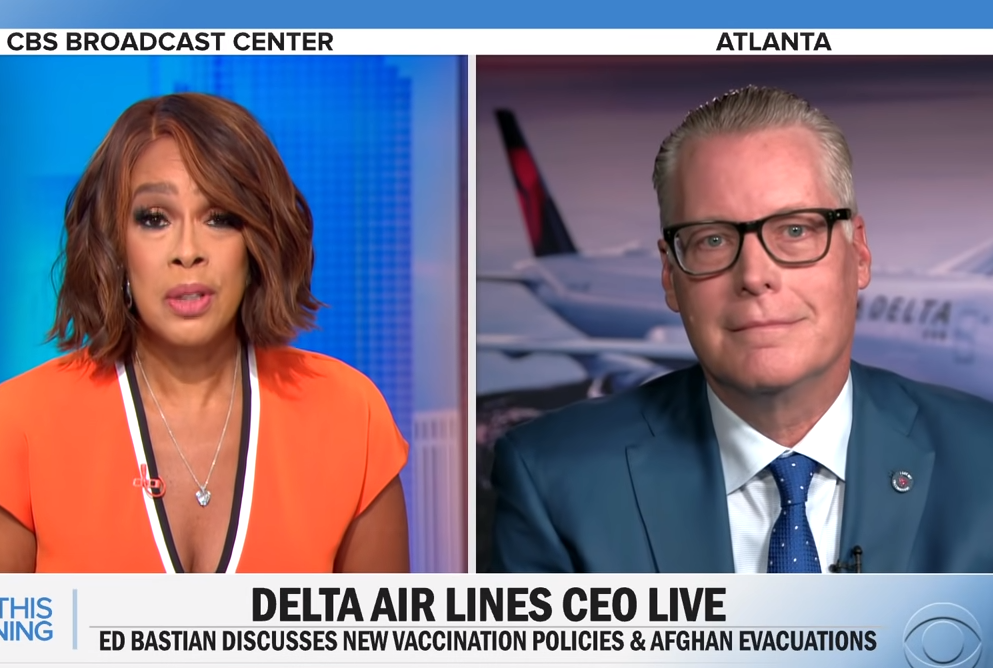
Unfortunately for Delta Airlines, the new COVID-19 variant is called Delta. In a message to employees, below, CEO Ed Bastian, refers to the virus by its scientific name, B.1.617.2 variant. He has also called it “the most recent virus variants” and simply “the variant.” Jimmy Fallon joked about the issue on his late-night show, saying that the airline is now called “Del-tay.”
Bastian may not need to worry. Reports show that Corona beer sales didn’t decline after the coronavirus first hit the news.
Bastian’s email to employees also is a good example of a persuasive message. He encourages employees to get vaccinated and describes extra precautions for those who are not. However, he stops short of requiring vaccinations as have other CEOs.
Ed Bastian to Delta Colleagues Worldwide
COVID-19 update
Since the earliest days of the pandemic, our No. 1 priority has always been to protect our people and customers. Over the past 18 months, we have invested heavily in cleanliness, personal protective equipment, testing, and – most importantly – vaccines.
Today I’m pleased to announce that we’ve reached the milestone of 75% of our people vaccinated, which puts us one step closer to getting back to what we do best – connecting the world and running the best airline on the planet. I want to personally thank all of you who have taken the time to receive a vaccination – your actions are making a real difference.
In addition to vaccinating our people, we’ve been proud to partner with the state of Georgia to operate the state’s largest mass vaccination site at the Delta Flight Museum, where nearly 35% of the state’s mass vaccination doses were administered to residents. In total, more than 150,000 doses were administered to our employees, their family members and friends at Delta clinics around the country.
Delta's top priority is protecting our people. Since the start of the pandemic, we've invested resources to mount industry-leading safety measures in the operation.
While we are grateful for the progress we’ve made, the most recent virus variants make it clear that more work remains ahead. The COVID-19 pandemic is a global health crisis, and one of the most dangerous challenges our world has faced in this lifetime. Over the past few weeks, the fight has changed with the rise of the B.1.617.2 variant – a very aggressive form of the virus. Our Chief Health Officer, Dr. Henry Ting, describes the variant as a “heat-seeking missile” that transmits predominantly through the unvaccinated community.
According to Dr. Ting, while breakthrough cases among the vaccinated do occur, the vast majority of those are mild and often present no symptoms at all. However, the variant has resulted in a significant rise in hospitalizations and deaths, almost entirely impacting those who have not yet been vaccinated. While we can be proud of our 75% vaccination rate, the aggressiveness of the variant means we need to get many more of our people vaccinated, and as close to 100% as possible.
We’ve always known that vaccinations are the most effective tool to keep our people safe and healthy in the face of this global health crisis. That’s why we’re taking additional, robust actions to increase our vaccination rate:
Effective immediately, unvaccinated employees are required to wear masks in all indoor Delta settings. This requirement will remain in place until community case rates stabilize.
Starting Sept. 12, any U.S. employee who is not fully vaccinated will be required to take a COVID test each week while community case rates are high. Those with a positive result will need to isolate and remain out of the workplace.
Beginning Nov. 1, unvaccinated employees enrolled in Delta’s account-based healthcare plan will be subject to a $200 monthly surcharge. The average hospital stay for COVID-19 has cost Delta $50,000 per person. This surcharge will be necessary to address the financial risk the decision to not vaccinate is creating for our company. In recent weeks since the rise of the B.1.617.2 variant, all Delta employees who have been hospitalized with COVID were not fully vaccinated.
Effective Sept. 30, in compliance with state and local laws, COVID pay protection will only be provided to fully vaccinated individuals who are experiencing a breakthrough infection.
More details will be coming soon from your divisional leaders.
I know some of you may be taking a wait-and-see approach or waiting for full FDA approval. With this week’s announcement that the FDA has granted full approval for the Pfizer vaccine, the time for you to get vaccinated is now. We can be confident that the Pfizer vaccine is safe and effective, and has undergone the same rigorous review for other approved medications to treat cancer and heart disease, as well as other vaccines.
If you aren’t fully vaccinated, I strongly urge you to discuss the issue with your personal physician or health provider. In addition, testing and vaccination information is available on Deltanet, and Dr. Ting provides regular, informative updates on the state of the virus and the tools available to keep yourself and your loved ones safe and healthy.
Protecting yourself, your colleagues, your loved ones and your community is fundamental to the shared values that have driven our success for nearly a century. Vaccinations are the safest, most effective, and most powerful tool we have to achieve our goals, live up to our values and move forward.
Ed

New "Jeopardy!" Host Resigns

Just nine days after he got the job, Mike Richards resigned as the new host of ”Jeopardy!“ The Anti-Defamation League revealed comments that the host made on a podcast, “The Randumb Show,” between 2013 and 2014.
Although Richards was selected as a host without too much personality to overshadow the show, his reputation is now tarnished by these remarks.
What surprises me is that the show producers didn’t uncover the comments themselves. Or did they find them benign? Did they also discount litigation against him when he was a producer for “The Price Is Right” and “Let’s Make a Deal”?
Regardless, this is yet another warning to students and others to consider carefully what they say and post online; everything becomes a permanent digital record.
Below is Richards’ email to “Jeopardy!” staff about the previous litigation, including a version of the now-classic, “This is not who I am.” Below the email is his apology about the podcast comments, including versions of the old classics, “I’m a father” and “It was a joke.”
Team Jeopardy!
Recently, Jeopardy!, our host search and the possibility of me hosting has been all over the news. I want to take a moment so that you can hear directly from me. The last year has been the most challenging in the history of the show. I know we are all still dealing with the loss of our hero, Alex, while at the same time continuing to produce amazing shows for our millions of fans through the pandemic. Our success over that time with our guest-host rotation, including the more than $3 million we raised for charities, is a singular achievement and a testament to your talent and dedication. I’ve produced a lot of television over the years, and I could not be more impressed with team Jeopardy!
It is true that I was asked if I would consider hosting the show. I was humbled and deeply honored. No final decisions have been made and discussions with me and other potential hosts are still ongoing. I know I have mentioned this to you all before, but the choice on this is not my decision and never has been. Throughout this search, Sony’s top priority has always been to continue the incredible legacy you and Alex built. As you know, Alex always believed the game itself and the contestants are the most important aspects of the show, and that will continue to be the guiding principle as the decision is finalized.
I want to address the complicated employment issues raised in the press during my time at The Price is Right ten years ago. These were allegations made in employment disputes against the show. I want you all to know that the way in which my comments and actions have been characterized in these complaints does not reflect the reality of who I am or how we worked together on The Price is Right. I know firsthand how special it is to be a parent. It is the most important thing in the world to me. I would not say anything to disrespect anyone’s pregnancy and have always supported my colleagues on their parenting journeys.
I am very proud of my time on The Price Is Right and Let’s Make a Deal. During my tenure, our female cast members welcomed seven beautiful children. We embraced and celebrated each pregnancy and birth both in front of and behind the camera. It was a joy to watch their families grow and highlight their happiness as part of the show.
For us, I realize there is a lot going on right now as we ramp up for the new season. Please do not hesitate to reach out of you have any questions or concerns.
It is truly an honor to get to work with all of you to produce this amazing show, and I look forward to the days ahead as we get back into production.
Mike
"It is humbling to confront a terribly embarrassing moment of misjudgment, thoughtlessness, and insensitivity from nearly a decade ago. Looking back now, there is no excuse, of course, for the comments I made on this podcast and I am deeply sorry," Richards said in a statement to the Ringer. "The podcast was intended to be a series of irreverent conversations between longtime friends who had a history of joking around. Even with the passage of time, it's more than clear that my attempts to be funny and provocative were not acceptable, and I have removed the episodes. My responsibilities today as a father, husband, and a public personality who speaks to many people through my role on television means I have substantial and serious obligations as a role model, and I intend to live up to them."
Apple Clarifies Policy

Apple software chief Craig Federighi spoke with a Wall Street Journal reporter about a misunderstood policy related to child pornography. The company had announced new reporting guidelines for illegal content. As part of the same message, they described new guidelines about photos sent to and from children. User backlash concerned how the company was monitoring their phones.
Federighi said, “I do believe the soundbite that got out early was, ‘Oh my God, Apple is scanning my phone for images.’ This is not what is happening.” He clarified that, using algorithms, they’re looking at photos stored on iCloud—not on people’s phones. The company is flagging only those photos that meet criteria of child pornography.
During the published interview with the WSJ reporter (what made the final cut on the website), Federighi didn’t emphasize the end goal: protecting children. The reporter provided this context, but the message was not at the forefront’s of Federighi’s main points. His focus was on clarifying the initial message: “I think our customers own their phones,” again, distinguishing what we choose to post on Apple’s server.
Federighi also demonstrated humility by admitting that the message was garbled and that AI technology does make mistakes. In hindsight, it sounds as though Federighi would have announced these guidelines in separate messages with more detail about the photo search process.
Report Details Governor Cuomo's Pattern of Sexual Harassment
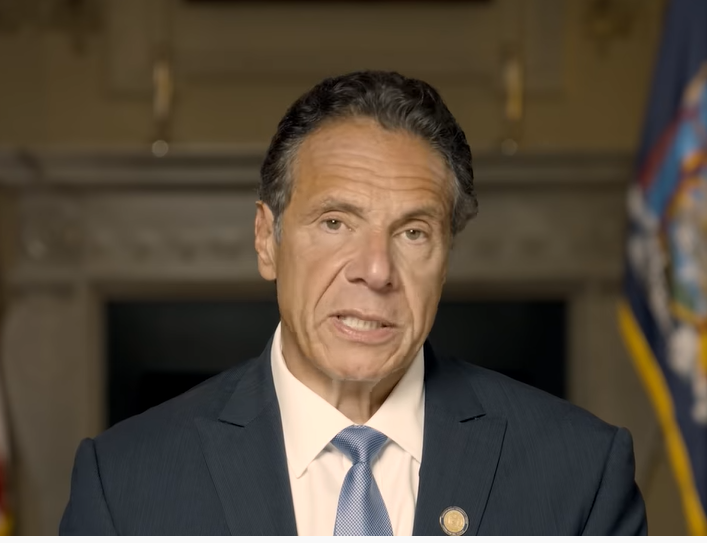
The New York State attorney general published a 165-page report detailing how Governor Andrew Cuomo has sexually harassed women for years and how a culture of “fear and intimidation” allowed his behavior to continue.
In addition to the report, other communications about the situation are interesting examples, particularly of persuasion:
Governor Cuomo’s video response
NY Times opinion calling for his resignation
What makes each of these messages credible—or not—is a rich topic of discussion. The report and other messages use details and examples to prove their points. In his video message, the governor intersperses images of him hugging and kissing many people. His strategy is to “normalize” and de-sexualize his behavior. However, the report describes incidents that go beyond these displays and concludes that the governor violated federal and New York State sexual harassment law.
Update: Governor Cuomo resigns. In a video, he explains his decision, which seemed inevitable.
Facebook Responds to President Biden's Criticism
Facebook is on the defensive after President Biden said the company is “killing people.” The president blamed Facebook for not managing misinformation about the COVID-19 vaccine and, as a result, causing more deaths: “Look, the only pandemic we have is among the unvaccinated. And they’re killing people.”
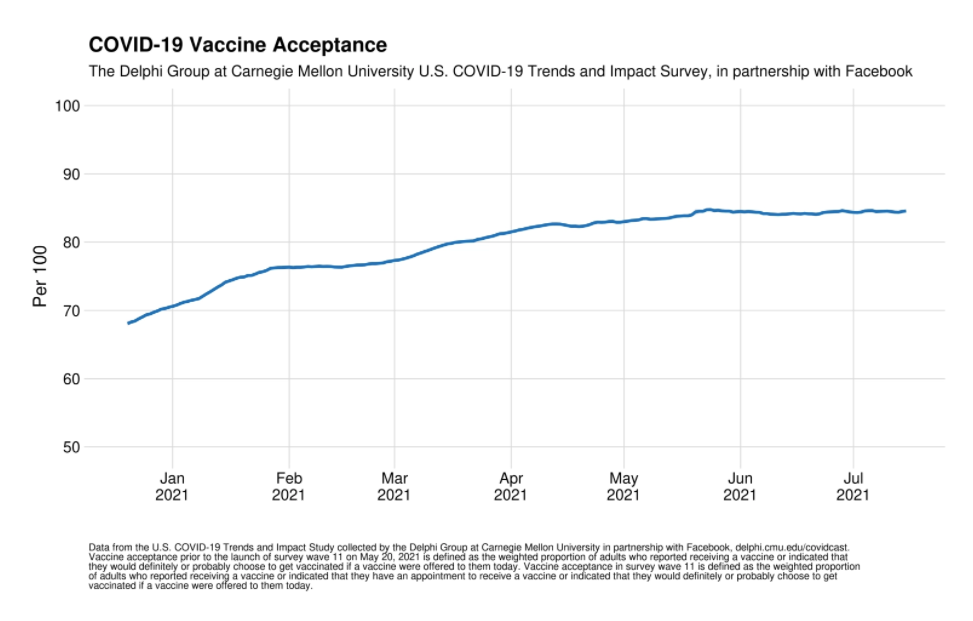
President Biden later softened his message, saying that information from about a dozen people is wrongly influencing people’s decisions: “Facebook isn’t killing people; these 12 people are out there giving misinformation. Anyone listening to it is getting hurt by it. It’s killing people. It’s bad information.”
In response, Facebook published a statement on its website, “Moving Past the Finger Pointing.” The writer, Guy Rosen, VP of Integrity, offers several points of evidence. He mentions partnerships with universities, the high vaccination rate among Facebook users (85%), and measures the company has taken, including promoting “authoritative information” and labeling “debunked” content.
Rosen disputes what is perhaps President Biden’s implied claim: that Facebook is the reason he missed his goal of having 70% of Americans vaccinated by July 4.
A New York Times Daily podcast analyzes the arguments and finds strengths and weaknesses on both sides. The reasons people don’t get vaccinated are complicated. At the same time, the reporter concludes, Facebook could do more to prevent the spread of misinformation.
This story is a good example of persuasion—and politics and business.
Persuading Wall Street

The Wall Street Journal describes a hedge-fund manager’s decision to convince Wall Street investors to improve Exxon’s board oversight. A former coal mine owner, Christopher James spent $250 of personal funds to rally support from other fund managers and win three board seats to encourage environmental, social, and governance (ESG) changes at the company.
Exxon was vulnerable, and the timing was right. James created an organization, Engine, which wrote an open letter to Exxon and shareholders. The demands include “putting the Company on a path to net zero total emissions by 2050.”
James says his inspiration came from a conversation with his children:
The hedge-fund manager’s school-aged sons asked him how he could consider himself an environmentalist if he invested in energy companies, and Mr. James said he struggled with his explanation.
“As I was listening to myself talk, I thought `I am really splitting hairs on this.’” One of his sons, he said, “had this look on his face where his forehead wrinkled. He didn’t buy it.”
James also said, “I can get rid of this compartmentalization. I could realign my values with an investment thesis.”
This story is a great example of integrity and courage character dimensions. James is living his values and took action despite risks.

Waitlisted Student Markets Himself

George Joseph White V was waitlisted from Cornell’s Dyson School, and he decided to promote himself. He advertised on the outside of a local bus with a photo of himself and his website. On his website, georgecantwait.com, White lists his hobbies, interests, and other information. He also includes quotes from a few of his teachers.
The approach certainly is creative and gutsy, but is it appropriate? From a business communication perspective, we consider the audience and the message. White describes his qualifications, but he doesn’t say much about how could contribute. What would he bring to the school that might differentiate him from other students on the waitlist?
White also is interviewed by a local radio station, which is posted on his website. He says he believes he’s qualified, and the only reason he wasn’t accepted is that the number of applicants increased. The number did increase, partly because of the pandemic and students taking a gap year and partly because Cornell dropped the SAT/ACT requirement.
Still, perhaps other students were simply more qualified than White, and that’s why he didn’t get in. White also chose an approach that isn’t available to all students: spending money on ads and a website.
When I asked students about the situation in class, they were mixed. Some respected his perseverance, while others thought his approach was too self-promotional and unfair. As one student wrote in chat, “It’s a WAIT list.”

Amazon’s Statement About the Failed Union Attempt
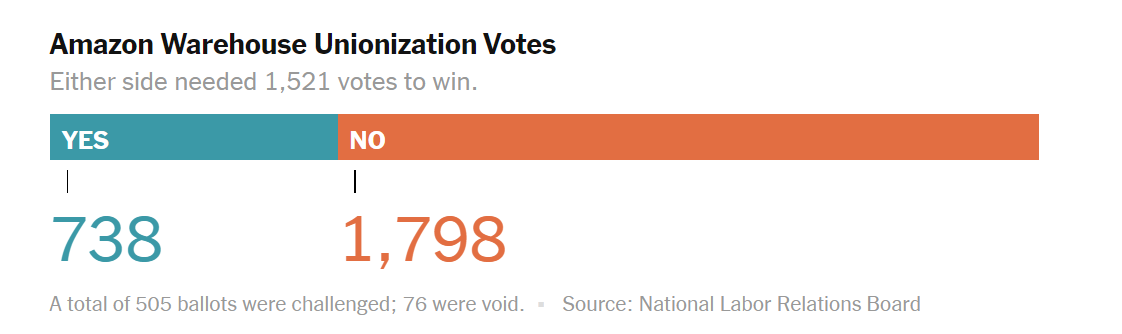
Employees at Amazon’s Bessemer, Alabama, warehouse voted against forming a union. Of 5,876 employees, 1,798 voted against and 783 for the union—not enough. The New York Times presents a simple, clear graphic of the vote.
Critics say that Amazon used aggressive tactics to deter workers from favoring the union. For example, union organizers approached employees at a traffic light, which the city changed based on a request from Amazon management. The change led to longer green lights and shorter red lights based on traffic. Before the vote, the National Labor Relations Board (NLRB) determined that two employees were fired illegally for their union-organizing activity.
In messages to employees, the company used a slogan, “Do it without dues,” meaning employees should negotiate with their managers and not through a union, which charges fees. The slogan was also the URL for a website, which has since been removed.
Amazon posted a statement about the win. The company denies intimidation charges and reinforces its $15 wage and starting benefits. Although the statement indicates that 16% of employees at the facility voted for the union, a higher percentage of those who voted were favorable towards the union.

Royal Family Responds to Racism Allegations

In an interview with Oprah, Prince Harry and Meghan Markle accused the British royal family of racism, and the fallout is severe. Markle talked about having suicidal thoughts and how she had been treated by the family, including plans for the couple’s baby. She said he wouldn’t have a title or security, and that the family had “concerns and conversations about how dark his skin might be when he was born.”
Prince Harry said that he a discussion with his grandmother and two with his father about the couple’s concerns until his father “stopped taking my calls.”
Victoria Murphy, a writer for Town & Country magazine, describes the family’s reaction:
So far, the royal family has remained tight-lipped. There have been no statements and, it seems, very little guidance offered. Perhaps they are retreating into a default “no comment” stance, or perhaps they are sensibly waiting to see what sticks before deciding whether to add fuel to the fire. In this war of words, there is a sense that we could go on and on.
Buckingham Palace did release a short statement, and the Queen took some time before signing off:
The whole family is saddened to learn the full extent of how challenging the last few years have been for Harry and Meghan.
The issues raised, particularly that of race, are concerning. While some recollections may vary, they are taken very seriously and will be addressed by the family privately.
Harry, Meghan and Archie will always be much loved family members.
Of course, the issue is that the royal family is a public organization, with several public figures, whether they wish to be or not.
Two days later, Prince William gave an interview and said, “We’re very much not a racist family.”
Murphy sums up the situation: “Make no mistake, this is an interview that will go down in history as having rocked the British royal family to its core.”
Governor Cuomo Address Sexual Harassment Allegations
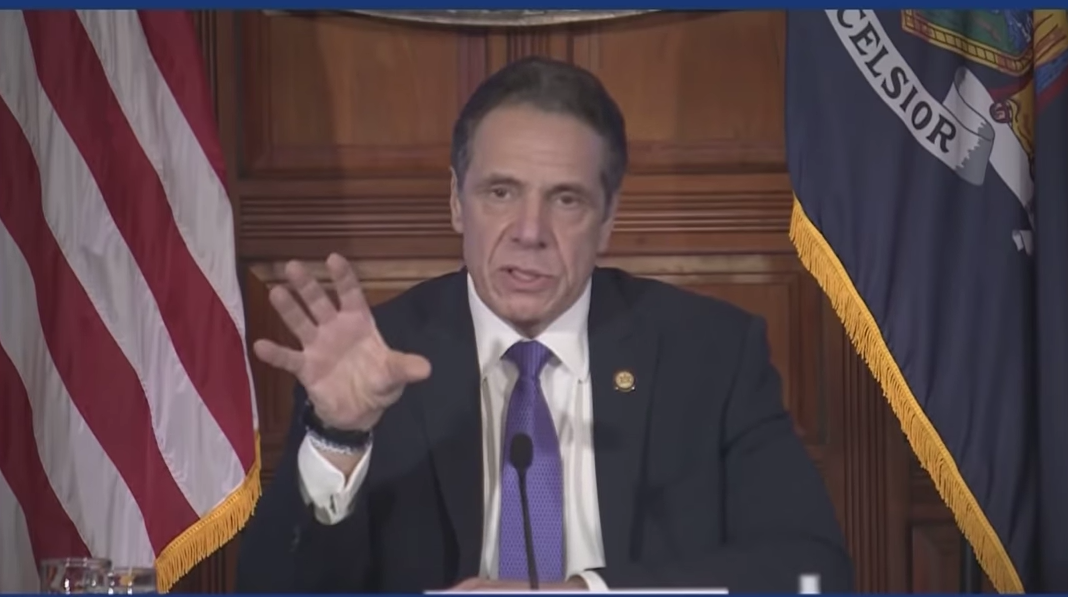
In a video statement, Governor Andrew Cuomo addressed sexual harassment allegations made by three women. He begins well, explaining his decision to speak directly to the public on the topic, although lawyers advised him to wait. To preserve his image, this is a good call: research shows that his apology is unlikely to negatively affect lawsuit outcomes—and may even have a positive effect.
But his apology goes awry. He uses language that is classic in non-apologies, for example, “It was not my intention” and “I certainly never meant to….” In sexual harassment law, intent does not matter—only the impact. Further, this type of language typically doesn’t land well. People don’t care. Instead, he should focus on the impact on these women and perhaps on the office.
He also says, “I now understand that I acted in a way that made people feel uncomfortable.” This is problematic because first, as he says at the beginning, he is a lawyer. As a lawyer and as a political leader, he should know better. Such language is reminiscent of “I’m sorry if you were offended,” implying that it’s the receiver’s problem. A couple of days earlier, after the second allegation, the governor said, “To the extent anyone felt that way, I am truly sorry about that.”
To his credit, he says, “I apologize” and “I’m sorry,” which people do want to hear in these types of statements.
We will see what results from these allegations, in the midst of calls for his resignation. Governor Cuomo also is embroiled in charges that he lied about the number of Covid deaths in nursing homes. So far, he says that he will not resign.

McKinsey Pays Settlement for Work with Purdue Pharma
Management consulting company McKinsey will pay almost $600 million to settle several lawsuits over its role in the opioid crisis, including offering marketing advice to Purdue Pharma. The largest settlement is for $573 million, which Massachusetts Attorney General Maura Healey describes in a video.
Healey’s presentation and delivery are interesting because she represents families and is speaking for 47 attorneys general in several U.S. states. Her anger is evident, but her audience is small: only 53 views one week after it’s posted, and at least three of those are me. What are the communication objectives? This will make a good class discussion.
McKinsey’s response is also interesting for students studying business communication and character. In an email to staff, Global Managing Partner Kevin Sneader describes “setting a higher standard.” Whereas the governors consider McKinsey’s actions unlawful, Sneader does not agree:
“Indeed, while our past work with opioid manufacturers was lawful and never intended to do harm, we have always held ourselves to a higher bar. We fell short of that bar. We did not adequately acknowledge the epidemic unfolding in our communities or the terrible impact of opioid misuse and addiction, and for that I am deeply sorry.”
The Massachusetts court filing explains the legal argument.
At some point in 2019, two McKinsey executives debated in emails “eliminating all our documents and emails.” These executives have been terminated. (See McKinsey communications.)

Fauci: "Numbers Don't Lie"
Dr. Anthony Fauci, the lead infectious disease expert in the U.S., was asked whether the nation has the worst COVID outbreak, and he said, “Numbers don’t lie.”
CNN’s Dr. Sanjay Gupta interviewed the doctor at a Harvard School of Public Health forum. Dr. Gupta asked, “We're not quite 5% of the world's population, yet represent 20-25% of the world's infections ... I mean, that has to be the worst. Is it not the worst?"
Dr. Fauci responded, “Yeah, it is quantitatively if you look at it, it is. I mean the numbers don't lie.”
The doctors are looking at infections per capita. Of course, we could look at other measures. In this interview, President Trump considers the number of deaths as a percentage of those infected.
Discussion:
Do numbers lie? Can they? What about this book: How to Lie with Statistics?
Find evidence to both support and dispute the claim that the U.S. is the “worst.” What measures can you find? Which do you find more meaningful?

COVID-19 Crisis Communication for Reopening the U.S.

What comes after we “flatten the curve” of COVID cases? New York Times opinion writer Charlie Warzel warns that, without a clear communication strategy for what’s next, people will distrust leaders.
Warzel cites six communication guidelines from the report of a working group at The University of Minnesota, The Center for Infectious Disease Research and Policy (CIDRP).:
Don’t Over Reassure.
Proclaim Uncertainty
Validate Emotions—Your Audience’s and Your Own
Give People Things to Do
Admit and Apologize for Errors
Share Dilemma
Discussion:
How should U.S. officials communicate now? What do they need to accomplish, and how well are our current leaders meeting the challenge? In other words, do you agree with Warzel that our leaders are falling short?
Read the entire report. What other principles does the group recommend?
Analyze the report: the audiences, objectives, writing style, organization, and so on. What are the strengths, and how could it be improved?

Airlines CEOs Criticize Boeing CEO's Prediction


During an interview on the “Today” show, Savannah Guthrie asked Boeing CEO David Calhoun whether a major U.S. airline might not survive because of the pandemic. Calhoun said, “Well, I don’t want to get too predictive on that subject, but yes, most likely. Something will happen when September comes around.” He also said that “we believe we will return to a growth rate similar to the past, but it might take us three, five years to get there.”
The response angered major airline executives, who are currently negotiating for federal assistance.
Another Boeing executive defended Calhoun’s statement:
“Some weren’t keen on his sobering assessment of industry challenges ahead, but others appreciated him telling it like it is. It’s in his nature to be frank.”
Discussion:
What’s your view of Calhoun’s comment? One view is that, during a global pandemic, executives might need to be particularly sensitive. Another view is that this is a time for honest, direct talk.
What are the potential implications of his comment? Should he have avoided it?
What the entire interview. How did Calhoun do overall? What are his communication objectives and key messages?

United Airlines Message
The COVID-19 messages keep coming from airlines and other companies. Here’s one from United Airlines, encouraging us to fly by offering flexibility and promising cleanliness.
Dear Amy,
As we all adjust to this new normal, my thoughts are with you and your families and I hope you're staying safe and healthy. The last several weeks have been emotional and trying for all of us, but I continue to be inspired by the goodness in people and the genuine acts of kindness, large and small, that I see every day. These gestures of warmth, strength and caring give me the confidence that in time, we will emerge more United Together than ever before.
It's in that spirit that I wanted to share with you some good news about what the 100,000 family members of United Airlines have been doing for you as we tackle the biggest and most disruptive crisis we've faced in our 94‑year history.
Good news as you're making travel plans
Life is unpredictable in lots of ways right now. We know many of you started the year planning to fly with us to visit family, go to a game or concert, attend a trade show or just get away. And you might be feeling anxious about what to do about your upcoming travel plans. That's why we've waived the fees to change or cancel any trip with us through the end of 2020, including travel that was already planned as well as trips that you're hoping to take in the future. Every customer now has until May 31 to make changes to current reservations or book new flights that can be changed or canceled without a fee, and you'll be able to reschedule your trip for anytime in the next 12 months. So take the next few weeks and do what's best for you, your family and your work.
Good news for when you choose to fly
Safety has always been our top priority, and because of that, the social distancing and cleaning procedures that have become a way of life for all of us are now staples of the way we run our airline. When you're ready to fly, you'll see that a lot has changed at the airport and on board our aircraft. We're boarding fewer customers at a time and starting from the back of the plane to avoid crowding in the gate area, on the jet bridge and in the aisle. We're automatically blocking middle seats to give you enough space on board, requiring all our employees on board, including our flight attendants, to wear masks and, in early May, making masks available to our customers. Of course, these measures are in addition to our state‑of‑the‑art sanitization procedures like cleaning our aircraft with electrostatic sprayers, and extra precautions like taking our employees' temperatures before they start work to protect the well‑being of our customers and colleagues. Find a complete overview of what's changed at United to adapt to this new normal.
Good news for our communities
While we wait to welcome you back, we've been using our time and resources to do our part and support those on the frontlines of this crisis as well as the millions of families who have been affected by the most dramatic disruption of the labor market since the Great Depression. Leveraging the full power of our airline to do the right thing, we've flown more than 1,000 medical volunteers for free; donated 170,000 pounds of food; and used our fleet to get close to 20,000 stranded people home and medical supplies to the places that need them most. Here are just a few examples of how we're contributing in the fight against COVID‑19:
I'll end where I started: I hope you and your family continue to be well. This crisis has revealed a great deal about who we are as people and I'm moved by your continued resilience and resolve. We look forward to welcoming you the next time you take to the friendly skies.
Stay safe and be well,
Toby Enqvist
Chief Customer Officer
United Airlines
Discussion:
What principles of business communication does the United message follow? What could be improved?
How does this message compare to others you received recently?
After reading the Morning Consult report about messaging during COVID-19, what recommendations would you make to United?