
Starbucks Message About Store Safety

Responding to employee concerns about crime, drug use, and other challenging incidents in several stores, Starbucks announced 16 store closings. The company promised to redeploy partners in those locations and reassured all workers that safety is a priority.
As usual, Starbucks posted a message on its public blog. The title, “Message to Starbucks partners: Safety in our stores,” starts with empathy, acknowledging that employees’ concerns have been heard. Two senior VPs of operations wrote, “We read every incident report you file—it’s a lot.”
The message provides eight ways the company will ramp up safety protections for store employees. Training, policies, alarm systems, counselors, health benefits, etc. demonstrate accountability and compassion.
Of course, this communication comes on the heels of increased union activity in Starbucks stores. Still, the company does seem to be "doing the right thing” for its employees, and the message is clear, well organized, and audience focused. One example of audience focus is mentioning the possibility of closing stores but not announcing the specific closures, which affect some employees but not all, as this message is intended.
Meta Bad-News Email to Staff
Facebook Chief Product Officer Chris Cox is direct in telling employees that “serious times” are ahead. The press reports contents of a “memo,” which appears to be a formal email or perhaps post on an intranet.
Organized by six “investment priorities,” the memo starts neutrally: “Every six months, we take stock of our product portfolio and investment plans across the company to assess how we are doing and chart the way forward.” But the tone and recommendations clearly represent tough decisions ahead that affect staff.
With no specific plans for layoffs, warnings come at the end of the memo:
I have to underscore that we are in serious times here and the headwinds are fierce. We need to execute flawlessly in an environment of slower growth, where teams should not expect vast influxes of new engineers and budgets. We must prioritize more ruthlessly, be thoughtful about measuring and understanding what drives impact, invest in developer efficiency and velocity inside the company, and operate leaner, meaner, better exciting teams.
Business communication students will notice lots of jargon, for example, “These are the areas where we see the biggest opportunities for angle-changes in the value we can deliver for people, or businesses, or for our own business, by investing disproportionately relative to our current baseline.” Out with the old; in with the new?
The memo echos a recent meeting CEO Mark Zuckerberg held with staff. Demonstrating vulnerability, he said that Meta is facing the “worst downturns that we’ve seen in recent history” and that hiring will slow. He also gave staff permission to leave:
I think some of you might decide that this place isn’t for you, and that self-selection is OK with me, [and]“Realistically, there are probably a bunch of people at the company who shouldn’t be here.
These warnings are helpful to manage employees’ expectations and to get them on board for the type of belt-tightening company leaders want. Meta might lose people, but this is an attrition strategy that could work in the company’s favor—opening up positions for new people with skills Meta needs going forward.
Airbnb Announces Party Ban
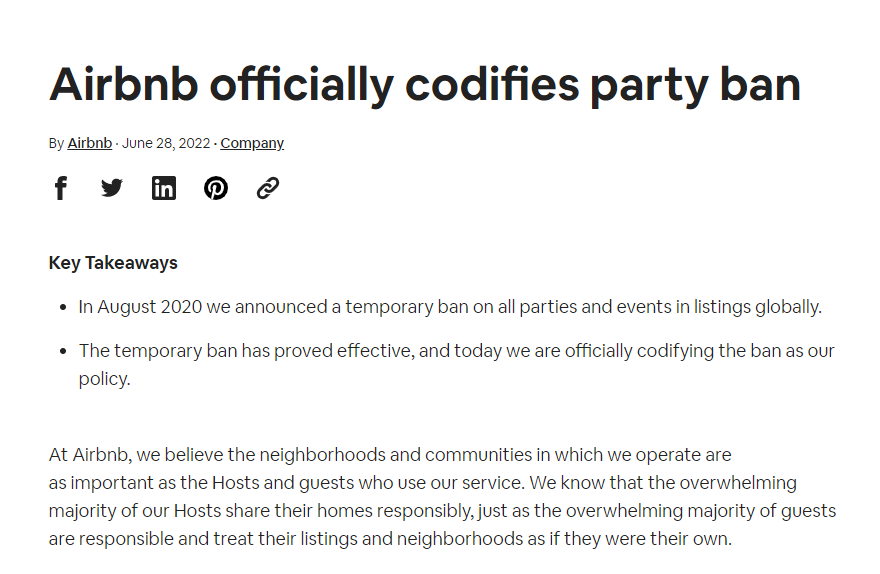
Airbnb’s message banning parties could be considered good news or bad, depending on your perspective. The company’s decision follows a temporary ban during the pandemic, when public gathering spots shut down and parties in rental homes increased. At the time, the rationale was to prevent COVID-19 spread and to reduce the negative impact on neighborhood, a common complaint about Airbnb even before the pandemic.
The decision is easier now—a continuation of the ban rather than a new announcement. As the company wrote in the statement, “It’s been working.” The rationale is clear, and the message is well organized with “Key Takeaways” at the beginning and message titles as headings. Points address concerns of three likely audiences: hosts, neighbors, and guests.
Whether you consider the news good or bad, the statement is an example of a persuasive message. The goal is to stop parties and to win favor of neighbors and municipalities frustrated with noise and other negative effects of short-term rentals, for example, diminished housing inventory and higher home prices. In this regard, the company is demonstrating accountability, although, of course, some would like Airbnb to do more.
BBB's Balanced Executive Change Announcement

On the day that Bed Bath & Beyond posted dismal first-quarter results, the company announced two leadership departures. Like most of these types of news releases, the statement includes quotes from the board chair complimenting the outgoing leaders.
But in this case, the statement starts with a clear acknowledgment of issues and plans to change:
“Bed Bath & Beyond Inc. (NASDAQ: BBBY) today announced significant changes to the Company's senior leadership to focus on reversing recent results, addressing supply chain and inventory, and strengthening its balance sheet. Sue Gove, an Independent Director on the Company's Board of Directors and Chair of the Board's Strategy Committee, has been named Interim Chief Executive Officer, replacing Mark Tritton, who has left his role as President and Chief Executive Officer and as a member of the Board.”
Interim CEO Sue Gove also reinforced the company’s turnaround strategy: "We must deliver improved results. Our shareholders, Associates, customers, and partners all expect more.”
The quote highlighting Tritton’s accomplishments, and those of the merchandising VP, who is also leaving, comes later, under the heading, “Executive Changes.”
Comparing Bed Bath’s statement to similar messages, organization and accountability are probably the most obvious differences. The message sequencing illustrates the company’s primary purpose of reassuring shareholders—prioritizing financial performance over outgoing leader relationships. Although this strategy is sound, the stock fell 20.6% so far today to 5.18, a dramatic fall from its 2013 high of more than 80.
Companies Navigate Comms After Roe v. Wade

After the U.S. Supreme Court decision to overturn Roe v. Wade, women’s constitutional right to have an abortion, companies are faced with thorny decisions about whether and how to communicate. Leaders have become more vocal on social issues, for example, gay marriage and Black Lives Matter, but this situation may be more complicated.
Several companies have expanded their health care coverage to include travel for medical procedures, but they avoid the word “abortion.” For example, Disney sent an email to staff:
“We have processes in place so that an employee who may be unable to access care in one location has affordable coverage for receiving similar levels of care in another location,” including, “family planning (including pregnancy-related decisions).”
Other companies were more direct. Back in April, after the Texas ruling that limited abortions, Yelp’s chief diversity officer said, “We want to be able to recruit and retain employees wherever they might be living,” She raised the issue of equity—access for employees who may not have the funds to travel. She also said, “The ability to control your reproductive health, and whether or when you want to extend your family, is absolutely fundamental to being able to be successful in the workplace,”
Starbucks, facing unionization efforts and staffing issues, sent three letters to partners during the past few months and posted them publicly. Each uses the word “abortion” and acknowledges different views on the subject and that some may feel “disheartened or in shock.”
How companies approach these communications reflects their business, employee base, location, and culture. We might expect Starbucks, whose founder and current interim CEO Howard Schultz has consistently been vocal on controversial issues. Starbucks leaders demonstrated courage, vulnerability, compassion, and integrity—standing up for what they believe is right, despite strong feelings on the other side.
"The" Ohio State Trademark

After a three-year legal process, Ohio State University was awarded the use of “The” as a trademark on its products. The Buckeyes football team, announcers, and others have emphasized “thee” at the beginning of the university name, and now it’s official. This means that only OSU can use “the” “on branded products associated with and sold through athletics and collegiate channels, such as T-shirts, baseball caps and hats.”
The university’s head of media relations said, “THE has been a rallying cry in the Ohio State community for many years, and Buckeye fans who purchase official Ohio State gear support student scholarships, libraries, and other university initiatives.” Indeed, athletic products bring in more than $12 million in annual revenue.
In a 2014 Saturday Night Live parody, players announce their crimes. When it’s Marvin Ingram’s turn, he says his crime and emphasizes “THEE” Ohio State University.
You can read about the history of “the” in the university’s name if you’re interested.
Comms About Disney Leadership Changes
When companies announce leadership changes, they typically include quotes from outgoing executives, but a Disney press release mentions the head of TV only in passing. The focus of the release is on Dana Walden’s promotion to Chairman of Disney General Entertainment Content. The 817-word statement mentions Tim Rice near the end of the first paragraph:

She will have oversight of ABC Entertainment, ABC News, Disney Branded Television, Disney Television Studios, Freeform, FX, Hulu Originals, National Geographic Content, and Onyx Collective. Walden previously served as Chairman, Entertainment, Walt Disney Television and succeeds Peter Rice, who is leaving the Company. Her appointment is effective immediately, and she will report directly to Chapek.
News reports explains that Rice was fired for differences over creative decisions, compensation, etc. The company statement could have acknowledged a bit more and demonstrated integrity and accountability for the decision; otherwise, the press carries the message.
In Walden’s email to employees, she mentions Rice in the 14th of 16 paragraphs:
In reflecting on my own professional journey, I am very fortunate to have worked alongside Peter Rice for a long time. We have been friends for almost three decades and he was my boss for eight years. He is a gifted executive, and I learned a lot from him. I know you all join me in wishing him the best in whatever he chooses to do next.
Of course, this is the right thing to do—and important for employees who may have loyalties to Rice. I respect that she didn’t sugarcoat his departure (and at least Disney isn’t claiming the weasley “mutual agreement” reason for leaving).
As always, leaders communicate by what they say and what they omit. This situation also illustrates a question for business communication students: is this bad news, good news, or a persuasive message? I would argue that it’s all three, depending on your perspective.
Fined for Writer's Block

I’m fascinated by a business in Tokyo, Manuscript Writing Cafe, that charges people if they miss the writing goal they set for their time working.
In addition to the $22 fee, book authors, corporate managers, and others (surprisingly, the article doesn’t mention students or academics) benefit from gathering with others to write. Co-owner Takuya Kawai says the strategy works: “Looking at each other, they find themselves under the same amount of stress—and so, together, they end up working hard.” Customers choose from varying levels of intervention from being left alone to constant observation.
Parts of this strategy match advice offered in Chapter 4 of Business Communication and Character for curing writer’s block, for example, choosing the right environment and scheduling a block of time. The cafe also might encourage free-writing and tackling the easiest parts first, particularly if goals are measured by number of words rather than quality.
Customers of the cafe (and business communication students) could consider why they experience writer’s block. For example, are they trying to make it perfect the first time? Are they impatient with the naturally slow pace of the writing process? Or do they avoid writing because they don’t like it? Many of us carry years of baggage, for example, feeling as though we’re “bad writers,” which would stymie anyone’s process. For this and other reasons, the cafe might help us overcome resistance by just writing—getting projects done. How can students use these principles in their academic work?
PGA Commissioner Sends Letter to Suspend Golfers

After a new golf tour has wooed Professional Golfers’ Association players, the association announced that they are no longer eligible to play in the PGA. The commissioner’s letter is an example of bad news for those who accepted the opportunity from the LIV Golf Invitational Series, a Saudi-backed organization, and it’s an example of persuasive communication for those who might consider doing the same.
In his letter, Commissioner Jay Monahan justifies the decision, using the word “regulations” several times. He mentions that players didn’t get proper releases for the conflict and blames players for making a “choice for their own financial-based reasons.” Monahan also appeals to a wide audience when he writes, “But they can’t demand the same PGA Tour membership benefits, considerations, opportunities and platform as you. That expectation disrespects you, our fans and our partners.”
Monahan uses strong language throughout and calls out specific players at the end of the letter, which players received while they were in the middle of a tournament. He demonstrates courage by facing some backlash, and he demonstrates some vulnerability by acknowledging, “What’s next? Can these players come back?”
The PGA is also holding players accountable, although not everyone agrees. In a statement, LIV Golf calls the decision “vindictive” and promises further action. The brief tweet is a notable counterweight to the PGA’s two-page letter. Students may analyze both in terms of tone, audience focus, content choices, and organization.
A Different Approach to Customer Replies
Squarespace is trying to reduce the volume of customer requests to handle, and I like the approach. I received this email three days after I submitted a ticket on the website.
From: Squarespace Customer Care <customercare@squarespace.com>
Sent: Tuesday, June 7, 2022 9:06 AM
To: Amy Newman <amynewman@cornell.edu>
Subject: [Support] Re: Automatic weekly?
##- Please type your reply above this line -##
Hello, this is Squarespace Customer Support. We're writing to confirm that we received your email a few days ago and are still working to respond as soon as possible.
We're currently experiencing a high volume of requests, so it's taking us longer than usual to respond. We apologize for any inconvenience this causes.
If you've resolved your issue since contacting us, please reply with the word "solved" to let us know and we'll close the case on your behalf. You can reopen a closed case at any time by replying to the thread.
If you want to speak to someone directly about your issue, contact us via live chat. Live chat is available Monday - Friday from 4:00 AM to 8:00 PM ET. To start a chat, visit this link, choose a topic, then select Live Chat:
https://support.squarespace.com/hc/en-us/requests/new#choose-topic
I wonder what percentage of customers resolve their own issue before the company can respond. Either way, this message gives customers some control over their fate and may reduce frustration. It worked for me, partly because the declining customer experience is well known and not unique to Squarespace.
It might not work for customers with a serious issue, but they can follow options in the last paragraph. In this sense, the message is a bad-news reply and, like most, it’s also persuasive. Students can analyze how well the writing style and organization work for the audience and purpose.
Elon Musk's Harsh Emails
Elon Musk wants employees to work in the office, and he doesn’t waste words in getting his message across. In two emails, below, to Tesla and SpaceX employees, Musk requires at least 40 hours of work in a company main office.
First email:
Subject: Remote work is no longer acceptble [sic]
Anyone who wishes to do remote work must be in the office for a minimum (and I mean *minimum*) of 40 hours per week or depart Tesla. This is less than we ask of factory workers.
If there are particularly exceptional contributors for whom this is impossible, I will review and approve those exceptions directly.
Moreover, the “office” must be a main Tesla office, not a remote branch office unrelated to the job duties, for example being responsible for Fremont factory human relations, but having your office be in another state.
Thanks,
Elon
Second email:
Subject: To be super clear
Everyone at Tesla is required to spend a minimum of 40 hours in the office per week. Moreover, the office must be where your actual colleagues are located, not some remote pseudo office. If you don’t show up, we will assume you have resigned.
The more senior you are, the more visible must be your presence. That is why I lived in the factory so much – so that those on the line could see me working alongside them. If I had not done that, Tesla would long ago have gone bankrupt.
There are of course companies that don’t require this, but when was the last time they shipped a great new product? It’s been a while.
Tesla has and will create and actually manufacture the most exciting and meaningful products of any company on Earth. This will not happen by phoning it in.
Thanks,
Elon///
In case it wasn’t clear, Musk tweeted consequences for employees who fail to follow his rules: “They should pretend to work somewhere else.” Musk is known for being demanding and direct. I refer to his emails as “harsh,” but not everyone will agree.
Musk has reasons for his decision, but he doesn’t include them. His strategy is coercion (implied, and then explicit in his tweet). He will get compliance, but I wonder how motivated and satisfied employees will be to work long hours in an office after having the flexibility to work from home.
Walmart Apologizes for Commercializing Juneteenth

Walmart is facing backlash for using the Juneteenth holiday to market its products. The new U.S. federal holiday on June 19 commemorates the emancipation of enslaved African-Americans. Walmart took the opportunity to promote clothing, books, and food.
A particularly painful example is a container of red-velvet ice cream showing the Pan-African flag with the text, “Share and celebrate African-American culture, emancipation, and enduring hope.” Twitter users point to a similar ice cream at the Black-owned company Creamalicious. As one Twitter user wrote, “Walmart could have used this opportunity to highlight this brand instead of making a cheap copycat for OUR Independence Day.”
Walmart published a statement to several news organizations:
"Juneteenth holiday marks a commemoration and celebration of freedom and independence. However, we received feedback that a few items caused concern for some of our customers and we sincerely apologize. We are reviewing our assortment and will remove items as appropriate."
Does the statement meet criteria for a “good” apology: express regret, explain what went wrong, acknowledge responsibility, declare repentance, offer reparation, and request forgiveness? I would say only minimally. It does use the word “apologize,” acknowledge what went wrong, and promise to take action, but the statement doesn’t identify why the promotion might “cause concern.” Notice a glaring logical leap between the first and second sentences. Leaders could demonstrate more humility and accountability by explaining how the decision fell short and what damage it caused.
FDA Communications About Baby Formula

In the midst of the baby formula shortage, the U.S. Food and Drug Administration has compiled resources for companies and parents.
A website provides “information about additional products headed to the U.S.” I find the language rather jargony and apparently targeted to companies seeking “enforcement discretion,” a technical term. The audience doesn’t seem to be parents.
A statement about the organization’s work sounds defensive and, again, not audience focused:
“We have made tremendous progress, including notable steps in just the past week, which will allow us to immediately begin bringing specialty and infant formula products into the U.S. as quickly as possible,” said FDA Commissioner Robert M. Califf, M.D. “We continue to work closely with our U.S. government partners and domestic and international manufacturers to identify additional formula product that will be available to parents and caregivers in the weeks and months ahead. It is our goal to ensure that hospitals, specialty pharmacies, and retail store shelves will begin seeing adequate supplies again in the coming weeks.”
The following paragraph is a good one for business students to revise. If this were intended for worried parents, how could the segment be more reassuring? What is most important to parents? (Hint: When will products be available?)
On Tuesday, the FDA announced that it informed Kendal Nutricare that the agency is exercising enforcement discretion for the importation of certain infant formula under the Kendamil brand. Under the agency’s recent increased flexibilities regarding importation of certain infant formula products, the company initially estimates that about 2 million cans of infant formula (over 50 million full-size, 8-ounce bottles) are expected to land on U.S. store shelves beginning in June. Kendal Nutricare also currently has over 40,000 cans in stock for immediate dispatch. The FDA also announced that it is not objecting to the release of about 300,000 cans of EleCare amino acid-based infant formula previously produced at Abbott Nutrition’s Sturgis, Michigan, facility to individuals needing urgent, life-sustaining supplies of this specialty formula on a case-by-case basis. These products will undergo enhanced microbiological testing before release.
Spirit Airlines Appeals to Shareholders
Spirit Airlines is trying to persuade shareholders to approve a merger with Frontier Airlines (and reject a hostile takeover bid from JetBlue). Communications on the website, evenmoreultralowfares.com, don’t mention JetBlue’s bid at all:

These messages illustrate adapting information to different genres. As we read each, we see clear, repeated main points—more cost savings for customers and value for shareholders. The company also promises promises more career opportunities and greater job stability for team members. In short, “Everyone wins.” The slide deck is a particularly good example for business communication students to analyze.
In a press release, Spirit confirms the plan with Frontier and encourages shareholders to reject JetBlue’s bid. But the messages on the website, above, remain unchanged. I was expecting to see a clearer comparison, but Spirit’s approach seems to be offensive rather than defensive.
JetBlue's Persuasive Appeal to Spirit Shareholders
Having lost bids to purchase Spirit Airlines, JetBlue is trying a hostile takeover, which includes appealing directly to Spirit shareholders. The letter and website, JetBlueOffersMore.com, are examples of persuasive messages.
On the website, the company uses a simple visual to compare, side-by-side, JetBlue’s offer and Spirit’s plan, which is to merge with Frontier Airlines. A fact sheet promotes the “JetBlue Effect,” which the company describes as lowering fares. In another document, JetBlue counters Spirit’s claim that the takeover would face regulatory challenges.
JetBlue uses strong language and message titles to present its main arguments, for example, “JetBlue’s All-Cash Superior Proposal Offers Greater Value and Closing Certainty.” Business communication students will find more examples of how the company uses persuasive communication principles in these messages.
Twitter's New Privacy Notice

Like most people, I ignore privacy notices, those jumbles of legalese in small print with too few headings. But Twitter’s latest is well designed and written in an authentic voice with conversational language. I can’t say whether previous notices were similar, but this one covers what users might care about and walks the reader through each part.
The notice starts with an engaging introduction that speaks to the reader: “Before you scroll, read this.” Six main points are up front, and each section leads with a user’s question, for example, “Seriously — what happens with my data?”
I wish more companies would write privacy notices this way. But then, people might actually read them.
Starbucks CEO Letter to Partners
After his first month back as CEO, Howard Schultz posted a letter to employees, promising changes. As Starbucks faces labor shortages and more unionized stores, Schultz is doing his best to quell further unrest—and to return to the HR practices, such as benefits for part-time employees back in 1988, that gave the company the reputation as a good employer.
I wonder how this letter “lands” with employees. Is it specific enough? Does it address their bottom-line needs, like enough pay to buy gas and keep up with rent? For example, what does a $1 billion investment mean for the average worker? Also, although not explicit here, reports say that pay increases will apply only to nonunion stores, which has raised legal questions.
These questions also raise issues of leadership character. Is Schultz demonstrating integrity, particularly transparency, in his letter? Otherwise, this is a typical positive-news letter. He demonstrates compassion and empathy and conveys hope. A feel-good video shows Schultz with partners and their ideas for the future.
Dear Partners:
Over the past month, I’ve traveled the country and met with thousands of you from our retail stores and all five roasting plants as we embark on co-creating the future of Starbucks.
The conversations we had were both humbling and inspiring. I heard about the challenges and frustrations you have faced. I heard how hard it has been during the pandemic, and the strain caused by accelerating demand and customer behaviors that have changed. I heard how your experience doesn’t always feel like the Starbucks you used to know or thought it would be.
You also voiced a great deal of hope: hope that meaningful change is possible; hope that Starbucks will restore our leadership in offering new and innovative investments that truly make a difference in your lives; and hope that we will reintroduce joy and connection back into the partner experience and make you proud.
The most important thing we must do in this moment is affirm unequivocally that to be a partner means:
You have the pay, benefits, and stability you need, so you can focus on your aspirations
You have everything you need to have the best shift, every shift
You are recognized and celebrated for who you are
You are part of co-creating the future of Starbucks. You have a voice, you feel heard, you can make a difference
As a direct result of your feedback, we are now making additional investments to lift up Starbucks partners and the store experience, contributing to the $1 billion in investments we are committing to the partner and store experience this year alone. Some of the new and more immediate changes you can expect are:
Doubling training hours in our stores
Pay increases that will apply to all U.S. store partners while recognizing and rewarding tenure
Reintroduction of the Black Aprons, Coffee Master program and Leadership in Origin trips to our coffee farm at Hacienda Alsacia
New collaboration tools and programs, including a new partner app for easier access to communication, information and resources
That’s just the start. We are also prioritizing and accelerating investments in equipment and technology, enhancements to digital tipping, a financial stability toolkit benefit, and recognition and career development, all with your input. Our history shows that working together is always the best way to transform and elevate the experience we deliver to you, to our customers and to the communities we serve.
As I shared with you last month, love and responsibility are what brought me back to Starbucks: my love of the company and my deep responsibility to our partners and shareholders. Hearing from so many of you since my return has only deepened my commitment and affirmed the need to take bold action to restore your trust and belief in Starbucks. I could not be more optimistic or confident in our next chapter that is now underway.
Onward with gratitude,
Howard
PPT About Lost Luggage

An @AerLingus passenger had been tracking his luggage with Apple’s Airtags but had no luck getting it back from the airline to his home in Dublin. He decided to tweet a PowerPoint presentation to show exactly what happened and where one of his three bags was left—at an address in London. He described the experience, including poor communication from the airline.
The news went viral and was picked up by CNN, but still, the airline didn’t respond. So far, he reports, “I still haven’t had a response or apology from the airline. Am I surprised? No. Am I disappointed? Yes.”
This story reminds me of a PPT way back in 2007, “Yours is a very bad hotel,” when PPT was in its infancy.
@aviosAdventurer did a nice job with the map graphics and location icons. I wish he had included some of the messages to and from the airline. Selfishly, I would like to analyze them against business communication principles, but I also believe they might have strengthened his case against the airline.
Editable Tweets
News about Elon Musk’s proposed Twitter takeover has died down, but a new feature to edit tweets, which Musk encourages, is in progress. The feature would allow users to change tweets without deleting them and reposting.
Proponents point to other platforms—Reddit, Facebook, Instagram—that allow text changes. The ability to edit would fix typos (remember “covfefe”?) and allow people to change their minds after sending, say, offensive tweets.

When Jack Dorsey was CEO, he resisted the idea, and Twitter made this joke about wearing masks. After all, the platform was designed like a text messaging service, and texts cannot be changed. The company viewed editing as an issue of integrity.
The company will keep a history of tweets, so editing creates a new one without deleting the original. This seems to be a good compromise and still meets users’ many requests for the feature.
Confusing Airbnb Message


Informational messages should be straightforward, but Airbnb sent one that confused hosts and former hosts. I received this email about taxes with the subject, “Action required: Provide missing taxpayer info.” The tone is threatening, and I wasn’t sure whether this applied to my recent international booking or a remnant from my hosting days, although I stopped in 2018.
Apparently, I wasn’t alone. Within two days, I received the second message, “Clarification regarding taxpayer information request.”
My guess is that the message inadvertently went to people who are no longer hosting. The second message could have admitted the mistake but didn’t. Instead of demonstrating accountability and humility, the author wrote, “We wanted to clarify that this action is not required for everyone.”