
Persuasive Messaging About Permanent Daylight Saving Time

U.S. lawmakers will debate the Sunshine Protection Act, which would make daylight saving time permanent—no more falling back or springing ahead. The Act name, emphasizing more sunshine, is a lesson in framing. If we keep daylight saving time year round, we’ll get more light in the evenings, but we’ll lose light in the mornings. An NBC writer jokes that it should be called the Rising in Darkness Act.
A Wall Street Journal article describes opposing arguments. One of the biggest downsides is that children will travel to school in the dark, which could lead to accidents. Others cite three previous tries to move to a permanent daylight saving time—all reversed.
The American Academy of Sleep Medicine (AASM) strongly opposes the Act. In a statement, the group supports a permanent time but writes that the better choice is standard time, with more light in the mornings. They cite research that standard time “aligns best with human circadian biology and provides distinct benefits for public health and safety” compared to daylight savings’ “increased risk of adverse cardiovascular events, mood disorders, and motor vehicle crashes.”
Both AASM statements, linked above, are good examples of concise communication and clear organization. I question the organization around “acute” and “chronic” impacts and would favor main point headings, but the argument is short and easy to read for laypeople—the primary audience.
Starbucks Announces CEO Transition

After 13 years at Starbucks, including five as CEO and president, Kevin Johnson will retire. Company founder Howard Schultz will serve as interim executive as the search for a replacement begins.
The company statement includes the typical quotes: the board chair complimenting Johnson’s accomplishments, Johnson expressing pride and gratitude, and Schultz providing a vision. Of course, the company doesn’t explicitly address two of the biggest challenges Schultz will face, which a Wall Street Journal article calls out in the headline, “Former Starbucks CEO Howard Schultz to Return as Chain Faces Union Push, Rising Costs.”
Shares declined 24% in the past year, and it’s been a rough time for the company, as for all restaurants trying to regain their footing after the pandemic amidst rising prices, staffing shortages, and wage increases. In the statement, Johnson says that he notified the board a year ago of his plan to leave, and the WSJ article confirms the story with a quote from the board chair, “His decision to leave was his own, not the result of any board or outside push, she said.”
We’ll never know the truth, and expecting full transparency in these situations isn’t realistic. Perhaps it’s a mix, anyway. The board may want a leadership change to address difficult issues, including improving relations with employees and unions, and Johnson felt internal and external pressure to leave.
Advice for Resignation Emails

A Wall Street Journal article suggests ways to resign from your job gracefully. With a wave of post-pandemic departures, we’re seeing all sorts of resignation messages, some more appropriate than others. The string of emails can be disheartening for people who decide to stay, and leavers should be mindful of burning bridges they may want to walk across in the future.
A law career coach advises that people “Let it rip. Let everything out”—in a document that you don’t send. Then, send an email that respects the workplace and the people you’ll leave behind:
“For the real deal, be gracious and express gratitude. Include up to three career highlights. (Any more and you risk being seen as a braggart.) And skip the passive-aggressive jabs.”
I hadn’t thought about including career highlights, and I wonder whether coworkers would appreciate reading them. Instead, I suggest observing what other resignation emails include and following suit. Every workplace has its own norms around these types of messages.
I do agree with this advice:
“By giving your notice, ‘the power dynamic has been leveled.’ Use that new sense of control and confidence to share more authentically about yourself, not torpedo your relationships on the way out the door.”
The coach is right: you made your decision and are burdening your manager and coworkers who will pick up the slack. Now’s the time to demonstrate humility instead of rubbing it in and causing more hurt feelings.
Peloton's New Ad Campaign

Peloton is trying for a comeback with a new ad campaign. After losing market share, market value, a CEO, a couple of fictional characters, and about 2,800 jobs, the company needs a boost, but the latest campaign feels, to me, defensive and, dare I say, desperate.
Ads quote negative views of the company and counter with positive quotes, presumably from people who have been converted. For persuasive communication, research supports acknowledging opposing sides, even hostile points of view, and then arguing against them. But the counter-quotes in these ads represent one person’s opinion and may not provide enough evidence to outweigh the introductory quote, which seems to represent many.
I also wonder whether Peloton—without providing more evidence—might inadvertently reinforce negative perceptions of the company and products. Introductory quotes refer to Peloton as a fad, a cult, elitist, a scam, an easy workout, and an overpriced coatrack. These are all good reasons for me to never buy a Peloton.
The ads seem to disregard real challenges. The quotes represent good feedback for company leaders who, in response, defend rather than try to change the brand.
Zillow's Letter to Shareholders

Zillow ended its failed iBuying business, but is recovering well, as the latest letter to shareholders explains. A foray into the home-flipping business didn’t pan out for the company, resulting in losses and layoffs.
The company’s letter demonstrates accountability, humility, and vulnerability, yet express optimism, as the CEO and CFO write in the closing:
“We want to acknowledge the past few months have been challenging for us all — Zillow leadership, employees, and investors — but innovation is a bumpy road. Big swings are core to Zillow, and they are what make our company so unique. We are excited about the opportunity in front of us. Thank you for joining us on this journey.”
In addition to describing plans, the leaders want readers to take away that performance was “better than expected.” “Better” is used 13 times in the 20-page letter. The approach seemed to work. As a CNBC article summarizes, “Zillow soars on upbeat outlook and faster-than-expected selloff of homes in portfolio.” However, for perspective, the article reports that the stock increased 20% after the letter was published, yet “the stock has lost three-quarters of its value since reaching a record almost a year ago.” Zillow’s leaders have more work to do.
Announcements About Leader Departures
Company announcements about leader departures typically follow a standard format, but content and medium choices communicate history and context. Two recent examples illustrate these types of messages:

Meta, Facebook’s parent, announced that Peter Thiel, a long-time investor, will step down from the board. The company chose a press release for the news, also posted on the Meta website. As expected, the press release includes positive quotes from CEO Mark Zuckerberg and from Thiel. What’s not said is found in a Wall Street Journal article: Thiel is a supporter of former President Trump and two Senate candidates who have spread false claims about election fraud. Thiel has also resisted changes to Facebook to quell misinformation on the platform.
Peloton announced that John Foley, the company founder, will step down. Like Meta, the company chose a press release and posted it on the Peloton website. Although the statement names Foley as executive chair and includes a quote from him, we don’t see the typical complimentary quote about his leadership. A New York Times article titled, “Peloton’s Future Is Uncertain After a Swift Fall from Pandemic Stardom,” cites several problems at the company: “The chief executive stepped down as a glut of unsold machines, negative TV portrayals, activist investors, and a recall plagued the fitness company.” A personal message, below, from Foley to Peloton customers explains more of his perspective.
These messages are a type of bad news—and they are examples of persuasive communication. Foley’s email tries to convince “members” that the company will continue to thrive and that Barry McCarthy, as the new CEO and president, is the answer. Foley uses logical arguments, such as the number of current users, and credibility, such as McCarthy’s past success, to persuade. He also uses emotional appeals, complimenting customers and their stories. He reassures customers by describing what won’t change—a persuasive strategy Adam Grant talks about in his book Think Again.
Whether Foley remains with the company—and what the future of the company holds—is questionable. In his email, he demonstrates some humility by introducing McCarthy but little accountability for what has happened to a company that was only recently a major success story.
Fellow Members,
There’s been quite a bit of news about Peloton in recent weeks, and through it all, you have stood with us. Thank you for all your support and encouragement! This year marks Peloton’s 10 year anniversary. My co-founders and I brought to life the concept of recreating the energy and benefits of a studio fitness class in the home to make getting healthy and staying healthy more achievable for more people. And together with you, we have built this incredible community from five people to 6.6 Million people, of all stages, ages, and backgrounds, leading healthier, happier lives. I remain inspired by you and your stories. Our north star has always been and will always be improving the lives of our Members. Your experience is what matters most and this is why we are making some changes to position Peloton for continued success the next 10 years and beyond.
Effective today, I will be moving into a new role as Executive Chair, and Barry McCarthy will be joining Peloton as CEO & President to lead the company. Barry is an incredible leader with a proven track record of working with founders to scale world-class businesses like Spotify and Netflix. In addition to the senior executive roles he has held at some of the world’s most successful media and entertainment brands, Barry has served as an advisor and board member at public and private technology companies. This appointment is the culmination of a months-long succession plan that I’ve been working on with our Board of Directors, and we are thrilled to have found in Barry the perfect leader for the next chapter of Peloton.
I care deeply about Peloton – our community, our team, and our ability to continue to motivate and inspire you through our world-class instructors and deep library of classes across fitness disciplines. And, because operating with a Members-first approach is one of our core values, I want to assure you that the changes that we’re making at the company across our operations will not impact our instructor roster, number of classes produced, or range of class modalities.
I still believe as strongly in this brand and in connected fitness as I did on Day One. But in order for us to continue to deliver the best possible member experience and lead us into the future, I need to hand the day-to-day reins of running the business to a seasoned and gifted executive who has helped transform and grow some of the world’s best streaming media companies – first in video, then in music, now in connected fitness.
I’m so excited to partner with Barry and for you to see what he brings to this brand and community. Please join me in welcoming him to the Peloton team. And I hope to see you on the leaderboard soon!
John Foley
Arguments in the Joe Rogan, Spotify Situation
A few musicians and podcast creators are leaving Spotify over controversy about “The Joe Rogan Experience,” a popular show that has included misinformation about COVID-19 vaccinations. Comparing messages from different points of view is an interesting look at persuasive arguments and raises issues of character. Here are a few to explore:

Spotify’s stance is explained in this statement and may be summarized as follows from the chief executive and co-founder: “I think the important part here is that we don’t change our policies based on one creator nor do we change it based on any media cycle, or calls from anyone else.” Spotify also created a COVID information hub.
Neil Young removed his music, which had hundreds of millions of views, and explained his rationale in a letter (since removed from his website): “I am doing this because Spotify is spreading fake information about vaccines—potentially causing death to those who believe the disinformation being spread by them.”
Crosby, Stills, and Nash followed suit and posted their reason on Twitter: “We support Neil and agree with him that there is dangerous disinformation being aired on Spotify’s Joe Rogan podcast. While we always value alternate points of view, knowingly spreading disinformation during this global pandemic has deadly consequences. Until real action is taken to show that a concern for humanity must be balanced with commerce, we don’t want our music—or the music we made together—to be on the same platform.”
Roxane Gay explained her decision to remove “The Roxane Gay Agenda” in a New York Times opinion letter. In closing, she wrote, “I am not trying to impede anyone’s freedom to speak. Joe Rogan and others like him can continue to proudly encourage misinformation and bigotry to vast audiences. They will be well rewarded for their efforts. The platforms sharing these rewards can continue to look the other way. But today at least, I won’t.”
Bréne Brown “paused” her two podcasts and wrote that she is waiting for more information: “I’ve enjoyed the creative collaboration with Spotify, and I appreciate how the leadership has shown up in our meetings over the past week. Now that Spotify has published its misinformation policy, and the policy itself appears to address the majority of my concerns, I’m in the process of learning how the policy will be applied. I’m hopeful that the podcasts will be back next week.” As you might expect, Brown demonstrates vulnerability, including negative, personal comments she has received about the issue.
Joe Rogan apologized in a 10-minute Instagram video, promising to “balance out viewpoints with other people’s perspectives.”
UPDATE: A video compilation of Rogan using a racial slur has emerged, and he apologized—again.
BlackRock CEO Defends Focus

Investment firm BlackRock has pushed companies to pursue a social purpose in addition to profits. The chief executive’s annual letter to investors defends this approach, which has been criticized as anti-business.
Up front in the title, “The Power of Capitalism,” Larry Fink addresses criticism head on and further explains in the letter:
“Stakeholder capitalism is not about politics. It is not a social or ideological agenda. It is not ‘woke.’ It is capitalism, driven by mutually beneficial relationships between you and the employees, customers, suppliers, and communities your company relies on to prosper. This is the power of capitalism.”
Fink states his belief clearly in the last paragraph:
“…it is more important than ever that your company and its management be guided by its purpose. If you stay true to your company's purpose and focus on the long term, while adapting to this new world around us, you will deliver durable returns for shareholders and help realize the power of capitalism for all.”
The letter illustrates persuasive communication, focusing not on emotional appeal but logical arguments. For his audience, which he defines at the beginning as CEOs, he encourages a commitment to purpose—for leaders to let stakeholders “know where we stand on the societal issues intrinsic to our companies’ long-term success.” He writes “long-term” 18 times in the letter, using repetition to drive the point home. Fink illustrates a few leadership character dimensions, for example, authenticity, integrity, and courage.

Strong Tone in Activist Investor Letters
Two recent letters illustrate strong language in persuasive messages to boards of directors:

Blackwells, which owns less than 5% of Peloton, is calling for the board to remove CEO John Foley and to sell the company. A Fortune article provides background, but the letter, as are most activist investor letters, is quite explicit. Jason Aintabi, chief investment officer for Blackwells, cites “multiple leadership failures,” blaming Foley for the company’s decline. With strong language throughout, Aintabi ends the letter with a pun intended, “The ride for Mr. Foley is over. This Board must now independently chart a new path for Peloton.”
Engine Capital wants the Kohl’s board of directors to evaluate the ecommerce business separately and to consider selling the company. The letter comes after a Starboard Value bid to buy the company. The tone of this letter is just as strong as the Blackwells letter about Peloton, but it’s less personal about the CEO. Still, Engine implores the board, “As we will show, there is no excuse for the Board to cling to the status quo.”
Both letters are good examples of tone in context. Of course, investors are not required to be so blatant, but the language is typical—and likely expected—for such demands to be considered credible and to be taken seriously.

Misrepresenting COVID-19 Study Findings
A study about COVID testing in schools is criticized for its authors’ conclusions. Researchers at Duke, in collaboration with the North Carolina Department of Health and Human Services, studied the “test-to-stay” approach for schoolchildren. With this approach, if a child tests negative after being exposed to someone who tests positive, that child can go to school. Researchers found this strategy to be effective in getting kids back to school—without increasing COVID transmissions.

The trouble, described in a Wall Street Journal opinion piece, is that authors concluded, “in schools with universal masking, test-to-stay is an effective strategy.” The writers explain their thinking:
“That invites readers to assume that test-to-stay doesn’t work without forced masking. But since they studied no unmasked schools, this conclusion is baseless. An honest report would either have said so or not mentioned masking at all.”
The writers believe that study authors are pushing their own agenda for schools to require masking. This is a good example of a study interpretation that is technically correct but omits important information for a fair comparison. In such cases, researchers might hurt their own credibility. On the other hand, do people assume, as the writers say, that “test to stay” doesn’t work in schools without mask mandates?

Company Responses to Tornado

An Amazon warehouse in Illinois and a candle factory in Kentucky seem to be the companies hardest hit by a devastating tornado. Although an easy target for critics, Amazon, and particularly CEO Jeff Bezos, probably could do more. Twitter comments called out his response as a “template” and “corporate line.” One wrote, “Literally a day late and a dollar short.” Further damaging his reputation as a compassionate leader, and by unfortunate coincidence, Blue Origin, Bezos’s company, launched six paying passengers into space on the day of the tornado.
Perhaps nothing Bezos said would have been right, or enough. In a news conference, Illinois Governor J. B. Pritzker said he “implored” Amazon “to stand up for this community to make sure that the families get whatever they need in this community, and they’ve offered to do so.” I have not found statements from Amazon about what that support might include.
The Kentucky factory, Mayfield Consumer Products, was “destroyed,” according to the website landing page. The CEO posted a brief statement, promising more information once known and promoting a victims’ fund. We see character and culture in both company responses.

Funny Song About Commas
Just in time for Christmas, lyrics set to the tune of "God Rest Ye Merry, Gentlemen" explore possible comma placements. It’s a fun look of how commas change meanings.

Emojis at Work
Should you use emojis in work emails? A Wall Street Journal writer says no based on a 2020 Computers in Human Behavior study about how women interpret the symbols.
Psychology researchers at Wayne State University found that women interpret negative emojis more negatively than do men. For example, the lead author described reactions to the thinking emoji: “Men see that as slightly positive, women as slightly negative.”
However, college students were the subjects in this study, and the authors say the results are consistent with the emotional negative bias. They describe the bias and explain that it is greater in women than in men: “young adults exhibit greater attention and memory for negative over positive information.” The bias lessens as people turn middle-aged, and then a positivity bias is more prevalent.
So, you might consider the age of your coworkers as you decide whether to use emojis. One function of emojis is to convey subtle emotion when words alone fail. But they may be just as confusing and open to interpretation as text.

Mailchimp Acquisition News

Mailchimp’s acquisition announcement is an example of a positive message. In an email and statement on the website, Co-founder and CEO Ben Chestnut reveals the news in the third paragraph. The single sentence is in bold type, but it takes a while for the reader to get the message.
Chestnut provides reasons for the acquisition in this paragraph:
Together with Intuit, we’ll deliver an innovative small business growth engine powered by marketing automation, customer relationship management, accounting and compliance, payments and expense, and e-commerce solutions, creating a single source of truth for your business. We’ll also be able to offer more personalized support and onboarding, expand our international footprint, and scale our teams to innovate faster and deliver the solutions you want and need.
Both sentences, long and jargony, use “we” as the subject. I wish he had explained the decision in more natural, conversational language written from the reader’s—”you”—perspective. Why should I care? How will the change help me manage my business, etc.?
Students could rewrite the entire message and do a better job. The message is positive—and it could be persuasive. Otherwise, it could be interpreted as bad news, not good.

Medical Journals Urge Climate Response

The editors of 220 medical journals wrote to inspire climate change action. In an open letter, the authors cite “catastrophic” health results of a degrading environment, particularly affecting ”countries and communities that have contributed least to the problem and are least able to mitigate the harms.”
The letter, below, is a good example of persuasive writing. We see a mix of emotional appeals, logical arguments, and credibility to encourage world leaders to do more. However, the writing doesn’t meet standards for organizing business messages. Business communication students could restructure the writing to make the organization more explicit, improve readability, and surface main points.
The UN General Assembly in September, 2021, will bring countries together at a critical time for marshalling collective action to tackle the global environmental crisis. They will meet again at the biodiversity summit in Kunming, China, and the UN Climate Change Conference of the Parties (COP26) in Glasgow, UK. Ahead of these pivotal meetings, we—the editors of health journals worldwide—call for urgent action to keep average global temperature increases below 1·5°C, halt the destruction of nature, and protect health.
Health is already being harmed by global temperature increases and the destruction of the natural world, a state of affairs health professionals have been bringing attention to for decades.1 The science is unequivocal; a global increase of 1·5°C above the pre-industrial average and the continued loss of biodiversity risk catastrophic harm to health that will be impossible to reverse.2, 3 Despite the world's necessary preoccupation with COVID-19, we cannot wait for the pandemic to pass to rapidly reduce emissions.
Reflecting the severity of the moment, this Comment appears in health journals across the world. We are united in recognising that only fundamental and equitable changes to societies will reverse our current trajectory.
The risks to health of increases above 1·5°C are now well established.2 Indeed, no temperature rise is “safe”. In the past 20 years, heat-related mortality among people older than 65 years has increased by more than 50%.4 Higher temperatures have brought increased dehydration and renal function loss, dermatological malignancies, tropical infections, adverse mental health outcomes, pregnancy complications, allergies, and cardiovascular and pulmonary morbidity and mortality.5, 6 Harms disproportionately affect the most vulnerable, including children, older populations, ethnic minorities, poorer communities, and those with underlying health problems.2, 4
Global heating is also contributing to the decline in global yield potential for major crops, falling by 1·8–5·6% since 1981; this, together with the effects of extreme weather and soil depletion, is hampering efforts to reduce undernutrition.4 Thriving ecosystems are essential to human health, and the widespread destruction of nature, including habitats and species, is eroding water and food security and increasing the chance of pandemics.3, 7, 8
The consequences of the environmental crisis fall disproportionately on those countries and communities that have contributed least to the problem and are least able to mitigate the harms. Yet no country, no matter how wealthy, can shield itself from these impacts. Allowing the consequences to fall disproportionately on the most vulnerable will breed more conflict, food insecurity, forced displacement, and zoonotic disease—with severe implications for all countries and communities. As with the COVID-19 pandemic, we are globally as strong as our weakest member.
Rises above 1·5°C increase the chance of reaching tipping points in natural systems that could lock the world into an acutely unstable state. This would critically impair our ability to mitigate harms and to prevent catastrophic, runaway environmental change.9, 10
Encouragingly, many governments, financial institutions, and businesses are setting targets to reach net-zero emissions, including targets for 2030. The cost of renewable energy is dropping rapidly. Many countries are aiming to protect at least 30% of the world's land and oceans by 2030.11
These promises are not enough. Targets are easy to set and hard to achieve. They are yet to be matched with credible short-term and longer-term plans to accelerate cleaner technologies and transform societies. Emissions reduction plans do not adequately incorporate health considerations.12 Concern is growing that temperature rises above 1·5°C are beginning to be seen as inevitable, or even acceptable, to powerful members of the global community.13 Relatedly, current strategies for reducing emissions to net zero by the middle of the 21st century implausibly assume that the world will acquire great capabilities to remove greenhouse gases from the atmosphere.14, 15
This insufficient action means that temperature increases are likely to be well in excess of 2°C,16 a catastrophic outcome for health and environmental stability. Crucially, the destruction of nature does not have parity of esteem with the climate element of the crisis, and every single global target to restore biodiversity loss by 2020 was missed.17 This is an overall environmental crisis.18
Health professionals are united with environmental scientists, businesses, and many others in rejecting that this outcome is inevitable. More can and must be done now—in Glasgow and Kunming—and in the immediate years that follow. We join health professionals worldwide who have already supported calls for rapid action.1, 19
Equity must be at the centre of the global response. Contributing a fair share to the global effort means that reduction commitments must account for the cumulative, historical contribution each country has made to emissions, as well as its current emissions and capacity to respond. Wealthier countries will have to cut emissions more quickly, making reductions by 2030 beyond those currently proposed20, 21 and reaching net-zero emissions before 2050. Similar targets and emergency action are needed for biodiversity loss and the wider destruction of the natural world.
To achieve these targets, governments must make fundamental changes to how our societies and economies are organised and how we live. The current strategy of encouraging markets to swap dirty for cleaner technologies is not enough. Governments must intervene to support the redesign of transport systems, cities, production and distribution of food, markets for financial investments, health systems, and much more. Global coordination is needed to ensure that the rush for cleaner technologies does not come at the cost of more environmental destruction and human exploitation.
Many governments met the threat of the COVID-19 pandemic with unprecedented funding. The environmental crisis demands a similar emergency response. Huge investment will be needed, beyond what is being considered or delivered anywhere in the world. But such investments will produce huge positive health and economic outcomes. These include high quality jobs, reduced air pollution, increased physical activity, and improved housing and diet. Better air quality alone would realise health benefits that easily offset the global costs of emissions reductions.22
These measures will also improve the social and economic determinants of health, the poor state of which may have made populations more vulnerable to the COVID-19 pandemic.23 But the changes cannot be achieved through a return to damaging austerity policies or the continuation of the large inequalities of wealth and power within and between countries.
In particular, countries that have disproportionately created the environmental crisis must do more to support low-income and middle-income countries to build cleaner, healthier, and more resilient societies. High-income countries must meet and go beyond their outstanding commitment to provide US$100 billion a year, making up for any shortfall in 2020 and increasing contributions to and beyond 2025. Funding must be equally split between mitigation and adaptation, including improving the resilience of health systems.
Financing should be through grants rather than loans, building local capabilities and truly empowering communities, and should come alongside forgiving large debts, which constrain the agency of so many low-income countries. Additional funding must be marshalled to compensate for inevitable loss and damage caused by the consequences of the environmental crisis.
As health professionals, we must do all we can to aid the transition to a sustainable, fairer, resilient, and healthier world. Alongside acting to reduce the harm from the environmental crisis, we should proactively contribute to global prevention of further damage and action on the root causes of the crisis. We must hold global leaders to account and continue to educate others about the health risks of the crisis. We must join in the work to achieve environmentally sustainable health systems before 2040, recognising that this will mean changing clinical practice. Health institutions have already divested more than $42 billion of assets from fossil fuels; others should join them.4
The greatest threat to global public health is the continued failure of world leaders to keep the global temperature rise below 1·5°C and to restore nature. Urgent, society-wide changes must be made and will lead to a fairer and healthier world. We, as editors of health journals, call for governments and other leaders to act, marking 2021 as the year that the world finally changes course.
FG serves on the executive committee for the UK Health Alliance on Climate Change and is a Trustee of the Eden Project. RS is the Chair of Patients Know Best, has stock in UnitedHealth Group, has done consultancy work for Oxford Pharmagenesis, and is chair of the Lancet Commission of the Value of Death. The other authors declare no competing interests.
This Comment is being published simultaneously in multiple journals (appendix). This full list of journals, as well as a further list of supporting journals, can also be found on the BMJ website.
More Hope for Email’s Demise

A hopeful New York Times article surmises that Gen Z will save us all from email. The subtitle sums up the sentiment:
“It’s actually crazy how outdated it is.” People born after AOL Mail was invented seem to prefer to communicate in almost any other way.
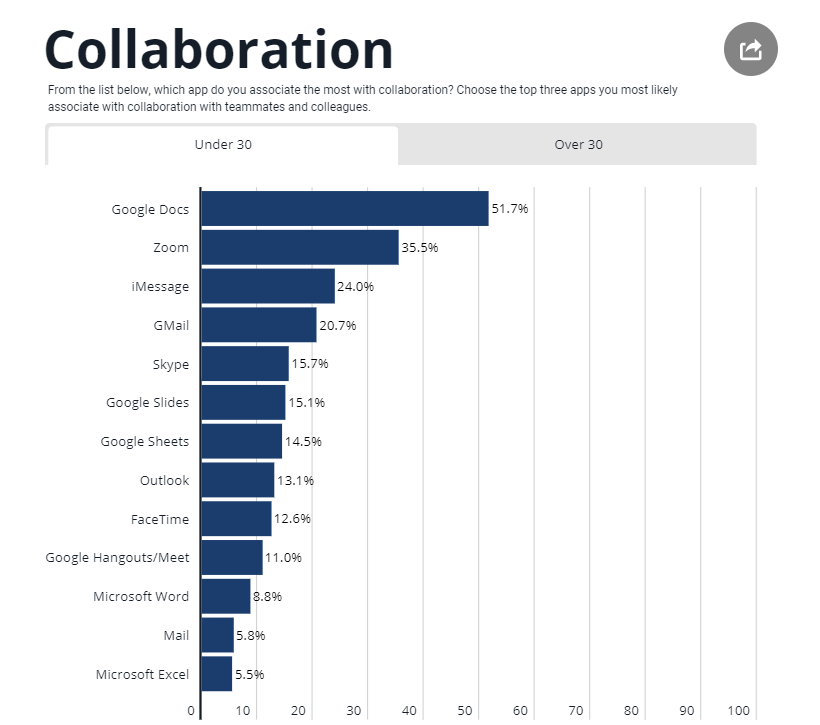
The article cites a study that describes the many collaboration tools employees use every day—tools from different companies that aren’t necessarily sanctioned by their organization. An employee might use Google Docs, Zoom, Apple iMessage, and Microsoft PPT or some other combination of products. This chart shows what tools people under 30 use more frequently.
One 24-year-old said she uses “literally anything but email” when given the choice. Email is viewed as a cause of stress, particularly having to check it often and because it often means task delegation: an email brings something that needs to get done. Because email takes time away from other tasks, employees also feel interrupted, and research tells us people need about a minute to get back on track.
A FastCompany writer hypothesizes that the younger generation might finally kill email, and iMessage, rather than Slack or Microsoft Teams, might be the bullet. I’m skeptical, but like these articles, I remain hopeful. Being older, I don’t have the emotional baggage of email because that’s how I grew up. But I understand the grace and simplicity of Apple tools and welcome them at work.

Blame the Intern
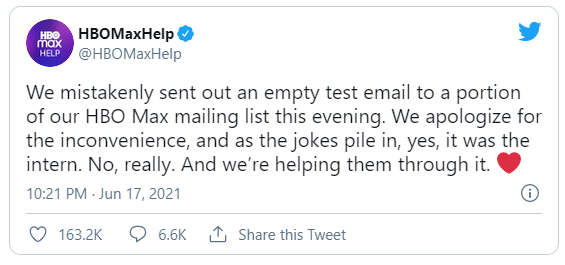
HBOMax customers received an email with the subject, "Integration Test Email #1,” that obviously wasn’t intended for them. In a follow-up email, the company blamed an intern for the mistake.
Twitter responses poured it to support and empathize with the intern. Embarrassing stories ranged from sending emails to big groups to typos. As an intern, someone replaced all “parties” to “panties” in a 50-page legal document (dare I say “brief”?).
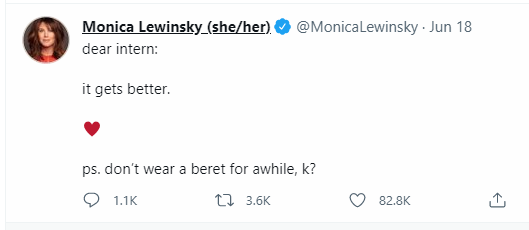
The best was when Monica Lewinsky weighed in.
Interns make mistakes; we all do. Facing the situation with humility—the ability to learn—is the best approach. The HBOMax situation could have been a lot worse, and fortunately, the public turned it around to focus on the shared experience we have all had.
Supreme Court Decision Rests on "a"

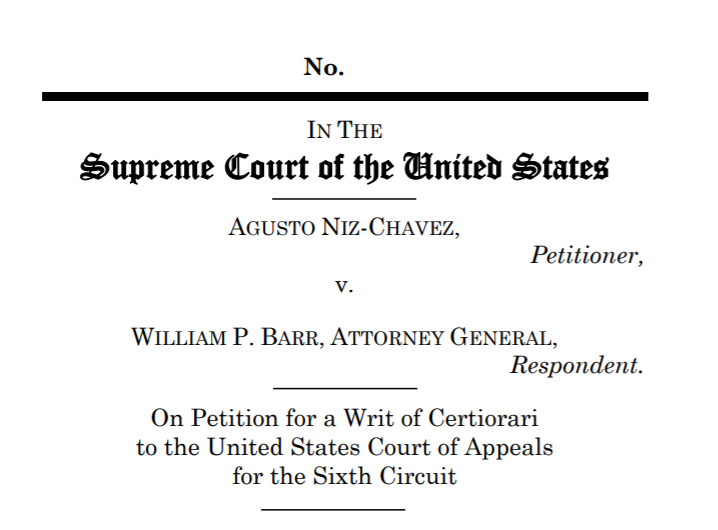
An extraordinary Supreme Court ruling was based on one of the smallest words in the English language: a. An immigration law requires that people who might be deported receive “a notice to appear.” Does that mean only one, or could the notice be divided into two?
Justices ruled that the law requires one and only one. The ruling is significant because Agusto Niz-Chavez, an immigrant from Guatamala who has been in the United States since 2005, received two notices, each requiring different documents.
Immigrants who have 10 consecutive years in the United States have an easier time staying. But a deportation document means that the clock stops. In Niz-Chavez’s case, because he received multiple notices, his attorney claimed that his clock didn’t stop—and most justices agreed.
This case is significant also because three conservative justices ruled with the liberal justices, who formed the majority.
Other legal cases have hinged on punctuation marks, but this is the first I remember that rested on such a small article of speech. Legal writers will heed the warning to craft regulations more carefully in the future.
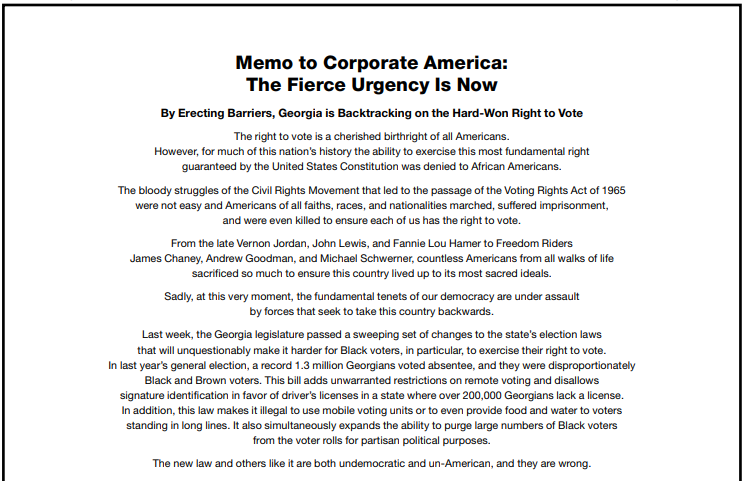
CEOs Speak Out
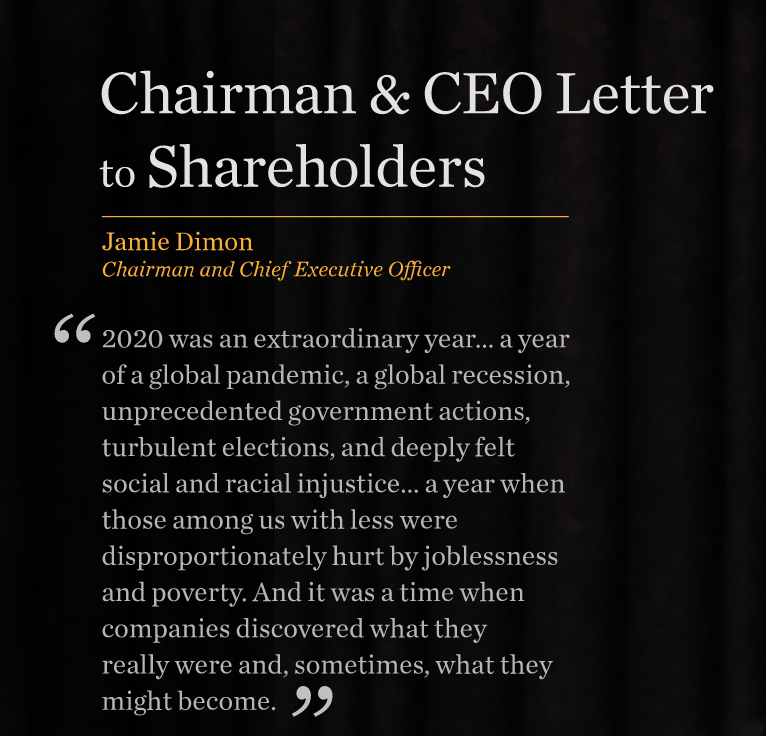
JPMorgan Chase published its Annual Report, leading with a letter from CEO Jamie Dimon. The introductory paragraph and corresponding callout quote reflect a leader’s and a company’s grappling with an extraordinary year.
Like many company leaders today, Dimon addresses societal issues directly. We’re seeing increasing employee and CEO activism, and this letter is a good example.
A Wall Street Journal opinion piece questions when leaders are even more direct about political events, such as Black leaders in Georgia speaking out against the election law decision. The law restricts voting rights, which doesn’t affect the companies directly. The WSJ editorial board writes, “To wit, they are pitting themselves against the interests of their own shareholders.”
The open letter appeared as a full-page ad in The New York Times, signed by Black CEOs, former CEOs, and others of major U.S. companies.
In my view, the CEOs demonstrate leadership character, particularly authenticity, courage, and integrity. By definition, demonstrating character carries some personal risk.
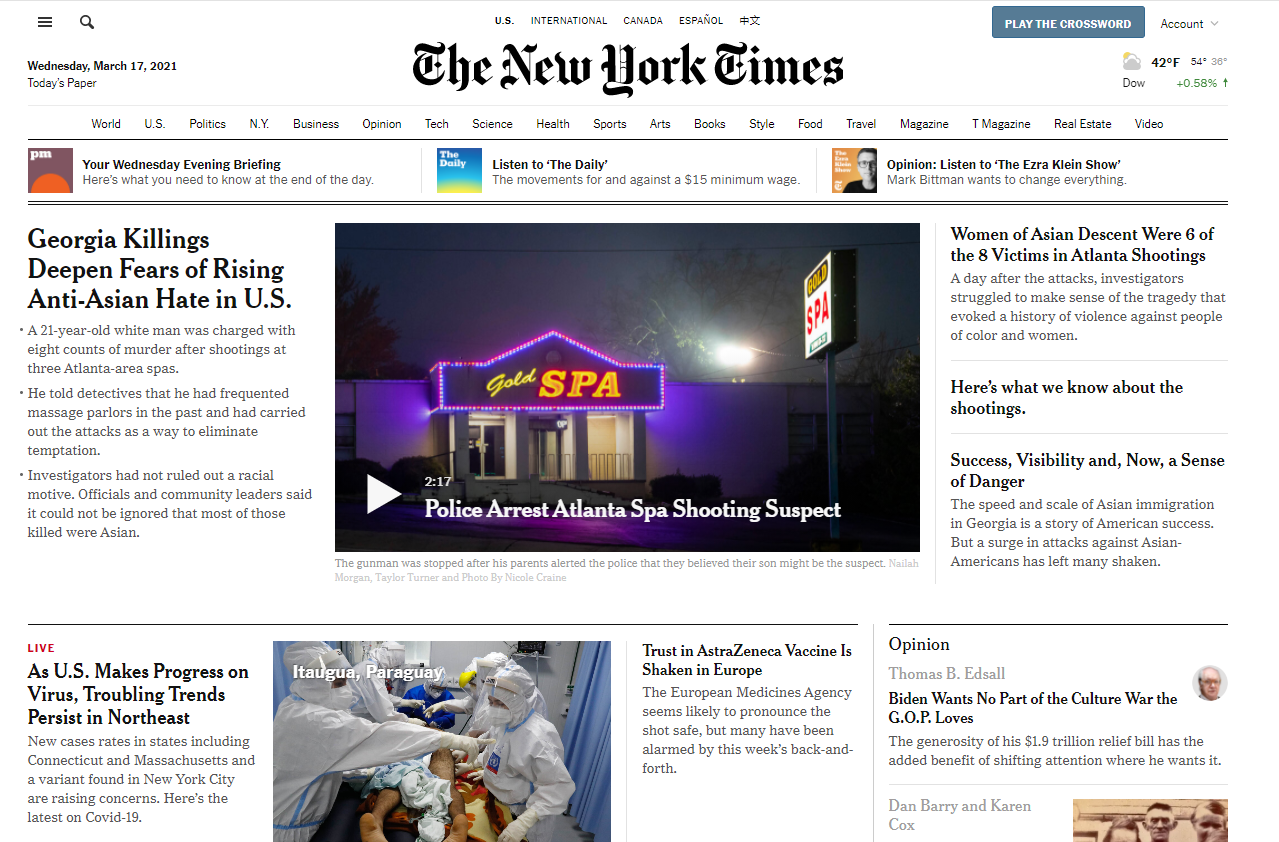
Comparing News Reporting About Shooting
How the media reports news reveals their political leanings and inherent biases. Compare the home pages of the New York Times and the Wall Street Journal from screenshots taken the evening of March 17, 2021.

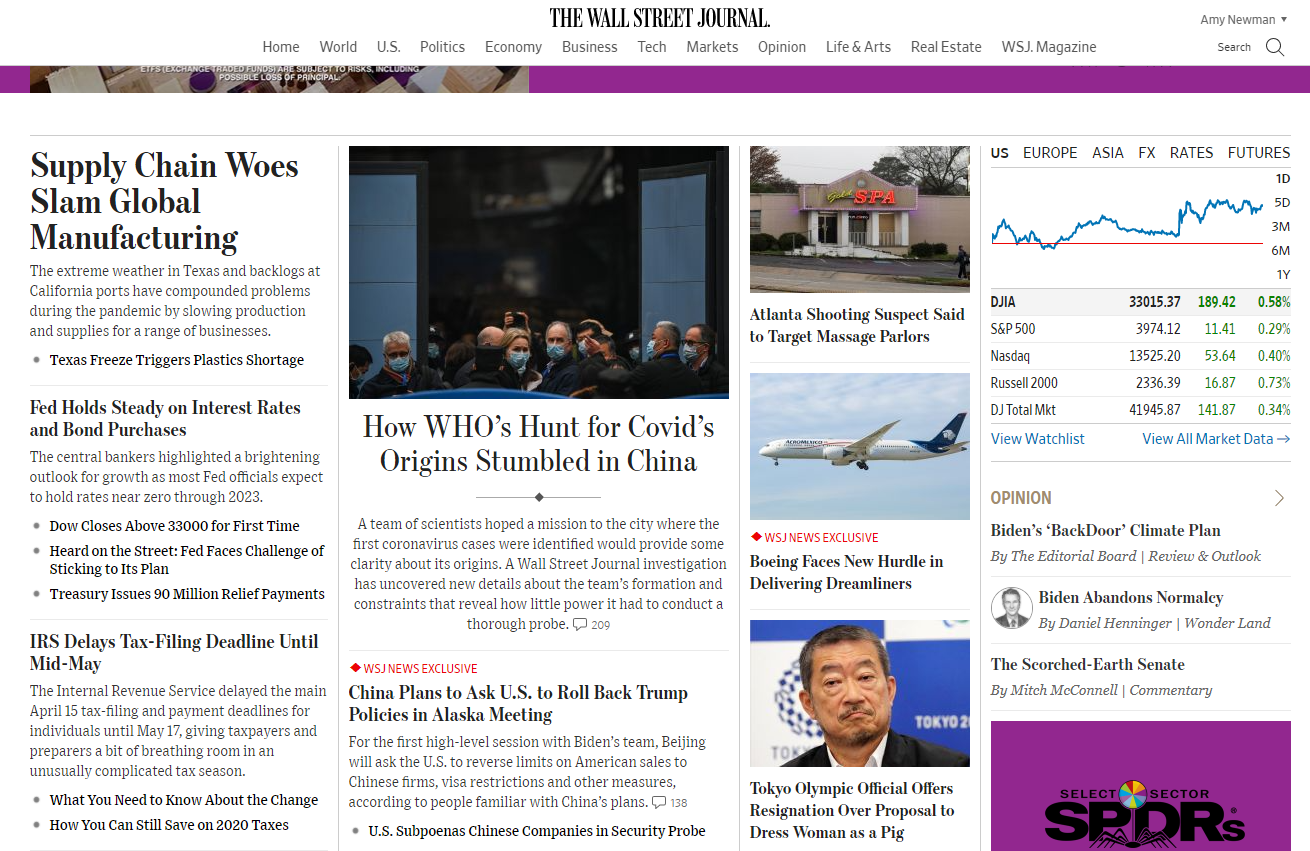
The New York Times led with the news and posted five stories at the top of the page. Stories focus on “Anti-Asian Hate in the U.S.” The Wall Street Journal posted one small article, and the headline makes no reference to the victims—six of the eight were Asian women.
I’m struck by the surrounding articles on the WSJ home page. The business and economy focus makes sense for the paper’s mission, but several other articles imply negative messages about Asians or Asian countries.
The headline about the Tokyo Olympics official, particularly, is quite inflammatory (or as a student in class said, “clickbait”). Although the news is notable given that this is the second official to resign for negative comments about women, the photo and headline, below news of the shooting is, as my partner said, “insensitive.” Do we need the actual negative statement?
Also in fairness to the WSJ, the shooter had not (and as of this writing, has still not) been charged with a hate crime, and he denies the association of bias. Perhaps the NYT is fueling the flames of xenophobia?
And yet, discrimination, bias, and violence against Asians and Asian Americans has been increasing in the U.S. Shouldn’t that be a significant part of any reporting about this terrible shooting?