

Backlash After President Trump Fundraiser

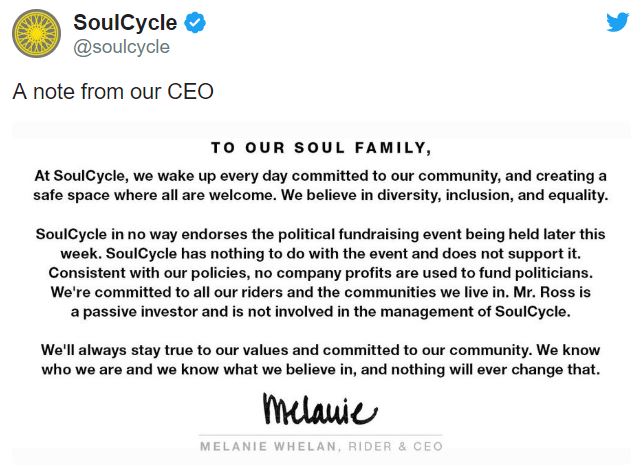
Equinox and SoulCycle customers are not happy about a fundraiser for President Trump sponsored by the companies’ owner, the chairman of a real estate firm. Threats of boycotts and cancelled memberships provoked quick responses from both companies.
SoulCycle CEO Melanie Whelan also said, “SoulCycle has nothing to do with the event and does not support it. … We know who we are and we know what we believe in, and nothing will ever change that.”
Capitalizing on the brands’ distress, other fitness companies are offering discounts and free trials to try to win business.
Discussion:
More company executives feel inspired towards political activism. What are the advantages and risks?
Did the real estate company owner, Stephen Ross, act inappropriately by hosting a fundraiser? Why or why not?
Analyze the companies’ statements. What persuasion strategies do they use to rebuild each brand?
Compare the statements. Does one work better than the other? What criteria do you use to compare them?

Another Blackface Disaster

Belgium’s Africa museum hosted an event for which people arrived in pith helmets, blackface, and other offensive and stereotypical clothing. Understandably, the Congolese community is upset. As one representative said, "Ethnic, exotic or African is not a costume that you can put on and take off.” You can read about Belgium’s occupation of the Congo to understand the history.
The party was organized by a separate company, Thé Dansant, and one organizer defended the party: “Even if one person painted his face black, it was not meant to be offensive. Many people of African origin were enthusiastic about the concept and were present.”
So far, the Royal Museum of Africa is trying to distance itself from the event and hasn’t issued a statement or apology.
Museum image source.
Party image source.
Discussion:
What’s your view of Thé Dansant’s response?
What is the museum’s accountability? What should the leaders do or say?

Employees Pressure Walmart to Consider Role in Gun Violence

Walmart is in a tough spot after recent shootings. Some employees are pressing the company to do more to fight gun violence, but no policy changes are planned. After previous attacks, Walmart stopped selling assault-style weapons and raised the minimum age to purchase guns and ammunition, but it’s unclear whether the leaders will do more. Employees are asking Walmart to stop selling firearms and to disallow customers from carrying guns into the stores.
The company seems divided about employees’ activism. Chief Executive Doug McMillon wrote, ”We are proud to be woven into the American fabric as a place for all people. We are more resolved than ever to foster an inclusive environment where all people are valued and welcomed.” At the same time, the company blocked two employees’ access to Slack, encouraging employees to use “more constructive ways for associates to offer feedback such as emails or conversations with leaders.”
A study recently published in the International Journal of Business Communication found that employees are more likely to “express dissent to managers and coworkers” when they are more socialized in the company and when they believe their company is “more ethical and reputable.”
A Wall Street Journal article explains the risk for Walmart to take more action against gun sales:
“[A]ny change to its gun policies risks alienating Walmart’s core customers, who often live in more conservative-leaning rural and suburban communities. The company faced some consumer backlash after raising the minimum age to purchase guns to 21.”
Discussion:
How can the company balance employees’ and customers’ perspectives? What else, if anything, should company leaders say and do?
Did the company do the right thing by blocking Slack access? In what ways are email and conversations more or less “constructive”?
What leadership character dimensions are illustrated by this situation?

Capital One's Response to the Breach

A hacker got access to 140,000 Capital One customers’ credit information and social security information, and about 106 million people were affected by other leaked information. Officials arrested Paige A. Thompson, who goes by “erratic” and was a former Seattle technology company software engineer.
In a bar chart, a BBC article puts this breach in context of others. Capital One’s press release describes the company’s quick response:
“Capital One immediately fixed the configuration vulnerability that this individual exploited and promptly began working with federal law enforcement.”
The release also includes a statement from Chairman and CEO Richard Fairbank:
"While I am grateful that the perpetrator has been caught, I am deeply sorry for what has happened. I sincerely apologize for the understandable worry this incident must be causing those affected and I am committed to making it right."
In addition, as expected, the release includes information for customers, offers free credit monitoring, and provides an FAQ.
Discussion:
Analyze the press release. Consider the audiences, objectives, organization, tone, and so on.
How well does Fairbanks demonstrate humility in the press release? What other leadership character dimensions are illustrated? How well does he inspire confidence in Capital One?
Analyze the BBC chart shown here. What works well about the chart, and what else would be helpful to understand these breaches in context?

How to Deal with Being "Ghosted"
Too often, employers stop responding to candidates. Even after an in-person interview, candidates never hear back. The CEO of a job search platform advises people to follow up in a few ways:

Send one email a week. Be thoughtful about your messages to express interest; maybe share new research about the company .
Try different channels. For example, send a LinkedIn message instead of email, but only once.
Reach out to others. Contact another recruiter or the hiring manager directly.
All of these actions come with risk, but the writer argues, and I agree, that the risk is worth it. None of these follow-ups are too annoying, and you may turn the tide in your favor.
Discussion:
Why do you think employers ghost applicants? Consider what incentive they have to follow up.
What’s your view of these follow-up approaches? Which are you more or less comfortable doing?

Suicide Among France Télécom Employees

Management couldn’t fire employees at France Télécom, so, according to critics, they harassed them hoping they would quit. But at least 35 committed suicide under the pressure, and some reports claim the number is closer to 60.
France Télécom was privatized and rebranded as Orange in July 2013. The company wasn’t keeping up with technological changes and, according to executives, were saddled with state employees, who are protected from termination. In 2007, Didier Lombard, the former chief executive of France Télécom, said they would get to their ideal number of layoffs “one way or another, by the window or by the door.”
A New York Times article describes the environment: “A grim universe of underemployment, marginalization, miscasting and systematic harassment was established at the huge company, according to testimony at the trial.” Managers tried changing job responsibilities for some workers, but employees were left without tasks or with tasks they couldn’t do.
With France’s high unemployment rate, employees felt they had few options. Union members, shown here, express their support during the trial in Paris. We’ll see whether the judges find company executives guilty.
Discussion:
How did management justify its practices? On the other hand, how could they have acted differently?
What experience do you have with international labor laws? Describe differences and how they might affect business decisions.
Should France reconsider its lifetime employment protections?
What leadership character dimensions are illustrated by this situation?

Noncompete Agreements for Interns

A Wall Street Journal article reports that college interns are increasingly asked to sign agreements that restrict their job choices in the future. “Noncompete, nondisclosure and forced arbitration agreements,” which have been common for senior-level employees, have made their way down the ranks.
Now, interns are asked to sign agreements on their first day with a company, and they don’t always understand what they’re signing. An agreement can prevent a new grad from, for example, accepting an offer with a competitor within a geographic region.
Some agreements are important for companies to protect their intellectual property and preserve confidentiality, but critics say they go overboard. Also, such agreements may not hold up in court, particularly when they affect low-skilled workers.
Bottom line: interns should be careful about what they sign. An agreement may be more of a deterrent and might not inspire legal action, but students shouldn’t have to feel as though their choices are limited right after graduation.
Signing image source.
Noncompete image source.
Discussion:
What’s your experience with these employment agreements?
What would you do if asked to sign one?
What should companies do differently to protect themselves?

How to Navigate Multiple Offers
It’s one of those “good problems”: getting more than one job offer. But navigating the relationships and making a decision can be tough.
A Wall Street Journal article tells the story of a man faking his own death to avoid telling a company that he didn’t want to take the job after accepting an offer. According to an executive at the staffing company Robert Half, “ghosting” a prospective employer is most common among people out of school between two and six years. More and more, employers receive last-minute text messages or no-shows on the first day of work.
A management consultant believes the trouble is that college students lack the communication skills to handle these situations more professionally: “This is the generation that breaks up by text message, so in a professional context, to have to let someone down or give bad news was terrifying.”
Twice this past semester, students asked me for advice in reneging offers. Overall, I’m not a fan of the tactic. To me, it’s an issue of integrity: when students make a commitment to one employer, they shouldn’t change their minds when a better offer comes along. I also worry about their reputation in the industry—and whether their expectations will be too high for the new job, and they’ll end up disappointed. At Cornell, students also give up their access to career services in the future when this happens.
But students do what is best for them. What matters after the decision is how it’s communicated. I always suggest a phone call rather than an email, which takes courage. A direct, honest approach is best, with an apology and some understanding of how the decision affects the employer, who’s left with an unfilled position and additional recruiting time.
Ideally, students get offers at the same time with the same decision deadlines, but of course, that’s not always the case, and comparing offers becomes challenging. The WSJ article recommends these practices for evaluating and accepting job offers:
DO
* Make clear early what you’re looking for in a new job.
* Ask employers their timeline for making a decision.
* Express appreciation and enthusiasm when receiving an offer.
* Take time to assess each offer carefully, weighing both financial and quality-of-life factors.
DON’T
* Communicate important decisions by text or email.
* Try to pit one employer against another in a bidding war.
* Respond to a job offer by announcing that you already have a competing one.
* Base your decision solely on pay.
Discussion:
Have you been in a situation of having multiple offers? How did you handle it?
Have you reneged on an offer? How did you communicate the decision, and how did the employer react?
What other advice would you give students who have multiple offers?

Boeing at the Paris Air Show
After two fatal plane crashes involving its 737 Max jet, Boeing is trying rebuild its image, and the company made some headway at the Paris Air Show, an international aircraft sales event.
Company leaders are coming closer to admitting mistakes more directly. CEO Dennis Muilenburg said, “We clearly had a mistake in the implementation of the alert.” Muilenburg also admitted that company communications were “inconsistent” and “unacceptable.” Kevin McAllister, the company’s head of commercial aircraft, said, “We are very sorry for the loss of lives as a result of the tragic accidents...our thoughts and our prayers are with their families," and "Our priority is doing everything to get this plane safely returned to service. It is a pivotal moment for all of us.”
At right is a video of McAllister discussing future plans.
Illustrating confidence in the plane, IAG, which owns British Airway, ordered 200 new 737 Max jets, worth about $24 billion at list price. Airbus wants a chance to bid, and we’ll see whether the request is granted.
Discussion:
Based on this and other news reports, how well is Boeing recovering from its crisis? Read more about reactions to the IAG order to help inform your conclusion.
Analyze Kevin McAllister’s communication in the video. Compare his style and approach to Dennis Muilenburg’s. What similarities and differences do you observe?

VW's New Ad
Volkswagen is still trying to rebuild its image after the emissions scandal in 2015. A new advertising campaign tackles the issue directly, beginning with audio news reports from that time. But the focus, described on YouTube, is on the future: “Every negative has a positive. Learn more about our all-electric vehicles and our plans to help make a better tomorrow at vw.com #drivefortomorrow #vw.”
With an emphasis on innovation, the ad is set to Simon and Garfunkel’s classic song, “The Sound of Silence.” Viewers can imagine company engineers during the past few years creating a new line of electric cars— while VW executives said little about the controversy.
The senior VP of marketing for VW of America acknowledged that the ad is risky but explains the rationale:
“[w]ithout mentioning the past...we would never have the credibility or authenticity to move forward with the brand. Through the last three-and-a-half years or so we kind of operated as usual in the consumers [sic] eye. We kept a very consistent message in the marketplace but didn’t really have a powerful point-of-view as a brand.”
Discussion:
What’s your view of VW’s new ad campaign? Did the company make the right decision by invoking the scandal?
Other companies facing scandals, such as Uber and Wells Fargo, placed large apology ads, but VW didn’t take this approach. Why do you think that may be the case? Compare VW’s strategy to other recent recovery campaigns.

Restaurant Owner Forgives Manager for $4,710 Mistake

The manager of Hawksmoor Manchester steakhouse accidentally served a $5,000 bottle of wine when the guests ordered one priced at $290. The owner forgave her publicly, on Twitter.
Naturally, the conversation doesn’t end there. Jokes abound, one announcing that the manager has since been placed in an “on-site incinerator.”
Others pounced on the expensive wine and criticized the restaurant, to which the owner responded in a tweet:
I’m sure you’re all getting tired of this now, so one last thing, to the people who put homelessness in Manchester next to ‘£4500 wine?!’ and suggesting we have no values: we’ve raised well over £1m for @ACF_UK, work with @WoodSt_Mission and @notjustsoupMCR. We have values.
Discussion:
What leadership character dimensions are demonstrated by this story?
How well did the owner respond to criticism?

Leadership Challenge at Uber
A New York Times article describes discomfort among Uber’s leadership as the company plans to go public. Founder and former CEO Travis Kalanick wanted to join the company to ring the opening bell at the New York Stock Exchange, a tradition for IPOs. Kalanick still holds a seat on the board and, as founder, he wanted to participate in the company’s joyous moment—and to bring his father.

Current CEO Dara Khosrowshahi denied the request. For two years, Khosrowshahi has been trying to shed negative public perceptions of Uber, partly attributed to Kalanick’s leadership style and the company’s “bro-culture.”
The article describes a fractured board that didn’t fully support Khosrowshahi and a company that has yet to turn a profit, losing revenue on almost every car ride. Uber follows Lyft’s recent IPO, which has lost about $26 per share since its IPO in March.
Discussion:
Did Khosrowshahi make the right decision? Why or why not?
Consider Kalanick’s perspective. What’s his point of view? Should he have asked at all?
What leadership character dimensions are illustrated by this situation?

Whistleblowers at Boeing
On The Daily podcast, a former quality manager at Boeing describes safety concerns and efforts to report them. He is one of more than 12 employees the New York Times reporter interviewed who had raised issues internally and with the Federal Aviation Administration (FAA) before the 737 MAX crashes—and dating back to the 787 Dreamliner, which was introduced in 2007.
Employees complained about debris left inside aircrafts, even as planes were going on test flights and getting ready for delivery, and about missing and doctored defective parts. The reporter describes a company under pressure taking serious safety shortcuts.
According to U.S. Department of Labor data, whistleblowers have little success. This chart shows a very small percentage of government-reported cases considered of “merit,” although in the table below the chart, the author tells us that cases that are “settled” or “settled other” (a nonstandard procedure) should also be considered winners. Still, it’s a small percentage in light of what it takes to come forward to file a complaint.

Discussion:
What’s your view of Boeing? Some employees say they felt proud when they first worked at the company, and now they are embarrassed. How, if at all, does this news change your perception of the company?
What does it take to be a whistleblower? What is at stake, and what are the potential rewards?
Assess the chart. Who is the audience, and what are the communication objectives? How could you change the chart to improve readability? For example, consider how the 3D effect might change how we interpret the data.

Boeing's Crisis Response
At a shareholder’s meeting, Boeing CEO Dennis Muilenburg addressed 737 Max safety concerns following two fatal crashes. He started, as predicted, with an apology and sympathy for the “loss of life,” acknowledging the “devastation.” He contrasted these losses with the many Boeing flights that run safely—”roughly every 1.5 seconds.”
Muilenburg didn’t explicitly address issues raised in the past couple of days, particularly a Wall Street Journal article the previous day accusing Boeing of failing to report the safety feature shut-off to airlines (including pilots) and the FAA.
When asked during the Q&A about accountability, Muilenburg spoke mostly about plans going forward. When asked whether he would resign, he talked about his and his employees’ commitment to safety.
At about 9:00 on the video, a reporter asks about whistle-blowers at Boeing, referring to recent reports that employees tried to alert senior management and the Federal Aviation Administration (FAA). Muilenburg says the question is “fair” but doesn’t quite respond to the accountability issue. At about 14:15, a reporter asks, “Can you admit that the design was flawed?” This is after Muilenburg skirts the previous question, blaming a “chain of events.” Still, he would not admit to a design flaw.
And then he ends the news conference, as a reporter shouts, “Sir, 346 died. Can you answer a few questions here about that?” Earlier, another reporter noted that this was the first time they had a chance to meet with him to ask questions.
Discussion:
Assess Muilenburg’s delivery skills. What does he do well, and what suggestions would you have for his future news conferences?
How well did Muilenburg address reporters’ questions? What, if anything, could he have said differently?
What leadership character dimensions are illustrated by this story? How well did Muilenburg demonstrate them?

Carlos Ghosn Responds to Charges
The former CEO of Nissan, Carlos Ghosn, who has been arrested four times on charges related to financial misconduct, responded in a video message. The key point: “I’m innocent of all the charges.” Ghosn also claims that accusations are “all biased, taken out of context, twisted.”
Ghosn was a celebrated business executive in Japan. His success in growing Nissan is “incontrovertible,” according to a New York Times podcast. He gained a reputation as a serious cost-cutter ("Le Cost Killer"), a strategy that was questioned at the time but brought about great profits for the company, placing it second in the list of Japanese automakers behind Toyota and ahead of Honda. Ghosn was CEO from 2001 - 2017, when he became chairman. He was then removed from the board in 2018, after his first arrest.
Charges against Ghosn include using company funds for multiple personal residences, hiding about half of his compensation, shifting $16.6 million in person losses to the company, and other accounting issues.
Nissan management responded to Ghosn’s video message:
“The sole cause of this chain of events is the misconduct led by Ghosn and Kelly. Aside from any criminal matters, Nissan's internal investigation has uncovered substantial evidence of blatantly unethical conduct. This resulted in a unanimous board vote to discharge Ghosn and Kelly as chairman and representative director, followed by a shareholder vote to discharge them from the board. Further discoveries related to Ghosn’s misconduct continue to emerge. The company's focus remains on addressing weaknesses in governance that failed to prevent this misconduct.”
Discussion:
What persuasive communication strategies does Ghosn demonstrate in his video message?
What are the most and least convincing statements?
Assess his Ghosn’s delivery skills.
Which leadership character dimensions are illustrated by this situation?

Boeing's Apology Dilemma

A Yahoo Finance article describes Boeing CEO Dennis Muilenburg’s decision to apologize for the 737 MAX tragedies and speculates that he may open the company up to lawsuits. However, for crisis communication, his apology is the right decision.
After a report found the planes to blame, Muilenburg admitted, “but with the release of the preliminary report of the Ethiopian Flight 302 accident investigation, it is apparent that in both flights, the Maneuvering Characteristics Augmentation System, known as MCAS, activated in response to erroneous angle of attack information." He’s not telling us anything we don’t already know, and Boeing will likely get sued anyway.
He also apologized: “We at Boeing are sorry for the lives lost in the recent 737 accidents and are relentlessly focused on safety to ensure tragedies like this never happen again.” The apology is critical—and too late in my opinion. Research on apologies indicate that they often reduce lawsuits, time to agree on settlements, and settlement pay.
Discussion:
Do you agree with the assessment that the CEO did the right thing by apologizing?
How does this situation illustrate vulnerability as a positive leadership character dimension?
What other character dimensions are illustrated by this situation?

Boeing System at Fault
According to investigators, the flight-control system caused trouble before the Boeing 737 MAX crash in Ethiopia. The report also concluded that pilots followed procedures and did nothing wrong.
On its website, Boeing posted a video and statement of CEO Dennis Muilenburg’s apology.
April, 4, 2019
We at Boeing are sorry for the lives lost in the recent 737 MAX accidents. These tragedies continue to weigh heavily on our hearts and minds, and we extend our sympathies to the loved ones of the passengers and crew on board Lion Air Flight 610 and Ethiopian Airlines Flight 302. All of us feel the immense gravity of these events across our company and recognize the devastation of the families and friends of the loved ones who perished.
The full details of what happened in the two accidents will be issued by the government authorities in the final reports, but, with the release of the preliminary report of the Ethiopian Airlines Flight 302 accident investigation, it’s apparent that in both flights the Maneuvering Characteristics Augmentation System, known as MCAS, activated in response to erroneous angle of attack information.
The history of our industry shows most accidents are caused by a chain of events. This again is the case here, and we know we can break one of those chain links in these two accidents. As pilots have told us, erroneous activation of the MCAS function can add to what is already a high workload environment. It’s our responsibility to eliminate this risk. We own it and we know how to do it.
From the days immediately following the Lion Air accident, we’ve had teams of our top engineers and technical experts working tirelessly in collaboration with the Federal Aviation Administration and our customers to finalize and implement a software update that will ensure accidents like that of Lion Air Flight 610 and Ethiopian Airlines Flight 302 never happen again.
We’re taking a comprehensive, disciplined approach, and taking the time, to get the software update right. We’re nearing completion and anticipate its certification and implementation on the 737 MAX fleet worldwide in the weeks ahead. We regret the impact the grounding has had on our airline customers and their passengers.
This update, along with the associated training and additional educational materials that pilots want in the wake of these accidents, will eliminate the possibility of unintended MCAS activation and prevent an MCAS-related accident from ever happening again.
We at Boeing take the responsibility to build and deliver airplanes to our airline customers and to the flying public that are safe to fly, and can be safely flown by every single one of the professional and dedicated pilots all around the world. This is what we do at Boeing.
We remain confident in the fundamental safety of the 737 MAX. All who fly on it—the passengers, flight attendants and pilots, including our own families and friends—deserve our best. When the MAX returns to the skies with the software changes to the MCAS function, it will be among the safest airplanes ever to fly.
We’ve always been relentlessly focused on safety and always will be. It’s at the very core of who we are at Boeing. And we know we can always be better. Our team is determined to keep improving on safety in partnership with the global aerospace industry and broader community. It’s this shared sense of responsibility for the safety of flight that spans and binds us all together.
I cannot remember a more heart-wrenching time in my career with this great company. When I started at Boeing more than three decades ago, our amazing people inspired me. I see how they dedicate their lives and extraordinary talents to connect, protect, explore and inspire the world — safely. And that purpose and mission has only grown stronger over the years.
We know lives depend on the work we do and that demands the utmost integrity and excellence in how we do it. With a deep sense of duty, we embrace the responsibility of designing, building and supporting the safest airplanes in the skies. We know every person who steps aboard one of our airplanes places their trust in us.
Together, we’ll do everything possible to earn and re-earn that trust and confidence from our customers and the flying public in the weeks and months ahead.
Again, we’re deeply saddened by and are sorry for the pain these accidents have caused worldwide. Everyone affected has our deepest sympathies.
Dennis Muilenburg
Chairman, President & CEO
The Boeing Company
Discussion:
Analyze Boeing’s communications so far. After the report was published, who were the primary and secondary audiences for these messages? What are the company’s communication objectives, and to what extent were they achieved?
What’s your view of the timing? Should the CEO have communicated via video and statement earlier or wait, as he did, for the investigation report results to be published?
What leadership character dimensions are demonstrated by this situation?

Updates on the Virginia Govenor

Whether Virginia Governor Ralph Northam resigns just got more complicated. If Northam steps down because of racist photos in his yearbook, the lieutenant governor would replace him. But Justin Fairfax faces his own challenges: a woman accused him of sexual assault.
Fairfax denies the claims and refers to the incident at the 2004 Democratic National Convention in Boston as consensual sex. To complicate matters further, Fairfax has accused Northam’s supporters of a “smear” campaign:
“Does anybody think it’s any coincidence that on the eve of potentially my being elevated that that’s when this uncorroborated smear comes out?”
Fairfax also questioned whether Mayor Levar Stoney of Richmond may have been involved in the accusation to which Stoney responded, “The insinuation is 100 percent not true, and frankly it’s offensive.”
For its part, Eastern Virginia Medical School is investigating how the racist photos got into the 1984 yearbook.
Discussion:
What’s your view of Fairfax’s response?
Should a 2004 sexual assault charge prevent Fairfax from replacing Northam?
Should the replacement issue drive whether Northam resigns?
What is the medical school’s responsibility in this situation?

Emails to International Duke Students Sparks Controversy

Faculty at Duke University Medical Center have been criticized for asking international students to speak only English. The controversy started when an administrator of the biostatistics program sent an email after hearing complaints from faculty members that Chinese students were speaking “VERY LOUDLY” in their native language in “student lounge/study areas.” The faculty expressed concern that students “were not taking the opportunity to improve their English and were being so impolite.”
Also in the email, the administrator said that faculty asked for students’ names so that they might deny them job and project opportunities.
Students took offense and started a petition. In response, the administrator of the program stepped down from her position, and the university posted a letter to students in the program.
Discussion:
What’s your view of international students speaking in their native language at an American University?
Was the administrator out of line? Why or why not?
How do you assess the university’s response to the controversy?
What leadership character dimensions are at play?

Law Firm Faces Backlash About Diversity

When a law firm announced its 2019 partners, they didn’t expect such a strong reaction. A photo shows the 12 members of the new group—all white and only one woman. Paul Weiss is an elite firm in midtown Manhattan and claims that this year is unusual.
The firm has since removed the photo from LinkedIn, where it drew attention. About 170 lawyers across the country wrote an open letter to express their wishes for a more diverse legal community.
Paul Weiss leaders took quick action to address the controversy and held a town hall meeting for employees. Firm leaders also say this group is unusually not diverse. In fact, the firm was recognized by a Microsoft initiative that offers bonuses to diverse law firms. In addition, 23% of the firm’s partners are women compared to about 18% of other law firms’ top leaders. The firm’s website boasts additional awards for diversity, including being ranked #16 in The American Lawyer’s 2018 Diversity Scorecard.
An email to Paul Weiss employees shows the words “diversity” and “associate professional satisfaction” in quotes, and a writer for the website Above the Law warns,
“…maybe there’s still some work to be done in mastering how to talk about these subjects. In general, don’t put anything in quotation marks that you wouldn’t be willing to sarcastically put air quotes around in conversation. That’s my advice.”
Discussion:
What’s your view of the photo and the reaction: should the firm have avoided the composite, did people overreact, or something else?
How do you assess the firm’s response? What else, if anything, should the firm leaders do to improve its image?
What persuasive strategies do the attorneys use in their open letter? Which are most and least effective for the situation?