
Zillow's Letter to Shareholders

Zillow ended its failed iBuying business, but is recovering well, as the latest letter to shareholders explains. A foray into the home-flipping business didn’t pan out for the company, resulting in losses and layoffs.
The company’s letter demonstrates accountability, humility, and vulnerability, yet express optimism, as the CEO and CFO write in the closing:
“We want to acknowledge the past few months have been challenging for us all — Zillow leadership, employees, and investors — but innovation is a bumpy road. Big swings are core to Zillow, and they are what make our company so unique. We are excited about the opportunity in front of us. Thank you for joining us on this journey.”
In addition to describing plans, the leaders want readers to take away that performance was “better than expected.” “Better” is used 13 times in the 20-page letter. The approach seemed to work. As a CNBC article summarizes, “Zillow soars on upbeat outlook and faster-than-expected selloff of homes in portfolio.” However, for perspective, the article reports that the stock increased 20% after the letter was published, yet “the stock has lost three-quarters of its value since reaching a record almost a year ago.” Zillow’s leaders have more work to do.
Announcements About Leader Departures
Company announcements about leader departures typically follow a standard format, but content and medium choices communicate history and context. Two recent examples illustrate these types of messages:

Meta, Facebook’s parent, announced that Peter Thiel, a long-time investor, will step down from the board. The company chose a press release for the news, also posted on the Meta website. As expected, the press release includes positive quotes from CEO Mark Zuckerberg and from Thiel. What’s not said is found in a Wall Street Journal article: Thiel is a supporter of former President Trump and two Senate candidates who have spread false claims about election fraud. Thiel has also resisted changes to Facebook to quell misinformation on the platform.
Peloton announced that John Foley, the company founder, will step down. Like Meta, the company chose a press release and posted it on the Peloton website. Although the statement names Foley as executive chair and includes a quote from him, we don’t see the typical complimentary quote about his leadership. A New York Times article titled, “Peloton’s Future Is Uncertain After a Swift Fall from Pandemic Stardom,” cites several problems at the company: “The chief executive stepped down as a glut of unsold machines, negative TV portrayals, activist investors, and a recall plagued the fitness company.” A personal message, below, from Foley to Peloton customers explains more of his perspective.
These messages are a type of bad news—and they are examples of persuasive communication. Foley’s email tries to convince “members” that the company will continue to thrive and that Barry McCarthy, as the new CEO and president, is the answer. Foley uses logical arguments, such as the number of current users, and credibility, such as McCarthy’s past success, to persuade. He also uses emotional appeals, complimenting customers and their stories. He reassures customers by describing what won’t change—a persuasive strategy Adam Grant talks about in his book Think Again.
Whether Foley remains with the company—and what the future of the company holds—is questionable. In his email, he demonstrates some humility by introducing McCarthy but little accountability for what has happened to a company that was only recently a major success story.
Fellow Members,
There’s been quite a bit of news about Peloton in recent weeks, and through it all, you have stood with us. Thank you for all your support and encouragement! This year marks Peloton’s 10 year anniversary. My co-founders and I brought to life the concept of recreating the energy and benefits of a studio fitness class in the home to make getting healthy and staying healthy more achievable for more people. And together with you, we have built this incredible community from five people to 6.6 Million people, of all stages, ages, and backgrounds, leading healthier, happier lives. I remain inspired by you and your stories. Our north star has always been and will always be improving the lives of our Members. Your experience is what matters most and this is why we are making some changes to position Peloton for continued success the next 10 years and beyond.
Effective today, I will be moving into a new role as Executive Chair, and Barry McCarthy will be joining Peloton as CEO & President to lead the company. Barry is an incredible leader with a proven track record of working with founders to scale world-class businesses like Spotify and Netflix. In addition to the senior executive roles he has held at some of the world’s most successful media and entertainment brands, Barry has served as an advisor and board member at public and private technology companies. This appointment is the culmination of a months-long succession plan that I’ve been working on with our Board of Directors, and we are thrilled to have found in Barry the perfect leader for the next chapter of Peloton.
I care deeply about Peloton – our community, our team, and our ability to continue to motivate and inspire you through our world-class instructors and deep library of classes across fitness disciplines. And, because operating with a Members-first approach is one of our core values, I want to assure you that the changes that we’re making at the company across our operations will not impact our instructor roster, number of classes produced, or range of class modalities.
I still believe as strongly in this brand and in connected fitness as I did on Day One. But in order for us to continue to deliver the best possible member experience and lead us into the future, I need to hand the day-to-day reins of running the business to a seasoned and gifted executive who has helped transform and grow some of the world’s best streaming media companies – first in video, then in music, now in connected fitness.
I’m so excited to partner with Barry and for you to see what he brings to this brand and community. Please join me in welcoming him to the Peloton team. And I hope to see you on the leaderboard soon!
John Foley
Arguments in the Joe Rogan, Spotify Situation
A few musicians and podcast creators are leaving Spotify over controversy about “The Joe Rogan Experience,” a popular show that has included misinformation about COVID-19 vaccinations. Comparing messages from different points of view is an interesting look at persuasive arguments and raises issues of character. Here are a few to explore:

Spotify’s stance is explained in this statement and may be summarized as follows from the chief executive and co-founder: “I think the important part here is that we don’t change our policies based on one creator nor do we change it based on any media cycle, or calls from anyone else.” Spotify also created a COVID information hub.
Neil Young removed his music, which had hundreds of millions of views, and explained his rationale in a letter (since removed from his website): “I am doing this because Spotify is spreading fake information about vaccines—potentially causing death to those who believe the disinformation being spread by them.”
Crosby, Stills, and Nash followed suit and posted their reason on Twitter: “We support Neil and agree with him that there is dangerous disinformation being aired on Spotify’s Joe Rogan podcast. While we always value alternate points of view, knowingly spreading disinformation during this global pandemic has deadly consequences. Until real action is taken to show that a concern for humanity must be balanced with commerce, we don’t want our music—or the music we made together—to be on the same platform.”
Roxane Gay explained her decision to remove “The Roxane Gay Agenda” in a New York Times opinion letter. In closing, she wrote, “I am not trying to impede anyone’s freedom to speak. Joe Rogan and others like him can continue to proudly encourage misinformation and bigotry to vast audiences. They will be well rewarded for their efforts. The platforms sharing these rewards can continue to look the other way. But today at least, I won’t.”
Bréne Brown “paused” her two podcasts and wrote that she is waiting for more information: “I’ve enjoyed the creative collaboration with Spotify, and I appreciate how the leadership has shown up in our meetings over the past week. Now that Spotify has published its misinformation policy, and the policy itself appears to address the majority of my concerns, I’m in the process of learning how the policy will be applied. I’m hopeful that the podcasts will be back next week.” As you might expect, Brown demonstrates vulnerability, including negative, personal comments she has received about the issue.
Joe Rogan apologized in a 10-minute Instagram video, promising to “balance out viewpoints with other people’s perspectives.”
UPDATE: A video compilation of Rogan using a racial slur has emerged, and he apologized—again.

Apology for Meatloaf Recipe

The folks at Weber Grill didn’t realize that singer Meat Loaf died on the day they published a meatloaf recipe. Had the company used the rock star’s death as a way to promote its products, that would have been in poor taste, but the email with a BBQ recipe was an unfortunate coincidence.
After some predicable backlash, the company quickly apologized for the mistake. Fortunately, just as the initial email made the rounds, so did the company’s apology.
The apology is simple and works well. The company didn’t need to apologize for insensitivity because the mistake was unintentional. In these situations, customers typically are more forgiving, and in this case, demonstrating compassion and humility was enough.

Peloton CEO Addresses Difficult Times
Peloton was hot during the pandemic, barely keeping up with demand for bikes and treads. But sales have tumbled as consumers became more price sensitive and competition increased. The Sex in the City HBO reboot, And Just Like That, and Billions Season 6 episode didn’t help when they killed off lead characters during or after a vigorous workout on a Peloton bike. Company shares tumbled 76% in 2021.
CNBC reported that Peloton is pausing production, but Co-Founder and CEO John Foley denies the claim. In a statement (posted on the website as a “note” sent internally), Foley criticizes an internal leak and subsequent “speculative articles.” His tone is firm when he writes about legal action against the “leaker,” a warning to other employees. Trying to get ahead of more bad news, Foley admits that layoffs are possible, while complimenting the team. He chooses positive data to present: the number of users, workouts, and churn rate. He doesn’t include negative data about revenue or stock price.
The note is part defense and part cheerleader, as Foley props up employees—and the company—against a turbulent time in the company’s history. He demonstrates some integrity, humility, and vulnerability, but his leadership will continue to be taxed in the weeks ahead.
Foley’s full message follows (with the giant logo as it appears on the website):

We have always done our best to share news with you all first, before sharing with the public. This week, we’ve experienced leaks containing confidential information that have led to a flurry of speculative articles in the press. The information the media has obtained is incomplete, out of context, and not reflective of Peloton’s strategy. It has saddened me to know you read these things without the clarity and context that you deserve. Before I go on, I want all of you to know that we have identified a leaker, and we are moving forward with the appropriate legal action. But moving forward, I want to take a moment to talk about some of the changes with you directly.
As a public company that is in a pre-earnings “Quiet Period”, we are limited in what information we can share. However, we issued a pre-earnings press release earlier this evening about our preliminary Q2 results, in order to offer an initial and more accurate picture of our business performance.
As you have heard me and other leaders say over the past few months, we are continuing to invest in our growth, but we also need to review our cost structure to ensure we set ourselves up for continued success, while never losing sight of the important role we play in helping our 6.2+ million Members lead healthier, happier lives.
What this means for our team right now
In the past, we’ve said layoffs would be the absolute last lever we would ever hope to pull. However, we now need to evaluate our organization structure and size of our team, with the utmost care and compassion. And we are still in the process of considering all options as part of our efforts to make our business more flexible.
This team is made up of some of the smartest, most passionate, hard-working and KIND people I have ever met. You have each painted your masterpiece at Peloton in your own way, and your contributions matter. They always have, and they always will.
I am SO proud of everything we have accomplished together, and it pains me we are faced with these tough decisions. I know this is difficult, and I want to thank you for your patience as we work through these times together.
Rumors that we are halting all production of bikes and Treads are false
Notably, we’ve found ourselves in the middle of a once-in-a-hundred year event with the COVID-19 pandemic, and what we anticipated would happen over the course of three years happened in months during 2020, and into 2021.
We worked quickly and diligently to meet the demand head-on at a time when the world really needed us, in large part thanks to how hard you worked every day. We feel good about right-sizing our production, and, as we evolve to more seasonal demand curves, we are resetting our production levels for sustainable growth.
Connected Fitness is here to stay
This past quarter, our churn rate was 0.79%. This means that our Members are sticking with us, again thanks to your brilliance and continued innovation. Connected fitness provides the convenience people need to stay active and centered and will continue to be a key part of the future of fitness. In fact, just a few days ago, we recorded our highest ever number of daily workouts -- over 2.9M workouts.
I want to acknowledge that this does not answer all of the questions I am sure many of you have right now. But, I did want to share what we could at this time.
I know there is a lot of noise and anxiety in our environment right now, which is why I wanted to take this moment to provide some additional context for you all as we navigate the next few weeks together.
John

British PM Responds to Criticism
During the height of 2020 COVID-19 lockdowns in England, Prime Minister Boris Johnson hosted a party. An email (below) from his private secretary invited more than 100 staff members to "bring your own booze!" to the lawn party held at Johnson’s residence. Between 30 and 40 people gathered, despite restrictions until a week and a half later, when only six people were allowed to gather. This wasn’t the only party: another was held in December during lockdowns.
A video of the House of Commons shows political leaders criticizing Johnson; some are calling for his resignation. Johnson says he considered the party a work event. The culture of this setting is so different from U.S. government meetings, where it would be inappropriate to respond to speeches.
Here is Johnson’s response to the criticism. He uses several persuasive tactics: apologizing (with a British “s”), empathizing, and taking responsibility. He tries to demonstrate several character dimensions: compassion, humility, and accountability, particularly. We’ll see what happens next.
I want to apologise. I know that millions of people across this country have made extraordinary sacrifices over the last 18 months.
I know the anguish they have been through—unable to mourn their relatives, unable to live their lives as they want or to do the things they love.
I know the rage they feel with me and with the government I lead when they think in Downing Street itself the rules are not being properly followed by the people who make the rules.
And though I cannot anticipate the conclusions of the current inquiry, I have learned enough to know there were things we simply did not get right and I must take responsibility.
No 10 is a big department with a garden as an extension of the office which has been in constant use because of the role of fresh air in stopping the virus.
When I went into that garden just after six on 20 May 2020, to thank groups of staff before going back into my office 25 minutes later to continue working, I believed implicitly that this was a work event.
With hindsight I should have sent everyone back inside. I should have found some other way to thank them.
I should have recognised that even if it could be said technically to fall within the guidance, there are millions and millions of people who simply would not see it that way, people who have suffered terribly, people who were forbidden from meeting loved ones at all inside or outside, and to them and to this house I offer my heartfelt apologies.
All I ask is that Sue Gray be allowed to complete her inquiry into that day and several others so that the full facts can be established.


Quotes from the Elizabeth Holmes Trial

A jury found Elizabeth Holmes guilty of four of 11 charges related to her start-up, Theranos. The jury was convinced that she defrauded several investors who bought into her blood-testing company, but they were not convinced that she defrauded patients.
A Wall Street Journal article, “The Elizabeth Holmes Trial: The 10 Most Quotable Moments,” reveals persuasive language used throughout the trial. Despite valiant arguments on both sides, jurors had a difficult time deciding this trial. They couldn’t agree on three of the 11 counts, causing the trial judge to instruct the group to try harder to reach agreement, but in the end, they did not.
A few of the quotes demonstrate Holmes’ persuasive communication skills. Jim Mattis, former U.S. defense secretary, Theranos board member, and four-star general, said, “There just came a point when I didn’t know what to believe about Theranos anymore.” The CEO of Safeway noted, “When she presented to our board, when she was talking, she owned the room.”
Holmes, however, didn’t own the courtroom. Two of her quotes are included in the list: “I wanted to convey the impact the company could make for people and for healthcare” and “He impacted everything about who I was, and I don’t fully understand that.” She tried to explain her passion for the company and the abuse she suffered from her former deputy and partner. She will get another chance to convince jurors when she likely appeals the decision.

A Good Apology
Sorry Watch assessors gave rave reviews to an apology from DisCon III, a science fiction convention. Sorry Watch identifies the following criteria for a good apology:

Use the word “sorry” or “apologize.”
Name the offense. (Not “what happened.”)
Take responsibility.
Show you understand the impact.
How will you ensure this doesn’t recur?
Make amends.
These suggestions align with academic research on apologies described in Chapter 7 of Business Communication and Character. (For example, see Roy J. Lewicki, Beth Polin, and Robert B. Lount Jr., "An Exploration of the Structure of Effective Apologies," Negotiation and Conflict Management Research 9 (2016): pp. 177–196).
DisCon accepted sponsorship from Raytheon, a defense contractor, and not everyone agreed with the choice. In addition to conference organizers, award recipients, who were unaware of the sponsorship, suffered harsh criticism.
The conference chair stepped up, describing what happened, acknowledging the impact, taking responsibility, and identifying future actions. Other than apologizing, amends or reparations are difficult to imagine in this situation. Mary Robinette Kowal did what she could and demonstrated several character dimensions, for example, accountability, humility, vulnerability, compassion, and courage.
I am Mary Robinette Kowal, and I was the chair for DisCon III. I take full responsibility for accepting Raytheon Intelligence and Space as a sponsor, and I apologize for doing so.
The decision tree that led us to this point is filled with branches that sound like excuses for my own culpability. At the root of it is simply that in accepting funding from Raytheon Intelligence and Space and partnering with them for the members’ red carpet event, I was wrong.
That choice has caused harm and damage to people: the finalists, who were unaware; the people in our communities; the members and staff of Worldcon, who trusted me to make good choices.
I am sorry that I let you all down.
DisCon III is making an anonymous contribution to an organization dedicated to peace, equal to the amount we received from Raytheon. I am also personally contributing to the same organization.
The delay in responding added to the distress that we caused. For this, I ask your forgiveness. We needed to have conversations that were slowed by post-convention travel.
For the past several days, we have read your comments in email and on social media. Thank you for sharing them with us and trusting that you would be heard and taken seriously. Your honesty and sincerity are what make our community a better place.
Future conrunners can avoid our mistakes by:
Developing a sponsorship policy for your organization that reflects the values and concerns of our community.
Creating a robust plan for doing due diligence on potential sponsors.
Creating a mission and value statement against which to measure actions.
We did none of those. Our Code of Conduct says that DisCon III aims to build an inclusive community for all fans. This sponsorship did not achieve that goal.
I cannot erase the harm that my actions caused. This happened on my watch. It is my fault, and I am deeply sorry for the pain I caused.
Signed,
Mary Robinette Kowal

Chris Noth and Peloton Respond to Sexual Assault Accusations
Peloton can’t seem to catch a break. Chris Noth, who played Mr. Big on the Sex in the City revival, first died on the show after using the bike, and then, after appearing in what seemed like a victorious response commercial, was accused by three women of sexual assault.
In a statement, Noth vehemently denied the claims:

"The accusations against me made by individuals I met years, even decades, ago are categorically false. These stories could've been from 30 years ago or 30 days ago—no always means no—that is a line I did not cross,” and
"The encounters were consensual. It's difficult not to question the timing of these stories coming out. I don't know for certain why they are surfacing now, but I do know this: I did not assault these women.”
Peloton removed the ad, and a spokesperson said, "Every single sexual assault accusation must be taken seriously. We were unaware of these allegations when we featured Chris Noth in our response to HBO's reboot. As we seek to learn more, we have stopped promoting this video and archived related social posts.”
I’m guessing that HBO is glad the writers killed off Noth’s character. For Peloton, the news is probably more attention than the company wants. It’s certainly more than Chris Noth wants.

CVS Statement on Jury Decision
A jury found that Walmart, Walgreens, and CVS contributed to the opioid crisis and will have to pay damages to Ohio counties. Plaintiffs argued that, as a New York Times article explains, pharmacists are “gatekeepers who have a duty to question suspicious prescriptions.”
The drug stores will likely appeal, and CVS published a statement disputing the decision:
We strongly disagree with the decision. Pharmacists fill legal prescriptions written by DEA-licensed doctors who prescribe legal, FDA-approved substances to treat actual patients in need.
We’re proud of the substantial work we’ve done to support our pharmacists in detecting illegitimate prescribing. But the simple facts are that opioid prescriptions are written by doctors, not pharmacists; opioid medications are made and marketed by manufacturers, not pharmacists; and our health care system depends on pharmacists to fill legitimate prescriptions that doctors deem necessary for their patients. We look forward to the appeals court review of this case, including the misapplication of public nuisance law.
As plaintiffs’ own experts testified, many factors have contributed to the opioid abuse issue, and solving this problem will require involvement from all stakeholders in our health care system and all members of our community.
CVS uses a classic crisis-communication strategy to deflect blame: zoom out and look at the entire system. True, the opioid crisis is complex, but this jury found that pharmacists are part of the problem and should be held accountable.

Jack in the Box Statement: More Well Wishes
Restaurant workers across the country are demanding higher wages and better working conditions, and Jack in the Box is one targeted group. In California, unions are lobbying for The Fast Recovery Act, which would hold corporate offices accountable if franchisees don’t comply with regulations. Today, that responsibility lies with individual stores, making it more difficult for employees to get mandatory Covid 19 protections and sick pay.
A local Jack in the Box didn’t response to a PBS NewsHour request for comment, but the corporate office sent a statement. I see the message only on the video (at 4:33), so here’s a blurry image. Note the much-maligned “hope you are well”—two variations. The first, in slightly larger font, looks like part of a template that wasn’t deleted. In this case, both are superfluous and insincere—like announcing the author’s name, which is at the bottom of the note, and the rest of the statement, in my opinion.
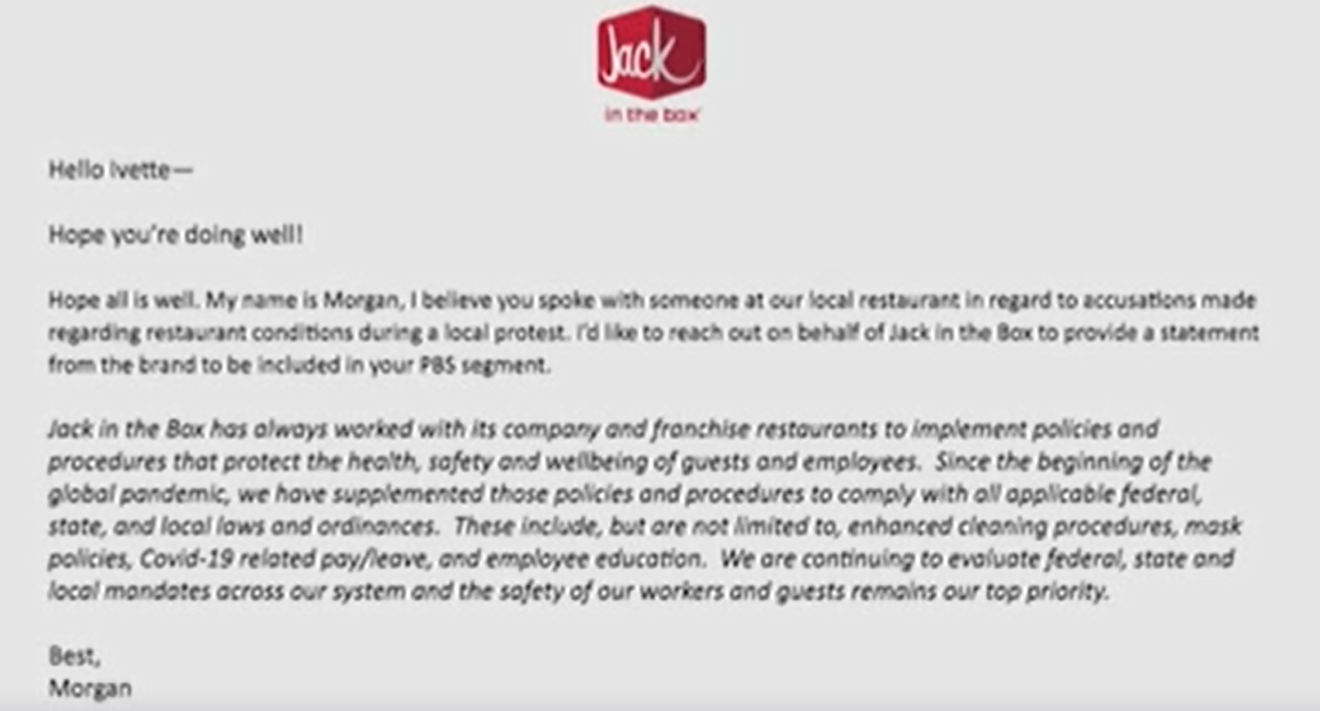
Nothing in the message acknowledges problems or provides plans to improve the situation. It’s defensive and does not inspire confidence in the brand. I see a lack of accountability and willingness to be vulnerable and learn from failure.

Facebook Becomes “Meta”
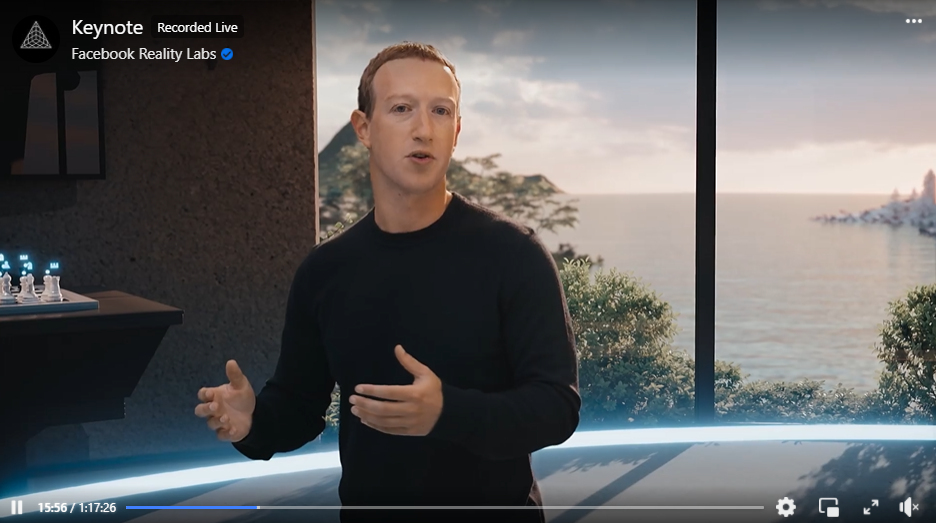
In the midst of controversy after internal documents were made public, Facebook is trying to reinvent itself with a new name: Meta. The company promises that “the metaverse will be social. 3D spaces in the metaverse will let you socialize, learn, collaborate and play in ways that go beyond what we can imagine.” After staying behind the scenes for the past few weeks, as the press cited internal strife as evidence of the company’s wrongdoing, Facebook’s CEO and Founder Mark Zuckerberg is out in front.
In a 1 hour and 17 minute video, Zuckerberg focuses on the “immersive experience” we’ll enjoy in the future. He emphasizes connection, which has been the company vision since around 2017.
Perhaps in a nod to the ongoing criticism of apps’ negative influence and relentless draw through algorithms, Zuckerberg says, “This isn’t about spending more time on screens. It’s about making that time we already spend better.” Of course, some of us still want to spend less time and want the same for our children. Zuckerberg also acknowledged, “The last few years have been humbling for me and my company in a lot of ways.”
Reactions to the name change are mixed but seem mostly skeptical. A Washington Post article points to a tweet: “Don’t forget that when Phillip Morris changed it’s name to Altria it was still selling cigarettes that caused cancer.”
Zuckerberg’s video is a good example of a scripted presentation with a (somewhat) conversational style. As he moves about, we see, as the Post describes, “a dizzying array of scenes that showcased the company’s vision for the metaverse. It included Zuckerberg doing his favorite water sport, hydrofoiling, with friends in a virtual environment, and then jumping into work meetings from a virtual home office, boxing with virtual avatars and working out on a virtual lily pad.” All this certainly would make me spend more time online and give me more reasons to never leave my house.
Business communication students can also analyze Zuckerberg’s “letter,” referring to a formal public message—not, of course, something mailed. I would say the same for the “keynote,” which is unlike any I’ve ever seen.

Congressman's "Bizarre" Video
Jeff Fortenberry, U.S. representative for Nebraska, was facing indictment for falsifying and concealing information and for lying to investigators about 2016 campaign contributions. In a video called “unusual” and “bizarre,” Fortenberry speaks to the camera from his truck with his wife and dog in the background. He says they are “out for a drive” in his 1963 Ford pick-up.
The video is an interesting attempt at authenticity to sway public opinion. Fortenberry wants us to believe that he is a trustworthy, everyday man—a victim rather than a criminal. He tells the story of FBI agents coming to his house “on a weekend” after a cyclone hit. With an incredulous tone, Fortenberry says, “We’re shocked. We’re stunned. I feel so personally betrayed.”
I wonder what counsel Fortenberry received or whether it was his own idea to create the video. Either way, based on the news reports and the indictment, which came later that day, Fortenberry’s message did not favorably affect the outcome for him. His arraignment is planned for later this week.

CDC Director Has a More Nuanced Approach

A New York Times writer compares CDC Director Dr. Rochelle Walensky’s vaccine messaging in different settings. Analyzing a podcast with someone Walensky likely considers a colleague, David Leonhardt describes her tone and approach as more conversational. He also identifies examples of Walensky’s acknowledgment of a “risk-benefit” assessment—more nuanced communication than we hear from the CDC in its official guidance on news media programs.
Leonhardt gave another example of Walensky’s more flexible stance on vaccines:
Walensky began her answer by restating official C.D.C. policy: “We’re not currently recommending it.” But then she added the fuller truth: “I’ll tell you what we do know, and some places where I think people might veer from standard guidance.”
He summarizes what could be more helpful in health communications:
“Health officials are frequently unwilling to take that second step in public. When confronted with uncertainty, they do not acknowledge it. They ignore gray areas and talk in black and white.”
This situation exemplifies humility as a character dimension. Leaders who admit uncertainty—that they don’t know everything and are still learning—may be more persuasive, not less.
Leonhardt is also describing integrity and, more specifically, transparency. Consistency in messaging, including giving a fuller picture, could help people make rational choices for themselves. That might not result in outcomes the CDC wants—or it might, but not in the exact timeframe or terms that the CDC dictates. As Leonhardt says, “the full truth” would give people more agency and could cause less backlash against prescriptive guidelines.

Painfully Long Peloton Email

This is the second email someone sent me from Peloton CEO and Founder John Foley. Both seem much longer than they need to be. The first paragraph muses on the company success, and the second paragraph introduces the main point—the Peloton Tread. Essentially, this is a sales pitch.
CEO and Founder John Foley organizes the email around three advantages of the Peloton Tread, which are clear and easy to follow. He could use more “you” language to focus on benefits to the reader rather than features of the product. Persuasive business writing tells readers “why” they should want to do what the writer asks.
If you were advising John Foley, what other advice would you offer? Would visuals help the message? How could he reduce the length of the email to increase the chance that people will read it? Read the entire message.
Hi there,
When we founded Peloton nearly a decade ago, we dreamt of bringing high-energy boutique fitness experiences into the home through vertically integrated platforms. That’s a fancy way of saying that we wanted the hardware to be the best in the world, the software to bring the energy and connection of other people into your home, and the content to deliver the inspiration of the most motivating instructors coaching over the best music. I hope you agree that we deliver on that goal already, but I hope you also see that we continue to innovate on the software and content because we always want your experience to get better, a commitment that I made to you back then and I am making to you again today…
But today, I write to you about another platform: The Peloton Tread. Have you ever taken a bootcamp class or a HIIT total body group class or any class involving a treadmill, where the instructor asked you to step off of the treadmill for a more full-body workout? As one of the founders of Peloton, I of course LOVE a great indoor cycling class! As you might guess, so does my wife Jill. But we have found over the years that complementing the fantastic cardio provided by the Peloton App with cardio AND strength training via bootcamp classes is a perfect new part of our fitness journey.
So I wanted to take a minute to share my excitement for the Peloton Tread with you.
Apple Clarifies Policy

Apple software chief Craig Federighi spoke with a Wall Street Journal reporter about a misunderstood policy related to child pornography. The company had announced new reporting guidelines for illegal content. As part of the same message, they described new guidelines about photos sent to and from children. User backlash concerned how the company was monitoring their phones.
Federighi said, “I do believe the soundbite that got out early was, ‘Oh my God, Apple is scanning my phone for images.’ This is not what is happening.” He clarified that, using algorithms, they’re looking at photos stored on iCloud—not on people’s phones. The company is flagging only those photos that meet criteria of child pornography.
During the published interview with the WSJ reporter (what made the final cut on the website), Federighi didn’t emphasize the end goal: protecting children. The reporter provided this context, but the message was not at the forefront’s of Federighi’s main points. His focus was on clarifying the initial message: “I think our customers own their phones,” again, distinguishing what we choose to post on Apple’s server.
Federighi also demonstrated humility by admitting that the message was garbled and that AI technology does make mistakes. In hindsight, it sounds as though Federighi would have announced these guidelines in separate messages with more detail about the photo search process.

Blame the Intern
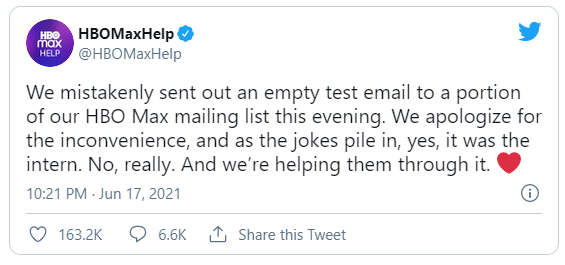
HBOMax customers received an email with the subject, "Integration Test Email #1,” that obviously wasn’t intended for them. In a follow-up email, the company blamed an intern for the mistake.
Twitter responses poured it to support and empathize with the intern. Embarrassing stories ranged from sending emails to big groups to typos. As an intern, someone replaced all “parties” to “panties” in a 50-page legal document (dare I say “brief”?).
The best was when Monica Lewinsky weighed in.
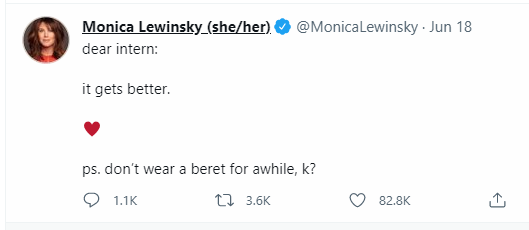
Interns make mistakes; we all do. Facing the situation with humility—the ability to learn—is the best approach. The HBOMax situation could have been a lot worse, and fortunately, the public turned it around to focus on the shared experience we have all had.

Waitlisted Student Markets Himself

George Joseph White V was waitlisted from Cornell’s Dyson School, and he decided to promote himself. He advertised on the outside of a local bus with a photo of himself and his website. On his website, georgecantwait.com, White lists his hobbies, interests, and other information. He also includes quotes from a few of his teachers.
The approach certainly is creative and gutsy, but is it appropriate? From a business communication perspective, we consider the audience and the message. White describes his qualifications, but he doesn’t say much about how could contribute. What would he bring to the school that might differentiate him from other students on the waitlist?
White also is interviewed by a local radio station, which is posted on his website. He says he believes he’s qualified, and the only reason he wasn’t accepted is that the number of applicants increased. The number did increase, partly because of the pandemic and students taking a gap year and partly because Cornell dropped the SAT/ACT requirement.
Still, perhaps other students were simply more qualified than White, and that’s why he didn’t get in. White also chose an approach that isn’t available to all students: spending money on ads and a website.
When I asked students about the situation in class, they were mixed. Some respected his perseverance, while others thought his approach was too self-promotional and unfair. As one student wrote in chat, “It’s a WAIT list.”

Peloton Announces Recalls

After resisting action despite consumer product warnings, Peloton has conceded and is recalling two models of its treadmills. One child died and more than 70 people were injured, so the Consumer Product Safety Commission (CPSC) recommended the recalls a month ago.
In the company statement, CEO John Foley admitted the mistake:
The decision to recall both products was the right thing to do for Peloton’s Members and their families. I want to be clear, Peloton made a mistake in our initial response to the Consumer Product Safety Commission’s request that we recall the Tread+. We should have engaged more productively with them from the outset. For that, I apologize. Today’s announcement reflects our recognition that, by working closely with the CPSC, we can increase safety awareness for our Members. We believe strongly in the future of at-home connected fitness and are committed to work with the CPSC to set new industry safety standards for treadmills. We have a desire and a responsibility to be an industry leader in product safety.
The CPSC said the decision came after “weeks of intense negotiation and effort.” Peloton will suffer financially: the company has stopped selling the treads and is offering a full refund of more than $4,000 for the products. But executives may have spared themselves and the brand some reputation damage if they had acted earlier.

Beware of Overtalking During Zoom Interviews


People seem to be talking too much during video interviews. A Chronicle of Higher Education article describes two possible reasons.
One is that job candidates want to build relationships and may overtalk in a somewhat desperate attempt to connect. After a year without intimacy, we might be overcompensating. I can imagine this applying to other types of meetings and presentations as well.
Second, visual cues are tough to see on video. The void isn’t quite as cavernous as during phone interviews, but still, it’s difficult to see subtle gestures. Imagine that an interviewer is leaning forward, changing a facial expression, or raising a hand slightly. These could be missed, particularly if a candidate is meeting with a group of people.
Next time you have an interview, try to pay attention to cues and allow people to interrupt you. You might also keep your answers a bit shorter—just in case. Allow time for follow-up questions.