

Airbnb Steps Up During Hurricane Harvey
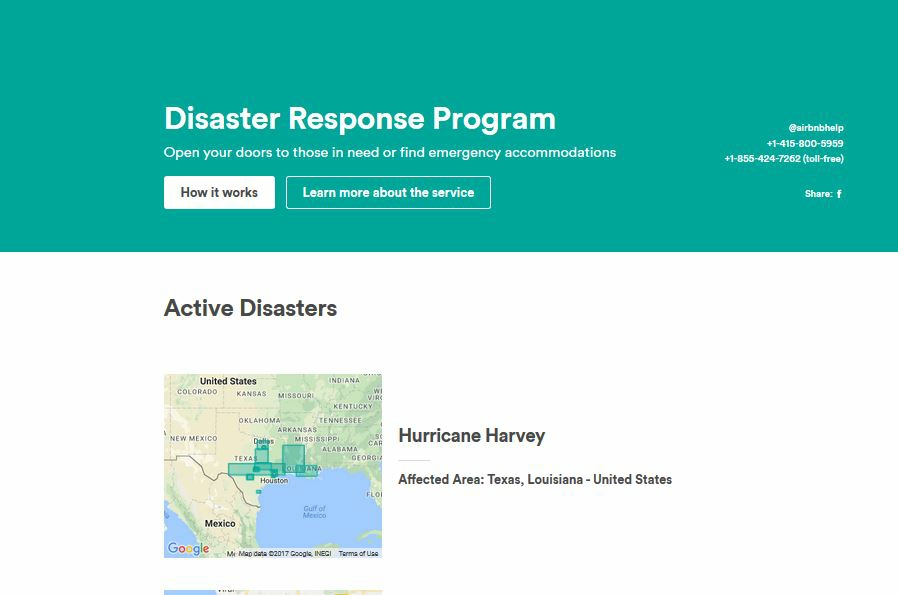 Airbnb is offering free rooms for people who had to leave their homes because of Hurricane Harvey. Evacuees won't have to pay fees to hosts through September 25. Originally, the offer was through September 1, but the company extended it after seeing the storm's devastation. Free listings appear for homes in Houston, Dallas, Austin, and San Antonio.
Conditions are explained on Airbnb's Disaster Response site. Currently, the site lists programs for Hurricane Harvey and for the Mumbai floods.
Other sharing companies have stepped up following the hurricane. Uber, Lyft, and WeWork are offering free services and other promotions.
Discussion:
- What examples of generosity have you seen during Hurricane Harvey?
- How should a small business owner decide what to offer? What are the advantages and disadvantages of, for example, a restaurant offering free food?

Companies Criticized for Price Gouging
As Texans are desperate for housing and food in the aftermath of Hurricane Harvey, some companies are taking advantage. People reported hundreds of examples of price gouging for items like bottled water, groceries, gas, and hotel rooms. 
A Best Buy near Houston was selling a case of water for $42; others reported prices up to $99. Price gouging is illegal after natural disasters, as the Texas attorney general's site explains.
Best Buy issued a statement that this was the act of one store.
A Best Western in Robstown was also over-charging: $321.89 a night compared to its usual price of $119. In addition to raising the room rate, the hotel added extra fees. The PR manager for Best Western's corporate office issued this statement:
"Best Western was founded on the principles of honesty, integrity, compassion, and service. We are deeply offended and saddened by the actions taken by this hotel. As a result, we are immediately severing any affiliation with the hotel. This hotel's actions are contrary to the values of Best Western. We do not tolerate this type of egregious and unethical behavior."
The hotel has been removed from Best Western's website.
Discussion:
- What's your view of raising prices during disasters? How is this different from revenue management?
- Analyze Best Buy's statement. How well does this meet audience needs and communication objectives?
- Did Best Western do the right thing in severing the hotel from the company? What will be the consequences of this action?

Martin Shkreli's Failed Communications
 Former pharmaceutical executive Martin Shkreli damaged his own case by failing basic communication principles. As a juror said, he is "his own worst enemy" and "All he had to do was to tell everyone, ‘I'm sorry, I lost the money, all I can say is I'm sorry,' and that would be it."
In other words, just apologize. The jury found him guilty of fraud because he lied to hedge fund investors.
Throughout his career in the media, Shkreli came across as arrogant and indifferent to his impact on others. His company hiked the price of Daraprim, a potentially life-saving drug, from $13.50 to $750 per pill. A Daily Beast article called him "reprehensible" and worse.
In 2014, he tweeted about his board of directors:
Rather upset at my inane BOD who was overly focused on irrelevant innuendo but also now can pursue a NewCo without them. So net-net excited.
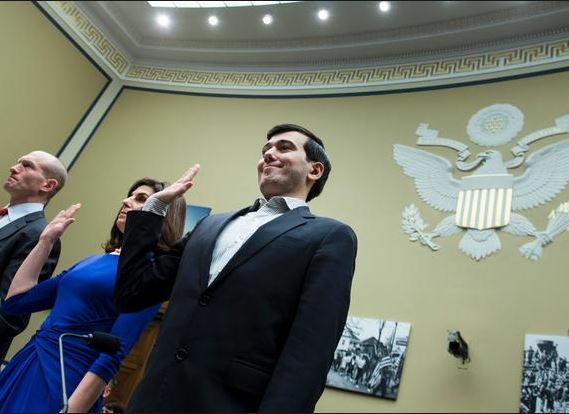
In January of this year, Shkreli was banned from Twitter for harassing a journalist. In 2016, he testified before Congress, and we see why people consider him offensive. He "takes the fifth," which is his right, but his behavior shows his lack of compassion. MoneyWatch posted "The many smirks of Martin Shkreli" during the hearing.
Discussion:
- What is the value of an apology, and how could saying "I'm sorry" have helped Shkreli?
- What non-verbal behavior does Shkreli demonstrate? For example, watch 8:00 - 9:00 of the Congressional hearing. How do you interpret his non-verbals?

Cargill Muslim Employees Get EEOC Support
 The Equal Employment Opportunity Commission (EEOC) is siding with Cargill employees over their right to pray at work. Employees filed a claim against the company because their opportunities to pray during breaks had been curtailed. The EEOC's support means that Cargill management will have to reach an agreement with employees on prayer time.
The issue began in Colorado in 2015 when 150 employees walked off the job in protest. Supervisors told them they would no longer be able to prayer during breaks. The employees were terminated for attendance violations.
Employees report being closely monitored so they didn't pray, for example, in the bathroom. Cargill denies such claims.
The hope is for Cargill and the employees to reach a confidential agreement. If they fail, the employees can pursue a discrimination lawsuit.
Discussion:
- What protects U.S. employees' right to pray at work?
- How would you describe the company's position?
- Assess statements by the company in the Star Tribune article. Based on these quotes, how well is the company responding to the controversy?

Irvine Finds Room for Admitted Students
 University of California, Irvine, is trying to do right by 800 students who accepted the college's admissions offer above the expected number. When making admissions decisions, colleges always consider their "yield," or the percentage of students who will enroll. Admissions officers admit more students than they have space for, assuming some won't come because of financial reasons or school preference.
Initially, Irvine rescinded offers from about 500 students, but it was too late for them to enroll in other schools by that time. They informed students during the summer about transcript and other issues, which happens in a few cases each year, but this is an extraordinary number.
Then university administrators began softening. They admitted that they used standards that were too strict in order to lower their enrollment numbers. The vice chancellor wrote a message to students, including this excerpt:
We heard from some students that this year's process was too stringent and our customer-service approach needs improvement. I acknowledge that we took a harder line on the terms and conditions this year and we could have managed that process with greater care, sensitivity, and clarity about available options. Also contributing to the angst many of you have experienced is our traditional communication and outdated telephone systems that did not serve us well in this circumstance. For those who felt ignored or mistreated, I sincerely apologize.
We are making every effort to do better, immediately. I have directed the admissions team to step up the personal outreach to notified students. We're bringing in more people to review appeals and answer phones. We are committed to correcting any errors swiftly and providing the help you need in an empathetic and understanding way.
A few days later, Irvine's chancellor also apologized, and the university found a way to accommodate 290 more students. His message included this excerpt:
The stories of our students whose college dreams were crushed by our decision to withdraw admissions to hundreds of students are heartbreaking. And unacceptable.
This process is not working. We are a university recognized for advancing the American Dream, not impeding it. This situation is rocking us to our core because it is fundamentally misaligned with our values.
The apology is notable because we see so few of them from university presidents. Writers for The New York Times and Insider Higher Ed commented on the rarity of apologies, partly because of the complexity of academic institutions.
Discussion:
- Analyze the chancellor's and vice chancellor's messages. What communication principles do they use? How do the messages compare in content, tone, word choice, and organization?
- What should Irvine have done differently in this situation? What are all of the touch points with students that could have been improved?
Ryan Getzlaf Calls Ref a Bad Name
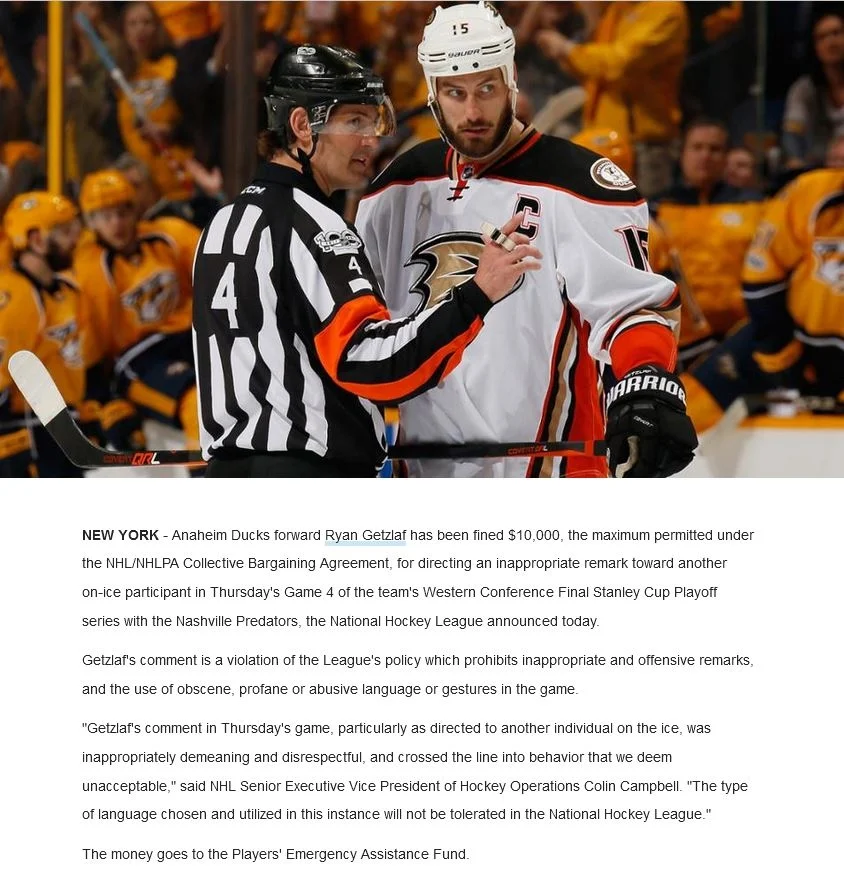
 NHL Anaheim Ducks captain Ryan Getzlaf will pay $10,000 for calling a referee a name too bad to print in BizCom in the News. People say it's homophobic, which technically it is, and it's just plain ugly. (Here's a detailed, NSFW analysis of the term, if you're so inclined.)
A statement on NHL's website, shown here, refers to " an inappropriate remark." The fine is the most allowed by the players' union.
In a statement called "luke warm," Getzlaf apologized, a little:
Read more at: http://nesn.com/2017/05/ryan-getzlaf-apologizes-sort-of-after-10k-fine-for-using-gay-slur/
A situation like that, where I'm on the bench by myself, frustration set in. There was obviously some words said, not necessarily directed at anyone in particular. It was just kind of a comment. I've got to be a little bit more responsible for the words I choose.
Definitely as a father, as somebody that takes a lot of pride in this game and the respect for it, it's tough to see somebody refer to it as (a gay slur). I didn't mean it in that manner in any way. For that to take that route was very disappointing for me. I do accept responsibility and I accept the fine.
Discussion:
- "There was obviously some words said." Help: What grammar problems do you see here?
- What make this a weak apology?
- Did the league take the right action? Some say Getzlaf deserved more of a punishment.
- What else should Getzlaf do or say?
College Prep Denied for Failing to Double Space Applications
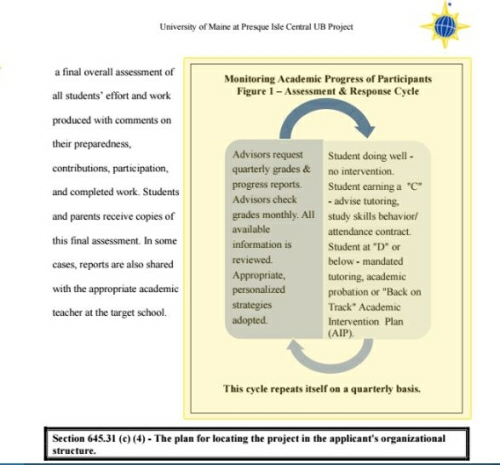 Dozens of colleges and organizations won't receive funding for Upward Bound programs because their grant applications failed to meet formatting requirements. The U.S. Department of Education, now led by Betsy deVos, rejected applications that would have served at least 2,400 low-income students who would have received tutoring and counseling to help prepare them for college.
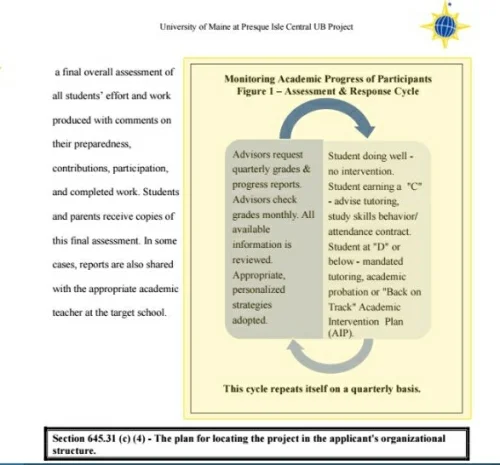
Applications missed the requirements because they weren't double spaced, used the wrong font, or forgot other formatting details.
Although members of Congress have appealed to Department of Education representatives, the decision seems to stand. The acting deputy assistant secretary said, "A rule is a rule. . . . I, too, have to abide by the rules." One rule is for "no more than three lines per vertical inch." In one application, shown here, an infographic contained text spaced one-and-a-half lines apart instead of two.
Discussion:
- What's your view of this situation? Is the Department of Education being too harsh, or is "a rule a rule"?
- How does this compare to grading of your writing assignments? Have you felt that instructors have been too nitpicky? What's the value of an instructor calling out formatting errors?
- The Chronicle says this decision doesn't seem motivated by the Trump Administration's cost-cutting plans. Still, what could be the political fallout if the Department of Education doesn't change its mind?
Altercation on American
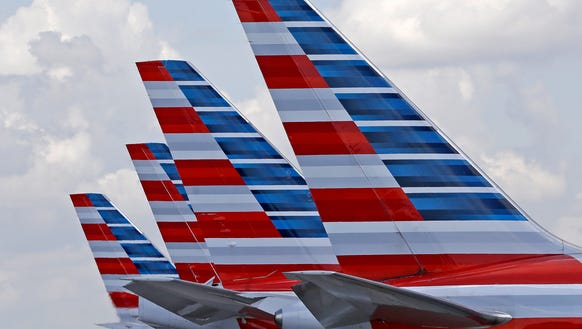 Emotions are running high on airplanes. An altercation on an American flight-captured on video, of course-resulted in an employee's suspension.
Apparently, a flight attendant took a stroller forcefully from a woman, hitting her with it. The woman is seen crying, upset that the stroller also just missed her baby. The conflict arose because the woman wanted to keep the stroller with her in the back of the plane, and the attendant wouldn't allow it.
At some point, another passenger got involved and said to an attendant, "You do that to me and I'll knock you flat." An altercation ensues and the flight attendant can be heard saying back to the passenger, "Hit me! Come on, bring it on."
After the United incident when a man was dragged off the plane, American Airlines had to take decisive action. The airline suspended the employee, upgraded the woman and her family to first class on their next flight, and issued a statement:
"We are deeply sorry for the pain we have caused this passenger and her family and to any other customers affected by the incident."
The Association for Professional Flight Attendants (the union) spoke out against American Airlines for acting too quickly. Instead, the president blamed airline conditions, such as shrinking seats and overcrowding, for part of the issue.
Discussion:
- Have we all gone mad? Who are the actors in this play, and what responsibility does each hold? In other words, could this scene have been avoided?
- Assess the airline's response. To what extent do you think the United incident affected the response? Either way, did the company respond appropriately?
Adidas Apologizes for Congratulatory Message
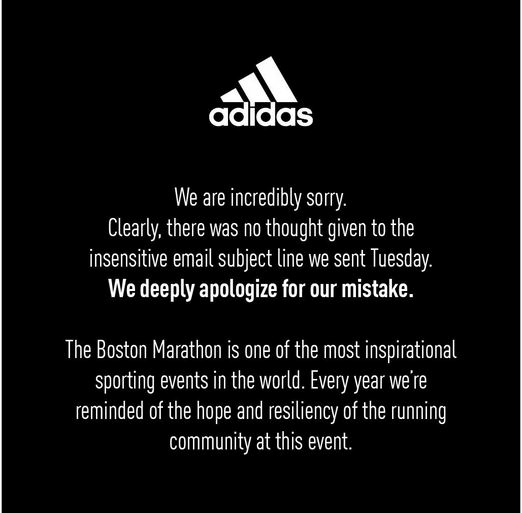
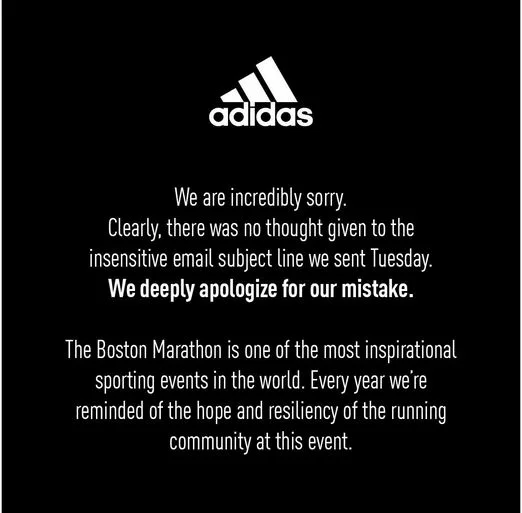
Adidas may need a better review process. After the Boston Marathon, the company sent a congratulatory email about "surviving" the marathon, not thinking about the terrorist attack four years ago. During that event, two bombs killed three people and left several hundred injured.
The subject line to the marathoners read, "Congrats, you survived the Boston Marathon!"
Outrage was swift. People immediately saw that Adidas hadn't posted this intentionally but had failed to consider the connection and potential reaction.
The apology also came quickly and did the job. Admitting that "no thought was given to the insensitive email subject line," the company didn't make excuses or apologize "if we offended anyone"; they said plainly that it was insensitive.
Discussion:
- Are people too sensitive, or was this a real gaffe?
- How does a mistake like this happen?
- What makes this an effective apology?
Choate Apologizes for Sexual Abuse

Private school Choate Rosemary Hall, in Wallingford, CT, has uncovered sexual abuse by 12 faculty members. According to a report commissioned by the board of trustees, abuse going back to the 1960s was mishandled:
"Sexual misconduct matters were handled internally and quietly. Even when a teacher was terminated or resigned in the middle of the school year because he or she had engaged in sexual misconduct with a student, the rest of the faculty was told little and sometimes nothing about the teacher's departure and, when told, was cautioned to say nothing about the situation if asked."
Some faculty were given recommendations to transfer to other schools.
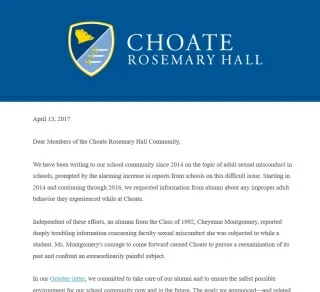
In a "Message to the Choate Rosemary Hall Community," posted on the website, the board chair and headmaster review the facts, thank the victims for coming forward, apologize, and promise action. The school hired Rape, Abuse & Incest National Network (RAINN) to review its policies and make recommendations. One conclusion in the letter follows:
RAINN has noted the strength of Choate's current confidentiality, amnesty, retaliation, and mandatory reporting policies; progressive training and education for students; and faculty and staff who are caring, empathetic, and supportive while preventing and responding to sexual misconduct on campus. Their recommendations call for continued codification of policies and procedures for reporting and investigating incidents, further review and refinement of adjudication processes, and additional training for faculty and staff who respond to incidents of sexual misconduct. We believe a commitment to constantly improving standards will provide more understanding and protection for our students.
Discussion:
- I'm skeptical reading the excerpt above. So, your policies are great? You just need to follow them? And of course, you need to do training, which everyone seems to say in these situation. Read the entire letter and form your own opinion. Am I too harsh?
- Should Choate have this letter prominently on its website? I followed a link from The New York Times, but I don't see any reference to the statement. What are the arguments for and against posted something, say, on the home page?
Sean Spicer Makes a Mistake

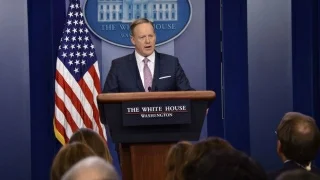
Another Hitler analogy gone awry? How is it possible? During a briefing with reporters, White House Press Secretary Sean Spicer compared the use of chemicals by Hitler and President Bashar al-Assad of Syria:
"We didn't use chemical weapons in World War II," Mr. Spicer said. "You know, you had someone as despicable as Hitler who didn't even sink to using chemical weapons."
When a reporter questioned the statement, Spicer may have made things worse:
"I think when you come to sarin gas, he was not using the gas on his own people the same way that Assad is doing."
He then said people came into "Holocaust centers."
He tried to fix it: "I was trying to draw a distinction of the tactic of using airplanes to drop chemical weapons on population centers. Any attack on innocent people is reprehensible and inexcusable, but that didn't do it." Finally, he gave a fuller apology during an interview, although The New York Times calls it "contrite."
Discussion:
- Where did Spicer go wrong? Do you find his comments offensive? Why or why not?
- What's your assessment of his apology in the NBC News interview? Do you find it "contrite," as The New York Times says?

United Drags a Man Off the Plane

I'm not sure United thought this one through; people have cell phones. The airline needed to free up four seats so their employees could to get to Louisville. Attendants offered $400 and $800 but couldn't get people to relinquish their spots. Four people on the plane were approached; three left "without incident," as The New York Times reports.

But the fourth wouldn't budge. He said, "I'm not getting off the plane. I'm a doctor; I have to see patients in the morning." The Times reports the airline's perspective:
Charlie Hobart, a United spokesman, said in a telephone interview on Monday that "we had asked several times, politely," for the man to give up his seat before force was used.
"We had a customer who refused to leave the aircraft," he said. "We have a number of customers on board that aircraft, and they want to get to their destination on time and safely, and we want to work to get them there. "Since that customer refused to leave the aircraft, we had to call" the police, and they came on board, he said.
The man was removed by force, dragged down the aisle, and eventually carried out on a stretcher. A video shows the man, somehow, back on the plane, clearly upset, saying, "I have to go home." In this video, we see that his mouth is bleeding.
United issued a short statement from CEO Oscar Munoz on Twitter. Although Munoz apologizes for "re-accommodating" passengers, no public apologies have been made to the man or other passengers as yet.
UPDATE: Munoz issued a longer statement and, as NBC News tweeted, "found new words like 'disturbed' and 'horrific event'":
"The truly horrific event that occurred on this flight has elicited many responses from all of us: outrage, anger, disappointment. I share all of those sentiments, and one above all: my deepest apologies for what happened. Like you, I continue to be disturbed by what happened on this flight and I deeply apologize to the customer forcibly removed and to all the customers aboard. No one should ever be mistreated this way."
Spokesperson Megan McCarthy also said, "We recognize that our response yesterday did not reflect the gravity of the situation," Ms. McCarthy said. "And for that we also apologize. Our focus now is looking ahead and making this right. Judging from a letter Munoz sent to his employees, he may have been supporting them, protecting them. But customers must come first in a situation like this. Meanwhile, the passenger, Dr. Dao, has hired lawyers, four senior senators wrote United a chastising letter, and the company has lost $255 million in value. What may be worse (or perhaps, all for the best) are grumblings about potential disruptors for the commercial airline industry.
Discussion:
- What leadership lessons would you like to teach United's staff? What crisis communications lessons could they learn?
- Where did the airline go wrong? Try to identify all steps in the process.
- What's your view of the response so far? Should United say more?

Penn State Trustee Resigns After Putting Foot in Mouth

Five or so years after the scandal at Penn State involving a football coach, young boys, and an inactive Administration, the university is still in the news for bad behavior. Former coach Jerry Sandusky was convicted of rape and child molestation and is serving prison time. You may remember that Joe Paterno was also accused of cover-ups, but he died of cancer soon after the scandal broke and he was dismissed from the university.

Last week, the former university president, Graham Spanier, was convicted of child endangerment. FBI director Louis Freeh wrote in a report that for more than 12 years, Spanier and other Administrators, "actively protected a notorious pedophile who inflicted irreparable harm on countless child victims on the campuses and locker rooms at PSU. Although these men had multiple opportunities to stop this vicious, serial predator from continuing to sexually assault children who trusted the PSU campuses and programs as safe havens, they decided together to protect this monster rather than report him to the police."
After the verdict, one of the Penn State trustees, Albert L. Lord, said, "Running out of sympathy for 35 yr old, so-called victims with 7 digit net worth," and "Do not understand why they were so prominent in trial. As you learned, Graham Spanier never knew Sandusky abused anyone."
Lord has since resigned from the board, and it's unclear whether he was asked to leave. He also issued an apology statement.
Discussion:
- If the board of trustees didn't ask Lord to resign, should they have?
- Analyze Lord's statement. How well does this work to explain the comment, apologize, and rebuild Penn State's image?