

Zuckerberg Testifies Before Congress

In many hours of testimony, Facebook CEO Mark Zuckerberg did his best to address lawmakers' questions about data privacy and, surprisingly, how Facebook works. Senators and Members of Congress asked questions about texting, about how the company makes money without a subscription model (Zuckerberg: "We sell ads."), whether Facebook owns users' data, whether Facebook sells data, how many "data categories" Facebook collects, and so on. This video compilation does not reflect well on our lawmakers.
Zuckerberg himself seemed surprised by some of the questions and wasn't fully prepared to answer them. A reporter captures a photo of Zuckerberg's notes, which are what we would expect, but it's fun (in a voyeuristic way) to see them.
On the second day of testimony, questions improved, and many focused on Facebook's treatment of conservative political views. These were fair questions, and Zuckerberg admitted they had made mistakes in screening some content as inappropriate. But several representatives seemed to ask similar questions about this and about the consent agreement with the FCC, as if the question hadn't been asked just moments earlier.
In a New York Times Daily Podcast, reporters discussed Zuckerberg's continued references to starting Facebook in his dorm room. They believed the strategy was a good one for demonstrating his humanity (emotional appeal) but was potentially damaging for his credibility because it reminded lawmakers that he is only 33 years old. A seat chair, which internet trolls called a "booster seat," didn't help.
Wall Street responded well to Zuckerberg's testimony, with the stock price rising both days.
Discussion:
- What's your view of Zuckerberg's testimony? Watch as much as you can tolerate.
- Should lawmakers have a better understanding of Facebook? What is their level of responsibility?
- Identify a few specific questions and Zuckerberg's answers. What leadership character dimensions does he demonstrate, and how could he have improved?
- Watching the testimony, how would you assess his authenticity? Do you know more about him as a person? Should we?

How to Talk About Failure During an Interview
A new podcast, Change Agent, explores creative solutions to people's problems. In one episode, "Telling the Truth," a recovering alcoholic talks about her challenges during job interviews. Should she explain the gap in her resume?

For help, the moderator looks to Domino's, which had notoriously bad reviews of its pizza. CEO J. Patrick Doyle explains how the company took an open approach to admitting failure. Doyle led a turnaround by running commercials admitting criticism about their pizza, for example, that the crust "tastes like cardboard." The results are documented in a Domino's video posted on YouTube.
The woman looking for a job was able to apply what she learned during a mock interview. Part of her recovery process is about being truthful, so was open to the strategy.
During the podcast, we hear the woman admitting her challenges, although she goes on longer than may be useful or appropriate during a job interview. Still, the interviewer reacted positively to her telling the truth.
Discussion:
- What are the risks to admitting failure in this way?
- How could you apply this strategy to your own job search? What failing or misstep could you explain in a way that demonstrates self-reflection and learning from failure?
- In what ways does the podcast demonstrate authenticity and vulnerability?

Stanford Event Criticized as "Too White and Too Male"

The organizer of a history conference at Stanford admitted to having trouble identifying a more diverse panel of speakers. All 30 are white men.
Priya Satia, history professor at Stanford said, “Given how prevalent women are in the history department, you’d have to try really hard to come up with a roster of speakers that looks like that." Satia also leads the history department's diversity committee.
Referred to as a "conservative British historian" by the New York Times, Niall Ferguson says he invited women, but only one could attend. Ferguson also said, "We all agreed that we must redouble our efforts to represent diverse viewpoints in future conferences."
Discussion:
- What are some possible reasons for the lack of diversity?
- Should Ferguson have done more to recruit women and people of color? How could he approach the conference planning differently?
- What is Stanford's responsibility? I don't see a statement from the university.
- In what ways does Ferguson demonstrate vulnerability, and in what ways does he fall short?

Turnaround for Martin Shkreli
We see a different Martin Shkreli from the one criticized for smirking during a congressional hearing on Capitol Hill in 2016. Shkreli ran Turing Pharmaceuticals when the company was accused of raising drug prices 5,000% in 2015. At the time, he was only 28 years old and was called "the most hated man in America."
Last week, Shkreli was sentenced to seven years in prison for fraud committed while he was a hedge fund manager and while running another drug company, Retrophin.
Shkreli pleaded for leniency. According to a CNBC report, he "broke down in tears." Another article summarizes his statements in court:
"The one person to blame for me being here today is me," a choked-up Shkreli told a judge before she imposed the prison term in Brooklyn, New York, federal court.
"Not the government. There is no conspiracy to take down Martin Shkreli."
"I took down Martin Shkreli with my disgraceful and shameful actions."
"This is my fault. I am no victim here," Shkreli said, before breaking down into tears as he promised not to let his lawyer Benjamin Brafman down in his efforts to contribute to society.
"Do not feel bad for me," Shkreli told a packed courtroom that included supporters and family members, many of whom had written letters asking Judge Kiyo Matsumoto to spare him from a harsh sentence.
And he had a message for the investors he duped: "I am terribly sorry I lost your trust. ... You deserve far better."
"I was never motivated by money," Shkreli said. "I wanted to grow my stature and my reputation."
"I am here because of my gross, stupid and negligent mistakes I made."
Discussion:
- Let's assume Shkreli's statements are sincere. How could you explain Shkreli's smirking in 2015 at such as serious hearing and his behavior more recently?
- Do you believe Shkreli's statements are sincere? Why or why not?

Bias in Online Courses
A Stanford University study found biases in how instructors interact with students in online courses. In a review of 124 Massive Open Online Courses (MOOCs) in a variety of subjects, researchers found that responses to comments vary by students' race and gender:
Each comment was randomly assigned a student name connoting a specific race and gender. We find that instructors are 94% more likely to respond to forum posts by White male students. In contrast, we do not find general evidence of biases in student responses. However, we do find that comments placed by White females are more likely to receive a response from White female peers.
The study is significant because it identifies teachers' potential responsibility for different student learning outcomes. In other words, it's difficult to isolate why teachers respond differently to students because the students may, for example, be less prepared or have less ability. But in this study, the issue is clearly isolated: teachers tend to favor students based on race and gender, which were randomly assigned by way of fictitious names.
Discussion:
- How well do these results match your own experience as a student?
- What are the implications of this study for instructors?
- What potential flaws or issues do you identify with this study?

Merck CEO Demonstrates Leadership Character

In an interview with The New York Times, Merck CEO Ken Fraizer demonstrates strong leadership character. He talks about his upbringing, building self-confidence, and learning from failure. He ends the interview with this quote:
There are lots of examples of companies that have lost their way because they’ve sort of lost their soul, which is a funny word to use, but companies do have souls.
Frazier was last prominent in the media after being the first executive to quit one of President Trump's advisory councils.
Now, he offers college students this advice:
I think people should seek adventure in life, as opposed to just allowing their ambitions to drive where they want to end up. Lots of people say, "Tell me what are the steps to get from here to the C.E.O.’s office." I can say honestly I never sought to be a C.E.O. But what I’ve always wanted was a new challenge, what I call an adventure. Seek adventure. Seek excitement in what you do.
Discussion:
- Read Frazier's interview. What do you learn from his perspective?
- When asked about Vioxx, how does Frazier address the failure? How else could he have answered the question? Which was the better choice?
- How does Frazier demonstrate authenticity?

Adam Rippon Demonstrates Authenticity and Questions Pence
U.S. Olympic figure skater Adam Rippon has been public about being gay and having a history of an eating disorder. Rippon says he felt pressure to fit a particularly body image and sometimes starved himself to achieve it.
In January, Rippon said he would refuse a meeting with Vice President Mike Pence because of his support of "conversion" therapies, attempts to change someone's sexual orientation or gender identity. Pence denied the claim and expressed support for all athletes:
“The accusation is totally false with no basis in fact," Alyssa Farah, Pence's press secretary, stated. "But despite these misinformed claims, the Vice President will be enthusiastically supporting all the U.S. athletes competing next month in Pyeongchang.”
However, an NBC article identifies a message on Pence's website that supports Rippon's claim:
Under the headline "Strengthening the American Family" and just below his stated opposition to same-sex marriage and anti-discrimination laws protecting "homosexuals," Pence's platform advocates that resources "be directed toward those institutions which provide assistance to those seeking to change their sexual behavior."
Discussion:
- What's your view of Rippon's statement?
- Explain VP Pence's statement given his documented platform? How do you reconcile the claims?
- In what ways does Rippon demonstrate authenticity?

News Conference About Florida Shooting
Officials have made statements about the school shooting in Parkland, Florida, that left 17 people dead and another 16 injured. Themes focus on healing—giving families and others affected time to mourn, charging the perpetrator, and preventing similar incidents from happening in the future.
As we typically see in these news conferences, multiple people give their perspective, and we may see the influence of their role and their personal views.
Political conversations about the FBI's role and gun control have already started. President Trump also made a statement after the tragedy.
Discussion:
- Analyze each person's contribution to the news conference. How do you see their role and their personal views affecting what they say and how they say it?
- What's your view about the political conversation: should we avoid talking about gun control now, or it this the best time? How do your own political views factor into your perspective?

President Trump Refers to "S---hole" Countries

During a meeting about immigration policy, lawmakers heard President Trump ask why the U.S. would admit people from "s---hole" countries like African countries and Haiti instead of places like Norway.
I have refrained here as have some TV news stations (NBC, shown here), but the major print news outlets—NY Times, Washington Post, and Wall Street Journal—all printed the actual profanity. The New York Times explains the decision:
But several media executives said on Thursday that the news value of Mr. Trump’s remarks, which the White House did not dispute, was undeniable.
“It would be futile to mask the word when the language itself, in reference to Haiti and African countries, was so extraordinary,” said The A.P.’s vice president for standards, John Daniszewski.
Discussion:
- Why would some media outlets use the word, while others avoid it? What does the decision involve?
- Some take issue with the reporting about "vulgar," "crude," or "profane" language, calling for the press to call the president a "racist" instead. What are your thoughts? First, does the comment indicate that he is a racist? Second, should the news agencies report this differently?
- An argument could be made that the president is just being himself, authentic. What do you think of this view?

NBC's Integrity Called Into Question
NBC's Twitter account manager overstepped when posting about Oprah at the Golden Globes.

The company tweeted a correction and removed the post:
"Yesterday a tweet about the Golden Globes and Oprah Winfrey was sent by a third party agency for NBC Entertainment in real time during the broadcast. It is in reference to a joke made during the monologue and not meant to be a political statement. We have since removed the tweet."
Donald Trump Jr. didn't miss the chance to reinforce his father's criticism of mainstream media as "fake news."

Discussion:
- How well did NBC handle the situation? What else, if anything, should the company do?
- How damaging do you think this tweet is for NBC and for mainstream media?
- To what extent did NBC demonstrate accountability?
- What are the other dangers of outsourcing a Twitter account? (Hint: authenticity)

Book World Announces Closing
The country's fourth-largest bookstore is closing the last of its 45 stores. Communicating such bad news is difficult for any leader. Book World was a family-owned business since 1976, which probably makes the decision even more painful.
The announcement, including book liquidation plans, is posted on the company's website. We see some of the writers' personality with the abundant use of exclamation points. Otherwise, the message is fairly straightforward.

Discussion:
- How do we see Book World's leaders demonstrating authenticity and vulnerability in this post?
- What's your view of the exclamation points? When is it appropriate to use these marks in business writing, and when is it overkill?
- What else, if anything, should the Book World statement include?

How Does a White Supremacist Change?
Derek Black grew up in a prominent white supremacist family, but his views about race changed when he went to college and met people who cared to challenge him. The New York Times Daily Show rebroadcast an interview with Black, and we hear first-hand about his growing up and about his evolution. (Read the transcript.)

Black's father started Stormfront, a white nationalist website, and his godfather was David Duke, once a leader of the Ku Klux Klan. Black describes his family and friends as a close group, connected by a shared purpose. Although he says that his family doesn't single out individuals, they believe that IQ is linked to race, and that people of color are biologically inferior.
After spending time with Jewish people and comparing research, Black came to understand—over the course of a year—that his research was flawed. He now denounces the white supremacist movement.
Discussion:
- How would you describe Black's transformation? What is significant about his development in terms of understanding cultural differences?
- Black wanted to stay in the background after his discovery, but he says he felt compelled to be more publicly vocal. What are the arguments for and against staying anonymous?
- Describe how Black demonstrates intellectual humility.

Roy Moore's Wife Doesn't Help His Case
At a campaign rally the day before her husband's election for U.S. Senator, Kayla Moore tries to convince audiences that he is a good man. As Roy Moore is accused of sexual assault and harassment of minors, Mrs. Moore tells the audience, "One of our lawyers is a Jew."
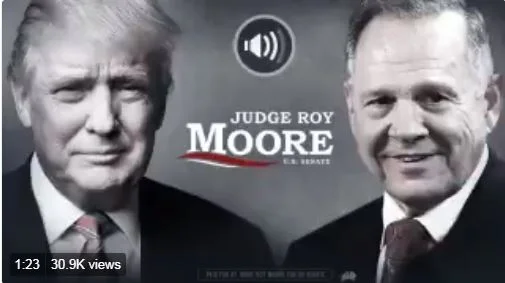
Mrs. Moore apparently didn't realize that the expression, "Some of my best friends are _______" has become a joke. In addition to her arguments against anti-Semitism, she said, "We have many friends that are Black, and we also fellowship with them in our church and in our home."
We hear weak, scattered applause after this comment. After her note about their attorney, we hear some laughter; perhaps people were embarrassed for her, or perhaps they thought she was poking fun at the old expression. But she was not.
President Trump continues to campaign for Roy Moore as we wait for the people of Alabama to decide tonight.
Discussion:
- How do you assess Kayla Moore's speech? Her husband seems proud. How do you explain it?
- Do you agree with the criticism or find it too harsh?
- What else could Kayla Moore have said to support her husband?

Should You Leave a Company Involved in a Scandal?
 A Wall Street Journal article explores the impact on employees whose company embarrasses them. When mired in a scandal, the company no longer reflects our values, and we may want to end the association.
An employee at Uber, for example, left after news about sexual harassment became public. Her family questioned her affiliation and, as she describes, "staying there would have meant going against what I believe in." Employees who want to live their values may feel better leaving. Of course, this assumes that people have opportunities elsewhere, which isn't the case for everyone.
The article warns against making a rash decision and suggests alternatives:
WHEN YOUR EMPLOYER'S IMAGE STRESSES YOU OUT
- Take time to calm feelings of stress or anxiety.
- Consider other options before quitting.
- Spend more time on job tasks that are meaningful to you.
- Find something to love in your company's mission.
- Try to fix some part of the company's problem that you can control.
- Strengthen relationships with people at work you enjoy.
- Mentor and encourage subordinates who show promise.
- Work on building skills that will help you in the future.
Discussion:
- Have you been a part of organization that didn't align with your values? How did you handle the situation?
- Which of the article's suggestions do you find most and least useful? Which have you used in the past?

Toyota Ads Vary by Ethnicity
 Toyota's new advertising approach is to tailor Camry commercials to people based on their assumed ethnicity. If your history shows that you watch Scandal or Sunday Night Football, you'll get a particular ad.
A New York Times article shows the differences for African-American, Hispanic, Asian-American, and "Transcultural Mainstream."

A group vice president for Toyota explains the strategy, "if a person of any group is looking for communication that is like them, that looks like them specifically, the good news is because of the breadth of something like a Camry campaign, they can find it." The NYT article explains more detailed strategies for eight ads targeted to ethnic groups.
Discussion:
- One argument against the tailored ads is that the U.S. is quite diverse, and people expect to see different ethnicities in ads anyway. What do you think?
- Read the strategies for eight examples in the article. Some, of course, are built on stereotypes. Is this wrong or a good marketing approach?

How Bad Was Theresa May's Speech?
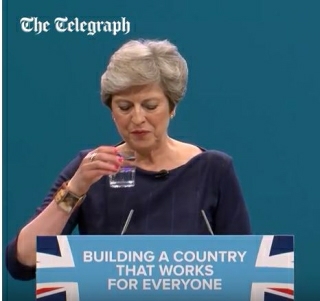 The Telegraph calls it a "car crash" and "one of the most disastrous conference speeches in history." British Prime Minister Theresa May faced three problems in front of the Conservative Party Conference in Manchester.
First, a protestor interrupted the speech to hand her a "P45," which is a document used to fire workers in the U.K. (Sounds like a "pink slip" in the U.S.) The prankster was escorted out, and May recovered by making a joke: "I was about to talk about someone I'd like to give a P45 to, and that's Jeremy Corbyn," who is the leader of the Labour Party.
Then, she had a coughing fit and had to drink a glass of water, some of which seemed to spill into her hand. (Here, I'm reminded of Marco Rubio's odd sip of water.)
Finally, captions dropped a letter, leaving "for" as "or." The Telegraph and other media outlets reported this mishap as "the stage falls apart," but I would say that's quite an exaggeration.
Discussion:
- I think the media outlets were too harsh. Do you agree? Why or why not?
- This is a humbling experience for May. How well did she recover?
- What lessons can you take for your own presentations?

Netflix's Funny Cease-and-Desist Letter
Netflix got high marks for a funny legal letter, which I realize is typically an oxymoron. A pop-up bar in Chicago showed Stranger Things, which is against Netflix's policy. In response, the company's lawyer sent a cease-and-desist letter, giving the owners a generous six weeks before they need to stop playing episodes for customers.

This reminds me of the Jack Daniels letter in Chapter 5 of the book. Both show lawyers as human beings.
Discussion:
- What's the value of a more conversational legal letter? What are the downsides?
- The letter isn't perfect. Try to find the punctuation error.
- What makes this letter authentic?

Miracles Happen: An Apology from Uber
 The typically non-apologetic Uber is apologizing. Two factors likely caused the company's change: 1) a new CEO, and 2) losing its operating license in London.
The new CEO has already demonstrated his vulnerability by talking about his emotions and showing us more of who he is as a person. An article in The Guardian explains why the city decided not to renew the company's license, which expires September 30:
TfL [Tranport for London] said last week Uber was not a "fit and proper" private car-hire operator and cited four areas of concern, including its approach to reporting criminal offences and carrying out background checks on drivers. But sources close to TfL indicated that a change of conduct from the taxi firm, the culture of which is being reformed by its new chief executive, could leave the door open to a fresh licence application.
The London decision is a blow for the ride-sharing company, and Uber is doing what it can to rebuild its image.
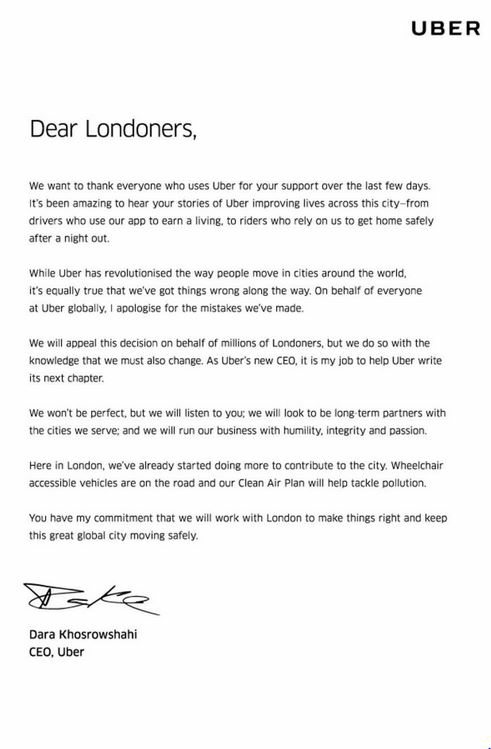
London Mayor Sadiq Kahn responded to the apology:
"I welcome the apology from Dara Khosrowshahi, the Uber CEO. Obviously I am pleased that he has acknowledged the issues that Uber faces in London. Even though there is a legal process in place, I have asked TfL to make themselves available to meet with him."
Discussion:
- Assess Khosrowshahi's apology. What works well, and what could be improved? (Hint: What organization principles apply?)
- What is the value of an apology? In this case, how does Uber's apology help its position with London?

iPhone X Face ID Doesn't Work During Presentation
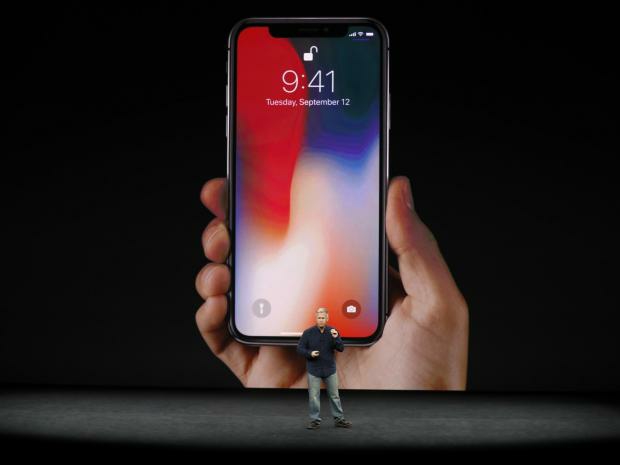 During Apple's big presentation to unveil and show features of the iPhone X, the Face ID program didn't work.
The presenter, Craig Federighi, SVP Software Development, reacted briefly when the passcode screen came up. Then he said, "Let's try that again." He picked up another device, and the feature worked.
What happened? Verge reports that it probably wasn't a problem Face ID. Rather, the passcode screen came up as a precaution just as it would on earlier versions when you restart your phone or when you haven't used it for a few hours.
Still, it was tough moment for Federighi.
Things often go wrong during presentations but, as is the case for more serious company crises, how the situation is handled is sometimes remembered more than initial issue.
Discussion:
- How well did Federighi handle the situation? What, if anything, could he have done differently?
- Apple has been quiet on the issue. Should the company explain what happened? If so, in what form, and what should they say?
- In this small moment, do we see authenticity from Federighi? What does he tell us about who he is as a person?

Pastor Responds to Criticism
 Joel Osteen, senior pastor at Lakewood Church in Houston, Texas, has a large following, but he has taken a hit since Hurricane Harvey. Critics say Osteen should have offered his mega-church, which seats 16,8000, to people needing housing after the storm. Instead, Osteen tweeted his prayers, and people say it wasn't enough.
Church officials said the building experienced "severe flooding," but pictures told a different story. In TV interviews, Osteen defended the church's practices. He said, "The main thing is, the city didn't ask us."
In an article on PR Daily, Brad Phillips raised the issue of authenticity:
If you're cynical about televangelists, Osteen's tone in the Today show interview probably struck you as smarmy and self-satisfied. If you're one of the millions of people who watch his sermons and read his books, you probably viewed him as sincere.
Phillips also questioned why the church didn't have plans in place and, specifically, why the leaders didn't coordinate with Houston city officials ahead of time.
The social media response has not been kind: memes abound.
Discussion:
- What's your view of the church's actions during and after the hurricane?
- How well did Osteen respond to criticism? What are his main arguments? Which are strongest, and which fall short?
- Given Phillips' question about Osteen's authenticity, how do you view his interview on the Today show?
- What's your view of the social media response and memes: cruel, justified, or something else?
- How do your own religious beliefs or practices influence your assessment of the situation and of Osteen, particularly?