
Coca-Cola's Campaign Misfires
The company describes the campaign "Taste the Feeling" as more focused on product than the previous slogan "Open Happiness." Chief Marketing Officer Marcos de Quinto explains, "We've found over time that the more we position Coca-Cola as an icon, the smaller we become. The bigness of Coca-Cola resides in the fact that it's a simple pleasure-so the humbler we are, the bigger we are. We want to help remind people why they love the product as much as they love the brand."
New 60-second spots show people enjoying the product, and a series of print ads are described as "Norman Rockwell meets Instagram."
That's all fine, but the company also launched a GIF maker for people to create their own ads, and we can guess what happened next. People created ads about divorce, foot fetishes, and predictably, bodily functions.
The company responded with this statement:
"Our intention is to invite people to share their feelings in fun and uplifting ways as they discover our new ‘Taste the Feeling' campaign. While the vast majority have used ‘GIF The Feeling' in positive ways, it's unfortunate to see that some people have chosen to use our campaign to do just the opposite."
Discussion Starters:
- Should Coca-Cola have predicted the results? A writer on Digiday thinks so.
- Assess the company's statement. How well does it work in response to the failed GIF maker?
- Besides this failure, what's your view of the "Taste the Feeling" videos and pictures?
Communications About Flint's Water
 Flint, Michigan, is battling issues about contaminated water from aging lead pipes. Messages from the governor's office reveal conflicting strategies for dealing with the situation.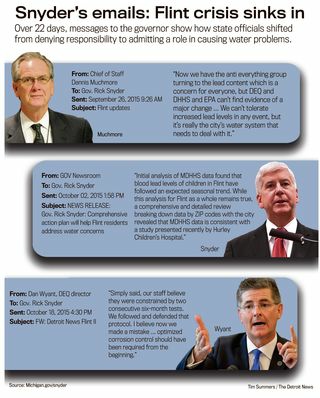
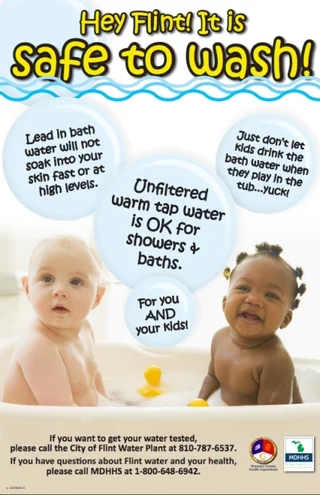
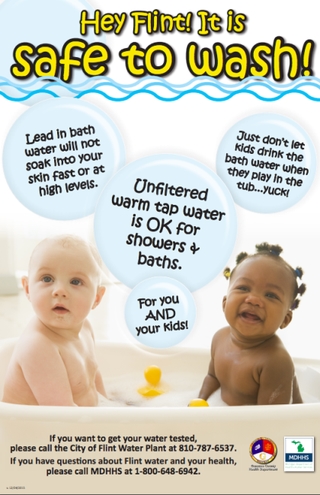
The "Flint Water" page of the Department of Environmental Quality shows a short statement from Governor Rick Snyder: "We are working closely with Genesee County and the Flint community, taking actions to immediately improve the water situation in Flint. Currently, we are focused on water testing, lead testing for children, and ensuring every home has water filters. We are also at work on long-term solutions, including follow-up care for affected residents." Before this statement, the site had a graphic claiming that the water was safe for bathing (shown here); it has since been removed. Now, an extensive list of resources appears under "Contamination Investigation."
The governor has released 274 pages of emails related to the investigation; some show officials debating responsibility for the problems.
As the controversy continues, Governor Snyder is actively communicating. On Twitter, as @onetoughnerd (!), Snyder is posting updates and links to videos and audio "townhall" calls. In the description of his State of the State address on YouTube, Snyder posted this message:
On Tuesday Jan. 19, Governor Snyder delivered a very different State of the State address.
He focused on Flint, a proud city in which residents are unable to drink the water that comes into their homes.
He acknowledged that this is unacceptable. It's a problem that we will fix, and fix quickly.
He spoke directly to the people of Flint, but also to everyone in our state and people across the country.
Discussion Starters:
- What are the governor's communication objectives at this point? Identify three or four for the public as his primary audience.
- Assess his recent messages. How well is he meeting these objectives?
- What's your view of his Twitter handle?
Apple Reports Disappointing Results
 On its Q1 earnings call, Apple reported slow iPhone growth and missed revenue targets. The Wall Street Journal summarizes results: "Apple said iPhone sales grew at the slowest pace since its introduction in 2007 for its first fiscal quarter ending in December." Business Insider, similarly, reports, "Apple's holiday-quarter revenue of $75.9 billion missed analyst expectations as well as the company's own guidance."
Of course, Apple's press release paints a different picture:
The Company posted record quarterly revenue of $75.9 billion and record quarterly net income of $18.4 billion, or $3.28 per diluted share. These results compare to revenue of $74.6 billion and net income of $18 billion, or $3.06 per diluted share, in the year-ago quarter. Gross margin was 40.1 percent compared to 39.9 percent in the year-ago quarter. International sales accounted for 66 percent of the quarter's revenue.
Our team delivered Apple's biggest quarter ever, thanks to the world's most innovative products and all-time record sales of iPhone, Apple Watch and Apple TV," said Tim Cook, Apple's CEO. "The growth of our Services business accelerated during the quarter to produce record results, and our installed base recently crossed a major milestone of one billion active devices."
Tim Cook did admit that the iPhone is increasingly expensive overseas because of foreign exchange rates.
Analysts don't seem too worried about the company's future. Of 14 analysts, 12 remain "bullish," while only two are "neutral."
Discussion Starters:
- Listen to the Q1 earnings call. How does the company handle the news?
- How well does Apple's press release summarize the results? Should anything else have been said in the release?
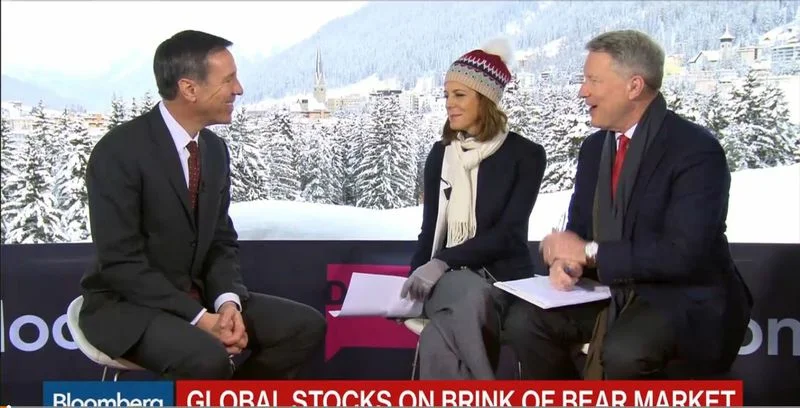
Marriott CEO Interview at Davos
Marriott CEO Arne Sorenson told Bloomberg TV at Davos that he's optimistic about the hotel outlook for 2016.
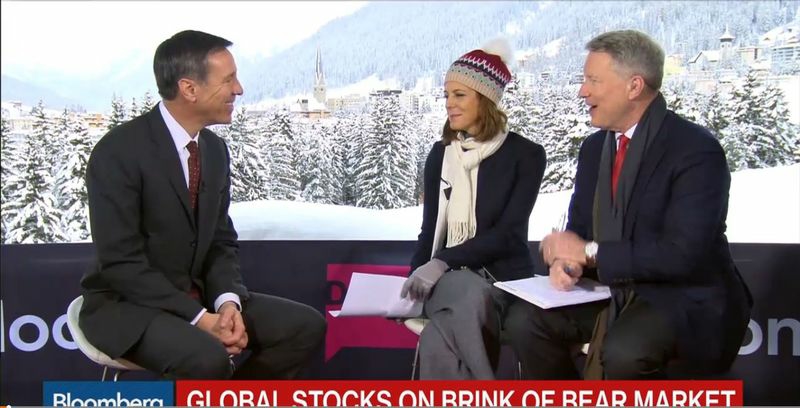
Sorenson uses logical arguments to explain his perspective on rates and bookings despite weak performance in the stock market. Referring to industry data, he makes a convincing case that Marriott will see similar revenue in 2016.
In discussing the Starwood acquisition, Sorenson explains the purchase of equity (and a lower price today than what was announced) and describes plans for the integration mid-2016. He also talks about more potential M&A activity for other hotel companies.
Discussion Starters:
- What examples of logical arguments do you identify in Sorenson's interview?
- What data does he use to support his points?
- Sorenson is realistic. Identify at least three examples of reservations and qualifiers you hear him use. How do these help or hurt his position?
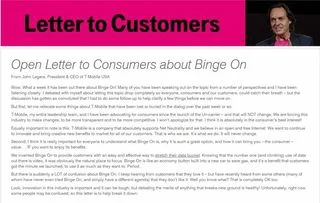
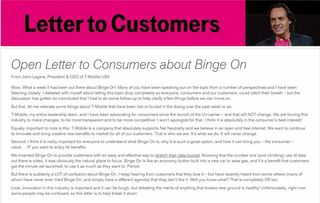
T-Mobile Letter: "Binge On!"
 T-Mobile announced "Binge On," a new program for consumers to "stretch their data bucket." The service allows customers to watch videos at lower resolutions (which the company says doesn't matter on small screens) and not count the time against their high-resolution data minutes. In addition, consumers can watch videos from partner sites for free.
Not all responses to Binge On have been positive. The Electronic Frontier Foundation (EFF) has questioned whether the program affects streaming in addition to bandwith. In a video tweet response, CEO John Legere shot back a response including the F-bomb. Legere later apologized.
In a letter to customers, Legere clarifies that the service is "opt-in" (a big concern) and explains the program in more detail. This paragraph is an example of Legere's usual, casual style:
But there is suddenly a LOT of confusion about Binge On. I keep hearing from customers that they love it – but have recently heard from some others (many of whom have never even tried Binge On, and simply have a different agenda) that they don't like it. Well you know what? That is completely OK too.
My sister sent me the letter and didn't appreciate the casual tone or the "creepy" picture of the CEO. She also noted that the letter isn't dated, so it's unclear when all of this happened.
Consumers can find more information on T-Mobile's FAQs about Binge On.
Discussion Starters:
- What's your view of Legere's writing style? Partly, it fits with the T-Mobile image, but is it too much for customers?
- Could T-Mobile have avoided some of the controversy with clearer communications during the rollout? What do you think happened, and how could the messaging have been handled differently?
Another Call for Hope in Obama's Last SOTU
President Obama's presidency came full circle in his last State of the Union (SOTU) address. The speech was not without humor. The president began by promising to keep it short, so people could get back to Iowa for more campaigning. (Transcript)
As expected, the president highlighted accomplishments from his administration and laid out plans for the future. The speech sounded optimistic, which of course, was the theme of his first presidential campaign. He ended this way:
That's the America I know. That's the country we love. Clear- eyed, big-hearted, undaunted by challenge, optimistic that unarmed truth and unconditional love will have the final word. That's what makes me so hopeful about our future.
I believe in change because I believe in you, the American people. And that's why I stand here, as confident as I have ever been, that the state of our Union is strong.
 The audience reaction is typical and always baffles me: Republicans don't support anything a Democratic president says, and the opposite happens when we have a Republican president. It's strange to me when the President makes some points that, surely, everyone agrees with. Early on, he says, "First, how do we give everyone a fair shot at opportunity and security in this new economy?" The camera is on Marco Rubio, who sits stoically in non-response. Doesn't he support opportunity for everyone?
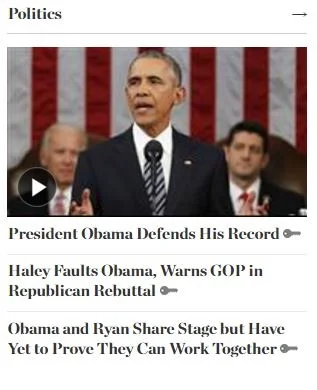
As usual, major newspapers showed their political bent in reporting on the SOTU. The Wall Street Journal ran a secondary headline on the front page with the title, "GOP Candidates Contrast Obama's Speech With Their Own Aims." The Journal showed additional stories under the "Politics" heading further down on the site, shown here.
In contrast, The New York Times ran the story as the main headline of the day with the title, "Obama Offers Hopeful Vision While Noting Nation's Fears," and ran more stories, including opinions, with positive titles about the speech.
Discussion Starters:
- What do you consider to be the highlights of President Obama's speech?
- Look at the audience's reactions. What's your view of the convention I mention above: how does the non-response serve each side?
ESPN Forgets to Identify Social Media Ads
The Federal Trade Commission's guidelines are clear: when people are paid to write social media posts that relationship must be disclosed. This applies to company employees. Two incidents this week show companies skirting those rules.
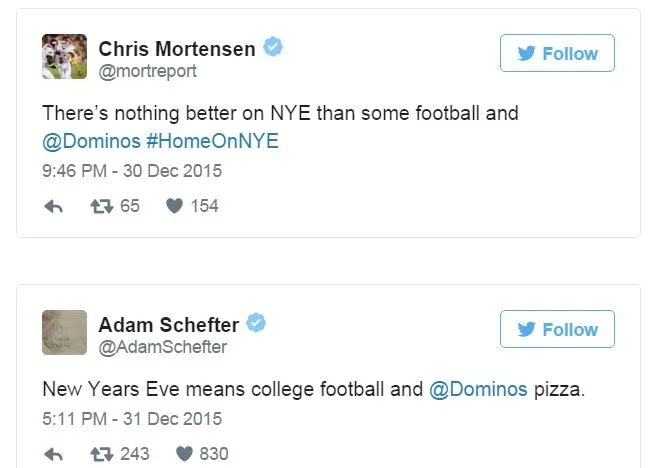
ESPN employees tweeted about Dominos, but didn't disclose their relationship to ESPN. By law, the tweets should include #ad or #spon to identify a sponsored ad.

ESPN responded to a request by Deadspin, calling the tweets an "error":
ESPN says this is all a mistake and that future tweets associated with Domino's ad buy with the network will be compliant with federal law. Which is fine, though we're still skeptical that New Year's Eve means either college football or pizza-and so were the millions of fans who didn't tune in for this year's college football playoff games.
Yet, a couple of days later, an ESPN journalist tweeted another advertisement. The company has argued that journalists aren't paid endorsers, and a Wall Street Journal article explains, "the issue of whether [ESPN's] roster of pundits and anchors are journalists guided by traditional editorial strictures or entertainers allowed to hawk products has been a thorny one for some time." However, Deadspin argues that Schefter and Mortensen are clearly "personalities," and the connection to the brand is clear.
This issue isn't new. The FTC admonished Cole Han for promotions on Pinterest, and I'm sure others have been caught.
Discussion Starters:
- We could argue that identifying ads is just a technicality. Some accuse the FTC of being too snarky about social media posts. What's your opinion on the issue?
- Would a hashtag identifying the posts as ad change your perspective on the post? How do you think fans would be influenced either way?
Thai Ads Pull at Heartstrings
A Wall Street Journal article highlights Thai commercials so emotional that people daring each other not to cry has become a "digital spectator sport." A YouTube description for one video reads, "You Too Will Cry After Watching This... 95% People Cry." The commercials have inspired videos of people watching them, trying not to cry. A video of "Deadlox" garnered more than 256,000 views.
Thanonchai Sornsriwichai creates short films (between 3 and 10 minutes) to sell insurance, phones, food, and other goods. The videos are mini-movies with a dramatic story. In "Silence of Love," a daughter with an angry father tries to commit suicide. The message is to "Remember to care for those who care for you"; in other words, buy life insurance.
With 27 million views, another ad for life insurance, "Unsung Hero," is Thanonchai's highest ranking.
Using pathos or emotional appeals to persuade is nothing new, but this video genre is gaining traction. Advertisers say these film shorts compete with TV ads and capitalize on social media. An executive at Ogilvy & Mather in Bangkok calls them "media events." Of course, videos about the videos increase the number of viewers, and tagging the no-cry challenge onto a film makes it go viral.
Discussion Starters:
-
Describe the value of using pathos in a persuasive argument. What aspects do these films use effectively?
-
On the other hand, what are the risks? For example, could people feel duped at the end? How do advertisers avoid this potential reaction?
Ted Cruz's Daughters as Monkeys: "Fair Game"?
The Washington Post has retracted a cartoon depicting presidential candidate Ted Cruz's children as monkeys.
The cartoonist, Pulitzer Prize winner Ann Telnaes, defended her cartoon:
There is an unspoken rule in editorial cartooning that a politician's children are off-limits. People don't get to choose their family members so obviously it's unfair to ridicule kids for their parent's behavior while in office or on the campaign trail- besides, they're children. There are plenty of adults in the political world who act childish, so there is no need for an editorial cartoonist to target actual children.
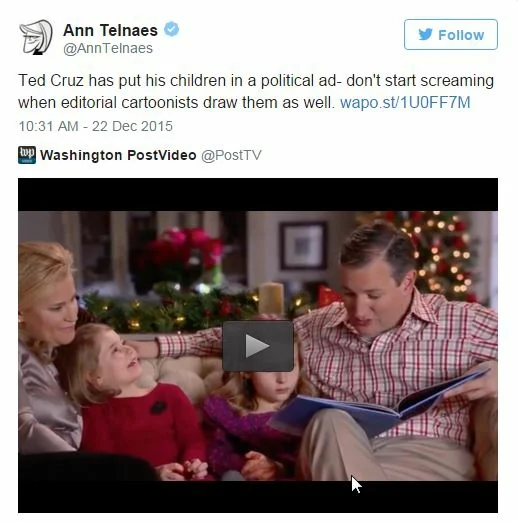
I've kept to that rule, except when the children are adults themselves or choose to indulge in grown-up activities (as the Bush twins did during the George W Bush presidency). But when a politician uses his children as political props, as Ted Cruz recently did in his Christmas parody video in which his eldest daughter read (with her father's dramatic flourish) a passage of an edited Christmas classic, then I figure they are fair game.

However, The Post editor Fred Hiatt disagreed:
It's generally been the policy of our editorial section to leave children out of it. I failed to look at this cartoon before it was published. I understand why Ann thought an exception to the policy was warranted in this case, but I do not agree.
The controversy may have given Cruz's campaign a nice Christmas jolt: so far, his family video has been watched more than 1.7 million times.
Is any publicity good publicity? That hasn't always held true on social media, but in this case, it's working in the candidate's favor.
And because it's Christmas, I'm reminded of Mike Huckabee's video in 2007. Some didn't appreciate the rather obvious window-pane-as-cross.
Discussion Starters:
- What's your view? Was the cartoonist justified in including Cruz's children?
- Was The Washington Post editor right? Should he have defied the cartoonist's position?
Behind the Scenes of Caitlyn Jenner's Announcement
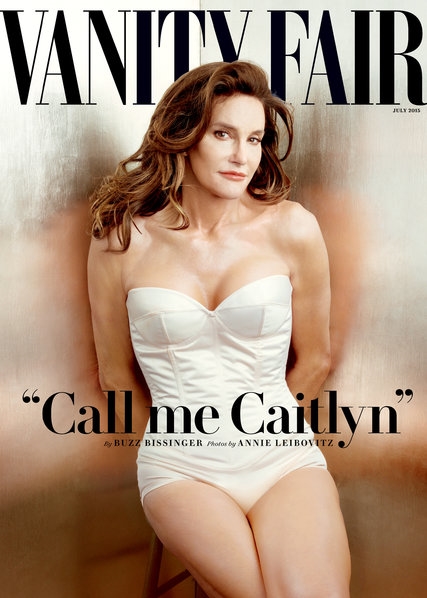 It's hard enough for companies to announce organizational changes, but Caitlyn Jenner had a real challenge ahead of her. An interesting New York Times article describes the publicist and process behind Caitlyn Jenner's announcement that she is transgender and planned to transition.
Alan Nierob managed her announcement but prefers to stay out of the limelight himself. What's useful for business communicators is to understand his decision process: what was the best way for Jenner to announce her transition? Here are the options described in the Times article:
- "Keeping Up With the Kardashians": At the time, Jenner was on this E! television show, but Neirob worried it would look too "self-serving," and they questioned the loyalty of the family and network to represent the story well.
- Interview with NBCUniversal: Nierob rejected this plan as too corporate and seemingly financially motivated.
- Interview with Diane Sawyer of ABC News: Nierob trusted Sawyer and ultimately chose this as one of the options.
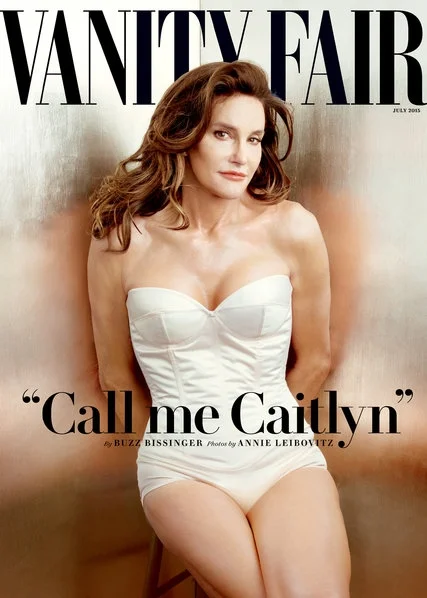
- Interview with Vanity Fair: This was Neirob's additional plan for people to understand Jenner's life and to see glamorous photos.
Reporters seem to respect Nierob's work. Here's a great description of an alternative to saying "no comment," which typically doesn't go over well. This is Nierob's response to questions about Mel Gibson's "blaming Jews for all the world's wars"(!):
"What I remember," said Jeff Jensen, a reporter for Entertainment Weekly assigned to write about Mr. Gibson's saga, "is that Alan respected our inquiry without participating. It was like: ‘I know this is a story, I know you have a job to do, and I wish you well, but I can't help, and Mel won't comment.' It was incredibly gracious and professional. He did his job for his client while showing respect for mine."
Discussion Starters:
- How could an interview with NBCUniversal look "corporate"? Explain how this might be perceived and how it could reflect negatively on Jenner.
- What if Jenner had described her transition on the Kardashian show? Describe potential positive and negative outcomes.
- Why is "no comment" a poor response to a reporter's question? What alternatives could work better?
Apology for "Should Be Shot" Comment
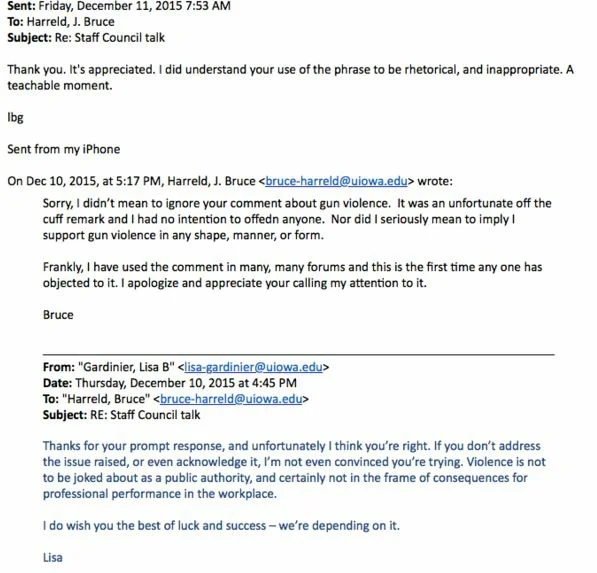
The University of Iowa president Bruce Harreld has apologized for using the expression "should be shot," in this case, referring to faculty who are unprepared. An email exchange between the president and a librarian shows a respectful interaction but indicates a reluctant apology.
The librarian, Lisa Gardinier, initiated a long email, calling his use of the term "flippant" and "horrifying and unacceptable" given "the tense atmosphere of racist law enforcement violence." She also criticized his "rambling, unfocused" talk-a bit harsh, in my view, but I don't have to listen to him.
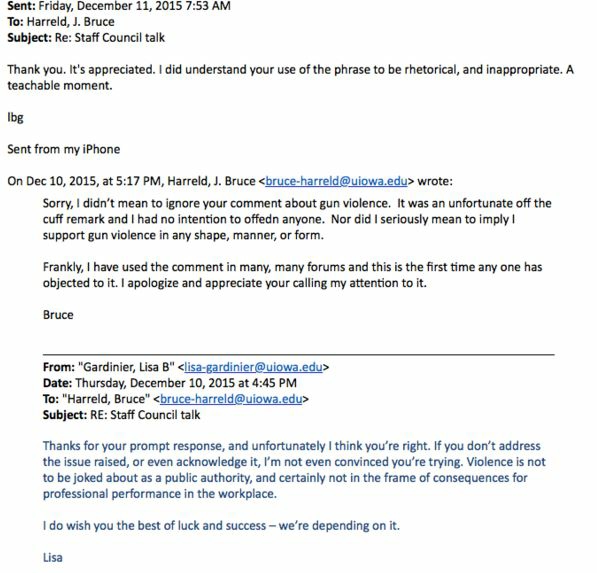
Clearly, Harreld isn't happy to hear from Gardinier, but starting a sentence with "frankly," could indicate the opposite. It's like saying "honestly"; what's the alternative?
Later, Harreld denied saying "they should be shot" but admitted saying, "I have learned the hard way that if I ever walk into a classroom without a teaching plan, I should be shot."
As usual, this criticism is not in isolation. People were unhappy with Harreld's appointment because of his business background and questions about the hiring process.
Discussion Starters:
- Read the entire email exchange, starting with Gardinier's first email. How does she successfully explain her argument? Where does her email fall short?
- Should Harreld have apologized sooner and more clearly? Why or why not?
- What's your view of the expression "should be shot"? Should it be avoided, or is it just a harmless expression?
- Does the use of "they" or "I" make a difference?
Kimpton Updates Rewards Members
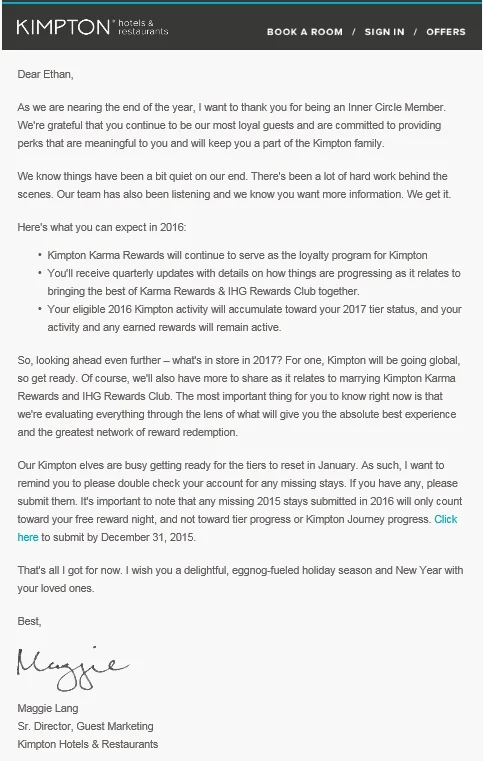
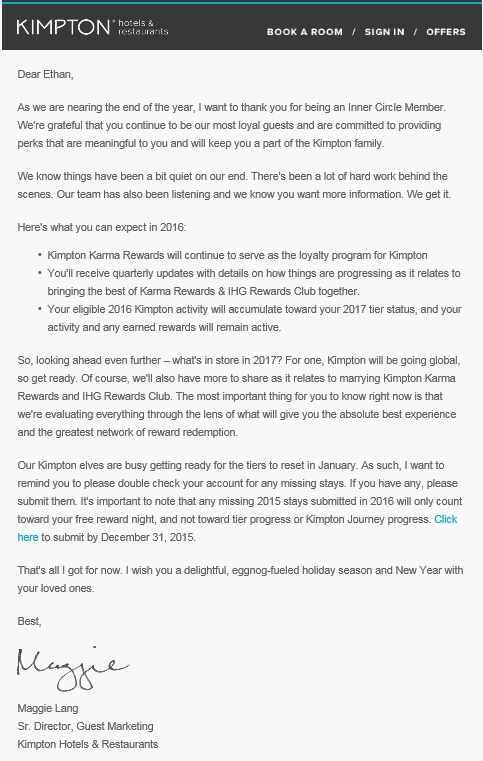 Kimpton Hotels has emailed Inner Circle members to provide an update on the rewards program. Sent by the senior director of guest marketing, the email seems to respond to unanswered questions. With a conversational style, Maggie Lane promises more communication:
We know things have been a bit quiet on our end. There's been a lot of hard work behind the scenes. Our team has also been listening and we know you want more information. We get it.
Her conversational style is also evident in the email closing:
That's all I got for now. I wish you a delightful, eggnog-fueled holiday season and New Year with your loved ones.
The approach is interesting and may be a reaction to the news of Marriott's acquisition of Starwood. Much of that news has been about the great opportunities for Marriott Rewards and Starwood Preferred Guest members. IHG's acquisition of Kimpton was announced in December 2014 and hasn't gotten much press since then.
Discussion Starters:
- Using principles from Chapter 4 in the textbook, analyze Kimpton's audience for this email. Who are Inner Circle members, what do we know about them, and so on?
- Assess the conversational style, particularly the word choice. How do you think the audience might react?
NRA Responds to Shooting
 The National Rifle Association is shifting blame for the shooting in San Bernardino county t0 President Obama and his administration's policies. In a letter in USA Today, the executive director of the NRA's Institute for Legislative Action uses principles of persuasion to focus on the tragedy.
Chris Cox uses strong language, accusing the president of "politicizing" the "horrific crimes." His argument is that our policies have made us less safe, so we need guns to protect ourselves.
California has the strictest gun control in the nation, so Obama's politicization of San Bernardino rings sickeningly hollow.
Just when we think that politics can't sink any lower, President Obama once again proves us wrong by politicizing the tragedy in San Bernardino before the facts were even known. What we do know is that theAmerican people are heartbroken by these horrific crimes - and despite what the president would have us believe - America's law-abiding gun owners are heartbroken by these horrific crimes as well. At the same time, we are sick and tired of this president suggesting the men and women of the National Rifle Association are somehow to blame.
The National Rifle Association is not to blame. Neither is our Second Amendmentfreedom. An act of evil unfolded in California. President Obama used it not as a moment to inform or calm the American people; rather, he exploited it to push his gun control agenda. Policy discussions should be intellectually honest and based on facts, not politics. And the fact remains that California has already adoptedPresident Obama's gun control wish list: "universal" background checks, registration, waiting periods, gun bans, magazine bans and an expansion of prohibited gun categories. But those laws did nothing to prevent this horrific crime from taking place. Nothing.
Here's another fact: the president's failed foreign policy has made us less safe. And his domestic gun control agenda would jeopardize our safety even further. In California, President Obama had what he wanted - the strictest gun control in the country - and it did not prevent this evil act. The plain truth is that the president cannot keep us safe. And his policies would leave us defenseless. That's why our Second Amendment right to defend ourselves must be protected. It's not just a constitutionally guaranteed freedom. It's a natural, God-given, human right.
Unlike the president, regular citizens are not surrounded by armed secret service agents wherever they go. When we find ourselves under attack, no one is there to protect us. That responsibility is ours and ours alone. The American people - including law-abiding gun owners - are scared these days, and for good reason. As a nation, we sit helpless and watch as innocent and defenseless people are slaughtered. President Obama's response is not one of unity, but rather a condescending lecture that we need more laws to restrict us from defending ourselves. Enough is enough with the self-righteous and self-serving demagoguery.
The NRA is calling on the president to stop exploiting tragedies to push his failed political agenda. It's shameful. Given the reality that he's unlikely to listen, however, we will continue to stand and fight for law-abiding gun owners who are both disgusted and heartbroken by these heinous acts - whether committed by madmen, gang members or terrorists. The NRA will neither accept the blame for the acts of murderers, nor apologize for fighting for our right to defend ourselves against them.
Of course, it's not just President Obama who is questioning the NRA's role in mass shootings, which, this year, have resulted in 462 deaths and 1,314 injuries. At the same time, now we know the shooters also had pipe bombs and links to ISIS, so have people blamed the NRA too quickly?
Discussion Starters:
- Assess the NRA's USA Today letter. What examples do you see of pathos, logos, and ethos? Which arguments are strongest and which fall short?
- What's your view: is the NRA to blame for this and other mass shootings? Plan your argument carefully.
Talks at the Climate Summit in Paris
With an impressive list of speakers, the United Nations Framework Convention on Climate Change started on Monday in Paris. The goal is for leaders from 195 nations to agree to limit carbon emissions. As expected, leaders, such as President Obama, began their speeches by expressing condolences for lives lost during the recent terrorist attacks in the city.
Reuters selected portions of leaders' talks as "highlights," and this video shows three hours of discussion.
The Telegraph analyzed 10 claims about climate change and comments "on just how far [leaders'] fears are really justified." The claims are about rising temperatures, melting polar ice, and increasing hurricanes.
Discussion Starters:
- Read Reuters' highlights. What distinguishes the leaders' key messages?
- Choose one of the claims identified by The Telegraph. Do you find the commentary convincing? What evidence is provided? What, if anything, is missing from the argument?
REI Makes Headlines with #OptOutside
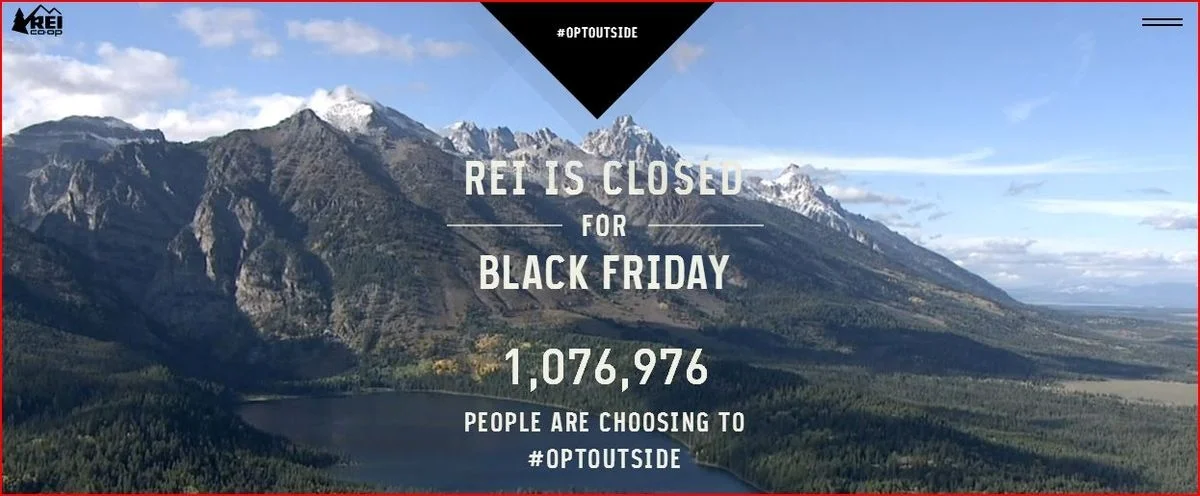
 Outdoor and sports equipment retailer REI is closing its 143 stores for Black Friday, instead encouraging people to #OptOutside. A CEO message on the company's website says employees will be paid not to work:
REI is closing on Black Friday.
You read that correctly. On November 27, we'll be closing all 143 of our stores and paying our employees to head outside.
Here's why we're doing it.
For 76 years, our co-op has been dedicated to one thing and one thing only: a life outdoors. We believe that being outside makes our lives better. And Black Friday is the perfect time to remind ourselves of this essential truth.
We're a different kind of company-and while the rest of the world is fighting it out in the aisles, we'll be spending our day a little differently. We're choosing to opt outside, and want you to come with us.
Jerry Stritzke, President, CEO
An NBC article questions whether the strategy will pay off. The move responds to criticism of increasing consumerism and from employees who want the day off, and it's a "gesture" against bigger box retailers who couldn't afford to lose the day's sales. Still, the company suffered some backlash with employees on Reddit complaining about low wages, poor benefits, and pressure to sell memberships.
Overall, its seems like a good move. After all, REI is an outdoor company-and the weather in New York at least is uncharacteristically warm for this time of year.
Discussion Starters:
- What's your view of REI's decision? How would the company decide whether the positive publicity is worth the lost sales?
- How could the CEO have handled the Ask Me Anything (AMA) questions on Reddit? Some say he didn't respond to important employee complaints, such as the pressure to sell memberships.
Nestle Addresses Worker Abuse
A non-profit organization commissioned by Nestle has exposed worker abuse in the Thailand seafood industry, which includes fish sold by the company. The report is titled, "Recruitment Practices and Migrant Labor Conditions in Nestlé's Thai Shrimp Supply Chain: An Examination of Forced Labor and other Human Rights Risks Endemic to the Thai Seafood Sector."
Business Insider explains the abuse:
The laborers come from Thailand's much poorer neighbors Myanmar and Cambodia. Brokers illegally charge them fees to get jobs, trapping them into working on fishing vessels and at ports, mills and seafood farms in Thailand to pay back more money than they can ever earn.
"Sometimes, the net is too heavy and workers get pulled into the water and just disappear. When someone dies, he gets thrown into the water," one Burmese worker told the nonprofit organization Verite commissioned by Nestle.
"I have been working on this boat for 10 years. I have no savings. I am barely surviving," said another. "Life is very difficult here."
Nestle has responded by restating its commitment:
"As we've said consistently, forced labor and human rights abuses have no place in our supply chain. Nestle believes that by working with suppliers we can make a positive difference to the sourcing of ingredients."
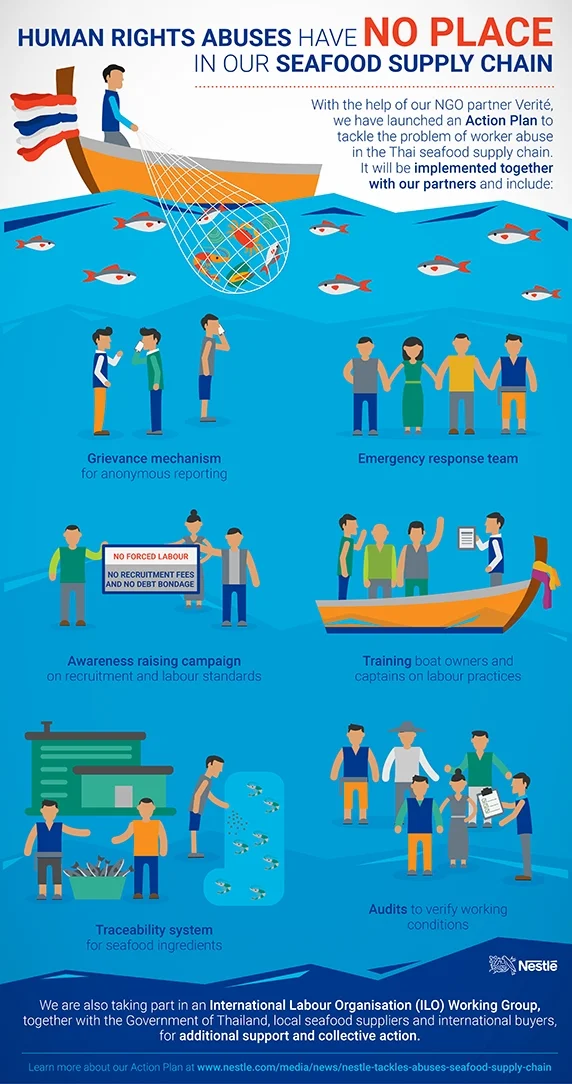
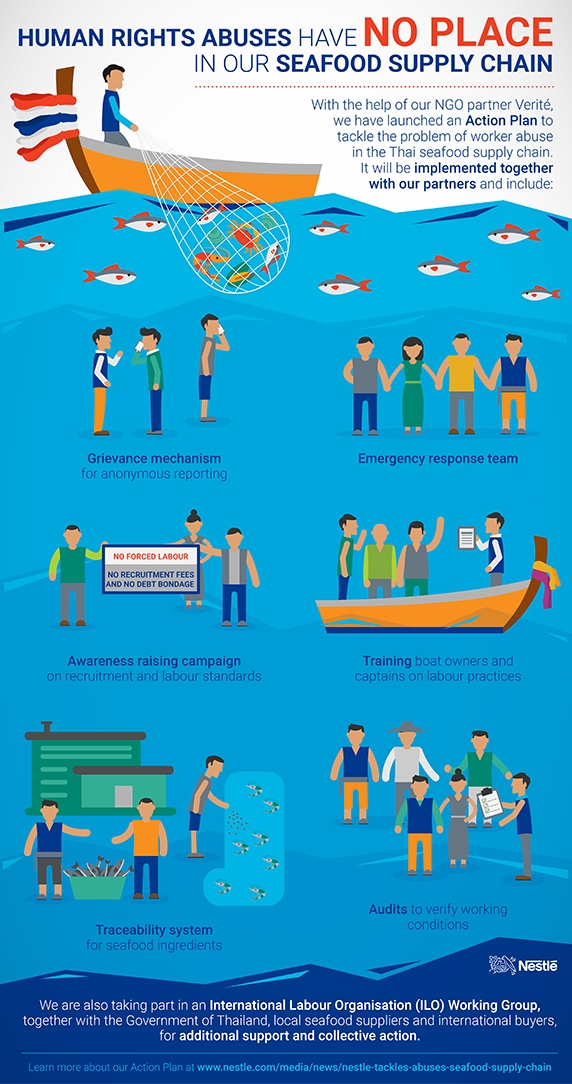
In an action plan posted on its website, Nestle reports on "pre-requisites achieved in 2014 - 2015" and identifies objectives for 2015 - 2016 summarized in this infographic:
Discussion Starters:
- Assess the infographic against principles in Chapter 10. Which are followed, and how could the graphic be improved?
- Do the same for the Verite report. Consider the format, design, content choices, organization, writing style, and so on.
Chipotle Addresses Spread of E. coli
 Chipotle's E. coli trouble is spreading to other parts of the United States. Although the outbreak was thought to be limited to Washington and Oregon, new reports show illnesses in California, Ohio, New York, and Minnesota. For the first time since it became an independent company, Chipotle's same-restaurant sales may decline, and the stock has taken a hit.
On a page on its website under "Food Safety Update," the company explains the situation.
The CDC has informed Chipotle that it identified six additional cases in which initial testing matches the E. coli strain involved in the Washington and Oregon incident. Although one of the individuals has no known link to Chipotle, five individuals did report eating at Chipotle, including two in Turlock, CA, one in the Akron, OH area, one in Amherst, NY, and one in Burnsville, MN.
Investigators have suggested that in incidents like this, it is not unusual to see additional cases after the initial incident as the investigation moves forward. The source of the problem appears to have been contained during a period in late October. 42 of the 43 cases linked to Chipotle reported visiting one of the restaurants in question between October 13 and October 30. One person reported having eaten November 6.
Since this issue began, Chipotle conducted deep cleaning at the restaurants that have been linked to this incident, replaced ingredients in those restaurants, changed food preparation procedures, provided all necessary supply chain data to investigators, and surveyed employees to be sure none had E. coli (note: no Chipotle employees in any states have had E. Coli stemming from this incident). Similar actions are immediately being taken in response to these newly reported cases.
Chipotle is also taking significant steps to be sure all of its food is as safe as possible. Specifically, we are expanding testing of key ingredients, examining all of our food-safety procedures to find any opportunity for improvement, and are working with two renowned food safety scientists to assess all of its food safety programs, from the farms that provide our food to our restaurants.
Connections to this incident are limited to seventeen Chipotle restaurants.
The statement goes on to list the locations and provide a Q&A for concerned customers.
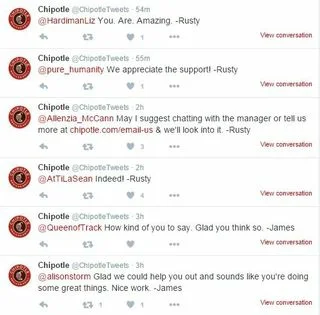
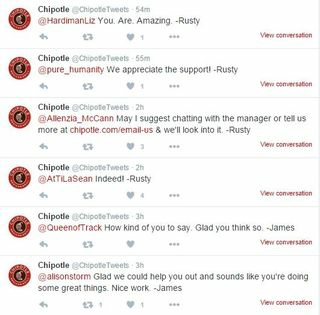
The company's Twitter page is active. Representatives respond personally to tweets, as shown here.
Discussion Starters:
- Analyze the company's statement on its website. What works well, and what could be improved? Particularly consider the last sentence shown above.
- Does this news affect whether you would visit a Chipotle restaurant? What, if anything, can the company do to assure you that the food is safe?
Radisson Blu Responds to the Terror Attacks
 A terrorist attack at the Radisson Blu in Mali resulted in 27 deaths, and the company is responding to the news.
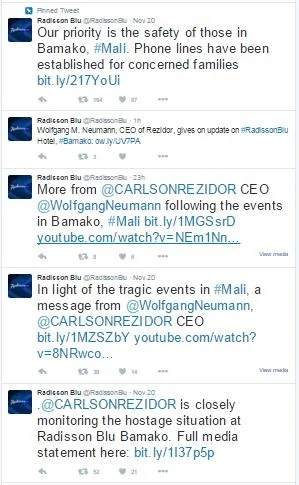
Radisson Blu's website features a large message: "Remember our guests and colleagues in Bamako." The message links to a statement and video from Wolfgang Neumann, president and CEO of The Rezidor Hotel Group (on behalf of the Carlson Rezidor Group).
In his video message, Neumann expresses condolences and appreciation. He also explains support services and provides a telephone line for people needing support and information.
On the day of the attack, the Rezidor website showed a statement saying the company was "closely following" the situation. Neumann created another video emphasizing safety and security.
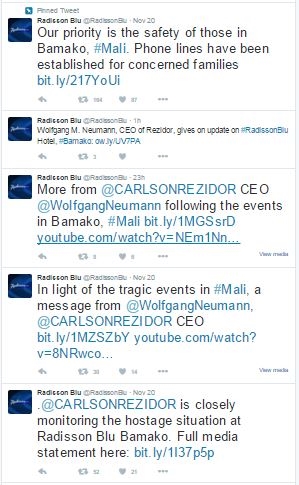
Radisson Blu has been active on Twitter, providing peridic updates and links to statements and videos.
Discussion Starters:
- Assess Neumann's video statements. As always, we have to empathize with his position during this difficult time. Still, if you were his media advisor, what strengths and suggestions would you identify?
- How do you assess company communications so far? What are the Radisson Blu and Rezidor doing well?
False Claims from an Obesity Study?

A Cornell University study concludes, "consumption of fast food, soft drinks, or candy was not positively correlated with measures of BMI," meaning (excluding those very under- and overweight), people consumed these foods at about the same rate. But a Forbes writer criticizes the "false claim" reflected in Cornell's press release (and similarly reported elsewhere): "Candy, soda and fast food are not driving the rising obesity trend in the U.S."
Other headlines, such as, "Is junk food making us fat? Why cutting candy, soda may not be enough," in USA Today have little connection to the findings at all. The study says nothing about restricting certain foods. It merely reports that people of different weights consume similar amounts of these particularly foods.
I also don't think the study distinguished between diet and regular soda. People at the lowest BMIs consumed the most soda.
One of the study's authors, David Just, responded to the Forbes writer's concerns:
"I clarified this with the study's lead author, David Just, a professor of economics at Cornell University, who said his aim was to consider the potential impact of public policies that banned certain foods. 'There's been a lot of diet advice given that narrowly focuses on eliminating soda and fast food and a rash of policies that are targeting these specific foods and promising to address the obesity crisis,' he said. 'I felt these policies were overpromising.'
"He said he did not intend people to leave with the message that sugary sodas and junk food have nothing to do with their weight, or that it's useless to try to lose weight by cutting back on sugar."
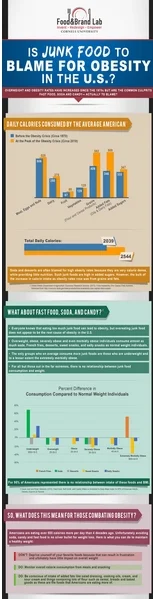
An infographic summarizes the study's findings, and Just describes the results in a video.
Discussion Starters:
- How would you explain the Forbes writer's concerns? What are the potential consequences of how the findings are reported?
- What conclusions are safe to draw from the study? How could the results be useful to policymakers and individuals?
McDonald's Video: Nutrition Advice or Infomercial?
McDonald's has created a 19-minute video, "540 Meals: Choices Make the Difference," which the company says is an educational video about nutrition. Others call it an infomercial or, as a Fortune writer put it, "a slickly produced McDocumentary." McDonald's encourages showing the film in schools and provides a Teachers Discussion Guide to help.
The star of the film is John Cisna, an Iowa teacher who lost 60 pounds on a McDonald's-only diet. (Remember Super Size Me?) Cisna reminds me of Subway's Jared, which didn't work out too well in the end.
McDonald's is hosting McTeacher's Nights, where teachers, students, and parents serve McDonald's food, and part of the revenue goes to a school fundraising campaign. Since 2013, McDonald's has contributed more than $2.5 million to schools from these nights.
Educators in a group called Corporate Accountability International call the practice "exploitative." In a letter to McDonald's, organizations and individuals write, in part,
"It is wrong to enlist teachers to sell kids on a brand like McDonald's whose core products are burgers, fries, and soda. Marketing junk food to children is a harmful practice. We are in the midst of the largest preventable health crisis in the U.S. -- one that is spreading throughout the world, and that increasingly affects children. If this trend is not reversed, many children will be burdened with diet-related diseases like obesity and Type 2 diabetes, affecting their heath for life."
Discussion Starters:
- What's your view of McDonald's video and the McTeacher's Nights?
- What principles of persuasion does the education group use in its letter to the company? Try to identify examples of pathos, logos, and ethos.