

Target's Response to the Security Breach
 Giving new meaning to Black Friday, an unknown number of credit card numbers were stolen from almost all of Target's 1,797 U.S. stores. The security breach seemed to happen through Target's point-of-sales terminals, where credit card information is collected. For students of business communication, perhaps the worse offense is Target's response to the incident.
Target was too quiet for too long. When the news became public, customers reported being unable to reach the company through its call center and website. With information stolen from 40 million credit and debit cards, that's a lot of affected customers. A Forbes article criticizes Target's response as a "PR mistake," particularly for "burying the lead" in its website message to customers:
"...the question of whether it is now safe to use your credit card at the company's stores is relegated to the fourth question of a FAQ at the end of a 1,500 word statement.
"So after eight minutes of reading time, Target finally answers the question on everyone's mind directly: Has the issue been resolved?"
The writer has a point: compare Target's messages to emails from companies after a security breach in 2011, and you'll see a big difference. In those emails to customers, companies were clear about actions to take: don't respond to emails that appear to be spam.
The CEO's video message is divided into several parts on the company's media website. Here's the first part:
Discussion Starters:
- Analyze the CEO's video message: delivery, organization, and content. What works well, and what could be improved?
- Compare the CEO's written message and his video message. What similarities and differences do you notice, and how is each appropriate (or not) for the medium?
- Prepare advice for Target's senior management team to improve their crisis communications. What are four or five communication principles should they be sure to follow in the future?

Dental Letter Appears to Deceive Families
 Dental insurance provider Healthplex sent a letter to 55,025 families that confused them into believing their children were required to get check-ups. Written to "Parent or Guardian" and quoting a state law, the letter sure sounds like a school directive, but it is not. Rather, the letter encouraging parents to bring their children in for dental exams-and to provide evidence to their school-is the insurance company's marketing approach.
 The confusion was discovered when school nurses started receiving signed notices verifying that children received check-ups.
In response to the controversy, Sharon Zelkind, senior vice president at Healthplex, said, "We try to do outreach to get as many children into the dentist as possible." She also admitted, "The wording of the letter was overzealous" and "Now we've learned we shouldn't do it that way."
Discussion Starters:
- What are the ethical considerations of the Healthplex letter? Evaluate the letter from the perspective of the company, dentists' offices, parents, children, and school officials.
- What, if anything, should Healthplex do in response to the controversy?
Fordham Accidentally Accepts 2,500 Students
 Fordham University sent acceptance letters to 2,500 students by mistake. This isn't the first time a university made this error-and it likely won't be the last. In 2012 alone, UCLA sent acceptances to 894 seniors on a wait list, Vassar sent letters to 76 early-decision candidates, and the University of California, Los Angeles, sent letters to 900 wait-list candidates, most of whom were later rejected.
At Fordham, the letters came as a financial aid notice sent to 500 students who were rejected and 2,000 who were deferred admission. A spokesperson for the university said,
"Oversight errors don't just come about, as you know. It occurred when data was transferred from a staging environment to our development environment and it was a member of our database services team who made the error."
In a statement to The New York Times, Fordham wrote,
"Fordham and its undergraduate admissions staff are acutely aware of the high hopes prospective students and their families have regarding college acceptances. The University deeply regrets that some applicants were misled by the financial aid notice. The admission staff is working with S.A.S. to find out what went wrong."
Although the note is heartfelt, some students may never forgive the university:

Discussion Starters:
- How do you suppose the error happened? What does the spokesperson mean by the "staging environment"?
- Write two apology emails to the Fordham applicants. What would you say differently to those who were rejected and those who were deferred?
SpaghettiOs' Pearl Harbor Tweet
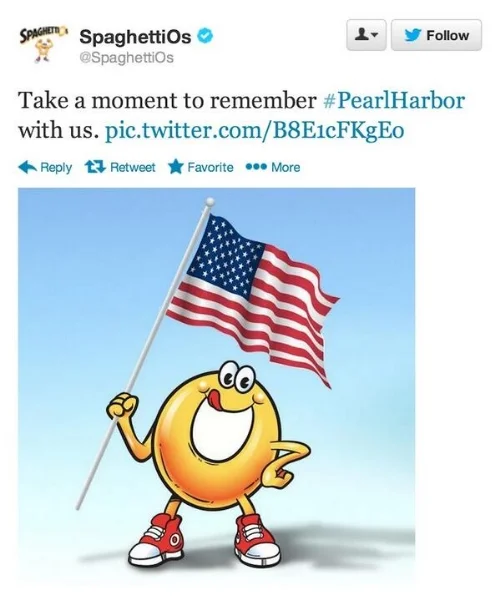
Campbell Soup has apologized for an inappropriate tweet posted by its SpaghettiOs brand. On December 7, the 72nd anniversary of the Pearl Harbor attack, whoever manages SpaghettiOs' Twitter feed had the wrong idea for commemorating the event:
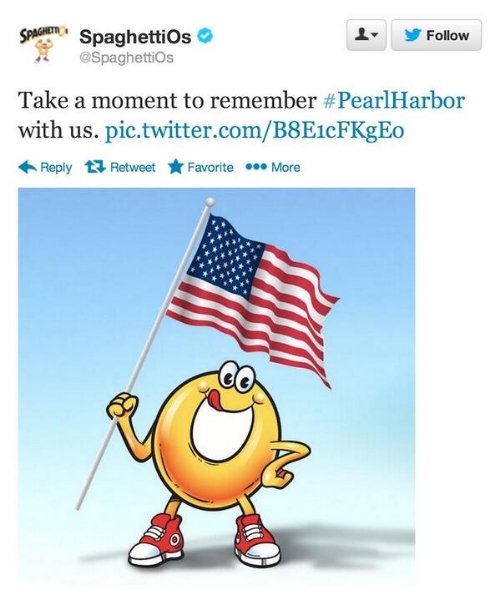
Twitter critics were quick, retweeting "A tweet that will live in infamy," "First UH-OH, SPAGHETTIOs headline in 3, 2, 1..." and "Those who believe that any publicity is good publicity have not had much publicity." A smiling piece of pasta didn't seem to be the best way to pay respects to the 2,400 Americans who died.
The tweet was deleted, and Campbell Soup issued this apology: "We apologize for our recent tweet in remembrance of Pearl Harbor Day. We meant to pay respect, not to offend." The spokesperson admitted that the Twitter account is managed internally.
Discussion Starters:
- Do you find the tweet offensive, cute, or something else? Are people just too sensitive?
- How could this situation have been prevented?
- Campbell Soup's statement is short. Do you find it effective? How, if at all, could the statement be improved?
Motorola Apologizes for Website Crash
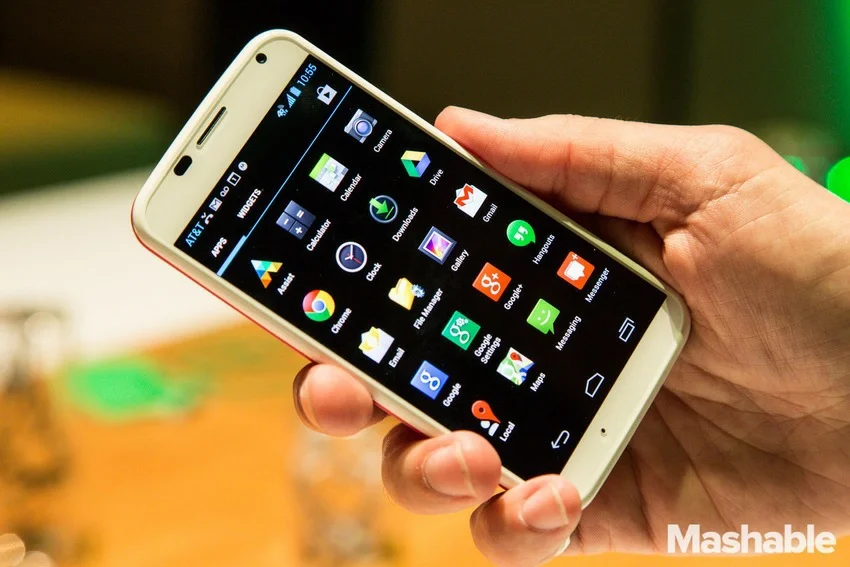
Motorola's website couldn't handle the traffic on Cyber Monday, and the company apologized.
A deal offering $150 off the price of a Moto X smartphone was so popular that people couldn't complete the transaction. Motorola's CEO posted an apology on the company's blog:
 I want to apologize to our customers and fans for the issues we experienced on our website with our Cyber Monday promotion. I want you to understand what happened, and what we are doing to rectify the situation.
Overall, feedback about Motorola's response was positive.
Discussion Starters:
- Assess the CEO's apology in terms of content, word choice, tone, audience focus, and tone. What works well, and what could be improved?
- What lessons could other companies learn when experiencing technical problems?
Virgin America's Safety Video Tops 7.8 Million Views
A flight safety video that people want to watch? Virgin America has surpassed Delta's and other creative in-flight videos by producing a fun, catchy musical.
What strikes me about this and all flight safety videos is the requirement to show us how to put on a seat belt. The video pokes fun ("For the .001 percent of you who have never operated a seat belt before..."), but apparently the FAA or whatever agency regulates these issues won't relent.
Discussion Starters:
- Look at Delta's and other airlines' safety videos. Which are best and why?
- What, if any, downsides do you see of showing Virgin's video on a flight?
Gap Responds Swiftly to Racist Comments
When Gap heard one of its ads was graffitied with racist comments, the company responded quickly.
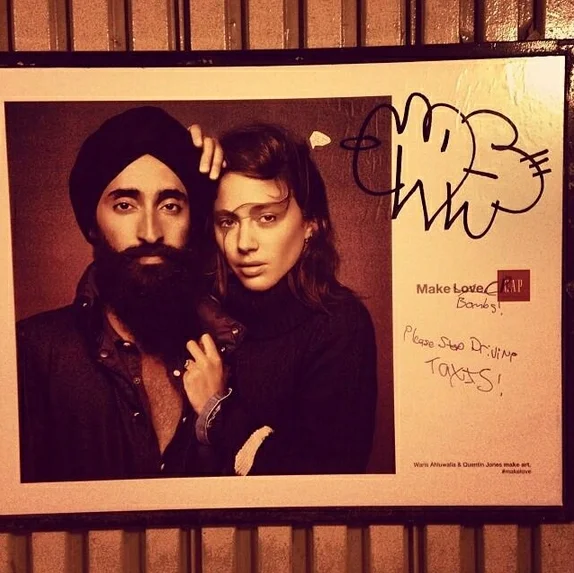
Gap created an ad featuring Waris Ahluwalia, an Indian-American designer and actor, and Quentin Jones, a model and filmmaker. Much of the reaction was positive, but not everyone was happy with the portrayal. This version of the ad made the rounds on Twitter:

When Gap learned of the graffitied ad, the company asked for more information, which is appropriate before deciding how to respond. Soon after, Gap changed its Twitter banner to the original image:
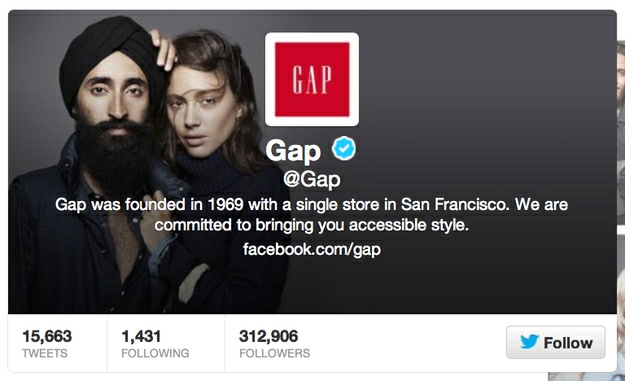
Support for Gap's response traveled throughout Twitter, with people thanking Gap and promising to shop the store for the holidays.
Still, Gap's other ads as part of the "Make Love" campaign are getting mixed reviews. An ad featuring two men was defaced with homophobic comments. That one was ordered removed by the mayor of Chicago.
Discussion Starters:
- What's your assessment of Gap's response? What worked well?
- I don't see any Gap comments or tweets about the situation. Should the company have done anything else?
No Apology About the Metro-North Derailment?
Metro-North is communicating little since a railroad from Poughkeepsie, NY, to Grand Central Station, NYC, derailed, leaving 67 people injured and 4 dead-and an apology doesn't seem forthcoming. No where online does the organization seem to show remorse or any emotion for the impact on people.
Metropolitan Transit Authority (MTA) communications have been paltry, focusing on service issues alone. I suspect the organization is operating under old-school rules, with lawyers cautioning against an apology for fear of admitting guilt. If this is the case, it's a strange mindset: it's unlikely the passengers are responsible in some way, and we know that the train was traveling 82 m.p.h. on a curve with a 30 m.p.h. limit. Signs are pointing towards a sleeping conductor, and lawsuits have already been filed. Why doesn't the MTA do the right thing and show some remorse?
The Metropolitan Transportation Authority(MTA) website is a curious mix of Christmas tidings, service announcements, coupons, and hidden messages. Under the "Transparency" tab on site, under the title "Current News," we see the latest articles, including December 2, when the accident occured:
Wednesday, December 4, 2013 - 18:43
MTA Metro-North Railroad Announces Full Hudson Line Service Thursday
Wednesday, December 4, 2013 - 15:12
See A Christmas Story,The Musical with LIRR
Wednesday, December 4, 2013 - 15:06
LIRR Gets You to Radio City's Christmas Spectacular
Wednesday, December 4, 2013 - 14:53
Our Gift to You – Coupon Savings!
Wednesday, December 4, 2013 - 13:52
Metro-North Crews Rebuild Spuyten Duyvil Tracks
Tuesday, December 3, 2013 - 15:03
Six Lanes For Holiday Travelers At Bronx-Whitestone
Monday, December 2, 2013 - 10:21
Metro-North Hudson Line Service Alert
The article on December 2, "Metro-North Hudson Line Service Alert" is where we find the news. But the bad news is assumed (never previously announced) in the first paragraph and then introduced, oddly, in the ninth paragraph. No mention is made of the 11 critical injuries and four deaths caused by the accident:
Following Sunday's derailment of a Hudson Line train in the Bronx, MTA Metro-North Railroad is operating limited service on the Hudson Line between Poughkeepsie and Yonkers. For travel to Manhattan, customers can catch a shuttle bus at the Yonkers Station to connect with the 242nd Street terminus of the Broadway 1 Subway Line Icon local subway.
New York City Subways will operate two additional 1 Subway Line Icon local trains per hour during the peak periods.
Hudson Line will continue to be cross-honored on the subway.
Many of the 26,000 people who use the Hudson Line on an average weekday are encouraged to ride the Harlem Line as an alternative.
People who do not have to travel are urged to telecommute. People should expect crowded trains.
In cooperation with Westchester and Putnam counties and local municipalities, special parking is being arranged to accommodate additional drivers at the Southeast Station at the northern terminus of the Harlem line and at KensicoDam, which is in walking distance to the Valhalla station. Riders should consult mta.info for additional information on the continuing repair effort and service restoration.
Metro-North Customer Service representatives will be on hand to assist customers in making the transfers.
Cranes and other special heavy equipment are being positioned to remove the rail cars from the area so that repairs can begin. The equipment will arrive this evening begin work following clearance from the NTSB and work will continue through the night.
The accident occurred just before 7:30 a.m. on Sunday, a southbound, Hudson Line train with about 120 passengers on board derailed just north of the Spuyten Duyvil station in the Bronx. All cars derailed.
The National Transportation Safety Board sent a team of investigators who arrived on Sunday and immediately began documenting the scene. Metro-North is cooperating fully with that investigation. With NTSB approval, Metro-North workers will begin clearing the cars, using cranes and heavy equipment.
Customers are advised to check the website for the latest service updates.
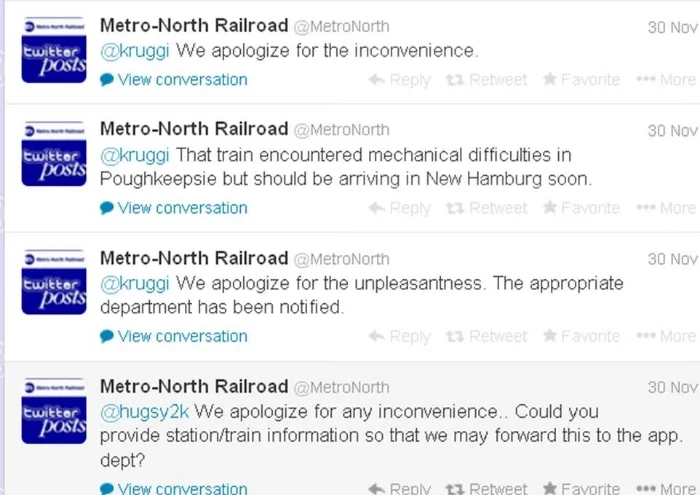
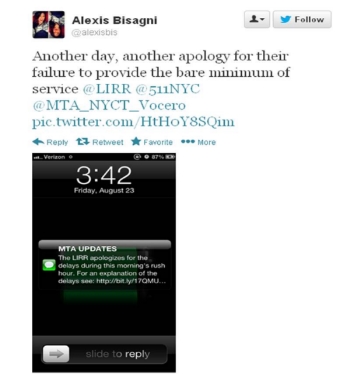
A Twitter search for an apology revealed nothing. Metro-North tweeted a flurry of apologies about service failures before the accident, and one rider posted an MTA text message apologizing for service back in August.

A NY Daily News article from November 11 tells us we should expect nothing like an apology:
"The MTA doesn't issue an apology when someone is hit by a subway train - and it doesn't whip out the checkbook, either.
"About 90% of the 92 "man-under" lawsuits that were resolved in the last five years ended in the Metropolitan Transportation Authority's favor, according to a breakdown by the MTA.
"The MTA didn't pay a dime in 73 of those cases. It dispensed with another nine cases with paltry go-away payments averaging $40,000, according to the authority's information. Five big cases did result in payoffs totaling $33 million. . . ."
Between Sunday, when the accident occurred, and today, Thursday, at noon, Metro-North tweeted about 85 times. Three of those tweets apologize only for service issues.
The only hint of humanity seems to be in this tweet:

Discussion Starters:
- How is the MTA different from other organizations we have seen apologize over the past several years?
- What is the legal perspective on apologies? How can a management team effectively balance this with humanity?
- Draft a tweet, news release, and email to victims' families to apologize for the derailment.
Study Finds Facebook Improves Image During a Crisis
 A Missouri School of Journalism study found that Facebook posts improved how people perceived organizations during a crisis. A doctoral candidate showed study participants two fictional stories about universities in crisis. Then, participants read Facebook posts by each university and were asked how the felt about the crisis. Attitudes about the organizations improved, and participants thought the crisis was less severe.
Seoyeon Hong also found that a narrative, or storytelling, type of writing in the Facebook posts was more effective than a style that wasn't narrative:
"This indicates that the effect of narrative tone in organizational statements during crises increases perceived conversational human voice, which represents a high level of engagement and best communicates trust, satisfaction, and commitment to the audience. This is an important practice for public relations professionals because perceptions that an organization is sincerely trying to provide timely and accurate information during a crisis can lead to not only more favorable attitudes toward the organization, but also perceptions of less responsibility the organization has for causing the crisis."
Discussion Starters:
- Does this research surprise you? Why or why not?
- Find an example of an organizationi's Facebook post written as a narrative. What is effective about that style?
Yale Communicates During "Lockdown"
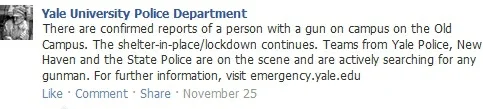
Yale University had a communication challenge after a threatening phone call caused a campus lockdown. A student reported that his roommate was planning to go to campus with a gun. Later, the police interviewed a witness who saw someone with a "long gun." The call turned out to be a hoax, and reports of someone with a gun could have been a police officer, who were making their way to the scene.
Still, the university sprung into action, possibly with concerns about another Virginia Tech or Sandy Hook shooting. The university policy department provided updates on its Facebook Page.

Appropriate for crisis communications, these bad-news messages use the direct style: the main point is right up front.

Now, on Yale's Emergency Management site, we see no mention of a potential gunman. Likely the university would like to see the entire incident go away.
Discussion Starters:
- Look for other university communications about the incident. What else can you find?
- Although I can't find the email on the web, the articles reference one sent from the university to students and parents. What do you think was included in the message? Draft a possible outline of the email.
Walmart Workers Plan Strike on Black Friday
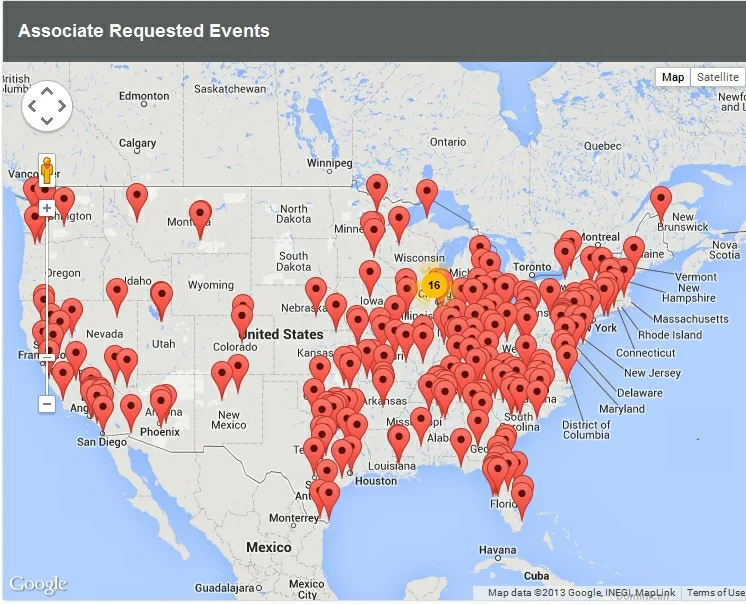
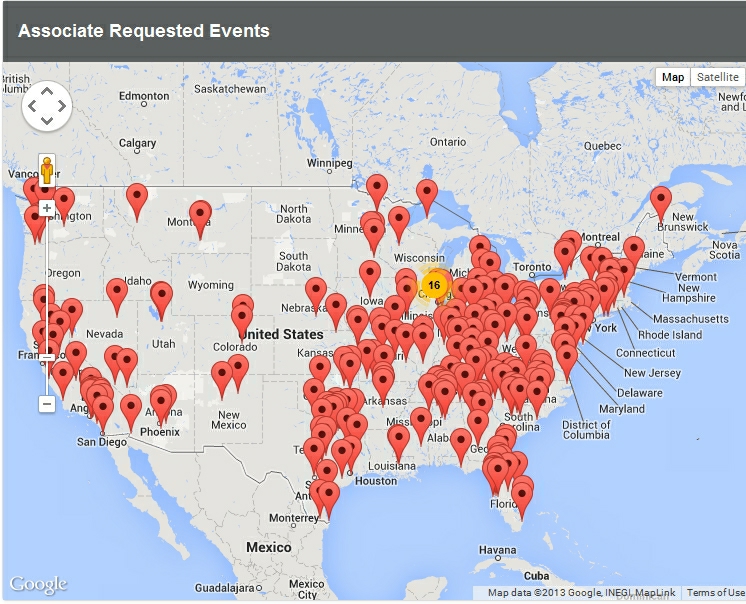
Our Walmart, an organization of employees, is planning a strike on Friday, November 29, Black Friday. On its website, Our Walmart conveys the group's mission:
OUR Walmart Vision
We envision a future in which our company treats us, the Associates of Walmart, with respect and dignity. We envision a world where we succeed in our careers, our company succeeds in business, our customers receive great service and value, and Walmart and Associates share all of these goals.
Called "Black Friday Walmart Protests," the strike is planned across the U.S. This map shows locations where associates have requested a strike.
Discussion Starters:
- Clearly, Our Walmart uses emotional appeal as the basis for its arguments. What about the video works well and what does not?
- Assess the Our Walmart website for effective design, organization, word choice, and so on. What improvements would you recommend for the site owners?
New "Teach" Campaign
The Department of Education is trying a new approach to get top students to become teachers. With help from Teach for America, Microsoft, State Farm, the teachers' unions, "Make More. Teach," videos feature teachers doing interesting work and show teaching as a rewarding profession.
Taylor Mali narrates the videos. Mali became associated with teaching after his comedy bit, "What Teachers Make." His commentary responded to criticism from someone asking the question about a teacher's salary.
The recruiting campaign is important, considering how the U.S. lags behind other countries in recruiting the best students. The comparison is clear in a McKinsey report, "Closing the Talent Gap: Attracting and Retaining Top-third Graduates to Careers in Teaching," which is featured in of Business Communication: In Person, In Print Online, Chapter 10.
Discussion Starters:
- Watch the videos. In what ways are they similar to the military recruiting ads?
- Analyze the persuasive strategies used. What examples do you find of logical arguments, emotional appeals, and credibility? How are visuals, voice, and music used? What types of people are portrayed, and so on?
Another Video from Low Pay Is Not OK
Here's another video brought to us by Low Pay Is Not OK, the organization promoting higher wages for fast-food workers. The last video was a captioned telephone call from McDonald's employee Nancy Salgado, asking about health and other benefits. This one takes issue with advice from the company to its employees.
In an email, the video was advertised with this introductory text:
Don't they read this stuff before they post it on the web?
McDonald's knows they don't pay their employees like me enough to make ends meet. But instead of paying us enough to get by, their "help" consists of a website that's chock full of CLUELESS (and offensive!) tips. You have to see it to believe it.
Titled, "McDonald's Really Told Their Employees to Quit Complaining," the video refers to documentation for employees:
Discussion Starters:
- What persuasion strategies are used in the video? Which are most and least effective in encouraging higher pay for workers?
- The music and graphics are similar to those used in the previous video. In what ways do they support and detract from the message?
Reinforcing Advertising Rules for Bloggers
 Bloggers who are paid by companies to advertise a product or service must come clean about the relationship, according to the U.K. Advertising Standards Authority (ASA). This should be just a reminder to bloggers because the rules aren't new-but apparently they aren't followed consistently.
The ASA article indicates that bloggers asked for clarification:
"Why are we doing this? We've received a steady stream of enquiries from bloggers wanting clarity on this issue and how the rules apply to their blogs."
Below are the rules:
Rules
2.1 Marketing communications must be obviously identifiable as such.
2.2 Unsolicited e-mail marketing communications must be obviously identifiable as marketing communications without the need to open them (see rule 10.6).
2.3 Marketing communications must not falsely claim or imply that the marketer is acting as a consumer or for purposes outside its trade, business, craft or profession; marketing communications must make clear their commercial intent, if that is not obvious from the context.
2.4 Marketers and publishers must make clear that advertorials are marketing communications; for example, by heading them "advertisement feature."
Part of the issue may be that bloggers are paid but asked by companies not to disclose the relationship. Although this puts bloggers in a difficult position, the rules-and ethics-are clear. Perhaps companies need the reminder, not bloggers.
Discussion Starters:
- What situations may be blurry for bloggers? Think of a few examples when the rules may not be clear.
- What are the U.S. rules for bloggers? Research the issue and compare the advice for U.S. blogger.
- What are the rules for people who tweet? Should celebrities, for example, reveal their relationships with companies they promote?

Guns & Ammo Editor Resigns Over Controversial Article
 Guns & Ammo editor Jim Bequette is stepping down after publishing an editorial, "All Constitutional Rights Need Regulation, Even 2nd Amendment." As a firearms magazine, Guns & Ammo doesn't typically include articles about regulation.
Bequette's apology was posted to the website:
"As editor of Guns & Ammo, I owe each and every reader a personal apology.
"No excuses, no backtracking.
"Dick Metcalf's 'Backstop' column in the December issue has aroused unprecedented controversy. Readers are hopping mad about it, and some are questioning Guns & Ammo's commitment to the Second Amendment. I understand why."
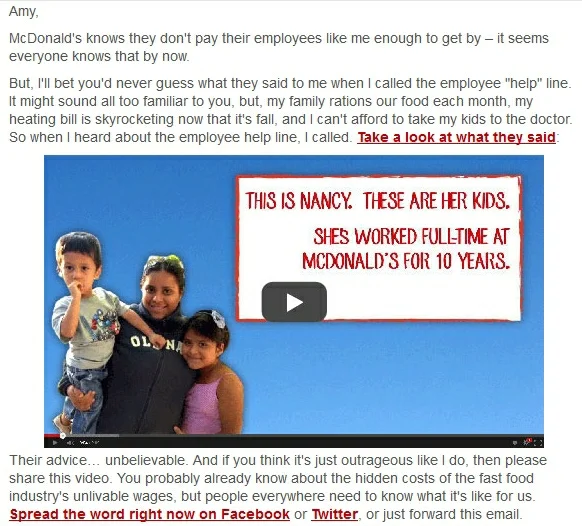
McDonald's Employee Help Line Is Recorded
You many remember Nancy Salgado, who recently confronted McDonald's USA President about her wages. She claims to be working at the restaurant chain for 10 years and is making $8.25 an hour.
The organization "Low Pay Is Not OK" posted a recording of her call to McDonald's employee help line. I received an email about the incident:

Video captions of the phone interaction focus on public assistance for McDonald's workers:
Discussion Starters:
- How do you assess the organization's argument that the public is supplementing workers' wages? In what ways do you find this argument convincing, and how does it fall short?
- Imagine that you're the person who received Salgado's call on the help line. How would you react to the posted video? Should she have done anything differently on the call?
- The recording is clearly edited. What do you think may have happened during the deleted portions? Does that affect your reaction?
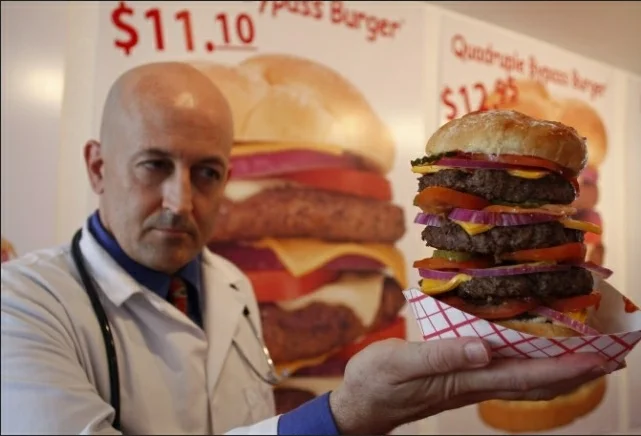
Former Hostess of Heart Attack Grill Tells All
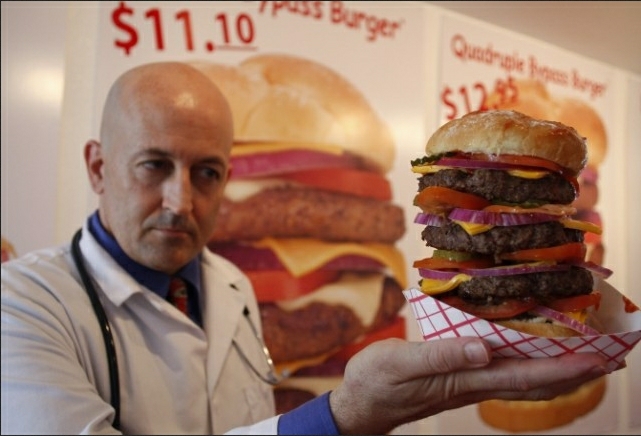 I guess we should expect unorthodox practices at a restaurant called Heart Attack Grill, but still, an ex-hostess's comments on Reddit are surprising. In an opening post, the former employee welcomes questions:
"I am an ex-Hostess of the controversial Heart Attack Grill. If you aren't familiar it's the restaurant located in Downtown Vegas who is known for their 9000 calorie Quadruple Bypass Burger, Butterfat Milkshakes, and the infamous "if you weigh 350 pounds you eat for free" gimmick. It is a hospital themed restaurant where all customers have to wear hospital gowns, and if you don't finish your food we spanked you with a paddle. Ask me anything!"
One jarring admission on the website (if it's true) is that the employee's manager had her video record a person who passed out in the restaurant:
"At one point, the man passed out. I heard him knock onto the hard ground. We had to call an ambulance. A manager made me take out my cell phone to record a video of the whole thing, so they could send it to the media. It was on a Friday afternoon, and he hoped it would make the news so they could have a busy weekend. The food may or may not have been responsible for what happened to that man."
With a name like Heart Attack Grill, you don't shy away from controversy. Rather, the restaurant founder and owner Jon Basso promotes the food, admitting in a Bloomberg interview, "I am probably the only restaurateur in the entire world who is unapologetically telling you that my food is bad for you, that it will kill you, and that you should stay away from it."
The Heart Attack Grill website describes the business: selling high-calorie food (including an 8,000-calorie Quadruple Bypass Burger), having customers dress in hospital gowns, spanking customers who don't finish their meal, and offering free meals to customers weighing over 350 pounds.
Discussion Starters:
- What's your view of the restaurant's "unapologetic" strategy?
- How do you assess the ex-hostess's Reddit posts? After reading several of them, do you think she helped or hurt the brand?
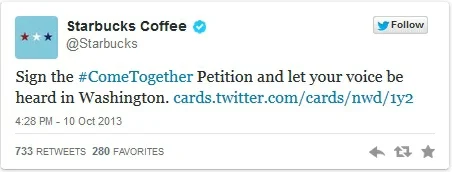
Starbucks' Petition to End the Government Shutdown
If you've been to Starbucks lately, you may have seen a petition to end the government shutdown. The company is promoting the petition through several channels.
In a brief video on Instagram, CEO Howard Schultz asks customers to "Join us in our stores to sign a petition to ask our government to come together, solve our problems, and open up our government."

With the hashtag #ComeTogether, Starbucks is inspiring its 4.7 million followers to sign, and full-page print ads in The New York Times, The Wall Street Journal, USA Today and The Washington Post are promoting the campaign.
If that's not enough, Starbucks is asking people to text a code to encourage the government to get back to work.
Discussion Starters:
- This is not the first political issue that Starbucks has gotten behind. What other recent examples can you find?
- What are the risks and rewards for Starbucks' involvement in this campaign? Why would the company-and Schultz particularly-want to deal with this controversy?
- Overall, do you think it's a good idea? Why or why not?
Employee Confronts McDonald's President at Dinner
The president of McDonald's USA Jeff Stratton was caught off guard during a dinner in Chicago. Ten-year-employee Nancy Salgado interrupted the event at the Union League Club of Chicago when Stratton was speaking. The confrontation was captured on video and is described by TheRealNews.com.
On the video, Salgado says, "I'm a single mother of two. It's really hard for me to feed my two kids and struggle day to day. Do you think this is fair that I have to be making $8.25 when I've been working at McDonald's for 10 years?"
Stratton responded, "I've been there 40 years." Then, Salgado was told she would be arrested. She and six other protestors were given trespassing tickets.
Discussion Starters:
- What's your view of the situation? What would lead Salgado to confront the president in this way? On the other hand, what other avenues does she have?
- How do you assess Stratton's response? What could he have said or done differently?
Twitter CEO Responds to Criticism About Lack of Women Execs
As Twitter's IPO approaches, the company is being criticized for having an all-white board and only one woman on its executive team (an attorney who was hired five weeks ago). Also, although Twitter has females in VP business roles, none are in technical roles.
Twitter management has acknowledged the problem. Back in March, chief technology officer Adam Messinger told The New York Times: "Half our customers, more or less, are women, and we want to have empathy for our customers, and part of that is having a wide variety of opinions in-house. It's also something a lot of people here think is the right thing to do." He also said, "There is definitely a supply-side problem." A New York Times writer has since suggested 25 women from a variety of industries who would "bring value beyond a checked box."
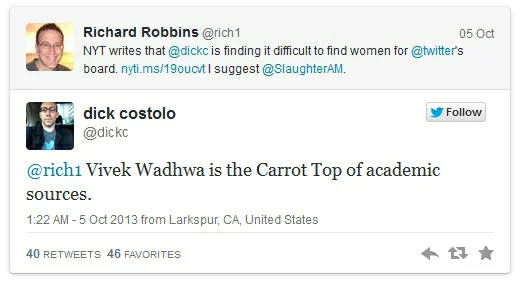
In response to the criticism, CEO Dick Costolo attacked Vivek Wadhwa, who was quoted in the NY Times article:

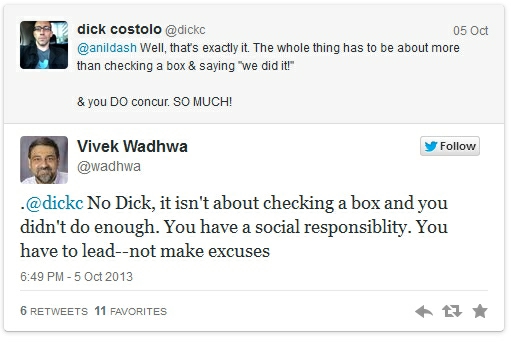
In a blog post for the Wall Street Journal, "Silicon Valley Has a Code Name for Sexism & Racism," Wadhwa asked for an apology-and flung an insult of his own:
"Yes, Costolo's comments were inappropriate and he owes me a formal apology. But I don't for a moment think that he is overtly sexist or that he deliberately discriminates. I think that he is reflecting a common behavior in Silicon Valley, where power brokers proudly tout their 'pattern recognition' capabilities. They believe they know a successful entrepreneur, engineer, or business executive when they see one. Sadly, the pattern is always a Mark Zuckerberg, Marc Andreessen, Jeff Bezos-or themselves. Nerdy white males."
And the missives continue:
Discussion Starters:
- Some people have expressed disappointment in what they consider Costolo's defensiveness. What's your view? What could have been a better response?
- How, if at all, do you think this controversy will affect Twitter's pending IPO? Should the issue of female management be a consideration as the comany goes public?