
Layoffs at Qualcomm
A Business Insider headline puts the news and purpose right up front:
Qualcomm is reportedly laying off as many as 1,000 employees as part of a $1 billion cost savings plan
The decision comes after a hostile takeover bid from Broadcom, a competitor in Singapore. Qualcomm made a commitment to save costs to its shareholders and appears to be following through, despite that the failing takeover bid.
A Bloomberg report reminds us that the company cut jobs in 2015, as well, in response to an activist investor's interests. A New York Times article calls Qualcomm "collateral damage" in "a looming trade war between the United States and China" that may impinge the company's growth.
The company declined to comment on news stories, and nothing related to layoffs is posted on its website.
Discussion:
- Should Qualcomm executives be more forthright about the change? What, if anything, should they communicate to the public and how?
- How do you assess the admission that the layoffs are intended to ward off hostile takeovers and reduce costs? How do you think these reasons would be received by shareholders? the press? customers? employees?
- How are the news and the company's communication an issue of integrity for Qualcomm?
Starbucks Apologizes, Again

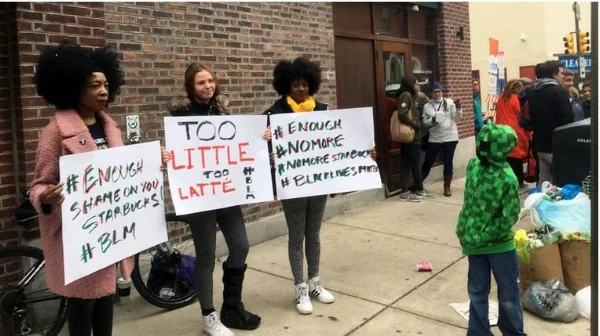
Two black men were arrested at a Philadelphia Starbucks. Witnesses say they were just waiting for a friend and asked to use the restroom. The reason for calling the police seemed to be the same: that they were just waiting for friend. But because they didn't order anything, they were asked to leave and did not. Other customers say this is common at Starbucks, and the only reason the police were called was because the two men were black.
The company, at first, gave a weak apology using unclear pronoun references (see "this" and "these"). A longer apology came from the CEO Kevin Johnson later. In the statement, he identified steps the company would take and closed with this paragraph:
Finally, to our partners who proudly wear the green apron and to customers who come to us for a sense of community every day: You can and should expect more from us. We will learn from this and be better.
Johnson also posted an apology video.
In a video statement, Philadelphia Police Commissioner Richard Ross explained the situation from his point of view and defended the officers' actions. He also said that all officers get implicit bias training and gave an example of a police sergeant who was also denied access to a Starbucks bathroom. Ross's conclusion was that "they are at least consistent in their policy." Of course, not everyone agrees.
Discussion:
- Analyze Johnson's statement. Who are his primary and secondary audiences? What are his communication objectives, and how well did he achieve them?
- What organizational strategy does Johnson's statement illustrate? How do you assess his tone and writing style?
- What is an unclear pronoun reference, and how are they used in the first apology?
- What's your view of the situation? Did Starbucks do wrong? If so, at what point(s)? Are you boycotting Starbucks, as some promote, as a result?
- Which leadership character dimensions are illustrated by this example?

Volkswagen Replaces Chairman

Three years after the emissions scandal, Volkswagen is replacing another chairman. Matthias Müller replaced Martin Winterkorn, who was ousted soon after the news broke in 2015. But Müller was another insider and hasn't led the turnaround the board expected.
Like Winterkorn, Müller struggled with public relations. During a 2016 NPR interview, Müller claimed the company misunderstood the American environmental law: “We didn’t lie. We didn’t understand the question [at] first.” After much criticism, VW’s communications department asked for another interview, which was granted. He delivered a better apology but blamed the first interview on “all these colleagues of yours and everybody shouting.” In other words, it was noisy.
As is customary in corporate change announcements, Chairman of the Supervisory Board Hans Dieter Pötsch spoke positively about the outgoing executive:
“Matthias Müller has done outstanding work for the Volkswagen Group. He assumed the chairmanship of the Board of Management in the fall of 2015 when the Company faced the greatest challenge in its history. Not only did he safely navigate Volkswagen through that time; together with his team, he also fundamentally realigned the Group’s strategy, initiated cultural change and, with great personal commitment, made sure that the Volkswagen Group not just stayed on track but is now more robust than ever before. For that, he is due the thanks of the entire Company.”
The new chairman, Dr. Herbert Diess, offers more hope. Diess joined the board in 2015 and is known for having conflicts with the union and for cost-cutting. He may shake up the status quo at VW and inspire real action. The company has aggressive plans, including building greener cars—for real this time.
Image source (VW cover).
Image source (Diess).
Discussion:
- Assess the company's statement about this change. Who are the primary and secondary audiences? What are the communication objectives? How well does the statement meet those objectives?
- Why do these statements typically include positive quotes about outgoing executives, even if they are asked to leave or, as this statement indicates, they leave "by mutual agreement"?
- What lessons do you think Volkswagen learned since the scandal?
- Why would the board appoint someone who is considered divisive?
Howard University Reports on Misappropriated Funds

Howard University's investigation has concluded that $369,000 had been misappropriated by six employees who were terminated last year. A full report by the university identifies how they "double dipped" by receiving both tuition assistance and university grants between 2011 and 2016.
In a cover letter to the report, President Wayne A.I. Frederick wrote, “Howard University is committed to uncovering any impropriety in the administration of university-provided financial aid and federal student aid, to remediating all problems identified during this investigation, and to maintaining a robust compliance program to prevent any inappropriate dealings in the administration of financial aid."
A Washington Post article reports that the university tried to avoid going public before the review was completed, but an article posted online made this impossible. Student protests, which went on for more than a week, also may have sped up the timing.
Discussion:
- What business writing principles does the report demonstrate and fail to demonstrate? How could the report be improved?
- Assess the president's cover letter. Who are his primary and secondary audiences, and what are the communication objectives? How well does the letter achieve those objectives?
- What can the university do now to restore trust?
- How well does the university take responsibility for the situation?
Major Retailers Respond to Data Breach
Retailers Saks Fifth Avenue and Lord & Taylor experienced a data breach affecting about 5 million customers. Hackers JokerStash Syndicate (also known as Fin 7) stole and resold credit and debit card information retrieved during the sales process.
Both companies are owned by Hudson's Bay Co., and we see that their customer messages have been coordinated. On both retailers' websites, text appears at the top of the page in a yellow box. When you click on the "Important Message" link, you see two statements dated one day apart and a list of FAQs.

The second message is below:
April 2, 2018 Statement
Updated Statement
We recently became aware of a data security issue involving customer payment card data at certain Saks Fifth Avenue, Saks OFF 5TH, and Lord & Taylor stores in North America. We identified the issue, took steps to contain it, and believe it no longer poses a risk to customers shopping at our stores. While the investigation is ongoing, there is no indication that this affects our e-commerce or other digital platforms, Hudson's Bay, Home Outfitters, or HBC Europe. We deeply regret any inconvenience or concern this may cause.
We wanted to reach out to our customers quickly to assure them that they will not be liable for fraudulent charges that may result from this matter. Once we have more clarity around the facts, we will notify our customers quickly and will offer those impacted free identity protection services, including credit and web monitoring. We encourage our customers to review their account statements and contact their card issuers immediately if they identify activity or transactions they do not recognize.
We are working rapidly with leading data security investigators to get our customers the information they need, and our investigation is ongoing. We also are coordinating with law enforcement authorities and the payment card companies. For further information, please visit https://www.saksfifthavenue.com/security-information/notice.html, https://www.saksoff5th.com/security-information/notice.html, or https://www.lordandtaylor.com/security-information/notice.html. To speak with a dedicated call center representative, beginning April 4, 2018, you can call 1-855-270-9187, Monday - Saturday, 8 am - 8 pm CT.
Discussion:
- Read the statements on the retailers' websites. Identify the primary and secondary audiences and communication objectives.
- How well do the statements achieve their objectives? What else, if anything, should the companies communicate at this point?
- To what extent are the retailers holding themselves accountable for the breach?
Howard University Responding to Embezzlement

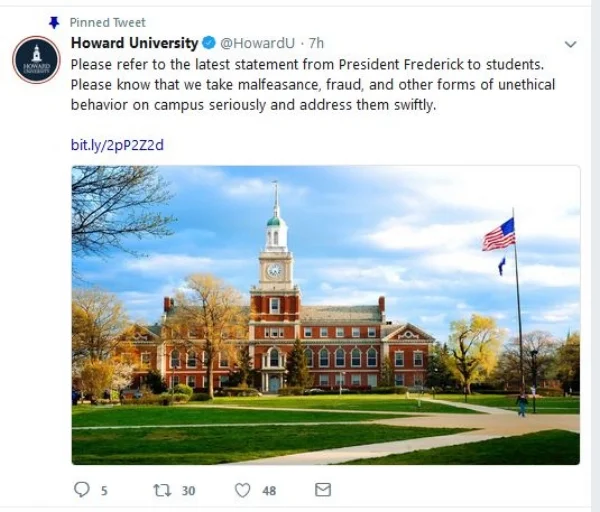
Six student employees were terminated by Howard University for embezzling financial aid funds. The students made up fake scholarships and found other ways to steal what could be more than $1 million.
On Twitter, the student association unleashed its frustration with the university's response. In a statement, President Wayne Frederick expressed empathy for this frustration and for other reactions:
Hearing about the mishandling of funds at the University can be difficult to process. I can also understand how upsetting it is to feel that the University has not communicated with you regarding this incident. The goal established at the onset of this investigation was to conduct it in a confidential manner that ensured a thorough examination of the issues without jeopardizing the integrity of the findings. However, that does not mitigate the sense of mistrust that many students and members of our community feel right now. We understand that and we hear you.
The statement also describes plans for investigating the charges and ends on a positive note.
Discussion:
- The above paragraph from the president's statement raises an interesting conundrum: how do leaders ensure both privacy and transparency? The same issue is relevant to investigating sexual harassment claims. What are your thoughts? How, if at all, is it possible to achieve both?
- Assess the president's statement. Who is the audience, and what are the communication objectives? How is the statement organized? How would you describe the writing style, tone, and so forth?
- How well does the president's statement demonstrate accountability?

Old and New Email Advice

The Wall Street Journal reports on new research that may improve business professionals' efficiency and reduce stress. We already know some of the email advice, but the article adds nuance to some decisions. For example, most people know to avoid all caps because it looks as though you're yelling. But one study shows that "AND" or "BUT," for example, can "provide emphasis, communicate urgency, or inject humor."
Older advice still stands, for example, to avoid answering too quickly and sending messages after work hours. Obsessively checking one's inbox is still a problem for many people, so closing email applications and scheduling times to check (for example, once every 45 minutes) is a better choice. Otherwise, incoming email interrupts work, and it takes people about a minute to get back to where they were.
The article also warns against using emoticons or emojis when you don't know the receiver well. Readers tend to judge these writers as incompetent. But go ahead and use them for internal communication, particularly within teams of people who know each other well.
New research about timing may help business professionals get the response they want. People respond most quickly to emails earlier in the week and earlier in the day, so sending an email on Monday between 8 am and noon may be a better choice than, say, Friday afternoon.
Discussion:
- What are your biggest challenges with email? How have you overcome them?
- As a reader, what, if any, aspects of emails that cause you to judge the intelligence or competence of the sender?

FB Admits Mistakes and Makes Promises

After five days of silence, Facebook CEO Mark Zuckerberg is addressing new criticism about privacy issues. Recent reports describe how Cambridge Analytica used data from about 50 million FB users without their permission, possibly to influence voters during the 2016 presidential campaign. Although some users gave permission for their information to be shared, their "friends" didn't, and this gave developers enormous amount of data about people's preferences. In addition, Cambridge claimed it had deleted data in 2014, but new reports indicate it did not.
Now Zuckerberg is visible in the media and has issued a statement that included the company's responsibility and failings:
We have a responsibility to protect your data, and if we can’t then we don’t deserve to serve you. I’ve been working to understand exactly what happened and how to make sure this doesn’t happen again. The good news is that the most important actions to prevent this from happening again today we have already taken years ago. But we also made mistakes, there’s more to do, and we need to step up and do it.
He also told CNN, "I'm really sorry that this happened." He promised to limit developers' access to data in the future.
Facebook also published a full-page newspaper ad in the New York Times on March 25.
Discussion:
- How does this situation represent issues of integrity and trust?
- Read Zuckerberg's full statement. Which parts do you find most and least convincing?
- How is the statement organized? Is this the best approach, or could other organizational strategies have worked better?
- Assess Zuckerberg's writing style. Which principles of business writing are followed, and which are not?
Toys R Us Closes

https://www.toysrusinc.com/restructuring
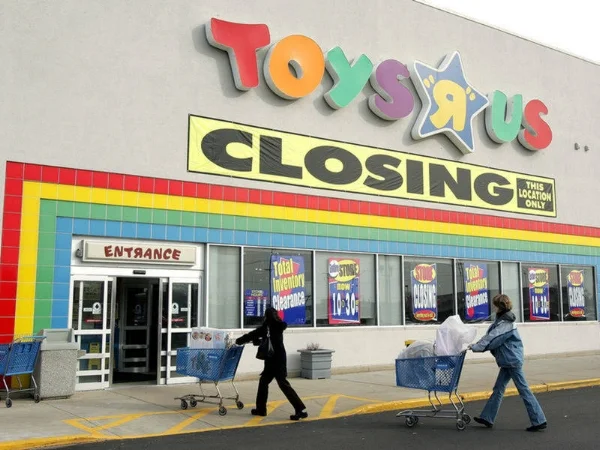
Toys R Us will close its remaining 735 U.S. stores and will lay off about 33,000 employees around the country. The company tried to survive after a bankruptcy filing in 2017, but the retailer can't compete with large stores, such as Walmart, and online sellers, such as Amazon.
Critics say Toys R Us failed to generate excitement, as one analyst describes in The Washington Post article:
“The liquidation of Toys R Us is the unfortunate but inevitable conclusion of a retailer that lost its way. Even during recent store closeouts, Toys R Us failed to create any sense of excitement. The brand lost relevance, customers and ultimately sales.”
A professor of brand management echoed this theme:
“We know that customers are willing to pay more for an enjoyable experience — just look at the lines at Starbucks every day — but Toys R Us has failed to give us anything special or unique. You can find more zest for life in a Walgreens.”
New York Senator Chuck Schumer is asking for the Federal Trade Commission (FTC) to ensure that customers aren't left "holding the bag" if they can't cash in or buy products with gift cards, particularly those recently received in December for Christmas.
Toys R Us has only a short statement on its website announcing the liquidation.
Discussion:
- Should the company leaders say more about the decision? What else, if anything, could be included in the statement?
- In addition to legal responsibilities, do company leaders have ethical responsibilities to make good on outstanding gift cards? Why or why not?
- In what ways has the company failed to learn from failure?

L.L. Bean: Return Doesn't Mean Lifetime Replacement
L.L. Bean has had it with customers who abuse their generous return policy. The company is making two major changes: customers must return products within one year unless they are damaged, and customers must produce a receipt.
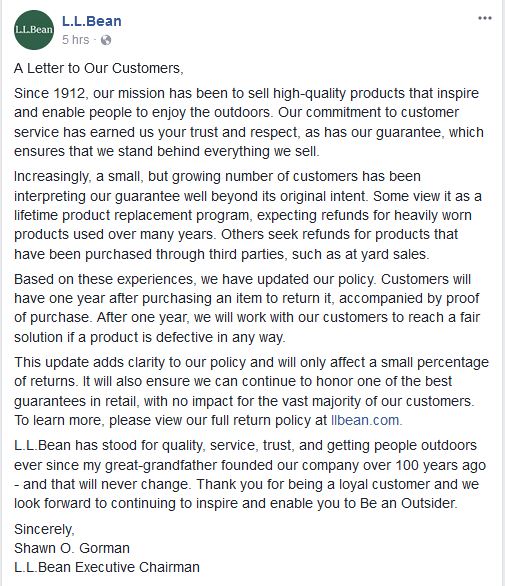
A company spokesperson explained the decision:
"If it's been over a year and someone is able to provide a proof of purchase and if the product does not fall within one of our Special Conditions such as products damaged by misuse, abuse, pet damage, personal reasons unrelated to product performance or satisfaction and more, we would honor the return."
Although it was a small percentage of customers, some had taken advantage of the product "guarantee." The question we might ask is, Why did it take so long? Or, why now?
Discussion:
- Why do you think L.L. Bean waited until now to tighten the return policy? What are the potential consequences of the decision?
- Assess the message to customers. Who are the primary and secondary audiences? How well does the message meets its objectives?
- How do you see this as an issue of integrity? How is L.L. Bean demonstrating learning from failure?

Questions of Transparency
The long-awaited memo written by Republican staff members about potential impropriety from the Justice Department and F.B.I in the Russia investigation has been revealed. Now, The New York Times editorial board is calling, once again, for President Trump to reveal his tax returns:
Since the Republicans are now on board with greater transparency, they will no doubt push President Trump to release his tax returns, as every other major-party presidential nominee has done for the past four decades, won’t they?
How about the White House visitor logs, which the Trump administration started hiding from the public last year? Or, say, the names of all foreign governments and officials who have stayed — at their own or at American taxpayers’ expense — at Mr. Trump’s Washington hotel, at his Mar-a-Lago resort in Florida or at his golf courses and his other businesses since he became president? Or the names of every foreign business with which the Trump Organization has a financial relationship, especially in countries where America has sensitive foreign policy interests, like China, India, Russia, Turkey or Saudi Arabia?

The reasoning sounds like reciprocity, but the argument may not get no more traction now than it did during the presidential campaign. A Pew research study in January 2017 showed that 60% of those surveyed believed Trump "has responsibility" to release his returns. Although some were adamant about the release at the time, the Wall Street Journal, for example, reported that the returns wouldn't tell us much anyway.
Discussion:
- What are the advantages and downsides of President Trump revealing his tax returns?
- Read the entire opinion piece. What other arguments do the authors make?
- Do you agree with their reasoning? Why or why not?
- How would you describe the tone? Does the approach help or hurt the argument?

Penn Removes Several Recognitions of Steve Wynn

For the first time in more than 100 years, the University of Pennsylvania has revoked an honorary degree. Following accusations of sexual misconduct against Steve Wynn, the trustees announced the revocation in addition to plans for removing Wynn's name from "Wynn Commons" and from a scholarship fund.
The message, sent by email and posted on the school's website, explained the decision and announced that an honorary degree for Bill Cosby also will be revoked. University leaders were careful to describe their decision process as well as the delay in revoking Cosby's degree. This is a good example of anticipating and addressing potential criticism.
Judging by comments on Twitter, reactions to the university's decision to take a stand seem to be neutral or positive.
Discussion:
- Did UPenn make the right decision? Why or why not?
- Analyze the message. What principles of business are followed, and how can the message be improved? Consider the audience analysis, organization, tone, and so on.
- How is this an example of courage? What risks does the university face?

How Well Can People Rate News "Credibility"?
Facebook has a solution to its fake-news problem: allow users to assess stories' credibility and trustworthiness. Stories rated more highly will get higher ranks in newsfeeds.

In a Facebook post, Mark Zuckerberg explained the plan:
Here's how this will work. As part of our ongoing quality surveys, we will now ask people whether they're familiar with a news source and, if so, whether they trust that source. The idea is that some news organizations are only trusted by their readers or watchers, and others are broadly trusted across society even by those who don't follow them directly. (We eliminate from the sample those who aren't familiar with a source, so the output is a ratio of those who trust the source to those who are familiar with it.)
Critics call the move "time-wasting stupidity":
So people get to rate the credibility of news. Based on what?
The answer is easy. People will believe any story that presents a view they want to hear.
Is there a point to this?
Sure, Facebook wants people to waste still more time on Facebook debating what is or isn't fake new [sic].
Rating news stores based on credibility is time-wasting silliness.
That's precisely why Facebook introduced the feature. Don't fall for it.
Discussion:
- Business communicators may have some questions as well. What principles of research and source credibility are in question here? What do we know about how people interact on social media that may jeopardize Facebook's plan?
- On the other hand, what is positive about the plan?
- On balance, are you more optimistic or pessimistic about Facebook's ability to reduce fake news?
- Assess Zuckerberg's writing skills in the full post. How well does he organize the message and communicate his ideas?
- Is this a good or a weak example of Facebook's accountability?
BlackRock Encourages "A Sense of Purpose"
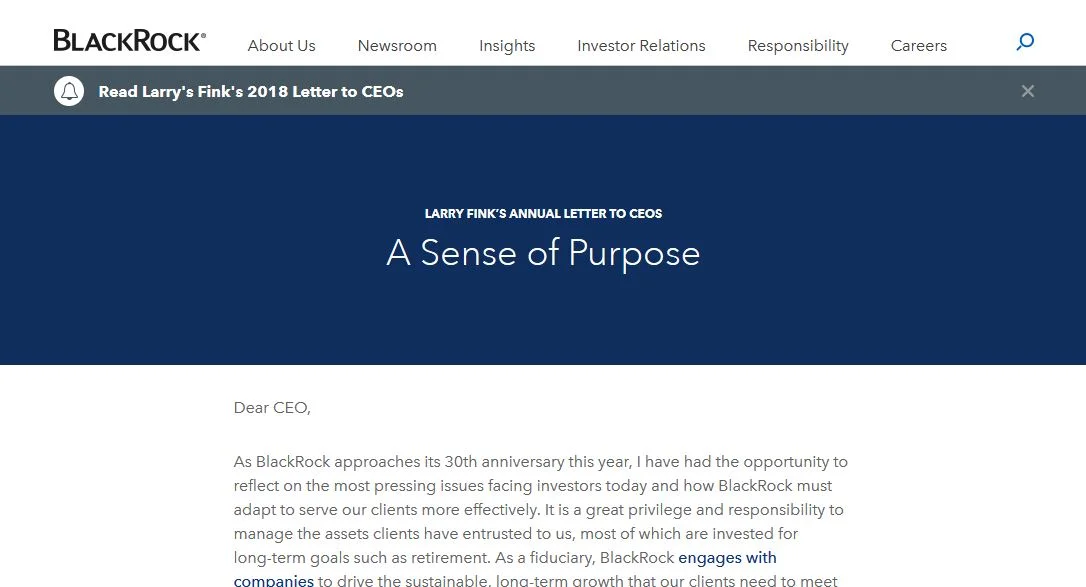
BlackRock CEO Larry Fink is encouraging companies to be more socially responsible. In his annual letter, the investment firm CEO describes the increasing wealth disparity in the United States:
"We are seeing a paradox of high returns and high anxiety. Since the financial crisis, those with capital have reaped enormous benefits. At the same time, many individuals across the world are facing a combination of low rates, low wage growth, and inadequate retirement systems. Many don’t have the financial capacity, the resources, or the tools to save effectively; those who are invested are too often over-allocated to cash. For millions, the prospect of a secure retirement is slipping further and further away – especially among workers with less education, whose job security is increasingly tenuous. I believe these trends are a major source of the anxiety and polarization that we see across the world today."

Fink is encouraging more engagement of shareholders and a focus on creating long-term value:
"Companies must ask themselves: What role do we play in the community? How are we managing our impact on the environment? Are we working to create a diverse workforce? Are we adapting to technological change? Are we providing the retraining and opportunities that our employees and our business will need to adjust to an increasingly automated world? Are we using behavioral finance and other tools to prepare workers for retirement, so that they invest in a way that that will help them achieve their goals?"
But critics say Fink is overstepping. On Squawk Box, Sam Zell said, "I didn't know Larry Fink had been made God."
Discussion:
- What's your view of Fink's position? Is this a good idea, or should he keep his thoughts to himself?
- What are Fink's communication objectives, and how well does he meet them?
- Assess the letter in terms of organization and writing style.

Intel CEO Warns of Vulnerability, a Little Late

The CEO of Intel has bad news: a patch for a chip vulnerability will slow down computer operations. In an interview with Bloomberg, a technology analyst explains the typical process when finding security issues: companies find a bug and solve it before going public. However, this time, an issue known for perhaps a year went unsolved and was kept quiet—until now.
Bloomberg says chip makers had downplayed the effects of the patch, but CEO Brian Krzanich has finally described the issue:
“We believe the performance impact of these updates is highly workload-dependent. As a result, we expect some workloads may have a larger impact than others. As of now we have not received any information that these exploits have been used to retrieve customer data.”
In other words, the patch works but will slow down operations.
A technology analyst says this is the first time chip makers like Intel have gotten caught needing to admit a potential vulnerability, and it's unclear why it hasn't been fixed before this point.
Bloomberg reports on the secrecy and implications:
“Our first priority has been to have a complete mitigation in place,” said Intel’s Parker. “We’ve delivered a solution.”
Some in the cybersecurity community aren’t so sure. Kocher, who helped discover Spectre [a bug], thinks this is just the beginning of the industry’s woes. Now that new ways to exploit chips have been exposed, there’ll be more variations and more flaws that will require more patches and mitigation.
"This is just like peeling the lid off the can of worms," he said.
Discussion:
- In what ways did Intel avoid accountability? How did the avoidance affect the company? What would have been a more appropriate response to finding the bugs?
- Distinguish between this computer vulnerability and vulnerability in interpersonal relationships. One is good; the other is not.
- Read the Intel CEO's quote, above. It sounds jargony but was presented at CES, a conference of IT professionals. Did he use appropriate language, or does his word choice demonstrate a lack of transparency? What do you think?

Banned Words for the CDC?
The Washington Post may have "mischaracterized" a report that the Centers for Disease Control (CDC) was "banned" from using certain words in its budget documents. Reports claimed that the Trump Administration would prevent the CDC from using these seven words: vulnerable, entitlement, diversity, transgender, fetus, evidence-based, and science-based.
But in a Facebook post, CDC Director Brenda Fitzgerald denied such restrictions. She is upholding the integrity of the organization.

What really transpired between the CDC and the Trump Administration? The Human Rights Commission, an LGBTQ organization, wants to know. In addition to projecting the seven words boldly across a Trump hotel in Washington, D.C., in protest, the organization has asked for more information:
"In conjunction with the enormous light display, HRC has filed a Freedom of Information Act (FOIA) with the Department of Health and Human Services (HHS) for any and all records, including communications with the CDC, relating to the banned words from November 2016 onward."
Discussion:
- How is this an issue of integrity for the CDC? What do you think actually transpired between the CDC and the Trump Administration?
- Where do you think the Washington Post went wrong—or did it?
- Assess the CDC director's response. How well did she handle the issue and rebuild the agency's image?
Delta Communicates Flight Cancellations

Delta announced that about 375 flights were cancelled because of weather conditions around Atlanta. In a short statement on its website, Delta explained the decision and provided customers with sources for more information.
Since the first announcement, Delta posted a large notice on the site: "UPDATED: Delta teams working through night to reset ATL operations." The company also posted updates at noon and again at 4 pm.
Discussion:
- Read the entire statement on the Delta website. Analyze the primary audience and identify the communication objectives. How well does the company meet these objectives?
- Assess the organization. Where are the main points, and how is the rest of the message structured?
Persuasive Letter from Scholars to NYC Mayor

New York City Mayor Bill de Blasio is under pressure to remove four statues that a group considers racist. More than 120 academics and artists signed a letter to persuade the mayor.
The letter assumes that two monuments "have no place on City property" and have "no defenders." They describe them as follows:
- The Dr. J. Marion Sims statue in Central Park, commemorating a doctor who performed surgical experiments on enslaved African American women, including children, without anesthesia or consent. Momentum for its removal has spurred a remarkably broad coalition in support of the long-standing demand from Black and Latinx Harlemites that this affront be removed.
- Historic markers of Vichy France’s Nazi collaborators, Philippe Pétain and Pierre Laval, are located in the Canyon of Heroes. Lest anyone need reminding, Vichy organized its own deportation to Auschwitz of over 70,000 Jewish French citizens.
The other two are more controversial, and the authors identify several arguments to support removing them. One is of Theodore Roosevelt, and the other is of Christopher Columbus.
In closing the letter, the group suggests alternatives:
In calling upon the Commission to recommend the removal of the aforementioned monuments, we also endorse any forward-looking post-removal initiative to advance understanding of these histories and make creative use of the vacated city property. These statues could be placed in dedicated museum spaces or memorial gardens, as has happened in Germany, India, South Africa and across Eastern Europe. The Roosevelt monument by James Earle Fraser could be profitably displayed alongside Fraser’s The End of the Trail in the Metropolitan Museum, for example, so that viewers could explore how race and eugenics were visualized in the period. The empty sites could be used as the subject for artistic competitions, as with London’s Fourth Plinth in Trafalgar Square. In short, we see the outcome of the Commission not as destroying heritage, let alone the purported erasure of history, but as the beginning of an exciting new set of possibilities for public art and museums in New York City, one finally devoted to an inclusive and reparative vision of the difficult histories of settler colonialism and the Indigenous peoples of this land.
Discussion:
- How would you describe the writing style in the letter? In what ways is it similar to and different from business writing?
- How is the letter organized? How could the organization be improved?
- Assess the argument for the two monuments in question. How do the authors use logical arguments, emotional appeals, and credibility? Which are their strongest and weakest arguments?
Chipotle Announces Search for New CEO

After founding the first Chipotle restaurant in 1993, Steve Ells will leave his position as CEO and become executive chairman. Chipotle locations have struggled with food safety issues since 2008, when customers at a La Mesa, California, restaurant came down with hepatitus, and 54 Kent State students were affected by norovirus at a local restaurant. Since then, other locations have been affected by these illnesses as well as Salmonella and E. Coli.
Company stock has suffered, and this move signals a hopeful change. It's a tough spot for the company's board because Ells has been the face of Chipotle for so long, but the situation has not improved despite efforts for better food safety and new menu items, such as queso dip, which was not well received.
In a company press release, Ells is quoted:
“I am incredibly proud of Chipotle and our people – and grateful to our loyal customers – and while we are continuing to make progress, it is clear that we need to move faster to make improvements,” said Ells. “Simply put, we need to execute better to ensure our future success. The Board and I are committed to bringing in an experienced leader with a passion for driving excellence across every aspect of our business, including the customer experience, operations, marketing, technology, food safety, and training.”
Added Ells, “Bringing in a new CEO is the right thing to do for all our stakeholders. It will allow me to focus on my strengths, which include bringing innovation to the way we source and prepare our food. It will ultimately improve our ability to provide our guests with delicious food that is prepared with high quality ingredients that are raised responsibly and served in a way that is accessible to everyone. I am confident that this will allow us to deliver value for our shareholders, and provide rewarding opportunities for our employees. Chipotle has vast unrealized potential. As we work hard to restore our brand, I believe we can capitalize on opportunities, including in areas such as the digital experience, menu innovation, delivery, catering, and domestic and international expansion, to deliver significant growth.”
The board chair is also quoted, speaking highly of Ells:
“Steve is a visionary leader and one of the most successful restaurateurs in history, having grown Chipotle from a single restaurant in Colorado to more than 2,350 restaurants today. Steve made the decision, and the Board agreed, that now is the right time to identify a new CEO who can reinvigorate the brand and help the company achieve its potential. We are committed to recruiting a world-class CEO for this incredible opportunity.”
Discussion:
- Read the entire press release. What is not said? Should the release include anything else?
- How well does Ells's quote inspire confidence in the future of the brand? What parts do you find most and least convincing?
- Who are the audiences for the press release? What are the company's objectives?
- In a sense the board is demonstrating vulnerability. How would you describe their approach, and how effective do you think this is?
More Than You Want to Know About Fonts
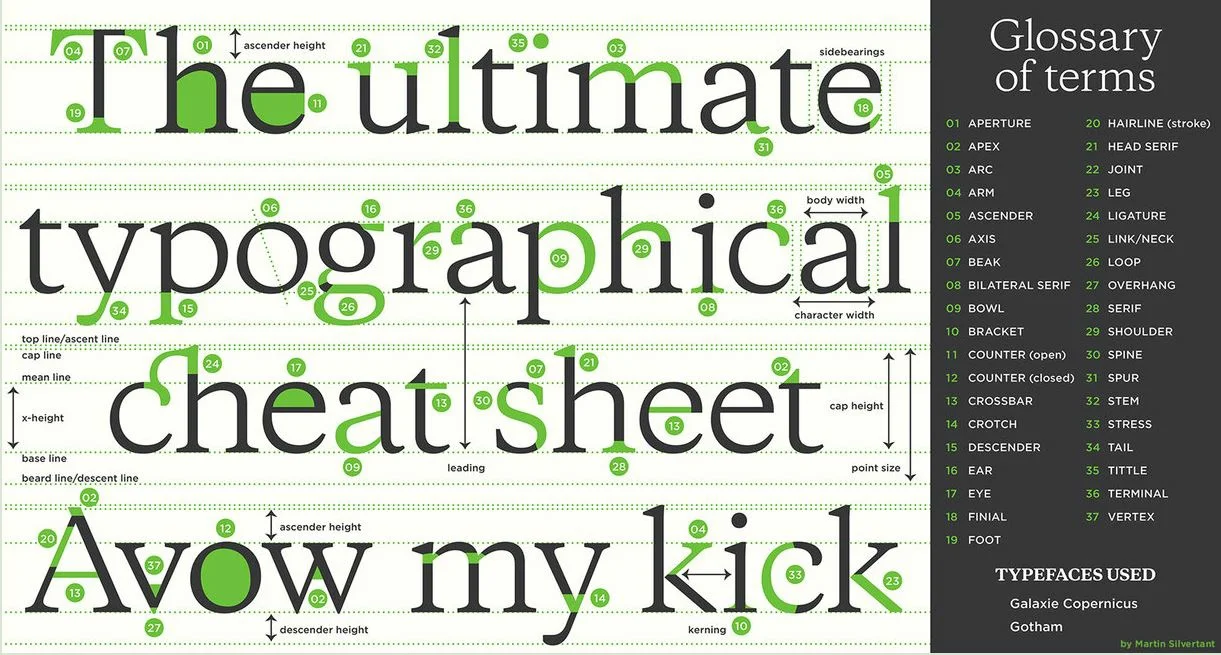
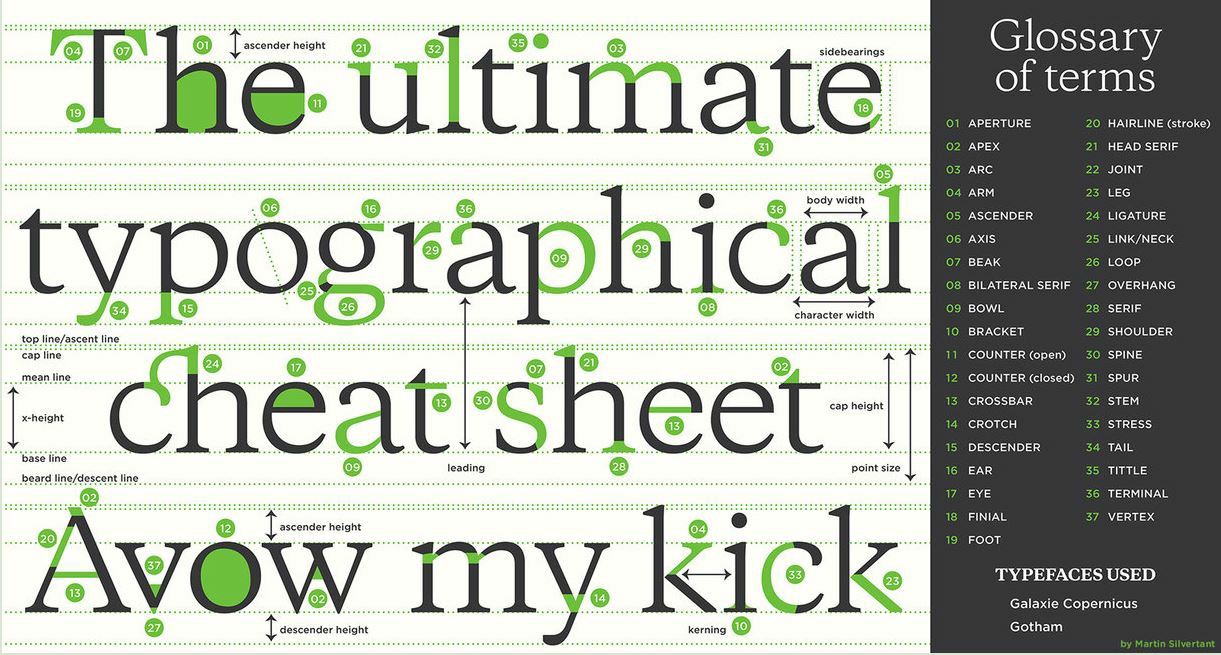 This may be more than mere mortals and business writers need to know, but typography is interesting. We often use default fonts that Microsoft chooses for us, but this graphic shows the many variables among them.
The most commonly known term is probably serif, shown here as 28 on the third row. The letter h in this font has small lines at the bottom. These "legs" are missing in sans-serif fonts, which means they are "without" them. Serif fonts include Times New Roman, Garamond, and Georgia (this one), while standard sans-serif fonts are Arial and Calibri.
Fonts can reflect a company or style of writing. Disney and others have their own special fonts, which could be fun for headings but may be too much for body text. People are long tired of Comic Sans, which is cute for K-12 documents but little else. Serif fonts tend to be more formal looking, while sans-serif are more informal.
Although presenters get creative in choosing fonts, a common problem is using a font that isn't installed on another computer. For example, you create a PPT file on one computer, but when you open the file on another and the font isn't available, the new computer will choose a default. This messes up alignment because the two fonts may be different sizes. More specifically, from the glossary at right, the character width, ascender height, or x-height may be different.
Some fonts are wholly unreadable and should be avoided entirely. Impact, for example, should be used sparingly for large headings only.
Discussion:
- Do you have a favorite font? What do you like about it?
- Have you tried different fonts for different purposes? How did it turn out?