
Restaurant Owner Terminates Employees but Fumbles the Explanation
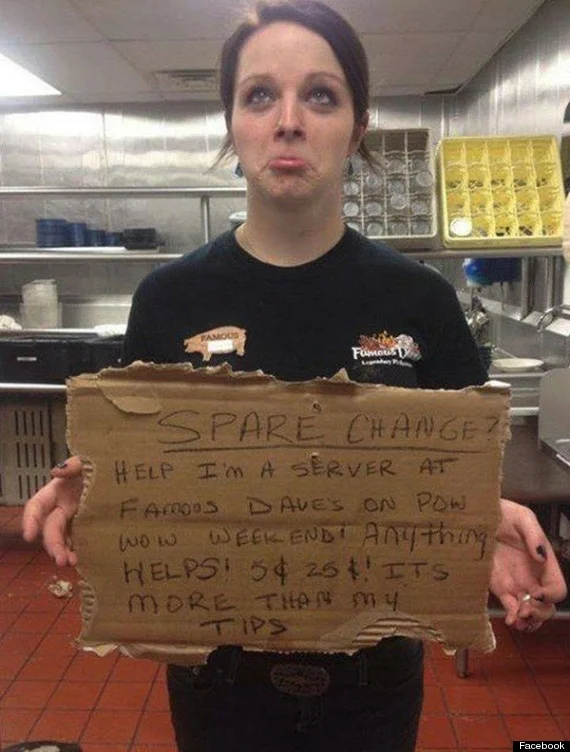
Two employees of Famous Dave's barbecue restaurant in North Dakota were fired for a Facebook post implying that Native Americans are bad tippers.
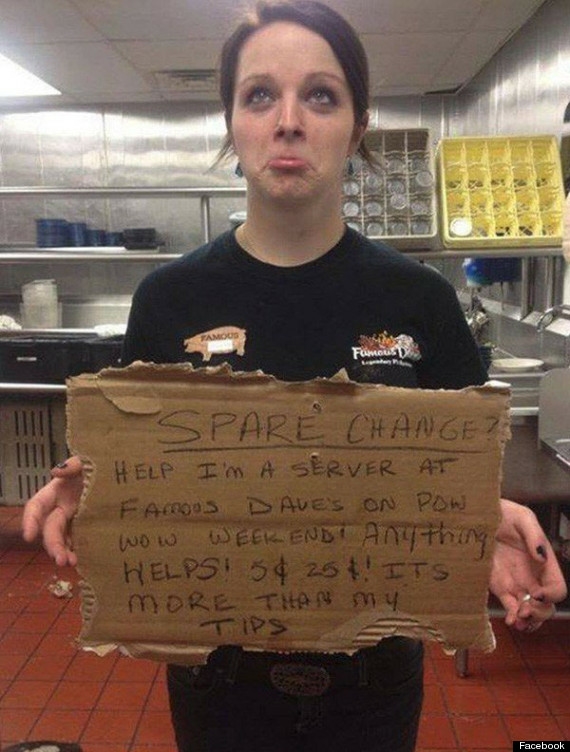 The photo was posted during United Tribes International Pow Wow, a festival attended by more 20,000 people, according to event organizers. According to The Huffington Post, the employee shown in the poto "denies creating the cardboard sign, but she doesn't deny posing for the picture." Good move!
Thinking the photo would disappear, the employee's friend shared the photo via Snapchat. Snapchat describes the app on its website, but in this case, the image was shared on Facebook:
"Snapchat is a new way to share moments with friends. Snap an ugly selfie or a video, add a caption, and send it to a friend (or maybe a few). They'll receive it, laugh, and then the snap disappears.
"The image might be a little grainy, and you may not look your best, but that's the point. It's about the moment, a connection between friends, and not just a pretty picture.
"The allure of fleeting messages reminds us about the beauty of friendship - we don't need a reason to stay in touch.
"Give it a try, share a moment, and enjoy the lightness of being!"
Snapchat has been criticized as an unsafe "sexting" app.
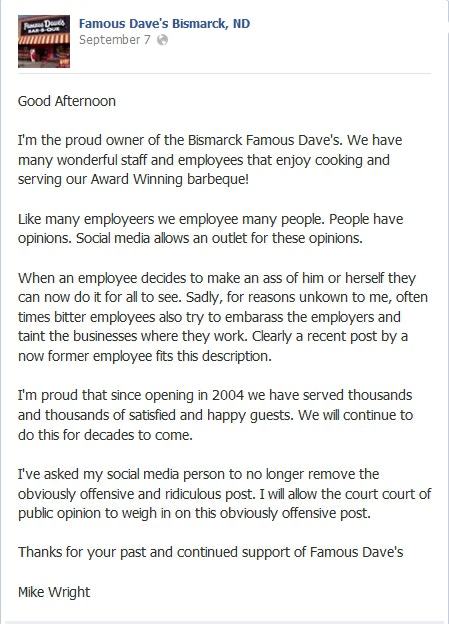
Although the owner of Famous Dave's may have done the right thing by terminating the employees, his Facebook post needs editing:
Discussion Starters:
- Assess Mike Wright's Facebook post. What works well, and what could be improved? Edit the post for accuracy.
- What's your view of Snapchat's claims? Can the site ensure that photos "disappear"? Is the company responsible for images that are shared in the interim, or do users hold this responsibility?
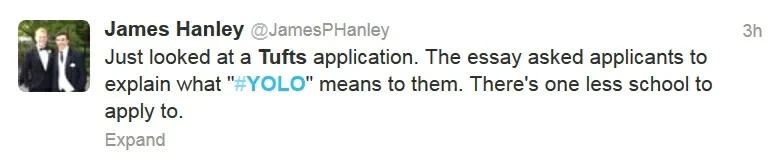
Tufts' "#YOLO" Question: Creative or Offensive?
Tufts is engaging the Class of 2018 by asking prospective students to include a supplementalwriting essay to the common application. Students are asked to respond to questions 1 and 2, and can select one option from question 3:
- Which aspects of Tufts' curriculum or undergraduate experience prompt your application? In short: "Why Tufts?" (50–100 words)
- There is a Quaker saying: "Let your life speak." Describe the environment in which you were raised – your family, home, neighborhood or community – and how it influenced the person you are today. (200–250 words)
- Now we'd like to know a little bit more about you. Please respond to one of the following six questions:
A) "If you do not tell the truth about yourself you cannot tell it about other people," Virginia Woolf. Respond to Woolf's quote in the medium of your choice: prose, video (one minute), blog, digital portfolio, slam poetry... For media other than writing, please share a link (video can be submitted via YouTube but we recommend using a privacy setting) that is easily accessible. .
B) What makes you happy?
C) Sports, science and society are filled with rules, theories and laws like the Ninth Commandment, PV=nRT, Occam's Razor, and The Law of Diminishing Returns. Three strikes and you're out. "I" before "E" except after "C." Warm air rises. Pick one and explain its significance to you.
D) Celebrate your nerdy side.
E) The ancient Romans started it when they coined the phrase "Carpe diem." Jonathan Larson proclaimed "No day but today!" and most recently, Drake explained You Only Live Once (YOLO). Have you ever seized the day? Lived like there was no tomorrow? Or perhaps you plan to shout YOLO while jumping into something in the future. What does #YOLO mean to you?
F) Boston is famous for its teams, its fans and its rivalries. Whether you are goaltending or cheering from the stands, celebrate the role sports plays in your life.
Not everyone appreciated the forward-thinking question:

One alum of the school explains why he's offended by the question (excerpt here):
The college admissions process is the biggest freakshow of self-aggrandizement and hapless people pleasing in modern American society. On the one hand Drake is exceedingly worthy of being name-dropped in an application essay because his claim to legitimacy, at least in the early part of his career, was the fact that he did whatever it took to make people like him no matter if it made him feel hollow inside. The general internet consensus on the #YOLO question seems to be, "Drake is stupid, Tufts is stupid, kids are stupid, America is stupid." While I agree with each of these conclusions taken separately, I'm also legitimately angered by their intersection. Most people are mad at Tufts for the #YOLO question because it's a cornball "cool dad" appeal to applicants. I'm mad because Tufts isn't being criticized for admission and administrative practices that deserve scorn, practices that are a toxic mixture of profiteering and systemic racism and classism that are symptomatic of higher education as gestalt. Since we live in a country where it's pretty much legal to stalk, assault and kill a black kid walking to his dad's house, I feel a pressing need to call Tufts, my alma mater and cool dad, on its recent history.
Discussion Starters:
- Regardless of your expected graduation year, answer the prompt. What do you think would be a good response to the admissions question?
- What's your opinion of the controversy? Do you find the question creative, offensive, stupid, or something else?
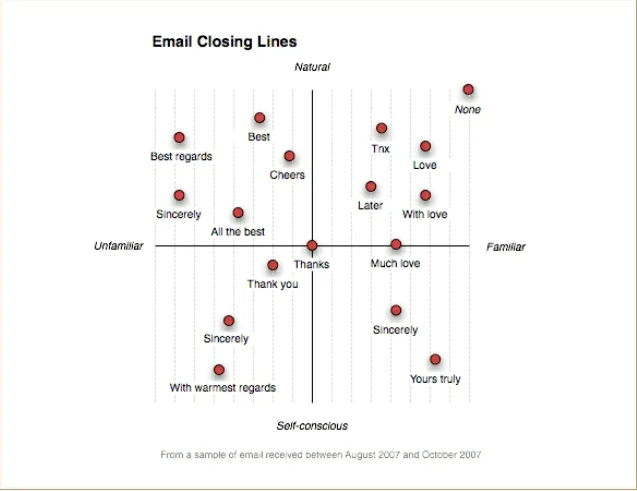
Visualization of Email Sign-Offs
Here's a cute (not much else) visualization of what your email closing may mean. Although compiled in 2007, this just made it to Twitter.

The graphic is an interesting way of categorizing email endings. "Self-conscious" implies an insecurity, perhaps as well as a lack of familiarity, so we may see some overlap here. Maybe "formal" and "informal" would be a better continuum. To me, this language has less judgement (but, then again, I'm self-conscious).
Discussion Starters:
- What's your assessment of the visualization? Do you agree with the author's characterizations of email closings?
- Look at 25 of your most recent emails, and plot them on a similar chart. What do you find?

Embarrassing Typos in School Book List
A Long Island school district published its summer reading list riddled with typos. The Hempstead Union Free School District suggested that students read "The Great Gypsy" among other remixed classics. Written for all grade levels in the district, the list includes 30 errors according to one count.

District spokesperson Alicia Figueras said, "I would like to announce that disciplinary action has been taken against the personnel who made the unfortunate clerical errors while compiling the list."
Although Figueras described the incident as an isolated event, the errors are part of bigger problems, according to Newsday:
"Hempstead consistently has been one of Long Island's worst-performing school systems. Its 2011-12 graduation rate of 38 percent was the lowest of the Island's 124 public school districts."
Discussion Starters:
- What action is appropriate for the employee who made the errors? Who else, if anyone, should be held responsible, and how?
- Read the entire document. How many errors do you find?
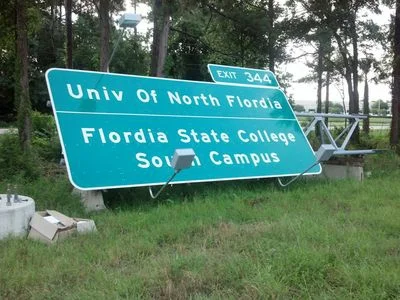
"Flordia" Road Sign
Never hire someone from Arizona to create traffic signs for Florida. That's what the Florida Department of Transportation (FDOT) is saying in response to a sign that misspells Florida-twice. For extra embarrassment to the FDOT, the sign points to the University of Florida.

Local news organization WOKV.com reported the story with the appropriate level of criticism. But WOKV is not flawless either. Here's an excerpt from the article:
"After posting the picture on WOKV.com and Facebook, WOKV News contacted the Florida Dept. or Transportation for comment and their spokesperson, Mike Goldman, says the FDOT had already realized the mistake when the sign was delivered and had left them by the side of the road while they awaited a replacement."
Can you find the two errors (one typo and one punctuation mark)?
Assignment Ideas:
- Spend the next couple of days looking closely at signs around town. Take photos of signs with typos or misused punctuation.
- Try to get one of the signs fixed. Identify the owner and talk to him or her in person or try to get an email address. Report your progress to the rest of the class.
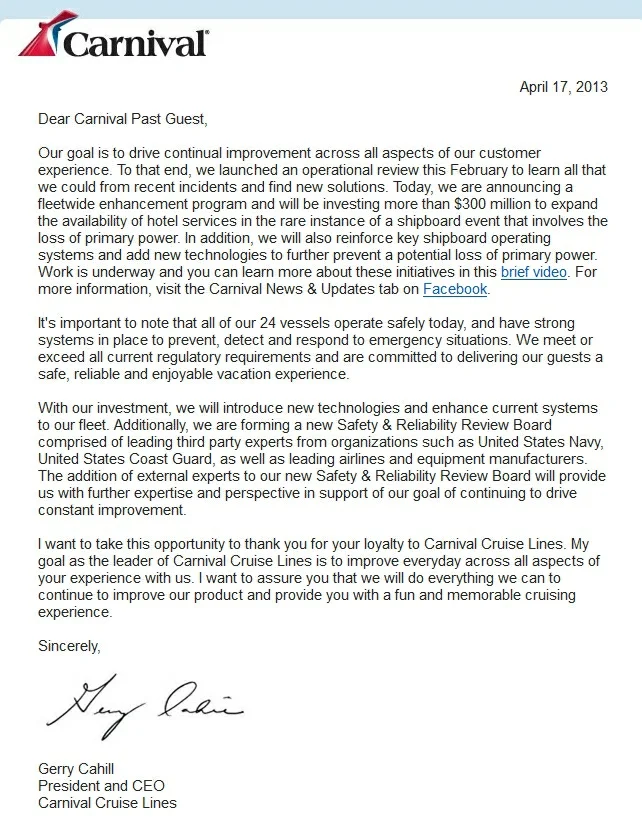
Carnival Updates Guests with "Improvement" Plans
In a letter from CEO Gerry Cahill, Carnival tries to restore guests' confidence in the brand after several technical and other issues on ships during the past few months. In addition to this letter, Carnival has posted a video on YouTube and created a News and Updates page on Facebook.

In some respects, the letter is a confusing mess. Although the $300 million is more clearly explained in the video, this letter makes it sound as though Carnival is buying hotels: "$300 million to expand the availability of hotel services." Cudos to having some of the main point upfront ("Our goal is to drive continual improvement across all aspects of our customer experience"), but isn't much of the main point at the end, where Cahill thanks guests for their loyalty?
Also, the letter seems overly jargony for typical Carnival guests. The company just wants them to book another cruise, right? The encouragement could be clearer and more direct.
Discussion and Assignment Ideas:
- Compare Carnival's guest letter, video, and Facebook page. What differences do you see, and how do you account for them; for example, what are the audiences for each?
- Rewrite the Carnival letter. How can you improve the content, organization, and tone?
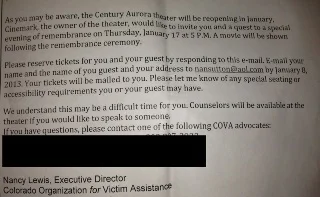
Victims' Families Don't Appreciate Theater Invitation
 The Century Aurora theater in Colorado, where 12 people were killed and 58 injured, reopened a few months after the horrific shooting incident. To encourage people to return, the theater sent invitations to the victims' families for a "special evening of remembrance," with a movie showing.
The families didn't appreciate the gesture. In a letter to the theater company, they called the invitation "disgusting" and "wholly offensive to the memory of our loved ones." Coming just two days after Christmas, the invitation stung even worse for some families.
To the Management of Cinemark USA, Inc.:
During the holiday we didn't think anyone or anything could make our grief worse but you, Cinemark, have managed to do just that by sending us an invitation two days after Christmas inviting us to attend the re-opening of your theater in Aurora where our loved ones were massacred.Thanks for making what is a very difficult holiday season that much more difficult. Timing is everything and yours is awful.
You (Cinemark) has shown, and continues to show, ZERO compassion to the families of the victims whose loved ones were killed in their theater. You, Cinemark, have never once reached out to the families to offer condolences.
This disgusting offer that you'd "like to invite you and a guest to a special evening of remembrance on Thursday, January 17 at 5 PM" followed by the showing of a movie and then telling us to be sure "to reserve our tickets" is wholly offensive to the memory of our loved ones.
Our family members will never be on this earth with us again and a movie ticket and some token words from people who didn't care enough to reach out to us, nor respond when we reached out to them to talk, is appalling.
You (Cinemark) refused our repeated invitations to speak parent to parent with no lawyers involved. Instead, we get invited to attend a "special evening of remembrance" at the very theater where our loved ones lay dead on the floor for over 15 hours. We would give anything to wipe the carnage of that night out of our minds' eye. Thank you for reminding us how your quest for profits has blinded your leadership and made you so callous as to be oblivious to our mental anguish.
We, the families, recognize your thinly veiled publicity ploy for what it is: A great opportunity for you to distance yourselves and divert public scrutiny from your culpability in this massacre.
After reading our response to your ridiculously offensive invitation, you now know why we will not be attending your re-opening celebration and will be using every social media tool at our disposal to ask the other victims to ask their friends and family to honor us by boycotting the killing field of our children.
Discussion Starters:
- What's your view of the theater's invitation: a nice gesture, an insensitive ploy to recoup revenue, or something else?
- What could have been a better approach for the theater?
- How well does the families' letter express their perspective? What suggestions, if any, do you have for a revision?
- In the families' letter, they say that the theater has refused to meet with them. How, if at all, does this influence your perspective of the invitation?
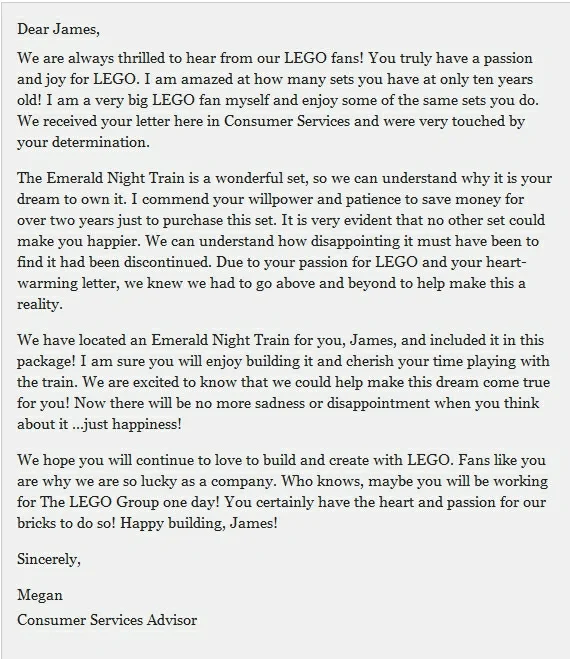
Lego Comes Through for Little Boy
For two years, James Groccia, an 11-year-old boy with Asperger's Syndrome, saved up for his dream Lego train set, but it had been discontinued. James wrote a letter to Lego and received a nice response-and the set he wanted.
James's mother, Karen, described the boy's process for writing the letter:
"James was very concise about what he wanted to say. He planned it, and I just helped him organize his thoughts."
How about that. James hasn't even taken a Business Communication course.
Lego's response is very enthusiastic and obviously tailored to James:

Discussion Starters:
- James's letter is great-for an 11-year-old boy-but it could be improved to meet business writing principles. What could be changed?
- Lego's letter isn't perfect either. What would you advise that Megan change in future letters?
News Corp's Reorganization Announcement
 News Corp will split into two separate, public companies: one focused on entertainment and the other on publishing. The company also announced the closing of its tablet newspaper because of low readership.
In a press release, the company announced leadership changes of the publishing company (News Corporation), additional organization changes in the New York office, organizational changes in the London office, and plans for the separation of the publishing company from the entertainment company (Fox Group).
In an internal email, Chairman Rupert Murdoch explained the changes, complimented the employees' work, and shared his personal mission for the company:
"Many of you know that a belief in the power of the written word has been in my bones for my entire life. It began as I listened to my father's stories from his days as a war correspondent and, later, a successful publisher. It deepened when, starting in grammar school, I rolled up my sleeves and worked alongside fellow students to publish school journals. I witnessed the hunger people had for well-written, thoroughly observed stories ... stories that provide not just information, but insight. That hunger is alive and well today; my personal mission is to serve and satisfy the human need for insight as well as I possibly can."
Discussion Starters:
- Read the company's press release in detail. How is it organized? What works well about the structure, and what could be improved?
- What is your reaction to Murdoch's email to employees? What are his most important messages, and how do you think employees might react?
Why We Should Stop Making Fun of Obama's Emails
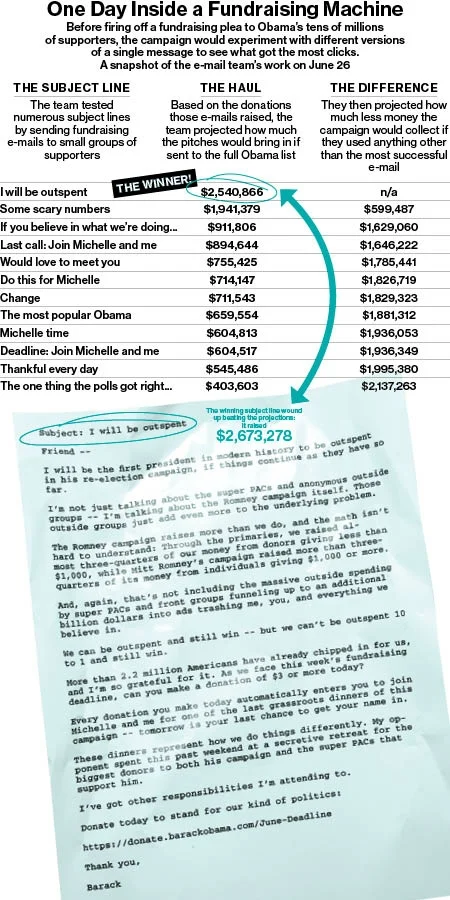
During the presidential campaign, the Obama Administration was criticized for sending emails some called "creepy" and "desperate." Well, laugh no more! According to Bloomberg Businessweek, "Most of the $690 million Obama raised online came from fundraising emails."
With subject lines such as "Wow," "Hey," and "Join me for dinner?" the emails were crafted by a team of analysts experimenting with different approaches to see what garnered the most financial support. During the campaign, Obama's staff was secretive about the email strategy, but now we learn that 20 writers would draft as many as 18 variations of emails to test responses before sending out the winning version.
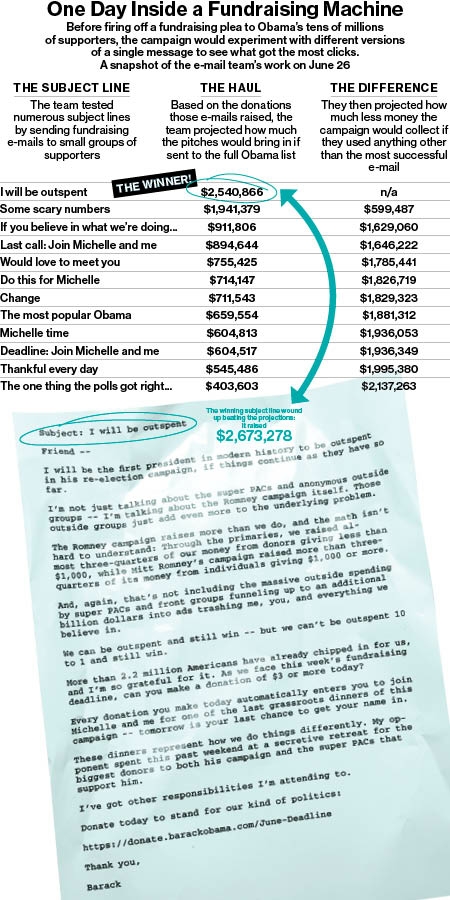
Amelia Showalter, the director of digital analytics, explains how the campaign changed emails based on results:
"We were so bad at predicting what would win that it only reinforced the need to constantly keep testing. Every time something really ugly won, it would shock me: giant-size fonts for links, plain-text links vs. pretty 'Donate' buttons. Eventually we got to thinking, 'How could we make things even less attractive?' That's how we arrived at the ugly yellow highlighting on the sections we wanted to draw people's eye to."
What can business writers learn from the analysis? Here are a few key points that may be adapted for work email:
- The most effective subject lines were similar "to what you might see in your in-box from other people," according to email director.
- Light profanity (e.g., "hell") got a strong reaction.
- Although the emails may have been "mildly irritating" to some, people did not unsubscribe, showing a lot of tolerance for a lot of messages.
Discussion Starters:
- Based on the previous criticism, are you surprised at the results of the email campaign? Why or why not?
- I'm not sure that business writers should use profanity in their email, but how could you interpret this finding and write subject lines for a professional work environment?
- Review a few of your own emails sent for business purposes. Given this analysis, what, if anything, would you change?

Fun Facts About the Emoticon
The New York Times today featured Scott Fahlman, creator of the smiley face. Fahlman invented the character, which he called a "joke marker," back in 1982 to temper flaming in online discussion forums. 
A linguist analyzed millions of tweets to see how emoticons were used and found that 10% of tweets had some type of character. His reasoning was that people could more accurately describe emotion in a longer paragraph, but shorter messages may require explanation.
We could debate whether and how emoticons should be used in business writing ad nauseum. Proponents see the ocassional smiley as a way to ensure accurately interpreted messages, particularly to convey tone, often misunderstood in business email.
Opponents think emoticons are silly and unprofessional. Writing instructors worry about the degradation of the language. As one communication lecturer said, "Certainly I understand the need for clarity. But language, used properly, is clear on its own." A British radio personality said, "If anybody on Facebook sends me a message with a little smiley-frowny face or a little sunshine with glasses on them, I will de-friend them. I also de-friend for OMG and LOL. They get no second chance. I find it lazy. Are your words not enough? To use a little picture with sunglasses on it to let you know how you're feeling is beyond ridiculous."
A recent CNN article offers this sound advice: use an emoticon if you must, "But nix emoticons from any initial emails with new contacts."
Discussion Starters:
- When do you use emoticons in your writing?
- In addition to initial emails, as CNN suggests, when would you avoid using emoticons in business email?
New NYT CEO Emails Staff
Mark Thompson, new CEO of The New York Times Company, emailed staff after his first week at work. This is a great example for business communication students to study:
- Content: What are Thompson's main points? What does he want NYT employees to know, and how does he want them to feel?
- Organization: What structure does Thompson use for his message? How does he sequence paragraphs? How does he convey the main point of each paragraph?
- Tone: How would you describe Thompson's tone? What changes, if any, do you see throughout the email? How does he balance positive messages with a sense of urgency?
- Sentence variety: How does Thompson vary sentence structure throughout his email? How many different types of sentences (simple, compound, complex) does he use?
- Punctuation: As we might expect, Thompson uses impeccable puntuation. How does he use m-dashes and semi-colons effectively?
As I finish my first week at The New York Times Company, I would like to thank the many people I've already met. As you'd expect, Times employees come across as super-smart and totally committed to maintaining the values and quality that the company and its newspapers have always stood for. But I've also been struck by how friendly and welcoming you've been to me.
I've been impressed by the work that's already in motion to tackle the structural trends that our industry faces and the products and services we're developing that will drive new growth and profitability, all while securing the brilliant journalism on which everything else depends. The digital subscription story continues to be an exciting one, and we can build on it further. With Invest in the Times and similar projects at the Globe and IHT, our company is already focusing on other growth opportunities. We are looking in the right places for future success: understanding and engaging with our readers and consumers better; developing compelling propositions in video, mobile and social; and figuring out how to drive more revenue from international audiences. The work done so far is really valuable.
But I don't want to underestimate the challenges we face. As our third-quarter results showed, the company is experiencing the same advertising and economic pressures as the rest of our industry. Figuring out how best to respond to these pressures - especially the long-term downward trajectory of print advertising - is also going to be an important part of our work in the coming months.
Thank you for a productive and inspiring first week. To help us get to know each other better, we have scheduled Town Hall meetings with me for Monday, Dec. 17, and Tuesday, Dec. 18, in The Times Center and Wednesday, Dec. 19, at College Point. More details will follow soon. I plan to have Town Hall meetings in Boston and at the IHT as soon as possible.
Obama Emails: "Creepy," "Weird," and "Desperate"?
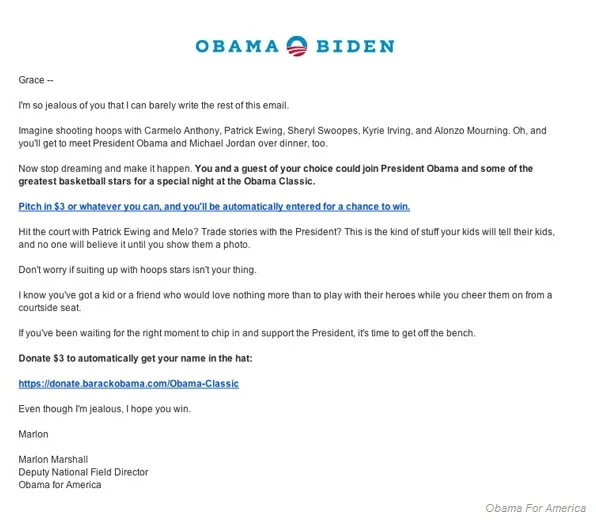
The Obama campaign is taking a hit because of emails that some consider strange and "increasingly weird" and "desperate." Business Insider is criticizing the Democrats' fundraising emails for their strong language:
- "When you get knocked down, get up. There's no quit in America. There's nothing we can't do." (Joe Biden)
- "We've gotta close the gap and fight back before it's too late." (James Carville)
- "I don't have as much time to campaign this time as I did in 2008, so this whole thing is riding on you making it happen." (President Obama)
In an email that Business Insider calls "the creepiest yet," the campaign uses a very casual tone and invites donors to enter for a chance to meet the president and shoot some hoops.

This isn't the first time Obama's emails have been criticized. Jon Stewart lambasted the campaign on The Daily Show, calling the tone in emails "fake familiarity."
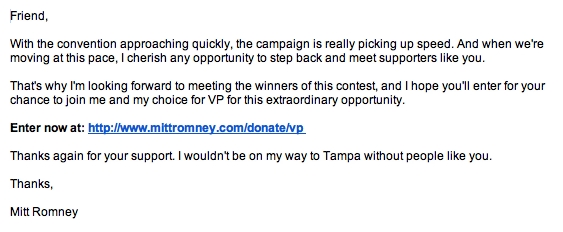
A recent Romney email also was criticized. Before he announced his VP running mate, Romney sent an email teasing supporters with the name of his VP pick. The subject line was "My Vice President," but the email didn't reveal Paul Ryan's name:
Discussion Starters:
- How do you assess President Obama's emails: would you call them creepy, effective, or something else?
- How effective do you think Romney's email was in raising money? What reaction would you have to the message?

Jack Daniel's: Finally, a Nice Cease-and-Desist Letter
BizCom in the News readers may recall the U.S. Olympics Committee's recent cease-and-desist letter to knitters, which didn't go over too well. This time, we have a much more polite example of a legal attempt to stop a trademark violation.
The Jack Daniel's letter addresses a violation of its whiskey label on this book cover. Comparing the two, we see obvious similarities in color, borders, and some of the text.

The full letter includes this excerpt:
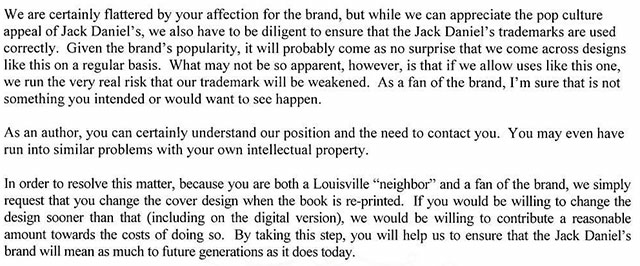
The book author acknowledged that the letter was nice:
"...perhaps, the most polite cease and desist ever written. If it wasn't signed by some lawyer, I'd imagine ol' Gentleman Jack penning it himself, twirling his bushy mustache."
However, he didn't take the company's offer to reprint the book:
"In case you're wondering, no, my publisher, Lazy Fascist Press, will not be taking them up on their offer. We're proudly independent and don't need any of that sweet corporate booze money to redo the cover."
Discussion Starters:
- What risks does a company such as Jack Daniel's take in writing a non-traditional legal letter?
- Can you find the modifier problem in the letter excerpt? How can you fix it?
Jon Stewart Criticizes President Obama's Emails
On The Daily Show, Jon Stewart questions the Obama campaign's informal approach to email. Stewart gives examples of subject lines such as "Hey" and "Dinner?" Rather than what he calls "fake familiarity," Stewart suggests that these email subjects should focus on the real purpose: "Give me money."
Jon Stewart isn't the first one to criticize President Obama's emails. Back in December, White House reporter Keith Koffler took issue with the the "Hey" emails:
"Obama, who was sold to us as something surpassingly genuine, actually likes to pretend he's someone he's not. All his town halls on people's back porches, trips to Best Buy, and dinners with three dollar donors doesn't change that he is a card carrying member of the elite liberal ruling class.
"He was admitted around college or law school, and that's where his soul has resided ever since. Recently, with book sales buoyed by his presidential success, he's gained the financial status commensurate with his social standing.
"He should act that way. The regular guy stuff diminishes both him and the presidency. More than classy or low-brow, friendly or stiff, Americans want one thing more than anything else in their leader: Authenticity.
"'Hey,' is phony. And it's puny for a president."
Discussion Starters and Assignment Idea:
- What's your view of the President's approach to email? Do you agree with this criticism?
- What could be better subject lines that do, in reality, request donations?
- As practice, write two email messages on behalf of a presidential candidate's campaign (a candidate of your choice). What could you say to inspire people to give, and what subject line will you use? Check the tone by asking other students for their opinion.
Emails Goes Mobile
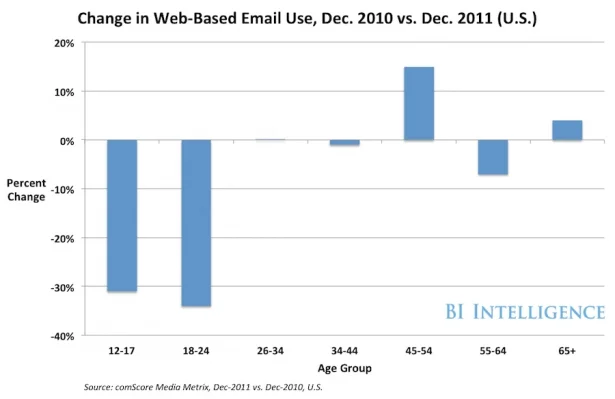
New research shows dramatic changes in where people access email. Between December 2010 and December 2011, according to BI Intelligence, web-based email dropped more than 30% for people between 12 and 24 years old. Email is moving to mobile devices-phones and tablets.

As you can see from the chart, results are mixed for older generations. This is one reason that I wouldn't get too excited about the so-called "death of email." Email is still highly pervasive in business, where we see people between 45 and 54 years old and about a 15% increase in web-based email. Also, people are still using email; they're just accessing it differently. Another study, by Radicati, indicates that 85% of business people access email on a mobile device. Whether people use both a browser and a phone is unclear from these numbers.
Yet the numbers likely predict a future increase in mobile email-no surprise to any of us, really.
This move has significant implications for how we write and respond to email messages. The lines between email and texting may continue to fade, and maybe we'll finally delete mobile-device tags, such as "Sent from my iPhone."
Discussion Starters:
- What are the advantages and disadvantages of using email on a browser and a mobile device?
- What are your thoughts about the tag "Sent from my [mobile device]"? Does it explain short messages or excuse lack of attention to detail?
NYU Student's Emails
Upset with a class assignment to write an ethnography about the Occupy Wall Street protestors in Zuccotti Park, NYU senior Sara Ackerman wrote several emails to her professors and university administrators. The emails show frustration on both sides-a student wanting a different assignment and a college struggling with how to respond to complaints.Besides the drama and voyeuristic appeal of the situation, the story is rather sad. Ackerman follows through on her threat to publicize the controversy, but does she get what she needs? And university officials are embarrassed and can't satisfy the student.
Sara Ackerman Emails: "An Open Letter to John Sexton regarding Professor Caitlin Zaloom"
One of Ackerman's goals is to get her professor fired. She claims that she was offered an A in the course to be quiet about the situation, but university officials deny this. Instead, the VP of public affairs said, "We looked into the complaint and found the accusations were unwarranted."
A look at NYU's Student Email Policy is no help, of course, particularly with a 2003 "effective date," and the Guidelines for Student Email Use offers little guidance other than how to forward email and expectations for regular email-checking-another throw-back to 2003. The confidentiality statement is getting closer, but students needs more help to determine effective use of university email.
Then again, what would help in this situation?
Discussion Starters:
- What is the student trying to achieve with her emails? To what extent is she successful?
- What alternative communication channels and avenues might be helpful to a student in a similar situation?
- If you were the head of communications for NYU, what, if anything, would you say to the press?
Two More UBS Executives Resign
Not surprisingly, the two co-global heads of UBS's Equities division have resigned. These resignations follow a trading scandal that cost the Swiss bank $2.3 billion and the CEO's resignation on September 25.
An email to employees from interim CEO Sergio Ermotti uses a sharper tone than emails from the previous CEO:
"We have to be straight with ourselves. In no circumstances should something like this ever occur. The fact that it did is evidence of a failure to exercise appropriate controls. Our internal investigation indicates that risk and operational systems did detect unauthorized or unexplained activity but this was not sufficiently investigated nor was appropriate action taken to ensure existing controls were enforced."
Discussion Starters:
- Ermotti's email uses an indirect organizational plan. Do you think this is appropriate in this case? Why or why not?
- Compare Ermotti's email to that of Carsten Kengeter, the head of the UBS investment bank. What differences do you notice, and how would you explain them? Download UBS emails.

AP Issues Situational Style Guide for 9/11 Anniversary
 Associated Press is known for its style guide to help journalists decide between "smart phone" and "smartphone," but now the organization has created something new: a so-called "situational stylebook" in preparation for the 10th anniversary of the 9/11 attacks. The Sept. 11 Style and Reference Guide may ensure that journalists writing about the events conform to certain standards, for example, "twin towers" (lowercase) and al-Qaida (pronounced al-KY'-ee-duh).
In addition to promoting consistency in writing style, the guide will help journalists accurately report about 9/11-related events. The guide includes common sense advice such as this:
"Do not make up names, however. There is no Boston Airport, for example. The Boston airport (lowercase airport) would be acceptable if for some reason the proper name, Logan International Airport, were not used."
The guide's timeline of events is also helpful; after all, it has been a decade since the events, and memories fade.
Discussion Starters:
- Looking at the AP Sept. 11 Style and Reference Guide, which advice do you think will be most important for people reporting about the 9/11 anniversary?
- Does any of the advice surprise you? Why?
- For what other situations or events do you think a situational style guide might be useful?
Are People Tired of Email?
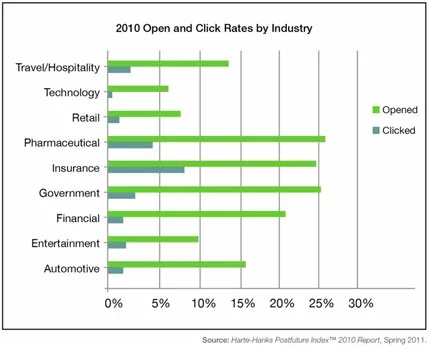
Email open and click rates are on the decline, meaning people are less likely to open a marketing email. The latest study shows people opening marketing emails at a rate of 17% (compared to 26% in 2009).

This continues a trend since 2007.

Discussion Starters:
- Do these statistics surprise you? Why or why not?
- What influences whether you open an email?
- What can you learn from this for your own email messages -- both internal and external?
Assignment Ideas:
- Open your email inbox. Looking at the last 25 or so messages, which are you most likely to open and why? In small groups, discuss your reaction to the marketing emails. Did you open them initially?
- Now look at your sent box. Rewrite the subject lines of five emails to make them more enticing for the receiver to open.