
Persuasion for Britain to Leave the EU
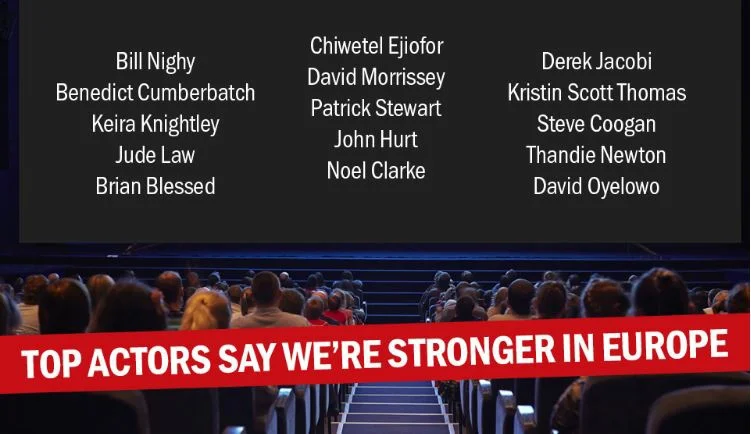
British celebrities have joined forces and signed a letter to convince Britons to stay with the European Union.

In the letter, 282 big names (most of which I never heard of) from film, fashion, art, music, and theater focus on "EU markets and influence, access to EU funding, and movement of talent." The letter body follows:
The EU referendum marks the biggest democratic decision of our time, and the outcome will have lasting and far-reaching consequences for the future of this country for generations to come.
The referendum forces us to look in the mirror and ask ourselves: what kind of nation do we want to be? Are we outward-looking and open to working with others to achieve more? Or do we close ourselves off from our friends and neighbours at a time of increasing global uncertainty?
From the smallest gallery to the biggest blockbuster, many of us have worked on projects that would never have happened without vital EU funding or by collaborating across borders. Britain is not just stronger in Europe, it is more imaginative and more creative, and our global creative success would be severely weakened by walking away.
And what would ‘Out' really mean? Leaving Europe would be a leap into the unknown for millions of people across the UK who work in the creative industries, and for the millions more at home and abroad who benefit from the growth and vibrancy of Britain's cultural sector.
From the Bard to Bowie, British creativity inspires and influences the rest of the world. We believe that being part of the EU bolsters Britain's leading role on the world stage.
Let's not become an outsider shouting from the wings.
Creative Industries Federation survey
Among reasons cited for the vote of confidence in Europe by Creative Industries Federation members were:
Access to EU markets and influence - the EU is the largest export market for the UK creative industries, totalling 56% of all overseas trade in the sector. It is vital that Britain is able to influence regulatory discussions which may have a bearing on future trading, such as the current discussions around the creation of the Digital Single Market.
Access to EU funding – the Creative Europe programme has provided seed funding for films such as The King's Speech, The Iron Lady and Slumdog Millionaire. ERDF funding has provided vital support to arts organisations in the regions, including the Liverpool Everyman and Sage Gateshead. In addition, Federation cultural education members benefit from the €80bn innovation fund, Horizon 2020. All this could be imperilled.
Movement of talent – the UK is a creative hub. Close collaboration with EU partners is key to Britain maintaining this position. From orchestras to art schools to architecture firms, the UK's creative industries are enriched by the diversity of cultural exchange and strengthened by the movement of talent across the EU.
The creative industries have been the fastest growing sector of the UK economy since 2008 and added £84.1bn GVA to the economy last year.
The creative industries employ 1.8m people in this country (1 in 17 jobs in the UK; and 1 in 8 jobs in London). [DCMS stats from January 2016 – 2014 figures].
The creative economy (includes the contribution of those who are in creative occupations outside the creative industries) employ 2.8m people in this country (1 in 11 jobs in UK; and 1 in 6 jobs in London).
Not everyone agrees. A columnist for The Guardian wrote an article titled, "The luvvies' Brexit letter only shows most people vote with their wallets." According to The New York Times, "luvvies" is "a satirical term borrowed from Private Eye magazine to describe Britain's self-enamored stars."
The New York Times article compares this effort to another political celebrity move: J.K. Rowlings opposed Scotland's independence, and didn't win herself any favors as a result.
Discussion Starters:
- How convincing do you find the celebrities' letter? Which are the strongest and weakest arguments?
- What's your view of celebrity involvement in political controversies? How does these differ, or do they, from celebrity product endorsements?
Amtrak Apologizes, Again
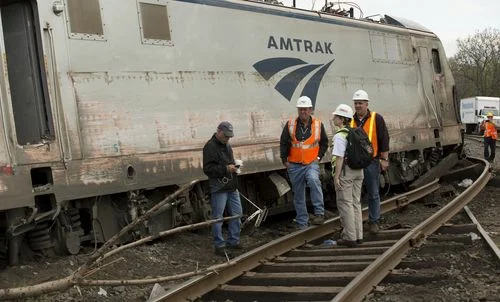
 It took a year, but the National Transportation Safety Board (NTSB) finally announced the cause of an Amtrak crash in May 2015 that killed eight and injured about 200 people. The driver had accelerated to 106 mph, although the limit for a curve on the track was less than half that. Turns out, the driver was distracted by an emergency situation involving another train, which the driver heard on the radio. The NTSB press release calls this "the result of a loss of situational awareness."
The NTSB report includes 11 safety recommendations and notes that "positive train control, a technology that could have automatically stopped the train and prevented the derailment" wasn't in place. Amtrak has since implemented the technology and issued this statement, included in a Yahoo article:
"Amtrak has taken full responsibility for and deeply regrets the tragic derailment of Northeast Regional Train 188. Our hearts go out to the families who suffered a loss, the passengers and employees who were injured and to everyone onboard the train," the company said in a statement, adding that they would "quickly implement" the NTSB's recommendations after a review.
On its Facebook page last May, Amtrak wrote this apology. Both statements are big improvements over the service updates we usually see from Amtrak and MetroNorth after accidents. Of course such updates are important, but so are apologies-and not only when the company is found to be at fault.
Discussion Starters:
- Compare the two apologies from Amtrak. Should the organization do something differently now?
- How can transportation companies balance important service updates with apologies in crisis situations?
Priceline CEO Resigns
Priceline CEO Darren Huston has resigned after a relationship with an employee became known. A former CEO, Jeffery Boyd, will serve as interim CEO, and COO Gillian Teams will replace Huston as Booking.com's chief, which was also Huston's position. Booking.com is a unit of Priceline Group.
Priceline denies any connection between company performance and Huston's departure. Huston has had some big wins as CEO: acquiring OpenTable, signing a booking agreement with TripAdvisor, and seeing company revenue increase almost 36% since taking over in January 2014.
The company also says that the employee wasn't under Huston's direct supervision, although, as CEO, all employees eventually report into him. In a statement, Priceline said Huston "had engaged in activities inconsistent with the board's expectations for executive conduct, which Mr. Huston acknowledged and for which he expressed regret." The former CEO received a salary of $22 million and won't receive any severance pay.
The lead investigator of the incident said, "I am satisfied with the board's thorough review of this issue. The performance of the business under Darren has been strong, and the company is very well-positioned to continue executing on its strategy for growth. Jeff is deeply familiar with the company's strategy and leadership team, which consists of highly accomplished entrepreneurs and seasoned professional executives with long tenure in the business. We are confident the company is in strong hands while we conduct a search for a new CEO."
Discussion Starters:
- Why would Priceline emphasize that the employee wasn't a direct report? Does it matter?
- Priceline has no statement on its website. Should the company post something? Why or why not, and if so, what should the statement say?
Lyft's First TV Commercial
With a bit of assonance and a lot of humor, Lyft creates its first television ad. The tagline is, "Riding is the new driving," and it shows all the discomforts and inconveniences of driving: traffic, accidents, and getting a ticket.
Lyft's creative director, Jesse McMillin told AdWeek,
"Obviously as we grow and continue to evolve as a brand, we want to make sure we're constantly pushing ourselves to have a vibe and aesthetic that feels professional and cool. But in doing that, we also want to make sure we stay true to the roots of the company. That's really what informs us more than what any of our competitors are doing."
In a second video, Lyft's executives describe the approach of the ad to convey the main point: ride-sharing is the better choice.
Lyft has had fun with other YouTube videos. Hall of Fame wide receiver Jerry Rice picks up a few people and chats them up, but he says, "I'm not really into sports." Before he reveals his true identity, he stops the car to stretch, take a nap, and dance with a few people. Racecar driver Danica Patrick also makes an appearance as a Lyft driver-a fast one.
Discussion Starters:
- What's your view of the commercial? Do you find it as entertaining as the Lyft executives intended?
- What makes the commercial memorable?
Did Airbnb Depress Hotel Rates?
 For the first time, I've seen a claim that Airbnb has affected hotel rates in New York City. A New York Post article, "Airbnb's cheap rates hurt Big Apple hotels big time," says that it's 1.7% less expensive to stay in a hotel in NYC this year than it was last year. Hotel stake owner Richard Born says, "If Airbnb were to go away, room rates would go up by 15 percent."
Students may see this as a single-cause fallacy, and they may be right: new hotel development added 30,000 rooms to the city this year. But Mark VanStekelenburg, managing director of CBRE Hotels, points to Airbnb's $80-per-room average rate and says that Airbnb rooms "account for" between 12 and 20% of all hotel rooms.
Born also says, "Anyone who says Airbnb is not affecting NYC hotels is an idiot or hired by Airbnb to say that."
Discussion Starters:
- Do you believe that Airbnb is to blame for declining NYC hotel rates? Why or why not?
- What are the implications either way? How, if at all, should Airbnb respond to these accusations?
Verizon CEO Responds to Criticism
A Verizon strike has put the CEO under pressure to explain worker pay and taxes. Employees in two unions have walked out after failed contract negotiations.
In a press release, union leaders from the International Brotherhood of Electrical Workers (IBEW) explained the reason for the strike, including this quotation from the president:
"No one wants to go on strike, but Verizon-this immensely profitable company-is putting the squeeze on hard-working men and women who just want to come to work, do their jobs and be treated fairly."
Verizon's press release blames the unions for ending negotiations and refusing mediation. The company calls out union leaders for "ignoring today's digital realities" and focuses on the impact of the strike on customers:
"Millions of Americans rely on Verizon for the ability to communicate, 24 hours a day, 7 days a week. We remain fully prepared to handle any work stoppage so that our products and services will be available where and when our customers need them."
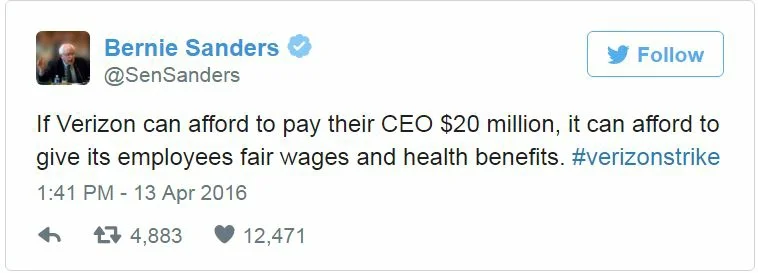
Presidential candidate Bernie Sanders has gotten into the fight:

Although CEO Lowell McAdam didn't address his own pay, he did respond to Bernie Sanders in a LinkedIn post. He focused on Verizon's contribution of taxes and employment. Like the press release, McAdam emphasized changing technologies and the need to keep pace.
Discussion Starters:
- Read arguments on both sides. Which are the strongest and weakest? With which do you most agree?
- Assess McAdam's LinkedIn post. How well does he address Sanders' criticism?
Amtrak Response to Crash
 Once again, a rail crash brings mostly service updates-no apologies on its website and in the press. An Amtrak train struck maintenance equipment in Chester, Philadelphia, killing two maintenance workers and injuring 34 passengers and an engineer. The derailment disabled the internal communication system, so passengers in some cars didn't receive information for a half-hour after the accident.
According to a Reuters report, Amtrak has little to say:
Amtrak spokesman Mike Tolbert said the railroad was operating its normal schedule of train service along the busy Northeast rail corridor on Monday. He referred all other questions to the NTSB, which did not immediately respond to a request for comment.
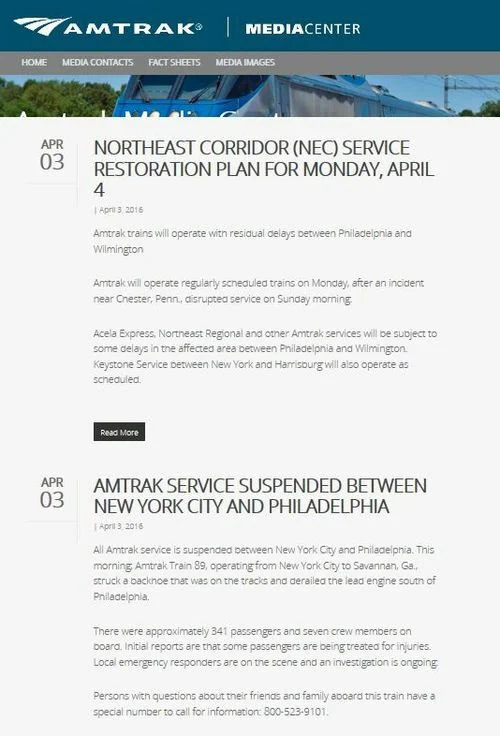
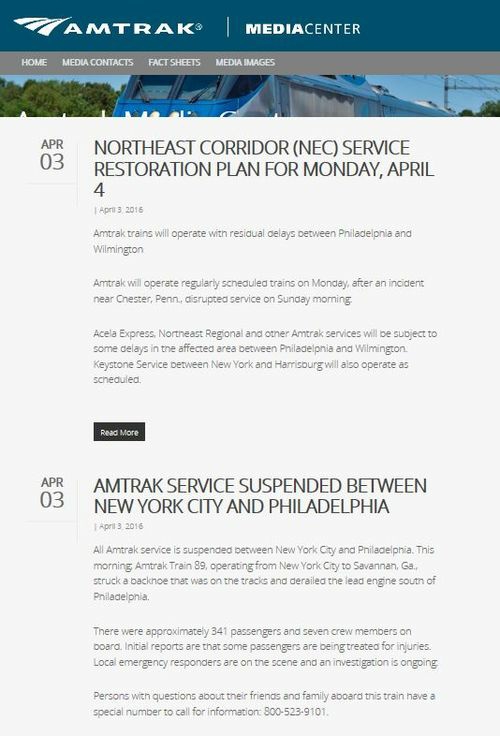
As usual, the railroad's website is focused on service updates with nothing in the way of an apology. The "News Release" page shows two posts, one announcing the service disruption and another announcing the restoration plan. This was also the case in a Metro-North derailment in 2013 that killed 4 people.
Likewise, the Amtrak Facebook page gives only service updates.
To find an apology, we need to go to back to a 2015 crash. At the time, Amtrak's Facebook page did express some sentiment, although it repeats in subsequent posts, "We are deeply saddened by the loss of life." The second post conveys the message well:
As always, our first concern is taking care of our customers and employees. We have established a Family Assistance Center in Philadelphia to work closely with the family of passengers and crew on the train. Family members are encouraged to call the Amtrak Incident Hotline (800-523-9101) with questions about individuals on the train. For our employees, the Amtrak Employee Assistance Program is staffed with trained counselors to support our employees and co-workers.
UPDATE: Finally, an apology on the Facebook page. Still nothing on the website.
Discussion Starters:
- What could explain the lack of apology? What, if anything, is different between this incident and 2015?
- How can Amtrak balance service updates and empathy? What should the organization post where?
Former Trump Communications Director Quits and Reveals Strategy
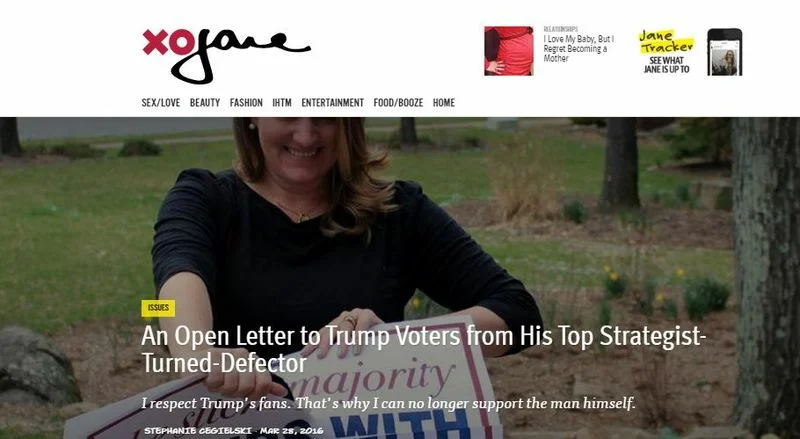
So much for loyalty. A communication director for Trump's Make America Great Again Super PAC has quit the campaign and written an open letter about her experience. Most significant, Stephanie Cegielski says that Trump wanted to hit double digits and perhaps hit second place, but he never wanted to nor expected to be in the lead.
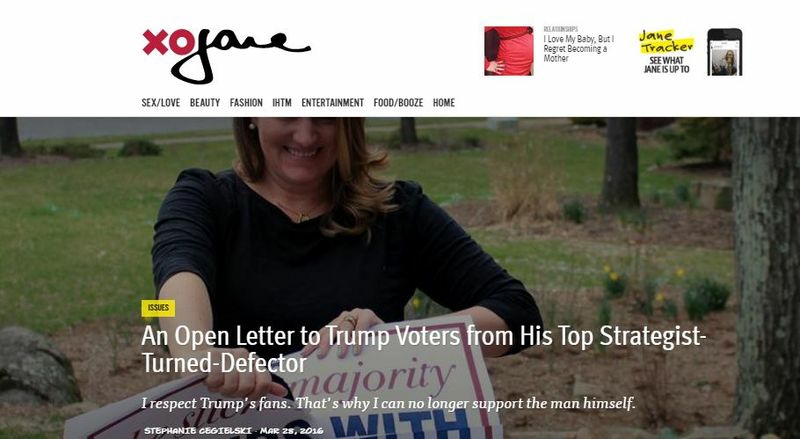
In her letter, Cegielski wrote, "His candidacy was a protest candidacy," and she describes her history:
"Almost a year ago, recruited for my public relations and public policy expertise, I sat in Trump Tower being told that the goal was to get The Donald to poll in double digits and come in second in delegate count. That was it."
She describes her initial excitement representing an alternative candidate but writes, "It wasn't long before every day I awoke to a buzzing phone and a shaking head because Trump had said something politically incorrect the night before. I have been around politics long enough to know that the other side will pounce on any and every opportunity to smear a candidate."
Cegielski, like many, was surprised at his continuing success. She eventually got disillusioned and now fears a possible win:
"What was once Trump's desire to rank second place to send a message to America and to increase his power as a businessman has nightmarishly morphed into a charade that is poised to do irreparable damage to this country if we do not stop this campaign in its tracks.
"I'll say it again: Trump never intended to be the candidate. But his pride is too out of control to stop him now."
Cegielski's credibility is at stake. The New York Times and The Wall Street Journal haven't taken up the story, and a Washington Post writer calls the article a successful "exercise in reputation management."
Discussion Starters:
- Read Cegielski's entire open letter. How do you assess her credibility? Consider The Washington Post perspective. Part of the writer's criticism is "She was literally the P.R. person for the Public Relations Society of America," and she "took a position teaching a class at New York University's School of Professional Studies" on Reputation Management.
- What, if any, loyalty does Cegielski have to Donald Trump and his campaign?

Starboard Value Wants New Yahoo Board
 Yahoo has been struggling, and hedge fund Starboard Value has a solution: replace the entire current board of directors. Known as an activist group, Starboard was successful in ousting Darden Restaurants' board in 2014 and gave us a great example of a persuasive PowerPoint deck. So far, we see a letter to shareholders, but with the same persuasive language. The opening is shown here:
NEW YORK, March 24, 2016 /PRNewswire/ -- Starboard Value LP (together with its affiliates, "Starboard"), one of the largest shareholders of Yahoo! Inc. (NASDAQ: YHOO) with an ownership interest in approximately 1.7% of Yahoo's outstanding shares, representing an investment of approximately $570 million, today announced that it is nominating a slate of nine highly qualified candidates for election to Yahoo's Board of Directors at the 2016 Annual Meeting.
Starboard also announced today that it has delivered the following open letter to Yahoo shareholders, which includes the names and detailed biographies of each of Starboard's nominees towards the end:
A LETTER TO THE SHAREHOLDERS OF YAHOO! INC.
Yahoo's Current Board has Failed to Deliver Results for Shareholders
Significant Board Change is Desperately Needed to Hold Management Accountable and Properly Oversee any Operational Turnaround Plan, Separation, or Sale of Assets
The Board Refuses to Embrace the Need for Significant Changes at Yahoo
Starboard is Therefore Nominating a Slate of Nine Highly Reputable and Extremely Qualified Directors for Election at Yahoo's 2016 Annual Meeting
The letter goes on to say, "We believe that Yahoo is deeply undervalued and opportunities exist within the control of management and the Board of Directors (the "Board") to unlock significant value for the benefit of all shareholders. Unfortunately, as we have outlined in previous letters, we have been extremely disappointed with Yahoo's dismal financial performance, poor management execution, egregious compensation and hiring practices, and general lack of accountability and oversight by the Board. We believe the Board clearly lacks the leadership, objectivity, and perspective needed to make decisions that are in the best interests of shareholders."
CEO Marissa Mayer has made several attempts to trim the business, but the company may be sold. In the shareholder letter, Starboard criticizes the process: "Bidders are uneasy over what was described as an uncharacteristically long document, three to four times longer than usual, without inclusion of private financial information." The board is accused of dealing unfairly in the process.
Discussion Starters:
- Read the Starboard Value letter to shareholders. What principles of persuasion are illustrated? How do the word choices contribute to or detract from the argument?
- How should Marissa Mayer respond? Research the Darden situation to draw some comparisons.
- Do you think we'll see a detailed PPT deck, as we did for the Darden situation? Why or why not? What are the similarities and differences in the businesses that may drive the genre choice?
Kellogg's Responds to Employee Urination Incident
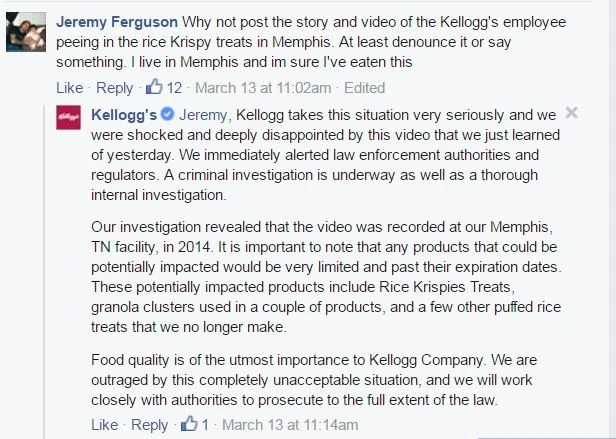
Kellogg's is responding to a video showing a man urinating onto a conveyor belt at one of its factories. The video was taken in Memphis, Tennessee, in 2014 during a labor dispute, so any affected products are past their expiration date. In other words, it's too late to worry whether your box of Rice Krispies was tainted.
The U.S. Food and Drug Administration has started a criminal investigation, and the company is investigating internally. Of course, customers are furious.
Kellogg's has issued a statement and is addressing questions on its Facebook page. To CNN, Kris Charles, a Kellogg's spokesman, said the company is "outraged by this completely unacceptable situation." He also said, "We were shocked and deeply disappointed by this video that we just learned of yesterday. We immediately alerted law enforcement authorities and regulators."

Kellogg's also posted a notice on its website.
Discussion Starters:
- What would lead an employee to take this action? Imagine the scene at the factory. Would other employees see this and not take action? In other words, how does something like this happen?
- Are people over-reacting, or is this a serious issue?
- Assess the company's response. How well did the social media manager address the Facebook post? Could he or she have said anything different?
- In addition to the statement given to CNN, what else could the company have said?
SeaWorld Ends Orca Breeding Program
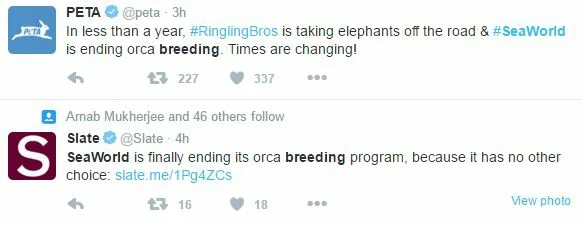
SeaWorld is still trying to recover from the negative publicity from Blackfish, the 2013 documentary about orca whales in captivity. Now, the entertainment park has announced it will no longer breed orca whales. This is the biggest move since SeaWorld changed its shows, and it gives hope to animal rights activists. PETA tweeted about the decision as well as Ringling Brothers' decision to stop traveling with elephants in its circus.
 Slate is probably right. Pressure continues to mount on SeaWorld: ticket sales continue to decline, and corporations continue to pull partnerships.
Although the reaction to the news is mostly positive, this still leaves current orcas in captivity, not living in the best conditions. But some experts say there's little other choice: whales bred in captivity cannot easily be released.
Discussion Starters:
- Read SeaWorld's "5 Things You Need to Know. . ." Assess the content choices and approach. Who is the intended audience? Would they find this piece convincing? What questions might remain?
- Should SeaWorld have made this decision long ago? Why or why not?
Snapchat Responds to Phising Scam
A Snapchat employee accidentally sent employees' personal information outside the company, and it has caused embarrassment. Snapchat has faced privacy concerns in the past, and now its own employees may question the company's security.
The employee responded to a fake email that looked like it came from CEO Evan Spiegel. This is a common phising scam, which according to the Federal Trade Commission (FTC), is when "internet fraudsters impersonate a business to trick you into giving out your personal information." The FTC gives these examples of phising emails; we have all seen something similar:
- "We suspect an unauthorized transaction on your account. To ensure that your account is not compromised, please click the link below and confirm your identity."
- "During our regular verification of accounts, we couldn't verify your information. Please click here to update and verify your information."
- "Our records indicate that your account was overcharged. You must call us within 7 days to receive your refund."
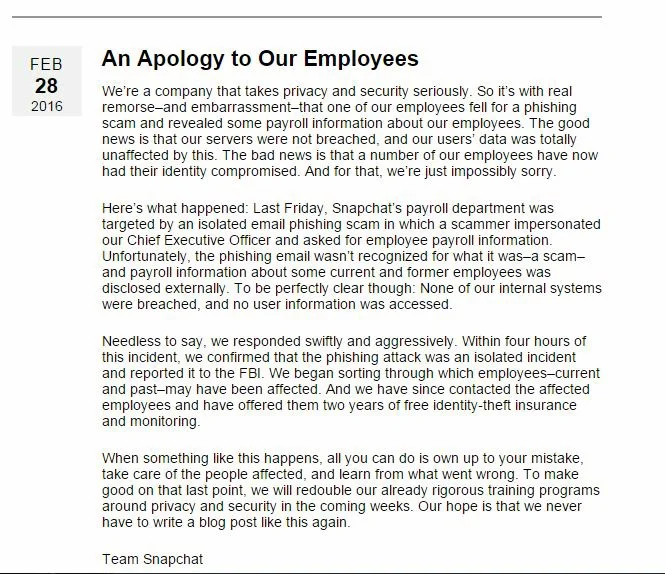
Snapchat responded with an apology to its employees, posted on its blog:

Discussion Starters:
- What are some clues that an email address is fake?
- Assess Snapchat's apology: word choice, tone, content, organization, and so on.
LinkedIn's First TV Ad
We'll see the first LinkedIn TV ad during this year's Oscars. The company decided to use a space theme for the commercial partly because of a successful NASA recruiting campaign on the platform. "We saw the astronaut as a universal symbol of the dream job and anchoring the campaign around that story would bring it to life," said Nick Bartle, vice president of marketing. With The Martian receiving nominations for best picture and best lead actor, the ad fits the awards ceremony well.
Bartle also explained the company's hope in producing the ad:
"'You're Closer Than You Think' is LinkedIn's first-ever integrated marketing campaign and TV spot that's inspired by LinkedIn's vision to create economic opportunity for the global workforce. We want this to permeate in everything we do, including helping our members find jobs, learn from influential people, build their professional brand and connect with people who can make a difference in their path."
The voice over, LinkedIn's CEO Jeff Weiner, personalizes the ad with a story about his father.
Discussion Starters:
- Why do you think LinkedIn waited until now to produce a TV ad?
- What's your view of the ad? Is this the right audience, and do you find it effective?
Uber Responds to Shooting Incident
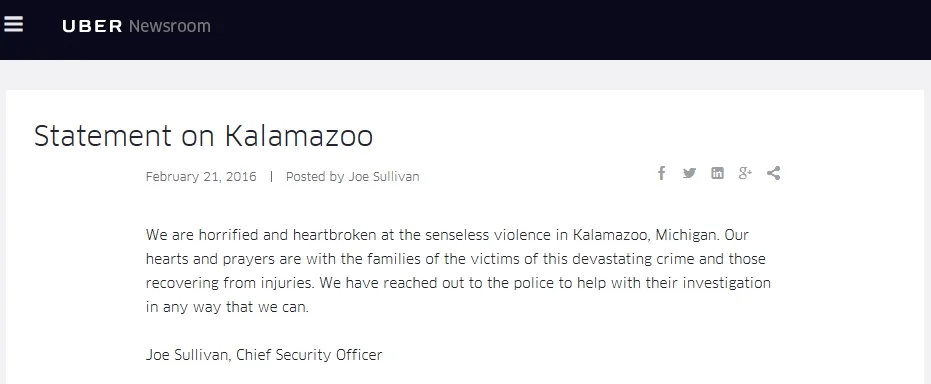
Uber is responding to a shooting incident with one of its drivers, who killed six people and wounded two in Kalamazoo, Michigan. The company's safety procedures are in question, but the incident had nothing to do with the shooter's role as an Uber driver, although this connection is how he's most identified in news reports. The company published the following short statement on its website.

In response to further questioning, Uber says the gunman passed its background checks, had no criminal record, and received customer ratings of 4.73 out of 5. He had been an Uber driver for almost a month and picked up more than 100 passengers.
Under "Details on Safety" on its website, Uber describes its driver-checking process. One criticism is that fingerprinting isn't required, as it is for taxi and limousine drivers. Also, unlike taxi drivers, there is little interaction with others. The founder of an app that lets Uber and Lyft drivers chat said, "I think taxi drivers traditionally have had fleets and lots, so at the beginning of the shift, you will go, check in with a dispatcher, hang out, have a coffee with other taxi drivers and then go out - rather than this completely dispersed Uber network, where you don't have to go anywhere, you just turn on the app in your car and drive for eight hours and never talk to any other driver."
But a member of Uber's Safety Advisory Board defending the company practice: "As it stands right now, the system that Uber has is extremely safe, and the idea that simply by having someone look at someone that they could determine if they're about to have a psychotic episode is a faulty theory."
This news comes soon after Uber settled a lawsuit about safety claims.
Discussion Starters:
- What's your view of the link between Uber and the shooting? Is it unfair to the company or about time its safety practices are revealed (or something else)?
- How else, if at all, should Uber respond? What's the danger of responding too loudly in this case?
Yelp Manages Open Letter from Employee
 Yelp is in the news for an employee's angry "open letter" about pay. She describes how she's suffering financially and blames the company for not paying a living wage.
The company issued this statement to Business Insider:
We do not comment on personnel issues. However, we did agree with many of the points in Ms. Jane's post and we viewed it as her real, personal narrative about what it's like to live in the Bay Area. Most importantly, it's an important example of freedom of speech.
We agree with her comments about the high costs of living in San Francisco, which is why we announced in December that we are expanding our Eat24 customer support team into our Phoenix office where will pay the same wage.
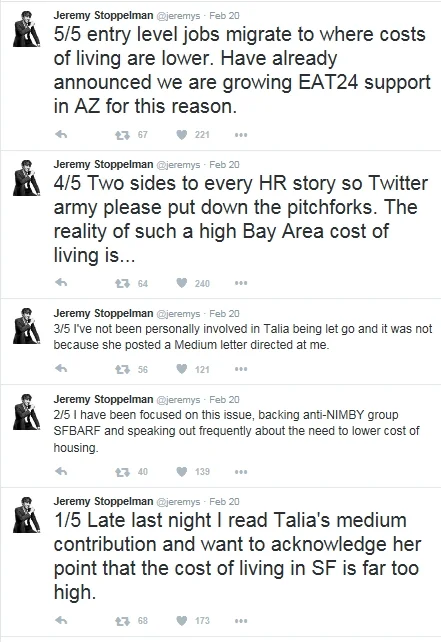
Yelp CEO Jeremy Stoppelman also responded on Twitter, shown here. As you see from tweet 3/5, the employee was fired, which didn't inspire goodwill.
The employee continued tweeting after her termination.
Discussion Starters:
- Should the employee have voiced her concerns in a different medium? Consider her goal, the ethics, and the result.
- Read the employee's letter. How well does she convey her argument?
- How well did Yelp handle the situation? What, if anything, should the company have done differently?
Apples Fights FBI's Demands
 This is a pivotal moment in privacy for the country. Apple is under pressure from the Federal Bureau of Investigations and the Justice Department for access to phones belonging to shooters who killed 14 people in San Bernardino, California, late last year.
Tensions are high in this situation. The Justice Department said, "It is unfortunate that Apple continues to refuse to assist the department in obtaining access to the phone of one of the terrorists involved in a major terror attack on U.S. soil."
But Apple and civil liberties organizations argue that this could set a bad precedent against consumer privacy. The company would need to develop new technology that could be used in other situations. In a statement, CEO Tim Cook said, "The government suggests this tool could only be used once, on one phone. But that's simply not true. Once created, the technique could be used over and over again, on any number of devices."
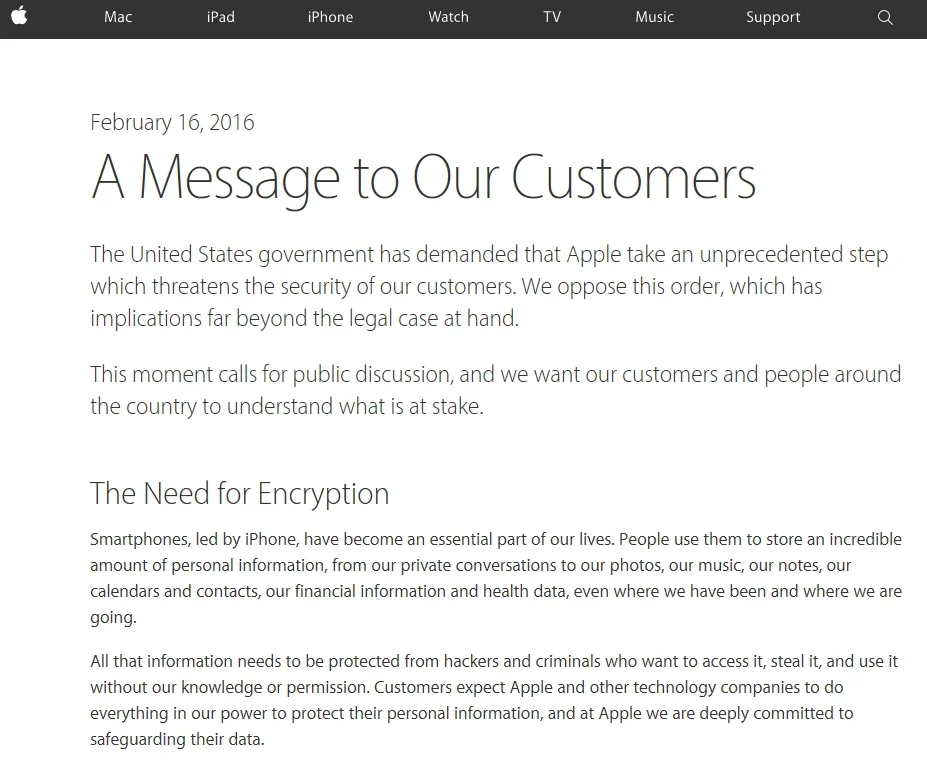
A message to customers on Apple's website further explains the company's position:
The government would have us remove security features and add new capabilities to the operating system, allowing a passcode to be input electronically. This would make it easier to unlock an iPhone by "brute force," trying thousands or millions of combinations with the speed of a modern computer.
The implications of the government's demands are chilling. If the government can use the All Writs Act to make it easier to unlock your iPhone, it would have the power to reach into anyone's device to capture their data. The government could extend this breach of privacy and demand that Apple build surveillance software to intercept your messages, access your health records or financial data, track your location, or even access your phone's microphone or camera without your knowledge.
Discussion Starters:
- What's your view? Should Apple meet the government's demands? What are the most convincing arguments on both sides?
- Read Cook's entire message to customers. How does he balance logical arguments, emotional appeal, and credibility?
Another IRS Data Breach
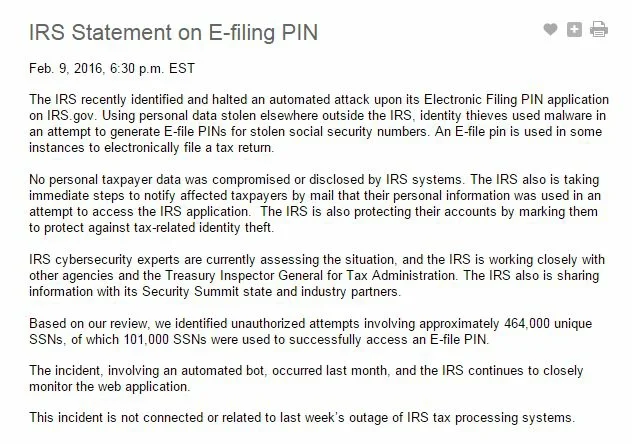
This is the second time the IRS has experienced a data breach. Hackers used social security information to create PINs for E-filing, which could allow them to capture tax refunds for 101,000 people.
In a statement posted on its website, the IRS tries to deflect the issue: "Using personal data stolen elsewhere outside the IRS..."

Last year, hackers made away with $50 million in refund money. A federal investigative report concluded: "The Return Review Program Enhances the Identification of Fraud; However, System Security Needs Improvement."
Discussion Starters:
- How well does the IRS statement rebuild taxpayer confidence?
- Read the 2015 report. Which principles from Chapter 10 are followed? Based on the report, should the IRS have done more in the past year?
Marriott Movie Is a Big Hit
With 3.6 million views and counting, Marriott's movie short, "Two Bellman Two," is a testament to engaging audiences with innovative content. According to Skift, this second Marriott movie tops the first, which was shot within one LA property. This one targets the luxury traveler and sells the destination:
"In Dubai, Marriott is now emphasizing the destination to sell the hotel by highlighting the wide panoramic vistas across the desert and sea, along with scenes of various tourist activities ranging from sand dune surfing to water jetpacking."
According to Skift, "All in all, Marriott has developed something with this movie franchise that transcends all of that. They have created two winning brand identities that establish JW Marriott in an entirely different consumer market landscape."
The movie site is about about the movies; we see no promotional information or links to Marriott properties at all.
Marriott Content Studio is behind the innovative films. A look inside the company shows a central control center, M Live, with "nine screens, showing everything from the social media campaigns of Marriott's 19 brands to real-time booking information to Marriott's editorial calendar." Swivel seats are for different departments within the company. According to David Beebe, Marriott's Emmy-winning vice president of global creative,
"This is a tool for everybody to use in the building. It's customer-first thinking. That's why a lot of brands can't achieve what we're doing. They think, ‘I can't do that because someone over there is not going to like it.' It gets very internal-political."
Discussion Starters:
- What are the potential downsides of a company venturing into this type of creative marketing?
- Read more about the Content Studio and the analytics: how is the company measuring success?
Chipotle Practices Transparency
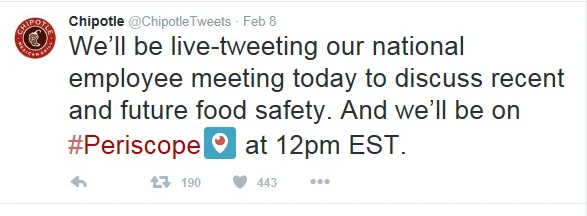
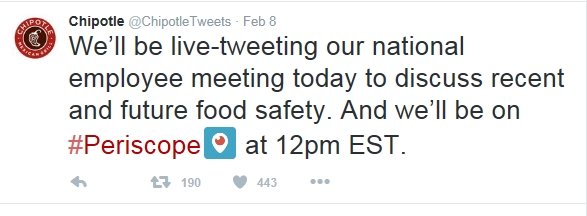 Chipotle is working hard to improve its food safety procedures and its image. After several reported E. coli outbreaks, the company announced a four-hour closing of its 1,900 stores to retrain its employees. The meeting was live-tweeted via @ChipotleTweets.
Chipotle also announced a local grower initiative to help farmers meet the company's new food safety demands, which can be tough on small farmers. The initiative includes education and training, financial assistance, and opportunities for add new farmers with greenhouses and other technologies.
In a fully developed section of its website, Chipotle outlines new plans for food safety for suppliers and in restaurants.
The good news for Chipotle is that the Center for Disease Control (CDC) declared the outbreak over as of February 1. Chipotle CEO Steve Ells is, of course, confident about a comeback, but he's not alone. Shake Shack CEO Randy Garutti expressed his confidence in the company's future as have analysts such as Darren Tristano, executive vice president of industry research firm Technomic: "Consumers have a surprisingly short memory. I would be surprised if it's still affecting them by mid-next year."
Discussion Starters:
- How do you assess Chipotle's messaging? Analyze its website and social media presence. Consider the audience analysis, communication objectives, messaging, organization, tone, and so on.
- What's your prediction for Chipotle's future?
In Tightening Race, Arguments About Wall Street
Hillary Clinton and Bernie Sanders debated last night in an elevated argument about policies and finances. In January, for the first time, the Sanders campaign raised more than Clinton's, which her finance director said was, "a very loud wake-up call." Clinton also won the Iowa caucus, but by a small margin. As a result, the tone of the debate changed.
In this clip, the reporter asks about Clinton's record, and Sanders avoids the question to discuss his view on "big banks."
As Sanders campaigns for equity, he shuns contributions from financial services companies: "I am very proud to be the only candidate up here who does not have super PAC, who's not raising huge sums from Wall Street and special interests." He questioned Clinton's contributions from companies, such as Goldman Sachs, which paid her $675,000 for three speeches, and gave examples of inequity:
He said that when a "kid gets caught with marijuana, that kid has a police record." But when "a Wall Street executive destroys the economy" and pays a $5 billion settlement, he has no criminal record.
Wall Street has been a popular topic on both the Republican and Democratic campaigns. Ted Cruz was recently criticized for accepting money from Goldman Sachs without disclosing it.
Discussion Starters:
- Assess the candidates' arguments about Wall Street. What's your opinion on the power of Wall Street?
- Who do you think won the debate? What were the highlights?