
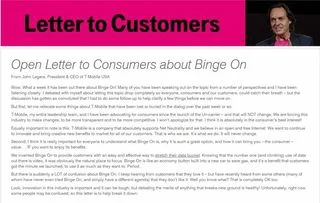
T-Mobile Letter: "Binge On!"
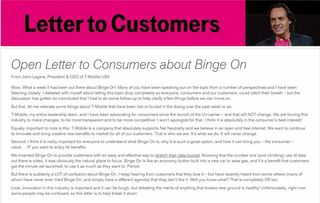 T-Mobile announced "Binge On," a new program for consumers to "stretch their data bucket." The service allows customers to watch videos at lower resolutions (which the company says doesn't matter on small screens) and not count the time against their high-resolution data minutes. In addition, consumers can watch videos from partner sites for free.
Not all responses to Binge On have been positive. The Electronic Frontier Foundation (EFF) has questioned whether the program affects streaming in addition to bandwith. In a video tweet response, CEO John Legere shot back a response including the F-bomb. Legere later apologized.
In a letter to customers, Legere clarifies that the service is "opt-in" (a big concern) and explains the program in more detail. This paragraph is an example of Legere's usual, casual style:
But there is suddenly a LOT of confusion about Binge On. I keep hearing from customers that they love it – but have recently heard from some others (many of whom have never even tried Binge On, and simply have a different agenda) that they don't like it. Well you know what? That is completely OK too.
My sister sent me the letter and didn't appreciate the casual tone or the "creepy" picture of the CEO. She also noted that the letter isn't dated, so it's unclear when all of this happened.
Consumers can find more information on T-Mobile's FAQs about Binge On.
Discussion Starters:
- What's your view of Legere's writing style? Partly, it fits with the T-Mobile image, but is it too much for customers?
- Could T-Mobile have avoided some of the controversy with clearer communications during the rollout? What do you think happened, and how could the messaging have been handled differently?
Words in Email Subject Lines
A study analyzed more than 3 billion emails in four industries to determine which words were most and least effective. The industries included retail & B2C, conferences & events, media & publishing, and B2B/professional services & financial.
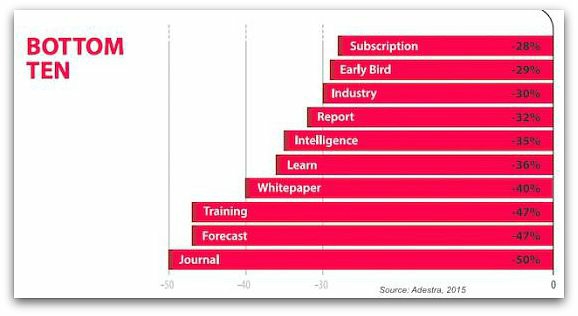
The authors warn that the words don't guarantee success and depend on the brand, but we can draw some conclusions about the results.
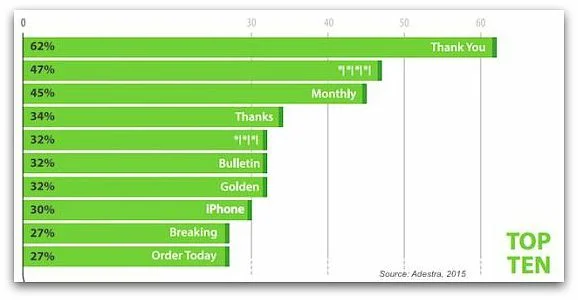
PR Daily summarizes the findings and shows two relevant charts:
Overall, email subject lines that include the words "thank you" have the highest above-average engagement levels (+62 percent)-perhaps because many automated, transactional messages include this phrase, such as email receipts sent by brands after customers complete online purchases.
Subject lines that separate topics with vertical pipes (e.g., "Sale now on | New lines added | Win trip to Dubai | Share your pics with #summer2015rules") also perform significantly above average (+47 percent).
Timeliness also tends to work well in email subject lines, with words such as "bulletin" (+32 percent), breaking (+27 percent), and "order today" (+27 percent) all boosting engagement.
The second and fifth bars are "vertical pipes" described above (four and three, respectively).

Discussion Starters:
- In Chapter 4, you read about catchy subject lines. How do these survey results match what you learned?
- Look at your 50 most recent emails. Which subject lines stand out to you? How many include successful words above?
- Practice writing a few subject lines with the successful words and vertical pipes.
eBay Updates User Agreement
eBay sent an email to its customers to announce new terms and posted the revised agreement on its website. In June, when eBay spun off PayPal, both companies changed their user agreements-and heard from the New York attorney general. They wanted to make automated calls to collect payments or get feedback, but such "robocalls" could be illegal in New York State.
This time, the guidelines aren't making many waves. One highlighted change is about contacting users by phone: eBay says it "updated some of the language." Another indicates that reductions in fees won't be communicated in advance. Other changes focus on listings and international shipping arrangements.
 |
 |
|
|
|
|
|
|
|
|
|
Discussion Starters:
- Assess the message organization. How does eBay use bullets, and do you find them effective?
- What's your view of the other changes? Which do you think could upset users?
"Gawker Grows Up"
 After big executive news last week, Gawker CEO Nick Denton wrote a long message to staff. Gawker's executive editor and the editor-in-chief of Gawker.com resigned after an article, which revealed that a high-ranking magazine executive was texting a gay escort, was removed from the site after a board vote. Denton explained the decision in a post, including, "The point of this story was not in my view sufficient to offset the embarrassment to the subject and his family."
The executives' perspective, reflected partly in a message from Max Read (editor-in-chief) to Gawker writers, was about the faulty separation between editorial freedom and business (my paraphrase):
"On Friday a post was deleted from Gawker over the strenuous objections of Tommy and myself, as well as the entire staff of executive editors. That this post was deleted at all is an absolute surrender of Gawker's claim to 'radical transparency'; that non-editorial business executives were given a vote in the decision to remove it is an unacceptable and unprecedented breach of the editorial firewall, and turns Gawker's claim to be the world's largest independent media company into, essentially, a joke."
In his message to staff, CEO Denton discussed these issues and announced management team changes. Part of his post addressed controversy about the removed story:
"My professional life is committed to a free press and open discourse. While the reputation of our media brands remains a proper concern of the company, we do not and will not make story decisions based on advertiser feedback. Our credibility with both readers and advertisers depends on strong, incisive and independent journalism.
"I will put the company on the line rather than cave to legal pressure from the subject of a story, no matter how powerful. I will preserve Gawker Media's reputation for fighting press freedom cases that other media companies would settle.
"In regards to the recent story about a media executive blackmailed by an escort, I've explained extensively I ordered this misjudged exposé removed because it was not in line with the editorial standards I believe Gawker.com should maintain. And yes, it was also damaging to the brand of Gawker.com and the reputation of the company that shares the same name."
Denton ended his message, "Gawker grows up."
Discussion Starters:
- Explain the executives' and the CEO's positions on the removed story in your own words.
- How is this story relevant to business communicators?
- Assess Denton's message to staff. What works well, and what could be improved in the organization, tone, writing style, and so on?
"Creepy Methods" and More in Emails
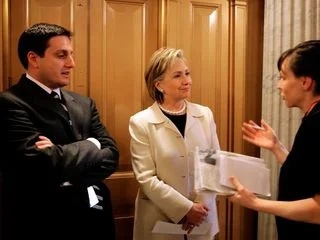
 Hillary Clinton's emails are becoming public as are emails about other personal accounts potentially used for official State Department business. In a series of emails, we see Clinton's aide, Philippe Reines, show his anger, including this "Note" at the end of a message to Gawker:
"(NOTE: How about you, me and lying liar source take a trip to the polygraph store. The three of us strap in and we let the needle decide. Loser pays and issues a public apology. I don't need to know their identity until they lose.)"
The email stream started with a question from a reporter to Reines:
From: CJ Ciaramella
Date: Tue, 3 Mar 2015 18:47:10
To: Philippe Reines
Subject: Comment on private email address at State Dept
Hi Philippe,
This is CJ Ciaramella, a reporter for the Washington Free Beacon and Vice. Wondering if you have any response to this Gawker article alleging that you and Huma Abedin used private email addresses to conduct official government business while at the State Dept:
http://gawker.com/source-top-cli...
As I'm sure you well know, not archiving official business conducted on a private email address is a violation of the Federal Records Act. A FOIA request for your State Dept. emails is also currently being appealed. Please email or call: [redacted]
Best,
CJ Ciaramella
Here are more quotations from Reines' emails:
- Did you attempt to verify your source's assertion of my use of such an email using the same creepy methods you did with my close friend and colleague Huma Abedin? Assuming you did, why doesn't your piece note the results of your creepy methods?
- If your lying liar pants on fire source worked with me at a federal agency as you and they contend, did you ask them to provide even a single email exchange with my using that account?
- Cockamamie Theory: Is it your belief that I orchestrated this from private life months after leaving my job at State? If yes, is it your belief that my long reach would rig something as implausibly stupid as the reply you got? That's just insulting. I mean, it put me in a worse light than if they had just ignored you.
Discussion Starters:
- Read all of the emails (if you have the time!). How is Reines both hurting and helping Clinton?
- To what extent should this email exchange reflect on Clinton personally and professionally?
New Meanings of Punctuation
 A New York Times article discusses the interpretations and misinterpretations of punctuation marks. Of course, texting has raised new issues, and this isn't the first time the topic is of interest.
Mashable published an article more than a year ago about the perplexities of marks in messages, particularly periods as aggression. Turns out, only 39% of college students use punctuation at the ends of texts (45% at the ends of instant messages).
The NY Times writer reminds us of the history of punctuation:
"The origins of punctuation lie in ancient oration, when marks were used in handwritten speeches to advise when and for how long a speaker should pause. A period was a part of speech that had a beginning and end, a comma indicated the shortest pause, while the colon was somewhere between the two.
"But there are no pauses or inflections in digital communication; we aren't speaking the words out loud. Which means that even within the tiniest spaces, punctuation fills in the tonal holes."
She adds spaces before some marks, for example, "Can't wait !!" She believes this can "soften the marks themselves."
One editor says it well: "You could drive yourself insane trying to decode the hidden messages in other people's punctuation." I'm sure many people do.
Discussion Starters:
- What's your view about periods at the ends of text messages?
- Look at your most recent text messages. How are you using punctuation? Can any be misinterpreted?
- Can you remember a text that had confusing punctuation? Why did it confuse you?
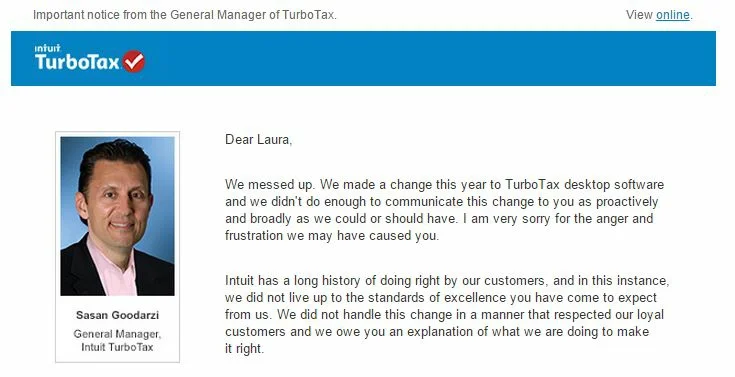
TurboTax Apologizes for Change
TurboTax changed its software and didn't communicate the decision as well as it could have. People rely on the program to do their own taxes rather than hiring an accountant. But the company omitted some forms, and users didn't realize until they starting working in the system.
General Manager Sasan Goodarzi is front and center-including this photo- in the apology that was distributed by email to TurboTax registered users.

Download full TurboTax apology.
Discussion Starters:
- What principles of business writing does Goodarzi use in his statement? Particularly consider the organization: how is the statement structured, and how does he organize each paragraph?
- How effective is his apology? What might users appreciate, and what could further anger them?

Study: Check Email Less Often
 A new study from the University of British Columbia's psychology department tells us to stop checking email so frequently. The study asked one group of subjects to turn off their email alerts and check email only three times a day for a week. Another group was told to check email as many times as they would like. Then, the groups switched for a second week.
Published in Computers in Human Behaviour, the study showed that checking email leads to feelings of stress and tension. Subjects answered the following questions:
- How often have you felt that you were unable to control the important things in your life?
- How often have you felt nervous and stressed?
- How often have you found that you could not cope with all the things that you had to do?
- How often have you been angered because of things that were outside of your control?
Discussion Starters:
- Do these results surprise you?
- How realistic is it to check email just two or three times a day at work?
- What could you do to limit the number of times you check email throughout the day?
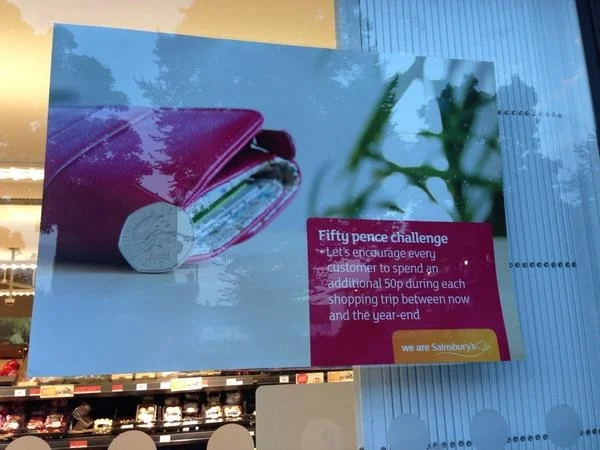
Internal Message Posted on a Window
Sometimes a simple mistake requires a simple solution. At one location of Sainsbury's, a British grocery chain, a message intended for employees was mistakenly posted in the window.

In a friendly tweet exchange, a Sainsbury's representative promised to follow up:

The grocer emailed an explanation to Business Insider:
"We often use posters to make store targets fun and achievable for our colleagues. They are intended for colleague areas in the store, but this one was mistakenly put on public display."
Discussion Starters:
- The tweet is quite conversational, including "yeah." Is this appropriate?
- Assess Sainsbury's explanation. Is it sufficient?
- What's your view of the campaign for employees?
Former Google CEO's Email Advice
Eric Schmidt, former Google CEO, has written a new book, How Google Works. His advice includes nine rules for managing email:
1. Respond quickly. There are people who can be relied upon to respond promptly to emails, and those who can't. Strive to be one of the former.
2. When writing an email, every word matters, and useless prose doesn't.
3. Clean out your inbox constantly.
4. Handle email in LIFO order (Last In First Out). Sometimes the older stuff gets taken care of by someone else.
5. Remember, you're a router. When you get a note with useful information, consider who else would find it useful.
6. When you use the bcc (blind copy) feature, ask yourself why. The answer is almost always that you are trying to hide something, which is counterproductive and potentially knavish in a transparent culture.
7. Don't yell. If you need to yell, do it in person. It is FAR TOO EASY to do it electronically.
8. Make it easy to follow up on requests. When you send a note to someone with an action item that you want to track, copy yourself, then label the note "follow up." That makes it easy to find and follow up on the things that haven't been done; just resend the original note with a new intro asking "Is this done?"
9. Help your future self search for stuff. If you get something you think you may want to recall later, forward it to yourself along with a few keywords that describe its content.
Schmidt's ninth rule supports an IBM study I read a few years ago: Filing emails into folders is a waste of time. I'm old school and still do this, but with more sophisticated search-as in Google's Gmail-finding messages is easier than ever.
Discussion Starters:
- Read more detail about the rules. With which rules do you agree and disagree?
- What advice would you add to Schmidt's list?
Nadella's Email to Microsoft Employees
 The beginning of a new fiscal year inspired Microsoft's new CEO Satya Nadella to send a 3,187-word email to employees about the company's future. (Thanks for counting, Business Insider!)
The email includes a mix of jargon and simple language. You'll see the typical verbs: reinvent, empower, deploy, maximize, thrive, and of course, digitize (What would Microsoft be otherwise?).
"Developers and partners will thrive by creatively extending Microsoft experiences for every individual and business on the planet." Whatever that means...
Discussion Starters:
- What key messages do you take from the email?
- The email is long. Do you think employees will read it? Why or why not?
- Who are the primary and secondary audiences? What are the objectives?
- What advice do you have for Nadella as a writer?

Maya Angelou Quotations
 PR Daily published this list of memorable quotations by the recently deceased writer Maya Angelou:
1. "There is no agony like bearing an untold story inside of you."
2. "When I am writing, I am trying to find out who I am, who we are, what we're capable of, how we feel, how we lose and stand up, and go on from darkness into darkness. I'm trying for that. But I'm also trying for the language. I'm trying to see how it can really sound."
3. "Music was my refuge. I could crawl into the space between the notes and curl my back to loneliness."
4. "The main thing in one's own private world is to try to laugh as much as you cry."
5. "All great artists draw from the same resource: the human heart, which tells us that we are all more alike than we are unalike."
6. "The best candy shop a child can be left alone in is the library."
7. "I make writing as much a part of my life as I do eating or listening to music."
8. "You can't use up creativity. The more you use, the more you have."
9. "If you have only one smile in you, give it to the people you love."
10. "The idea is to write it so that people hear it and it slides through the brain and goes straight to the heart."
In articles about her death, CNN called her a "legendary author" and Fox referred to her as a "renowned poet."
For a laugh, here's Tracy Morgan impersonating Maya Angelou on Saturday Night Live with Tina Fey.
Discussion Starters:
- What can we learn from Maya Angelou for business writing?
- Which of her quotations-here or others-do you find most relevant to business writing?

Chipotle Bags and Cups Go Literary
 Chipotle Founder and CEO Steve Ells liked a customer's idea to change its white, boring cups and bags to something more interesting. Frustrated at Chipotle without reading materials (or a smartphone?), Jonathan Safran Foer pitched the idea for getting writers to submit text. In a Vanity Fair article, Foer described his email to Ells:
"I said, ‘I bet a s***load of people go into your restaurants every day, and I bet some of them have very similar experiences, and even if they didn't have that negative experience, they could have a positive experience if they had access to some kind of interesting text,'" Foer recalled. "And unlike McDonald's, it's not like they're selling their surfaces to the highest bidder. They had nothing on their bags. So I said, ‘Wouldn't it be cool to just put some interesting stuff on it? Get really high-quality writers of different kinds, creating texts of different kinds that you just give to your customers as a service.'"
The project, called Cultivating Thought, has already garnered quite the list of celebrity authors, including Foer, who bills himself as curator. Foer authored Everything Is Illuminated, Extremely Loud and Incredibly Close, and Eating Animals.

Discussion Starters:
- What do you think of the idea? As you can imagine, not everyone loves it.
- Why would Steve Ells be interested in this project? What does Chipotle-and possibly Ells personally-have to gain?
Pom Wonderful Steals the Show
Pom Wonderful did a great job responding to criticism from HBO talk show host John Oliver. According to an Adweek article, Oliver had "dismissed Pom Wonderful as snake oil and suggested putting stickers on Pom's juice bottles saying it contains dogs." This was after showing a clip from a TV show, on which Pom was promised to reduce the possibility of prostate cancer.
Pom responded by sending Oliver a refrigerator, a case of the juice, and a clever letter, which he read on air.
Discussion Starters:
- What's your view of Pom's response? In what ways was it effective, or not?
- The Adweek article referred to Pom's "strangely stilted letter ('We like to think we're able to take a joke. It was very funny. We laughed hard')." Do you agree with this assessment?
Comparing Heartbleed Emails
 By now, most people know about Heartbleed, the computer vulnerability that takes advantage of a programming flaw in websites' OpenSSL encryption code. As we wait to see which sites are affected, companies are beginning to send emails to customers. We can compare these bad-news messages in the same way we looked at emails about the Epsilon security breach back in 2011.
Here are the emails I've seen so far:


Discussion Starters:
- What differences do you notice among these emails? Consider the message, tone, organization, and so on.
- What could account for these differences?
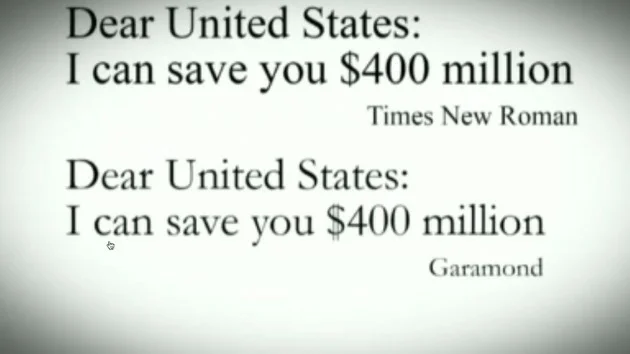
Teenager Proposes Font Change for $234m in Savings
A 14-year-old boy claimed that the U.S. government could save $234 million by switching from Times New Roman to Garamond. But The Washington Post reports, "That claim is patently false."
Suvir Mirchandani, from Pittsburgh, made a good point: a smaller or thinner font could reduce paper and toner expenses. Garamond simply takes less ink than does Times New Roman.
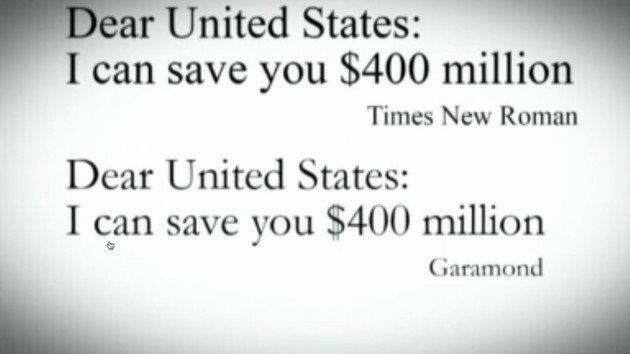
But experts say that the government doesn't print nearly the quantity that Mirchandani estimated in his paper, published in the Journal of Emerging Investigators. The Government Printing Office, which prints about half of the government's work, spent only $700,000 on ink last year. Mirchandani admits that he didn't get his information directly from the government in time for his paper to be published.
Second, Mirchandani failed to consider that the font change, as you see above, makes the printing harder to read. That's a real consequence of a smaller or thinner font-and who knows what problems that would cause and how much they would cost.
Discussion Starters:
- Read Mirchandani's paper. Can you identify the flaws?
- How would you describe the consequences of a font that's more difficult to read? Consider who reads government documents and for what reasons.
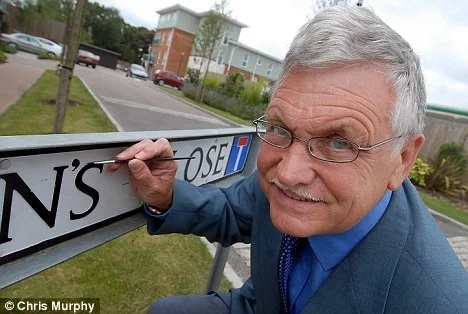
British Street Signs Omit Apostrophes
In Britain, apostrophists are marking street signs to correct what they consider an assault on the English language. King's Road has become Kings Road to help emergency vehicles get to the right address, a problem that recently led to a teenager's death. The British government has recommended no punctuation in street signs.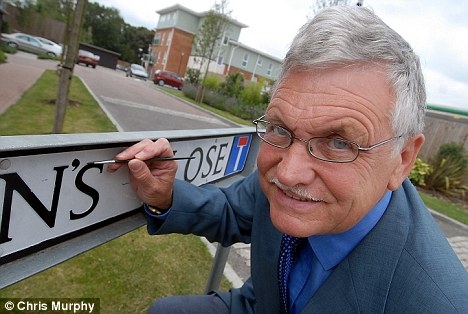
One grammarian defended the corrections to street signs: "If the apostrophe needs to be there, I don't think it's vandalism because I would say the language is being vandalised." And the chair of the Apostrophe Protection Society said, "I don't know why their computers couldn't be trained to recognise an apostrophe."
This isn't the first time someone took a black marker or paintbrush to a sign. In 2009, a British man added an apostrophe to correct a "St. John's Close" sign in front of his house. But it didn't last: neighbors scratched off his work. At the time, the government council favored no punctuation for the sake of "simplicity."
Visitors to the stairwell in the Beck Center at Statler Hall at Cornell may notice, in addition to the faint smell of smoke, an "n" added to "Personel." Who would do that?
Discussion Starters:
- What's your view of the decision to remove punctuation from street signs: an assault on language, a practical move, or something else?
- Should people who add signs be punished? Are they vandals?
- How did we get to this point: why can't a GPS recognize an apostrophe?
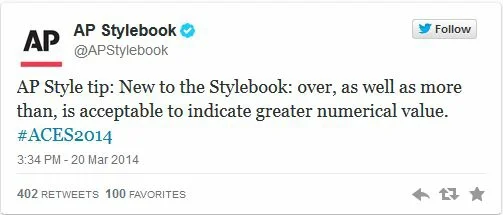
Fury Over AP Style Guide's Acceptance of "Over"
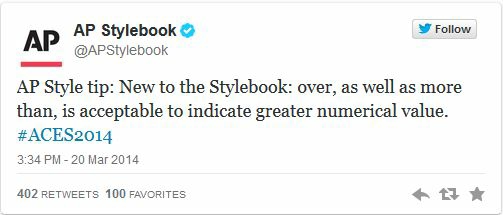
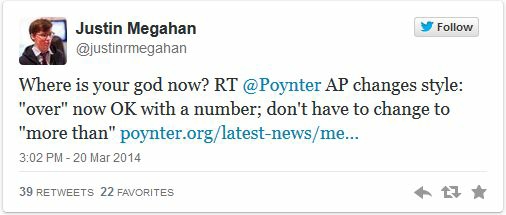
The AP Style Guide has updated a grammar rule and caused an outcry on Twitter. According to the new rule, "over" is acceptable to mean "more than," which strict grammarians won't accept.

A 2011 Inkhouse post explains the previous distinction:
"More than, over. More than is preferred with numbers, while over generally refers to spatial elements. The company has more than 25 employees; The cow jumped over the moon."
AP Stylebook explained the decision:
"We decided on the change because it has become common usage. We're not dictating that people use ‘over' – only that they may use it as well as ‘more than' to indicate greater numerical value."
Discussion Starters:
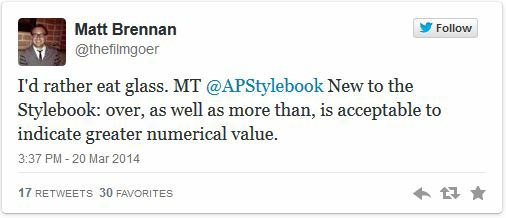
- What would you rather do: eat glass or use "over" interchangeably with "more than"?
- Seriously, what do you think inspires this outrage? In what ways is it justified-or not?
- To me, these tweets are extraordinarily funny. Do you agree? If so, why do you think that's the case?
A Handwritten Job Ad
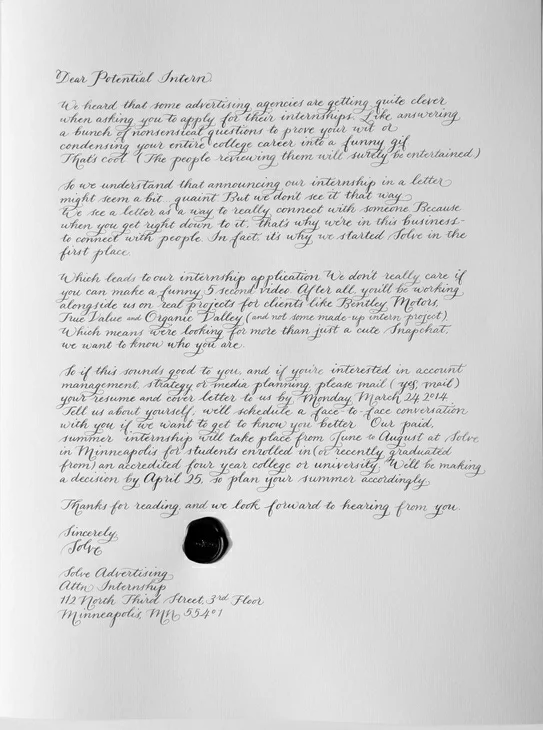
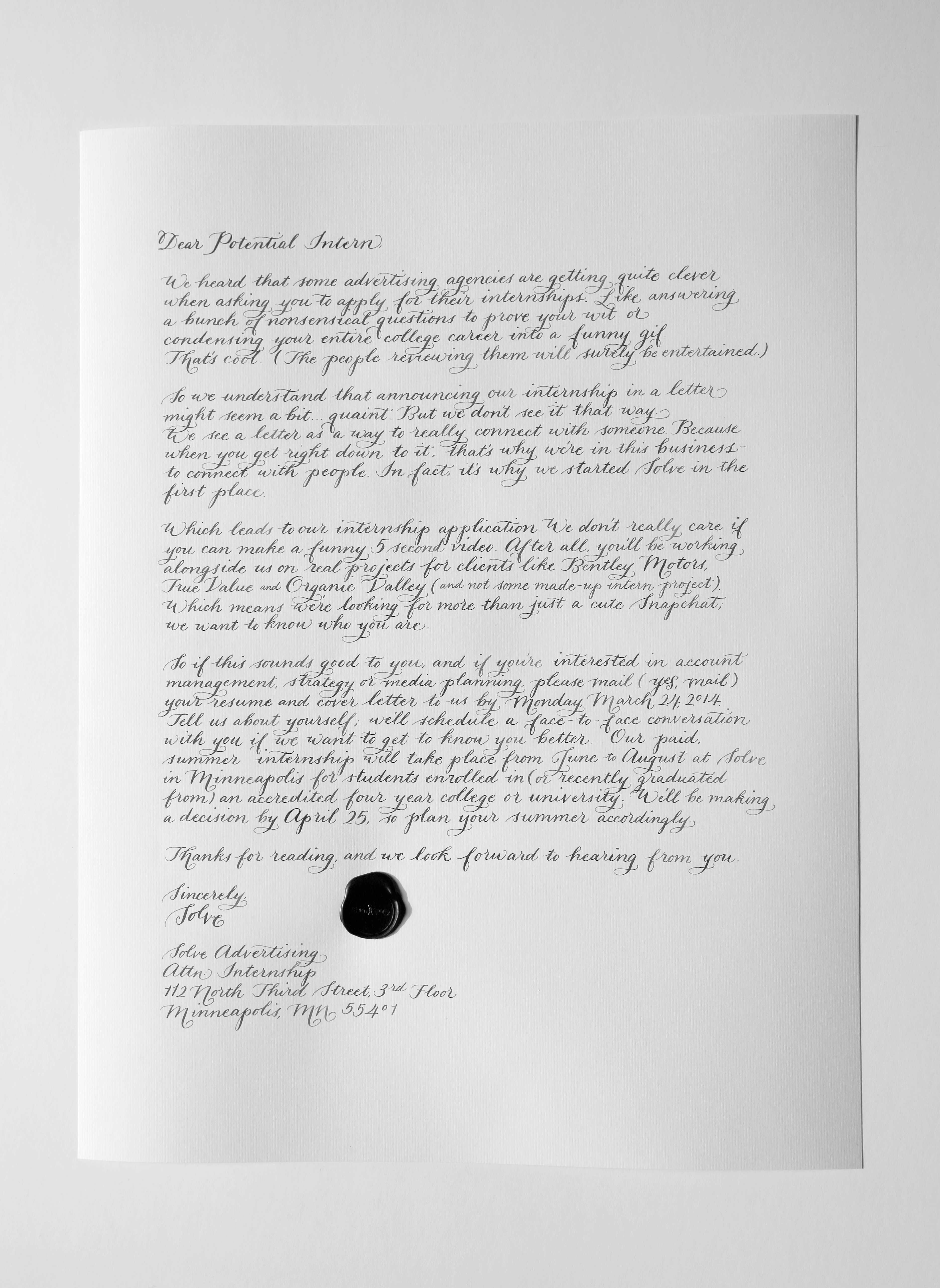
Advertising agency Solve has a new-and old-way of inviting interns to apply for jobs. In a handwritten letter posted around college campuses, Solve asks interns to submit a traditional cover letter and resume by mail. Emphasizing "genuine connections" and a "personal, straightforward" approach, the agency describes its rationale:
"Valuing substance over silliness, Solve refuses to ask candidates to condense resumes into 140 characters, present themselves via fake campaign or funny videos, or answer irrelevant nonsensical questions. Rather, Solve is simply asking for a resume and cover letter…to be sent (via mail) to the agency."
Discussion Starters:
- What's your view of the agency's campaign: refreshing, as gimmicky as a tweet, or something else?
- I'm having trouble reading the letter. Is it just me?
- The letter asks prospective interns to mail in their cover letter and resume. Would you submit something typed or handwritten?
- The letter has a fairly major grammatical error. Can you find it?

Error in "12 Years a Slave" Story
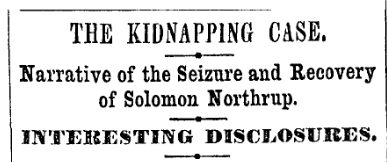 The New York Times has just corrected an error in spelling the name of the man featured in the Academy Award winning movie 12 Years a Slave. The 1853 article about the free African American man who was sold into slavery spelled his name Solomon Northrop and, in the headline, Northrup, rather than the correct spelling, Northup.
The New York Times correction acknowledges a tweet for pointing out the error:
An article on Jan. 20, 1853, recounting the story of Solomon Northup, whose memoir '12 Years a Slave' became a movie 160 years later that won the best picture Oscar at the 86th Academy Awards on Sunday night, misspelled his surname as Northrop. And the headline misspelled it as Northrup. The errors came to light on Monday after a Twitter user pointed out the article in The Times archives. (The errors notwithstanding, The Times described the article as 'a more complete and authentic record than has yet appeared.')
Rebecca Skloot's tweets revealed the error but also included a typo:
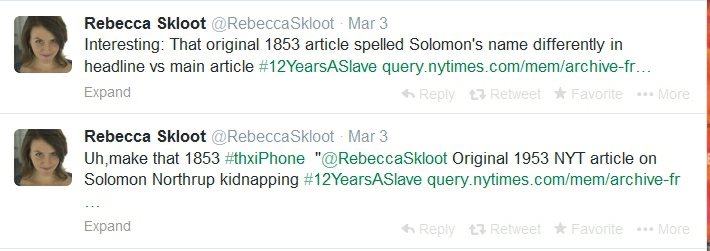
In a later tweet, Skloot admitted, "The irony, of course, is that I'm a terrible speller and proofreader."
Discussion Starters:
- How could an error like this happen? What technologies and processes may be in place today that might have caught the error before going to press?
- Does it surprise you that the error was revealed in a tweet and that The New York Times didn't catch the mistake until 161 years later?