

Kraft Heinz Gets Mixed Reviews for Holiday
 Kraft Heinz won't have a commercial in this year's Super Bowl, but the company will give employees Monday off. Joking that the day after, #SMunday, should be a national holiday, Heinz started a petition on change.org:
"We can all agree that going to work the Monday after the ‘Big Game' on Sunday is awful," the petition states. "So as far as we're concerned at Heinz, we as a nation should stop settling for it being the worst work day of the year. We don't settle for that awesome football Sunday to be just like every other day of the year."
They're certainly getting mainstream press, for example, in The Washington Post, but the article refers to the move as a "Super Bowl stunt."
The company recently laid off thousands of workers, and the day off isn't available to factory employees. Some social posts call the campaign "pandering" and one tweet reads, "I think we have bigger things to worry about."
Discussion:
- What's your view of the campaign: pandering, clever, inappropriate, or something else?
- What about the timing? News from the Trump Administration is heavy is week.
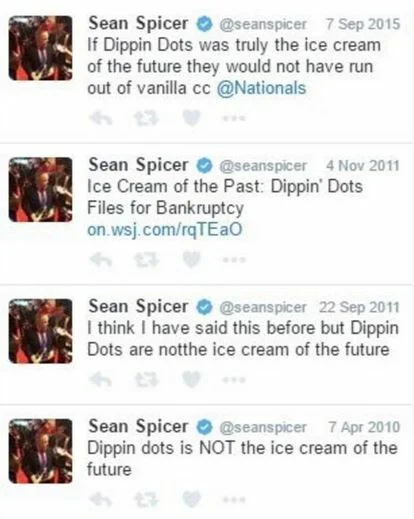
Dippin' Dots Responds to Spicer
 White House Press Secretary Sean Spicer has periodically blasted Dippin' Dots via tweets over the years. Now the company has responded in an open letter.
In an NPR interview, the CEO of the ad agency said they were concerned about getting in the political mix, but people were expecting the company to respond, so they had little choice. The company executives decided how to respond: "Scott Fischer, the CEO of Dippin' Dots, and his executive team wanted to openly address the issue in a way which was transparent and stayed true to their brand values – fun, community, and camaraderie."

Dippin' Dots offered to serve the White House and press, but Spicer suggested treating the military and first responders. It's not clear how this might happen.
Discussion:
- How well did Dippin' Dots handle the situation? What were the risks?
- It sounds as though Dippin' Dots responded because of the social outcry. Should the company have jumped into the conversation with Spicer earlier? How could they have done this?
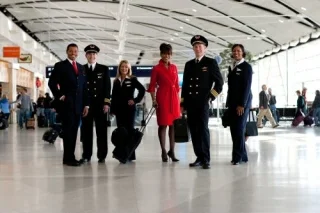
Diversity Training at Delta
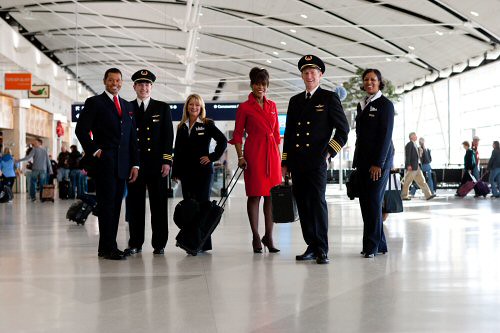 In response to two recent incidents, Delta crew members will attend diversity training that company executives already attended.
In one situation, CEO Ed Bastian banned a passenger after seeing a video of him yelling about Trump. In a statement, the company said the passenger should not have been allowed to fly. In another situation, covered by BizCom, an African-American doctor was questioned about her credentials and discouraged from helping a sick passenger.
The planned program includes unconscious bias and microaggressions-two current topics in diversity and inclusion circles. That's good because traditional diversity training programs haven't been found to be effective. A 2012 HBR article, "Diversity Training Doesn't Work," faults programs for causing more problems than they solve, and a 2016 BizCom story reiterated the point covered in a 2016 article.
Discussion:
- What's your view of diversity training programs? Are you skeptical like me?
- How could covering topics of unconscious bias and microaggressions be different?
- What difference do you think the training will make at Delta?

Campaign Debrief Gets Heated
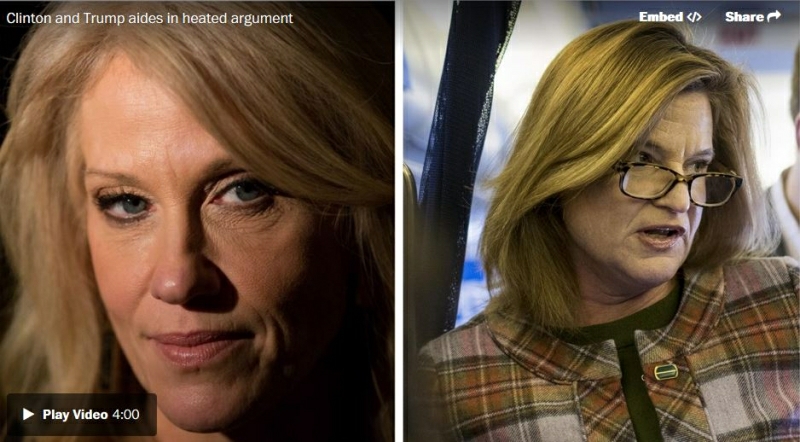
A postmortem campaign session at Harvard University's Kennedy School of Government "erupted into a shouting match," according The Washington Post. Hillary Clinton's communications director Jennifer Palmieri blasted the Trump campaign:
"If providing a platform for white supremacists makes me a brilliant tactician, I am proud to have lost. I would rather lose than win the way you guys did."
Palmieri was emotional during the discussion; the Post reported that she "choked up at various points of the session."
Kellyanne Conway, Trump's campaign manager, took her share of shots:
"Guys, I can tell you are angry, but wow. Hashtag he's your president. How's that? Will you ever accept the election results? Will you tell your protesters that he's their president, too?"
Discussion Starters:
- What's your view of the exchange? In what ways is this discussion productive, and how did it fall short?
- Someone on the Trump team said of the Clinton team, "You guys are pathetic." Do you agree? Is this just about "sour grapes"?
- Are people still saying "hashtag"?
Communications About Train Derailment in India
More than 140 people died, and dozens more were injured when a train derailed in Uttar Pradesh State, India. Although the cause isn't yet determined, one theory is a crack in the rail, which may be one of dozens on the country's tracks.
Railway Minister Suresh Prabhu visited the site and said, "Right now the immediate priority is rescue people and to bring relief to those injured and that's what we are doing." He later gave a statement to a reactive audience.
According to a CNN report, the train system employs 1.3 million people and serves 23 million passengers every day. The rail system has been criticized for poor maintenance:
India's sprawling rail system is state-run, and the government is being heavily criticized on the nation's television networks. The rail system is known to be poorly maintained, and upgrades have been long overdue. In its last budget, the government put aside large sums of money to modernize the system, to improve traffic lights and lay more rail tracks.
According to a BBC report, "Train accidents are fairly common in India, where much of the railway equipment is out of date. An accident in Uttar Pradesh in March last year killed 39 people and injured 150." In 2014, 27,581 people died in train-related accidents in India.
Discussion Starters:
- How would you describe the setting where Railway Minister Suresh Prabhu is speaking? How does this compare to similar situations in the United States?
- What should Prabhu say in his statement?
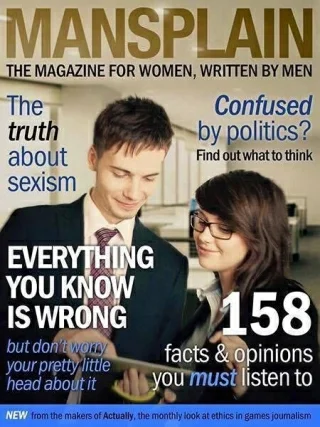
"Mansplaining" Hotline
 A Swedish trade union set up a temporary hotline for men and women to report instances of "mansplaining" on the job. Mansplaining was first described in 2008, and the term starting becoming popular around 2102. An Atlantic article describes its origins and offers a definition: "explaining without regard to the fact that the explainee knows more than the explainer, often done by a man to a woman."
A spokesperson for the union described the rationale for the hotline:
Our objective is to contribute to awareness and start a discussion which we hope will be the first step in changing the way we treat each other and talk about each other in the workplace.
It's important to create awareness about how seemingly small things that we do or say add up to a larger issue.
Mansplaining may be a type of microaggression, a term used for subtle, yet damaging forms of discrimination. Microaggressions can be small acts and expressions that, taken alone may not constitute, for example, racism or sexism. But when people are subjected to similar acts or comments over time, it sure feels like racism or sexism.
Columbia Professor Derald Wing Sue has written extensively on the subject. He defines microaggressions as "brief and commonplace daily verbal, behavioral, or environmental indignities, whether intentional or unintentional, that communicate hostile, derogatory, or negative racial slights and insults toward people of color."
Discussion Starters:
- This post started about mansplaining and ended about microaggressions. Do you see the connection, or is this a stretch?
- Consider your own experience with mansplaining. Have you experienced it or done it? How has it affected you?
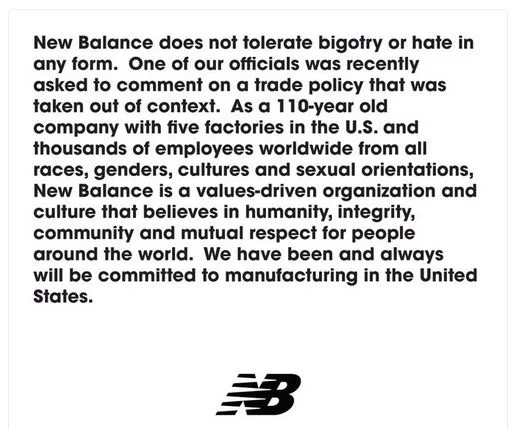
New Balance Responds to Neo-Nazi Controversy
 New Balance sneaker company has aligned with Trump's trade policies and is getting Neo-Nazi support it doesn't want. People responded by trashing their sneakers, and the company tweeted this statement.
A GQ writer suggests, instead, that New Balance should be more direct:
Why not just say, "We do not want the endorsement of Neo-Nazis and if you are a Neo-Nazi please stop wearing our shoes." Is it really that hard to plain and simple condemn Neo-Nazis? This seems to be an attempt to not ostracize any customers or even, yes, Trump himself.
New Balance seems to be walking a line, trying not to lose customers on either side of aisle. The executive may very well be questioning whether he should have weighed in about the trade policy at all. Although CEOs should enter political debates carefully, New Balance has a lot at stake, according to a company statement:
As the only major company that still makes athletic shoes in the U.S., New Balance has a unique perspective on trade in that we want to make more shoes in the U.S., not less.
Discussion Starters:
- Should the executive have resisted commenting on Trump's trade policy? Why did New Balance enter the conversation?
- What's your view of the company's statement? Should it have been more direct, as the GQ writer suggests? What are the potential consequences?

Diageo Bans PowerPoint
 Diageo, an alcoholic beverages company, has banned PowerPoint presentations at some meetings. In an AdAge article, James Thompson, the company's North American chief marketing and innovation officer, describes his perspective:
"It stops conversation. It makes people feel secure they've communicated what they wanted to. But, in fact, it doesn't move anything on," he said. So he has instituted a PowerPoint ban in some meetings. "Just talk to me, please" is his plea. His goal is to ensure his marketing team is "not totally buttoned-up all the time," he said. "We just want people to be at their best, and that is usually when they are able to think and respond and build rather than sell."
The change is part of other efforts, for example, hiring, to revive the company culture. Thompson said, "I've got nothing against MBA programs," but he is recruiting people from different sources instead of "where people came into the organization in a very conventional way and worked their way up in a very conventional way."
Discussion Starters:
- Do you agree with Diageo's decision? What are potential consequences of the decision?
- What could be some alternatives to a ban on PowerPoint?
- If you banned PowerPoint at some meetings, which type of meetings would you include?
- Consider different types of PowerPoints discussed in the text book. How are some outputs better for some audiences?
Managers Encourage Unity at Work
 Last week, we read about increasing divisions at work because of the contentious presidential election. Now that the election is over, companies are trying to unite workers who may have been on opposite sides.
Starbucks CEO Howard Schultz had emailed employees before the election:
Many Americans have allowed the vitriolic nature of the presidential campaign to ignite our differences and strip away our civility and dignity. In the process, we've lost faith in what we all know has always been true, the promise of America.
But you are the true promise of America.
…
Kindness, compassion, empathy, and yes love is what we need. It is what we must display and share. We are all longing for a deeper sense of human connection and humanity because, when we are touched by it, it fills us up.
Now, several companies are trying strategies, such as videos and chat sessions, to help employees move on from the high emotions during the campaign season.
The news isn't all bad at work. In a commercial real estate firm, The Wall Street Journal reports, managers believe difficult conversations have offered a type of "team building in this weird sort of way."
Discussion Starters:
- What has been your experience post-election at work and at school? How are people managing differences?
- If you were to write an email to foster unity among students at your school, what would you say?
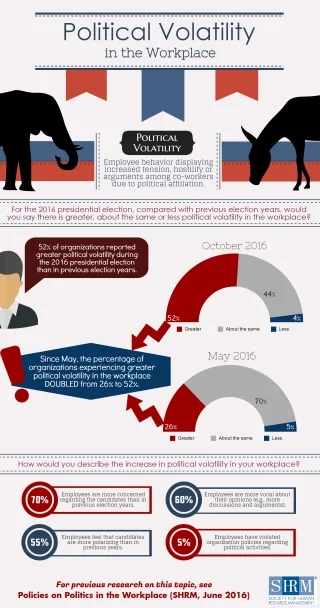
Election Causes Emotions to Run High at Work
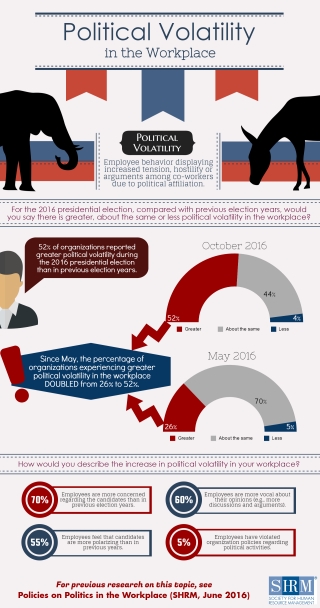 A Society for Human Resources (SHRM) survey found more "political volatility" at work than in previous election years. The rate is up from another SHRM survey conducted in June. Respondents said that employees are more concerned this year about the candidates and more vocal about their opinions.
This infographic summarizes the survey responses.
Politics are part of life, and perhaps this is just part of "bringing your whole self to work," which we discuss in Chapter 2 of the tenth edition. Or should we avoid talking about politics in the workplace?
Although these conversations may be uncomfortable, a Harvard Business Review article quotes Joseph Grenny, coauthor of Crucial Conversations:
"[Y]ou spend the majority of your waking hours with your colleagues, and so it's natural to "feel the need to process your thoughts and feelings" with them. In fact, he says, learning how to talk about politics in a productive manner can help you "manage other difficult conversations at work," including peer performance reviews or disagreements over strategy and policy. Politics is just another topic where "emotions run strong, the stakes are high, and opinions vary," he says.
The article suggests strategies for managing political discussions at work, for example, viewing them as an opportunity to learn more about each other, focusing on the process instead of a candidate, and knowing when to "disengage."
Discussion Starters:
- What's your view? Should we avoid talking about politics at work, or is it an opportunity for building a better team?
- Have you been in an awkward or frustrating situation with a coworker about a political situation? How did you handle it, and what did you learn?
- What do you think will happen after this year's election? Will we all go back to normal, or is that just wishful thinking?

Italy Can't Seem To Get "Fertility Day" Ads Right
Italy has stepped into another quagmire of controversy with its second "Fertility Day" ad. To encourage births, the first ad showed a woman with a timer, implying that her child-bearing days are numbered. The caption read, "Beauty has no age. But fertility does." People took offense: some felt it was insulting to people who had trouble conceiving; others felt it encouraged people to procreate regardless of their situation (e.g., no partner or job). The latter may particularly sting because Italy was a high youth unemployment rate: 35%.
 The newest ad is deemed racist. Two white couples are featured at the top of a brochure photo, looking happy and healthy. Below this picture is a group of people, including a Black person, smoking marijuana.
Oddly, the bottom photo is similar to one used by Maricopa County Attorney's Office to discourage heroin use in Arizona.
Contrasting people of different races is never a good idea. In a public service announcement earlier this year, the American Red Cross was similarly criticized for showing White people behaving well and people as color behaving badly around a swimming pool.
At first, the Italian health ministry denied the criticism: "The photos represent a homogeneity of people, as is the multi-ethnic society in which we live. Racism is in the eye of the beholder." But the group has since come around: the pamphlet has been removed, as had the first ad.
Italy has the lowest birth rate in the EU, so having a campaign is understandable, but the approach isn't working.
Discussion Starters:
- What's your view of the ad? Do you find it offensive? Can you see how others might?
- Compose a different ad that might help Italy meet its fertility goals.
British Airways Apologizes for Delays
 Computer issues plagued Delta recently, and now British Airways is feeling the pain. Tens of thousands of customers have been delayed while checking in, dropping off luggage, and waiting to take off. Frequent fliers may remember similar delays in July, when the airline was upgrading its check-in system. This time, an IT issue shut down some systems, causing staff to hand write boarding passes.
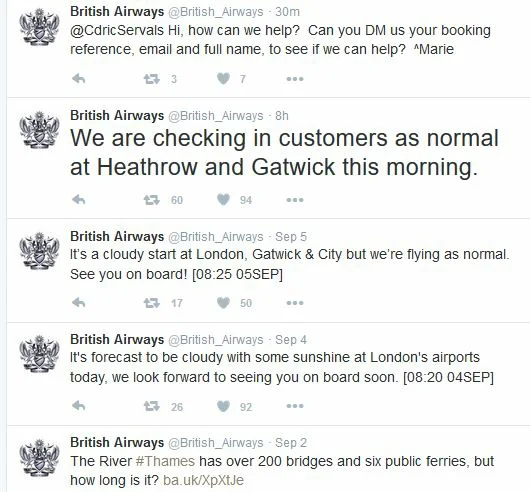
The airline apologized for the delays, admitting that processes have been "taking longer than usual": "We are sorry for the delay to their journeys." Although passengers were actively complaining on Twitter, the company had little to say online. The Twitter page has only one reference to the delays-after the issues were resolved.
But some customers did receive a letter, posted in an NBC article.

Discussion Starters:
- Assess the letter to customers. What principles of letter writing and bad-news messages does the airline follow in this communication? What would improve the letter?
- What word choices and other aspects of the letter tell you it's British? Why did the airline chose this method of communication?
- What else, if anything, should the airline have communicated on social media?
More Jargon to Banish
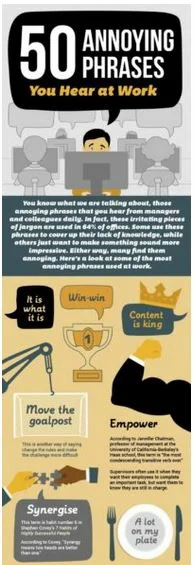
 Once a year or so, I write about business clichés and jargon. This infographic, generated by GoToMeeting is a good summary of perhaps the worst examples heard in companies recently.
Here are some of my favorites (to avoid, that is):
- Content is king (Who's the queen?)
- Game change, par for the course, and other sports references I don't understand
- With all due respect, which usually indicates no respect at all
- Do more with less, a.k.a. work harder for less pay
- Open the kimono, which has both sexual and racial overtones.
Discussion Starters:
- What's the value of business jargon? It's not all bad.
- Compare these 50 to those in Chapter 5 of the textbook. Which are most and least familiar to you?
- Do you find any of the terms offensive?
Maine Governor Regrets Voice Message
Maine Governor Paul LePage is know for his brash style, but he seems to have crossed a new line. Politico calls him "America's Craziest Governor." Reacting to a reporter, LePage left an enraged voice mail message (NSFW) that included,
"Mr. Gattine, this is Gov. Paul Richard LePage, I would like to talk to you about your comments about my being a racist, you (expletive). I want to talk to you. I want you to prove that I'm a racist. I've spent my life helping black people and you little son-of-a-b----, socialist (expletive). I need you to, just friggin, I want you to record this and make it public because I am after you. Thank you."
He discussed his remarks in a news conference:
Listeners are debating whether LePage has apologized, with a political scientist at the University of Maine, Amy Fried, referring to his speech as "a non-apology apology." Mostly, LePage blames reporters and vowed never to speak to one again:
"I will no longer speak to the press ever again after today," LePage said. "And I'm serious. Everything will be put in writing. I am tired of being caught - the gotcha moments."
"You folks live in a seven-second fiction world. I live in 24-hour reality," he continued.
Some are calling for LePage to resign. At first, he seemed to consider it ("maybe it's time to move on"), but he has since changed his mind.
Discussion Starters:
- Few people will accept LePage's shifting the blame to the reporter, but does he have a point? What, if any, responsibility does the reporter have in this situation? Read more.
- What's your view of LePage's "non-apology apology"? What else should he say? Should he resign?
Conversational Customer Service Wins Big Points
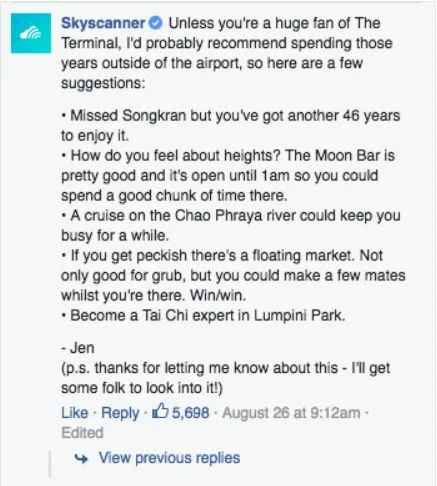
 When Skyscanner travel app suggested a 47-year itinerary for a customer, he asked what he could do during the layover. Jen, the customer service rep didn't miss a beat: she's quick and fun, and includes her promise in the P.S.
The post went viral on Facebook, with people commenting on her spontaneity and lack of script. Customers are getting tired of the template response. The Houston Chronicle wrote, "We aren't sure who Jen is, but she totally just owned the Internet and we all loved it."
Social media responses have been getting friendlier. Perhaps companies (or their social media reps) are taking more risks. Sure, a negative post can cause all sorts of trouble, but this example and others prove that a positive, personal style by a human being can garner a lot of attention.
Discussion Starters:
- Look at recent social posts by your favorite company. Analyze the tone and approach. Have you noticed a change over time?
- Jen's strategy may not work for everyone. What are some risks of her casual style?
Trump Vs. Morning Joe
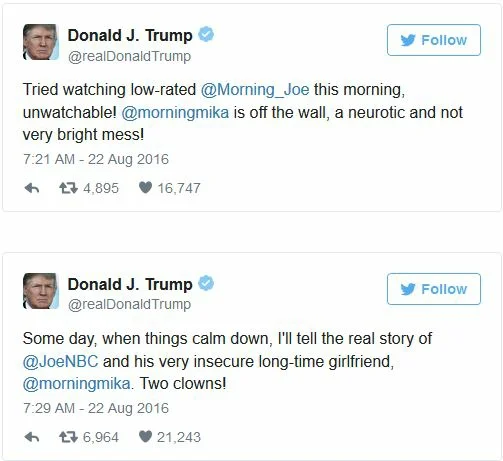
Now, Donald Trump is feuding with the hosts of MSNBC's Morning Joe, Mika Brzezinski and Joe Scarborough. Earlier this month, Scarborough wrote a scathing piece in The Washington Post, "The GOP Must Dump Trump." He ended by encouraging Republicans to withdraw their support and find a new candidate:
"A bloody line has been crossed that cannot be ignored. At long last, Donald Trump has left the Republican Party few options but to act decisively and get this political train wreck off the tracks before something terrible happens."
Escalation of the debate has continued, as Brzezinski said he sounded as if "he's had a lot to drink" during a campaign rally speech in Fredericksburg, VA.
Trump did not enjoy that comment and struck back with a series of tweets matched by Scarborough, who shot back, "Neurotic and not very bright? Look in the mirror."
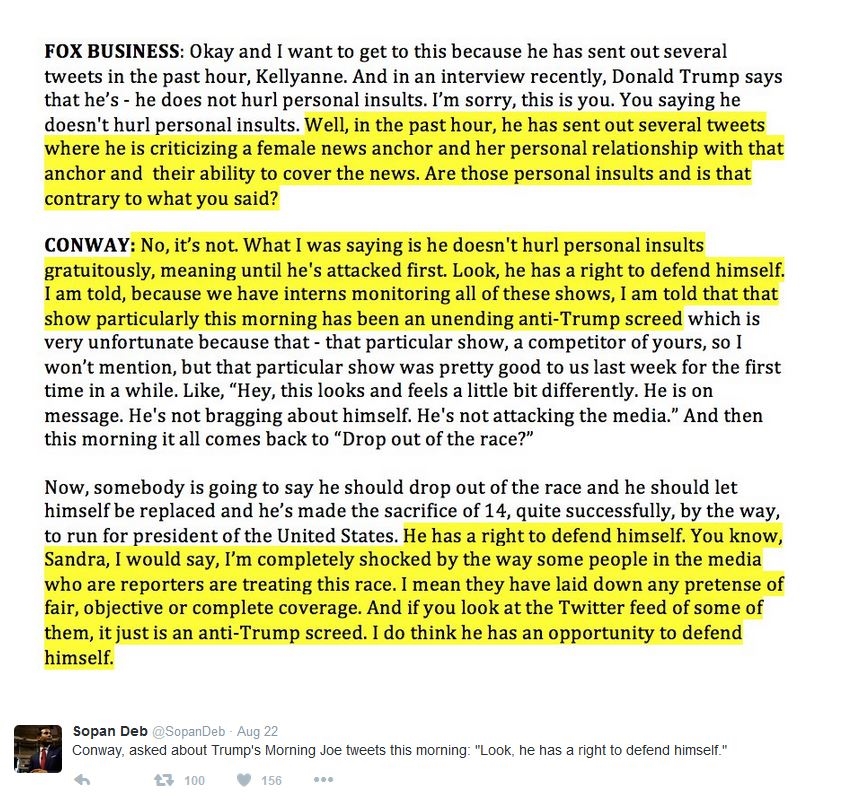
 The tweets came a few hours after Trump's campaign manager said he doesn't insult people. This is from Huffington Post:
"I don't like when people hurl personal insults," Kellyanne Conway told ABC News' "This Week." "That will never be my style, I'm a mother of four small children, it would be a terrible example for me to feel otherwise ... [Trump] doesn't hurl personal insults."
And yet Conway told Fox Business, "He has a right to defend himself."
Discussion Starters:
- When you watch the clip from Morning Joe, what do you notice about Brzezinski's delivery of the comment? How do others on the show react? Do you think she may regret her comment?
- How should Trump have reacted? And how should Scarborough have responded? As always, all players in the situation had several choices throughout these exchanges.
Arizona Mayor Angry About Bilingual Invitation
 When John Cook, executive director of the U.S.-Mexico Border Mayors Association, sent invitations to mayors in border states in the United States and Mexico, he didn't expect the strong reaction he got from Ken Taylor, mayor of Huachuca City, AZ. The invitation was sent in both English and Spanish, which The New York Times calls "standard for any type of official communication about binational events."
"The excitement is building and we are ready for a great meeting of the Border Mayors Association in Laredo. We hope to see you there at 9 a.m. on August 24th at the Laredo Country Club. The draft agenda and a list of hotels is attached to this email," Cook said in the email, which then provided the Spanish translation. "La emoción está construyendo y estamos listos para una gran reunión de la Asociación de alcaldes de la frontera en Laredo. Esperamos contar con su presencia a las 9 am el 24 de agosto en el Laredo Country Club. El proyecto de programa y una lista de hoteles se adjunta a este correo electrónico."
Taylor responded to the invitation: "I will NOT attend a function that is sent to me in Spanish/Mexican."
Cook said, "I don't want to pick a flight," "I will certainly remove you from our email list. Ours is a bi-national association with mayors from the United States and Mexico that were elected to serve border communities. All of our communications are intended to inform mayors from both sides of our border about our association." Cook also said, "The purpose of the Border Mayors Association is to speak with one voice in Washington, D.C., and Mexico City about issues that impact our communities, not to speak in one language. My humble apologies if I ruffled your feathers."
The concession wasn't enough for Taylor: "American is going ‘Down Hill' fast because we spend more time catering to others that are concerned with their own self interests. It is far past time to remember that we should be ‘America First' ... there is NOTHING wrong with that."
Discussion Starters:
- What's your view of the invitation? Should invitations to U.S. mayors be written only in English?
- Given Taylor's objection, how well did he handle the situation? What else could he have said and done? What are the consequences of his response?
- How well did Cook handle Taylor's reaction?

Biles Handles the Media
 In addition to winning an Olympic gold medal for gymnastics, Simone Biles made headlines for handling two difficult situations beautifully.
Tired of hearing some media coverage for the games, Biles shot back, "I'm not the next Usain Bolt or Michael Phelps. I'm the first Simone Biles." An article in The Atlantic called NBC's coverage of the Olympics:
The coverage of women's gymnastics has a long tradition of emphasizing the contrasts of its competitors: traditional girlishness on the one hand, traditionally masculine qualities-"power" chief among them-on the other. And NBC's gymnastics commentators (under a mandate from NBC to address themselves to a notional "Madeleine in Middle America, who doesn't know gymnastics") have reveled in those easy contradictions. Biles stands, they have emphasized, at only 4 feet, 8 inches tall. She giggles a lot. A promotional package NBC aired during Rio's women's gymnastics qualifying round featured Biles's parents talking about her love for shopping. It also showed her getting a manicure.
The article went on to say it was as though NBC were saying, "Look at that girl do all that! She's powerful like Michael Phelps, but a girl!." 
In another incident drawing attention to her (and needing her attention to clear things up), an NBC commentator, Al Trautwig, referred to her parents as Biles's grandfather and his wife. The couple legally adopted and raised Simone. Trautwig repeated his position on social media.
Biles simply said, "I personally don't have a comment. My parents are my parents, and that's it."
Discussion Starters:
- Biles is getting a crash course in media attention. Do you agree with my assessment that she's handling it well? What else can she do?
- Read The Atlantic article about NBC's portrayal of women and the Olympics. Do you agree with the author's criticism? What rings true for you, and what doesn't?

Saatchi Chair Resigns Admitting, "Fail Fast, Fix Fast, Learn Fast"
 Saatchi Chairman Kevin Roberts told Business Insider that the "debate is over" about gender diversity in the advertising industry:
"Edward de Bono [the physician, psychologist, and author] once told me there is no point in being brilliant at the wrong thing - the f---ing debate is all over. This is a diverse world, we are in a world where we need, like we've never needed before, integration, collaboration, connectivity, and creativity ... this will be reflected in the way the Groupe is."
Instead, Roberts pointed to financial services, where he says the issue is "way worse."
On Twitter, senior lecturers from other ad agencies as well as major companies disagreed, including PepsiCo's beverage group president, who said he wasn't proud to be client, and the CMO from JPMorgan, who said his comments were "positively Trumpian."
Parent company Publicis issued the following statement:
Following the comments made by Saatchi & Saatchi Executive Chairman and Publicis Groupe Head Coach, Kevin Roberts, in a recent interview with Business Insider, Publicis Groupe Chairman & CEO, Maurice Lévy addressed a statement internally to all Publicis Groupe employees to reiterate the Groupe's no-tolerance policy towards behavior or commentary counter to the spirit of Publicis Groupe and its celebration of difference as captured in the motto Viva la Difference!
It is for the gravity of these statements that Kevin Roberts has been asked to take a leave of absence from Publicis Groupe effective immediately. As a member of The Directoire, it will ultimately be the Publicis Groupe Supervisory Board's duty to further evaluate his standing.
Diversity & inclusion are business imperatives on which Publicis Groupe will not negotiate. While fostering a work environment that is inclusive of all talent is a collective responsibility, it is leadership's job to nurture the career aspirations and goals of all our talent.
Promoting gender equality starts at the top and the Groupe will not tolerate anyone speaking for our organization who does not value the importance of inclusion. Publicis Groupe works very hard to champion diversity and will continue to insist that each agency's leadership be champions of both diversity and inclusion.
For his part, Roberts apologized:
"Fail fast, fix fast, learn fast" is a leadership maxim I advocate. When discussing with Business Insider evolving career priorities and new ways of work/life integration, I failed exceptionally fast. My miscommunication on a number of points has caused upset and offence, and for this I am sorry. I have inadvertently embarrassed Saatchi & Saatchi and Publicis Groupe, two companies I love and have been devoted to for almost 20 years. I have expressed my regret and apology to the companies for the furor my remarks and language stimulated, and I extend this to colleagues, staff and clients.
Discussion Starters:
- Read more from Roberts' interview with Business Insider. Where did he go wrong?
- Assess his apology. What works well to instill trust in the brand? How authentic does it sound to you?
Should Miss Teen USA Give Up the Crown?
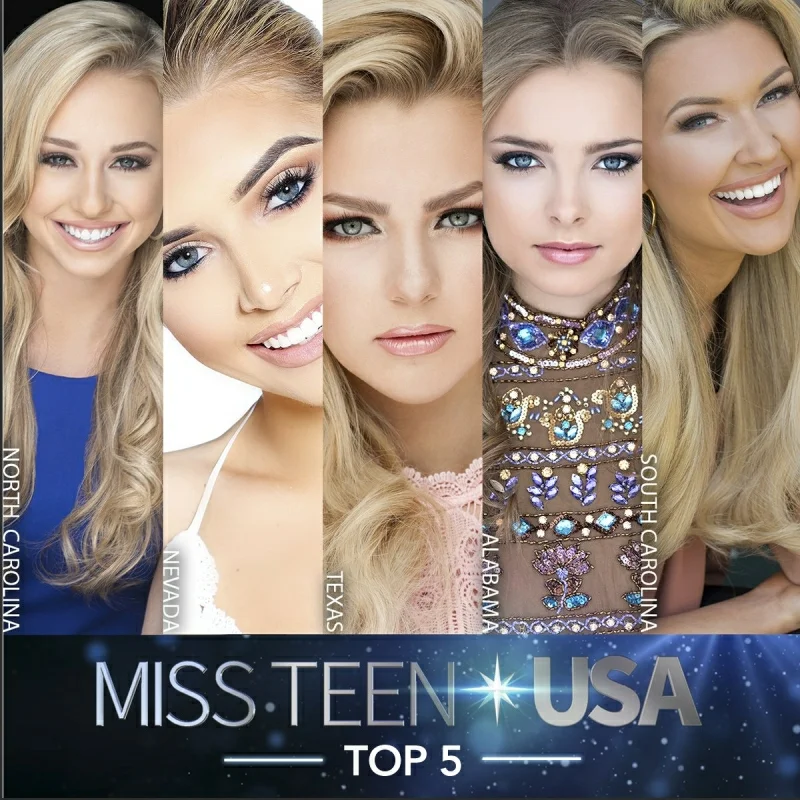
Karlie Hay, from Texas, was crowned Miss Teen USA on Saturday, but evidence of her using a racial slur in 2013 and 2014 has surfaced. Hay apologized for her tweets in a statement and in an interview with George Stephanopoulos:
"I am very sorry. It's embarrassing. It's something I'm ashamed of. I've grown up from that 15-year-old girl who used that type of language. It's never acceptable and now I know how hurtful it is. It hurts me to know that at one point in my life I used that language. I said that. It's not me."
The Miss Universe organization decided not to have Hay give up the crown:
"As Karlie stated, she was in a different place in her life and made a serious mistake she regrets and for which she sincerely apologizes."
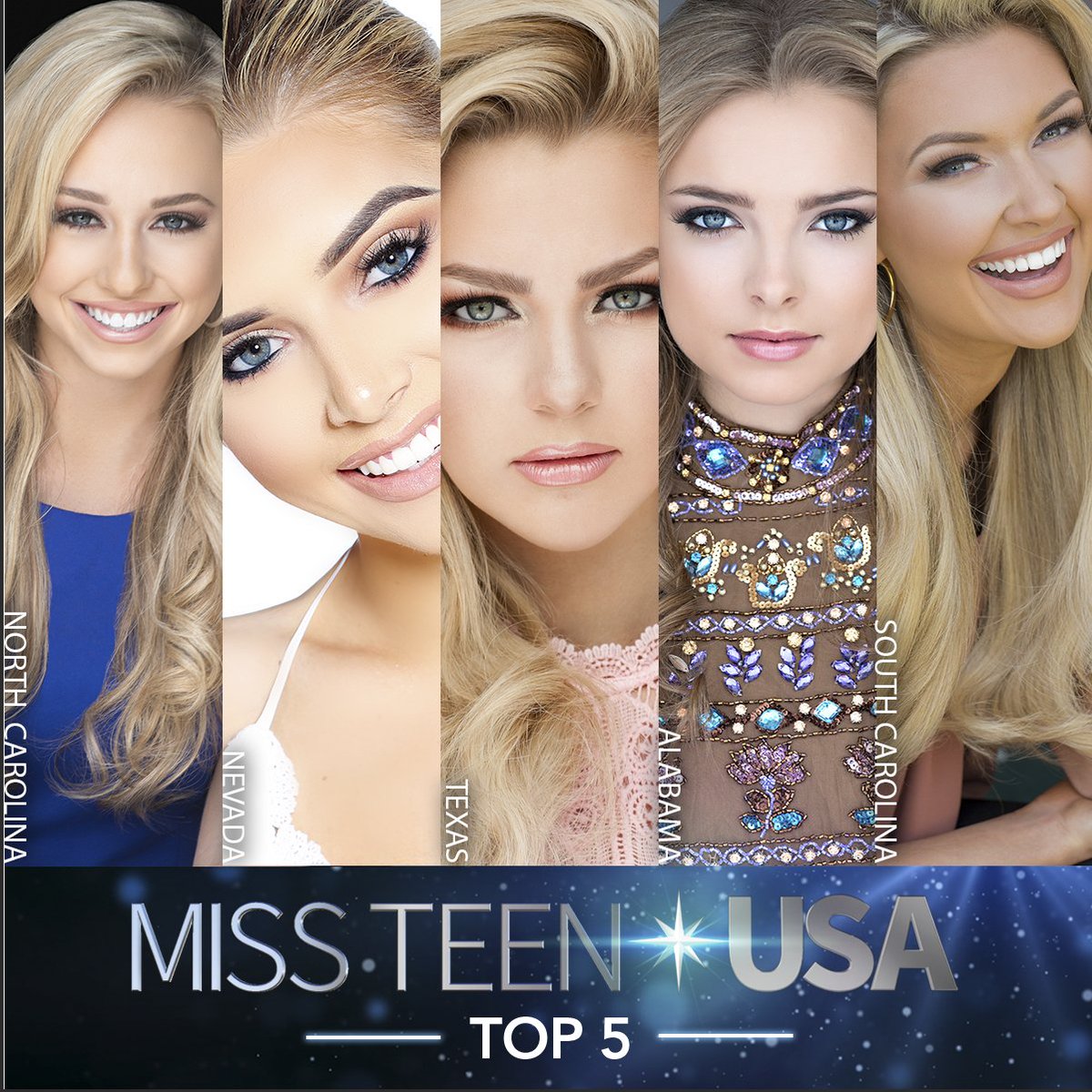
I don't watch beauty pageants, but I can't imagine how the judges chose a winner from the top 5 contestants. The New York Times called them "striking similar in physical appearance."
Discussion Starters:
- Should Hay give up the crown? If she chooses not to, should the Miss Universe organization force her to?
- Hay's tweets emerged just hours after the show ended. Should social media screening be part of the pageant process? Why or why not?
- Another option was for Hay to present this information as part of her application or maybe to discuss her personal growth in her speech or interview. (Do they still do that?) What do you think of this get-out-ahead-of-it strategy?