
Ryanair CEO "Ruffles Feathers" (Again)
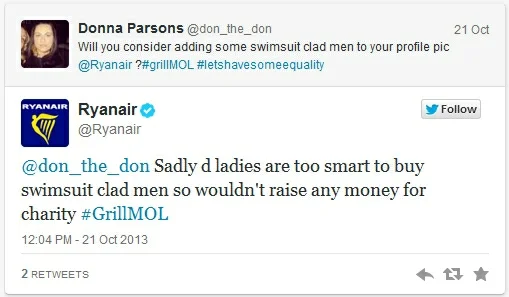
No stranger to controversy, Ryanair CEO Michael O'Leary angered people during a recent Twitter chat. You may recall that O'Leary called a customer "stupid" and other insults when she complained about being charged €300 for not printing boarding passes ahead of time. Ryanair is a discount airline and charges fees for extra services.
Now, a PR Daily article says O'Leary invited criticism as part of a "PR stunt." Although some tweets were deleted, Skift captured a few choice examples:


Discussion Starters:
- What do you think of Michael O'Leary's approach on Twitter?
- Take a look at the Google Image search of Michael O'Leary. What's your reaction? Does he overdo the stunts, is he being who he wants to be, or something else?
- Do you find his tweets and other communications offensive or not?
McDonald's Employee Help Line Is Recorded
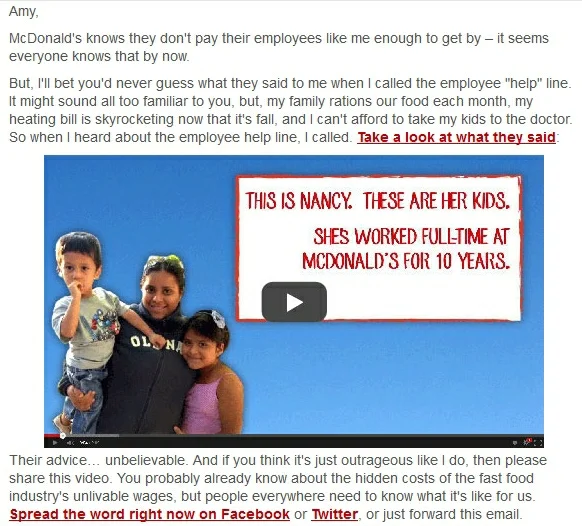
You many remember Nancy Salgado, who recently confronted McDonald's USA President about her wages. She claims to be working at the restaurant chain for 10 years and is making $8.25 an hour.
The organization "Low Pay Is Not OK" posted a recording of her call to McDonald's employee help line. I received an email about the incident:

Video captions of the phone interaction focus on public assistance for McDonald's workers:
Discussion Starters:
- How do you assess the organization's argument that the public is supplementing workers' wages? In what ways do you find this argument convincing, and how does it fall short?
- Imagine that you're the person who received Salgado's call on the help line. How would you react to the posted video? Should she have done anything differently on the call?
- The recording is clearly edited. What do you think may have happened during the deleted portions? Does that affect your reaction?
Twitter CEO Responds to Criticism About Lack of Women Execs
As Twitter's IPO approaches, the company is being criticized for having an all-white board and only one woman on its executive team (an attorney who was hired five weeks ago). Also, although Twitter has females in VP business roles, none are in technical roles.
Twitter management has acknowledged the problem. Back in March, chief technology officer Adam Messinger told The New York Times: "Half our customers, more or less, are women, and we want to have empathy for our customers, and part of that is having a wide variety of opinions in-house. It's also something a lot of people here think is the right thing to do." He also said, "There is definitely a supply-side problem." A New York Times writer has since suggested 25 women from a variety of industries who would "bring value beyond a checked box."
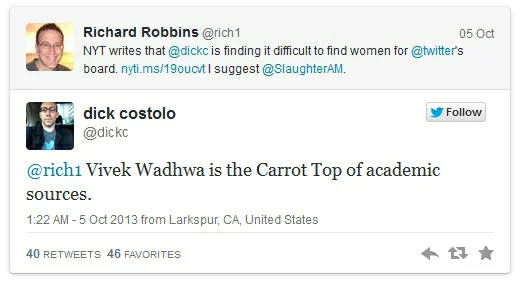
In response to the criticism, CEO Dick Costolo attacked Vivek Wadhwa, who was quoted in the NY Times article:

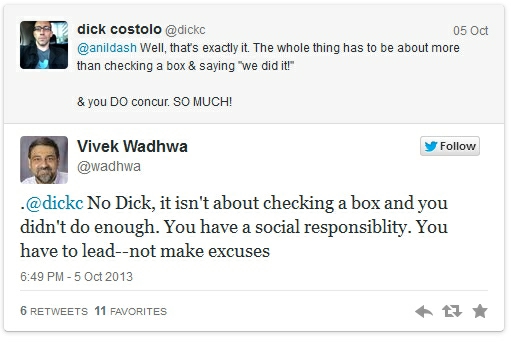
In a blog post for the Wall Street Journal, "Silicon Valley Has a Code Name for Sexism & Racism," Wadhwa asked for an apology-and flung an insult of his own:
"Yes, Costolo's comments were inappropriate and he owes me a formal apology. But I don't for a moment think that he is overtly sexist or that he deliberately discriminates. I think that he is reflecting a common behavior in Silicon Valley, where power brokers proudly tout their 'pattern recognition' capabilities. They believe they know a successful entrepreneur, engineer, or business executive when they see one. Sadly, the pattern is always a Mark Zuckerberg, Marc Andreessen, Jeff Bezos-or themselves. Nerdy white males."
And the missives continue:
Discussion Starters:
- Some people have expressed disappointment in what they consider Costolo's defensiveness. What's your view? What could have been a better response?
- How, if at all, do you think this controversy will affect Twitter's pending IPO? Should the issue of female management be a consideration as the comany goes public?
News Anchor Compares Shooting to "Breaking Bad"
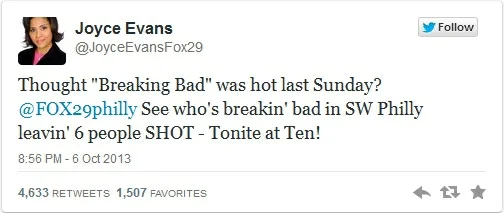
Not quite as tasteless as the CEO of AIG comparing its bonus controversy to lynchings, but a news anchor was criticized for comparing Philadelphia shootings to the TV series "Breaking Bad."

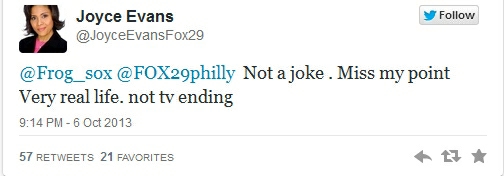
Either really insensitive-or perhaps a bit dense-Evans replied with this general tweet and repeated it as a reply to a few naysayers:
It didn't take long for Twitter joksters to create #JoyceEvansTweets:

Discussion Starters:
- What's your view of the reaction? Are people just too insensitive?
- How does the #JoyceEvansTweets help or hurt the situation?
- Write a more appropriate tweet response (an apology) of Evans' behalf.
Bertolli Capitalizes on Barilla's Anti-Gay Comments
Competitor Bertolli is taking full advantage of the CEO of Barilla pasta's anti-gay comments.
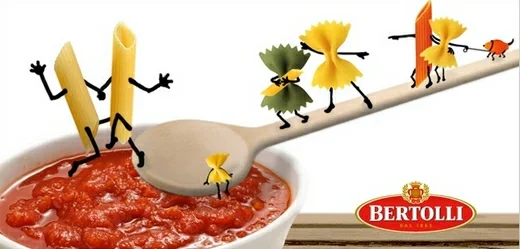
After saying that he'll never make ads featuring gay people, CEO Guido Barilla is facing a new foe: Bertolli. Promising "Love and pasta for all!" the company posted this image to its Facebook timeline:
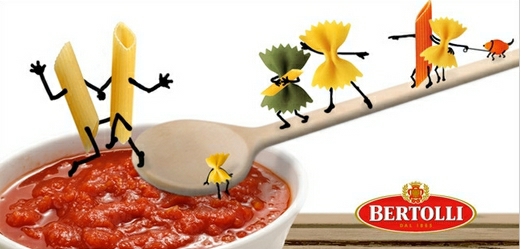
Given its history, Bertolli seems to be a supporter from way back. AdWeek discovered this commercial from a "couple of years" ago:
Discussion Starters:
- What are the potential risks of Bertolli's advertising strategy?
- If you were Guido Barilla, what, if anything, would you do in response?
Restaurant Owner Terminates Employees but Fumbles the Explanation
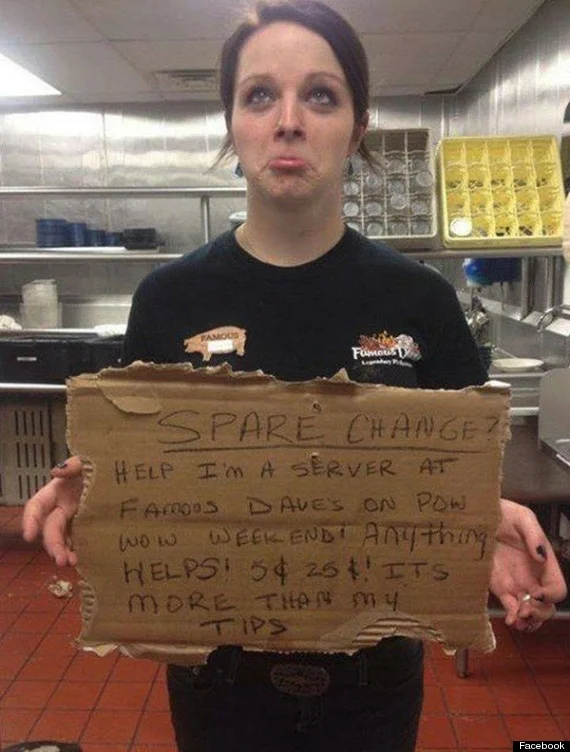
Two employees of Famous Dave's barbecue restaurant in North Dakota were fired for a Facebook post implying that Native Americans are bad tippers.
 The photo was posted during United Tribes International Pow Wow, a festival attended by more 20,000 people, according to event organizers. According to The Huffington Post, the employee shown in the poto "denies creating the cardboard sign, but she doesn't deny posing for the picture." Good move!
Thinking the photo would disappear, the employee's friend shared the photo via Snapchat. Snapchat describes the app on its website, but in this case, the image was shared on Facebook:
"Snapchat is a new way to share moments with friends. Snap an ugly selfie or a video, add a caption, and send it to a friend (or maybe a few). They'll receive it, laugh, and then the snap disappears.
"The image might be a little grainy, and you may not look your best, but that's the point. It's about the moment, a connection between friends, and not just a pretty picture.
"The allure of fleeting messages reminds us about the beauty of friendship - we don't need a reason to stay in touch.
"Give it a try, share a moment, and enjoy the lightness of being!"
Snapchat has been criticized as an unsafe "sexting" app.
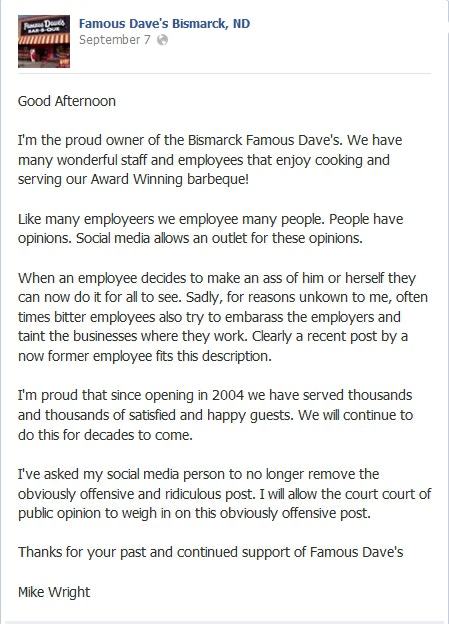
Although the owner of Famous Dave's may have done the right thing by terminating the employees, his Facebook post needs editing:
Discussion Starters:
- Assess Mike Wright's Facebook post. What works well, and what could be improved? Edit the post for accuracy.
- What's your view of Snapchat's claims? Can the site ensure that photos "disappear"? Is the company responsible for images that are shared in the interim, or do users hold this responsibility?
Is Kenneth Cole Trolling?
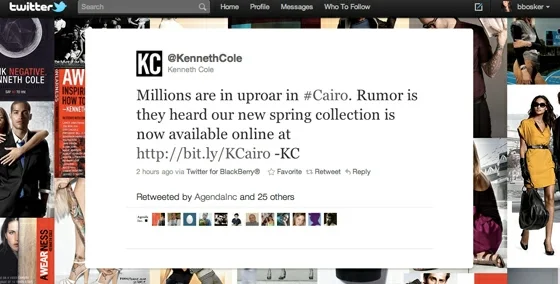
How is it possible for Kenneth Cole to write yet another offensive tweet capitalizing on an international conflict? This time, the apparel designer is making no apologies.
In 2011, Cole used the hashtag #Cairo during the Egyptian uprisings:

Cole apologized for that tweet, and Ad Age did a fun summary of events (which I converted into a PowerPoint presentation), showing how quickly the hoopla emerged-and passed.
This time, Cole chose the controversy about Syria to hook into. "Boots on the ground" is a common reference to whether the United States will proceed with a military strike on Syria.
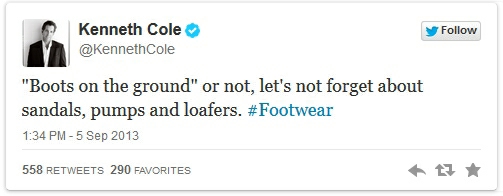
Reactions on Twitter were swift and harsh, but Cole isn't sorry at all. He issued this statement to CNBC and posted a video to Instagram:
"For 30 years I have used my platform in provocative ways to encourage a healthy dialogue about important issues, including HIV/AIDS, war, and homelessness. I'm well aware of the risks that come with this approach, and if this encourages further awareness and discussion about critical issues then all-the-better."
Discussion Starters:
- Did Kenneth Cole do as he says and purposely promote "a healthy dialogue"? Did he forget? Is he insensitive? Too proud to apologize a second time? Or, as some suspect, was he trolling?
- What's your view of Cole's statement and video? What do you make of his creating a video in this situation?
- This is Cole's Twitter description: "Designer, Aspiring Humanitarian, Frustrated Activist, Social Networker In Training." Should he change it?
H&M Didn't Learn the Headdress Lesson from Victoria's Secret
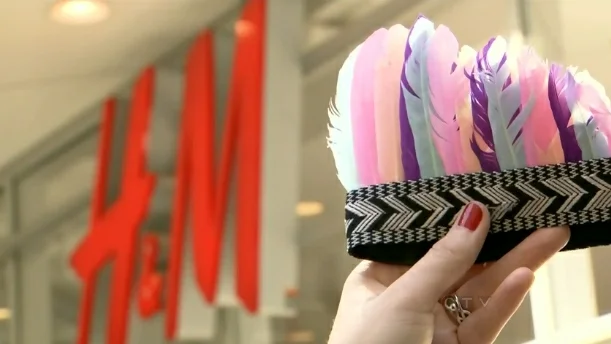
How many more retailers will make this mistake? H&M Canadian customers were offended by hair accessories that imitated Native American headdresses with fake feathers.
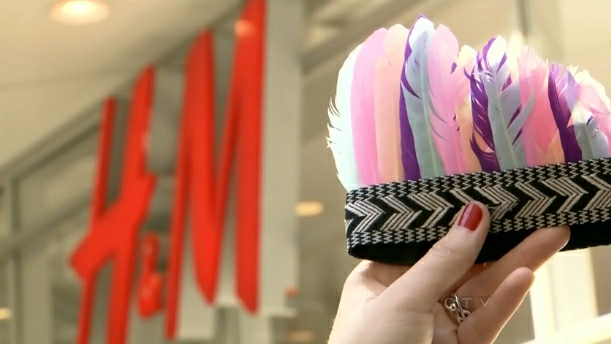
Kim Wheeler, an Ojibwa-Mohawk woman, complained to H&M after seeing the headdress in a Vancouver, B.C., store. She told CTV,
"They're worn by chiefs. They're a sign of honour and respect and leadership. They're not a cute accessory to be worn in a nightclub. It's not something you take lightly and throw on your head and wear to the bar or a concert."
H&M issued this statement:
"We always want to listen to our customers and their feedback, our intention was never to offend anyone or to be insensitive. We chose to remove the headdress inspired accessory from our shelves. This was a limited edition item that was sold in 5 of the 62 locations we operate in Canada."
CTV reports that H&M pulled the headdress after hearing three complaints; however, they have not commented on whether they are removing the accessory from stores in other countries.
Victoria's Secret made a similar mistake recently when the company outfitted a model in Native American-style headdress, leopard-print underwear, turquoise jewelry, and high heels.
Discussion Starters:
- What's your view of the situation? Did H&M do the right thing, did the customer overreact, or something else?
- Compare this situation to that of Victoria's Secret. What are the similarities and differences in the use of the headdress and how the companies responded?
AOL CEO Fires Employee During a Conference Call
Tim Armstrong, AOL CEO, may have acted impulsively during a conference call when he terminated an employee on the spot. Frustrated with Patch, a division of AOL that hosts websites with local news and information, Armstrong was explaining the future of Patch to about 1,000 employees. Part of the plan is to reduce the number of sites from 900 to 600.
At about 2:00 into this clip, Armstrong tells Abel Lenz, Patch's creative director, to "put that camera down." Apparently, Lenz regularly recorded meetings and posted pictures on AOL's intranet. Then Armstrong said, "Abel, you're fired. Out." After a few seconds of silence, Armstrong continued, "If you guys think that AOL has not been committed to Patch, and won't stay committed to Patch, you're wrong. The company has spent hundreds of millions of dollars, the board of directors is committed, I'm committed...."
According to sources, the call lasted one hour and forty minutes; it's unclear at what point during the call this segment took place.
SFGate explains Armstrong's position:
"A few minutes later, Armstrong complained about leaks to the media. He said the leaks were making Patch seem like 'loser-ville' in the press.
"He said, 'That's why Abel was fired. We can't have people that are in the locker room giving the game plan away.'"
Lenz has been quiet about the incident. He gave a "No comment" response to PR Daily and told Jim Romenesko, "I appreciate the interest, Jim, but I have nothing to share. Go Patch!"
Two days later, Armstrong sent this email to all AOL staff:
AOLers -
I am writing you to acknowledge the mistake I made last Friday during the Patch all-hands meeting when I publicly fired Abel Lenz. It was an emotional response at the start of a difficult discussion dealing with many people's careers and livelihoods. I am the CEO and leader of the organization, and I take that responsibility seriously. We talk a lot about accountability and I am accountable for the way I handled the situation, and at a human level it was unfair to Abel. I've communicated to him directly and apologized for the way the matter was handled at the meeting.
My action was driven by the desire to openly communicate with over a thousand Patch employees across the US. The meeting on Friday was the second all-hands we had run that week and people came to Friday's meeting knowing we would be openly discussing some of the potential changes needed at Patch. As you know, I am a firm believer in open meetings, open Q&A, and this level of transparency requires trust across AOL. Internal meetings of a confidential nature should not be filmed or recorded so that our employees can feel free to discuss all topics openly. Abel had been told previously not to record a confidential meeting, and he repeated that behavior on Friday, which drove my actions.
We have been through many difficult situations in turning around AOL and I have done my best to make the best decisions in the long-term interest of the employees and the company. On Friday I acted too quickly and I learned a tremendous lesson and I wanted you to hear that directly from me.
We have tough decisions and work to do on Patch, but we're doing them thoughtfully and as openly as we can. At AOL, we had strong earnings last week and we're adding one of the best companies in the world to the team. AOL is in a great position, and we'll keep moving forward.
Discussion Starters:
- Defend Armstrong's actions. What else could be happening at the company to justify the firing?
- What are the potential dangers of an employee intranet site, where news and other company information is shared among employees?
- How do you asssess Armstrong's email to staff? What works well, and what could be improved?

Tactile Brazilians and Other French Stereotypes
The French tourism board is trying to help retailers, restaurateurs, hoteliers, and taxi drivers be more welcoming to visitors. But the "Do You Speak Touriste?" website provides stereotypes that some may find offensive.

According to The Telegraph, the tourism guide (downloadable in French) offers these helpful hints for French business owners (note that the punctuation is European):
The guide informs Parisians that the British "like to be called by their first name", spend an average of 145 euros (£124) per person per day – more than their American counterparts – and eat breakfast from 7.30-8.30am, lunch at 12-1pm and supper at 6-7pm.
They seek a mixture of "authenticity and relaxedness", expect smiling and friendly staff" and appreciate "architecture, traditional gastronomy and the need for a playful (approach to culture)."
The Japanese are the biggest spenders – 186 euros per tourist per day – but need constant reassurance and are "discreet but demanding". "They never complain straight away when they are not satisfied but will criticise once back in their own country."
The Chinese have an "idealised and romantic" view of Paris, and come "above all for luxury shopping."
Brazilians, meanwhile are "easily tactile", expect a "totally poetic experience" and spend more than the British, around 166 euros per day.
Parisians are told that cash-strapped Spaniards are on the "lookout for freebies" and expect you to speak their language, while Italians are delighted if you are nice to their children, like "going on excursions" but are "impatient tourists".
Perhaps the trickiest visitors of all, judging by the guide, are the French themselves, described as "particularly demanding" guests who above all "don't want to be considered as tourists".
Jeanerre Blat, general director of the Paris area tourist board, explained the board's philosophy:
"The aim is to fight against the poor reputation for welcome in Paris and the Paris area. You don't welcome a Japanese tourist the same way as an Italian one. There are codes to take into account, so you have to adapt."
Discussion Starters:
- What's the value of stereotyping? In other words, what's the value of this guidance for French business owners?
- Looking at the examples of nationalities above, are you more offended by some than by others? Which and why? Or do you find none offensive?
- Could the tourism board have met its objectives in another way? If so, how?
- Before The Telegraph paragraph, I wrote that the punctuation is European. Revise it to meet American standards.
Results of the Paula Deen Controversy
Paula Deen admitted using the "N-word" and apologized, but it wasn't enough. She has been fired from the Food Network and has lost her sponsorship deal with Smithfield Foods, the largest pork producer.
Deen's language became public from her deposition in a lawsuit by Lisa T. Jackson, who worked closely with Deen in one of her restaurants in Savannah, GA. Part of the suit accused Deen of talking about her dream "Southern plantation wedding," using racial slurs and fantasizing about having black waiters to "tap dance around" as in the "Shirley Temple days." During the deposition, Deen admitted using racial slurs at times and said, according to The New York Times, "'most jokes' are about Jews, gay people, black people and 'rednecks.'" She also said, "I can't, myself, determine what offends another person."
Since then, Deen has been tripping over herself in apology videos-three, so far.
Her first apology video didn't go too well. She seemed to focus more on asking for forgiveness than showing remorse and has several curious cuts (apparently in the original as well). What could have to be cut in a 46-second video? Also, words like "beg" aren't the best choice for an apology.
Although Deen's second apology video garnered 3.7 million views within three days, it has about the same number of likes as dislikes.
Dean also posted this note to describe her video:
"After spending all day soul searching and trying to figure out how to deal with what I did, I recorded a video trying to do the right thing. In the end, I felt that I needed to just be myself, say I am sorry and beg for forgiveness.
"What I said was wrong and hurtful. I know that and will do everything that I can do make it right. I am not about hate, and I will devote myself to showing my family, friends and fans how to live a life helping others, lifting us all up, and spreading love."
Paula
In yet a third video (similar to the second), Deen apologizes directly to Matt Lauer for failing to appear for a scheduled interview on The Today Show.
But all of her efforts don't seem to be saving Deen's reputation. The Food Network dropped her two shows and issued only this statement, with no further comment: "Food Network will not renew Paula Deen's contract when it expires at the end of this month."
Smithfield Foods issued this statement about terminating Deen's contract:
"Smithfield condemns the use of offensive and discriminatory language and behavior of any kind. Smithfield is determined to be an ethical food industry leader and it is important that our values and those of our spokespeople are properly aligned."
Discussion Starters:
- What, if anything, could Paul Deen have done to salvage her image and employment contracts?
- What works well about her second apology video, and what could be improved?
- Should the Food Network have said more about the situation? What is its strategy in issuing only a short statement and offering no further comment?
Is "Dudes Grilling Things" Sexist?
Bon Appetit has apologized for calling grilling-and company leadership-a male activity:
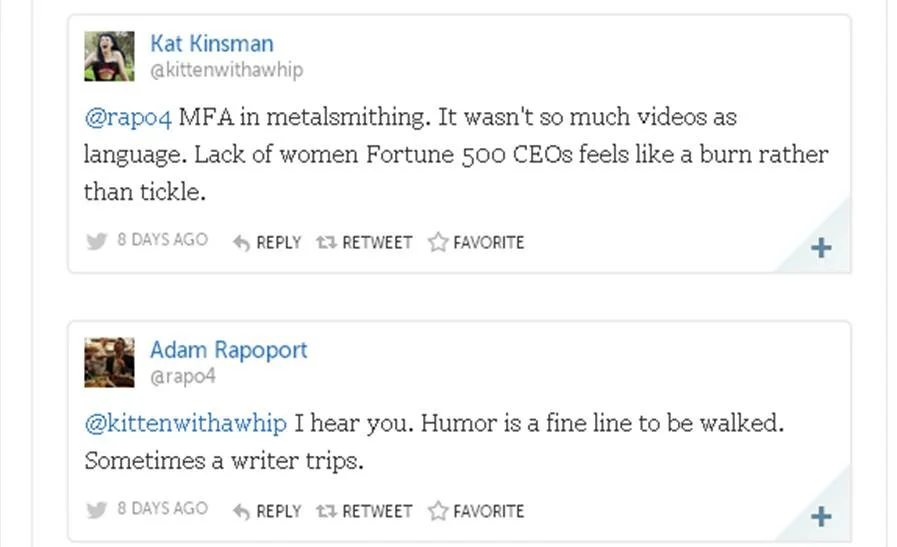
"It's a cliche because it's true: men like grilling things. Women like grilling things, too, of course, but at this point in history, grilling, like crying about sports and being a Fortune 500 CEO, is firmly located in the domain of Dude."
This paragraph was an introduction to a Bon Appetit video, "Dudes Grilling Things."
Here's one exchange about the paragraph on Twitter:

Now an editorial note offers an apology:
"Editor's Note: We're aware that some readers did not like our attempt to be tongue-in-cheek here. We in no way meant to imply that women aren't just as masterful at the grill. In fact, we'd like to take this opportunity to draw your attention to some of the stories we've run about women who grill: Elizabeth Karmel's 10 Commandments of Grilling; Mom Gets Her Grill On; La Buena Vida Cooks from Our New ‘Grilling Book'; and (just today!) How to Grill Maitake Mushrooms."
Bon Appetit quickly handled the situation without too much groveling.
Discussion Starters:
- What's your view of the paragraph? Do you find it offensive? Can you see how others might, or are they overreacting?
- In what ways did Bon Appetit recover well, and how, if at all, could the editor have done a better job?
Whole Foods Criticized for English-Only Policy
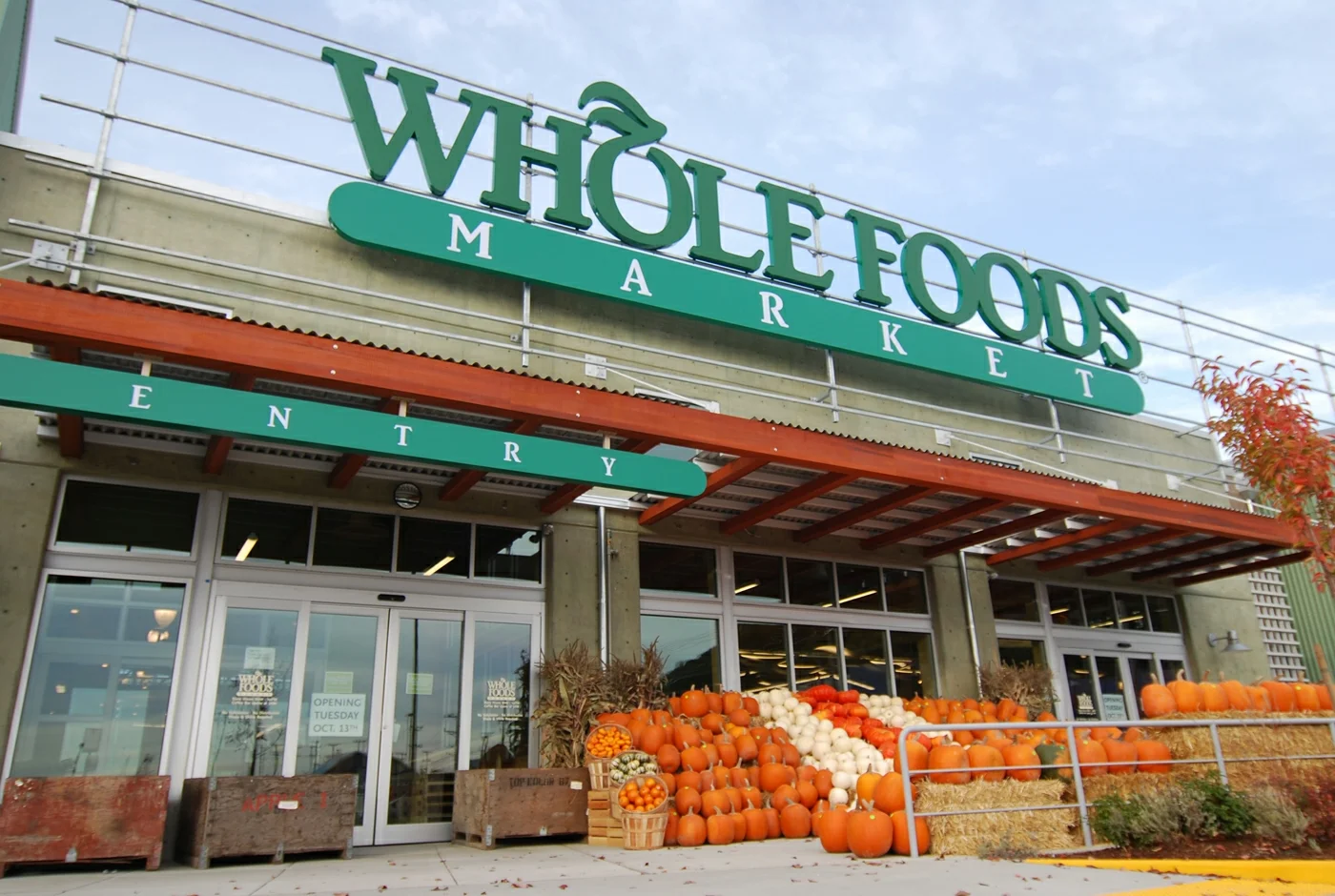
Two employees claim they were suspended for complaining about Whole Foods' policy that employees speak only English while at work. The New Mexico League of United Latin American Citizens and ProgressNow New Mexico are threatening boycotts of Whole Foods.
 On its website, the company posted this response-in both English and Spanish:
Whole Foods Market® responds to AP story about Spanish speaking team members
Article is misleading; company celebrates and honors our diverse team members
AUSTIN, Texas (June 6, 2013) – At Whole Foods Market, we do not have "no foreign languages spoken" policies in any of our stores. Our policy is that the default language is English, for consistent communication, inclusion, and especially for safety and emergency situations. We want our team members to use their judgment about when it's appropriate to speak other languages. We are proud of our multilingual team members and try to work with customers in other languages whenever needed!
The facts are: two team members in New Mexico became upset when they believed they were told in a team meeting they could not speak Spanish at work. That was not what was communicated. They were suspended with pay due to rude and disrespectful behavior. Their suspension was due to their behavior alone, not for speaking Spanish.
Nevertheless, the store leadership launched a full investigation and seventeen team members who also attended the meeting confirmed that the language policy was discussed, and at no time were the two team members told they could not speak Spanish.
We will be looking at written guidelines across our multiple regions on this front to ensure clarity.
The statement could use some editing. For starters, "Spanish speaking team members" needs a hyphen for clarity. Also, isn't speaking Spanish a behavior? The sentence, "Their suspension was due to their behavior alone, not for speaking Spanish" is unclear, and "due to" is best reserved for owing money.
Discussion Starters:
- What's your view of English-only policies at work? Do you buy Whole Foods' justification?
- Assess the company's response. What works well, and what else could be improved?
Cheerios' Commercial Featuring an Interracial Family Takes Some Hits
It's tough to escape backlash on the web these days. After months of controversy about the use of GMOs (genetically modified organisms) in the cereal, Cheerios produced a commercial featuring an interracial family. The feedback is mostly positive, but racist comments caused General Mills to cull its Facebook page.
How could such a cute, little girl cause so much controversy? Advocates applaud the company's example of biracial families as typical families. As one writer says,
"This commercial is a huge step for interracial families like mine who want to be seen in public together and maybe eat some heart-healthy snacks. But it also validates the existence of biracial and multiracial people. Often we're treated like exotic flowers, who should feel complimented when people say stuff to us like, 'All biracial women are so beautiful' or 'I would kill for your skin.' One of the hardest things about growing up the way I did is feeling like you need to choose one racial identity over another just to fit in. . . .
"So, this is just a stupid commercial about Cheerios but it means a lot to me. It shows interracial families and their children being normal and cute, not something to gawk at or to question. Hopefully this commercial will lead to even more positive representations of not just interracial families, but all kinds of non-traditional families."
But others find the commercial offensive for a variety of uninteresting reasons. Debate on Reddit has some calling posters bigots and-my favorite-subreddits.
Cheerios issued this brief statement to Gawker:
"Consumers have responded positively to our new Cheerios ad. At Cheerios, we know there are many kinds of families and we celebrate them all."
Discussion Starters:
- What's your view of the commercial? Do you find it offensive in some way?
- What's Cheerios' rationale for the ad? Am I too cynical to suspect that the brand is trying to deflect attention away from the GMO controversy?
Exxon Refuses to Add Sexual Orientation to Anti-Discrimination Policy
 Although 88% of U.S. Fortune 500 companies ban discrimination on the basis of sexual orientation in the workplace, Exxon Mobil is not one of them. This is not a required federal policy but one that most large employers have added to their anti-discrimination policies. For the 14th year in a row, however, Exxon Mobil has denied a shareholder proposal to do so. The company has, of course, included such policies and provided same-sex benefits in countries where it's required, but the restriction in the United States is intentional-and has raised more than a few eyebrows.
The move is surprising, particularly considering the increasing national acceptance of same-sex marriage; Don't Ask, Don't Tell laws for the military; and, this week, the Boy Scout's dismissal of a ban on gay scouts.
The company's decision may hurt business and their recruiting efforts. When the company's new head of human resources met with a group recently and asked, "What's your opinion of Exxon Mobil?" one representative said, "Every single person said the equivalent of, 'I'd walk 20 miles in a blizzard to find another gas station if I'd run out of gas. We'd never spend a dime at Exxon Mobil.'" Also, Exxon Mobil may be at a disadvantage when hiring talent. Would a gay or lesbian work for a company with this history?
The company's position is that a policy against all forms of discrimination already exists, and sexual orientation is mentioned on the web site. But, for many people, this is not enough.
Discussion Starters:
- Exxon Mobil says this is a board of directors decision. What do you think are the deliberations of the board? What are the considerations for and against including sexual orientation, specifically, in an anti-discrimination policy?
- How, if at all, does this news affect your view of Exxon Mobil? Does it affect your buying decisions?
"Socially Devoted" Brands on Twitter
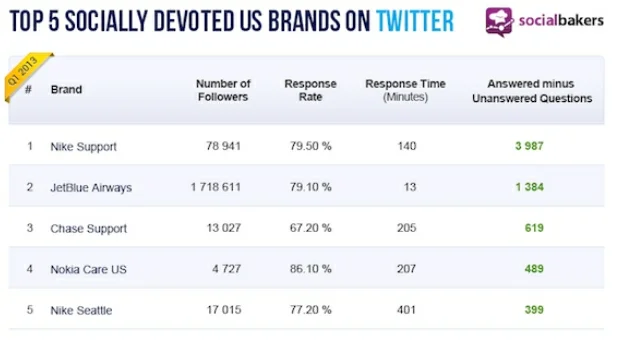
Which brands are most responsive to customers on Twitter? Socialbakers released its view of the top five companies.
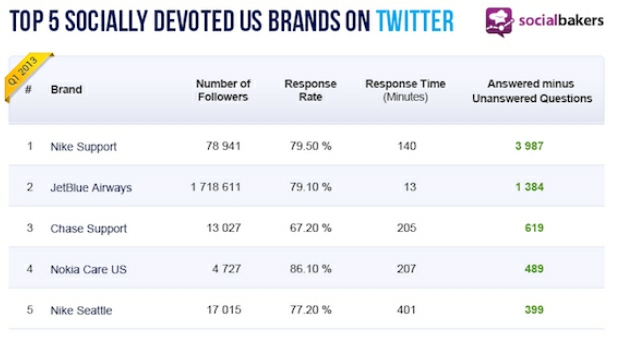
Although Nike answered a higher percentage of questions, JetBlue clearly is leading in response time, with an impressive 13 minutes. With so many more followers, it may not be possible for the company to beat Nike's rate.
Socialbakers also looked at the most engaged industries on Twitter, again using percentage of questions answered as the metric.
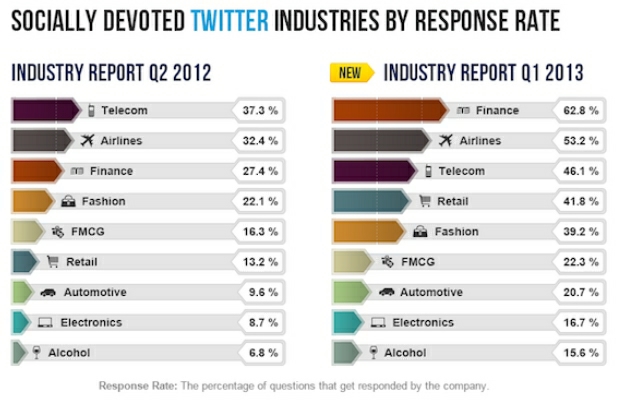
Although an imperfect measure, response rate is better than looking at the number of followers, which had been the prevailing metric of engagement for some time. At least with this data, human intervention is considered.
Discussion Starters:
- What, if anything, surprises you about the companies' and industries' level of "social devotion"?
- I say that response rate is an imperfect measure. Why do you think this is the case?
- What other metrics could be used to determine companies' success on Twitter?
A Personal Touch: Hotel Wake-Up Calls
 Automated wake-up calls at hotels have become the norm, but now some
brands want to differentiate themselves with a more personal touch. According to a USA Today article, the following examples show this move to personalization:
Automated wake-up calls at hotels have become the norm, but now some
brands want to differentiate themselves with a more personal touch. According to a USA Today article, the following examples show this move to personalization:
- At the Westin Resort and Casino, Aruba, once you respond to the first telephone wake-up call, an employee goes to your room and knocks on your door to make sure you actually get up.
- At Las Ventanas al Paraiso, A Rosewood Resort in Los Cabos, a butler shows up at your room to wake you up with complimentary tea, coffee and breakfast breads.
- At the Mandarin Oriental and The Four Seasons, a person rather than an automated system will call to wake you up. If you don't answer, you'll get a wake-up knock.
- You don't want to oversleep at The Adolphus in Dallas. If you miss your wake-up call three times, a security guard will show up at your door.
Although most people have Smartphones, according to one study, 53% of guests still want a hotel wake-up call.
Discussion Starters:
- What's your preferred method for alarms at hotels? What value do you see in a hotel's personalized wake-up call?
- What are the potential downsides of the hotels' approaches, listed above?
Offensive Ad of the Day: Mountain Dew
Mountain Dew pulled an ad that was deemed racist and sexist. This one seems to jump, rather than cross, the line. A badly bruised woman is asked to identify someone in a police line-up of African-American men-and a goat.
Felicia the Goat, with the voice of rapper Tyler The Creator, made his first appearance in Mountain Dew commercials in March. In an earlier episode, the goat beats up the waitress for failing to give him enough soda. As one might expect, the ad was criticized for being misogynistic. Because bad things come in threes, Mountain Dew has another commercial set to air on May 24.
In a statement to The Hollywood Reporter, PepsiCo has taken responsibility for the ad:
"We apologize for this video and take full responsibility. We have removed it from all Mountain Dew channels and Tyler is removing it from his channels as well."
A representative for Tyler The Creator released a statement to The Hollywood Reporter:
"It was never Tyler's intention to offend however, offense is personal and valid to anyone who is offended. Out of respect to those that were offended the ad was taken down," it said. "For those who know and respect Tyler he is known for pushing boundaries and challenging stereotypes through humor. This is someone who grew up on David Chappelle. This situation is layered with context and is a discussion that Tyler would love to address in the right forum as he does have a point of view."
"Contrary to what many may discern from this Tyler is the embodiment of not judging others, his delivery may not be for everyone (which is true for anyone who pushes boundaries) but his voice is nonetheless important to the conversation since his demographic understands what he ultimately stands for and sees the irony of it all," continued the statement.
"He absolutely never intended to spark a controversy about race," it read. "It was simply an again admittedly absurd story that was never meant to be taken seriously. Again we apologize if this was taken out of context and would never trivialize racism, especially now in America where voting and civil rights are being challenged at the highest level."
Discussion Starters:
- What's your view of the first two commercials? Do you find them offensive, funny, or something else?
- PepsiCo's response differs from the recent McDonald's and Hyundai situations, where the companies said ads were created without their approval. Does PepsiCo's response work better?
Restaurant Berates No-Shows on Twitter
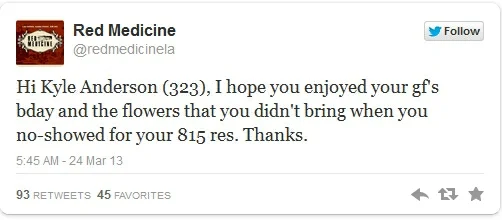
Noah Ellis of Beverly Hills restaurant Red Medicine did what most owners would like to do but wouldn't dare: called out no-shows on Twitter.
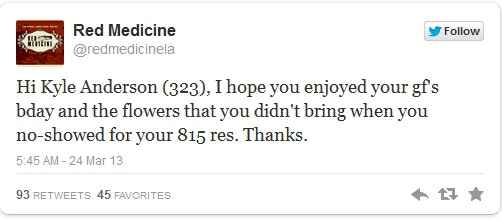

After the public shaming, Ellis was unapologetic to the LA Eater:
"The a**holes who decide to no-show, or cancel 20 minutes before their reservation (because one of their friends made a reservation somewhere else) ruin restaurants (as a whole) for the people who make a reservation and do their best to honor it. Either restaurants are forced to overbook and make the guests (that actually showed up) wait, or they do what we do, turn away guests for some prime-time slots because they're booked, and then have empty tables."
To ABC News, Ellis seemed calmer and explained the impact that no-shows have on the restaurant:
"We're a small restaurant. You can see there's about 54 seats in the dining room. When you lose 20 people in that kind of peak time of the time it's inconsiderate to the other guests."
Ellis also admits that he was frustrated:
"The intent was never to focus on or draw attention to these specific people, it was more to put names to a problem to get some attention and get people discussing it."
Discussion Starters:
- How do you assess Ellis' approach: just desserts, over-the-top, or something else?
- How else can restaurant owners manage no-shows?
MIT Media Lab SXSW Faux Pas
As the rest of us watch the snow fall, participants in the SXSW interactive festival in Austin are enjoying the technology, music, and general coolness of the event.
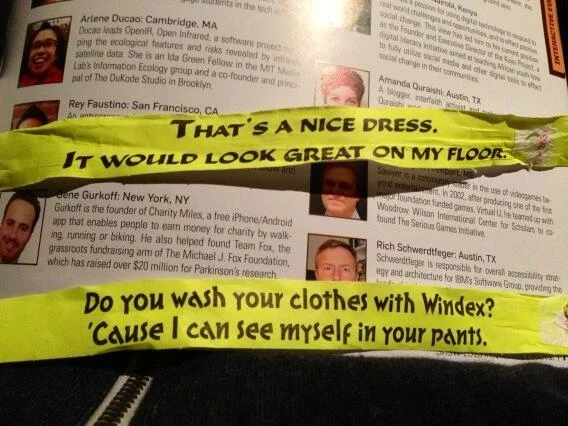
Festival mainstay MIT Media Labs surprised people with its promotional wristbands that many considered sexist. The bands were given to people who attended an MIT party.

In a blog post, the organization published this apology:
"We appreciate all of the feedback we've received about the party we hosted at The Parish Underground on Saturday night at SXSW. While we received a lot of positive responses, we want to address an issue with the wristbands that were given to people who came in the door. They were offensive and in no way reflect the sentiments of the MIT Media Lab. These wristbands were provided by the venue, and while we didn't realize what was printed on them until after they'd been handed out, we should have prevented the situation from occurring in the first place.
"The Media Lab is firmly committed to supporting women in the sciences, computing, arts, and engineering. We don't like – and certainly don't want to support or disseminate – offensive messaging. We appreciate those of you who noticed the wristbands and pointed them out to us; please accept our sincere apology."
Discussion Starters:
- What's your reaction to the wristbands: clever marketing, offensive, or something else?
- What's the significance, if any, of MIT Media Labs distributing the wristbands at SXSW?
- How do you assess the organization's apology?