
Princess Cruises Admits Dumping
 Princess Cruises, a division of Carnival, will pay $40 million in penalties for illegally dumping oil-contaminated waste into the ocean. The Department of Justice announced the news and called the activity "deliberate":
Princess Cruise Lines Ltd. (Princess) has agreed to plead guilty to seven felony charges stemming from its deliberate pollution of the seas and intentional acts to cover it up. Princess will pay a $40 million penalty-the largest-ever criminal penalty involving deliberate vessel pollution-and plead guilty to charges related to illegal dumping of oil contaminated waste from the Caribbean Princess cruise ship.
Assistant Attorney General Cruden had harsh words for the company:
The pollution in this case was the result of more than just bad actors on one ship. It reflects very poorly on Princess's culture and management. This is a company that knew better and should have done better. Hopefully the outcome of this case has the potential not just to chart a new course for this company, but for other companies as well.
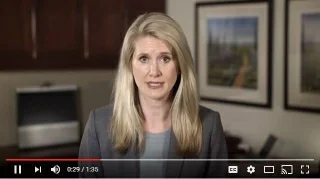
Princess Cruises responded extensively in a statement posted on the website, in an FAQ, and in videos from the company executives. The president's video blames a few employees. A comment posted on YouTube under the video sums up one response: "this video needs taking down and a new one with someone who looks sorry is put up. her reading of this is terrible, like watching a 12yr old at a school play."
Discussion Starters:
- Read the company's statement and watch the videos. How well do the executives respond to the crisis? What could they have done differently?
- Does this news affect your decision to take a Princess Cruise? Why or why not?
Olive Oil Companies Sue Dr. Oz
 Dr. Oz is in trouble again for possible false claims. The TV personality is featured in the textbook in Chapter 9 for promoting products without evidence that they work. Now, an olive oil trade association, North American Olive Oil Association (NAOOA), is suing him for attacking the industry.
On his show, Dr. Oz said, "[A] shocking 80% of the extra virgin olive oil that you buy every day in your supermarket isn't the real deal," and "It may even be fake. Most of the olive oil in your pantry might be a scam." But Dr. Oz used taste tests, which Eryn Balch, a NAOOA representative said aren't an accurate way to determine product quality and purity.
A Forbes article explains the issue:
The problem with the study and its interpretation is twofold: 1) Sensory taste tests cannot detect purity and 2) The number of samples was small and hardly representative of the marketplace, testing only three specimens each of fourteen imported and five California brands. "It got misinterpreted, and it just spread," Balch said. Even the New York Times got it wrong, with an infographic claiming that 69% of all imported olive oils are "doctored," even though the Olive Center report showed no such thing. The Times eventually corrected its mistake but the damage was already done. "It's been five years now, and it's still spreading," Balch said.
Dr. Oz was most recently in the news because a group of doctors signed a petition to have him removed from his position at Columbia University Department of Surgery. He also made headlines for promoting a weight loss program without proven evidence. His impact is sometimes called the "Dr. Oz Effect" because his claims sell a lot of product.
Discussion Starters:
- Dr. Oz will fight the suit, of course. What claims and evidence will he use to make his case?
- What does it take to convince you to buy a new product or stop buying a product you have been using? Consider principles from Chapter 7 on persuasion: logical argument, emotional appeal, and credibility. To which do you most respond?
Some Carrier Jobs Will Be Saved
 Some Carrier employees in Indiana will keep their jobs, while other positions, as planned, will move to Mexico.
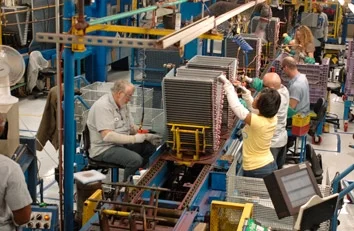
President-elect Donald Trump has met with Carrier executives to keep the plant open for manufacturing gas furnaces. This is good news: more than 1,000 U.S. positions will be saved, but communication with employees has been lacking. Understandably, employees are skeptical about the decision and want more details.
Here are a few quotes from those affected:
- "There's excitement with most people, but there's a lot of skepticism and worry because we don't know the details."
- "There's a few that are worried. And there's still a few that don't even believe this is real. They think it's a play, a set-up or a scam."
- "Who is going to be retained? What is the structure there will be for the retention? What is going to be put in place?" "Are these the same jobs at the same wage? I would sure like to know as soon as I can."
- "I'm optimistic, but I don't know what the situation is. I guess it's a good sign. ... You would think they would keep us in the loop. But we know nothing."
The last quotation is from the president of a local United Steelworkers union. The plant closure was announced in February and video recorded by an employee. During the meeting, the speaker said that they would involve union representatives, but they may be a missing link in this recent news.
Carrier released a statement about the decision, claiming, "The incentives offered by the state were an important consideration." Vice President-elect Mike Pence is currently the governor of Indiana.
Discussion Starters:
- What advice would you give to Carrier executives about how the plan is communicated? Consider how the initial announcement took place as well.
- The company has a practical challenge: although they may have accepted incentives to keep the plant open, details about staffing have yet to be worked out. How can they communicate with employees in the meantime?
South Korean President Mired in Scandal
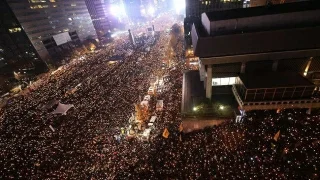
 With a dismal 4% approval rating, South Korea President Park Geun-hy is facing possible impeachment. The country is outraged, and people are calling for her resignation. The trouble involves the president's long-time friend, Choi Soon-sil, who was just indicted for fraud and abuses of power.
The Washington Post describes Park's relationship with Choi:
A famously aloof person, Park is accused of relying on Choi for everything from policy advice to wardrobe choices, instead of seeking counsel from her aides. Choi, the daughter of a shamanistic cult leader, is accused of exploiting those ties to raise money and win favors for herself and her family.
Choi used her influence to get companies to "donate" $70 millions; business leaders felt if they didn't contribute, they would be subjected to audits or other actions taken by the government. The prosecution for Choi determined that Park was heavily involved.
According to The Washington Post, the protests are the largest the country has seen since 1987, when South Korea democratized.
Discussion Starters:
- What parallels do you see between this story and recent company scandals?
- How should we decide when it's time for a country or a company president to resign? Is it Park's time?
JPMorgan Found Guilty of Hiring Chinese Execs' Children
 JPMorgan Chase will pay settlements worth $264 million for hiring the children of Chinese executives in exchange for business. A three-year investigation found that the hires constitute bribery, and five more banks are under investigation.
An SEC press release describes the findings:
According to an SEC order issued today, investment bankers at JPMorgan's subsidiary in Asia created a client referral hiring program that bypassed the firm's normal hiring process and rewarded job candidates referred by client executives and influential government officials with well-paying, career-building JPMorgan employment. During a seven-year period, JPMorgan hired approximately 100 interns and full-time employees at the request of foreign government officials, enabling the firm to win or retain business resulting in more than $100 million in revenues to JPMorgan.
"JPMorgan engaged in a systematic bribery scheme by hiring children of government officials and other favored referrals who were typically unqualified for the positions on their own merit," said Andrew J. Ceresney, Director of the SEC Enforcement Division. "JPMorgan employees knew the firm was potentially violating the FCPA yet persisted with the improper hiring program because the business rewards and new deals were deemed too lucrative."
A company statement is nowhere to be found. The major news articles don't include a company quotation, and neither the Press Releases or News and Announcements sections of the JPMorgan website list a response.
According to a statement by the U.S. Department of Justice, the company has taken some internal action:
JPMorgan APAC also took significant employment action against six employees who participated in the misconduct resulting in their departure from the bank, and it disciplined an additional 23 employees who, although not involved in the misconduct, failed to effectively detect the misconduct or supervise those engaged in it.
Discussion Starters:
- How does this happen inside an organization? Consider who is involved in hiring decisions-sometimes a lot of people.
- Should JPMorgan make a statement about the settlement? Complete an audience analysis before you decide, and consider why the company leaders might choose to stay silent.
New Balance Responds to Neo-Nazi Controversy
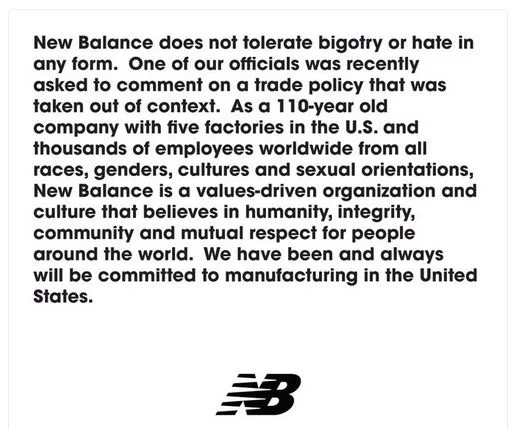
 New Balance sneaker company has aligned with Trump's trade policies and is getting Neo-Nazi support it doesn't want. People responded by trashing their sneakers, and the company tweeted this statement.
A GQ writer suggests, instead, that New Balance should be more direct:
Why not just say, "We do not want the endorsement of Neo-Nazis and if you are a Neo-Nazi please stop wearing our shoes." Is it really that hard to plain and simple condemn Neo-Nazis? This seems to be an attempt to not ostracize any customers or even, yes, Trump himself.
New Balance seems to be walking a line, trying not to lose customers on either side of aisle. The executive may very well be questioning whether he should have weighed in about the trade policy at all. Although CEOs should enter political debates carefully, New Balance has a lot at stake, according to a company statement:
As the only major company that still makes athletic shoes in the U.S., New Balance has a unique perspective on trade in that we want to make more shoes in the U.S., not less.
Discussion Starters:
- Should the executive have resisted commenting on Trump's trade policy? Why did New Balance enter the conversation?
- What's your view of the company's statement? Should it have been more direct, as the GQ writer suggests? What are the potential consequences?
Facebook's Fake News
Facebook has been displaying news according to users' preferences, which could override news that conflicts with their point of view. During the election, people saw fake stories that may have affected their vote. One frequent fake news writer bragged, "I think Trump is in the White House because of me. His followers don't fact-check anything - they'll post everything, believe anything."
BuzzFeed analyzed data from Facebook news stories and found that the top 20 fake election news stories outpaced shares, comments, and reaction to the top 20 legitimate election news stories. Although Mark Zuckerberg at first denied any connection between FB's fake stories and the election outcome, he later posted a plan for the social networking site to address fake news.
Zuckerberg posted, "[W]e don't want any hoaxes on Facebook." Still, he said, it's tough to distinguish fake news, and it's quite uncommon:
"Of all the content on Facebook, more than 99% of what people see is authentic. Only a very small amount is fake news and hoaxes. The hoaxes that do exist are not limited to one partisan view, or even to politics. Overall, this makes it extremely unlikely hoaxes changed the outcome of this election in one direction or the other."
This is a clever strategy, but the top 20 fake news stories got more than 8,711,000 shares, reactions, and comments, so it's not an insignificant number.
Melissa Zimdars, an assistant professor of communication and media at Merrimack College, compiled this list of ways to spot fake news.
In addition, a small group of students at a hackathon at Princeton University wrote FiB, which uses an algorithm to distinguish true and false news.
Discussion Starters:
- How do you assess news on Facebook or other social media sites?
- Have you ever posted something that you knew wasn't true? Why, and did you consider the potential consequences?
- Do you think fake news stories influenced the election? How?
Marriott CEO's Letter to Trump
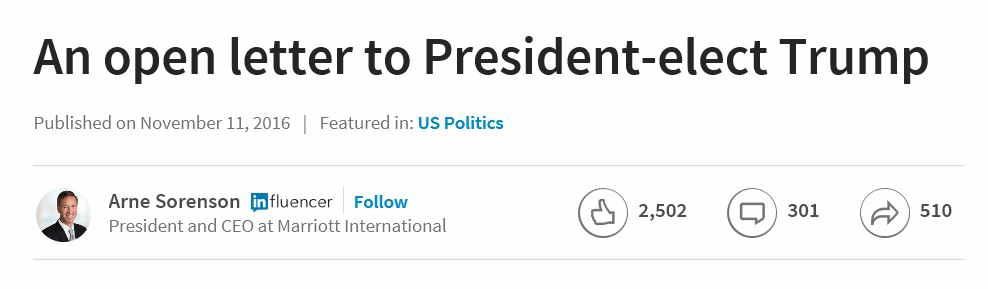
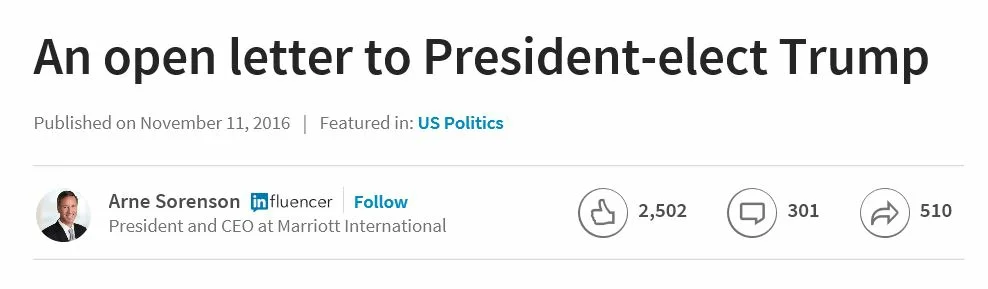
Marriott CEO Arne Sorenson is the latest company executive to write about the election results. In an open letter on LinkedIn, Sorenson offers some leadership advice.
The letter starts with Sorenson's views about government's role:
"The government has no business in our bedrooms – or our bathrooms. Everyone, no matter their sexual orientation or identity, has a right to live without interference in their private lives. Similarly, everyone, no matter their sexual orientation or identity, gender, race, religion disability or ethnicity should have an equal opportunity to get a job, start a business or be served by a business. Use your leadership to minimize divisiveness around these areas by letting people live their lives and by ensuring that they are treated equally in the public square."
Sorenson then focuses on three areas: "infrastructure, immigration reform and tax reform." As a hotel manager, Sorenson clearly is concerned about potential reductions in global travel and talent. He also encourages a more realistic approach for immigrants who are already in the U.S.
Discussion Starters:
- Why do you think Sorenson chose an open letter on LinkedIn as the medium for his message? What are some alternatives?
- What principles of persuasion, discussed in Chapter 7 of the book, does Sorenson use? Try to find examples of logos, pathos, and ethos.
- How does Sorenson's role as the CEO of Marriott influence his positions? Which of his suggestions would benefit hotel companies?
- Should Trump respond? If so, how, and what should he say?
Grubhub CEO: Agree or Resign?

The CEO of Grubhub had a tough message for employees who disagree with his anti-Trump sentiment: "you have no place here." After the election, Matt Maloney wrote an email about tolerance and inclusion. He expressed his disappointment in Trump's election, particularly his "demeaning, insulting and ridiculing minorities, immigrants and the physically/mentally disabled" and his "nationalist, anti-immigrant and hateful politics."
He went a step further at the end of the email:
"If you do not agree with this statement then please reply to this email with your resignation because you have no place here. We do not tolerate hateful attitudes on our team. I want to repeat what Hillary said this morning, that the new administration deserves our open minds and a chance to lead, but never stop believing that the fight for what's right is worth it."
Media reports and social media responses interpreted Maloney's message as a threat: anyone who voted for Trump should resign.
Maloney has responded that his email was misinterpreted:
"I want to clarify that I did not ask for anyone to resign if they voted for Trump. I would never make such a demand. To the contrary, the message of the email is that we do not tolerate discriminatory activity or hateful commentary in the workplace, and that we will stand up for our employees."
This distinction is important; otherwise, the company may be discriminating against people based on political views.
Discussion Starters:
- Read Maloney's full message to employees and his statement. How do you interpret his original message and the explanation?
- Should Maloney have sent the email to employees? What are the benefits and risks to the company and to him personally?
- Could Maloney have revised the email to avoid the controversy? How so?
NY Times Promises Fair Coverage
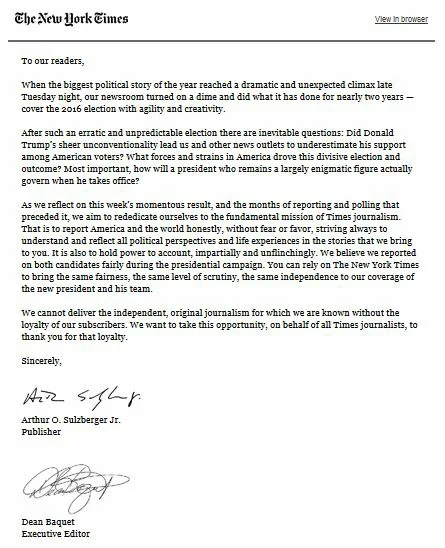
The New York Times publisher and executive editor sent an unusual email to subscribers about election coverage. Poynter reports that this email and another to employees were in response to criticism of left-leaning coverage of the campaign.
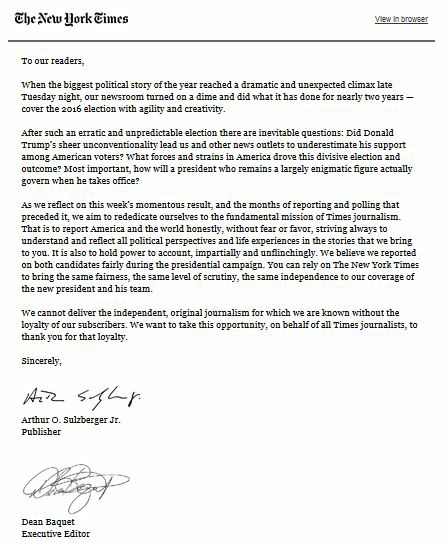
The message is both reflective and forward-looking, questioning an unprecedented election and assuring readers fair coverage of President Trump in the future. The publisher and editor promise to stay true to the newspaper's core mission, and they thank loyal customers.
Arthur Sulzberger is the newest member of the family to be named publisher of The Times. A fifth-generation publisher, Sulzberger is a descendant of Adolph S. Ochs, who bought the paper in 1896.
The email comes after Sulzberger sent an internal memo to staff:
Dear Colleagues,
As we close one of the most momentous weeks in our nation's recent history, let's pause for a moment on those famous instructions that Adolph S. Ochs left for us: to cover the news without fear or favor.
As Donald Trump begins preparing for his new administration, those words have rarely felt more important.
The Times is certainly not afraid - our investigative report has demonstrated our courage many times over. That fearless, hard-fought journalism will always stand as the backbone of The Times, no matter the President.
But we also approach the incoming Trump administration without bias. We will cover his policies and his agenda fairly. We will bring expert analysis and thoughtful commentary to the changes we see in government, and to their ramifications on the ground.
We will look within and beyond Washington to explore the roots of the anger that has roiled red and blue America. If many Americans no longer seem to understand each other, let's make it our job to interpret and explain.
Our predecessors founded our singular newspaper for just this moment - to serve as a watchdog to the powerful; and to hold mighty institutions accountable, without fear or favor. We are more than ready to fulfill that promise.
Together, we have built the world's best digital newsroom and it, too, was made for just this moment. We will chronicle the new administration with a lightning-fast report that features stories told in every medium and on every platform.
Here is what we have all dedicated our careers to: Going after the biggest stories in the world, and telling them as ambitiously as possible.
Get some rest this weekend. We have lots to do.
Arthur
Discussion Starters:
- You might read this as either an admission or a defense. What's your view?
- What are the communication objectives of both emails? You might consider the newspaper business today. To what extent do you think they meet those objectives? Overall, are the messages effective?
- Assess the writing style against principles in Chapter 5. Pay particular attention to word choice and sentence structure.
FBI Says Nothing New in Clinton Emails
Just under the wire-two days before a close election-the FBI has announced nothing worthy of attention, after all, in Hillary Clinton's emails. The news comes just eight days after the FBI, led by James Comey, said the organization discovered new emails during an investigation of Anthony Weiner. At the time, no charges were made, and the FBI said they had no information about the emails, which wasn't helpful just 10 days before the national election.
Some question whether the FBI could reasonably read all messages, but it seems that most emails were personal or duplicates of what the FBI already reviewed.
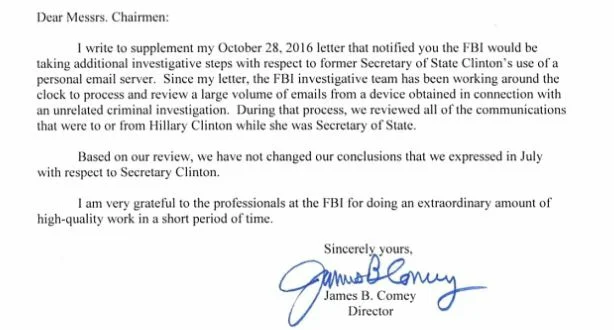
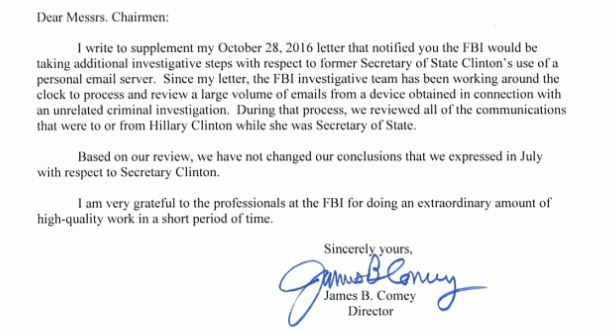
In his letter to Congress, Comey stressed the work of the FBI agents to review the messages and said their conclusion from July was unchanged: no charges will be made in relation to Clinton's email server.
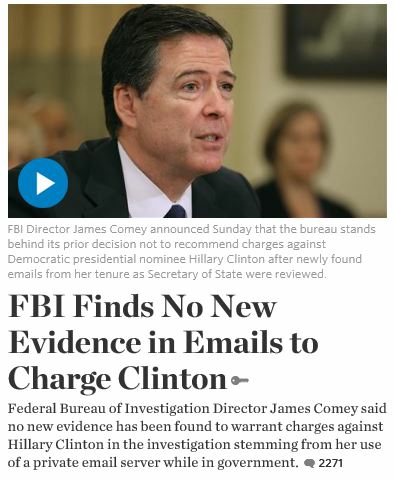
The news made The New York Times' biggest online front page headline as well as The Wall Street Journals'.
Discussion Starters:
- Once again, did Comey do the right thing? What kind of pressure do you think he's been under?
- How, if at all, do you think this latest news will affect the election results? The first announcement did seem to tighten Clinton's lead. Will this announcement reverse it?
- Why are people influenced by this news-either way? The candidates have starkly different approaches, backgrounds, and plans.
Christie Associates Found Guilty
Two former associates of NJ Governor Chris Christie were found guilty of causing traffic problems for political gain. In what has been called "Bridgegate," Bridget Anne Kelly and Bill Baroni conspired to close lanes on the George Washington Bridge in 2013 as retaliation against the mayor of Fort Lee. At the time, Kelly was Christie's deputy chief of staff, and Baroni was the deputy director of Port Authority. Previously, two other aides admitted guilt in relation to the scandal.
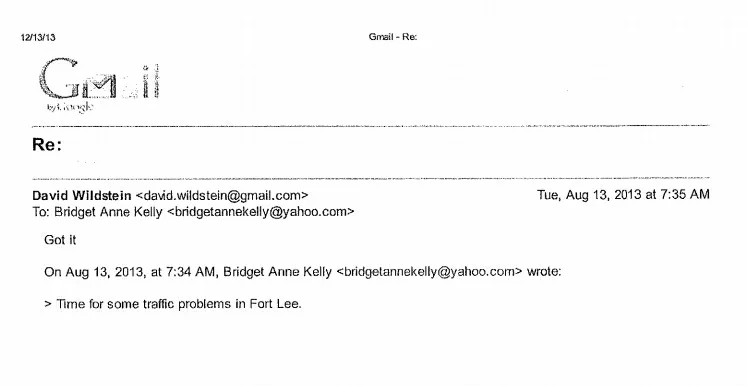
The most incriminating piece of evidence was an email exchange between Kelly and David Wildstein, who leaked the plan. The message is clear: "Time for some traffic problems in Fort Lee."
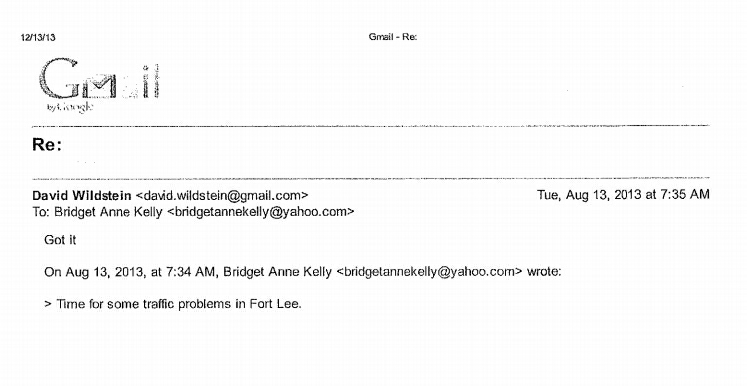
In a statement released after the verdicts, Christie says he's "saddened," but he continues to maintain his innocence.

Christie reiterated this point during an interview with CBS News.
But the verdict is bad news for Christie-and possibly for Donald Trump. On the stand during her trial, Kelly said that Christie knew about the plan, and text messages from another aide said he "flat out lied." Trump had named Christie to lead a transition team should he become president, and Christie is actively campaigning for Trump in these last days before the election.
Discussion Starters:
- Does this verdict hurt Christie's chance of maintaining his innocence? Why or why not?
- Assess his statement to the press. How effectively does he stay clear of the case and verdicts?
- What, if anything, should Trump do at this point? He didn't choose Christie as his vice presidential running mate, but he's clearly a Christie fan.
Does Comey Regret His Decision?
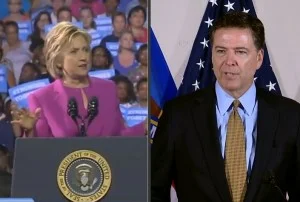
 FBI Director James B. Comey made headlines today for reporting new allegations against Hillary Clinton because of, you guessed it, her use of email. This time, new emails have been discovered in connection with Anthony Weiner, the former NY congressman who was caught "sexting." His ex-wife is Huma Abedin, a Clinton aide.
Comey apparently went public with the news, in the form of a letter to Congress, without any specifics, with no decision to bring charges, and despite warnings from the Department of Justice. Soon after Comey went public, he issued this email to FBI employees, perhaps indicating his ambivalence about the release.
To all:
This morning I sent a letter to Congress in connection with the Secretary Clinton email investigation. Yesterday, the investigative team briefed me on their recommendation with respect to seeking access to emails that have recently been found in an unrelated case. Because those emails appear to be pertinent to our investigation, I agreed that we should take appropriate steps to obtain and review them.
Of course, we don't ordinarily tell Congress about ongoing investigations, but here I feel an obligation to do so given that I testified repeatedly in recent months that our investigation was completed. I also think it would be misleading to the American people were we not to supplement the record. At the same time, however, given that we don't know the significance of this newly discovered collection of emails, I don't want to create a misleading impression. In trying to strike that balance, in a brief letter and in the middle of an election season, there is significant risk of being misunderstood, but I wanted you to hear directly from me about it.
Jim
Clinton's approach to the news is to go on the attack, criticizing Comey's decision as "unprecedented" and "deeply troubling."
Discussion Starters:
- Did Comey make the right decision? Why or why not? Is this just a distraction from the election, which is just 10 days away, or is this essential to Americans' decision?
- Will Hillary ever live down this issue? If she becomes president, what is the best way for her to handle the situation?
Layoffs at Twitter
Twitter is laying off about 9% of employees and closing Vine, the short video app it purchased in October 2012 before it launched. When Instagram offered video options, Vine immediately lost much of its user base. About 350 employees are affected.
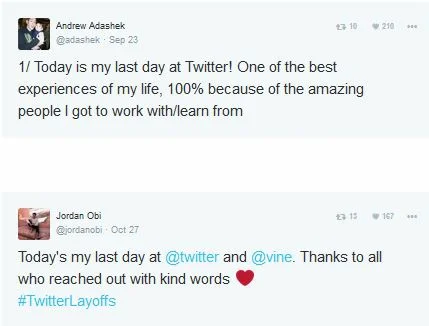
Layoffs are awkward for Twitter, a site sometimes used for "live tweeting" bad news. In this case, a former employee created a Twitter Moment, "Last Day at Twitter." Exiting employees also used the hashtag #TwitterLayoffs. This could be risky for a company, but the posts are positive. It could be that employees enjoyed their time at Twitter and understand the rationale for layoffs. It could also be that employees are in high demand from other companies, so they won't be out of work too long.

Discussion Starters:
- Why do you think employees tweeted nice messages on their last day? I offered two theories. Any other ideas?
- Should the company have created its own hashtag for the event to pre-empt something worse? Why or why not?
NFL's Image Problem
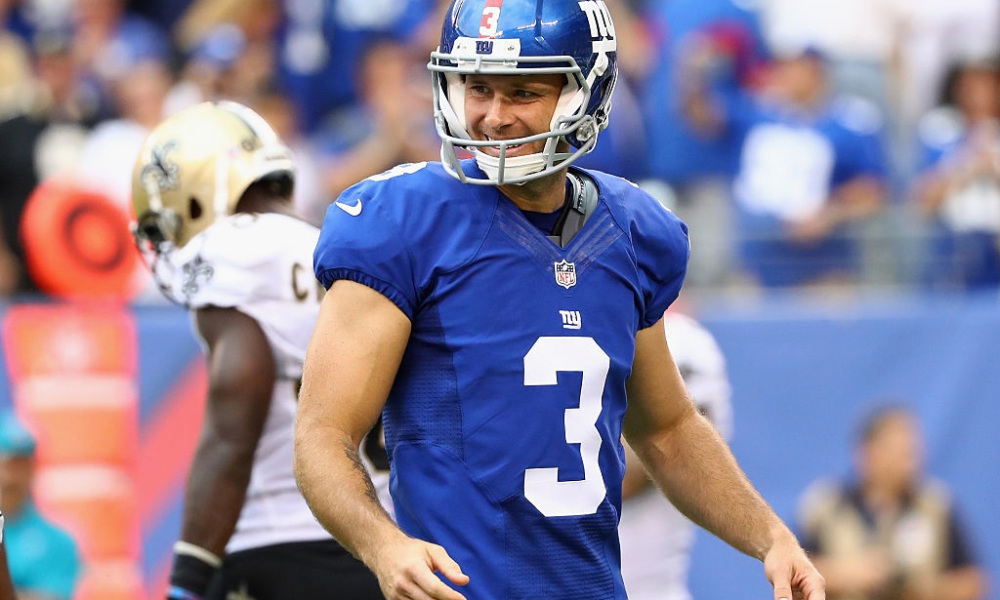 The NFL's image is further damaged by a New York Times article today titled, "N.F.L. Shows It Doesn't Really Care About Domestic Violence." The piece starts by highlighting declining viewership, for which the league blames the current election. Certainly, people are sensitized to sexual assault incidents, but the NFL isn't helping itself:
"Yet again, in the case of Giants kicker Josh Brown, the league has shown that it could not care less about women and really, really doesn't want to call out its players for doing bad things to them."
Tough words. But the Times explains that Brown "was charged with assaulting his wife" "more than two dozen times." After investigating the case for 10 months, the NFL decided to suspend Brown for only one game.
The Times also said the league blamed the victim: "Brown's wife had failed to cooperate, the league said, and that's why its investigators couldn't get to the bottom of what he had done."
People are voicing their dismay on Twitter, with the second tweet here retweeted almost 2,000 times.

Discussion Starters:
- What's your view of the Times' headline: overstated, unfair, spot-on, or something else?
- To what extent do you think these assault issues are causing declining viewership?
- What should the NFL do to restore its image?
Facebook Debates Trump's Posts as Hate Speech
Are some of Donald Trump's posts considered hate speech? That's what Facebook employees debated in December according to a Wall Street Journal article, and CEO Mark Zuckerberg decided against censorship. Some employees felt strongly-even threatening to quit-over Trump's posts proposing banning Muslims from entering the country. 
A spokesperson for Facebook said, "That context [of a post] can include the value of political discourse. Many people are voicing opinions about this particular content, and it has become an important part of the conversation around who the next U.S. president will be." Another management team member wrote, "In the weeks ahead, we're going to begin allowing more items that people find newsworthy, significant, or important to the public interest-even if they might otherwise violate our standards."
Facebook is in the spotlight partly because Americans increasingly use the site as a news source, and the company has been viewed as left-leaning. Clearly, Facebook is in a tough spot.
Discussion Starters:
- What is considered hate speech?
- Did Mark Zuckerberg make the right decision? Research Facebook's policy for context.
- Should Facebook adjust its policy? Or is this a decision relevant only to the current election?
Ronald McDonald Sits Out Creepy Clown News
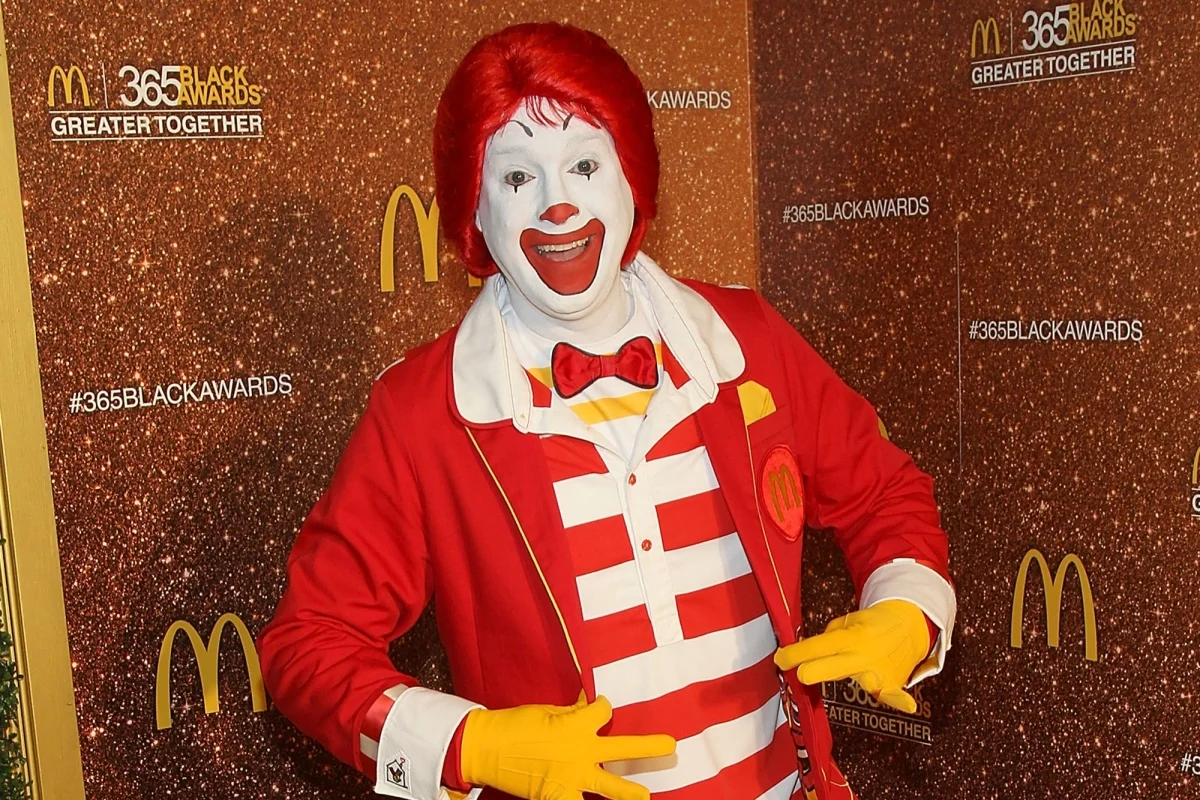
 McDonald's classic clown, Ronald McDonald, is taking a vacation amidst news of so-called "creepy clowns," which have been scaring and possibly harming children. A company representative said, "McDonald's and franchisees in the local markets are mindful of the current climate around clown sightings in communities and as such are being thoughtful in respect to Ronald McDonald's participation in community events for the time being."
The issue began with reports of clowns luring children into unsafe places in South Carolina. Since then, pranks across the country have scared kids and taken much of the fun out of clowning.
Discussion Starters:
- A look at several clown association sites reveals no statement about the issue. Should they have a statement? If so, what? If not, why not?
- Why do you think the associations don't yet have statements? Your response could be related to the previous question-or not.
- Did McDonald's make the right decision in benching Ronald for a while? What's your view of the short statement?
Wells Fargo CEO Steps Down
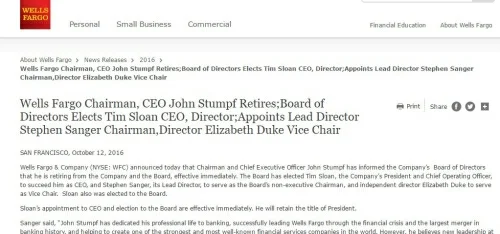
It was probably just a matter of time. Wells Fargo CEO John Stumpf announced his retirement in the wake of a bank scandal that brought the CEO in front of the federal government and brought the company millions of dollars in fines. Stumpf will walk away with about $134 million as his retirement package (although no additional severance pay). According to The Wall Street Journal, the board didn't try to convince Stumpf to continue on.

In a news release, the company included quotations from Stumpf and from the new executives. Stumpf quote read, "I am grateful for the opportunity to have led Wells Fargo. I am also very optimistic about its future, because of our talented and caring team members and the goodwill the stagecoach continues to enjoy with tens of millions of customers. While I have been deeply committed and focused on managing the Company through this period, I have decided it is best for the Company that I step aside. I know no better individual to lead this company forward than Tim Sloan."
A Slate writer called the news "a stunning fall for a banking leader who had helped guide Wells Fargo through the financial crisis and lead the company through its acquisition of Charlotte-based Wachovia." A New York Times writer called Stumpf's resignation "abrupt."
Discussion Starters:
- Do you agree with the reporters' language? Is this a "stunning fall" and an "abrupt departure"?
- Is Stumpf's retirement the right decision for the company at this time? Why or why not? What did the board of directors likely consider in encouraging-or at least accepting-his retirement?
Samsung Trying to Control the Damage
Samsung is dealing with a tough situation: batteries in the Galaxy Note7 have been causing fires. Warnings to turn off Samsung phones are heard on many flights, including mine to Denver this weekend. As the BBC reports, "that sends out a negative message about your products beyond even your own customers."
The company handled the initial reports well but lost favor when its replacements overheated or burned. The BBC article explains the growing issue for Samsung:
"The trouble is that even one phone which catches fire makes for startling pictures and a whole heap of consumer anxiety. Samsung may soon have to decide whether to cut its losses and abandon the Note 7 before it does more damage to its brand."
The New York Times also reported on Samsung's poor crisis communication:
"But for people to see those words, they had to click a link at the top of Samsung's home page with the not-so-urgent label 'Updated Consumer Guidance for the Galaxy Note 7.' As of Tuesday afternoon, the instructions had not been posted to Samsung's Facebook page or the company's Twitter account.
"For some who work in crisis management, it was a baffling and overly passive way for the South Korean electronics giant to deal with a prominent problem that has worsened in the last month."
On its website, Samsung posted this message:
Samsung Will Ask All Global Partners to Stop Sales and Exchanges of Galaxy Note7 While Further Investigation Takes Place
We are working with relevant regulatory bodies to investigate the recently reported cases involving the Galaxy Note7. Because consumers' safety remains our top priority, Samsung will ask all carrier and retail partners globally to stop sales and exchanges of the Galaxy Note7 while the investigation is taking place.
We remain committed to working diligently with appropriate regulatory authorities to take all necessary steps to resolve the situation. Consumers with either an original Galaxy Note7 or replacement Galaxy Note7 device should power down and stop using the device and take advantage of the remedies available.
Discussion Starters:
- Look at Samsung's recent news statements about this situation. How well has the company handled communication on its website?
- How, if at all, do you see this issue potentially reflecting poorly on the mobile industry? What should other phone manufacturers do?
How Naked Is Naked Juice?
Is Naked juice really "healthy" and worth the money? A lawsuit filed by the Center for Science in the Public Interest says Pepsi is misleading consumers with some of its claims.
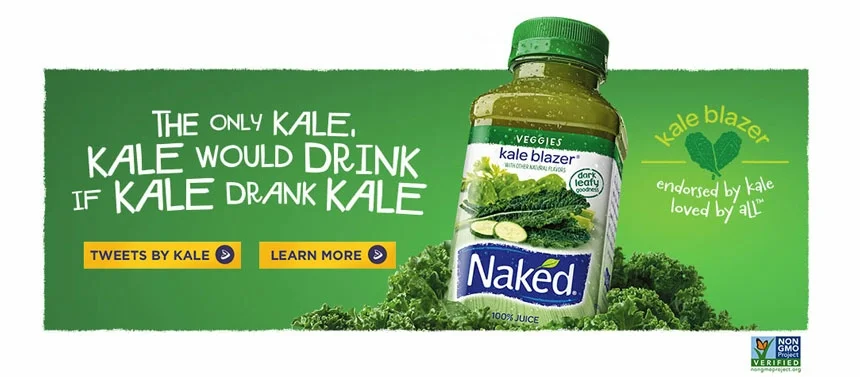
On the packaging, Pepsi promotes the juice as having "no added sugar" and repeats words like kale, when the truth tells a different story. A 15-ounce bottle of Naked contains eight teaspoons of sugar; compare that to a 16-ounce soda, which has about 12 teaspoons. The company's Kale Blazer certainly emphasizes kale on its label, but the primary ingredients are apple and orange juice, cheap products that don't justify the price consumers pay, according to the lawsuit.

In addition to these misleading statements, the CSPI is faulting Pepsi for not labeling the drinks, "not a low-calorie food," which is required by the FDA when consumers could think otherwise.
Pepsi has responded to the lawsuit:
"Any sugar present in Naked Juice products comes from the fruits and/or vegetables contained within and the sugar content is clearly reflected on label for all consumers to see. Every bottle of Naked Juice clearly identifies the fruit and vegetables that are within."
This isn't Naked's first challenge. In 2013, Pepsi paid $9 million for calling the product "all natural."
Discussion Starters:
- Do you agree more with the lawsuit or with Pepsi's response?
- What's the difference between sugar from fruit and added sugar? How much does this distinction matter?
- If the lawsuit is successful, how should Pepsi change the labels on its Naked products?