
Suing Glassdoor for Bad Reviews
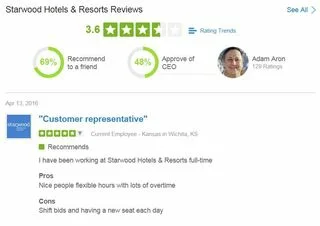
 In addition to poor customer reviews online, companies are feeling the pinch of negative employee comments, and they're taking action. Glassdoor has been targeted as the largest site for employee reviews about company management, interview processes, benefits, and pay. The site has been issued subpoenas for the names of people who posted views thought to be anonymous.
A lawyer arguing the case against Glassdoor claims, "The right to anonymous speech also extends to the Internet and those constitutional principles [of free speech], but at the same time the Constitution does not protect defamation. It does not protect statements that are false or could give rise to other claims, for example, false light or tortious interference."
At issue is whether comments are true or "maliciously false." If true, comments may be protected, but if they are false, the author may not be protected. The National Labor Relations Board (NLBR) has a role, as I've written about before on BizComintheNews. An attorney James R. Redeker, at Duane Morris explains:
"If an employer tried to take action against an employee who it found published something in either social or public media anonymously-and/or published something that was false and misleading-the NLRB [National Labor Relations Board] general counsel and the board take the position that an employee is entitled to and protected in making statements with regard to the working conditions of their employer."
Glassdoor has refused hundreds of employers' requests for content to be removed and for identities to be revealed. The company argues, "Glassdoor is an anonymous community and we will vigorously fight on behalf of our users to protect their identities and right to free speech, provided they adhere to our community guidelines and terms of service."
Discussion Starters:
- What is an employee's responsibility when posting to sites such as Glassdoor?
- Do you agree with Glassdoor's resistance to reveal identities and remove posts? Why or why not?
- The attorney quoted in one of the articles said that companies can respond to comments online, but "...that's very unsatisfying. And sometimes it exacerbates the problem." What's your view? That's certainly how companies manage customer comments. How might this differ?
Illinois College Bans Yik Yak
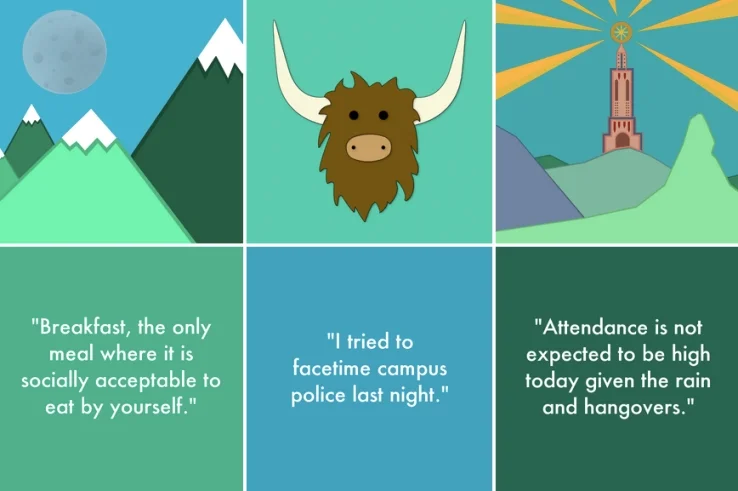
 Illinois College President Barbara Farley made the tough call to block students from using the app Yik Yak. Posts are anonymous and can be seen by location. The app is notorious for attracting mean and sometimes racist comments, which has caused complaints by students and faculty. At Illinois College, the Student Senate, Black Student Union, and faculty members have been particularly vocal about Yik Yak problems.
Students joke that the ban isn't really a ban at all because they can continue to access the app through their data plans. Although a handful of universities have banned the app, others refuse, partly for this reason. According to the vice president for student affairs at Duke University, "Since it can always be accessed via cell signal, no institution could truly eliminate it from their campus. For any institution to seek to silence it plays right into [Yik Yak's] hands...since what they seek is notoriety."
Several feminist and civil rights groups have urged the Department of Education to take action against Yik Yak. However, a Slate writer also argues that Yik Yak is helpful to students adjusting to college and struggling with mental illness. She says a university ban hurts some of the students they are trying to protect.
Discussion Starters:
- What's your opinion of Yik Yak: is it more helpful to students or harmful?
- How do you use the app?
- Should universities ban the app? What are the considerations and possible consequences?
WhatsApp Announces End-to-End Encryption
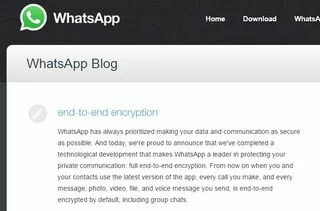
 Facebook-owned WhatsApp has announced end-to-end encryption, promising users more privacy. The news follows the recent debate between Apple and the FBI, which wanted to access iPhones of those involved in the San Bernardino terrorist shooting.
In a blog post, WhatsApp co-founders describe the new technology. The post continues after the excerpt here: "The idea is simple: when you send a message, the only person who can read it is the person or group chat that you send that message to. No one can see inside that message. Not cybercriminals. Not hackers. Not oppressive regimes. Not even us. End-to-end encryption helps make communication via WhatsApp private – sort of like a face-to-face conversation." The notice links to a description of the security features.
PR Daily comments on the political implications of the technology and announcement:
As you can imagine, this will do nothing to foster good will in the already tenuous relationship between the United States government, which would seemingly prefer to be able to see everyone's data all the time, and tech companies in Silicon Valley, which are receiving increasing user demands for more privacy and security.
Discussion Starters:
- Assess the founders' blog post: the organization, word choice, and so on. What makes this a persuasive message? Where does it fall short?
- Although the company ensures security, the system isn't foolproof. What are some ways that people other than the recipients might see a message?
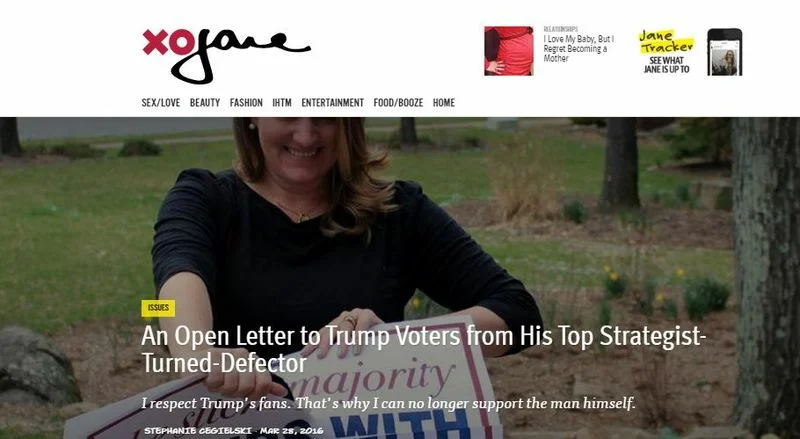
Former Trump Communications Director Quits and Reveals Strategy
So much for loyalty. A communication director for Trump's Make America Great Again Super PAC has quit the campaign and written an open letter about her experience. Most significant, Stephanie Cegielski says that Trump wanted to hit double digits and perhaps hit second place, but he never wanted to nor expected to be in the lead.
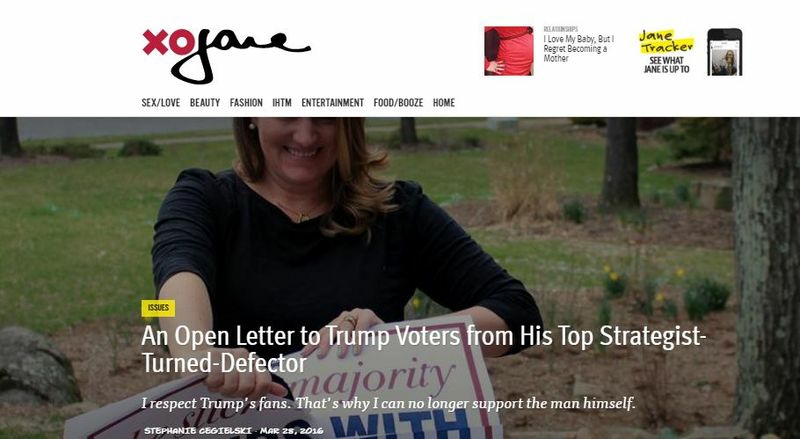
In her letter, Cegielski wrote, "His candidacy was a protest candidacy," and she describes her history:
"Almost a year ago, recruited for my public relations and public policy expertise, I sat in Trump Tower being told that the goal was to get The Donald to poll in double digits and come in second in delegate count. That was it."
She describes her initial excitement representing an alternative candidate but writes, "It wasn't long before every day I awoke to a buzzing phone and a shaking head because Trump had said something politically incorrect the night before. I have been around politics long enough to know that the other side will pounce on any and every opportunity to smear a candidate."
Cegielski, like many, was surprised at his continuing success. She eventually got disillusioned and now fears a possible win:
"What was once Trump's desire to rank second place to send a message to America and to increase his power as a businessman has nightmarishly morphed into a charade that is poised to do irreparable damage to this country if we do not stop this campaign in its tracks.
"I'll say it again: Trump never intended to be the candidate. But his pride is too out of control to stop him now."
Cegielski's credibility is at stake. The New York Times and The Wall Street Journal haven't taken up the story, and a Washington Post writer calls the article a successful "exercise in reputation management."
Discussion Starters:
- Read Cegielski's entire open letter. How do you assess her credibility? Consider The Washington Post perspective. Part of the writer's criticism is "She was literally the P.R. person for the Public Relations Society of America," and she "took a position teaching a class at New York University's School of Professional Studies" on Reputation Management.
- What, if any, loyalty does Cegielski have to Donald Trump and his campaign?
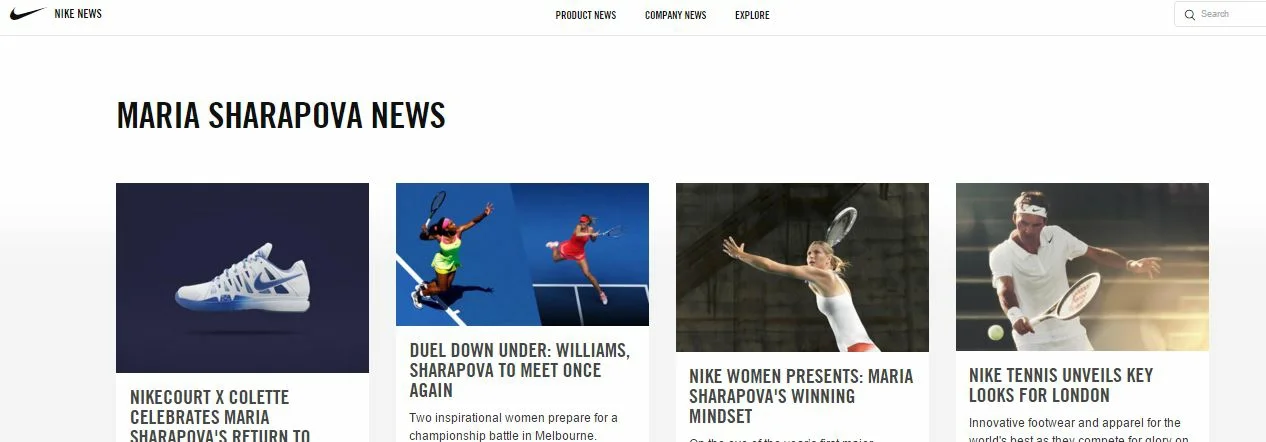
Sponsor Trouble for Maria Sharapova
Russian Tennis star Maria Sharapova is in a tough spot. She admitted that she failed a drug test and has taken "full responsibility" for it.
Sharapova said she was taking Meldonium, a medication for heart disease, which was added to the list of banned substances this year. She also said that the medication goes by another name, which she didn't know: "It is very important for you to understand that for 10 years this medicine was not on WADA's banned list, and I had been legally taking the medicine. But on January the first, the rules have changed." She also said, "I made a huge mistake. I let my fans down and I let the sport down."
But did she have to call the hotel's carpet "ugly"?
Although her admission and apology are clear, her sponsors don't want to wait for more news. Nike issued this statement: "We are saddened and surprised by the news about Maria Sharapova. We have decided to suspend our relationship with Maria while the investigation continues. We will continue to monitor the situation." Tag Heuer and Porsche also cancelled contracts, with the former explaining, "We had been in talks to extend our collaboration. In view of the current situation, the brand has decided not to renew the contract with Sharapova."
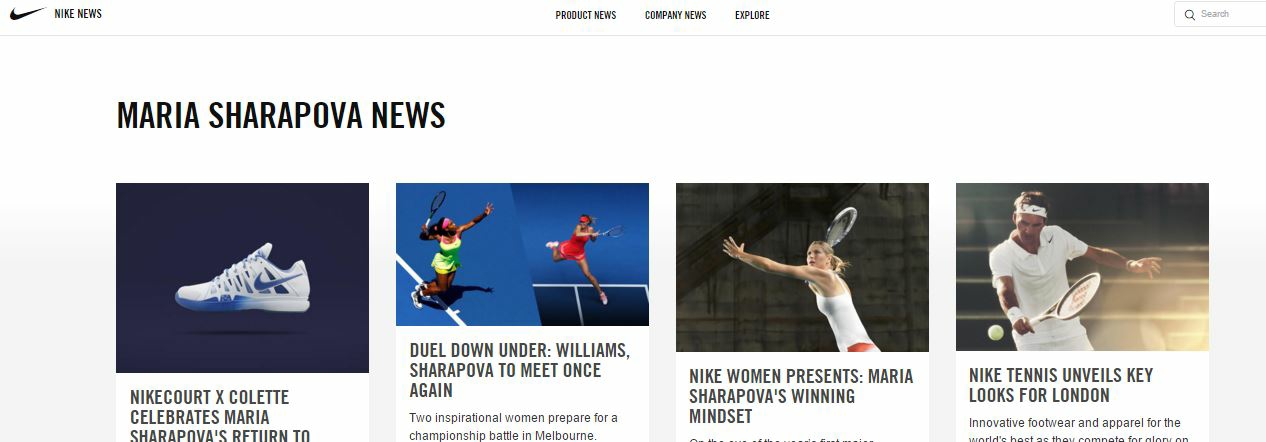
As of today, Nike's website page, "Maria Sharapova News" shows positive stories about the star and no mention of the decision.
Discussion Starters:
- How well is Sharapova handling the situation? Assess the news conference.
- Did Nike, Tag Heuer, and Porsche do the right thing? What pressures are on the sponsoring companies?
Criticism of Law Schools' Graduation Data
 A 2008 graduate of Thomas Jefferson School of Law is suing the institution for luring students to enroll by using false post-graduation data. Anna Alaburda's claim is one of 15 similar suits, although all but two have been dropped or dismissed.
Alaburda has $170,000 worth of student debt and has not found a full-time job in law since her graduation. Students' claims are that law schools include jobs such as part-time waitressing in their employment stats, inflating their placement rates. According to an article in The New York Times,
"Law schools labor to keep their employment data at the highest percentage level because it is a major factor in national law school rankings, which in turn give schools the credibility to charge six figures for a three-year legal education."
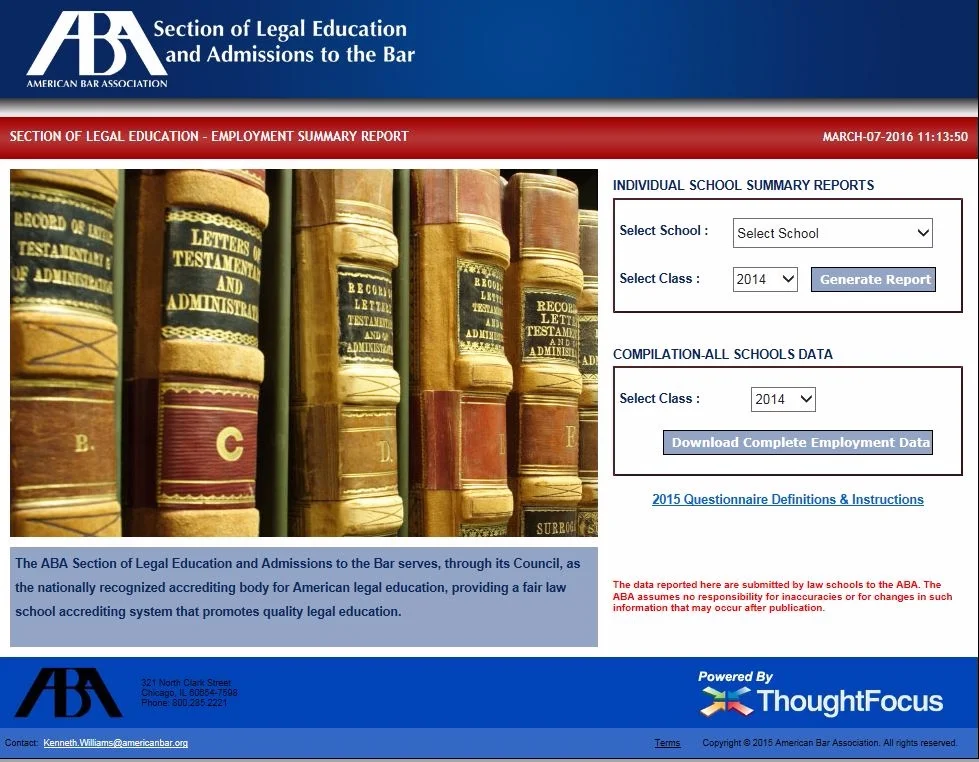
Since the charges, the American Bar Association has required law schools to give more information. On its website, you can download detailed statistics from all schools.
Overall, according to the National Association for Law Placement, rates have increased, but class size is shrinking, so it's tough to draw conclusions.
Discussion Starters:
- What is a law school's responsibility to share placement rates with prospective students? How does it balance honesty with recruiting targets?
- How would you make a decision about whether to attend law school-or a particular school? What data would be important for you to consider?
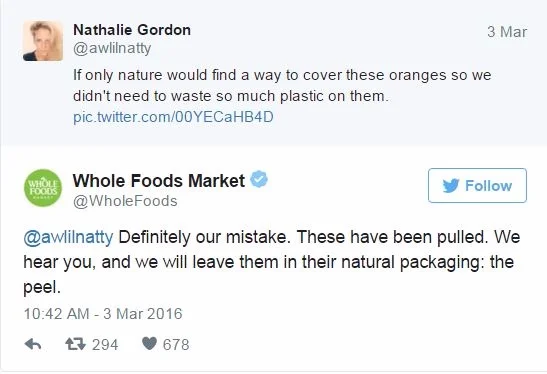
Whole Foods' Orange Controversy
 Whole Foods is selling pre-peeled, plastic-packaged oranges and has been criticized for it. The company touts sustainability measures, including, according to its mission statement, "reduced or reusable packaging, as well as encouraging shoppers to reduce waste through our 'nickel per bag' rebate program."
The tweet, at left, shows the company's decision, and a representative told Huffington Post, "a lot of our customers love the convenience of our cut produce offerings, but this was a simple case where a handful of stores experimented with a seasonal product spotlight that wasn't fully thought through. We're glad some customers pointed it out so we could take a closer look."
But people didn't like the decision to pull the oranges either. Some said they were useful for people with arthritis and other physical limitations.
Whole Foods is struggling because of lower-cost organic sellers, such as Costco. Last year, the company was criticized for selling asparagus spears in a bottle of water for $5.99. This product was also pulled.
Discussion Starters:
- What's your view of the pre-packaged orange? Is this a good product, does it contradict Whole Foods' mission, or both?
- Did Whole Foods act hastily in pulling the product? Consider the company's decision process.
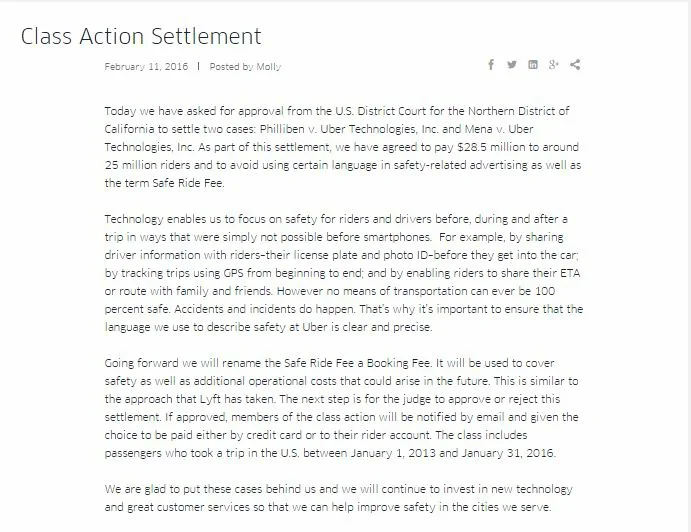
Uber Pays $28M and Adjusts Safety Language
Uber has settled two lawsuits claiming the company misled consumers about safety. Charging a $2.30 fee, Uber promised to do background checks of its drivers, but the company failed to do the type of fingerprinting required for taxi drivers.
As part of the settlement, Uber will change some language in its promotions: the "Safe Ride Fee" will now be called a "Booking Fee."
In a statement, Uber reinforces its rationale for assuring passengers of safety but admits, "no means of transportation can ever be 100 percent safe. Accidents and incidents do happen."

Discussion Starters:
- How, if at all, will the language change and financial settlement affect passengers?
- How well does Uber explain the settlement? Of course, the company tries to spin the news positively. Does it succeed?
22 Clinton Emails Under Scrutiny

Hillary Clinton has more email trouble: 22 messages on her private server while she was working for the State Department have been identified as "top secret" and won't be released to the public. The Clinton campaign says the emails weren't classified at the time and that the issue "appears to be over-classification run amok." This has been her defense for using a private server for these messages, which she also admitted was a mistake.
The timing, just days before the Iowa caucus, is unfortunate. Republican candidates are using the news to their advantage, although Bernie Sanders is still leaving it alone. As he said in a debate back in October, "Enough of the emails. Let's talk about the real issues facing America."
NPR describes other messages that were released recently: discussions of an upcoming presidential speech, observations about Joe Biden, support for her testimony about Benghazi, and issues with the press. From NPR's excerpts, we get a sense of Clinton's work style and personality.
Discussion Starters:
- Should Clinton say more about this new group of emails? If so, what?
- Now that the Democratic primary is getting close, should Bernie Sanders use this news to his advantage? What are the advantages and downsides of doing so?
ESPN Forgets to Identify Social Media Ads
The Federal Trade Commission's guidelines are clear: when people are paid to write social media posts that relationship must be disclosed. This applies to company employees. Two incidents this week show companies skirting those rules.
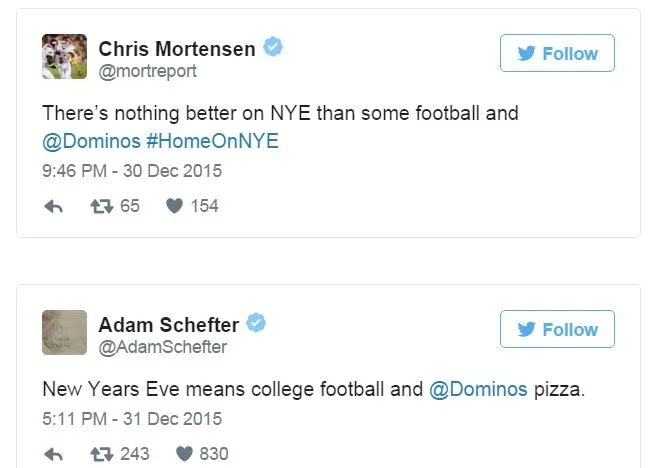
ESPN employees tweeted about Dominos, but didn't disclose their relationship to ESPN. By law, the tweets should include #ad or #spon to identify a sponsored ad.

ESPN responded to a request by Deadspin, calling the tweets an "error":
ESPN says this is all a mistake and that future tweets associated with Domino's ad buy with the network will be compliant with federal law. Which is fine, though we're still skeptical that New Year's Eve means either college football or pizza-and so were the millions of fans who didn't tune in for this year's college football playoff games.
Yet, a couple of days later, an ESPN journalist tweeted another advertisement. The company has argued that journalists aren't paid endorsers, and a Wall Street Journal article explains, "the issue of whether [ESPN's] roster of pundits and anchors are journalists guided by traditional editorial strictures or entertainers allowed to hawk products has been a thorny one for some time." However, Deadspin argues that Schefter and Mortensen are clearly "personalities," and the connection to the brand is clear.
This issue isn't new. The FTC admonished Cole Han for promotions on Pinterest, and I'm sure others have been caught.
Discussion Starters:
- We could argue that identifying ads is just a technicality. Some accuse the FTC of being too snarky about social media posts. What's your opinion on the issue?
- Would a hashtag identifying the posts as ad change your perspective on the post? How do you think fans would be influenced either way?
Nestle Addresses Worker Abuse
A non-profit organization commissioned by Nestle has exposed worker abuse in the Thailand seafood industry, which includes fish sold by the company. The report is titled, "Recruitment Practices and Migrant Labor Conditions in Nestlé's Thai Shrimp Supply Chain: An Examination of Forced Labor and other Human Rights Risks Endemic to the Thai Seafood Sector."
Business Insider explains the abuse:
The laborers come from Thailand's much poorer neighbors Myanmar and Cambodia. Brokers illegally charge them fees to get jobs, trapping them into working on fishing vessels and at ports, mills and seafood farms in Thailand to pay back more money than they can ever earn.
"Sometimes, the net is too heavy and workers get pulled into the water and just disappear. When someone dies, he gets thrown into the water," one Burmese worker told the nonprofit organization Verite commissioned by Nestle.
"I have been working on this boat for 10 years. I have no savings. I am barely surviving," said another. "Life is very difficult here."
Nestle has responded by restating its commitment:
"As we've said consistently, forced labor and human rights abuses have no place in our supply chain. Nestle believes that by working with suppliers we can make a positive difference to the sourcing of ingredients."
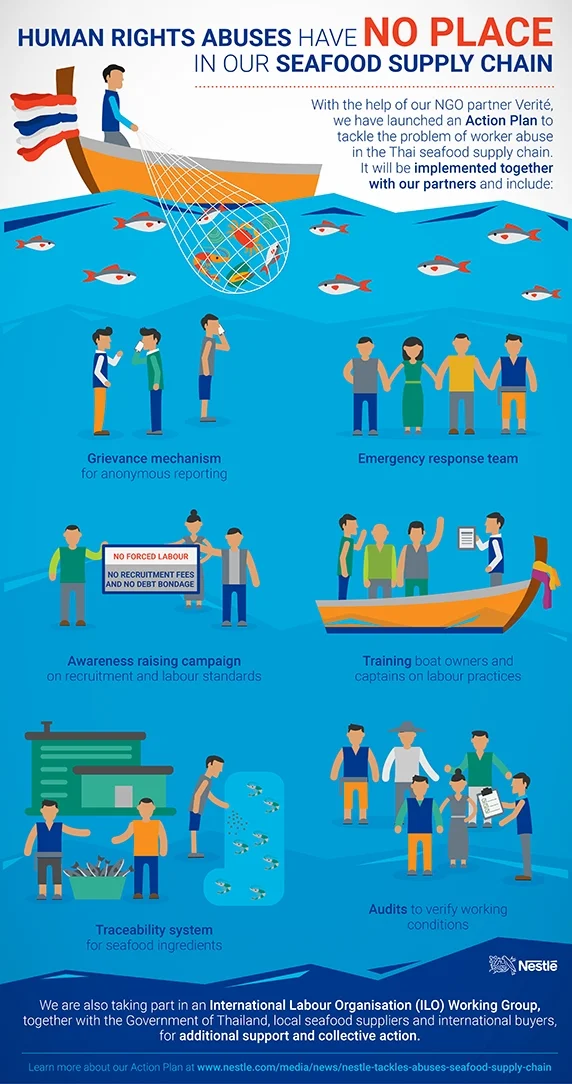
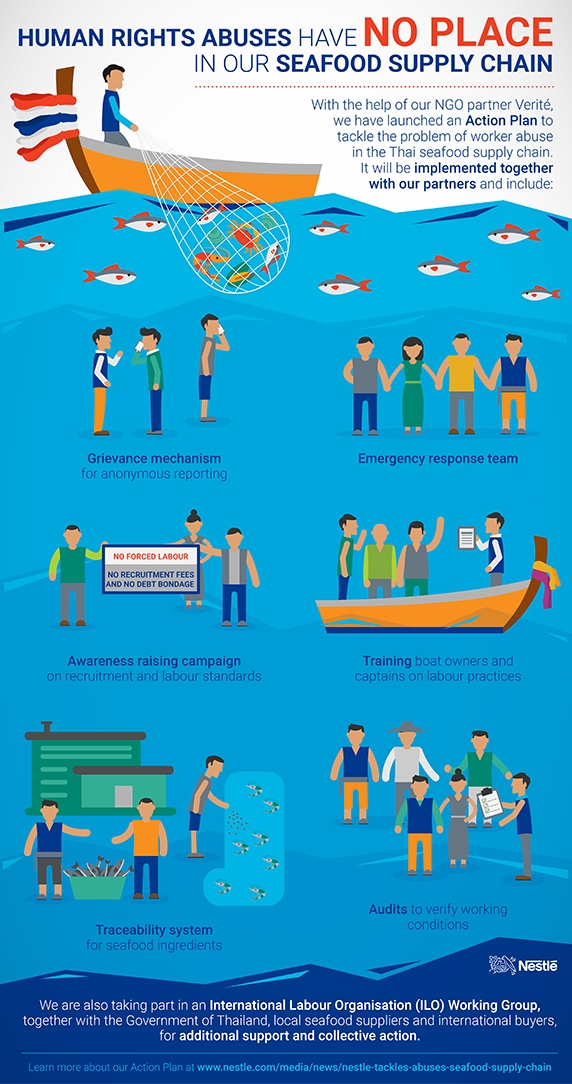
In an action plan posted on its website, Nestle reports on "pre-requisites achieved in 2014 - 2015" and identifies objectives for 2015 - 2016 summarized in this infographic:
Discussion Starters:
- Assess the infographic against principles in Chapter 10. Which are followed, and how could the graphic be improved?
- Do the same for the Verite report. Consider the format, design, content choices, organization, writing style, and so on.
Executives' "Email Habits"
 Business Insider has identified ways CEOs and other executives manage their email. On average, people send and receive 116 emails per day, but we can expect this group to handle many more.
Here are a few of the lessons learned from executives:
- LinkedIn CEO Jeff Weiner sends less email, believing he receives fewer in return: "After recognizing this dynamic, I decided to conduct an experiment where I wouldn't write an email unless absolutely necessary. End result: Materially fewer emails and a far more navigable inbox. I've tried to stick to the same rule ever since." Weiner is right, according to a 2013 study in London.
- Amazon CEO Jeff Bezos seems to scare his employees when we forwards a customer complaint with only a question mark in his message. According to Businessweek, "When Amazon employees get a Bezos question mark email, they react as though they've discovered a ticking bomb. They've typically got a few hours to solve whatever issue the CEO has flagged and prepare a thorough explanation for how it occurred, a response that will be reviewed by a succession of managers before the answer is presented to Bezos himself."
- Zuckerberg Media Founder and CEO Randi Zuckerberg has two rules: "1. She waits at least 20 minutes after she's woken up before she checks it, and 2. She holds off on sending emails when she knows she's feeling overly emotional."
On the somewhat random list, others don't start with "I," wake up at 3:45 a.m. (or 5:30 a.m.), don't check email right before bed, hire "email ninja" to help, or ask people to specify by when they need a response.
The CEO of Hootsuite sometimes "declares inbox bankruptcy" and deletes everything. He recommends doing this only occasionally and letting people know in a disclaimer. This is the second time I've heard this strategy in the past two weeks, and it scares me. I would never do it. What if I miss a great opportunity or an email from a student in crisis?
Discussion Starters:
- What are your biggest challenges in managing email? Which of these tips may help you?
- What's your view of "inbox bankruptcy"? Who can get away with this and under what circumstances?
Commentary on Google's New Logo
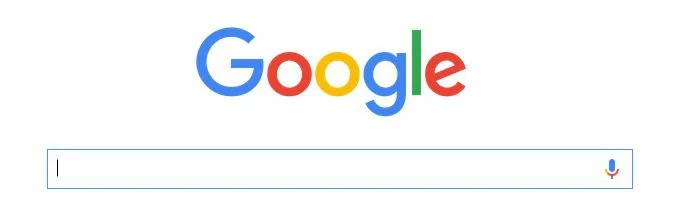
When Google changes its logo, everyone seems to weigh in. Some criticism has been harsh. The author of a New Yorker article, "Why You Hate Google's New Logo," writes, "Whenever a brand wants to freshen itself up, you start hearing talk about 'clean lines,' as if a few gorgeous, old-fashioned letters were keeping us in the Dark Ages."
The new logo is sleeker, looking as though it dropped a few pounds and got a tummy tuck.
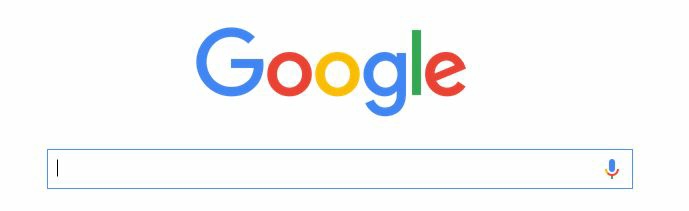
The author's disappointment continues:
The new logo retains the rainbow of colors but sheds the grownup curlicues: it now evokes children's refrigerator magnets, McDonald's French fries, Comic Sans. Google took something we trusted and filed off its dignity. Now, in its place, we have an insipid "G," an owl-eyed "oo," a schoolroom "g," a ho-hum "l," and a demented, showboating "e."
In a blog post, the company describes the logo as "simple, uncluttered, colorful, friendly" and touts its visibility on "even the tiniest screens."
Discussion Starters:
- What's your view of the new logo? Love it, hate it, indifferent to it?
- The New Yorker article describes more of Google's evolution. Do you agree with the author's perspective?

Auschwitz Museum Accused of Insensitivity
Management of the Auschwitz museum in Poland say they were just trying to cool off visitors from the heat, but people took offense to the sprinkler system they say reminded them of gas chambers used during the Holocaust. A visitor from Israel said, "As soon as I got off the bus I walked into the shower contraption. I was in shock. It was a punch to the gut."

A spokesperson for the museum told TIME, "Because of the extreme heat wave we have experienced in August in Poland, mist sprinklers which cool the air were placed near the entrance to the Museum. The mist sprinkles do not look like showers and the fake showers installed by Germans inside some of the gas chambers were not used to deliver gas into them."
He also said, "The safety and health of visitors are our priority during the period of extreme heat. Cooling air have been really helpful to visitors in this difficult situation."
Discussion Starters:
- What's your view of the situation? Should the museum have had the foresight to avoid this controversy? Should the management handle the situation differently now? Or are people just being overly sensitive?
- Can you think of a statement that would address visitors' concerns, yet explain management's perspective in a more balanced way?
Google Fights EU's Antitrust Allegations
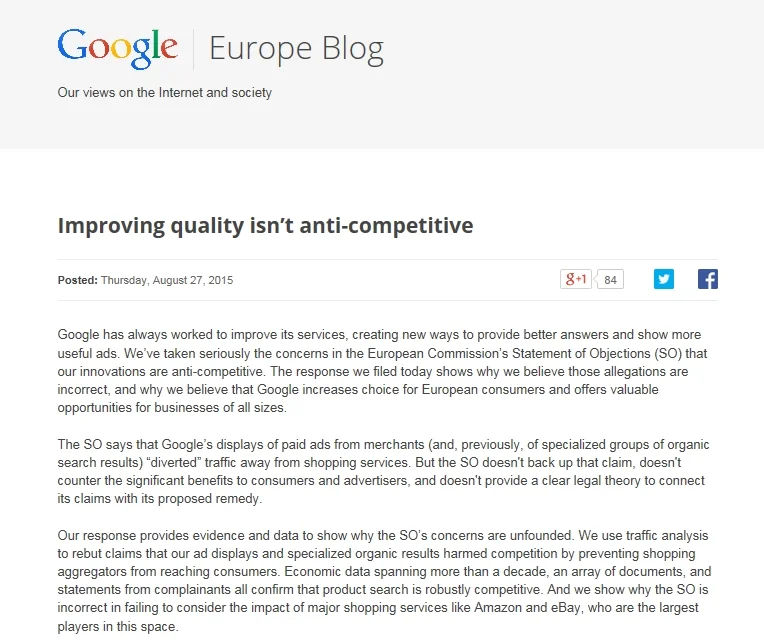
In a post on Google's "Europe Blog," Kent Walker, SVP & General Counsel, focuses on the company's innovation and quality. In a previous post, Google argued against the contention that search results favor the company. Now Google is trying to reframe the argument for us to see the value the company brings.
The first three paragraphs of the post, shown here, explain the European Commission's Statement of Objections (SO), including how Google ads shift users away from shopping on other websites.

The posts ends, "We believe that the SO's preliminary conclusions are wrong as a matter of fact, law, and economics. We look forward to discussing our response and supporting evidence with the Commission, in the interest of promoting user choice and open competition."
Discussion Starters:
- Assess the organization of Walker's post, particularly the paragraph organization. What principles of business communication are demonstrated by the article?
- Assess the video included in the blog post. What works well about the interviews and examples, and what could be improved? What value does the video add to the blog post?
Chicago Tribune Takes Heat for Katrina Op-Ed
An opinion piece in the Chicago Tribune titled, "In Chicago, wishing for a Hurricane Katrina," has offended many who survived the devastating storm. The author's point was that New Orleans is better off today than before Hurricane Katrina. Kristen McQueary gives examples of an overthrown government, new housing, and improved schools: "Hurricane Katrina gave a great American city a rebirth."
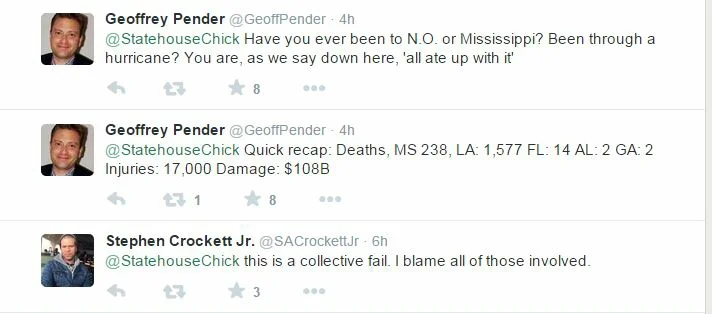
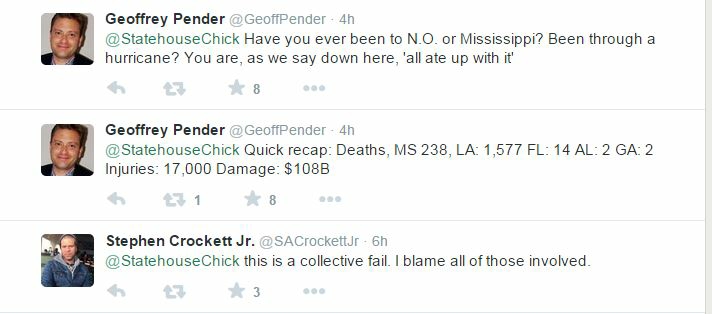
Still, people didn't appreciate the humor:
The newspaper has changed the article title to "Chicago, New Orleans, and rebirth" and removed some of the more offensive parts. But McQueary doesn't seem moved.

Discussion Starters:
- Read the original article. What's your reaction: does it offend you, do you see McQueary's point, or something else?
- McQueary's tweet seems to imply that, if would just read the piece, we would understand her perspective and why it's valid. How is her thinking flawed?
- If she were to write an apology, what could she say to rebuild trust in herself as a journalist and for the Chicago Tribune?
Controversy About CEO Pay Disclosure
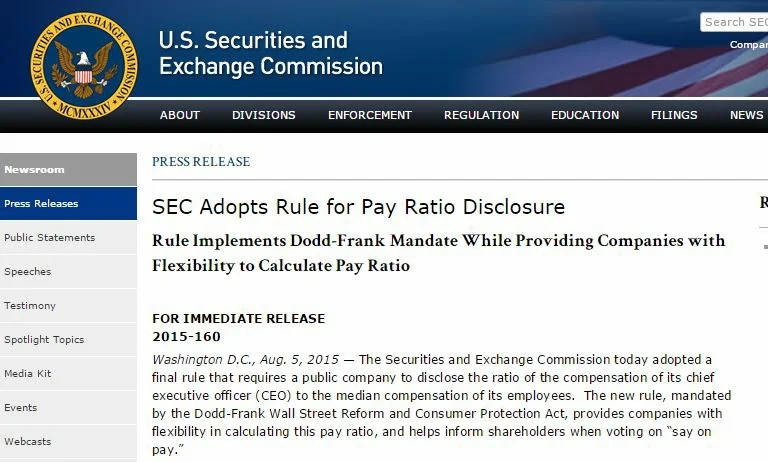
The U.S. Securities and Exchange Commission voted to require CEOs to disclose how their pay compares to that of employees in their organization. The requirement is part of the Dodd-Frank Act, passed in 2010 to prevent another financial crisis and to protect consumers.

The decision is one strategy for what people consider pay inequity between high- and low-earners in the United States, which has increased dramatically, as reported by BloombergBusiness:
"Average CEO pay at the 350 largest U.S. companies by revenue surged 997 percent from 1978 to 2014, while the compensation of non-supervisory employees rose 10.9 percent, according to the Economic Policy Institute, a research group that advocates for workers.
"While CEOs earned about 30 times what the typical employee did in 1978, corporate chiefs' pay had jumped to more than 300 times their employees' compensation as of 2014, the institute said."
Opponents say the ruling creates an expensive process and will serve only to embarrass CEOs. But the decision offers several ways for companies to calculate wages, excludes up to 5% of foreign workers, and requires reporting only every three years.
Discussion Starters:
- What's your view of the ruling? Is this the right move, and will it achieve its purpose?
- How do you assess the Economic Policy data shown above? What story do the numbers tell, and what may be missing?
- How could you display the Economic Policy Institute data visually? What chart type(s) would be most appropriate?
"Gawker Grows Up"
 After big executive news last week, Gawker CEO Nick Denton wrote a long message to staff. Gawker's executive editor and the editor-in-chief of Gawker.com resigned after an article, which revealed that a high-ranking magazine executive was texting a gay escort, was removed from the site after a board vote. Denton explained the decision in a post, including, "The point of this story was not in my view sufficient to offset the embarrassment to the subject and his family."
The executives' perspective, reflected partly in a message from Max Read (editor-in-chief) to Gawker writers, was about the faulty separation between editorial freedom and business (my paraphrase):
"On Friday a post was deleted from Gawker over the strenuous objections of Tommy and myself, as well as the entire staff of executive editors. That this post was deleted at all is an absolute surrender of Gawker's claim to 'radical transparency'; that non-editorial business executives were given a vote in the decision to remove it is an unacceptable and unprecedented breach of the editorial firewall, and turns Gawker's claim to be the world's largest independent media company into, essentially, a joke."
In his message to staff, CEO Denton discussed these issues and announced management team changes. Part of his post addressed controversy about the removed story:
"My professional life is committed to a free press and open discourse. While the reputation of our media brands remains a proper concern of the company, we do not and will not make story decisions based on advertiser feedback. Our credibility with both readers and advertisers depends on strong, incisive and independent journalism.
"I will put the company on the line rather than cave to legal pressure from the subject of a story, no matter how powerful. I will preserve Gawker Media's reputation for fighting press freedom cases that other media companies would settle.
"In regards to the recent story about a media executive blackmailed by an escort, I've explained extensively I ordered this misjudged exposé removed because it was not in line with the editorial standards I believe Gawker.com should maintain. And yes, it was also damaging to the brand of Gawker.com and the reputation of the company that shares the same name."
Denton ended his message, "Gawker grows up."
Discussion Starters:
- Explain the executives' and the CEO's positions on the removed story in your own words.
- How is this story relevant to business communicators?
- Assess Denton's message to staff. What works well, and what could be improved in the organization, tone, writing style, and so on?
Email Still Prevails
New evidence shows the continued prevalence of email in the workplace. Its demise has been predicted over time, particularly with the increase of social media. But three examples this week tell us otherwise:
- Eighty-one percent of respondents in a Social Journalism Study by Cision prefer email for story pitches. Thirty percent preferred the phone, and 24% preferred social media. (Respondents could choose multiple methods.)
- A video, "Email in Real Life," is making the Internet rounds. "A Conference Call in Real Life" was popular a couple of months ago, and this video follows the same corporate humor.
- Complaints about email persist. A TechCrunch article, "It's All Your Fault Email Is Broken," denies help from programs and instead blames us, the user. The author cites a GFI Software study, which found that 55% of people check email after 11 p.m., 59% check email on vacation, and 76% respond to emails within an hour. A New York Times article tells us to "Stop Checking Email So Often."
Discussion Starters:
- The GFI study asked people whether email is a blessing or a curse. Ninety-percent said it was a blessing. What do you think? How would you answer the other questions?
- How long will email persist in organizations? With so many other tools available, why has it been the default communication for so long?
Toshiba Resignations
Toshiba has announced the resignation of the chief executive and seven other board members in the wake of an accounting scandal. An independent report found that the company had overstated earnings by $1.2 billion over seven years.
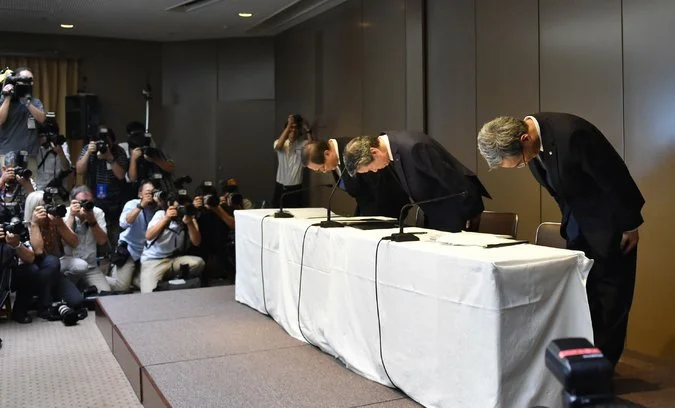
In a news conference, Chief Executive Hisao Tanaka said, "I apologize from my heart to all our stakeholders. To clarify management responsibility, I resign my posts as president and member of the board of directors as of today."
In the Japanese culture, it is traditional to bow deeply, particularly when admitting wrongdoing. Tanaka also said, "The responsibility lies in the management, including myself. As a response, I am stepping down from the post as the CEO and president."
The committee that issued the report found "systematic involvement, including by top management, with the goal of intentionally inflating the appearance of net profits." The committee also wrote, "Within Toshiba, there was a corporate culture in which one could not go against the wishes of superiors."
In a company statement, Toshiba promises changes as a result of the committee's findings, including disclosing the investigation report and correcting past financial statements.
Discussion Starters:
- What differences do you see in Toshiba and Toyota's news conferences (in 2010) compared to American companies' public hearings, such as GM's?
- How much confidence do you have in Toshiba after hearing this news? What can the company do to rebuild the brand?