

The Internet Mob
A New York Times article criticized reactions to Justine Sacco's AIDS tweet as harshly as the tweet itself.
Sacco, the terminated communications director of an Internet company, fired off a jokey tweet ("Going to Africa. Hope I don't get AIDS. Just kidding. I'm white!") and suffered harsh consequences. Response tweets threatened murder and rape: 
- "Someone please borrow me a Gun, I need to shoot -->"
- "Someone (HIV+) must rape this b**** and we'll see if her skin colour can protect her from AIDS."
Such tweets are painful to read and, of course, do nothing to teach a lesson, if that's the intent, of appropriate social media behavior.
The New York Times article explains the power of an Internet mob,
"...today's riots are different in that it is the powerful, specifically those with the largest followings online, that could help quell these eruptions, yet instead douse them with more anger and hate."
and continues:
"In the eyes of the mob, there was justice.
"Yet the people who threatened to rape and murder Ms. Sacco, who attacked her family and friends, aren't held in contempt or fired from their jobs."
As the social media cycle goes, people have come out in defense of Sacco: not to justify her tweet, which would be difficult, but to say that she's generally a nice person. Also, a friend relays a recent conversation in which Sacco said "people seemed to like the tweets that were just a little bit risqué or outrageous."
Discussion Starters:
- What's your view of The New York Times article? Should people who criticize so harshly also suffer consequences?
- This story reminds me of when Adam Smith was fired from his company after "berating" a customer service employee at Chick-fil-A. What similarities and differences do you see in these situations?

Dental Letter Appears to Deceive Families
 Dental insurance provider Healthplex sent a letter to 55,025 families that confused them into believing their children were required to get check-ups. Written to "Parent or Guardian" and quoting a state law, the letter sure sounds like a school directive, but it is not. Rather, the letter encouraging parents to bring their children in for dental exams-and to provide evidence to their school-is the insurance company's marketing approach.
 The confusion was discovered when school nurses started receiving signed notices verifying that children received check-ups.
In response to the controversy, Sharon Zelkind, senior vice president at Healthplex, said, "We try to do outreach to get as many children into the dentist as possible." She also admitted, "The wording of the letter was overzealous" and "Now we've learned we shouldn't do it that way."
Discussion Starters:
- What are the ethical considerations of the Healthplex letter? Evaluate the letter from the perspective of the company, dentists' offices, parents, children, and school officials.
- What, if anything, should Healthplex do in response to the controversy?
Glassdoor's Best Employer List
Glassdoor is now in the game of ranking companies to work for, using employee data to determine the top 25. The website asks employees to complete anonymous online surveys about career advancement, compensation, benefits, and work/life balance.
Bain tops the list of the "Employees' Choice Awards" as the best company to work for in 2014, followed by Twitter, LinkedIn, Eastman Chemical, and Facebook. It's interesting that three of the top 5 are social media sites, and Twitter's ranking can only help the new stock. Facebook, however, dropped from first place last year to fifth.
On the rest of the list, we see some old favorites from Fortune's Best Companies to Work For, such as Wegman's and Google, which are both in the Fortune top five.
But the companies don't match entirely. Three of Fortune's top five-SAS, CHG Healthcare Services, and The Boston Consulting Group-are missing entirely from Glassdoor's top 50.
Discussion Starters:
- What could explain the difference in Fortune's and Glassdoor's lists?
- Why do you think Facebook dropped from 1 to 5?
- What surprises you about the Glassdoor company list? Do you see companies that you wouldn't expect on the list, and which are missing?
Gap Responds Swiftly to Racist Comments
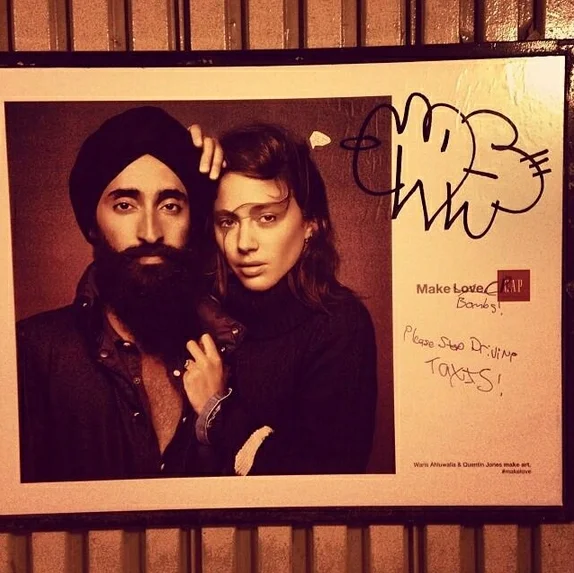
When Gap heard one of its ads was graffitied with racist comments, the company responded quickly.
Gap created an ad featuring Waris Ahluwalia, an Indian-American designer and actor, and Quentin Jones, a model and filmmaker. Much of the reaction was positive, but not everyone was happy with the portrayal. This version of the ad made the rounds on Twitter:

When Gap learned of the graffitied ad, the company asked for more information, which is appropriate before deciding how to respond. Soon after, Gap changed its Twitter banner to the original image:
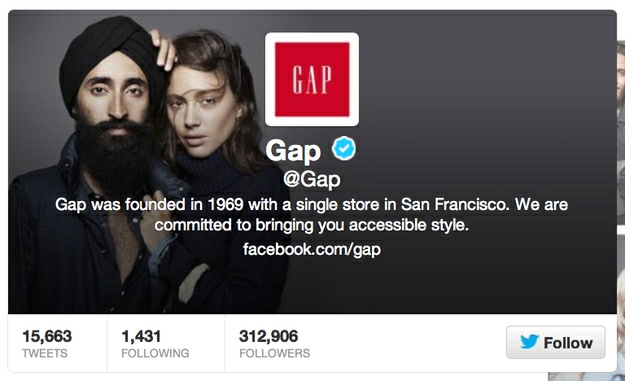
Support for Gap's response traveled throughout Twitter, with people thanking Gap and promising to shop the store for the holidays.
Still, Gap's other ads as part of the "Make Love" campaign are getting mixed reviews. An ad featuring two men was defaced with homophobic comments. That one was ordered removed by the mayor of Chicago.
Discussion Starters:
- What's your assessment of Gap's response? What worked well?
- I don't see any Gap comments or tweets about the situation. Should the company have done anything else?
Walmart Criticized for Food Drive for Employees
Walmart Foundation has initiated a campaign against hunger, but an internal effort to help Walmart associates is getting more attention. In this video produced by Walmart Corporate, an executive explains the $2 billion effort, which includes a food drive.
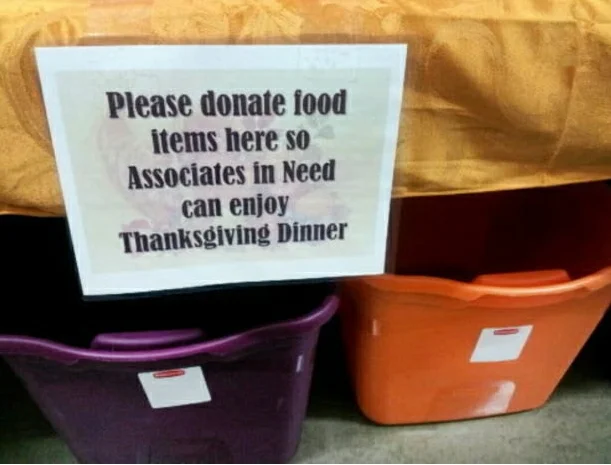
The sign, below, taped to a table inside an employee breakroom at Walmart store, isn't getting such a welcome response. A Walmart employee in Canton, Ohio, photographed the sign as an indication that the company pays insufficient wages.
Spokesperson Kory Lundberg told Yahoo Finance,
"That store has set up a bin for associates to help out other associates. These are people that have had some unforeseen hardship in the last year. Maybe their spouse lost a job, or they experienced the death of a loved one, or a natural disaster impacted their home-things you just can't plan for. It's a chance for associates to look out for and help each other."
Discussion Starters:
- What's your reaction to the food drive for employees? Do you buy the spokesperson's explanation, does this prove that Walmart doesn't pay enough, or something else?
- What important messages do you hear in the Walmart video? How effective is the video in convincing you that Walmart has a serious commitment to ending hunger?
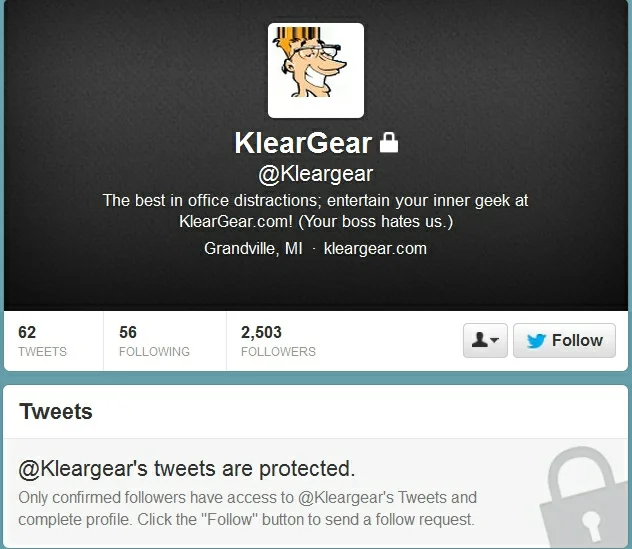
KlearGear Charges Customer $3,500 for a Bad Online Review
A customer who didn't receive what she ordered from KlearGear wrote a negative review on a complaint site and was charged $3,500. KlearGear sells desk toys such as an LED shoelaces and something called a Splat Stan Coaster-a figure squashed by a coffee mug (not on my Christmas wish list).
Three years after the customer posted on the site RipoffReport, KlearGear contacted her husband and requested $3,500, based on a clause in the company's terms of service (which apparently wasn't included at the time):
Non-Disparagement Clause
In an effort to ensure fair and honest public feedback, and to prevent the publishing of libelous content in any form, your acceptance of this sales contract prohibits you from taking any action that negatively impacts KlearGear.com, its reputation, products, services, management or employees.
Should you violate this clause, as determined by KlearGear.com in its sole discretion, you will be provided a seventy-two (72) hour opportunity to retract the content in question. If the content remains, in whole or in part, you will immediately be billed $3,500.00 USD for legal fees and court costs until such complete costs are determined in litigation. Should these charges remain unpaid for 30 calendar days from the billing date, your unpaid invoice will be forwarded to our third party collection firm and will be reported to consumer credit reporting agencies until paid.
The clause, of course, is ridiculous. Trying to control social media conversation is a fool's game and can only hurt a company in the long-run. KlearGear made the situation worse when it closed its Twitter and Facebook accounts.

Discussion Starters:
- What's your view of KlearGear's "Non-Disparagement Clause"? One writer calls it "contemptible, unethical, and un-American." Do those adjectives sum it up for you-or are others more appropriate?
- How would you advise KlearGear to handle the social media situation?
- Imagine that KlearGear reopened its Facebook page. Write an apology post on behalf of the company.
Lululemon Offends Again
After months of controversy over Lululemon's declining yoga-wear quality, the company is in the news for a new issue: mocking a shelter's fundraising strategy.
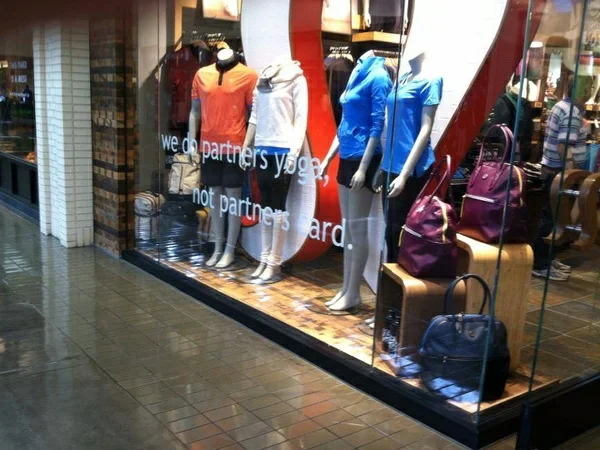
Reflecting what a Dallas website calls an "oddly aggressive stance against Dallas charity," Lululemon posted a sign on a local store window that reads, "We do partners yoga, not partners card." "Partners Card" refers to the work of The Family Place, a Dallas-based not-for-profit organization that provides housing, counseling, and other resources for people in abusive situations.
The Family Place website describes the Partners Card:
"Partners Card is the signature fundraiser for The Family Place, Dallas' largest domestic violence agency. 100% of your Partners Card purchase goes directly to supporting survivors of family violence."
People who buy a $70 Partners Card through the organization receive a 20% discount at hundreds of local stores-a list that doesn't include Lululemon.
Responding to the criticism, Lululemon posted this message on its Facebook page:
"The intention behind the window decal was to share our love for yoga, not to offend our community. Although we choose not to participate in Partner's Card, we choose to give back in a different way. We are working in collaboration with Family Place to offer the gift of yoga, and what we can create together."
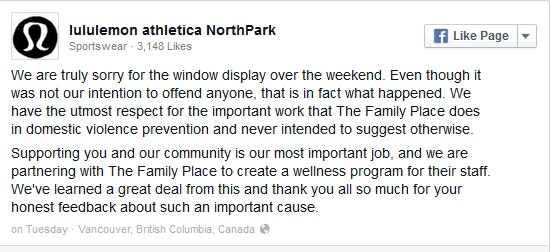
In another post-this one from the corporate headquarters in Canada-the company seemed to be taking action:
In response to an inquiry from Dallas Culture Map, The Family Place expressed appreciation to its supporters:
"Every Partners Card we sell at the Family Place provides a night of safety and shelter for victims of family violence. We understand that not every retailer can give the 20% discount, but we are thankful for the hundreds who do and for the thousands of donors who buy a card. We look forward to working out a way Lululemon can join our important mission to end violence in the homes of Dallas County."
Discussion Starters:
- What were Lululemon marketers thinking when they put up this display? What do you think the store was expecting, and how was management misguided?
- How do you assess Lululemon's apology-both the store's post and the corporate headquarter's approach of working with Lululemon?
- In the headquarter's post, the company says it's creating a wellness program for staff. Is this an appropriate solution? Why or why not?
Facebook Finally Admits Decline in Young Teens
 After denying reports of young teens forgoing Facebook, company officials have finally admitted the decline. On a third-quarter earnings call, CFO David Ebersman told analysts,
"Our best analysis on youth engagement in the US reveals that usage of Facebook among US teens overall was stable from Q2 to Q3, but we did see a decrease in daily users, specifically among younger teens."
This drop seemed to shake investors' confidence. The stock dropped 2% on the news.
According to the CNET article, Ebersman also admitted that it's difficult to determine teen activity becauses this group often fabricates dates of birth.
Earlier reports claimed that Facebook isn't cool now that mom and dad (and grandma) have accounts. Some statistics show that young teens are flocking to sites such as Twitter and Tumblr instead.
Discussion Starters:
- How do you think Facebook made the decision to stop denying reports? What do you think were the deciding points?
- What's your view of Facebook's claim about fabricated birth dates? What are the responsibilities of users, the company, parents, and perhaps other groups?
Ryanair CEO "Ruffles Feathers" (Again)
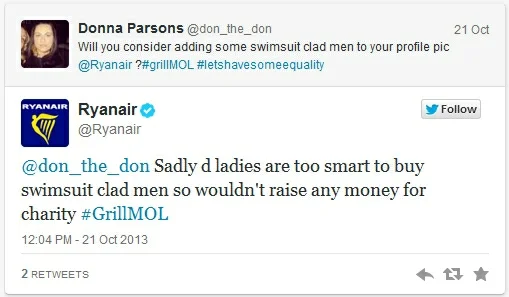
No stranger to controversy, Ryanair CEO Michael O'Leary angered people during a recent Twitter chat. You may recall that O'Leary called a customer "stupid" and other insults when she complained about being charged €300 for not printing boarding passes ahead of time. Ryanair is a discount airline and charges fees for extra services.
Now, a PR Daily article says O'Leary invited criticism as part of a "PR stunt." Although some tweets were deleted, Skift captured a few choice examples:


Discussion Starters:
- What do you think of Michael O'Leary's approach on Twitter?
- Take a look at the Google Image search of Michael O'Leary. What's your reaction? Does he overdo the stunts, is he being who he wants to be, or something else?
- Do you find his tweets and other communications offensive or not?
Users Aren't Happy About Yahoo Mail Changes
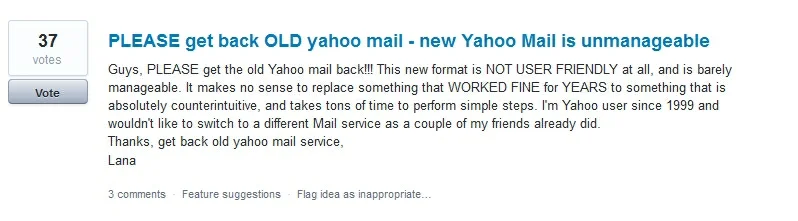
Trying to be more Gmail-like, Yahoo has changed how its mail system works, and people don't like it. Users are organizing online by signing a petition, participating in a Facebook group, and posting to a Yahoo Mail forum with comments such as this:

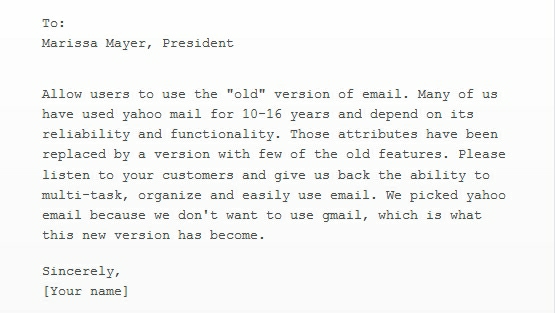
The petition asks Marissa Mayer to revert back to the old mail:
People are complaining most about the lack of tabs and ability to multitask:
"We are asking Yahoo to restore the old version - with tabs, with the ability to edit an email and switch to a folder - to multi-task like we used to be able to do. If they are unable to do so, we want them to restore these BUSINESS-CRITICAL functions to Yahoo Mail.
"Most of us picked Yahoo because of its interface. We don't like gmail! Please let us go back!"
On the Yahoo Mail forum, the company explains the new features this way:
"We have refreshed your inbox with more room for messages and added exciting new features you will love. These include 1TB of free mail storage, Conversations, Stunning new Themes, Attachments preview and much more. Please note that while there is no way to revert to the previous version of Yahoo Mail, you can learn more about the new features.
"We want to hear what you think about Yahoo Mail. Help us make it better for you. The more specific your feedback, the more useful for us. While we can't respond to every suggestion, we do take your suggestions seriously and review them regularly."
Discussion Starters:
- What features do you most appreciate in your current email program? Compare those to Yahoo Mail's functionality.
- How could Yahoo have communicated the changes differently?
- How should Yahoo address these complaints now?
Study Shows Importance of Employees' Role in Social Media
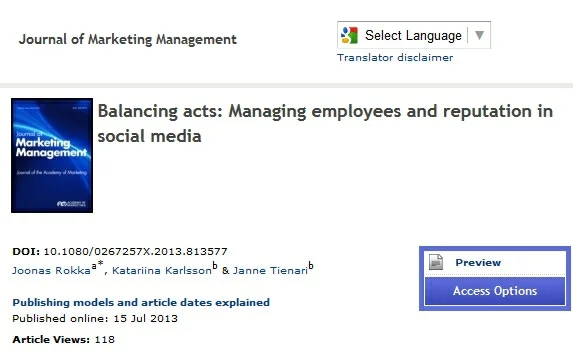
 A recent study in the Journal of Marketing Management has an important message for companies: manage employees for them to represent you well on social media. Education News summarizes the study results:
"...companies need to focus more on managing employees as active reputation builders and brand ambassadors in social media instead of conceiving them only as possible reputation risks."
According to lead author Joonas Rokka, "employees have a crucial role as active meaning makers and reputation builders in various social-media networks that include customers, colleagues, and friends." Rokka also emphasized companies' role in employees' well-being:
"When companies trust and treat employees fairly, and employ good day-to-day management practices, employees will do good for the company in return. For instance, by sharing their experiences of the company and its products in social media."
The article is titled "Balancing Acts: Managing Employees and Reputation in Social Media" in recognition of the paradoxes and contradictions in managing employees as well as a company's reputation. In other words, companies won't find easy approaches or perfect solutions.
Discussion Starters:
- How, if at all, has your own experience working at companies affected your online posts about them?
- What would inspire you to talk positively about your employer on social media sites?
Poor Spelling and Grammar Top List of Dislikes of Brands on Social Media
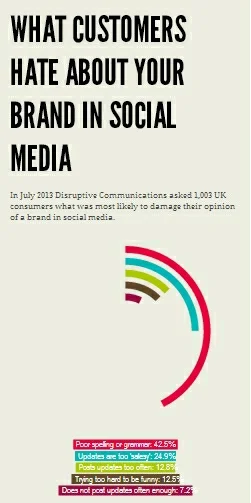
Disruptive Communications asked 1,000 UK consumers what they find most likely to damage a brand on social media. The winning response was "poor spelling or grammar."
 Perhaps this is an inevitable trade-off of brands becoming more personal on social media. With a natural, conversational voice may come some sloppiness. But, at least according to this survey, brands shouldn't become too sloppy, or they risk their brand's reputation.
Surprisingly (or maybe not), respondents between 18 and 24 weren't as concerned about grammar and spelling. Instead, their biggest complaint was "does not post updates often enough," at the bottom of the list for other age groups. Maybe this is because the younger age group checks brands' posts more frequently?
Brands have a tough balance to strike: 13% of respondents said they "post updates too often." A similar percentage said brands tried "too hard to be funny," and "salesy" updates were the second biggest frustration of respondents, particularly for those between 45 and 54 years of age. Clearly, brands can't overdo it on social media, either.
Discussion Starters:
- How would you have responded to the survey? To what extent do you agree with the responses?
- This is a UK survey. Do you think the results might have been different in the US?
- Follow a brand on Twitter and Facebook for a few days. How do its posts match these survey results?
H&M Didn't Learn the Headdress Lesson from Victoria's Secret
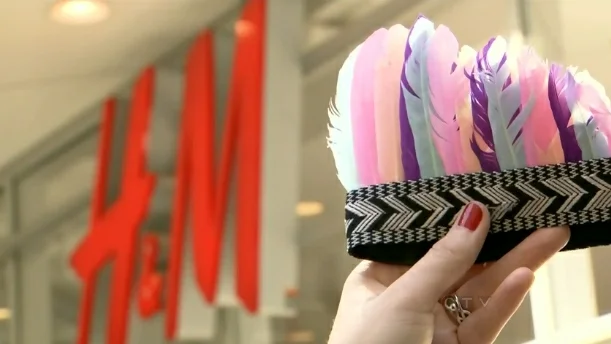
How many more retailers will make this mistake? H&M Canadian customers were offended by hair accessories that imitated Native American headdresses with fake feathers.
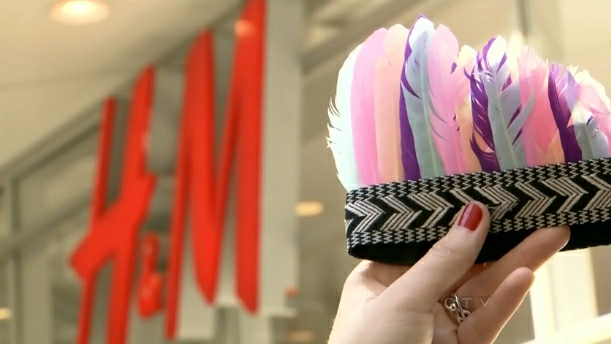
Kim Wheeler, an Ojibwa-Mohawk woman, complained to H&M after seeing the headdress in a Vancouver, B.C., store. She told CTV,
"They're worn by chiefs. They're a sign of honour and respect and leadership. They're not a cute accessory to be worn in a nightclub. It's not something you take lightly and throw on your head and wear to the bar or a concert."
H&M issued this statement:
"We always want to listen to our customers and their feedback, our intention was never to offend anyone or to be insensitive. We chose to remove the headdress inspired accessory from our shelves. This was a limited edition item that was sold in 5 of the 62 locations we operate in Canada."
CTV reports that H&M pulled the headdress after hearing three complaints; however, they have not commented on whether they are removing the accessory from stores in other countries.
Victoria's Secret made a similar mistake recently when the company outfitted a model in Native American-style headdress, leopard-print underwear, turquoise jewelry, and high heels.
Discussion Starters:
- What's your view of the situation? Did H&M do the right thing, did the customer overreact, or something else?
- Compare this situation to that of Victoria's Secret. What are the similarities and differences in the use of the headdress and how the companies responded?
Food Truck Employee Gets Fired for a Tweet
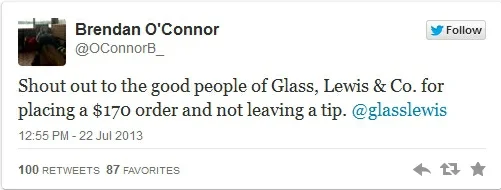
Unhappy about not receiving a tip, a food truck employee let loose on Twitter:
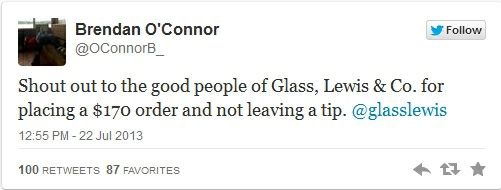
Employees at Glass Lewis & Company, a consultancy specializing in corporate governance, ordered $170 worth of grilled cheese sandwiches and milkshakes but didn't leave a tip. Brendan O'Connor, the Milk Truck employee, chronicled the incident on his blog:
"I was making sandwiches, another worker took the order and a third made the milkshakes and watched the grills. A line grew while we worked, and we had to tell other customers that their lunch orders would take longer than usual. They paid; I asked my co-worker who was dealing with the money how much of a tip they'd left. They had left actually no tip at all. (They had paid with a card so we checked the cash tips to see if there'd been a bump. There hadn't.)
"I asked some of the group as they were picking up their orders if they had intended to not tip. They hemmed and hawed and walked away.
"Well. I could have not said anything. I could have made it a subtweet. I probably should have made it a subtweet. But I didn't, because of some misguided notions about having 'the courage of your convictions,' or whatever."
O'Connor explains that he was fired by the owner after someone from Glass Lewis complained about being "tip-shamed." O'Connor's argument is that his employer uses social media feedback to monitor employees' performance, so why shouldn't he use social media to "advocate for a more civil exchange between worker and consumer?"
Well, no companies want their customers embarrassed publicly, and many have policies in place to this effect. Milk Truck managed to restore its credibility with an apology tweet, accepted by Glass Lewis:

But Twitter is still abuzz with the ethics of the situation. Did Milk Truck do the right thing by terminating O'Connor? Was O'Connor's tweet justified? Does Glass Lewis owe an apology? What's your view?
Why Employers Shouldn't Care About Facebook Photos of Drinking
 HR and hiring managers are passing up good candidates who post or are tagged in photos of drinking, according to a new study. The study by Stoughton, Thompson, and Meade, "Big Five Personality Traits Reflected in Job Applicants' Social Media Postings," was published in Cyberpsychology, Behavior and Social Networking.
Explaining the rationale for searching for candidates online, co-author Dr. Lori Foster Thompson said, "Companies often scan a job applicant's Facebook profile to see whether there is evidence of drug or alcohol use, believing that such behavior means the applicant is not 'conscientious,' or responsible and self-disciplined." But posting such content is not correlated with conscientiousness. Further, those who post rated highly on extrovert measures, which employers may value.
However, the study warns companies to avoid people who "bad-mouth" or post negative comments about an employer online. People who rated highly on agreeableness and conscientiousness were very unlikely to post such content.
This advice is consistent with a recent Wall Street Journal article, which reported that 44% of employers would not hire someone found to be "badmouthing employers on social media." The author of this article also suggested, "While some employers may be willing to overlook the occasional rowdy photo or off-color tweet, it goes without saying that any post linking a job candidate to illicit activity such as drinking and driving or illegal drugs, or to racist or sexist behavior, won't go over well."
A recent Harris Interactive/Career Builder study showed that 43% of employers have rejected candidates based on their social media posts, and 48% of them did so because "There was info about candidate drinking or using drugs." These employers may want to reconsider their practices.
Discussion Starters:
- What's your view of the study findings? Do you agree with the two main conclusions: that Facebook posts about drinking don't indicate poor job qualifications but that negative posts about employers might be a good reason to disqualify a candidate?
- How, if at all, does this study influence what you will post or how you will handle posts on your Facebook page?
Tactile Brazilians and Other French Stereotypes
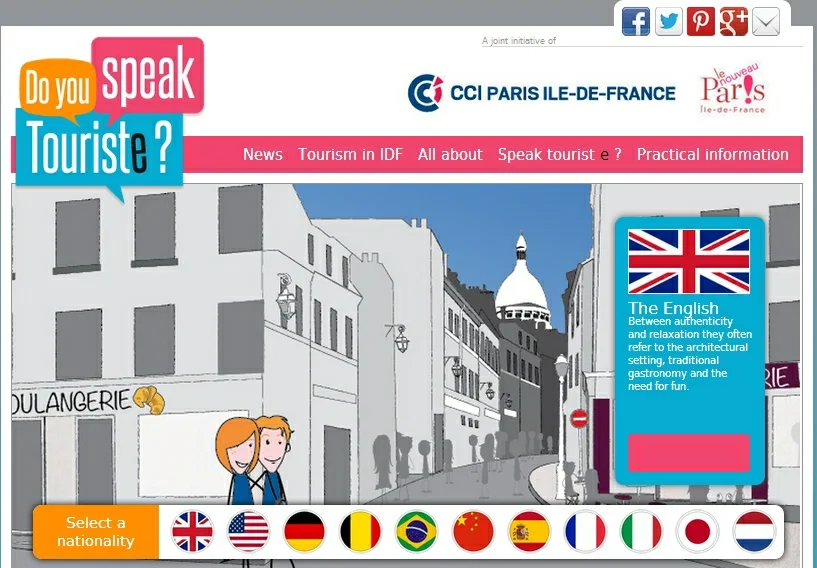
The French tourism board is trying to help retailers, restaurateurs, hoteliers, and taxi drivers be more welcoming to visitors. But the "Do You Speak Touriste?" website provides stereotypes that some may find offensive.
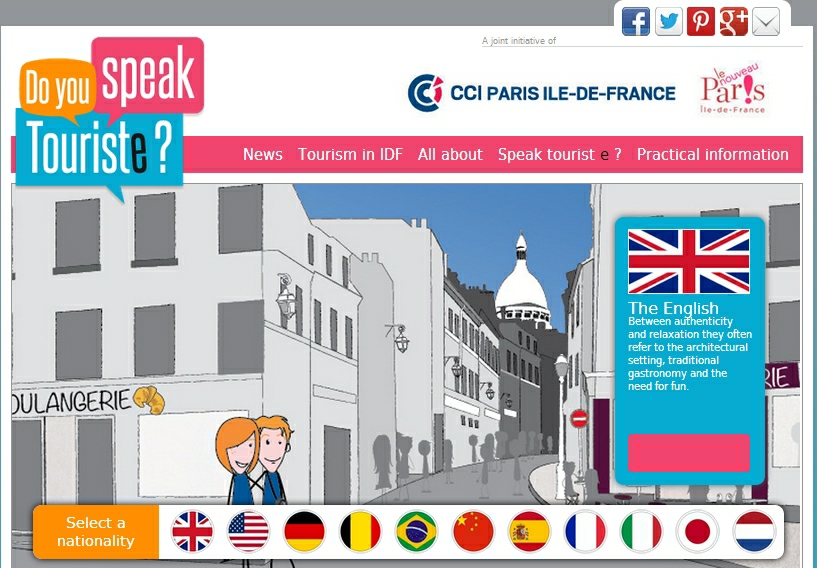
According to The Telegraph, the tourism guide (downloadable in French) offers these helpful hints for French business owners (note that the punctuation is European):
The guide informs Parisians that the British "like to be called by their first name", spend an average of 145 euros (£124) per person per day – more than their American counterparts – and eat breakfast from 7.30-8.30am, lunch at 12-1pm and supper at 6-7pm.
They seek a mixture of "authenticity and relaxedness", expect smiling and friendly staff" and appreciate "architecture, traditional gastronomy and the need for a playful (approach to culture)."
The Japanese are the biggest spenders – 186 euros per tourist per day – but need constant reassurance and are "discreet but demanding". "They never complain straight away when they are not satisfied but will criticise once back in their own country."
The Chinese have an "idealised and romantic" view of Paris, and come "above all for luxury shopping."
Brazilians, meanwhile are "easily tactile", expect a "totally poetic experience" and spend more than the British, around 166 euros per day.
Parisians are told that cash-strapped Spaniards are on the "lookout for freebies" and expect you to speak their language, while Italians are delighted if you are nice to their children, like "going on excursions" but are "impatient tourists".
Perhaps the trickiest visitors of all, judging by the guide, are the French themselves, described as "particularly demanding" guests who above all "don't want to be considered as tourists".
Jeanerre Blat, general director of the Paris area tourist board, explained the board's philosophy:
"The aim is to fight against the poor reputation for welcome in Paris and the Paris area. You don't welcome a Japanese tourist the same way as an Italian one. There are codes to take into account, so you have to adapt."
Discussion Starters:
- What's the value of stereotyping? In other words, what's the value of this guidance for French business owners?
- Looking at the examples of nationalities above, are you more offended by some than by others? Which and why? Or do you find none offensive?
- Could the tourism board have met its objectives in another way? If so, how?
- Before The Telegraph paragraph, I wrote that the punctuation is European. Revise it to meet American standards.
George Takei's Ghost Writer Fesses Up
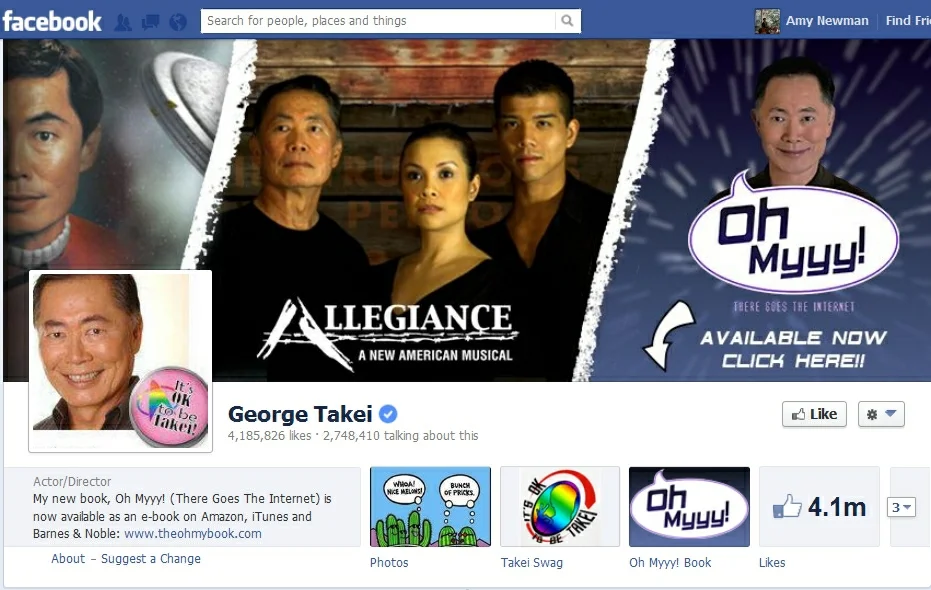
George Takei, 1960s Star Trek cast member, is highly popular on Facebook. But his posts have been written, at least in part, by someone paid $10 per joke. With 4.1 million likes, Takei's Facebook page is a mix of cartoons, jokes, and other lighthearted posts.

Rick Polito came clean in an email to Jim Romenesko's blog but seemed to have regretted the decision after a few days' rest:
"Polito tells Romenesko readers today: 'I wrote an apology to George and Brad and their guy said he'd pass it on. I just said that I'd been looking for any mention of my book I could get and that I hadn't meant to expose anything.
"He adds: 'I don't update his page. I've had no direct contact with George. I've sent him some memes, as have other comedian types and I was happy for the exposure.'"
In an email to Wired, Takei doesn't share his fans' concern:
"What is this hoo-ha about my FB posts? I have Brad, my husband, to help me and interns to assist. What is important is the reliability of my posts being there to greet my fans with a smile or a giggle every morning. That's how we keep on growing."
Discussion Starters:
- Compare this situation to that of Mark Davidson, whose tweet writer exposed him on his own Twitter feed. What are the similarities and differences?
- How do you assess this situation? Under what circumstances is it acceptable for someone to write social media posts on another's behalf?

Study Shows Value of Internal Social Networks
A Kellogg School study found positive effects of an internal social networking system at a major credit card company.
 As more companies implement enterprise social media tools, Paul Leonardi, a professor of communication at Northwestern University, wanted to evaluate their usefulness. The credit card company was installing "A-Life," and Leonardi compared two groups, marketing and operations, to see the impact. The marketing group was given access to the system, while the operations group was not. Before the six-month period, employees were asked who within the organization knew what-an important question for knowledge management and for getting work done.
After using the site rather than email, the marketing group reported a 31% improvement to find information and a 71% improvement in finding people who knew those with needed information.
Perhaps most interesting is that younger employees were the most skeptical of the system, as a Kellogg article explains:
"...he found that use differed by age: younger employees across the company were generally more skeptical of the tool. 'So many young people use social media tools'-like Facebook and Twitter-' their lives daily,' and those tools are really for social, non-work-related communication, says Leonardi. This, he believes, made it harder for younger employees to embrace social technology in the workplace. 'They would say, "Oh, I don't want to be posting things my boss would see." … On the other hand, the senior employees didn't have that same concern. For them, the technology was another mode for communicating about work-related matters.'"
Discussion Starters:
- What, if any, social networking tools have you used at work? What do you see as the benefits and potential pitfalls?
- Are you surprised at the results about younger employees? Why or why not?
General's Email About Reading
Marine General James Mattis's email response to a colleague who was "too busy to read" offers good lessons for business leaders-and writers. The 2004 email went viral and was recently published on a blog and picked up by Business Insider.
Here is the email:
The problem with being too busy to read is that you learn by experience (or by your men's experience), i.e. the hard way. By reading, you learn through others' experiences, generally a better way to do business, especially in our line of work where the consequences of incompetence are so final for young men.
Thanks to my reading, I have never been caught flat-footed by any situation, never at a loss for how any problem has been addressed (successfully or unsuccessfully) before. It doesn't give me all the answers, but it lights what is often a dark path ahead."
With [Task Force] 58, I had w/ me Slim's book, books about the Russian and British experiences in [Afghanistan], and a couple others. Going into Iraq, "The Siege" (about the Brits' defeat at Al Kut in WW I) was req'd reading for field grade officers. I also had Slim's book; reviewed T.E. Lawrence's "Seven Pillars of Wisdom"; a good book about the life of Gertrude Bell (the Brit archaeologist who virtually founded the modern Iraq state in the aftermath of WW I and the fall of the Ottoman empire); and "From Beirut to Jerusalem". I also went deeply into Liddell Hart's book on Sherman, and Fuller's book on Alexander the Great got a lot of my attention (although I never imagined that my HQ would end up only 500 meters from where he lay in state in Babylon).
Ultimately, a real understanding of history means that we face NOTHING new under the sun.
For all the "4th Generation of War" intellectuals running around today saying that the nature of war has fundamentally changed, the tactics are wholly new, etc, I must respectfully say … "Not really": Alex the Great would not be in the least bit perplexed by the enemy that we face right now in Iraq, and our leaders going into this fight do their troops a disservice by not studying (studying, vice just reading) the men who have gone before us.
We have been fighting on this planet for 5000 years and we should take advantage of their experience. "Winging it" and filling body bags as we sort out what works reminds us of the moral dictates and the cost of incompetence in our profession. As commanders and staff officers, we are coaches and sentries for our units: how can we coach anything if we don't know a hell of a lot more than just the [Tactics, Techniques, and Procedures]? What happens when you're on a dynamic battlefield and things are changing faster than higher [Headquarters] can stay abreast? Do you not adapt because you cannot conceptualize faster than the enemy's adaptation? (Darwin has a pretty good theory about the outcome for those who cannot adapt to changing circumstance - in the information age things can change rather abruptly and at warp speed, especially the moral high ground which our regimented thinkers cede far too quickly in our recent fights.) And how can you be a sentinel and not have your unit caught flat-footed if you don't know what the warning signs are - that your unit's preps are not sufficient for the specifics of a tasking that you have not anticipated?
Perhaps if you are in support functions waiting on the warfighters to spell out the specifics of what you are to do, you can avoid the consequences of not reading. Those who must adapt to overcoming an independent enemy's will are not allowed that luxury.
This is not new to the USMC approach to warfighting - Going into Kuwait 12 years ago, I read (and reread) Rommel's Papers (remember "Kampstaffel"?), Montgomery's book ("Eyes Officers"…), "Grant Takes Command" (need for commanders to get along, "commanders' relationships" being more important than "command relationships"), and some others.
As a result, the enemy has paid when I had the opportunity to go against them, and I believe that many of my young guys lived because I didn't waste their lives because I didn't have the vision in my mind of how to destroy the enemy at least cost to our guys and to the innocents on the battlefields.
Hope this answers your question…. I will cc my ADC in the event he can add to this. He is the only officer I know who has read more than I.
We know that General Mattis is an avid reader because he writes well. Reading is essential for good writing.
Discussion Starters:
- What do you read? In what ways does it help you?
- Do you agree with my assertion that reading is essential to good writing? Why or why not?
Ethical Social Media Marketing After the Boston Bombings
An article by Augie Ray, director of social media for a Fortune 100 company, describes the ethics of social media marketing, and gives us several interesting examples from the Boston Marathon tragedy. In contrast to these companies that perhaps crossed an ethical line, recall El Pelon Taqueria, the restaurant that offered help and asked for nothing in return.
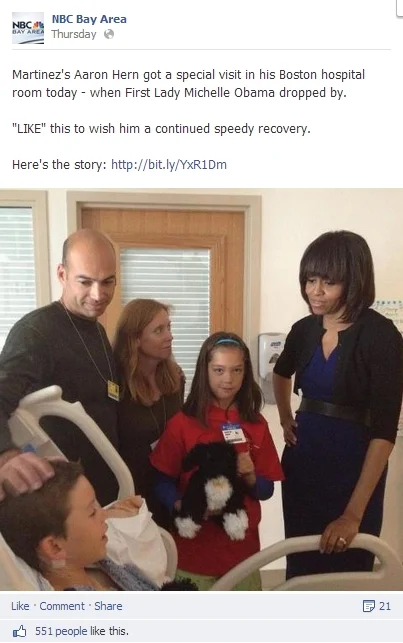
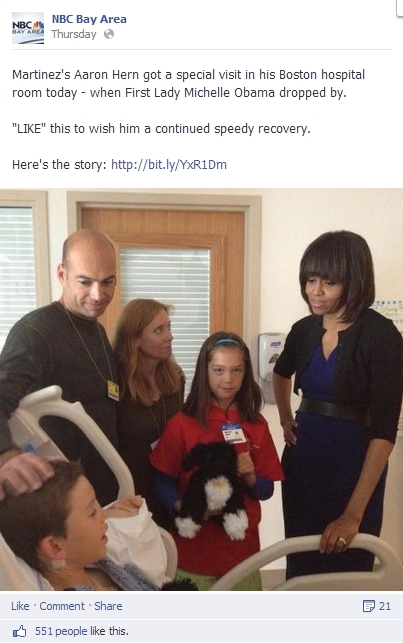
Calling it a "desperate attempt to trade on people's feelings," Ray described an NBC Facebook picture of a boy in a hospital bed. The post asks people to "'LIKE' this to wish him a continued speedy recovery." Ray points out that "liking" a post does nothing to help the boy recover.
In another example, Ray criticizes Ford for muddying a message with its products. According to Ray, "Ford's use of brand imagery not only reduced the sincerity of the message but demonstrated questionable ethics." For comparison, Ray presents Ford's actual post, at right, next to one without branding, at left. The difference is fairly obvious.

Individuals made mistakes as the tragedy was unfolding, too. Author Guy Kawasaki was criticized for continuing to post promotional tweets, as others were suspending theirs. Clearly, he didn't agree with the criticism. He responded, "Loving how people with less [sic] than 1,500 followers are telling me how to tweet."
Discussion Starters:
- How do you assess these three situations? Do you agree with the criticism of each?
- Augie Ray offers a sound suggestion for modifying the Ford post. Can you think of something similar for the NBC post? What might make this one more acceptable (read: more compassionate)?