
Facebook's Fake News
Facebook has been displaying news according to users' preferences, which could override news that conflicts with their point of view. During the election, people saw fake stories that may have affected their vote. One frequent fake news writer bragged, "I think Trump is in the White House because of me. His followers don't fact-check anything - they'll post everything, believe anything."
BuzzFeed analyzed data from Facebook news stories and found that the top 20 fake election news stories outpaced shares, comments, and reaction to the top 20 legitimate election news stories. Although Mark Zuckerberg at first denied any connection between FB's fake stories and the election outcome, he later posted a plan for the social networking site to address fake news.
Zuckerberg posted, "[W]e don't want any hoaxes on Facebook." Still, he said, it's tough to distinguish fake news, and it's quite uncommon:
"Of all the content on Facebook, more than 99% of what people see is authentic. Only a very small amount is fake news and hoaxes. The hoaxes that do exist are not limited to one partisan view, or even to politics. Overall, this makes it extremely unlikely hoaxes changed the outcome of this election in one direction or the other."
This is a clever strategy, but the top 20 fake news stories got more than 8,711,000 shares, reactions, and comments, so it's not an insignificant number.
Melissa Zimdars, an assistant professor of communication and media at Merrimack College, compiled this list of ways to spot fake news.
In addition, a small group of students at a hackathon at Princeton University wrote FiB, which uses an algorithm to distinguish true and false news.
Discussion Starters:
- How do you assess news on Facebook or other social media sites?
- Have you ever posted something that you knew wasn't true? Why, and did you consider the potential consequences?
- Do you think fake news stories influenced the election? How?
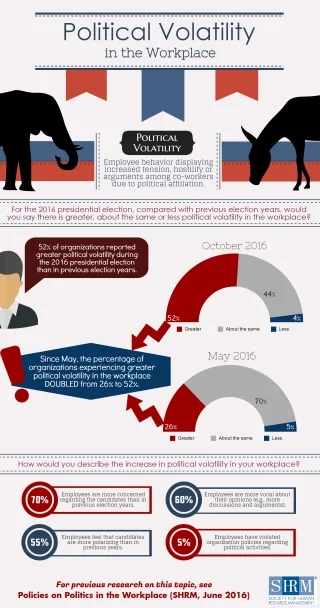
Election Causes Emotions to Run High at Work
 A Society for Human Resources (SHRM) survey found more "political volatility" at work than in previous election years. The rate is up from another SHRM survey conducted in June. Respondents said that employees are more concerned this year about the candidates and more vocal about their opinions.
This infographic summarizes the survey responses.
Politics are part of life, and perhaps this is just part of "bringing your whole self to work," which we discuss in Chapter 2 of the tenth edition. Or should we avoid talking about politics in the workplace?
Although these conversations may be uncomfortable, a Harvard Business Review article quotes Joseph Grenny, coauthor of Crucial Conversations:
"[Y]ou spend the majority of your waking hours with your colleagues, and so it's natural to "feel the need to process your thoughts and feelings" with them. In fact, he says, learning how to talk about politics in a productive manner can help you "manage other difficult conversations at work," including peer performance reviews or disagreements over strategy and policy. Politics is just another topic where "emotions run strong, the stakes are high, and opinions vary," he says.
The article suggests strategies for managing political discussions at work, for example, viewing them as an opportunity to learn more about each other, focusing on the process instead of a candidate, and knowing when to "disengage."
Discussion Starters:
- What's your view? Should we avoid talking about politics at work, or is it an opportunity for building a better team?
- Have you been in an awkward or frustrating situation with a coworker about a political situation? How did you handle it, and what did you learn?
- What do you think will happen after this year's election? Will we all go back to normal, or is that just wishful thinking?
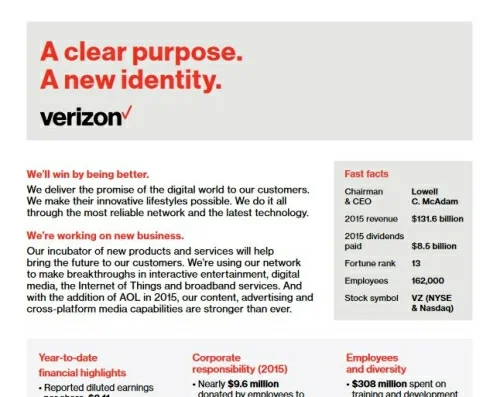
Verizon's 2016 Fact Sheet
In addition to annual reports, many companies publish fact sheets-shorter, friendlier versions for financial and other company information. In Verizon's recent Fact Sheet, the company puts its message clearly up front: A clear purpose. A new identity. Verizon mentions the recent AOL acquisition, but it's too soon to include the bid for Yahoo. 
The company is clearly proud of its girth: big numbers are listed throughout the two pages. However, we have little context for the data. For example, $308 million was spent on training and development. Who benefited, and how was that money shared throughout the organization? Did senior managers attend executive MBA programs? Or was it spent on basic skills required for the company instead of developing more transferable skills? How does that compare to training investment at similar firms, etc.?
Discussion Starters:
- Looking at the Fact Sheet, what other questions do you have about the data?
- Graphically, the two pages are very simple. Why do you think Verizon made this choice? What are the alternatives? Research other companies to explore other designs.
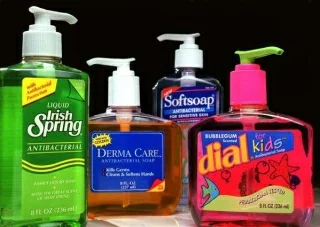
FDA Finds No Evidence for Antibacterial Soaps
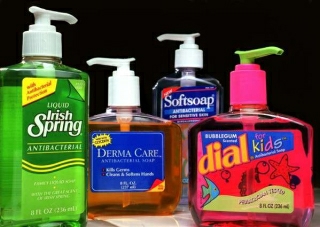 What does "antibacterial" mean, and is it better than regular soap and water? The Food and Drug Administration says there's no evidence to back up such claims. In a press release and a post on the FDA website, the agency explains that antibacterial soap won't prevent the spread of germs any better than regular hand washing.
The FDA explains, "To date, the benefits of using antibacterial hand soap haven't been proven. In addition, the wide use of these products over a long time has raised the question of potential negative effects on your health." The announcement will affect many brands with false claims:
"Companies will no longer be able to market antibacterial washes with these ingredients because manufacturers did not demonstrate that the ingredients are both safe for long-term daily use and more effective than plain soap and water in preventing illness and the spread of certain infections. Some manufacturers have already started removing these ingredients from their products."
Manufacturers were criticized for lacking evidence:
"Because the manufacturers haven't proven that those ingredients are safe for daily use over a long period of time. Also, manufacturers haven't shown that these ingredients are any more effective than plain soap and water in preventing illnesses and the spread of certain infections. Some manufacturers have already started removing these ingredients from their products, ahead of the FDA's final rule."
Discussion Starters:
- Chapter 9 describes types of evidence. What principles apply in this situation?
- Antibacterial brands will have a difficult time defending their products. What advice would you give brand managers?
Mylan CEO Defends EpiPen Price Hike
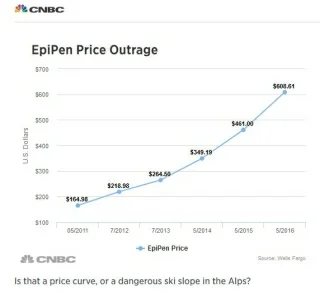
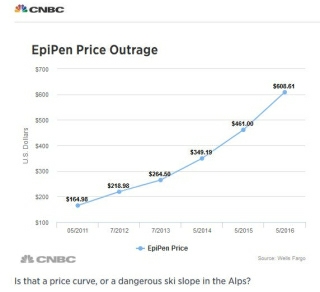 Fighting critics who call the price hike "greedy" and "outrageous," Mylan CEO Heather Bresch makes no excuses for running a for-profit company. Yet the cost of an EpiPen has increased from about $165 in 2011 to more than $600 today.
In a CNBC interview, Bresch stressed that "everybody who needs an EpiPen, has an EpiPen." She focused the costs involved in making the product widely available.
Trying to deflect blame, Bresch said, "This is a healthcare issue. . . . The system incentivizes higher prices." Pharmacy, retailers, and wholesalers are all taking a cut and are raising their prices.
Discussion Starters:
- Twice, Bresch said, "As a mother..." How effective is this strategy as part of her argument?
- How well does Bresch convey her points? Which arguments do you find most and least convincing?
- CNBC's chart is effective because it shows the dramatic increase over time. What's your view of the caption about skiing?
Yahoo CEO Takes Sale in Stride
News of a potential Yahoo sale has circulated for years, and now it's a reality. CEO Marissa Mayer discusses Verizon's acquisition in a blog post, concluding, "Yahoo is a company that changed the world. Now, we will continue to, with even greater scale, in combination with Verizon and AOL."
In a press release, Mayer spoke positively about the sale:
"Yahoo and AOL popularized the Internet, email, search and real-time media. It's poetic to be joining forces with AOL and Verizon as we enter our next chapter focused on achieving scale on mobile. We have a terrific, loyal, experienced and quality team, and I couldn't be prouder of our achievements to date, including building our new lines of business to $1.6 billion in GAAP revenue in 2015. I'm excited to extend our momentum through this transaction."
Although Mayer writes that she'll stay with Yahoo, PR Daily notes conflicting reports, including a New York Times article that said she'll get $57 million in severance pay, or $218 million total for her reign at Yahoo.
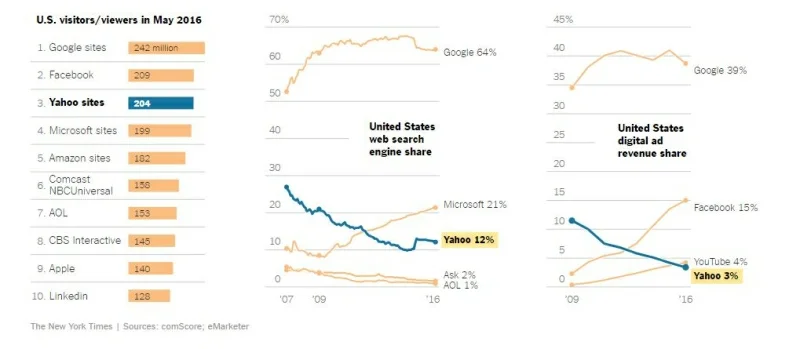
The New York Times also posted a few impressive graphics showing Yahoo's considerable US visitors, yet declining search traffic and ad revenue.
Discussion Starters:
- Assess Mayer's blog post. Who are the audiences, and what are her key messages? How well does she convey enthusiasm for the sale?
- What principles of visual communication does The New York Times use in these graphics? How can they be improved?
Melania Trump's Plagiarized Speech
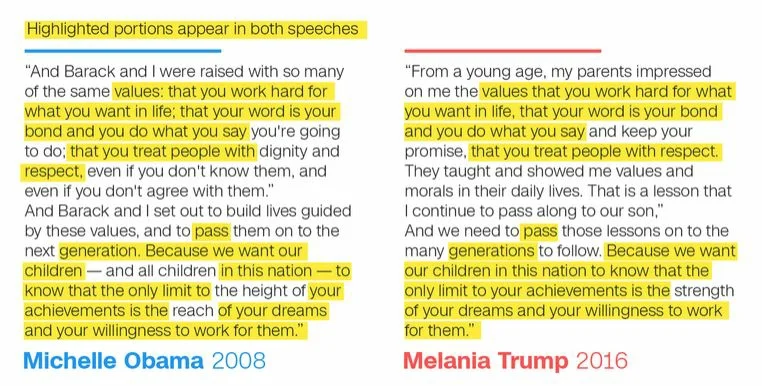
By any definition, Melania Trump's GOP Convention speech was plagiarized from Michelle Obama. The similarities between Donald Trump's wife's speech and Michelle Obama's 2008 DNC speech are uncanny. Here's one comparison from CNN, and other similarities exist:

Donald Trump's campaign chairman Paul Manafort denied accusations of plagiarism: "To think that she would do something like that knowing how scrutinized her speech was going to be last night is just really absurd." Senior Communications Advisor Jason Miller said only, "In writing her beautiful speech, Melania's team of writers took notes on her life's inspirations, and in some instances included fragments that reflected her own thinking. Melania's immigrant experience and love for America shone through in her speech, which made it such a success."
Later, the RNC communications director, Sean Spicer, said that searches for some of Ms. Trump's phrases turn up similarities from "My Little Pony" and John Legend, who tweeted, "I would very much like to be excluded from this narrative." But the phrases are not nearly as verbatim as those in Michelle Obama's speech. Spicer told The Huffington Post, "Melania Trump said, 'You work hard for what you want in life.' Akon said, 'Work hard for what you get in life.' John Legend said, ‘Work hard.'"
Update: Meredith McIver, a Trump staff writer, took responsibility for the mistake. A New York Times article said the letter "breathed new life into a story now in its third day."
Discussion Starters:
- How could such a mistake happen? Melania Trump said, "I read once over it, that's all, because I wrote it ... with (as) little help as possible."
- The Trump campaign said that no one will be fired over this incident. Should someone take the fall?
- Does McIver's admission end the conversation? What else, if anything, should the campaign managers or Trumps say? Is The New York Times writer right: did the admission just keep the story alive?

Airbnb and AHLA Argue About Use and Impact
 The American Hotel and Lodging Association reports "83% of Airbnb revenue in Boston-or $40 million-comes from operators listing units for rent more than 30 days per year." This is damming criticism because it claims that operators (or "hosts," which Airbnb prefers) are more like hotel owners avoiding taxes.
But Airbnb disputes the data and told the Business Journal that 86% of Boston hosts share their primary residence and earn an average of $5,900 for sharing 45 nights each year.
It's difficult to know where the truth lies. The AHLA study was sponsored by the association and data were gleaned from Airbnb by John W. O'Neill, a professor of hospitality management and director of the center for hospitality real estate strategy at Penn State University's School of Hospitality Management.
Airbnb spokesperson Christopher Nulty called the report "factually inaccurate" and said, "The AHLA is out of touch with the increasing number of consumers and cities embracing the tremendous benefits of home sharing. Airbnb is working with cities across the country and around the globe to create clear, fair home sharing rules and to collect and remit hotel taxes on behalf of our community, and we support similar efforts in Boston and across Massachusetts."
Fights for and against Airbnb continue throughout the country. Airbnb has reached agreements with some cities to automatically charge a 3% tax on all rentals, but other cities are hoping to ban short-term rentals entirely. New York City already prevents rentals for fewer than 30 days, but a proposed measure would fine owners for posting properties online.
Discussion Starters:
- What could explain the discrepancy in Airbnb data?
- Compare persuasive strategies used by the AHLA and Airbnb. How does each use emotional appeal in addition to data to support their argument?
FDA Changes the Nutrition Label
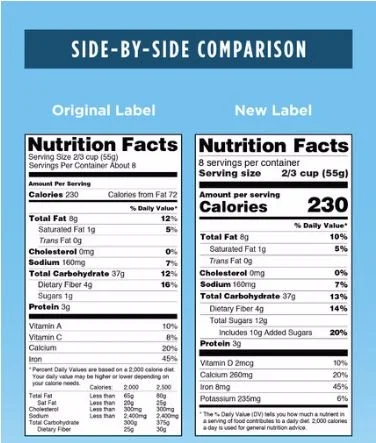
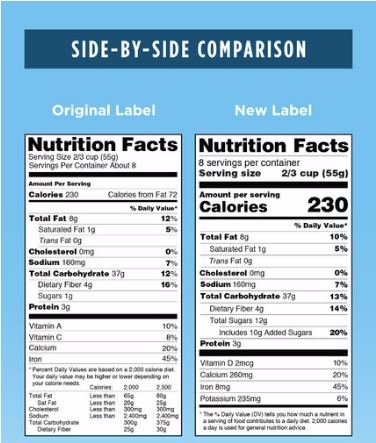 For the first time since the early 1990s, the Food and Drug Administration has updated the nutrition label that appears on packaged foods. The agency is proud of the change, calling it a "major step." Michelle Obama has been part of the process and is quoted in the FDA's press release: "This is going to make a real difference in providing families across the country the information they need to make healthy choices."
The major changes, in case they're hard to notice, include bigger calorie and serving size numbers, and a new line for added sugars.
I have to say I'm disappointed. This is the first change in more than 20 years, when the label was introduced. Although these modifications are important, they say little for the FDA's ability to rethink what information people need to make good food choices and how it could be best represented.
Is there no other visual that could help people? A more dramatic change, in itself, might encourage people to look. Also, the percentages are still based on a 2,000-calorie diet, which the FDA deems average, but this doesn't suit everyone.
This change comes when the FDA is under pressure to revise what it calls "healthy" food. This month, The Wall Street Journal questioned the agency's logic. According to the FDA, avocados and almonds aren't healthy because they are high in fat. Frosted Flakes and low-fat Pop Tarts are okay because the requirements don't include other factors, such as sugar content. The FDA responded to The WSJ's inquiry: "We believe now is an opportune time to re-evaluate regulations concerning nutrient content claims, generally, including the term ‘healthy.'"
We'll look forward to those changes happening soon.
Discussion Starters:
- What other type of visual could help people make decisions about food?
- Why do you think the label has stayed the same for more than 20 years?
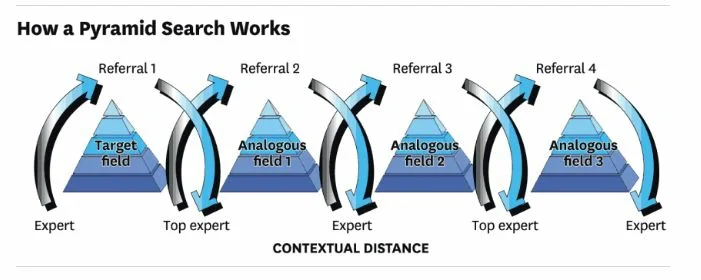
Data Visualization as a "Discipline"
A Harvard Business Review article reminds us to focus on our message when visualizing data. Author Scott Berinato suggests asking ourselves two questions to start:
- Is the information conceptual or data-driven?
- Am I declaring something or exploring something?
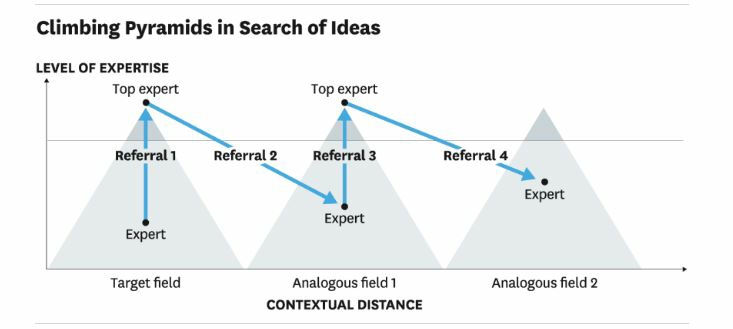
Berinato then identifies four types of visual communication: idea illustration, idea generation, visual discovery, and everyday dataviz. For idea illustration, he offers a weak and an improved example. You'll notice that the first includes elements of "chart junk" that detract from the message.

 Discussion Starters:
- How does Berinato's second example illustrate principles from Chapter 9 in the text book?
- Consider a message you need to communicate. How does this article help you decide what visuals would support your points?
Personality and Grammar
A PLOS One study tells us that people who are less agreeable, according to a Big Five Personality assessment, judge paragraphs with typos and grammatical errors more harshly. Researchers at The University of Michigan asked 80 participants to take the personality test and then respond to a paragraph that had two typos and two grammatical errors.
According to the authors,
"Summarizing the results, three out of the Big Five personality traits interacted with only one type of error, either grammos (agreeability) or typos (openness, conscientiousness). One trait (extraversion) interacted with both types of errors, and one trait (neuroticism) interacted with neither. This pattern is consistent with our speculation that typos and grammos carry different evaluative weight and potentially different social meanings."
The results aren't as interesting to me as how the study is getting spun. The article is appropriately titled: "If You're House Is Still Available, Send Me an Email: Personality Influences Reactions to Written Errors in Email Messages." However, a Mashable article reads, "People obsessed with grammar aren't as nice as everybody else, study suggests."
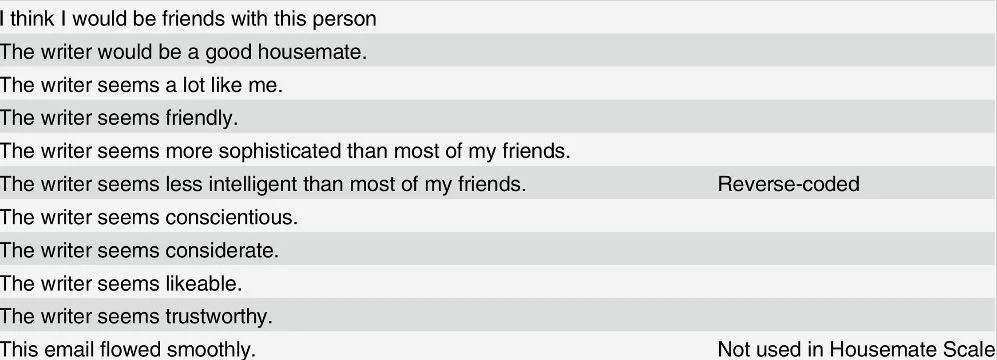
This seems to be a bold conclusion: is identifying four mistakes in a short paragraph considered an obsession? In answering the questions about the writer, shown here, I'm not sure how the respondents could be called obsessive.

Discussion Starters:
- Do I sound defensive? I am, but do I have a point?
- Do the study results surprise you? Read more detail about the influence of the five personality types in the PLOS One article.
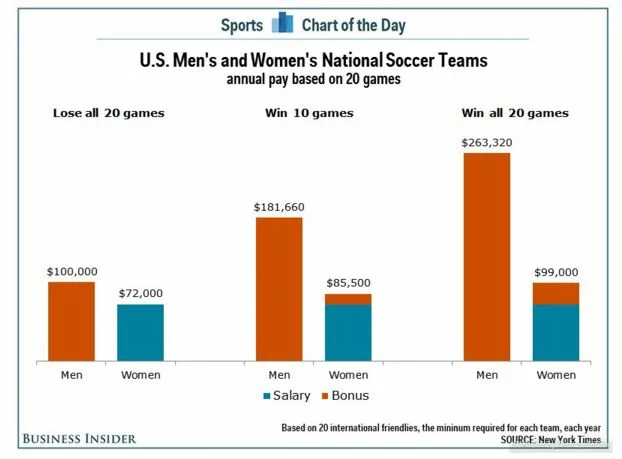
Soccer Salary Differential Charts
Five members of the U.S. Women's National Team filed a complaint with the Equal Employment Opportunity Commission (EEOC) citing pay discrimination based on sex. Business Insider created a few simple bar charts to show striking comparisons.

This one, and the others, are clear and simple, highlighting that the women's complaint may be justified. In the article, Business Insider uses strong language to describe the differences:
- "...a closer look at the differences in pay between the men and women reveals a disparity that is jarring."
- "While it [per diem pay] is the smallest form of compensation, the difference between the men and women is arguably the most jaw-dropping."
In the four charts, consistency helps the viewer get the message quickly. All show men and then women on the x axis and use only two or three colors.
Discussion Starters:
- What principles of visual communication do these charts follow? How could they be improved?
- Read the women's complaint. From the data presented, what other charts could complement the message? Consider pie charts or more creative visuals such as infographics.
Bad Data Almost Makes a Documentary
A study had found a link between autism and the vaccine for measles, mumps and rubella, but the article, published in 1998 in the British medical journal The Lancet, was retracted in 2010. The article caused parents not to vaccinate their children and, as a result, a rise in measles in Britain and the United States. This situation was used as an example of bad data in Chapter 9 of the text book.
Although the study author, Andrew Wakefield, has had his medical license revoked because of financial and ethical violations, he recently directed and wrote a documentary, "Vaxxed: From Cover-Up to Catastrophe," which was to play at the Tribeca Film Festival.
In a New York Times article, a doctor at Vanderbilt University School of Medicine discredited Wakefield's work as a documentary film:
"It gave these fraudulent ideas a face and a position and an energy that many of us thought they didn't deserve. We're all for ongoing reasonable debate and discussion, but these are ideas that have been proven to be incorrect many, many, many times over the past 15 years."
The film has been pulled, with festival founder Robert De Niro explaining, "My intent in screening this film was to provide an opportunity for conversation around an issue that is deeply personal to me and my family. But after reviewing it over the past few days with the Tribeca Film Festival team and others from the scientific community, we do not believe it contributes to or furthers the discussion I had hoped for."
Discussion Starters:
- Did the film festival make the right decision? What are the consequences?
- What are the implications of this situation for business communicators researching and writing reports?
Criticism of Law Schools' Graduation Data
 A 2008 graduate of Thomas Jefferson School of Law is suing the institution for luring students to enroll by using false post-graduation data. Anna Alaburda's claim is one of 15 similar suits, although all but two have been dropped or dismissed.
Alaburda has $170,000 worth of student debt and has not found a full-time job in law since her graduation. Students' claims are that law schools include jobs such as part-time waitressing in their employment stats, inflating their placement rates. According to an article in The New York Times,
"Law schools labor to keep their employment data at the highest percentage level because it is a major factor in national law school rankings, which in turn give schools the credibility to charge six figures for a three-year legal education."
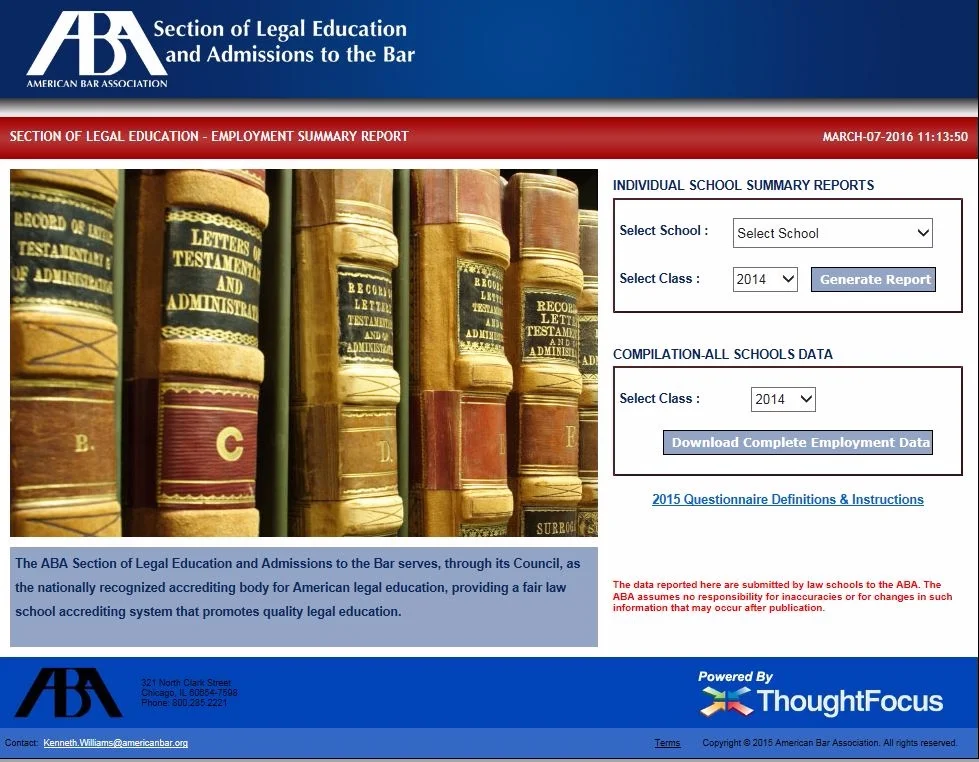
Since the charges, the American Bar Association has required law schools to give more information. On its website, you can download detailed statistics from all schools.
Overall, according to the National Association for Law Placement, rates have increased, but class size is shrinking, so it's tough to draw conclusions.
Discussion Starters:
- What is a law school's responsibility to share placement rates with prospective students? How does it balance honesty with recruiting targets?
- How would you make a decision about whether to attend law school-or a particular school? What data would be important for you to consider?
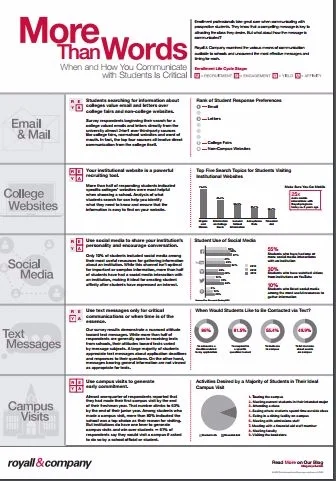
How to Communicate with College Applicants
 A new survey could help college admissions officers reach applicants. A Chronicle of Higher Education article describes the results as "complicated," but I think most students would say they make perfect sense. Students want to receive texts for timely information, such as application deadlines and events, but they don't want general information blasts. Students are also open to one-on-one texts with admissions counselors.
Differences among students may show their willingness for assistance. First-generation, low-income, and underrepresented minority students were more open to receiving texts.
When asked which communication channels were helpful, students rated letters 46%, emails 65%, and the college website 52%.
Discussion Starters:
- What about the survey results, if anything, surprises you?
- How do you think the results may have changed in the past 5 years? 10 years?
- What should admissions officers do with this information?
- How well does this work as an infographic? Compare the image to principles in Chapter 9.
U.S. Mayors Hear Airbnb Arguments
 American mayors heard arguments about Airbnb's short-term rental business and have to decide whether it's good for their cities. Airbnb argues that the business brings millions of dollars in tax revenue to municipalities. If the company is allowed to continue connecting hosts and guests online, according to Chris Lehane, Airbnb's head of global policy, hotel, tourist and occupancy taxes could mount to $200 million a year.
The opposing view at the mayor's conference was led by Katherine Lugar, president of the American Hotel & Lodging Association. According to a Penn State study, many of Airbnb hosts are professional landlords who rent rooms illegally and have made more than $500 million in revenue: "Our data is showing a tremendous growth of commercial operators who are exploiting sites like Airbnb to avoid paying taxes, following zoning rules and following basic laws for health and safety."
Airbnb is working through local organizations to fight restrictions, but short-term rentals have been banned in several municipalities.
Discussion Starters:
- Read the Penn State report. How does it provide evidence for AHLA's point of view? How does it fall short?
- Analyze the graphics used in the report. Which principles of creating infographics from Chapter 9 are used?
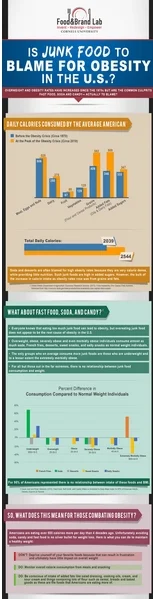
False Claims from an Obesity Study?

A Cornell University study concludes, "consumption of fast food, soft drinks, or candy was not positively correlated with measures of BMI," meaning (excluding those very under- and overweight), people consumed these foods at about the same rate. But a Forbes writer criticizes the "false claim" reflected in Cornell's press release (and similarly reported elsewhere): "Candy, soda and fast food are not driving the rising obesity trend in the U.S."
Other headlines, such as, "Is junk food making us fat? Why cutting candy, soda may not be enough," in USA Today have little connection to the findings at all. The study says nothing about restricting certain foods. It merely reports that people of different weights consume similar amounts of these particularly foods.
I also don't think the study distinguished between diet and regular soda. People at the lowest BMIs consumed the most soda.
One of the study's authors, David Just, responded to the Forbes writer's concerns:
"I clarified this with the study's lead author, David Just, a professor of economics at Cornell University, who said his aim was to consider the potential impact of public policies that banned certain foods. 'There's been a lot of diet advice given that narrowly focuses on eliminating soda and fast food and a rash of policies that are targeting these specific foods and promising to address the obesity crisis,' he said. 'I felt these policies were overpromising.'
"He said he did not intend people to leave with the message that sugary sodas and junk food have nothing to do with their weight, or that it's useless to try to lose weight by cutting back on sugar."
An infographic summarizes the study's findings, and Just describes the results in a video.
Discussion Starters:
- How would you explain the Forbes writer's concerns? What are the potential consequences of how the findings are reported?
- What conclusions are safe to draw from the study? How could the results be useful to policymakers and individuals?
Candidate Word Clouds
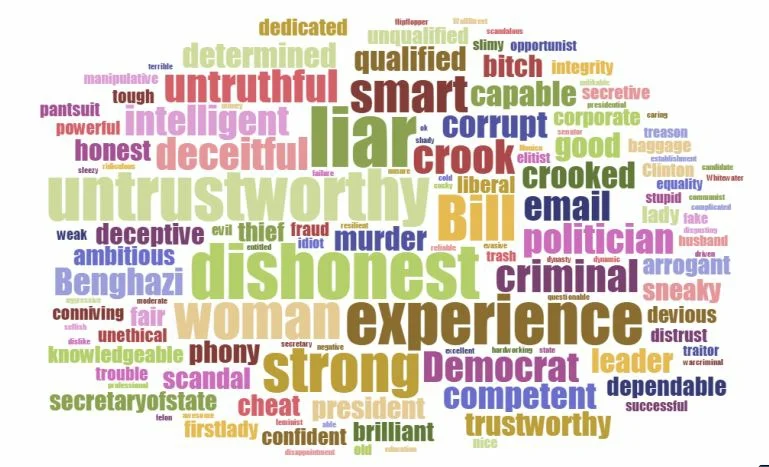
A Quinnipiac University poll isn't good news for Hillary Clinton-or the other candidates. Sixty-one percent of voters said Clinton is untrustworthy. When asked to identify words associated with the democratic candidate, the most frequent was "liar."
For republican candidate Donald Trump, the most common word association was "arrogant" and for Jeb Bush, it was "Bush," which could mean bad news if he's too closely associated with the family, particularly George W. Bush, not a very popular president. The word cloud shows mostly negative words for Clinton, and the one below, for Trump, isn't much more inspiring.


The word clouds can be deceptive. Even if the word height is representative of sentiment, several aspects may skew visual impressions, for example, 1) the (presumably) random color choice, 2) the length of the word (number of letters), and 2) the position of the words, which may make some stand out more than others.
Discussion Starters:
- Looking at these word clouds, which words stand out most to you? Of the smaller words, which ones stand out that may be equal in height to others, but capture your attention because of color or word length?
- Does this poll influence your opinion of either leading candidate? If so, how?
Controversy About CEO Pay Disclosure
The U.S. Securities and Exchange Commission voted to require CEOs to disclose how their pay compares to that of employees in their organization. The requirement is part of the Dodd-Frank Act, passed in 2010 to prevent another financial crisis and to protect consumers.

The decision is one strategy for what people consider pay inequity between high- and low-earners in the United States, which has increased dramatically, as reported by BloombergBusiness:
"Average CEO pay at the 350 largest U.S. companies by revenue surged 997 percent from 1978 to 2014, while the compensation of non-supervisory employees rose 10.9 percent, according to the Economic Policy Institute, a research group that advocates for workers.
"While CEOs earned about 30 times what the typical employee did in 1978, corporate chiefs' pay had jumped to more than 300 times their employees' compensation as of 2014, the institute said."
Opponents say the ruling creates an expensive process and will serve only to embarrass CEOs. But the decision offers several ways for companies to calculate wages, excludes up to 5% of foreign workers, and requires reporting only every three years.
Discussion Starters:
- What's your view of the ruling? Is this the right move, and will it achieve its purpose?
- How do you assess the Economic Policy data shown above? What story do the numbers tell, and what may be missing?
- How could you display the Economic Policy Institute data visually? What chart type(s) would be most appropriate?
Political Polls and Charts
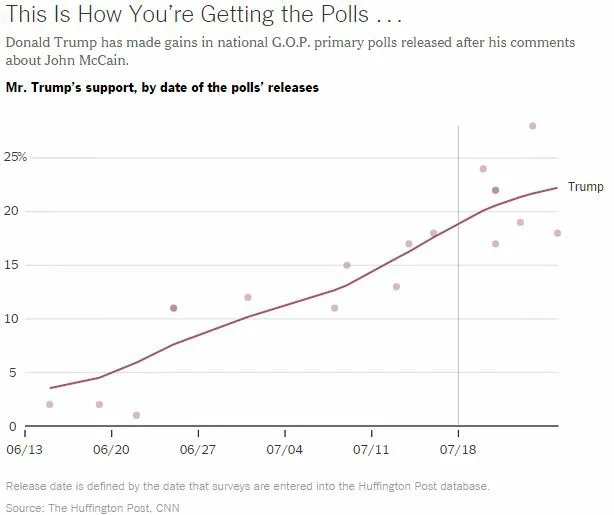
Ah, politics and polling. The media loves to report every data point, but now we have an example of a misleading poll. People have been surprised that Donald Trump, Republican presidential candidate, hasn't taken more of a hit after his comment about Senator John McCain. Trump said, "He's a war hero because he was captured. I like people that weren't captured, OK?"
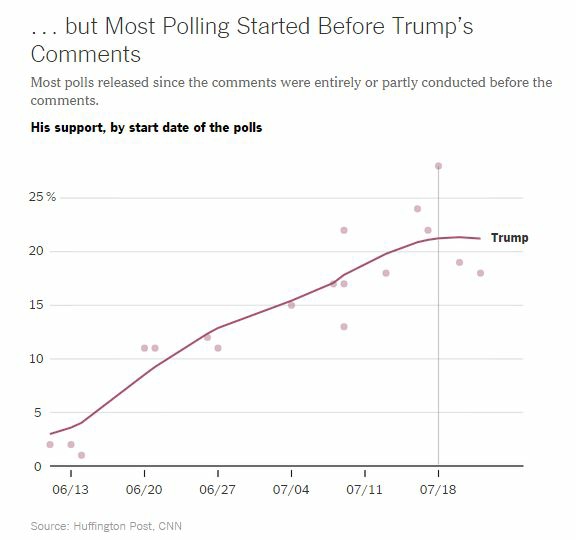
A New York Times article explains why Trump may still lead the Republican polls, although people are upset by the remark. One explanation is that poll reporting lags. We hear the results of polls days after they're taken. In the chart below, the article shows the results of Huffington Post and CNN polls as we saw them in the news, showing Trump's comments on July 18.
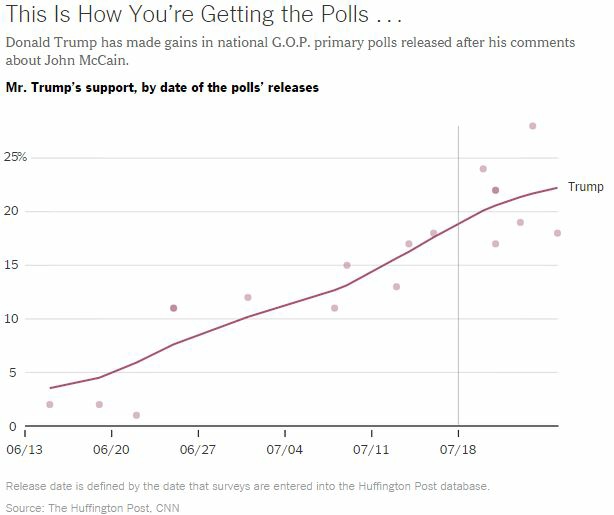
This second chart shows the results of polls the date they were taken:
Discussion Starters:
- How much do you think poll matter during an elective? How, if at all, do they influence you?
- What can be done to ensure that polls don't mislead the public? Consider the roles and responsibilities of news agencies.