
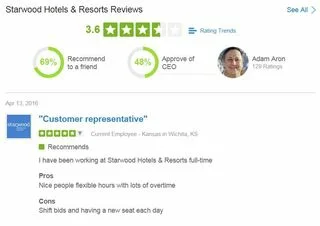
Suing Glassdoor for Bad Reviews
 In addition to poor customer reviews online, companies are feeling the pinch of negative employee comments, and they're taking action. Glassdoor has been targeted as the largest site for employee reviews about company management, interview processes, benefits, and pay. The site has been issued subpoenas for the names of people who posted views thought to be anonymous.
A lawyer arguing the case against Glassdoor claims, "The right to anonymous speech also extends to the Internet and those constitutional principles [of free speech], but at the same time the Constitution does not protect defamation. It does not protect statements that are false or could give rise to other claims, for example, false light or tortious interference."
At issue is whether comments are true or "maliciously false." If true, comments may be protected, but if they are false, the author may not be protected. The National Labor Relations Board (NLBR) has a role, as I've written about before on BizComintheNews. An attorney James R. Redeker, at Duane Morris explains:
"If an employer tried to take action against an employee who it found published something in either social or public media anonymously-and/or published something that was false and misleading-the NLRB [National Labor Relations Board] general counsel and the board take the position that an employee is entitled to and protected in making statements with regard to the working conditions of their employer."
Glassdoor has refused hundreds of employers' requests for content to be removed and for identities to be revealed. The company argues, "Glassdoor is an anonymous community and we will vigorously fight on behalf of our users to protect their identities and right to free speech, provided they adhere to our community guidelines and terms of service."
Discussion Starters:
- What is an employee's responsibility when posting to sites such as Glassdoor?
- Do you agree with Glassdoor's resistance to reveal identities and remove posts? Why or why not?
- The attorney quoted in one of the articles said that companies can respond to comments online, but "...that's very unsatisfying. And sometimes it exacerbates the problem." What's your view? That's certainly how companies manage customer comments. How might this differ?
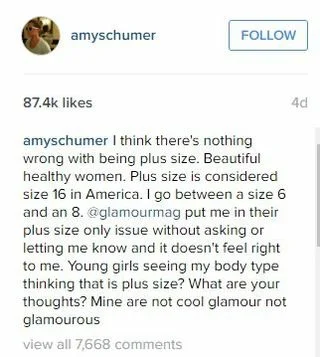
Is Amy Schumer "Plus-Size"?

Comedian Amy Schumer isn't happy about being featured on Glamour magazine's plus-size issue. Schumer was listed on the cover, without her permission or knowledge, along with Melissa McCarthy, Adele, and Ashley Graham. One concern is whether women Schumer's size are considered plus-size: does this give young girls a misperception about their own bodies?
Glamour's editor-in-chief Cindi Leive appeared on Nightline and responded to the criticism:
"I'm certainly sorry that she didn't like being named on the cover, and I'm sorry that she wishes her piece hadn't been included," she said, "but I'm confident that the message of the issue, which is there are great clothes out there for all of us, is one that will resonate with our readers."
"I don't believe that Amy Schumer is plus-size. That's not a term that I love but it's very clear that she's not what people mean when they say plus-size. But that wasn't the intent at all. The cover line says "Women Who Inspire Us," and we felt the audience for this special edition would be inspired by her completely hilarious and constant, consistent message of body positivity."
Asked about the Twitter war with Schumer, Leive said, "No one can out tweet Amy."
Discussion Starters:
- What's your reaction to Schumer's perspective?
- Should Glamour have done anything differently in putting together this magazine issue?
- How well did Leive handle the situation?
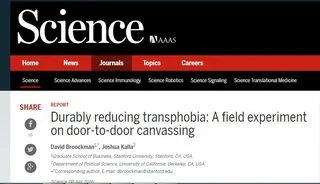
Brief Conversations Change Opinions
 A retracted study is getting new life. Researcher Michael J. LaCour had published a widely cited political science study in Science, claiming that short conversations changed people's minds about gay marriage. However, two scientists, wanting to replicate his work, found problems and published in a paper, "Irregularities in LaCour."
Although the issues stand, those who fought to get the study retracted have since been able to replicate some important findings, after all. The new study focuses on attitudes about transgender people:
...well-trained canvassers walked around Miami neighborhoods, knocking on doors and having 10-minute conversations with voters about legal discrimination against transgender people. The activists showed the residents a brief video describing both sides of the debate, encouraged them to talk about their personal experiences of prejudice, and asked where they stood on the issue. The researchers surveyed the same residents three days later, three weeks later, six weeks later, and three months later to see how their convictions had changed.
About 10 percent of respondents expressed more-positive feelings toward transgender people after talking to canvassers. Those changes in attitude were substantial, and they held up through the follow-up surveys. Both transgender and nontransgender canvassers were able to change minds - a difference from Mr. LaCour and Mr. Green's retracted study, which claimed that voters had found gay canvassers more persuasive on gay rights.
Discussion Starters:
- What does the situation tell us about research and publications?
- What are the implications of this study for other political issues and persuasive arguments?
- These conversations included a 55-second video. To what extent do you think this video affected attitudes?
Emory Chalk Writing About Trump: Free Speech or Intimidation?
 Emory students and administrators are debating whether chalkings on campus about Donald Trump are appropriate. In a letter to the school community, President James Wagner discussed both sides of the argument:
Dear Emory Community,
Yesterday I received a visit from 40 to 50 student protesters upset by the unexpected chalkings on campus sidewalks and some buildings yesterday morning, in this case referencing Donald Trump. The students shared with me their concern that these messages were meant to intimidate rather than merely to advocate for a particular candidate, having appeared outside of the context of a Georgia election or campus campaign activity. During our conversation, they voiced their genuine concern and pain in the face of this perceived intimidation.
After meeting with our students, I cannot dismiss their expression of feelings and concern as motivated only by political preference or over-sensitivity. Instead, the students with whom I spoke heard a message, not about political process or candidate choice, but instead about values regarding diversity and respect that clash with Emory's own.
As an academic community, we must value and encourage the expression of ideas, vigorous debate, speech, dissent, and protest. At the same time, our commitment to respect, civility, and inclusion calls us to provide a safe environment that inspires and supports courageous inquiry. It is important that we recognize, listen to, and honor the concerns of these students, as well as faculty and staff who may feel similarly. . . .
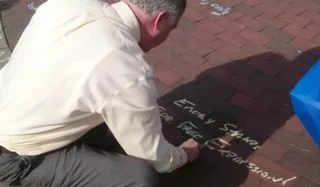
The letter goes on to identify actions the university will take, including clarifying policies and providing more opportunities for dialogue. The president also chalked a message of his own, shown here.
In related news, a Chronicle story reports the results of a Gallup survey about students' view of free speech on campus:
Nearly half of college students believe in curtailing the news media's access to campus events in certain scenarios, such as when protesters want to be left alone (48 percent), when they believe a reporter will be biased (49 percent), and when they want to tell the story themselves on social media (44 percent), a new Gallup survey has found.
At the same time,
While more than 75 percent of students believe colleges should expose students to all types of speech and viewpoints, a majority of students believe campus climates prevent people from saying what they believe out of fears of offending others.
Discussion Starters:
- Describe both sides of the issue in this situation. Image you're a student on either side of the argument: defend your position.
- How well did President Wagner's letter address the controversy?
"Advantage Women" Program for Gender Equality
 Ad agency Burson-Marstellar has a new initiative to help companies close the gender gap. According to PRWeek, the program will help companies with communications to "help all levels of leadership recognize the importance of women in executive roles and gender balance across the workplace":
Burson-Marsteller plans to leverage its research and data analytics to produce "evidence-based campaigns," including internal audits, perception analyses and research and message testing on women audiences.
This matters to companies partly because women make 90% of household purchase decisions.
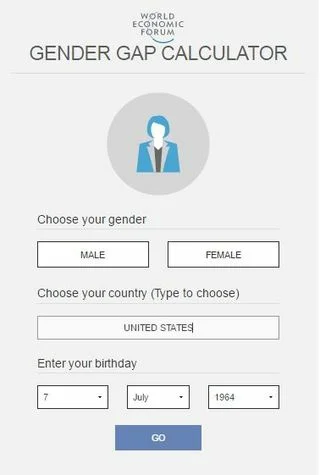
The World Economic Forum has a Gender Gap Calculator that shows how old you'll be when the gap is eliminated, mediated by your home country. I'll be 169 years old.
Of course communication is only part of the issue. Companies can make themselves more attractive to women leaders and encourage directors and senior managers to hire women, but a culture shift within an organization takes years, and we have a lot more work to do.
Discussion Starters:
- How would you describe the impact of the gender gap on men and women?
- How can communication help? In other words, how will Burson-Marstellar be working with companies?
Whole Foods' Orange Controversy
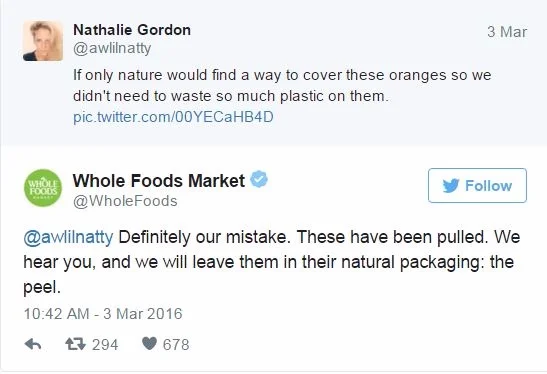
 Whole Foods is selling pre-peeled, plastic-packaged oranges and has been criticized for it. The company touts sustainability measures, including, according to its mission statement, "reduced or reusable packaging, as well as encouraging shoppers to reduce waste through our 'nickel per bag' rebate program."
The tweet, at left, shows the company's decision, and a representative told Huffington Post, "a lot of our customers love the convenience of our cut produce offerings, but this was a simple case where a handful of stores experimented with a seasonal product spotlight that wasn't fully thought through. We're glad some customers pointed it out so we could take a closer look."
But people didn't like the decision to pull the oranges either. Some said they were useful for people with arthritis and other physical limitations.
Whole Foods is struggling because of lower-cost organic sellers, such as Costco. Last year, the company was criticized for selling asparagus spears in a bottle of water for $5.99. This product was also pulled.
Discussion Starters:
- What's your view of the pre-packaged orange? Is this a good product, does it contradict Whole Foods' mission, or both?
- Did Whole Foods act hastily in pulling the product? Consider the company's decision process.
Facebook's Reactions
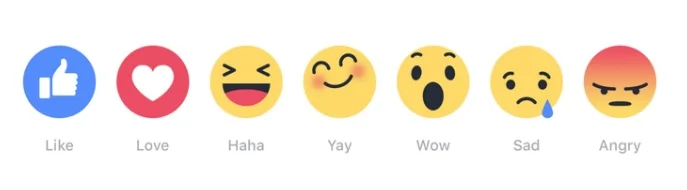
Today, Facebook finally rolled out its new Reactions, a broader array of symbols to complement the traditional "like" button. The six new emojis let us express more refined feelings, such as love, laughter, sadness, and anger, and they are animated.

The selections took Facebook a while. After user testing, the company settled on these six winners and decided how to represent them on a page. Too many cluttered posts, but too few got lost. Instead, the three most common reactions to posts will appear below each.
Quoted in Wired, Vyvyan Evans, a professor of linguistics at Bangor University said, "The stratospheric rise of emoji is essentially fulfilling the function of nonverbal cues in spoken communication." We miss, for example, facial expressions and gestures in Facebook posts and text messages, so emojis help us express our feelings.
Chevrolet seems first out of the gate to use the new Reactions in an ad. In this commercial, the company tells us, "Chevrolet looked out into a sea of likes and thought the time was right to love. Introducing the new Chevy Malibu. Start Loving."
Discussion Starters:
- Do you love the new emojis, or do they make you sad or angry?
- What downsides do see for Facebook to expand the options?
Nike Ends Relationship with Manny Pacquiao
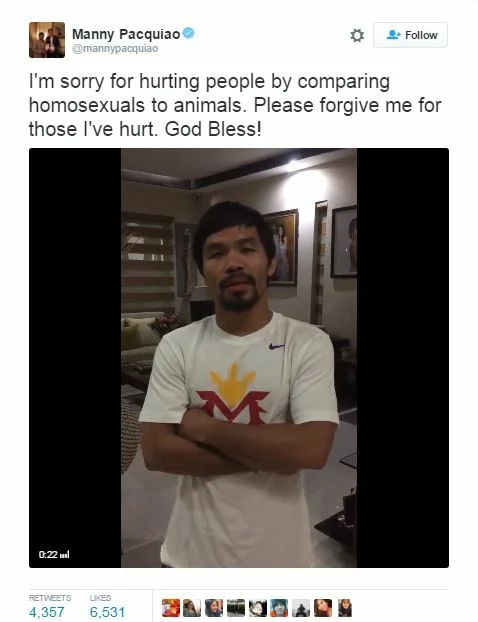
 Boxer Manny Pacquiao made derogatory comments about same-sex couples and lost his eight-year endorsement deal with Nike. On a Filipino television program, Pacquiao said. "If you have male-to-male or female-to-female [relationships], then people are worse than animals." He was explaining why he opposed same-sex marriage.
Nike issued this statement: "We find Manny Pacquiao's comments abhorrent. Nike strongly opposes discrimination of any kind and has a long history of supporting and standing up for the rights of the LGBT community."
In a video posted on Twitter and Instagram, Pacquiao apologized.
According to ESPN, Pacquiao has a history of anti-gay sentiment:
This week wasn't the first time Pacquiao has been involved in a furor over gay rights. In 2012 he was quoted as saying he was against same-sex marriage because "it's the law of God," though he denied implying that homosexuals should be put to death.
Discussion Starters:
- Assess Pacquiao's video: do you find his statement and body language convincing?
- Did Nike do the right thing? Discuss pros and cons of the decision.
Trump's Reaction to the Iowa Caucus
In the Iowa caucus, Republican presidential candidate Donald Trump lost to Senator Ted Cruz after having a consistent lead in the polls, but he's still confident about winning the election. Analysts say his infrequent visits to Iowa and lack of campaign organizing may have hurt him. He also skipped the most recent Republican debate because of a quarrel with Fox reporter Megyn Kelly, which didn't help.
But Trump says, "I don't feel any pressure. We'll do what I have to do." He also said he's "honored" to finish second.
His tone did change in this video: he seems just a little humbled, and he compliments his opponents, which is quite different from his previous approach. The New York Times compiled "Donald Trump's Twitter Insults: The Complete List (So Far)."
Last week, Trump made headlines after Sarah Palin endorsed him, with her usual, grammatically questionable style, for example,
"When both parties, the machines involved, when both of them hate you, then you know America loves you and we do love he who will be the next president of the United States of America, Donald J. Trump!"
Discussion Starters:
- Compare this video to Trump's previous speeches. Do you notice a difference in tone? What indicates a change?
- What's your view of Trump's tweets? Is this a good political strategy, or will it eventually backfire?
Oscars' (Typewritten?) Response to Lack of Inclusion
Like last year, Oscar nominations from The Academy of Motion Picture Arts and Sciences included not one black actor or filmmaker in the top categories, and people are upset. Spike Lee, Jada Pinkett Smith, and Will Smith and others will boycott the award ceremony in February, and #OscarsSoWhite is trending on Twitter.
The Academy has responded by promising to prioritize diversity for the organization. Much of the criticism is about the make-up of the group itself:
A Los Angeles Times study found that academy voters are markedly less diverse than the moviegoing public, and even more monolithic than many in the film industry may suspect. Oscar voters are nearly 94% Caucasian and 77% male, The Times found. Blacks are about 2% of the academy, and Latinos are less than 2%.
Oscar voters have a median age of 62, the study showed. People younger than 50 constitute just 14% of the membership.
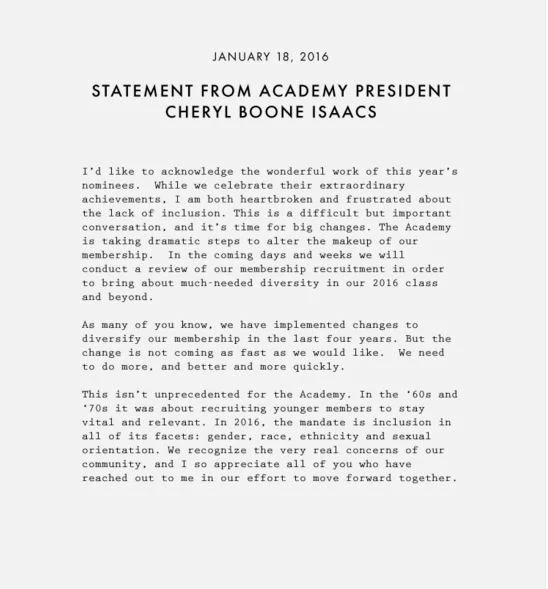
President Cheryl Boone Isaacs, one of two non-white members of The Academy issued this statement in response to the controversy.
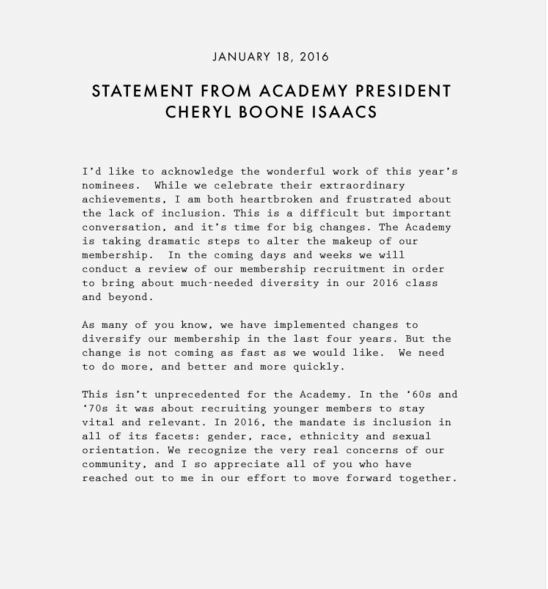
Why does the statement look as though it were written on a typewriter? This can't help The Academy's image as a bunch of old, out-of-touch people. Also, I have long stopped double-spacing between sentences based on style guides and this sound advice from PR Daily.
Discussion Starters:
- Assess The Academy's response. How well did Boone address concerns?
- What will you do? If you typically watch the awards ceremony, will you boycott this year? Why or why not? What do you think the actors should do?
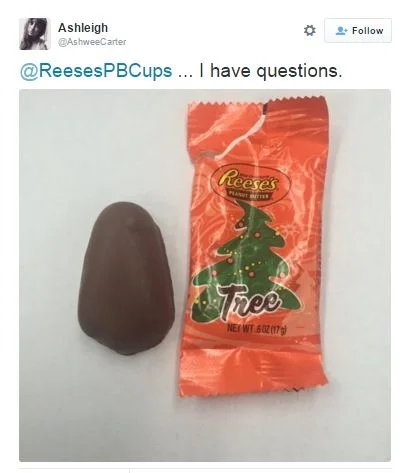
Reese's Handles Criticism Well
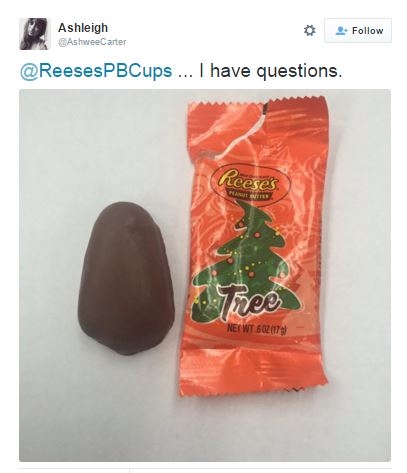 Several tweets showed some questionable-looking Reese's trees. In addition to this example, people wrote, "I feel deceived," and "Does this look like a Christmas tree to you??"
These photos do look more like shapeless blobs than tress.
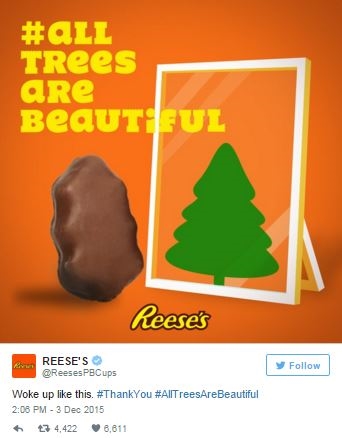
In response, Reese's shifted the focus with a funny play on appearance. In a second post, Reese's showed four trees with the same slogan; however, all of these examples are more, may I say, shapely than the ones posted by consumers.
Inquisitr called the response "epic."
People are fussy. Critics said Starbucks' polar bear cookies look as though their throats have been cut.
Discussion Starters:
- What are other ways the company could have responded to the criticism? What are the advantages and downsides of other approaches?
- The response worked well, but I could see further criticism because the Resee's example don't quite match what people are finding. Could the campaign have backfired?
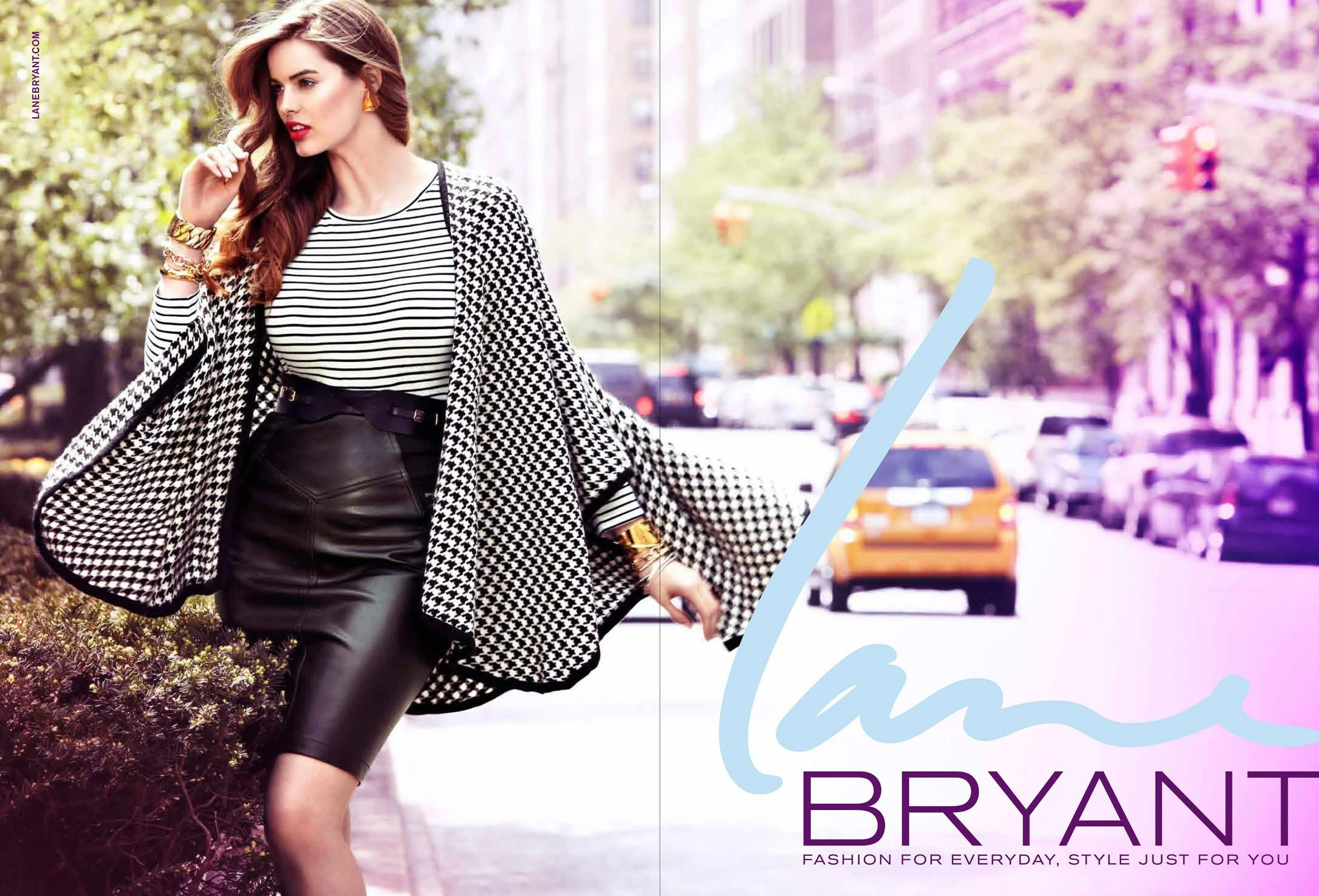
Latest Hashtag Trouble: Lane Bryant

You never know what you'll get on Twitter with a hashtag campaign. Lane Bryant's CMO Brian Beitler tried to engage customers with #AskLaneBryant, but he got a lot of tough comments. PR Daily captured many of them and complimented some of the company's approach:
To the brand's credit, Beitler addressed several concerns during the hour, and the brand's account tweeted its thanks for the "candidness" from chat participants.
Several comments criticize the plus-size retailer for product, model, and associate choices. Although some tweets were "snarky," as PR Daily calls them, Beitler could have been bolder in tackling some of them.
One of the more challenging tweets referenced a study published in the journal Social Problems. Here are the tweet and article abstract:
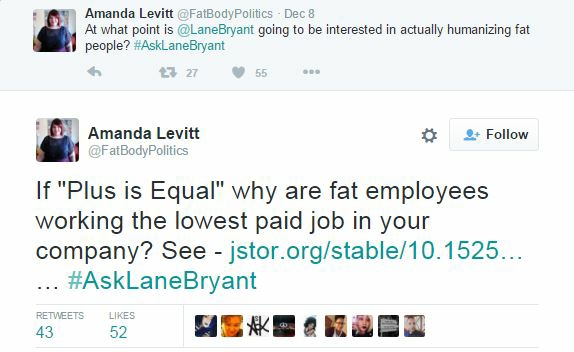
Drawing on participant observation at a women's plus-size clothing store, "Real Style," this article draws on the unique experiences of plus-sized women in their roles as workers, managers, and customers, to examine how mainstream beauty standards, body-accepting branding, and customers' diverse feeling rules shape service interactions. Despite branding that promoted prideful appreciation for "Real" bodies, the influence of these body-accepting discourses was constrained by women's internalization of mainstream fat stigma, resulting in an environment characterized by deep ambivalence toward larger body size. This ambivalence allowed hierarchies between women to be reified, rather than dissolved; although plus-sized employees and customers expressed gratitude to have Real Style as a "safe space" to work and shop, workers experienced gender segregation of jobs, and thinner employees were privileged with special tasks. Further, managers and white (but not black or Latina) customers used body-disparaging "fat talk" to elicit workers' emotional labor while confronting thinner workers for defying aesthetic expectations. This research offers a more nuanced understanding of the ties between aesthetic labor and emotional labor, while highlighting some of the factors that prevent stigmatized groups from successfully reclaiming status within consumer contexts.
Discussion Starters:
- Read PR Daily's compilation of tweets. To which do you think the company should have responded?
- How should Beitler have responded to the reference to the journal article.
- Once again, should companies just avoid a branded Twitter hashtag? Discuss the value and the downsides.
"They" Can Be Singular in The Washington Post
It's a sad day for grammarians everywhere. The Washington Post will allow "they" as a singular pronoun when we don't know the person's gender. A memo from Bill Walsh, the paper's style chief explains the decision:
It is usually possible, and preferable, to recast sentences as plural to avoid both the sexist and antiquated universal default to male pronouns and the awkward use of he or she, him or her and the like: All students must complete their homework, not Each student must complete his or her homework.
When such a rewrite is impossible or hopelessly awkward, however, what is known as "the singular they" is permissible: Everyone has their own opinion about the traditional grammar rule. The singular they is also useful in references to people who identify as neither male nor female.
I find Walsh's second example puzzling: why can't we write, "Everyone has an opinion..."? On the other hand, if we're talking just about the case for "everyone," I wouldn't rebel over it. I also understand using the singular they for transgender people including those who choose not to conform to a binary gender.
Of course, this is only an issue because we don't have an adequate gender-neutral pronoun. Unfortunately, none of several proposed options have stuck. The APA Style Guide provides a more reasoned approach to the dilemma.
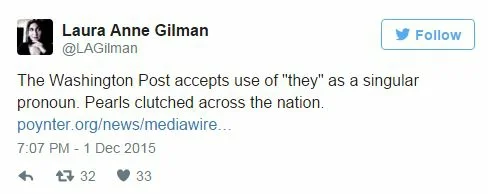
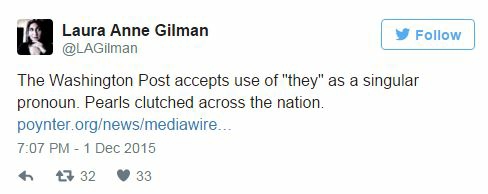
Here's my favorite tweet on the subject:
Discussion Starters:
- What do you think of The Washington Post's announcement? Is this a big deal or not?
- How do you handle this issue in your own writing?
Trump Speaks to Republican Jewish Coalition
Donald Trump spoke at the Republican Jewish Coalition in Washington, DC. He started by saying that his daughter is Jewish (she is married to a Jew and converted). He then talked about how his campaign is self funded but he hasn't spent a lot of money on ads and is still in "first place by a lot" in all polls.
Trump made some questionable comments to this audience. An MSNBC article summarizes them well: "at times [Trump] flirted with stereotypes about Jews as wealthy deal-makers":
- "I'm a negotiator, like you folks. Is there anybody that doesn't renegotiate deals in this room?. . . . This room negotiates them perhaps more than any other room I've ever spoken in."
- "You're not going to support me because I don't want your money because, stupidly, you want to give money."
Trump focused much of his speech on Hillary Clinton, how she's unqualified to be president and why she shouldn't be allowed to run.
He was characteristically confident: "I'm gonna win." "My life has been about winning." He also said that now he's dealing in trillions for the first time; he is used to dealing in billions. Trump promised to repeal "Obamacare" and criticized Jeb Bush's low energy.
Discussion Starters:
- Do you find Trump's comments offensive? Why or why not?
- What else do you find notable in Trump's speech and in the Q&A?
- How, if at all, does this speech affect your vote?
Nordstrom Excelling on Social Media
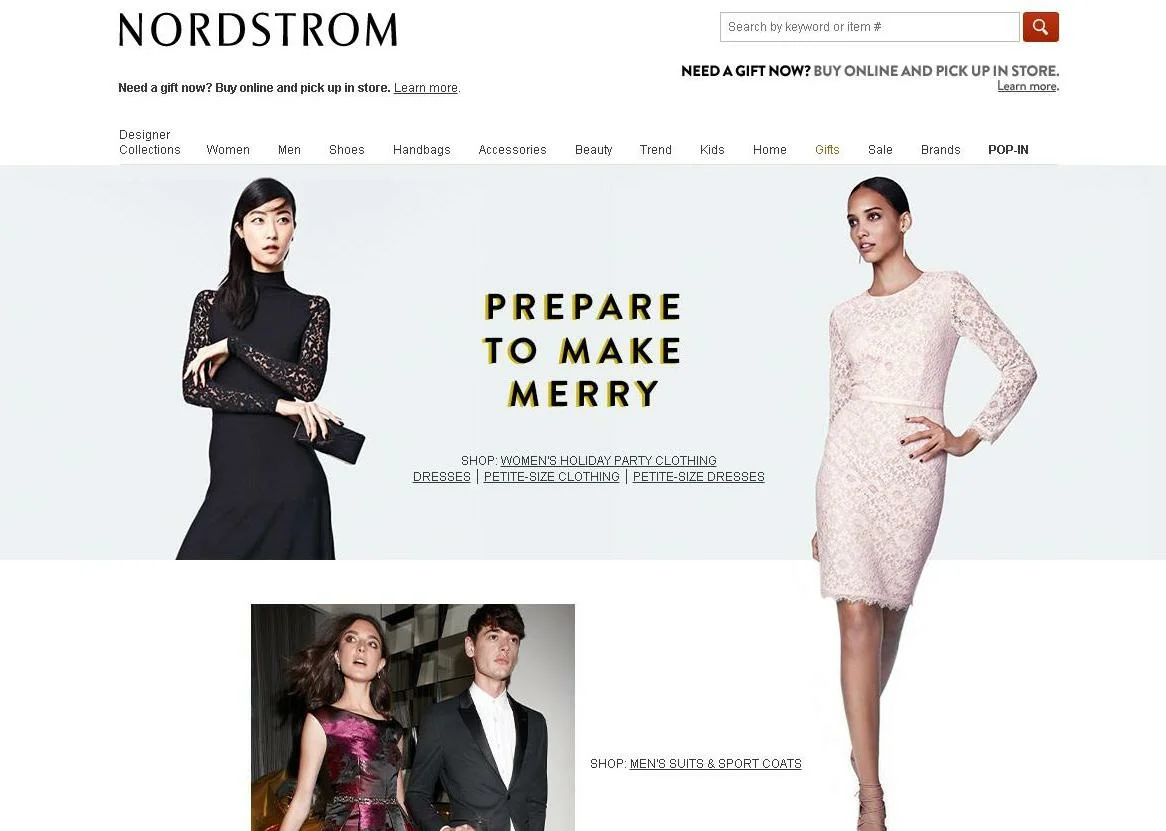
 According to Engagement Labs, Retailer Nordstrom is doing a great job on social media based on three performance rankings on specific social networks:
- Engagement: how much interaction the company's posts receive
- Impact: the level of reach to constituencies
- Responsiveness: how quickly the company replies to specific users' comments
Of all the brands Engagement Labs analyzes, Nordstrom is doing the best, according to a write-up by Forbes:
"Upscale fashion retailer, Nordstrom, is a top performer on Facebook FB +0.00% and Twitter TWTR -1.20%. On Facebook, Nordstrom has the highest eValue average score on the list at 93.11. It has enjoyed fan growth of 89,536 within the one-month tracking period and attracted 380.57 likes per 1,000 fans-the highest on the entire list."
Engagement Labs also follows Vloggers and has highlighted YouTube stars PewDiePie, Smosh, Rhett & Link, and others.
Discussion Starters:
- What is your favorite brand, and how would you rate its levels of engagement, impact, and responsiveness on social media? What examples do you see of interaction?
- How, if at all, does a brand's use of social media affect your purchase decisions?
Volkswagen Tries to Win Customers with Gift Cards
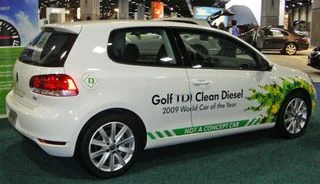
 Too little, too late? Volkswagen is finally trying to rebuild its image, but the approach may not work. The company is offering U.S. customers two credits for $500: one to be spent at a VW dealership and the other to be spent anywhere. In addition, customers with diesel cars will have free roadside assistance for three years.
The "Goodwill Package" is announced on the VW website.
A Fortune writer doubts the cash will have any impact:
"When it comes to throwing money at a problem, we can learn something important from an experiment that was conducted on 632 eBay users in Germany, who had left negative feedback following a transaction. In the study, published in 2010, half received an apology 'I would like to apologize and ask whether you might withdraw your evaluation.' The other half received a cash rebate (about $5) 'as a goodwill gesture.' The results? When offered cash, 21% removed their critical rating. But when offered an apology (without any cash), 45% removed the critical rating."
Customers are still waiting for a solution, but U.S. CEO Michael Horn says the company isn't ready: "We are working tirelessly to develop an approved remedy for affected vehicles. In the meantime we are providing this goodwill package as a first step towards regaining our customers' trust."
Discussion Starters:
- How effective do you think the customer credit will be in rebuilding VW's image?
- The company is taking a long time to identify a solution for customers. What's your view of the situation? Do you find it understandable, stalling, or something else?
Employers Discriminate on Disability
 A new study showed that employers reject candidates based on disabilities discussed in a cover letter.
Researchers sent cover letters and resumes for accounting positions and found that people who mentioned either a spinal cord injury or Asperger's Syndrome received 26% fewer interview offers than those who didn't mention a disability. The rejection numbers were higher for candidates who had more experience and by companies with fewer than 15 employees (who don't need to comply with federal Americans with Disabilities Act requirements).
Although some disabilities may affect job performance, the researchers chose these examples because they would not likely impact job success in an accounting position.
The study may explain the lower employment rates of adults with disabilities: 34% compared to 74% for people without disabilities. Although the researchers say they expected some evidence of discrimination, they were surprised by the extent. The study abstract concludes,
"The overall pattern of findings is consistent with the idea that disability discrimination continues to impede employment prospects of people with disabilities, and more attention needs to be paid to employer behavior and the demand side of the labor market for people with disabilities."
Discussion Starters:
- What about the study results surprise you-or not?
- What is the employer's perspective? Why would they discriminate, particularly against more experienced applicants?
United Misses Step for Passenger with Disability
 United Airlines didn't give D'Arcee Neal the access and assistance he needed. Neal, who has cerebral palsy, had asked for a wheelchair, which was available for him but then removed for some reason. Neal needed to use a restroom and, according to CNN, "crawled up the aisle and to the gangway, where a wheelchair was then ready." According to Neal, the flight attendants weren't helpful: "I expected them to ask to assist me, but they just stared."
United called Neal to apologize and issued this statement:
"As customers began to exit the aircraft, we made a mistake and told the agent with the aisle chair that it was no longer needed, and it was removed from the area," the airline said in a statement. "When we realized our error-that Mr. Neal was onboard and needed the aisle chair-we arranged to have it brought back, but it arrived too late."
Neal is a disability advocate and was on his way home from a meeting in San Francisco with Uber about their accessibility policies. Although the incident relates to his work, it became public only after he posted on his Facebook page that United had apologized. He said he didn't expect any response and was surprised the company responded at all:
"Quite frankly, I was just shocked, because this had happened a couple of times before (with various airlines), and no company had ever bothered to apologize when they've done something wrong.
Discussion Starters:
- What should the flight attendants or other passengers have done differently?
- What's your assessment of United's apology? Should the company do more at this point?
IHOP Gets Cute But Crosses a Line
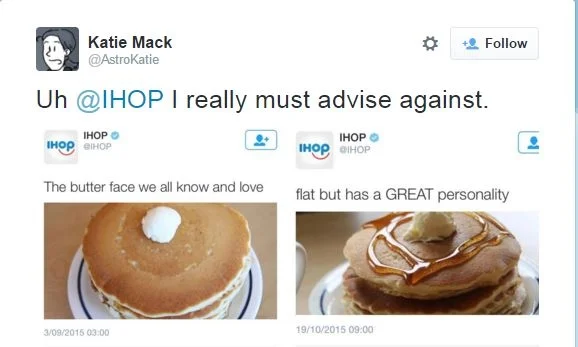
Sure, companies need to attract attention, and social media is a good way to differentiate a brand. But IHOP went too far with its references to breasts, and people didn't respond well. These images and the tweet say it all.

With an edgy voice, the company is trying to reach a younger demographic, but it backfired. People responded with anger and surprise. @JuddLegum tweeted, "Something is going on with IHOP on Twitter and I hope I never find out what it is."
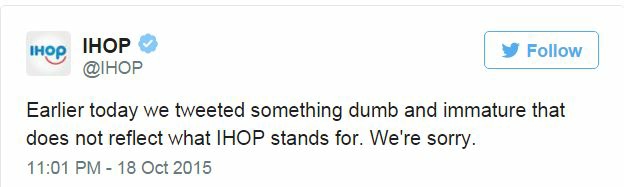
To the company's credit, it sent a quick, natural apology tweet:
Discussion Starters:
- It's difficult for companies to know what's just edgy and funny-and what crosses an ethical line. How would you advise companies to distinguish?
- Assess IHOP's response tweet. Does it work? Should the company have issued a longer or different apology?
McGraw-Hill Addresses Textbook Controversy
Under the title "Patterns of Immigration," a McGraw-Hill textbook explains that Africans came to America as "workers." In another section, the book says Europeans came as "indentured servants." A mother's video describing her son's experience and the book went viral. She shows pages from the book that list consultants, advisors, and reviewers who seem to have approved the book.
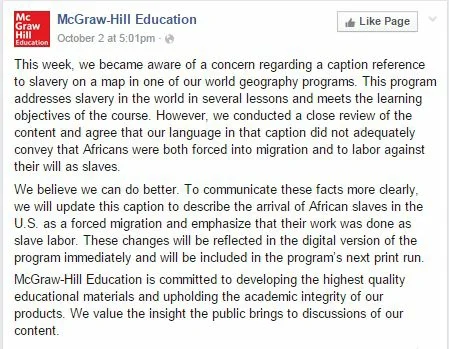
The publisher issued a statement.
McGraw-Hill President and CEO David Levin called the caption a "mistake" and wrote in a message to employees, "We are deeply sorry that the caption was written this way. While the book was reviewed by many people inside and outside the company, and was made available for public review, no one raised concerns about the caption. Yet, clearly, something went wrong, and we must and will do better."
Discussion Starters:
- What's your view of the "mistake"?
- How could the text get by so many reviewers?
- Analyze McGraw-Hill's two statements: the Facebook post and the CEO's quotation. What do you find effective, and what could be improved?