
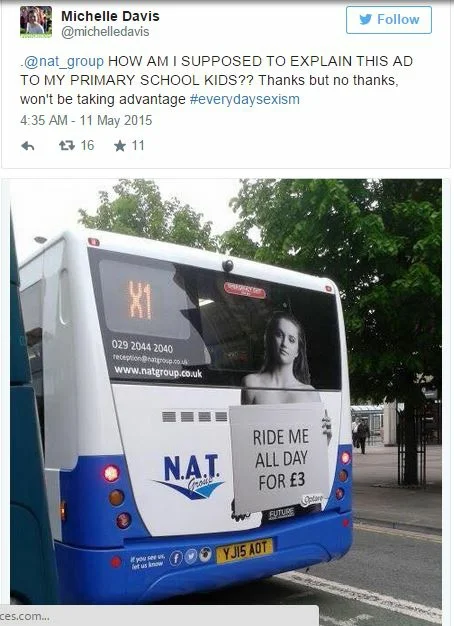
Welsh Bus Company Rethinks Sexy Ad
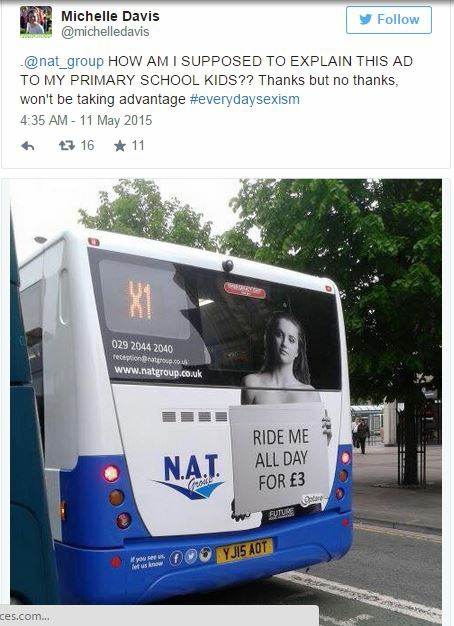 Are people just too sensitive, or did this Welsh bus company cross a line with its ad? The picture of a naked woman with a provocative line was created for a Cardiff, Wales, company promoting its cross-city service.
A representative for the Advertising Standards Agency reported 45 complaints and told Business Insider, "We've received complaints about this ad, but we understand that the advertiser will be taking it down within the next 24 hours and has removed its accompanying tweet in response to the concerns it's received. We'll continue to monitor the situation in case further action is needed."
On Twitter, New Adventure Travel promised to take down the ads:
In view of the reaction to our bus advertising today we wish to set out our position:
Firstly we have stated that our objectives have been to make catching the bus attractive to the younger generation. We therefore developed an internal advertising campaign featuring males and females to hold boards to promote the cost of our daily tickets.
The slogan of 'ride me all day for £3' whilst being a little tongue in cheek was in no way intended to cause offence to either men or women and, if the advert has done so then we apologise unreservedly. There has certainly been no intention to objectify either men or women.
Given the volume of negativity received we have decided to remove the pictures from the back of the buses within the next twenty four hours.
Discussion Starters:
- What's your view? Is this just a catchy ad and people are too sensitive? Or is the ad potentially offensive?
- What, if any, cultural differences are at play? How do you think this would be received in the United States?
- How do we decide what "crosses a line"? What criteria do you use to form your opinion?
- Did New Adventure Travel do and say the right thing?

RBS Executive Leaves After Snapchat Photos Become Known
 Rory Cullinan, the chairman of the Royal Bank of Scotland's investment bank, will leave the company by agreement. The news followed shortly after Snapchat images became publicly known.
Last year, Cullinan sent his daughter Snapchats with captions saying, "Not a fan of board meetings xx," "Boring meeting xx," and "Another friggin meeting." Snapchats don't last-unless, of course, someone takes a screenshot and posts them to Instagram, as his daughter did, with the message, "Happy Father's Day to the indisputable king of Snapchat."
Cullinan was with the bank for six years but in his current role for only two months. The Telegraph reported that critics didn't think McEwan took his role seriously, particularly because the bank is mostly owned by the government. RBS CEO Ross McEwan gave this statement:
"We would like to express our thanks to Rory for his very significant contribution to the rebuild of RBS over the past 6 years. He has built and led APS, Non-Core, RCR and recently completed the very successful follow-on sale of Citizens post its IPO last year. We wish him every success in the future."
Cullinan said, "I am pleased and proud to have played a significant part in restoring RBS to a safe and sound agenda over the past 6 years. I wish all my colleagues continued success."
In his defense, someone wrote on the Telegraph site: "Personally I think any sane well adjusted adult would find those sort of meetings boring. If there any grounds for criticism it is that he didn't cut the number of unnecessary meetings typical in large banks."
Discussion Starters:
- Was it the right decision for Cullinan to leave the bank after six years? Why or why not?
- What's your view of the comment about boring meetings in large banks?
- In what ways, if at all, does it matter that the bank is mostly government owned?
- Does anyone else find it strange for a father to send such messages to his daughter and for her to post them on Instagram?
Facebook's Community Standards
Facebook provided more detailed "Community Standards," which include the social network's approach to government requests. Requests for data and to restrict content were up to 35,051 in 2014.
The new guidelines specify what's acceptable and unacceptable in four categories:
- Keeping you safe (e.g., self-injury, bullying and harassment)
- Encouraging respectful behavior (e.g., nudity, hate speech)
- Keeping your account and personal information secure (e.g., authentic identity, fraud and spam)
- Protecting your intellectual property.
The Community Standards are particularly relevant this week, as a Penn State fraternity was suspended for having photos of nude women and other offensive images on "secret" Facebook pages.
Discussion Starters:
- What is the purpose of the Community Standards? Identify three or four specific communication objectives. Consider all of Facebook's many constituencies.
- Which of the Standards do you find most and least clear?
- Assess the video above. What's your view of the content and graphics?
Hillary Clinton Discusses Personal Email Situation
At a news conference, Hillary Clinton describes how she used her personal email account while she was Secretary of State, a position she left two years ago. Clinton says she used one account (one device) for all emails for "convenience."
Her view is that work-related emails were sent to .gov accounts, so they are saved. For others, she says she followed the federal guidelines that "for any government employee, it is that employee's responsibility to determine what's personal and what's work related."
Clinton says she regrets not using two separate devices but is glad that her personal email will become public. She sounds confident that no wrongdoing will be uncovered. According to The New York Times, about 30,500 personal emails have been given to the State Department in December, but another 32,000 have been deleted.
The Times article also questioned her explanation of wanting to carry just one device:
"Mrs. Clinton's explanation that it was more convenient to carry only one device seemed at odds with her remark last month, at a technology conference in Silicon Valley, that she uses multiple devices, including two kinds of iPads, an iPhone and a BlackBerry. She said then: 'I don't throw anything away. I'm like two steps short of a hoarder.'"
Discussion Starters:
- How do you think this controversy might affect Clinton's pending candidacy for president?
- What's your view of The Times' criticism of her carrying just one device, although she says she doesn't throw old devices away. Is this the same thing?
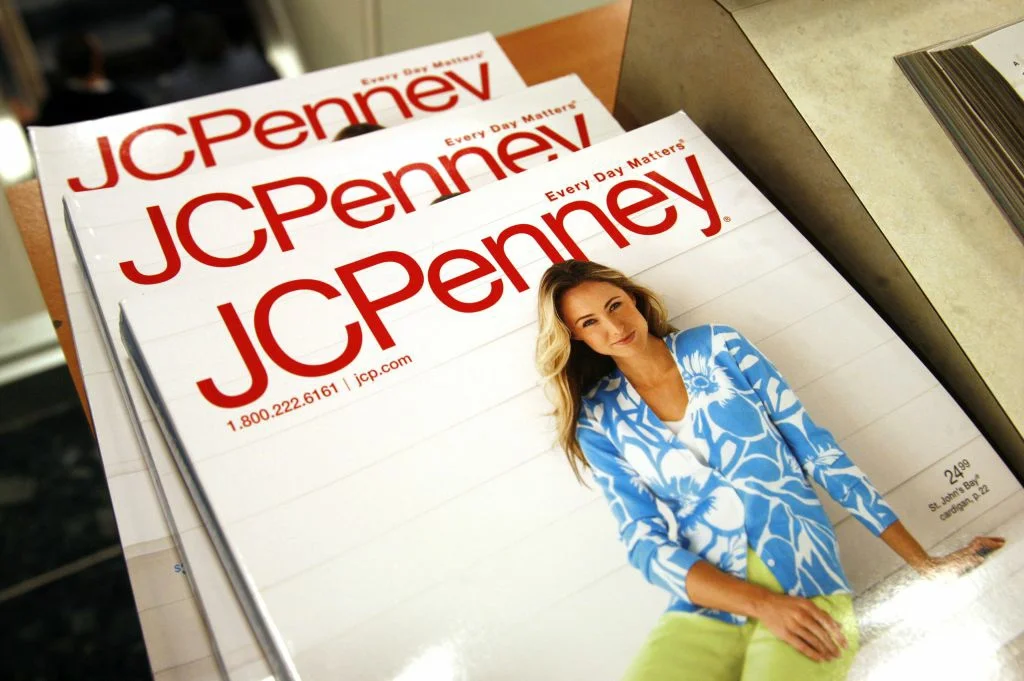
Print Lives (at JCPenney)
 JCPenney is bringing back its hefty (120-page) print catalog. After reviewing data from online sales, the company recognized that, although people bought online, they were inspired by print photos.
It's been six years of focusing on web marketing, but the Consumerist explains the turnaround:
"The catalog has been revived by the executive who killed it off in the first place, chairman and CEO Myron Ullman. The company assumed that catalog shoppers would switch to making their purchases online, as they have at other retailers. That wasn't the case: Ullman says that the company discovered that many online sales actually began when the customer was flipping through a catalog offline."
The Consumerist compares JCPenney's strategy to Restoration Hardware's. I'm not on the mailing list, but apparently the company distributes a 17-pound catalog.
Discussion Starters:
- What are the company's considerations in bringing back the catalog? Why do you think the management team discontinued it six years ago?
- How do you see print and online ordering working together? What's your own process for shopping on the web?
Facebook Time, Multitasking, and Students' Performance
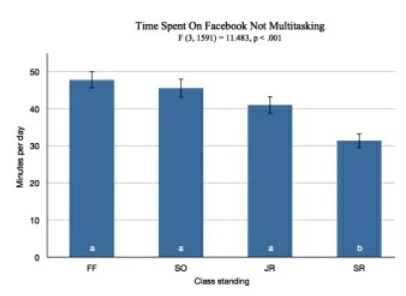
 A study published in the Journal of Applied Developmental Psychology correlates time spent on Facebook and multitasking with poorer academic performance. An Iowa State researcher studied 1649 active student users, and found that seniors spent less time on Facebook and less time multitasking than freshmen, sophomores, and juniors.
Time spent on the site was negatively predictive of freshmen's GPA, and multitasking was negatively predictive of GPA for all ranks but seniors.
Discussion Starters:
- What, if anything, about these findings surprise you?
- The respondents attended Iowa State University. Do you think the results would differ at other universities?
- What cautions would you raise about the findings?
McDonald's "Signs" Campaign
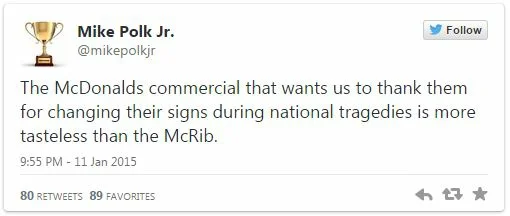
McDonald's is trying another tact for improving business. The latest marketing campaign, "Signs," shows the company standing by the community in times of tragedy.
McDonald's is certainly taking different approaches from simply promoting the taste of its food. The previous campaign focused on how food is made-an attempt at transparency, which worked for some but not everyone. The same could be said of this one.
Steve McKee, president of an ad agency in Albuquerque, complimented the approach: "I thought the ad was awesome. It's clear that all the billboards were real. It was demonstrating that McDonald's is Americana." Some say the ads distinguish McDonald's from Wendy's, Chipotle, and Burger King, which couldn't make such claims.
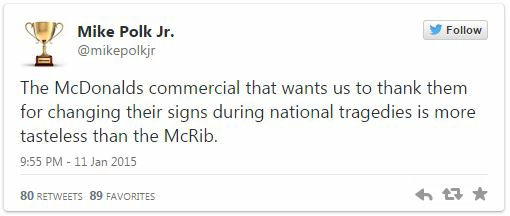
But others say the company is capitalizing on tragedy. And of course, any campaign is an opportunity for ridicule.
Discussion Starters:
- Describe the ad strategy. What objectives is McDonald's trying to achieve?
- What's your view of the campaign: tasteless, clever, or something else?

Study: Check Email Less Often
 A new study from the University of British Columbia's psychology department tells us to stop checking email so frequently. The study asked one group of subjects to turn off their email alerts and check email only three times a day for a week. Another group was told to check email as many times as they would like. Then, the groups switched for a second week.
Published in Computers in Human Behaviour, the study showed that checking email leads to feelings of stress and tension. Subjects answered the following questions:
- How often have you felt that you were unable to control the important things in your life?
- How often have you felt nervous and stressed?
- How often have you found that you could not cope with all the things that you had to do?
- How often have you been angered because of things that were outside of your control?
Discussion Starters:
- Do these results surprise you?
- How realistic is it to check email just two or three times a day at work?
- What could you do to limit the number of times you check email throughout the day?
Ogilvy Apologizes for Distasteful Ad
Ad agency Ogilvy & Mather has apologized for an offensive ad produced for Kurl-on, an Indian mattress company. What could go wrong when portraying a 14-year-old Taliban shooting victim in a cartoon?

The company wanted to show that heroic figures "bounce back," but the ad doesn't quite work. The New York Times describes Malala Yousafzai, featured in the promotion:
"At the age of 11, Malala Yousafzai took on the Taliban by giving voice to her dreams. As turbaned fighters swept through her town in northwestern Pakistan in 2009, the tiny schoolgirl spoke out about her passion for education - she wanted to become a doctor, she said - and became a symbol of defiance against Taliban subjugation."
Two other ads in the series aren't much better. Steve Jobs is shown pushed out a door, and Gandhi is thrown from a moving train.
Before this one hit paid media outlets, online news organizations flagged the image. Although Kurl-on hasn't responded to inquiries, Ogilvy issued this statement:
"We deeply regret this incident and want to apologize to Malala Yousafzai and her family. We are investigating how our standards were compromised in this case and will take whatever corrective action is necessary."
Discussion Starters:
- How do Kurl-on and Ogilvy share responsibility for the ad? How did this happen?
- The ad was created in Ogilvy's Indian office and produced in a Chilean studio. How, if at all, do these facts affect your thinking about the ad?
Uber's Questionable Ethics
Uber's senior vice president of business Emil Michael made a mess for the company. At a dinner in NYC, Michael suggested paying $1 million to research information about members of the media: "your personal lives, your families." Michael's comments were directed particularly to Sarah Lacy, who wrote a scathing article about sexism and misogyny at Uber. BuzzFeed notes that this comment comes on the heels of Uber's commitment to improve its image and relations with the media.
A BloombergBusinessweek article notes Uber's history of retaliating against people who speak against it. Although later reinstated, a driver's account was deactivated after he posted a negative tweet about the service.
In a statement through his publicist, Michael, who said he thought his remarks were off the record, apologized:
"The remarks attributed to me at a private dinner-borne out of frustration during an informal debate over what I feel is sensationalistic media coverage of the company I am proud to work for-do not reflect my actual views and have no relation to the company's views or approach. They were wrong no matter the circumstance and I regret them."
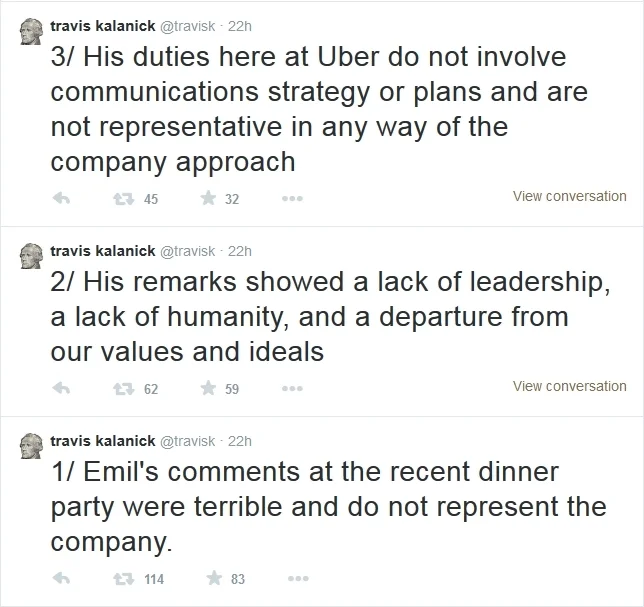
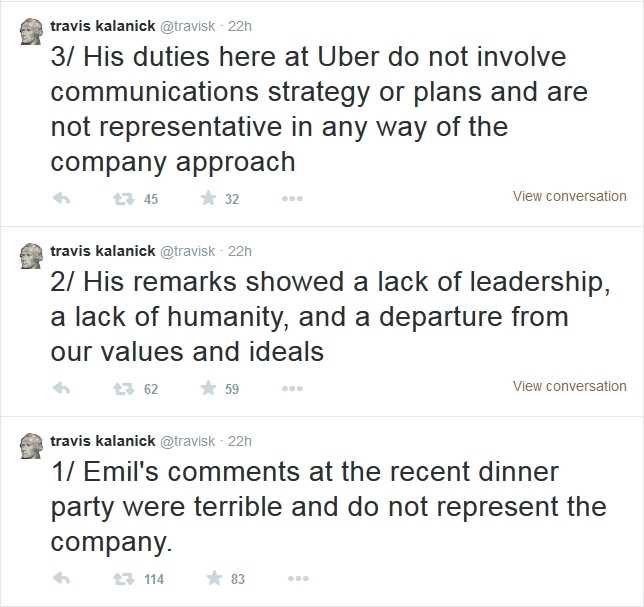
In 13 tweets, Uber CEO Travis Kalanick explained the company's position.
Tweet 14 apologized to Sarah Lacy.
Uber's head of communication also weighed in via Twitter: "We have not, do not and will not investigate journalists. Those remarks have no basis in the reality of our approach."
Discussion Starters:
- Was it unrealistic for Michael to consider his comments at a dinner "off the record," or did the journalist at the table act inappropriately?
- What should Uber do to regain trust?
- Should Michael be fired?
Arguments over a $3,750 Bottle of Wine
 When a diner at Bobbie Flay Steak at the Borgata in Atlantic City heard the price of a wine, he thought it was $37.50, not $3,570. The host asked Joe Lentini to order a bottle, and here's how he explained the situation to NJ.com:
"I asked the waitress if she could recommend something decent because I don't have experience with wine. She pointed to a bottle on the menu. I didn't have my glasses. I asked how much and she said, 'Thirty-seven fifty.'"
Lentini then tasted the Screaming Eagle, Oakville 2011, from the sommelier: "It was okay. It was good. It wasn't great. It wasn't terrible. It was fine."
Borgata executive vice president Joseph Lupo insists that protocol was followed:
"As the leading culinary destination in this region, we consistently serve as many, if not more high-end wine and spirits without incident. In this isolated case, both the server and sommelier verified the bottle requested with the patron."
Lupo also said:
"Due to these factors along with very detailed accounts from multiple sources regarding the incident, Borgata is confident there was no misunderstanding regarding the selection. We simply will not allow the threat of a negative story that includes so many unaccounted and questionable statements to disparage our integrity and standards, which Borgata takes great pride in practicing every day."
The wine list shows wines in the hundreds but plenty in the $30 - $50 range too. The Screaming Eagle was by far one of the most expensive wines in the restaurant.
Discussion Starters:
- Some believe the server should be held responsible. What do you think? Does seeing the wine list influence your thinking?
- What should guests do to avoid this situation? What should servers do?
Google Teaches Employees About Unconscious Bias
In talks and videos, Google is teaching its employees about unconscious bias. Puzzled by its lack of employee diversity, the company has identified bias as a possible contributor. SVP of People Operations Laszlo Bock is leading the effort based on research from Yale University, which found that, "science professors at American universities widely regard female undergraduates as less competent than male students with the same accomplishments and skills."
An employee video asks, "What would the world like like if everybody were aware of the stereotypes that they have and the biases that they have?"
The initiative, further explained on Google's blog, encourages people to take four steps to reduce bias:
- Gather facts.
- Create a structure for making decisions.
- Be mindful of subtle cues.
- Foster awareness. Hold yourself - and your colleagues - accountable.
Discussion Starters:
- Watch the video. What messages do you find useful, and which are not? What could improve the video for employees?
- What's your view of Google's approach? Will it help the company reach its objectives, in part, to increase the number of women in leadership positions?
Microsoft CEO Regrets Comment About Women and Raises
Don't worry about pay, women, trust that the system will work. That was Microsoft CEO Satya Nadella's suggestion during an interview at the Grace Hopper Celebration of Women in Computing on Thursday:
"It's not really about asking for the raise but knowing and having faith that the system will actually give you the right raises as you go along. And that, I think, might be one of the additional superpowers that quite frankly women who don't ask for a raise have, because that's good karma. It'll come back because somebody's going to know that's the kind of person that I want to trust, that's the kind of person that I want to really want to give more responsibility to. And in the long term efficiency, things catch up."
In addition to backlash on social media sites, Nadella's comment caught heat from a New York Times reporter who appropriately reminded us of the research:
"Women are paid less than men, and one reason is that women are less likely to negotiate for raises or promotions. They feel more anxiety about negotiating and are less likely to consider job situations to be negotiable, according to Linda Babcock, an economics professor at Carnegie Mellon University and a leading researcher on women and pay negotiations."
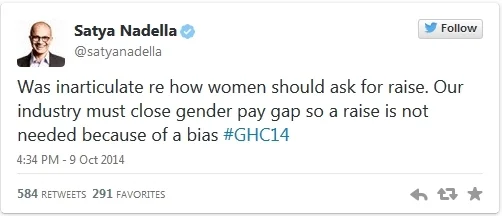
In an email to employees and in a tweet, Nadella said he regretted his comment.
From: Satya Nadella
Sent: Thursday, October 9, 2014 5:24 PM
To: Microsoft - All Employees (QBDG); Retail: All FTE
Subject: RE: Empowering OthersAll - Today I was interviewed on stage by Maria Klawe at the Grace Hopper Conference - I encourage you to watch the video. It was great to spend time with so many women passionate about technology. I was honored to be a part of it and I left the conference energized and inspired.
Toward the end of the interview, Maria asked me what advice I would offer women who are not comfortable asking for pay raises. I answered that question completely wrong. Without a doubt I wholeheartedly support programs at Microsoft and in the industry that bring more women into technology and close the pay gap. I believe men and women should get equal pay for equal work. And when it comes to career advice on getting a raise when you think it's deserved, Maria's advice was the right advice. If you think you deserve a raise, you should just ask.
I said I was looking forward to the Grace Hopper Conference to learn, and I certainly learned a valuable lesson. I look forward to speaking with you at our monthly Q&A next week and am happy to answer any question you have.
Satya
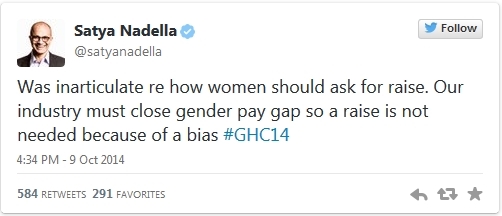
Update: Nadella apologizes again in an email.
Discussion Starters:
- Assess Nadella's original comment during the interview. Do you agree with him?
- Now assess his apology. In what ways does this change your thinking about his comment?
Teens Continue to Dismiss Facebook
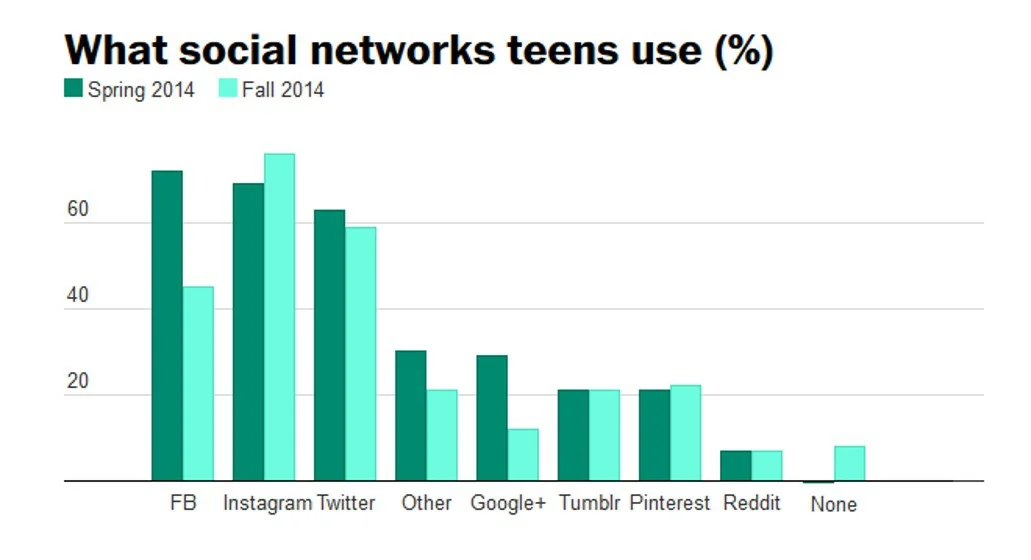
The slide continues: In a new report cited in the Washington Post, only 45% of teens between 13 and 19 years of age use Facebook. The article warns that "teen whims are as volatile as Twitter's trending hashtags," but this trend is not new. Use has been rather steadily declining long before Facebook executives admitted the phenomenon in November 2013.
Are teens reading more books? Of course not. They are flocking to newer sites, such as Twitter and Instagram, which can both now claim a higher percentage of teen usages than can Facebook.
Discussion Starters:
- Should the trend worry Facebook executives? Why or why not?
- How does the changing demographic affect companies' presence on Facebook. What would you advise a company such as Abercrombie on its social media use?

NLRB Ruling on "Likes"
 The National Labor Relations Board has ruled on another social media case in which employees were terminated for posting about their employer in social media. In this case, the NLRB upheld the court decision that Triple Play Sports Bar and Grille wrongfully terminated two employees.
The employees had responded to this Facebook post by a former employee:
"Maybe someone should do the owners of Triple Play a favor and buy it from them. They can't even do the tax paperwork correctly!!! Now I OWE money…Wtf!!!"
One current employee "liked" the post and another commented, "I owe too. Such an a**hole." Both were fired.
The NLRB protects employees' rights to concerted activity, meaning they can discuss issues, such as pay and working conditions, with other employees. "Mere griping" or simply bad-mouthing an employer or customers typically is not protected.
What's significant about this case is it's the first NLRB ruling that addresses and protects simply "liking" a post.
The NLRB also ruled that Triple Play's Internet/blogging policy was too broad. Employers cannot prevent employees from making any negative comments about a company online.
Discussion Starters:
- Research other cases when the the NLRB has ruled for or against an employer when an employee has posted online. What themes emerge?
- Why do you think "concerted activity" is protected? What does that mean?
Latest Email Stats
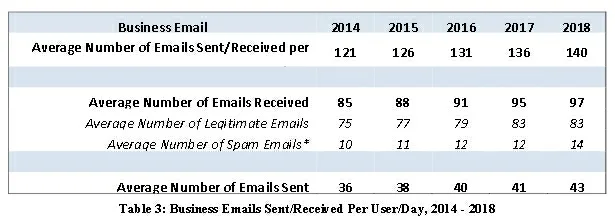
The Radicati Group has published its annual email statistics report. The executive summary highlights these survey findings:
- Email is still "the most pervasive form of communication in the business world." Social networking and mobile IM, particularly, are increasing, but "email remains the most ubiquitous form of business communication."
- Most email traffic is from business; consumer email is slowing.
- Business users send and receive an average of 121 emails per day, and this number is expected to increase through 2018.

Discussion Starters:
- What, if anything, about these figures surprise you?
- How can business users manage the number of emails they send and receive? What other tools are available to them?
Professor Bans Email
 Spring-Serenity Duvall, assistant professor of communications at Salem University, got tired of responding to students' emails:
"For years, student emails have been an assault on professors, sometimes with inappropriate informality, sometimes just simply not understanding that professors should not have to respond immediately. In a fit of self-preservation, I decided: no more. This is where I make my stand!"
With her department head's approval, Duvall banned all emails from students unless they are writing to schedule a meeting with her. In her course syllabus, she explains her rationale:
"E-mail: You should only use email as a tool to set up a one-on-one meeting with me if office hours conflict with your schedule. Use the subject line "'Meeting request.' Your message should include at least two times when you would like to meet and a brief (one-two sentence) description of the reason for the meeting. Emails sent for any other reason will not be considered or acknowledged. I strongly encourage you to ask questions about the syllabus and assignments during class time. For more in-depth discussions (such as guidance on assignments) please plan to meet in person or call my office. Our conversations should take place in person or over the phone rather than via email, thus allowing us to get to know each other better and fostering a more collegial learning atmosphere."
According to Duvall, the ban has been successful: She spends less time responding to minor emails and more time talking with students on the phone or in her office. She has made one exception to the policy and allows students to email course-related content.
Discussion Starters:
- What's your view of Duvall's new policy? How would you react as a student?
- The top comment on the story was, "95% of the emails you receive as a professor can be answered by ‘read the syllabus.'" Do you agree with this statement?
A Tribute to Kathy Berggren
My friend and colleague Kathy Berggren died suddenly last week, a terrible shock to the Ithaca community. Kathy taught courses in the communication department at Cornell for more than 20 years and recently moved to a management communication position at the Dyson School.
Although Kathy served in this role for only one semester, she already made her mark. She built the program from scratch, creating a practical course to develop students' personal and professional communication skills. From this semester and from her many in the communication department, it's hard to say how many students would call her "mentor."
Perhaps Kathy's greatest contribution was her work with teaching assistants. She mastered the large lecture, which many business and management communication faculty resist, by developing a cadre of students who could teach and coach other students. Her comprehensive guide for teaching assistants should help sustain the course now that she's gone.
One of the many modules Kathy taught exceptionally well was an "elevator pitch." I'm guessing that thousands of students can sell themselves within minutes because of Kathy's guidance.
As a frequent Facebook poster, Kathy might enjoy the outpouring of comments on her page. Friends and family are posting memories and photos for everyone to enjoy. I found out about her death from a mutual friend who texted me about some Facebook posts. And so goes our communication world today.
As a colleague, I'll miss Kathy's forwarded articles, including recommendations for BizCom in the News. I know she found this blog useful as a teaching tool, and I'm glad for that.
As a friend, I'll miss Kathy's direct communication. She set me straight on more than one personal issue I was whining about. I told her that I have many friends who will empathize with me but too few who will tell me what to do when it's clear what must be done.
I regret never seeing Kathy work with students directly. I imagine they benefited from her delicate balance of caring for people regardless of their ability and telling them what they needed to hear. I know I did.
Fake Facebook Accounts of MH17 Victims
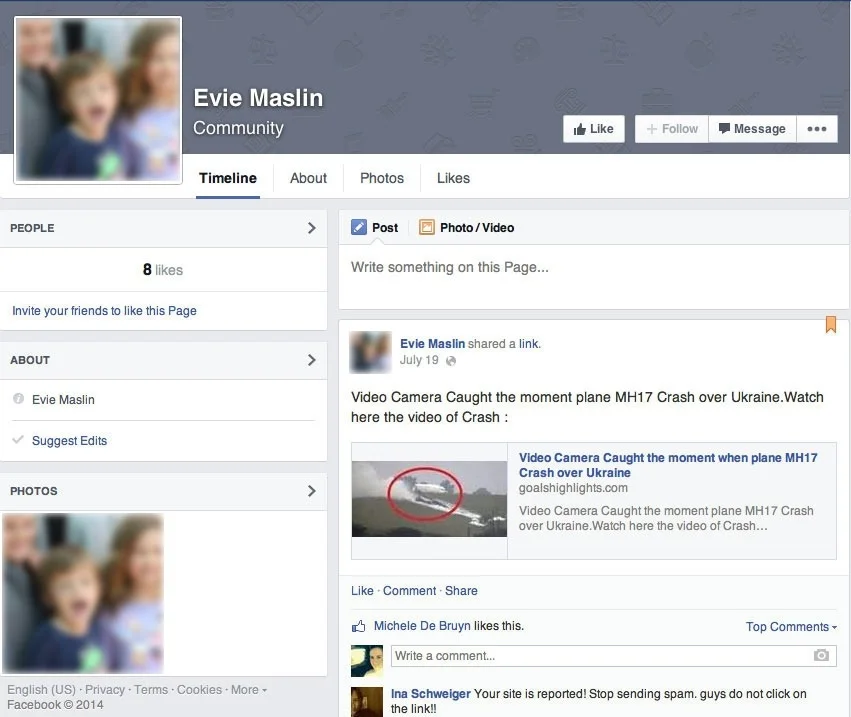
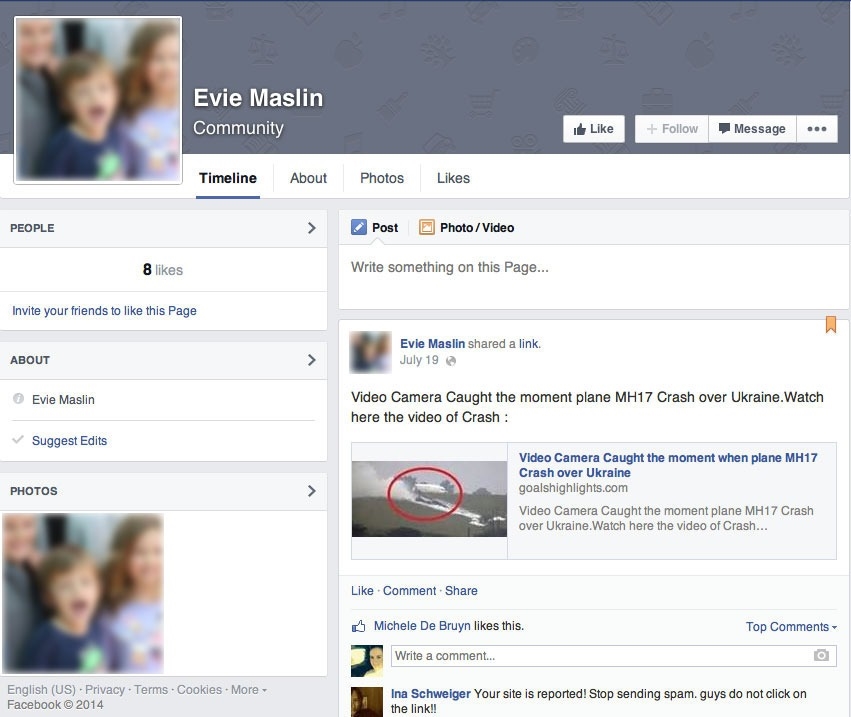 If the downing of Malaysia Airlines flight MH17 and the looting of victims' belongings at the crash site didn't depress you enough, here's more news. Several fake Facebook pages were set up in the names of Australian victims of the crash.
Among the accounts were three pages created in the names of children who died in the crash. When clicked, video images open external pop-up ads for gambling, sex, and counterfeit drug sites.
Although early reports said Facebook wasn't taking action and couldn't until the sites were proven illegal, the company has since taken them down. A Facebook spokesperson said, "We are disabling these profiles as soon as we are made aware of them. We encourage people to block those responsible and report suspicious behaviour to our team of experts via our reporting buttons so that we can quickly take the appropriate action."
Discussion Starters:
- What are the potential consequences of Facebook's decision to remove these pages? Why would the company not act immediately?
- If the creators of these pages were caught, what would be appropriate action against them?
NPR Tweets DO Reflect on the Organization
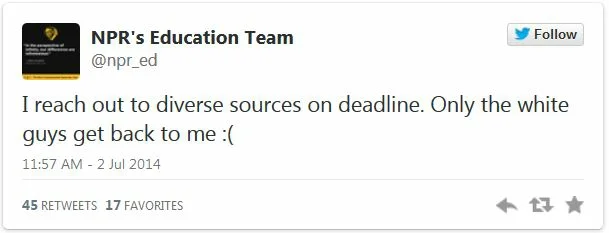
A National Public Radio employee got her hand slapped after tweeting from @npr_ed (NPR's Education Team):
Anya Kamenetz apologized, saying that her tweets don't reflect on the public radio station. But NPR executives don't agree. In response, NPR Standards & Practices supervising editor sent this email to employees:
From: Mark Memmott
Sent: Tuesday, July 08, 2014 2:24 PM
To: News-All Staff
Subject: Reminder: There Is No Privacy On The Web, And ‘Personal' Pages Are Not Safe Zones
"If you wouldn't say it on the air, don't say it on the Web."
That's been the basic guidance for quite a few years.
In reality, Twitter and other social media sites allow us to show more of our personalities than we might on the air or in a blog post.
BUT, though the words may be on "personal" Twitter or Facebook accounts, what we say can reflect on NPR and raise questions about our ability to be objective.
Matt Thompson offers a test. Before posting something about your work or a news event or an issue, even if you're putting it on what you think of as a personal page, ask this question: "Is it helping my journalism, or is it hurting my journalism?"
Here's a bit more from the Ethics Handbook:
"We acknowledge that nothing on the Web is truly private. Even on purely recreational or cultural sites and even if what we're doing is personal and not identified as coming from someone at NPR, we understand that what we say and do could still reflect on NPR. So we do nothing that could undermine our credibility with the public, damage NPR's standing as an impartial source of news, or otherwise jeopardize NPR's reputation. In other words, we don't behave any differently than we would in any public setting or on an NPR broadcast."
Also, despite what many say, retweets should be viewed AS endorsements. Again, from the handbook:
"Tweet and retweet as if what you're saying or passing along is information that you would put on the air or in a ‘traditional' NPR.org news story. If it needs context, attribution, clarification or ‘knocking down,' provide it."
The email provides sound advice for people representing the organization, perhaps even when they're not representing the organization.
Discussion Starters:
- PR Daily asks readers good questions for business communication students: "Do tweets, even from personal accounts, reflect on employers? Do retweets equal endorsements?"
- @NPR is another Twitter handle, but there are no tweets about this incident. Should the account holder have written something? If so, what?