
The Amazon cargo flight crash at Miami International Airport provides a useful crisis communication case study. Here are statements as of September 8, 2026, from the many involved parties.
For students to analyze responses, they might review text from Business Communication and Character, Chapter 7:
How a company responds depends on the type of crisis—victim, accidental, or preventable. A victim crisis involves an event, for example, a hurricane, that is beyond a company’s control. In an accidental crisis, for example, an equipment failure, the company has more responsibility, and in a preventable crisis, for example, financial impropriety, the company has full responsibility (Tachkova and Coombs, Communicating in Extreme Crises: Lessons from the Edge, 2022, 35–42).
Investigations will reveal how to categorize the crisis but, regardless, we know that five people on the ground were killed and five injured (three in critical condition), so the reputational stakes are high for companies’ responses. Flight 7598A, operated by 21 Air LLC for Amazon Air, was a 32-year-old Boeing 767-33 (a converted freighter); because an operator, major brand, and manufacturer are involved, a lot of fingers could be pointed.
Here is what we see so far.
Local Authorities News Conference: The primary goal for this public news conference is to ensure safety. The first two speakers don’t introduce themselves, but they are the sheriff and mayor, who doesn’t add much except to thank people for their work. The fire chief provides more details, emphasizing his team’s work in rescue and fire safety in the “very complex situation.”
National Transportation Safety Board (NTSB): One communication goal is to build credibility for the investigation and, later, confidence in its findings. Chair Homendy leads the conference, first explaining who they are and what they do. At around 1:44, she stops to offer condolences. Demonstrating compassion, her delivery is heartfelt (much more so than in the local news conference). She also thanks first responders. She provides details about the situation, for example, that the aircraft struck the vehicles. She explains their process, emphasizing “fact-based information” and building credibility for the agency and their work. This part is rather detailed, listing which team will analyze which data. At about 15:00, she describes the scene as “utter devastation” and “hard to see.”
She doesn’t address a question about speed, but public information now shows the plane exited the runway at 112 knots, which is about 129 miles an hour.
Her response at 19:00 is masterful and worth watching. She balances reassuring people about safety with conveying compassion, while emphasizing that recommendations must be implemented.
Amazon: A primary communication objective may be to distance itself from the flight operator (that is, to shift blame). A company statement posted on the corporate news site mentions "operated by 21 Air” and plans to “coordinate with 21 Air.” Otherwise, the statement offers condolences, as it should, and little else at this point. The first statement includes, “This is a fast-moving situation,” which may be a poor choice of words considering the plane speed would be questioned.
21 Air: Like Amazon, the company says little but posts a notice (signed by the CEO) on its website—on the homepage. Clearly, it’s the most significant news for the company, which promises updates on that same page as information becomes available. The primary communication objectives may be to avoid drawing any more attention to itself than necessary and to reduce speculation before investigations are complete. Curiously, the statement says nothing about the pilots, who were trapped in the cockpit and hospitalized (and then released). Students might question the reason for the omission and draft ways the company might acknowledge the pilots’ condition without assigning responsibility for the crash.
Boeing: No stranger to a crisis, Boeing has no news release on its website and no post on X. Certainly, Boeing leaders would want to avoid the situation entirely and hope this plane isn’t to blame. Like 21 Air, leaders want to reduce speculation. A Reuters article includes only this: “Boeing and 21 Air said they would support the government investigations into the crash.”
A CBS News report questions 21 Air’s safety record. Pilots claim the company fails to provide enough rest between flights, discourages safety complaints, and defers plane maintenance. If these allegations are true, they might point to a preventable crisis for the company, which affects the communication strategy.
When asked about these claims, an Amazon spokesperson demonstrated a distancing strategy:
We'll defer to the NTSB regarding the circumstances of their investigation and to 21 Air regarding these allegations that pre-date our relationship with the company.
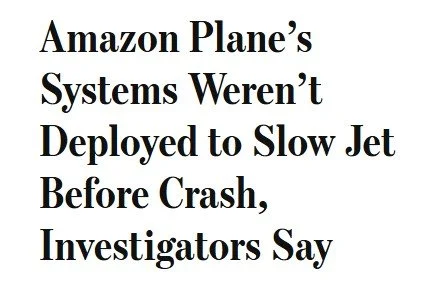
Article headlines like this Wall Street Journal’s indicate that Amazon has more work to do in distancing itself.
We’ll see what the NTSB concludes and what, if any, blame may rest with Amazon.