
ChatGPT created a timeline (below) illustrating the evolution of Ms. as a courtesy title. Students might be interested in the history and The New York Times’ resistance to using it.
Letters from the early 1970s between Gloria Steinem and Abe Rosenthal explain her rationale for using Ms.—to match Mr., which doesn’t indicate marital status. Finally, in 1986, Rosenthal announced the paper would use Ms., noting that the term had become widely accepted. (Fun facts: Rosenthal was asked to retire two weeks after the decision, and Hillary Clinton asked the paper to use Mrs. before her name.)
Do we need the courtesy title at all? For students writing cover letters, we advise using full names when a gender is unknown, and the same logic seems to apply when marital status is unknown or irrelevant, which is probably always. In 2000, the AP Stylebook eliminated courtesy titles with a few exceptions. The guideline is to write only the person’s last name after writing the full name, as I have done in this blog since its inception in 2010. The Wall Street Journal stopped using courtesy titles in 2023, leaving The Times, as The Washington Post called it, “the most notable holdout.”
To be fair, the Times dropped these titles for much of its pop-culture coverage in 2018. The rest of the paper could follow.
Reading the history below (not fact checked), students might wonder why a gender-neutral singular pronoun hasn’t stuck in similar fashion. They has become a widely acceptable substitute, but attempts at thon, and ze, s/he haven’t. Both Ms. and singular they existed before their recent popularity. A pronoun like ze is a new entry and requires new multiple forms, while they and its multiple forms (them, their) already exist (although we know the plural-for-singular grammar is difficult for some to accept).
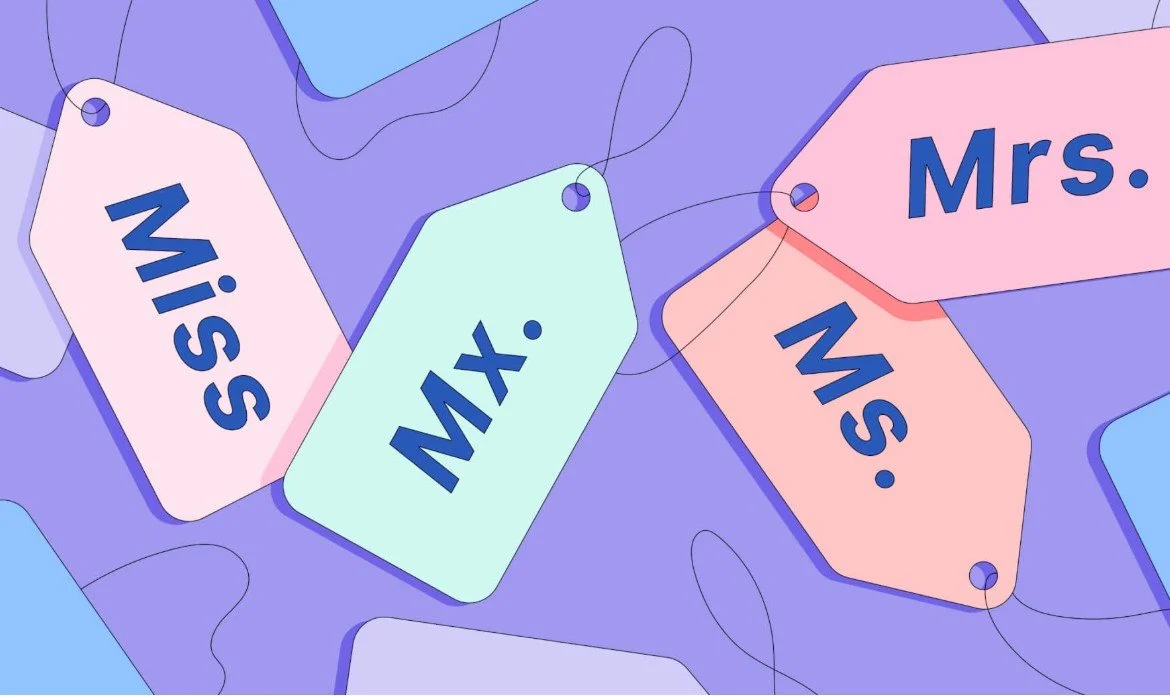
Mx., revealing neither gender nor marital status, never took off either, although The Times used Mx. for a short time for individual cases on request. The associate masthead editor for standards at the time explained the rationale in 2015, including this guiding principle:
In this as in other areas of language and usage, The Times is not looking to lead the way, set the rules or break new ground. Our hope is to reflect accepted, standard usage among educated readers.
Fair enough, but perhaps the paper doesn’t want to be behind either.
A Brief History of “Ms.” [not fact checked]
Today, Ms. is a familiar title for a woman, regardless of whether she is married. But the history of the term is older—and more complicated—than its association with the women's movement of the 1970s suggests.
From Mistress to Miss and Mrs.
The story begins with mistress, the feminine counterpart of master. In earlier English, mistress was not necessarily a reference to a woman's marital status. Over time, however, mistress was shortened into forms including Miss and Mrs., and by the nineteenth century the two titles had acquired distinct meanings: Miss generally referred to an unmarried woman, while Mrs. referred to a married woman.
Men, meanwhile, had a single standard title: Mr. Their title did not reveal whether they were married.
1901: The first modern “Ms.”
The idea of a marriage-neutral title appeared in print much earlier than is commonly assumed.
In 1901, the Springfield Republican in Massachusetts proposed Ms. as a useful title for a woman when her marital status was unknown or irrelevant. The newspaper even suggested that it be pronounced “Mizz.”
The proposal was essentially a practical one: rather than having to choose between Miss and Mrs., writers could use a title that avoided the question altogether.
This is the earliest known example of Ms. in essentially its modern sense.
The idea resurfaces
The proposal did not immediately catch on. Nevertheless, Ms. periodically appeared during the first half of the twentieth century, particularly as a suggested solution for business correspondence when the writer did not know whether a woman was married.
In 1949, linguist Mario Pei discussed Ms. as a possible combination of Miss and Mrs. The term was still unusual, however, and it remained largely on the margins of standard usage.
Sheila Michaels and the women's movement
The modern history of Ms. changed in the 1960s.
In 1961, feminist and civil-rights activist Sheila Michaels encountered “Ms.” on a mailing label. At first she assumed it was a typographical error. She soon recognized the significance of the term: it offered women a title that did not define them according to whether they were married.
Michaels began advocating for Ms. as part of the emerging women's movement.
In 1969, she discussed the term on a New York radio program. Among those who heard her was Gloria Steinem, who later helped bring the title to a much larger audience.
1972: Ms. magazine
The decisive moment came in 1972, when Ms. magazine was launched.
The magazine deliberately used Ms. to challenge the assumption that a woman's marital status should be part of her public identity. Its name helped transform a little-known, decades-old abbreviation into a symbol of women's equality.
The distinction was important:
The women's movement did not invent “Ms.” It gave an existing but obscure term a new social and political significance.
The 1901 proposal was primarily about convenience and uncertainty—What should I call a woman if I don't know whether she is married?
The feminist movement reframed the question:
Why should a woman's title have to tell you whether she is married at all?
1970s–Today
During the 1970s, Ms. increasingly entered mainstream American usage, with “Mizz” becoming its standard pronunciation. Dictionaries began recognizing it as an established courtesy title.
In 1986, The New York Times adopted Ms. in its news and editorial usage, an important indication that the title had moved beyond its feminist origins into conventional American English.
Today, Ms. is widely used as a neutral title for women. It is particularly useful when marital status is unknown, irrelevant, or intentionally not disclosed.
The evolution in one line
Mistress → Miss / Mrs. → Ms.
But the history of the final step is worth remembering:
1901: Ms. proposed as a practical, marriage-neutral title
↓
1960s: Sheila Michaels revives and advocates for the term
↓
1972: Ms. magazine popularizes it nationally
↓
1980s onward: Ms. becomes mainstream usage
↓
Today: Ms. is the standard title for a woman without reference to marital status.
The larger significance
The history of Ms. illustrates how language can change in response to changing ideas about social identity.
The word itself is old. Its meaning as a statement of equality is newer.
What began in 1901 as an elegant solution to a problem of etiquette eventually became, through the women's movement, a challenge to the assumption that a woman's marital status should be publicly encoded in the way she is addressed.