

Wells Fargo Blames a Manager

An investigation led by Wells Fargo's board into the practices that led to thousands of false accounts blames Carrie Tolstedt, the former head of the retail division:
The root cause of sales practice failures was the distortion of the Community Bank's sales culture and performance management system, which, when combined with aggressive sales management, created pressure on employees to sell unwanted or unneeded products to customers and, in some cases, to open unauthorized accounts.
The report also says the former CEO John Stumpf was "too slow" to investigate possible issues. The report is public on Wells Fargo's website.
Tolstedt's lawyers dispute the allegations. Stumpf once referred to Tolstedt as the "best banker in America." Reuters reported:
Tolstedt was perceived by high-level employees as having the support of Stumpf, with whom it was considered best to avoid raising problems with.
"Stumpf was ultimately responsible for enterprise risk management at Wells Fargo, but was not perceived within Wells Fargo as someone who wanted to hear bad news or deal with conflict," the report said.
Duke Law School Professor James Cox told Reuters, "There's a tremendous amount of pressure from regulators to throw someone under the bus. If they don't, then Wells Fargo is going to be even more in the crosshairs."
In a statement, "Wells Fargo Statement Regarding Board Investigation into the Community Bank's Retail Sales Practices," CEO and President Tim Sloan summarized actions the bank has taken: // <![CDATA[ // <![CDATA[ // <![CDATA[ // <![CDATA[ // if this line executes, then javascript is turned on and we'll therefore remove the no-js class from the HTML tag document.documentElement.className = document.documentElement.className.replace(/(^|\s)no-js(\s|$)/, '$1$2'); // ]]> // ]]> // ]]> // ]]</p></div>
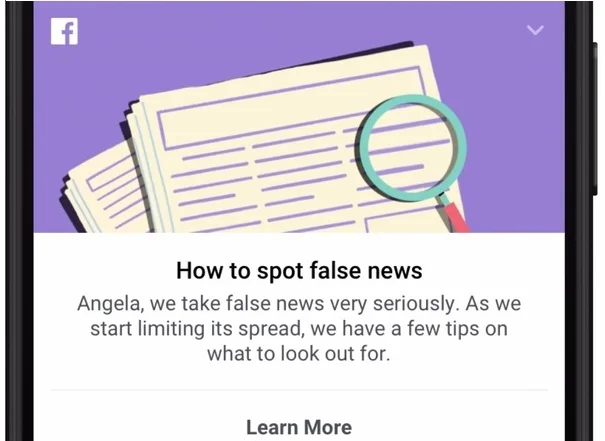
New Facebook App for Spotting Fake News
 Facebook is launching a new app for spotting what the company is calling "false news and hoaxes." In a blog post titled "A New Educational Tool Against Misinformation," the company explains the new tool:
We know people want to see accurate information on Facebook – and so do we. False news and hoaxes are harmful to our community and make the world less informed. All of us have a responsibility to curb the spread of false news.
At Facebook we have been focusing on three key areas:
- disrupting economic incentives because most false news is financially motivated;
- building new products to curb the spread of false news; and
- helping people make more informed decisions when they encounter false news.
Facebook and Google has been under pressure to address the increasing number of offensive and incorrect posts on their sites. This is Facebook's latest strategy to take responsibility and address the criticism that such sites are not doing enough.
The tool offers the following advice:
1. Be skeptical of headlines. False news stories often have catchy headlines in all caps with exclamation points. If shocking claims in the headline sound unbelievable, they probably are.
2. Look closely at the URL. A phony or look-alike URL may be a warning sign of false news. Many false news sites mimic authentic news sources by making small changes to the URL. You can go to the site and compare the URL to established sources.
3. Investigate the source. Ensure that the story is written by a source that you trust with a reputation for accuracy. If the story comes from an unfamiliar organization, check their "About" section to learn more.
4. Watch for unusual formatting. Many false news sites have misspellings or awkward layouts. Read carefully if you see these signs.
5. Consider the photos. False news stories often contain manipulated images or videos. Sometimes the photo may be authentic, but taken out of context. You can search for the photo or image to verify where it came from.
6. Inspect the dates. False news stories may contain timelines that make no sense, or event dates that have been altered.
7. Check the evidence. Check the author's sources to confirm that they are accurate. Lack of evidence or reliance on unnamed experts may indicate a false news story.
8. Look at other reports. If no other news source is reporting the same story, it may indicate that the story is false. If the story is reported by multiple sources you trust, it's more likely to be true.
9. Is the story a joke? Sometimes false news stories can be hard to distinguish from humor or satire. Check whether the source is known for parody, and whether the story's details and tone suggest it may be just for fun.
10. Some stories are intentionally false. Think critically about the stories you read, and only share news that you know to be credible.
Discussion:
- To what extent do you think this will address the concerns about fake news?
- Which of the suggestions for spotting fake news do you find most and least helpful? Which are more obvious than others?
- What else, if anything, should Facebook do?