
This Tweet Brought to You by Dos Equis
To promote its "Legend of You" app, Dos Equis hired a comedian to tweet.
When Michael Ian Black ("The State" and "Ed") tweeted that the new app turned him into "a Most Interesting Person," his 1.9 million followers knew it was a paid advertisement. Black's other tweets are funny (depending on your sense of humor).
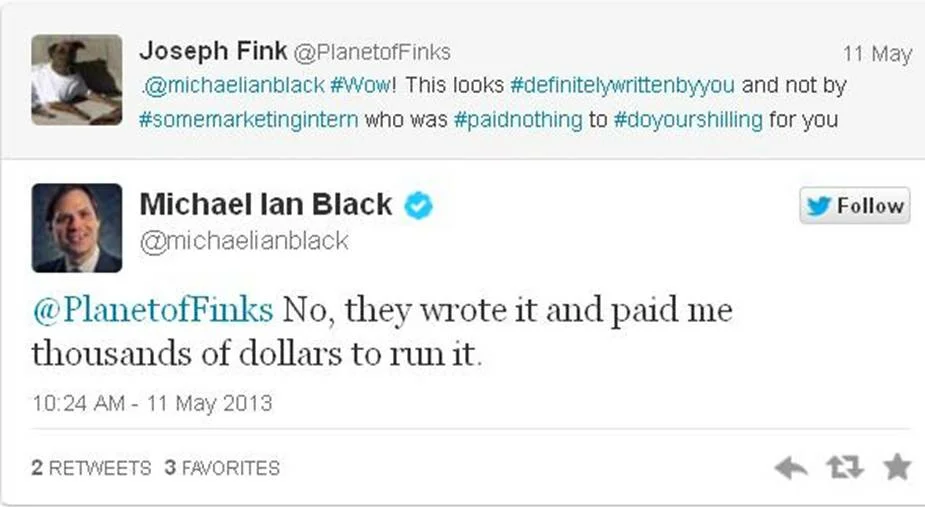
The backlash was harsh, with one tweeter saying, "I wish you had died in 9/11" and another criticizing Black for using language that an unpaid intern probably wrote. Black responded to some tweets, such as this one:

You have to admire Black's honesty, but I wonder how his employer feels about it.
Discussion Starters:
- What advice would you give to companies considering paying for tweets? Should they not do this at all, or can safeguards be put in place?
- If you were the marketing manager for Dos Equis, would you hire Black again to promote your products? He did get a good discussion going...
Abercrombie CEO Faux Pas
CEO Mike Jeffries has surprised and disturbed people with his alleged comments about customers in 2006, which just became public:
"We go after the attractive all-American kid...A lot of people don't belong [in our clothes] and they can't belong. Are they exclusionary? Absolutely."
The comment has been interpreted to mean that plus-sign people aren't welcomed in the store, and this may be substantiated by the retailer's inventory: no pants size is larger than 10.
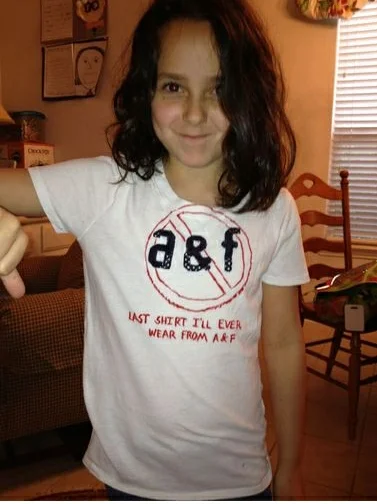
Public reaction has been strong. As of yesterday, about 1,000 people signed an online petition to boycott Abercrombie. And a nine-year-old in Plano, TX, altered her T-shirt to express her feelings:

Discussion Starters:
- As yet, the company has not responded to requests by ABC news. Should the corporate communication people say something? If so, what?
- What's your reaction to the CEO's alleged comment? Do you find it offensive, his right to define his customer, or something else?
JC Penney's Re- ReBranding Efforts
After rebranding and ousting its CEO, JC Penney is trying to lure customers back to the store. In a new commercial, the company says, "It's no secret that JC Penney changed" and admits that not everyone liked what they saw. The voiceover asks people to return, saying "We learned a very simple thing: to listen to you."
The CEO was in place for only 17 months, and by most accounts was a disastrous choice for the company. A former Apple executive, Ron Johnson implemented a strategy to target younger customers, and the company brought in hipper products and stopped running sales. But JC Penney's loyal customers were alientated in the process.
Will the new commercial and CEO (Mike Ullman, who preceded Johnson) turn the company around? Skeptics say it's a rough road: same-store sales were down 20% last year and are down 15% so far this year.
A writer for USA Today thinks the company is doomed:
"Either way, there is no reason that these customers will come back. J.C. Penney's share of the retail market is already permanently depressed.
"J.C. Penney is done for. The only party that has not admitted as much is management.
Discussion Starters:
- Assess the new commercial. How does the company use language, images, and music to convey its message?
- Which arguments in the commercial might convince customers to return to the store? Which may detract from the company's message?
Nike Pulls "Boston Massacre" T-Shirts
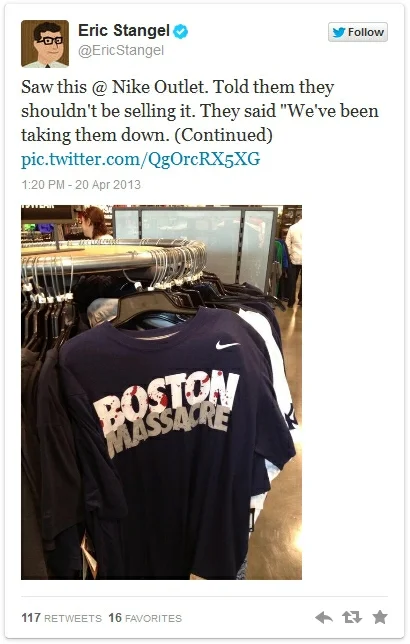
A "Boston Massacre" T-shirt showing splattered blood stains will mean only one thing to people now: the bombing tragedy at the Boston Marathon. But this Nike T-shirt is a reference to the Red Sox/Yankees baseball games in 1978 and 2006.
Still, some people feel the T-shirts should have been removed from the outlet store before being spied (and photographed) by a producer for the "David Letterman Show."

A Nike spokesperson emailed a response to the Huffington Post:
"The shirts being referenced are older baseball shirts that were predominantly being sold through our Factory Stores Outlets. In light of the tragedy in Boston we took immediate action last week to remove this product from distribution. We conducted this process as quickly as possible and are confident the product has been removed from distribution."
The situation is reminiscent of Nike T-shirts in a Boston store window sporting slogans such as "Dope" and "Get High." In this situation, the mayor of Boston wrote a complaint letter, but the company denied that it promoted drug use.
Discussion Starters:
- In what ways does the "Boston Massacre" T-shirt differ from the "Dope" and "Get High" T-shirts? How are they similar?
- How do you assess Nike's response? Should the company have done anything differently, or is this an understandable mistake?
Hyundai's Ad Mocking Suicide: Not Funny
Hyundai is apologizing for an ad that pokes fun at a failed suicide attempt. Proud of its new ix35 model that uses water rather than carbon monoxide emissions, the company played on a way that some people end their lives. But the ad didn't go over well, particularly for one woman, who lost her dad to this method of suicide.
Holly Brockwell wrote a touching blog post about her father's suicide and how the ad affected her. As a creative advertising director, Brockwell has good credibility for her reaction: 
"I understand better than most people the need to do something newsworthy, something talkable, even something outrageous to get those all-important viewing figures. What I don't understand is why a group of strangers have just brought me to tears in order to sell me a car. Why I had to be reminded of the awful moment I knew I'd never see my dad again, and the moments since that he hasn't been there. That birthday party. Results day. Graduation."
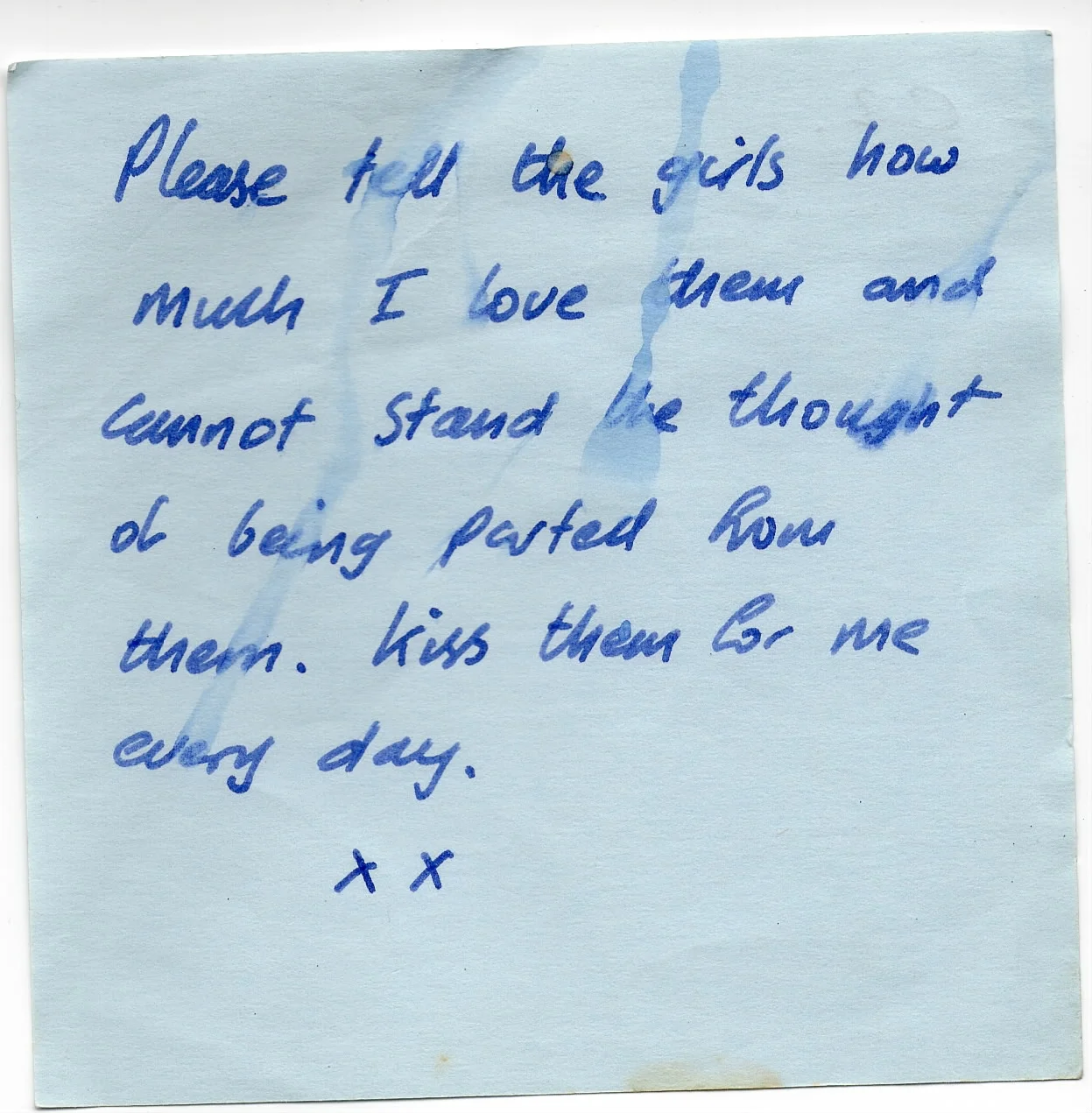
Brockwell also posted her father's suicide note, which has gone viral.
A week before Brockwell's blog post, AdWeek had criticized the ad. Apparently, a reporter contacted Hyundai but received no response. That was a warning the company should have heeded.
Now, after more bad press, Hyundai has pulled the ad from YouTube and issued these statements:
Hyundai Motor America Statement:
"We at Hyundai Motor America are shocked and saddened by the depiction of a suicide attempt in an inappropriate European video featuring a Hyundai. Suicide merits thoughtful discussion, not this type of treatment."
Hyundai Motor Company Statement:
"Hyundai Motor deeply and sincerely apologizes for the offensive viral ad.
"The ad was created by an affiliate advertising agency, Innocean Europe, without Hyundai's request or approval. It runs counter to our values as a company and as members of the community. We are very sorry for any offense or distress the video caused. More to the point, Hyundai apologizes to those who have been personally impacted by tragedy."
Discussion Starters:
- Hyundai's defense is similar to McDonald's, which was criticized for the subway ad mocking mental illness: the ads were created "without Hyundai's request or approval." Do you buy it?
- We haven't seen a response from Innocean, the ad agency. What, if anything, should they do?
Ethical Social Media Marketing After the Boston Bombings
An article by Augie Ray, director of social media for a Fortune 100 company, describes the ethics of social media marketing, and gives us several interesting examples from the Boston Marathon tragedy. In contrast to these companies that perhaps crossed an ethical line, recall El Pelon Taqueria, the restaurant that offered help and asked for nothing in return.
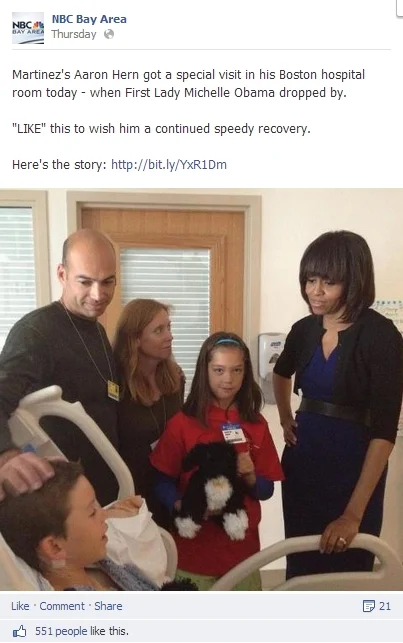
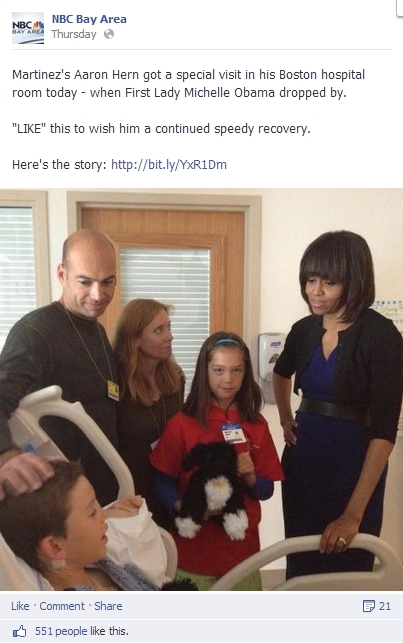
Calling it a "desperate attempt to trade on people's feelings," Ray described an NBC Facebook picture of a boy in a hospital bed. The post asks people to "'LIKE' this to wish him a continued speedy recovery." Ray points out that "liking" a post does nothing to help the boy recover.
In another example, Ray criticizes Ford for muddying a message with its products. According to Ray, "Ford's use of brand imagery not only reduced the sincerity of the message but demonstrated questionable ethics." For comparison, Ray presents Ford's actual post, at right, next to one without branding, at left. The difference is fairly obvious.

Individuals made mistakes as the tragedy was unfolding, too. Author Guy Kawasaki was criticized for continuing to post promotional tweets, as others were suspending theirs. Clearly, he didn't agree with the criticism. He responded, "Loving how people with less [sic] than 1,500 followers are telling me how to tweet."
Discussion Starters:
- How do you assess these three situations? Do you agree with the criticism of each?
- Augie Ray offers a sound suggestion for modifying the Ford post. Can you think of something similar for the NBC post? What might make this one more acceptable (read: more compassionate)?
Carnival Updates Guests with "Improvement" Plans
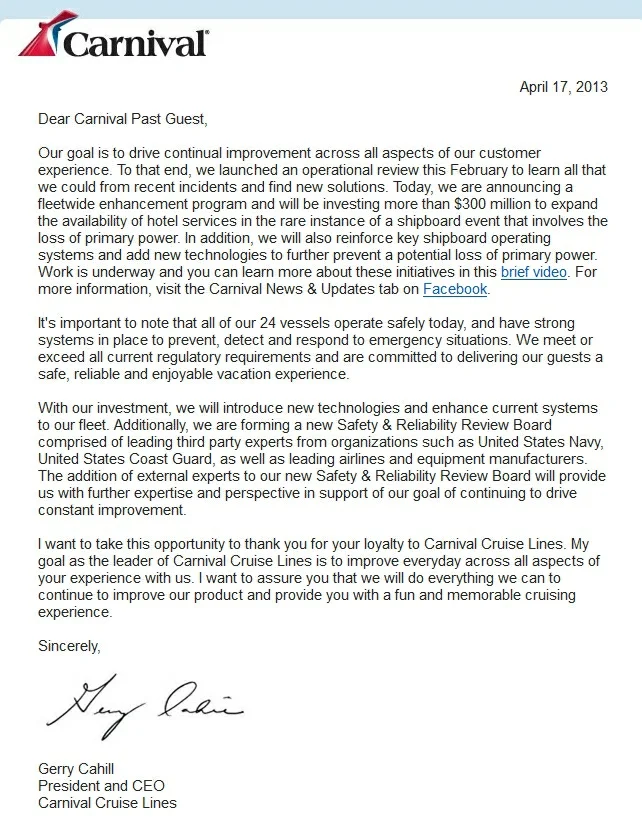
In a letter from CEO Gerry Cahill, Carnival tries to restore guests' confidence in the brand after several technical and other issues on ships during the past few months. In addition to this letter, Carnival has posted a video on YouTube and created a News and Updates page on Facebook.

In some respects, the letter is a confusing mess. Although the $300 million is more clearly explained in the video, this letter makes it sound as though Carnival is buying hotels: "$300 million to expand the availability of hotel services." Cudos to having some of the main point upfront ("Our goal is to drive continual improvement across all aspects of our customer experience"), but isn't much of the main point at the end, where Cahill thanks guests for their loyalty?
Also, the letter seems overly jargony for typical Carnival guests. The company just wants them to book another cruise, right? The encouragement could be clearer and more direct.
Discussion and Assignment Ideas:
- Compare Carnival's guest letter, video, and Facebook page. What differences do you see, and how do you account for them; for example, what are the audiences for each?
- Rewrite the Carnival letter. How can you improve the content, organization, and tone?
Student's Letter Stirs Up Controversy
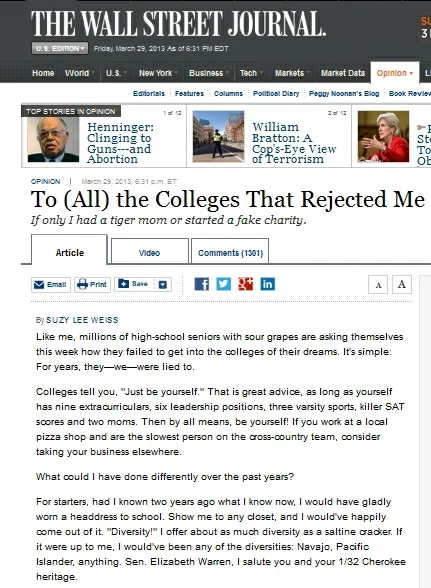
Like many high school seniors, Suzy Lee Weiss is receiving her share of college rejection letters. Disappointed-and clearly more than a little peeved-Weiss published a letter in The Wall Street Journal, "To (All) the Colleges That Rejected Me."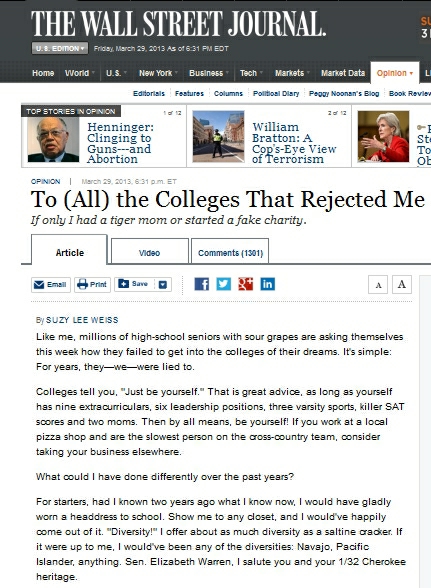
Weiss claims that her 4.5 GPA, 2120 SAT score, and experience as a U.S. Senate page weren't good enough. Partly, she blames her lack of diversity:
"For starters, had I known two years ago what I know now, I would have gladly worn a headdress to school. Show me to any closet, and I would've happily come out of it. 'Diversity!' I offer about as much diversity as a saltine cracker. If it were up to me, I would've been any of the diversities: Navajo, Pacific Islander, anything. Sen. Elizabeth Warren, I salute you and your 1/32 Cherokee heritage."
Jokingly, Weiss also blames her parents and uninflated job titles.
A student who claims "I took your spot at Harvard," wrote a snarky response to Weiss, including,
"But when my parents got divorced and my mom came out of the closet and hooked up with the ¼ Navajo lady neighbor, I closed my textbooks and put down my pen. I figured-why bother? I'm a black female from the inner city with divorced parents, a gay mother, and a part-Native American stepmother. Every college was going to recruit me like I had a great jump shot. . . .
"As for me-I'm set for life. Obama is president, racism has ended, and law schools have already come a-callin."
Discussion Starters:
- Although Weiss says it's just satire, some people read the piece as cynical and bitter. Are you with the 53% of Today Show viewers who said the letter was whiny? What's your view?
- Watch Weiss on the Today Show. How, if at all, does this change your opinion of her?
RBC Responds to Outsourcing Plans
The Royal Bank of Canada is under fire for replacing 45 employees with oversees workers. A representative of RBC admits that work is being moved to another supplier, and current employees are training their replacements. The company is looking for new jobs for the displaced workers, who will leave at the end of the month. The new supplier is iGATE Corp., an Indian multinational outsourcing firm.
In an interview, RBC HR chief Zabeen Hirji tried to explain that RBC isn't hiring the workers, and the workers aren't replacing RBC employees-just transitioning to the new staff. Both are tough sells. First, RBC hired the supplier who is hiring the workers (so they have some accountability). Second, having interim workers doesn't change the outcome: people are losing their jobs, and-as it appears-foreign workers will be doing the work. The reporter called the distinction "semantics" and said, "I get what you're trying to sell, but I'm not sure I'm buying it."
Criticism is high, particularly the concern that RBC is violating federal rules that foreign workers may not replace Canadian citizens. In response, the bank published a statement that said, "External suppliers with the right skills allow us to introduce new efficiencies, continually improve our service at reduced cost and reinvest in initiatives that enhance the client experience. Agreements with our suppliers include strict controls and ongoing monitoring to ensure full compliance with all regulatory requirements."
Public backlash is also high. A Facebook page, Boycott Royal Bank of Canada, has 7,600 likes.
Discussion Starters:
- Analyze Zabeen Hirji's interview. What does she do well, and what could be improved? What are her strongest and weakest arguments?
- Overall, do you buy RBC's position?
- One article referred to Hirji's "corporate-speak explanation and histrionic hand gestures." Do you agree with this characterization?
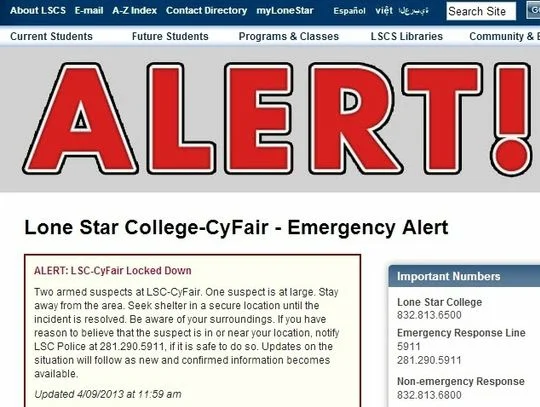
Lone Star College Communicates Stabbings
At least 14 students were stabbed on the Lone Star Community College campus near Houston, TX. One student critically injured two others, as he ran to different buildings, stabbing people with an Exacto knife. When the suspect, known only as "James," was tackled, he said, "I give up. I give up."
The college posted an emergency alert on its website, and the school went into lock-down, with students held in classrooms until more information was known.

The college told students, "Stay away from the area. Seek shelter in a secure location until the incident is resolved." This is sound advice and reminds us of Virginia Tech's emails during the 2007 shootings-although some of those messages came too late.
Discussion Starters:
- Assess the college's emergency web page. What works well, and what could be improved?
- What additional communications would you recommend that the college send to students, faculty and staff, alumni, and parents? What medium should be used for each group?
Carnival Responds to Yet More Ship Trouble
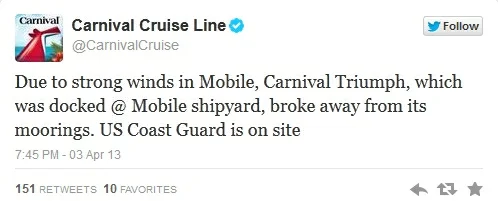
Are all of Carnival Cruise's recent ship problems unrelated? That's what the company would like the public to believe. Carnival's Triumph-which was stranded in Alabama last month-broke free from its moorings. Hurricane-link winds blew the ship from its anchors and threw two shipyard employees into the Mobile River. Although one man was found, another is still missing.
Although the crises are mounting for the cruise company, it's getting better at responding via social media. The company quickly tweeted about the situation and posted several updates throughout the day:

Carnival also posted this statement to its Facebook page:
April 3, 2013, 7PM ET
Earlier this afternoon, due to strong winds that reached speeds exceeding 70 miles per hour during a severe storm in Mobile, Ala., Carnival Triumph, which was in wet dock at a Mobile shipyard, broke away from its moorings. The ship drifted, and was secured.
With the assistance of tugboats on site, the ship has been moved to the Mobile Cruise Terminal. Lines have moored the ship, and, as a precaution, tugboats will remain alongside the vessel as well.
All of the approximately 600 crew and 200 contractors who were onboard the vessel are safe and have been accounted for through a roll call. There are no reports of injuries. While assessment of damage to the ship is ongoing, initial indications suggest the damage is limited.
According to reports, two shipyard employees on an adjacent pier fell into the water. One has reportedly been rescued by the U.S. Coast Guard and the search continues for the second. Our thoughts and prayers are with the missing shipyard employee and the family.
Discussion Starters:
- Assess Carnival's response on social media. How else is the company using Facebook and Twitter to communicate during this crisis?
- How can Carnival rebuild the brand and explain the recent incidents as separate and distinct from one another?
Rutgers Coach Gets Terminated—and Apologizes
Rutgers basketball coach Mike Rice was terminated for abusive behavior towards his players. The decision was a surprise only because it came months after Rice's suspension from the university.
The videos of Rice's interactions with players are shocking: throwing balls at them, pushing them, and calling them homophobic slurs. But the university's decision last year was to suspend him, fine him $75,000, and send him to anger management classes.
Only recently-within a day after a video of Rice became public-did the university decide to terminate his employment.
Athletic Director Tim Pernetti is taking responsibility for the initial decision:
"I am responsible for the decision to attempt a rehabilitation of Coach Rice. Dismissal and corrective action were debated in December, and I thought it was in the best interest of everyone to rehabilitate, but I was wrong. Moving forward, I will work to regain the trust of the Rutgers community."
Rice did apologize in this video interview:
New Jersey Governor Chris Christie weighed in on the situation:
"Rutgers has done the right thing by firing Mr. Rice, but that still doesn't resolve questions about how he was allowed to continue overseeing college students after this behavior first came to the attention of Rutgers administration last year.
"I'm puzzled as to how anyone could think Mr. Rice was someone who should be representing our state university on a national level.
"I expect a full and detailed explanation from the Rutgers administration as to why Mr. Rice was not dismissed sooner and how exactly that decision was made. If answers aren't forthcoming, we are prepared to do what's needed to get them for the people of New Jersey."
Discussion Starters:
- What's your view of the athletic director's statement: a noble admission, poor showing for a bad decision, or something else?
- How do you assess Governor Christie's statement? Why would a state governor insert himself in this situation?
Ford Regrets "Distasteful" Ads
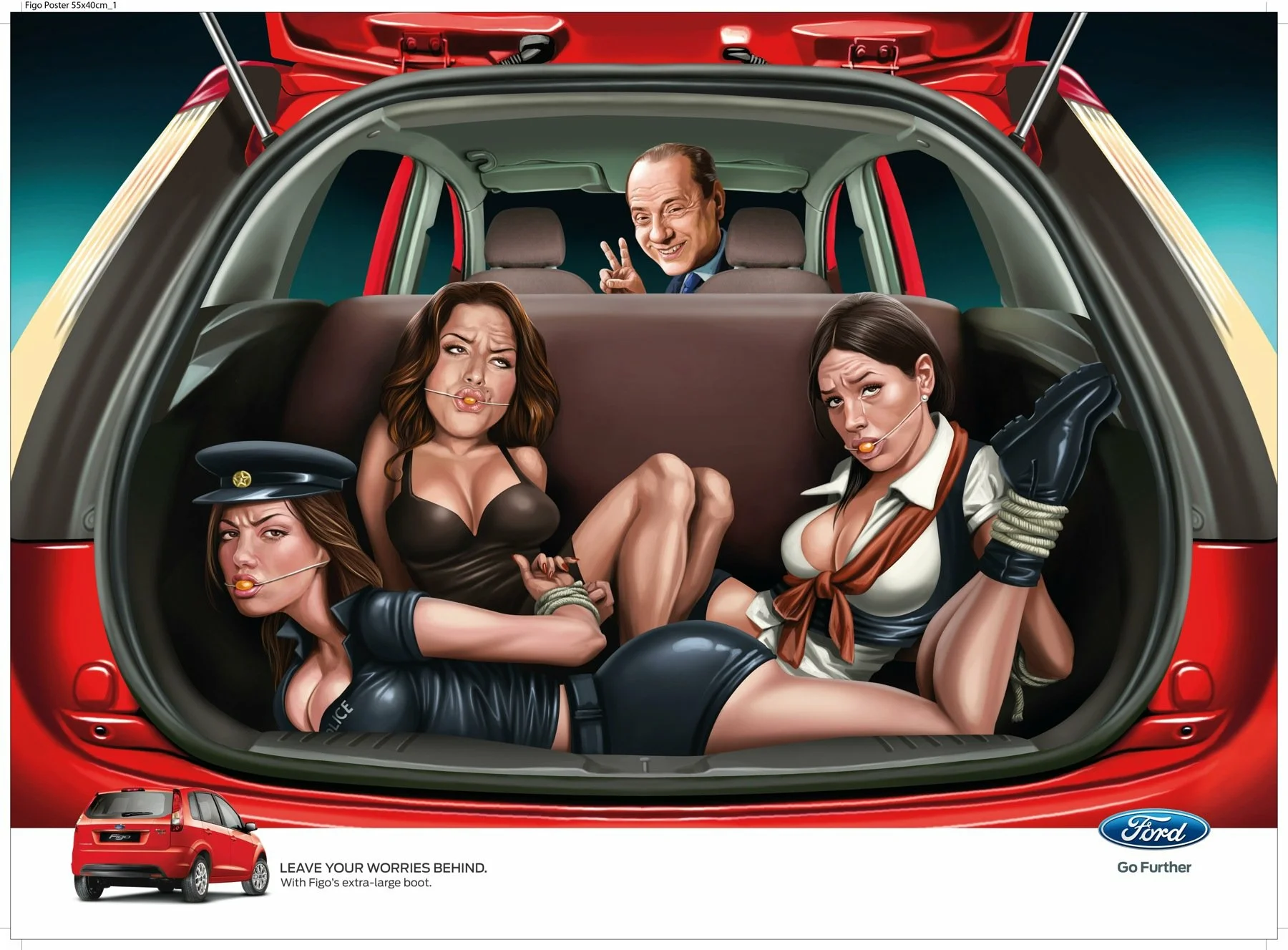
Ford is doing damage control after a PR firm created two ads showing a Figo truck with women tied up and gagged. In one ad, the driver is former Italian prime minister Silvio Berlusconi, in the other, Paris Hilton (with Kardashians in tow). The tag line for both ads is "Leave your worries behind with Figo's extra-large boot."
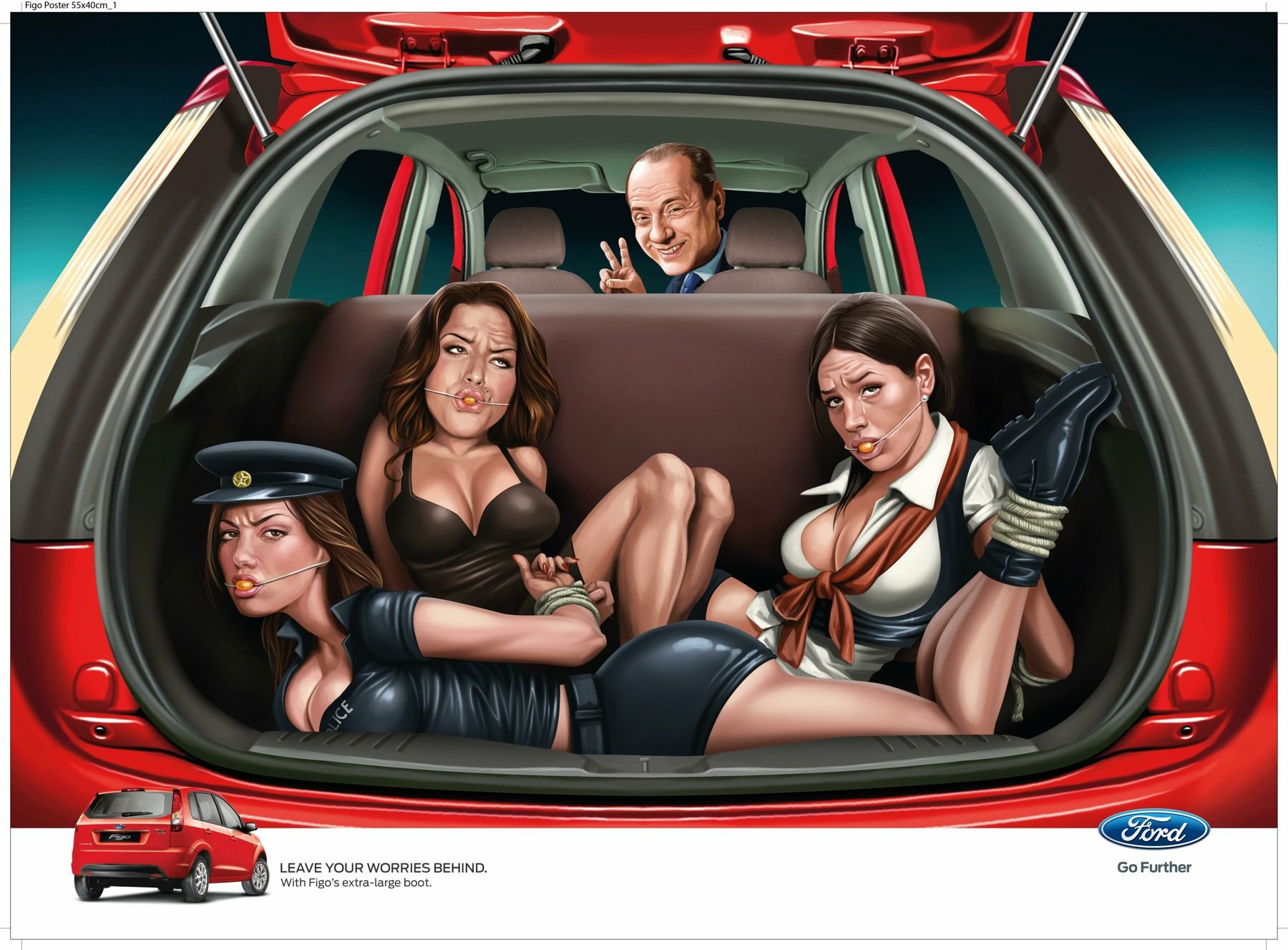

JWT India, the PR firm, admitted to creating the ads as mock-ups, or creative examples, without Ford's approval. Still, WPP, JWT's parent company repudiated the ads:
"We deeply regret the publishing of posters that were distasteful and contrary to the standards of professionalism and decency within WPP Group. These were never intended for paid publication and should never have been created, let alone uploaded to the Internet. This was the result of individuals acting without proper oversight and appropriate actions have been taken within the agency where they work to deal with the situation."
Although the company wasn't involved in the design, Ford submitted its own statement to explain the ads:
"We deeply regret this incident and agree with our agency partners that it should have never happened. The posters are contrary to the standards of professionalism and decency within Ford and our agency partners. Together with our partners, we are reviewing approval and oversight processes to help ensure nothing like this ever happens again."
Discussion Starters:
- Consider the view of JTW's creative team. What is possibly their defense of the ads?
- Assess the two companies' statements. In what ways did they handle the response well, and how could they have improved the response?
IRS Criticized for $60,000 Training Video
You would think that government agencies would learn the lesson that taxpayers don't like footing the bill for expensive training. About this time last year, the General Services Administration (GSA), which oversees purchasing and cost-cutting policies, was caught spending $822,000 at a conference in Las Vegas. Now, the IRS is being criticized for creating a $60,000 "Star Trek" parody video for leadership training.
When Miller refers to the "island theme," he means Gilligan's Island, of course.
Discussion Starters:
- What's your view of the IRS' video series: justifiable business expense, flagrant misuse of taxpayer dollars, or something else?
- What are alternatives for the IRS to get its points across? Could the agency use another approach for training on specific topics?

Hyundai Apologies for Ad Capitalizing on Murdered Baby
Hyundai Motor Company has apologized for a social media post linking car safety to a murdered two-month-old baby. The baby was abducted from an SUV and then strangled and buried in the snow. Of course, people were horrified by the event and took to Weibo, China's microblogging site for consolation and updates.
A post on Hyundai's Weibo account referenced the new Santa Fe SUV's safety features. The company says it was posted by a non-employee and has since deleted the post:
"A few thoughts following the Changchun stolen car and child incident: When buying a car it's completely okay to choose brands with better technology. Tianhe Buicks carry the OnStar GPS system, which can track down the location of a stolen vehicle at any time and automatically report it to the police. Feel at ease, have peace of mind, if you're going to buy a car, why not choose a completely safe Buick!!!. Sales Hotline: 024-86547880 86547881 QQ:521279389 2523275273 www.inthbuick.com"
In an email to Bloomberg, Hyundai apologized:
"We pledge to be more vigilant in managing our social networking service accounts, while we send our deepest condolences to the victim's family. Hyundai Motor is a responsible corporate citizen that is not in the practice of taking advantage of tragic incidents."
According to Bloomberg, GM has been more reluctant to comment:
"Dayna Hart, a Shanghai-based spokeswoman for GM, which owns the Buick brand, said the U.S. automaker is monitoring the situation and isn't ready yet to comment."
Aside from the egregious overuse of exclamation marks, the post does what other brands have regretted: "newsjack"-take advantage of news for the purpose of sales. Some strategies work well, such as Oreo's tweet during the Super Bowl. But many others have failed because of poor taste and inevitable backlash.
Discussion Starters:
- What other companies have tried newsjacking and failed?
- If you were consulting for a company, what criteria would you identify to help the management team decide whether to hook into something trending on Twitter or Weibo?
Carnival Responds to More Ship Trouble
Generator trouble on Carnival Dream, docked at St. Maarten, caused a problem no company wants to explain: non-working toilets, the second publicized incident for Carnival within the past month.
A discrepancy seems to exist between passengers' accounts and Carnival's position. According to CNN, passenger Gregg Stark said,
"There's human waste all over the floor in some of the bathrooms and they're overflowing -- and in the state rooms. The elevators have not been working. They've been turning them on and off, on and off."
Jonathan Evans, another passenger, emailed CNN:
"We are not allowed off of the boat despite the fact that we have no way to use the restrooms onboard. The cruise director is giving passengers very limited information and tons of empty promises. What was supposed to take an hour has turned into 7-plus hours."
But Carnival posted this message on its Facebook page:
"We know there have been questions on the conditions onboard Carnival Dream last night and wanted to update you. We have had multiple conversations with the ship's management team. Based on the ship's service logs and extensive physical monitoring of all public areas, including restrooms, throughout the night, we can confirm that only one public restroom was taken offline for cleaning based on toilet overflow and there was a total of one request for cleaning of a guest cabin bathroom. Aside from that there have been no reports of issues on board with overflowing toilets or sewage. The toilet system had periodic interruptions yesterday evening and was fully restored at approximately 12.30am this morning."
Discussion Starters:
- CEO Gerry Cahill gave a press conference during the recent Triumph situation. If he were to give another conference, how should this one be different? What can Cahill do to rebuild trust in the Carnival brand?
- Trouble started during the last part of a seven-day trip. The company is reimbursing passengers for three days of the trip and is offering half off a future cruise. Carnival has been criticized for insufficient compensation in the past. Is this deal appropriate?

Weight Watchers Employees Weigh in on Compensation
Frustrated by big payouts for celebrity endorsers, Weight Watchers employees have taken to airing their complaints on a message board hosted by the company.

The New York Times published an article highlighting the pay gap. As one employee said, "They know my love for the program, but I can't say we're treated right. We are professionals, we have to dress nice, but we are paid less than kids who work at McDonald's." As celebrities Jessica Simpson and Jennifer Hudson collect millions of dollars for their endorsements, many Weight Watcher employees are paid minimum wage.
Company CEO David Kirchhoff, responded to employees' complaints: "One of our top priorities is to improve your working life at Weight Watchers, and in particular, the way we reward you for the incredible work you do."
On his blog, Mr. Media Training, Brad Phillips speculates about what Weight Watchers could have done differently:
"I couldn't help thinking that Weight Watchers could have helped prevent this story from bubbling up to the surface simply by moderating their site more carefully. Sure, nothing would have stopped employees from complaining on third party websites, but it would have been much more difficult for them to communicate without a central website to visit, especially because the workforce is diffused and decentralized."
Discussion Starters:
- Do you agree with Brad Phillips' assessment?
- What else could the company have done differently to prevent employee sentiment from becoming public?
- How else could the company have managed employees' communications?
Travel Blogger Thrown Off United Flight for Taking Pics
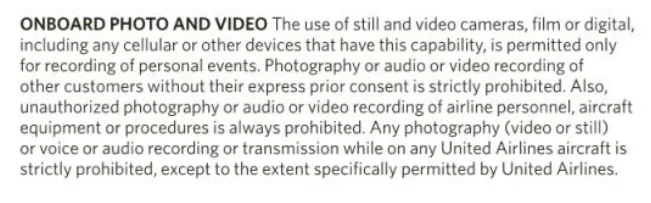
On a United Airlines flight from Newark to Istanbul, a passenger was asked to deplane after taking pictures of his seat and surroundings. A flight attendant asked Matthew Klint to stop using his camera, and pointed to this blurb in Hemisphere, United's in-flight magazine:
 According to Klint's version of events, he smiled at the flight attendant and stopped taking pictures. But, a while later, he did ask her to hang up his coat and continued the conversation:
"I want you to understand why I was taking pictures. I hope you didn't think I was a terrorist. Here is my business card [offering her one]. I write about United Airlines on an almost-daily basis and the folks at United in Chicago are even aware of my blog."
A Global Services representative then asked Klint to leave the plane: "The captain is not comfortable with you on this flight. You'll need to gather your things, and we'll find another way to get you to Istanbul." Klint then had a conversation with the captain, which you can read in Klint's blog post. During the conversation, the captain (apparently, not making eye contact) said that the flight attendant asked Klint to stop pictures, but he did not. Klint said, "Your FA is lying-I did not disobey any crewmember instruction." This continues to be a topic of debate.
Others on the flight seem to agree with Klint's telling of the story. In an NBC News article about the incident, Klint admits, "perhaps I should not have used the term ‘terrorist.'"
Klint has reported good contact with United, which is conducting an investigation. In the meantime, Klint has an interesting perspective on corporate apologies and says he doesn't expect one from United:
"At this point, United has not offered an apology and frankly I am not expecting one. An apology would reflect horribly on the pilot and FA and I do understand the delicacy of corporate apologies in general. United did express an appreciation for my loyalty and a desire to see me continue to fly on the carrier."
Well, Matthew, there are many types of apologies.
Discussion Starters:
- Based on Klint's version of the story, did United do the right thing? Could the airline have done anything differently?
- We haven't heard much from United yet. What could be the airline's position?
- How could United apologize without reflecting "horribly on the pilot and FA," as Klint says?
Arguments for Remote Workers
The buzz after Yahoo!'s come-to-the-office email hasn't died down yet. Business Insider has jumped on the critic-wagon, suggesting that Yahoo! take an approach similar to Google's.

In an article with the descriptive title, "Marissa Mayer Should Have Used Google's Excellent Argument To Bring Remote Workers Back," Business Insider reminds us that Google was Marissa Mayer's employer before she joined Yahoo!. Although she may have been inspired by the Google culture to encourage remote employees to come to the office, she missed some of the obvious persuasive arguments, according to writer Max Nisen.
Nisen highlights two differentiators between Yahoo!'s recent message and how Googlers are encouraged to and rewarded for coming to the office. In addition to emphasizing the "magical moments" that Google employees share when they are in the same space, Google offers significant benefits for employees to be in the same physical location: "great food, amazing offices, and great amenities."
Nisen also suggests that Yahoo! could sell the tax benefits to employees, particularly how the benefits save employees money. Perks offered in the office are considered fringe benefits and are not taxable income. He points to DealBook's Victor Fleischer's assessment of the tax benefits of working in an office:
"Suppose Abe works at Yahoo, makes $150,000 a year and is taxed at an effective 33 percent rate, thereby paying $50,000 in taxes. Bridget, by contrast, makes $120,000 and also enjoys $30,000 of untaxed fringe benefits.
"Bridget's tax liability is only $40,000 (33 percent of $120,000), meaning that she pays $10,000 (or 20 percent) less in taxes, yet received the same economic compensation as Abe."
Yahoo! could have done a better job of communicating its message. This could have saved some backlash for the company and perhaps have clarified the intent-and the benefits-of having employees come to an office.
For more about the benefits and challenges of remote workers, read Cornell ILR's summary.
Discussion Starters:
- How, if at all, do you think this suggested approach would have helped Yahoo! with the initial announcement?
- Other than the initial response of "This isn't a broad industry view on working from home. This is about what is right for Yahoo right now," we have heard little from Yahoo! since the controversy. What, if anything, should the company say at this point?
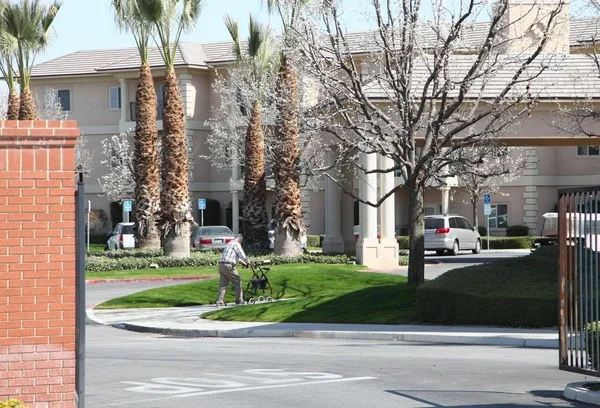
Facility Stands By Decision Not to Perform CPR
 An independent living center is defending a staff member who refused to give CPR to a woman who died.
At Glenwood Gardens in Bakersfield, CA, a staff member called 911 when 87-year-old Lorraine Bayless was found lying on the floor, not breathing and with no pulse. Fire dispatcher Tracey Halvorson asked the woman to administer CPR, but she refused. The facility didn't have a do-not-resuscitate order on file for Bayless.
According to the 911 tape, the fire dispatcher tried several times to get someone to administer CPR:
- "EMS takes the liability for this."
- "Is there a gardener? Or any staff? ... Can we flag someone down in the street and get them to help this lady? Can we flag a stranger down? I bet a stranger will help her."
- "Is there anybody there that's willing to help this lady and not let her die?"
In response to the last question, the staff member said, "Not at this time."
Christopher Finn, a spokesperson for Brookdale Living Center, which owns the facility, said that, although the staff member is a nurse, she was "serving in the capacity of a resident services director, not as a nurse." Finn also explained that Glenwood Gardens, "is an independent living facility, which by law is not licensed to provide medical care to any of its residents."
The executive director of Glenwood Gardens further stated, "In the event of a health emergency at this independent living community, our practice is to immediately call emergency personnel for assistance and to wait with the individual needing attention until such personnel arrives."
Discussion Starters:
- Based on the statements of Brookdale and Glenwood so far, do you find the staff member's refusal justified?
- What, if anything, else should the company representatives say about the incident?