
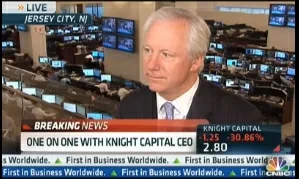
Knight Capital Group CEO Responds to Trading Glitch
Thomas Joyce, CEO of Knight Capital Group, has lost no time in addressing concerns about a trading software problem that almost doomed the company. The error caused price distortions in almost 150 stocks, and Knight lost $440 million in a half-hour. In total, Knight has lost 600 million shares.
Joyce has been vocal on business news programs, trying to rebuild confidence in Knight. Sources say he has been transparent about the error and about the company's decision to accept a cash infusion.
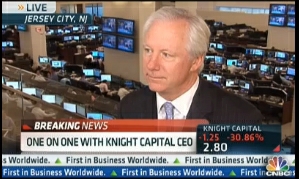 On CNBC, Joyce started on a positive note. He said that the industry has responded well to the crisis: "The wildly flattering thing was how our clients responded to us." Joyce then said that the company made clients the priority, admitting, "There was a problem. We took the consequences. None of our clients took the consequences. And, importantly, the industry didn't suffer."
Joyce also explained what happened: "Sadly, it was a very simple breakdown...an issue with trading technology... Right now, we're doing an internal investigation." Joyce was firm about coming up with solutions.
When Joyce was asked about an interaction with SEC chair Mary Shapiro, Joyce addressed the question directly. He admitted contacting her while on vacation to request that the SEC cancel some of the incorrect trades. She refused.
"She did what she thought was right for the industry... I'm kind of biased, I wish she had made a different decision, but she did what she thought was right..."
Discussion Starters:
- Watch Joyce's interview on CNBC.What strategies does he use to rebuild confidence in the firm?
- What non-verbal communication skills does Joyce use during the interview? Which are effective, and which, if any, are not?
Burger King's Response to Posted Photo
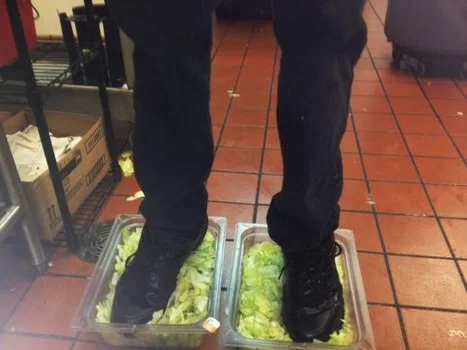
Reminiscent of the Domino's Pizza incident back in 2009, a Burger King employee photographed himself standing in two bins of lettuce. The image, posted in 4Chan, made the news rounds, and the poster was tracked down. Finding the employee wasn't too hard-GPS data was attached to the image, which was traced to a northern Ohio suburb.
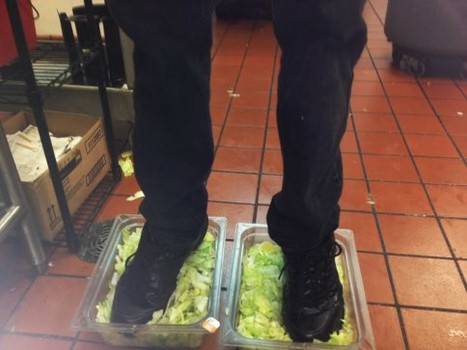
The Board of Health for the Mayfield Heights location confirmed that the restaurant "threw out all of the affected food on Saturday morning" and that the lettuce wasn't served to customers.
Burger King issued this statement in reponse:
"Burger King Corp. is aware of a photo that shows a BURGER KING® restaurant employee violating the company's stringent food handling procedures. Food safety is a top priority at all BURGER KING® restaurants and the company maintains a zero-tolerance policy against any violations such as the one in question.
"The restaurant where this photo was taken is independently-owned and operated by a BURGER KING® franchisee. The franchisee has taken swift action to investigate this matter and has terminated the three employees involved in the incident."
Discussion Starters:
- Burger King's statement could use editing. What are the two punctuation errors?
- What else could Burger King say to reassure customers?
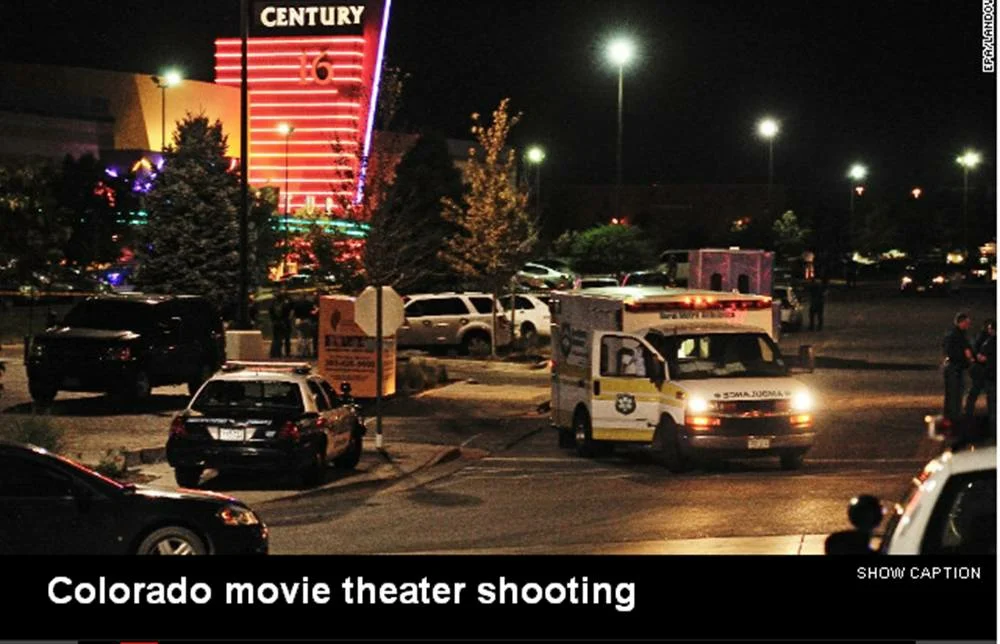
Theaters Respond to Colorado Shooting
After a terrible night at an Aurora, CO, movie house, theaters across the country are responding. Twelve people were killed and 59 were wounded during a midnight showing of "The Dark Knight Rises," the latest Batman movie. The gunman dressed in black and described himself as the Joker to police.

In response, Warner Bros. has cancelled the movie's planned premiere in Paris. The company also said, "Out of respect for the victims and their families, Warner Bros. Pictures will not be reporting box office numbers for 'The Dark Knight Rises' throughout the weekend. Box office numbers will be released on Monday."
AMC Theaters is banning masks and fake weapons in theaters. The company issued this statement:
"AMC Theatres is deeply saddened by the Aurora tragedy. Movie going is part of our social fabric and this senseless act shakes us to our core. We're reinforcing our security procedures with our theatre teams, which we cannot discuss in detail for obvious, safety reasons. Local law enforcement agencies, our landlords and their and our local security teams are stepping up nationwide to ensure we provide the safest environment possible for our guests. We couldn't be more grateful for their collective support. At this time, our show schedules circuit-wide will not change. We will not allow any guests into our theatres in costumes that make other guests feel uncomfortable and we will not permit face-covering masks or fake weapons inside our buildings. If guests wish to exchange or refund any tickets, we will honor our existing policy and do as our guests wish. We are taking necessary precautions to ensure our guests who wish to enjoy a movie this weekend can do so with as much peace of mind as possible in these circumstances."
Regal Cinema also issued a statement about the incident:
"We are profoundly saddened by the tragedy that occurred at a Denver area theatre and are concerned for the victims and their families. The security and safety of our guests and staff is always our number one priority. As is our custom, we will continue to monitor the situation and adjust our security needs as necessary. In the meantime, our thoughts and prayers go out to the victims and their families."
President Obama responded to the tragedy, cancelling a campaign stop in Orlando, FL:
"Michelle and I are shocked and saddened by the horrific and tragic shooting in Colorado. Federal and local law enforcement are still responding, and my Administration will do everything that we can to support the people of Aurora in this extraordinarily difficult time. We are committed to bringing whoever was responsible to justice, ensuring the safety of our people, and caring for those who have been wounded. As we do when confronted by moments of darkness and challenge, we must now come together as one American family. All of us must have the people of Aurora in our thoughts and prayers as they confront the loss of family, friends, and neighbors, and we must stand together with them in the challenging hours and days to come."
Discussion Starters:
- Read several additional statements following the shooting massacre. Which do you find most and least effective?
- Did President Obama do the right thing in canceling his campaign stop? Why or why not?
- What, if anything, should movie theaters change in their security policies? Should all theaters ban costumes?
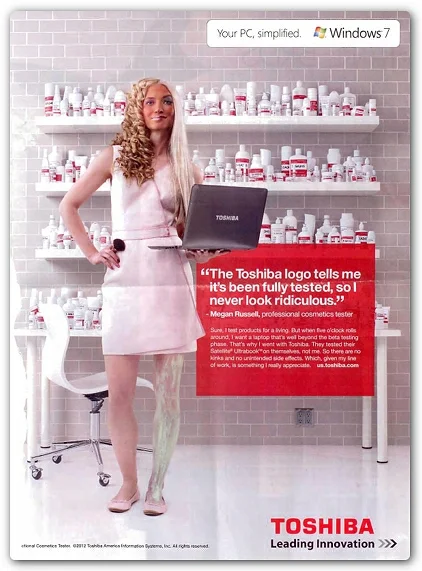
Toshiba Apologizes for "Test Monkey" Ads
A Toshiba ad for the Satellite Ultrabook computer pokes fun of people who participate in clinical trials. The ad claims that Toshiba, unlike other "tech companies," fully tests products and doesn't treat "paying customers like test monkeys." With a similar message, a print ad features a cosmetics tester.
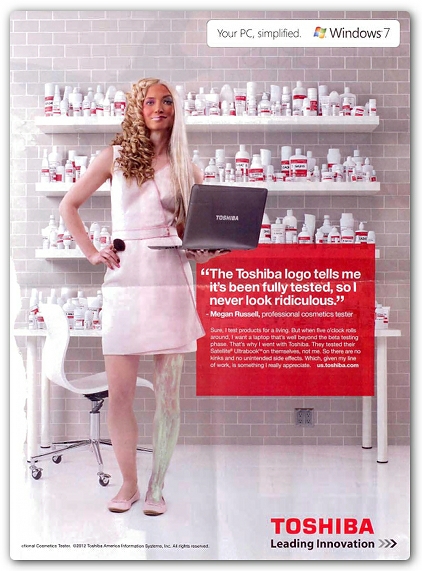 The ads riled clinical researchers, who struggle to find participants in medical trials. In fact, Toshiba's own medical systems group is currently looking for young people to participate in a trial.
A sokesperson for the Association of Clinical Research Organizations (ACRO) explained the group's concern: "It's dangerous. We don't need any more reasons to discourage people from research. We need to encourage people and not portray them as some kind of freak."
According to PR Daily, "The ad does seem to contradict parts of Toshiba's corporate social responsibility guidelines. According to its standards of conduct for advertising, Toshiba group directors and employees should 'not use advertising to cast third parities in a negative light, in an attempt to make Toshiba Group appear more favorable, or for any other negative purpose.'"
In response to ACRO's criticism, Toshiba's director of marketing communications sent this response:
"Dear Mr. Peddicord,
"Thank you so much for raising your concerns over one of Toshiba's new television commercials showing people in medical testing situations.
"Our intent was not to minimize the value of clinical research or insult people participating in clinical trials.
"We will absolutely take your objections into consideration as we develop future advertising."
So far, the company has not pulled the ads, which ACRO had requested.
Discussion Starters:
- What's your interpretation of ACRO's complaint? Is the group right, overreacting, or something in between?
- Looking at Toshiba's standards of conduct for advertising, do you believe the company violated its own standards?
- If you led Toshiba's marketing communications group, would you pull the ads? Why or why not?
Barclays Issues Statements About Resignations
Barclays CEO Bob Diamond has resigned under pressure admist an interest rate rigging scandal. Barclays will pay $453 million to settle a U.K. and U.S. investigation that revealed traders manipulated the Libor to prop up the bank's position and traders' wallets. Diamond said his decision to leave "was the right thing for the bank."
Other departures have already taken place or are expected to soon. Marcus Argius, chairman of Barclays, and Jerry del Missier, chief operating officer, also resigned.
Barclays issued three separate statements so far about the resignations:
- "Board Changes," July 2 (about Argius)
- "Board Changes," July 2 (about Diamond)
- "Management Changes," July 3 (about del Missier)
The statement about Diamond's resignation included this long quote from the outgoing CEO:
"I joined Barclays 16 years ago because I saw an opportunity to build a world class investment banking business. Since then, I have had the privilege of working with some of the most talented, client-focused and diligent people that I have ever come across. We built world class businesses together and added our own distinctive chapter to the long and proud history of Barclays. My motivation has always been to do what I believed to be in the best interests of Barclays. No decision over that period was as hard as the one that I make now to stand down as chief executive. The external pressure placed on Barclays has reached a level that risks damaging the franchise – I cannot let that happen.
"I am deeply disappointed that the impression created by the events announced last week about what Barclays and its people stand for could not be further from the truth. I know that each and every one of the people at Barclays works hard every day to serve our customers and clients. That is how we support economic growth and the communities in which we live and work. I look forward to fulfilling my obligation to contribute to the Treasury committee's enquiries related to the settlements that Barclays announced last week without my leadership in question.
"I leave behind an extraordinarily talented management team that I know is well placed to help the business emerge from this difficult period as one of the leaders in the global banking industry."
Discussion Starters
- Read the Board Changes statement about Diamond. What's the rationale for including the former CEO's long quote? How is this effective or ineffective in conveying the bank's message?
- Assess the three statements. How do you explain the bank's strategy of issuing these separately? Why did the board do this, and was it the best approach?
Science: It's a Girl Thing -- Demeaning or Clever?
To attract more female scientists, the European Commission created a video and other promotional videos. With an abundance of pink and a focus on cosmetics, the video has been criticized as demeaning to girls. Some even questioned whether the video was a joke, to which a spokesperson said that the European Commission, "doesn't really do irony."
As of today, the video on YouTube was viewed more than 626,000 times and received 974 likes and 6,432 dislikes.
In fairness, the EC has several videos as part of this campaign that don't focus on girls' high-heeled bodies or show girls blowing kisses. The Irish Times reported the EC's reaction from an interview with spokesperson Michael Jennings:
"'It is intended to catch the attention of the target audience – 13- to 17-year- old girls.'
"Mr. Jennings said that focus groups informed the commission that the video had to 'speak their language to get their attention' and that it was intended to be 'fun, catchy' and strike a chord with young people. 'I would encourage everyone to have a look at the wider campaign and the many videos already online of female researchers talking about their jobs and lives,' he said."
Discussion Starters:
- What's your view of the video? Do you find it demeaning, clever, or something else?
- The EC took down the video after the criticism. Was this the right decision?

Olympics Committee Responds to Knitters
 The U.S. Olympics Committee managed to anger an unlikely group-knitters. To protect the "Olympics" trademark, the group sends hundreds of cease-and-desist letters when it believes the name has been misused. In this case, a group of knitters promoted a "Ravelympics" competition: While watching the Olympics, knitters participate in events such as "afghan marathon" and "scarf hockey."
Knitters were offended by the language in the cease-and-desist letter, which included the following:
"We believe using the name 'Ravelympics' for a competition that involves an afghan marathon, scarf hockey and sweater triathlon, among others, tends to denigrate the true nature of the Olympic Games. In a sense, it is disrespectful to our country's finest athletes and fails to recognize or appreciate their hard work."
The outcry from the knitting community was extraordinary, as one blogger wrote: "2 Million Knitters with Pointy Sticks are Angry at the US Olympic Committee."
USOC apologized, but botched the message. Here's an excerpt:
"We apologize for any insult and appreciate your support. We embrace hand-crafted American goods as we currently have the Annin Flagmakers of New Jersey stitching a custom-made American flag to accompany our team to the Olympic Games in London. To show our support of the Ravelry community, we would welcome any handmade items that you would like to create to travel with, and motivate, our team at the 2012 Games."
One person responded: "Thanks for the half-hearted attempt at a maybe apology that keeps you clear of any blame. Now, you want us to give you free stuff?"
In an interview with PR Daily, Patrick Sandusky, spokesperson for the USOC, admitted, "The letter itself that was sent to this group was definitely too strident in its tone." He also said, "We do believe they're in violation of the law Congress passed and how we'll protect our trademark, but we could have gone about it in a slightly more sensitive way."
To address the criticism, Sandusky used his personal Twitter account. He explains this decision:
"I'm a firm believer that people don't believe organizations as much as they believe individuals. And if somebody's going to put their name on it and be a voice of reason specifically as a person who works at an organization and not just hide behind a blanket generic Twitter account-which has its uses without a doubt. And we have far more people that follow that than follow me. But it was something to supplement the main Twitter feed and show that this wasn't just a generic corporate account speaking corporate speak but it was an actual person willing to answer questions. And I answered more than, I think, 500 people online who contacted me directly with their questions. All those answers aren't going to be sufficient for some people but at least they're getting a response and not just being pointed to a generic statement. We believe here that we're the people that are responsible for the organization and I don't have any problem putting my name on organizational decisions and responding directly."
Discussion Starters and Assignment Ideas:
- Read the cease-and-desist letter. Rewrite it to improve the style and tone.
- How do you assess the USOC's apology? Could the group have done a better job? Rewrite the statement to improve the message.
Shell Regrets Social Media Campaign
In a creative, but failed attempt to encourage public contribution to its marketing efforts, Shell asked people to submit their own memes. Shell was perhaps naive in thinking that people would support its positive thinking about the company's contribution to the environment.
The campaign around the "Let's Go" slogan brought a mockery of images with captions such as "Because there are still places we haven't f'ked. Let's Drill" and "Proudly plundering and destroying environments for almost 200 years."
 At least Shell hasn't hidden from the reaction. On its site, the company has posted the memes and made this statement:
"We at Shell are committed to providing consumers with clean and abundant Arctic energy. We're also committed to the open exchange of ideas and the wonder of human creativity which makes our job possible.
"It is in this spirit that we approached the exciting untapped resource of socialized media with our Let's Go! Arctic user-generated advertising technology. While we do realize that a very small portion of the user-generated content below does not accurately represent Shell's commitment to providing consumers with clean and abundant Arctic energy, this pioneering experiment in user-generated content does reflect our commitment to freedom.
"Shell remains proud of our commitment to freedom. The freedom to develop newly available and abundant Arctic energy reserves. And the freedom our consumers have to discount the work of a very small number of extremist individuals who remain determined to stand in the way of our quest to bring first class heritage technology to bear on the top of the world. We thank you for sharing in our commitment to freedom.
"And thank you for contributing to our Let's Go! Arctic campaign."
Discussion Starters:
- Should Shell have avoided the campaign entirely, knowing that this could be the result-or was this an unintended, unpredictable result?
- How do you assess Shell's reaction-its statement on the website? What else, if anything, should Shell say about the memes received?
Coca-Cola President Argues Against Soda Limit
Last week, New York Mayor Michael Bloomberg proposed limiting sugary drinks to 16 ounces. This change would apply to sodas and other beverages sold in NY restaurants, at movies, and by street vendors.
USA Today interviewed Katie Bayne, Coca-Cola's president of sparkling beverages in North America. Bayne's response to the proposal focused on what people "need"-an interesting argument-and the lack of evidence to support the Mayor's proposal.
Here are excerpts from the interview:
Q: But critics call soft drinks "empty" calories.
A: A calorie is a calorie. What our drinks offer is hydration. That's essential to the human body. We offer great taste and benefits whether it's an uplift or carbohydrates or energy. We don't believe in empty calories. We believe in hydration.
The Mayo Clinic agrees that soda hydrates; however, nutritionists recommend water over soda.
Q: What do you say to those who believe that sugar - particularly in soft drinks - works on the brain like an addictive substance?
A: There is no scientific evidence.
Discussion Starters:
- Do your own research about whether sugar in soft drinks has addictive qualities. What do you find? Does it support or contradict Katie Bayne's response that there's no scientific evidence linking the two?
- Read the entire interview. Overall, how do assess Bayne's responses?
- Part of the Mayor Bloomberg's argument, in the video above, is that the size of drinks has increased. How do you assess this argument? Is this a convincing data point for his decision to cap the size of soft-drinks?
"I Love New York" Makeover
To increase tourism, Governor of New York Andrew Cuomo is spending $5 million to reinvent the classic logo, "I (Heart) New York." David Lubars, chairman of BBDO, the advertising firm working on the campaign, says that the logo needed to be revitalized because it's been "co-opted" by other countries:
"If you go to Russia, if you go to Spain, you see ‘I heart something,' and it's lost its New York cachet. My team's assignment was to bring new cachet back to that logo and make it mean something important."
As part of their summer campaign, The New York State Tourism website, http://www.iloveny.com/, encourages people to draw their own "heart." Drawings are varied and creative but perhaps a little boring.
In a press release, the Govenor's office explained the rationale for this approach:
"This is the first time in nearly 40 years, since the logo's inception, that New York State has officially asked the public for their interpretations of the 'I Love NY' and for the reasons they love New York."
New TV commercials will air for seven weeks during the summer. You see the logo prominently used during the commercials, which target tourists within 5 or 6 hours of driving distance to major NY cities.
Discussion Starters:
- At the end of the press release, the Governor's office cites several statistics about NY tourism and spending. What in this section are most and least convincing reasons to invest $5 million in this campaign?
- Offering the failed "New Coke" campaign as an example, Brian Sheehan, advertising professor at Syracuse University, warned, "You should mess with an icon at your own risk." What is your interpretation of Sheehan's view, and do you agree with him? What are the risks to NY in this campaign?
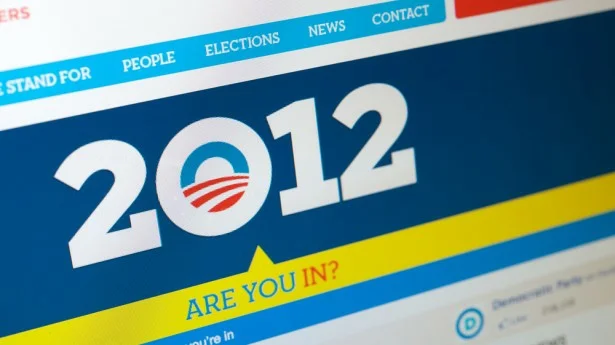
U.S. Presidential Candidates Go Social
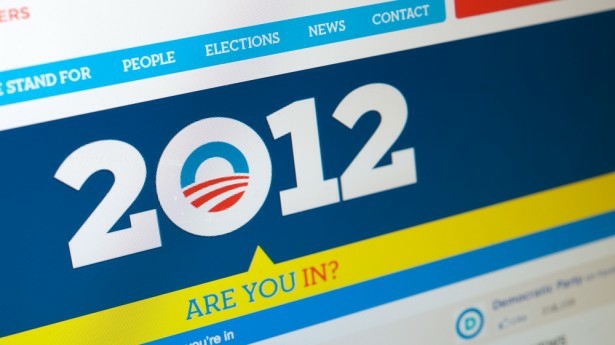 President Obama and Republican contender Mitt Romney are using social networking to boast their campaigns. Today, the Obama campaign is releasing a new platform called "Dashboard." Katie Hogan, spokesperson for the campaign, described the purpose of Dashboard:
"Dashboard is our online field office - a hub for campaign volunteers and supporters to communicate with each other and become members of neighborhood teams. . . .
"Supporters can use the tool to set goals, communicate those goals, and see what other supporters are doing. Supporters who want to be engaged can go to Dashboard, message other supporters in their area, and have a conversation about how to get started. It provides a good volunteer experience online that is directly tied to our field operation goals."
Built into the system is a keen focus on setting goals and friendly competition among neighborhoods. With a Facebook-like interface, volunteers are expected to use the site easily.
Since the fall, Mitt Romney's campaign has used a different home-grown system, "MyMitt."

Images via Raw Story and Signal News.
Discussion Starters:
- If you supported one of the candidates, would you use his social network? Why or why not?
- Why would both campaigns create their own platform rather than use Facebook as their main tool for volunteers?
- Consider signing up for both sites. What differences do you notice? Which is more effective for what purposes?
Facebook's IPO Video Focuses on Emotional Appeals
This is not your grandmother's IPO video. Facebook has taken a unique approach in luring investors to buy a stake in the company's initial public offering.
Staff members tell the Facebook story through a 30-minute video that the CFO says is consistent with their "focus on authentic, engaging communications." Mashable agrees that the video is a different approach to IPO communications:
"It's an interesting take on the normal business investment pitch video-instead of a heavy emphasis on dry finance numbers, Facebook plays to the heartstrings.
"Soft lighting, multiple interview angles and background music fit for sunrise in a nature show combine to make a clear emotional pitch to potential investors."
A theme throughout the video, as you might expect, is connecting people and "changing within a generation, the fabric" of how people communicate. In simple language, Facebook executives explain their platform and how their product functionality makes the web social. They compare Facebook to a game.
Section 3, Advertising, begins to cover financial information. The section profiles Ben & Jerry's, who claim that every dollar spent on Facebook returns $3 in incremental sales. Sheryl Sanberg, Facebook's COO, claims that online advertising will increase, in part because of Facebook's value proposition of "reach, relevance, engagement, and social context."
Section 4, Finance, starts 23 minutes into the 30-minute video. In this section, CFO David Ebersman reviews the number of users (including global penetration rates) revenue (advertising and payments), capital expenditures, operating margins, and future investment plans.
The video ends with Mark Zuckerberg claiming that almost every app will be connected to Facebook in some way.
Discussion Starters:
- Watch the entire video. Does it convince you to invest? Which are the most and least convincing arguments?
- What are the advantages and disadvantages of Facebook's approach compared to more traditional IPO communications?
Another Restaurant Serves Alcohol to a Child
Within the past year, at least three restaurants have mistakenly served alcohol to children. This time, an Olive Garden in Indianapolis gave a 10-year-old boy a rum drink. 
The boy drank half of what he thought was a non-alcoholic Wildberry Frullato drink before his family became concerned. After seeing his "increasingly strange behavior," he was taken to the hospital.
In a statement, Olive Garden said that the server had been fired:
"We find this situation completely unacceptable and we are extremely upset that this occurred. We have a zero-tolerance policy for any violation of our responsible alcohol service policy, and the employee who served the wrong drink has been terminated. We are thankful that the child is OK, and we will continue to work with the family to resolve this issue."
About a year ago, an Olive Garden in Orlando served sangria in a sippy cup to a two-year-old. This incident was just days after an Applebee's in Detroit accidentally spiked a 15-month-old boy's apple juice.
Discussion Starters:
- How do you assess Olive Garden's statement, particularly the part about their "zero-tolerance policy"?
- In your opinion, was the restaurant's termination of the server appropriate? Why or why not?
Heineken Responds to Dog Fighting Accusation
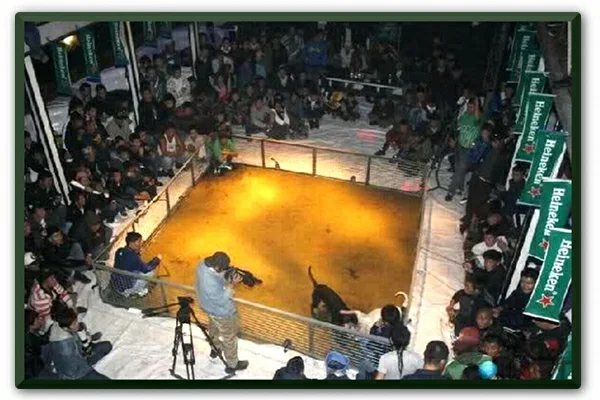
Bad timing for Heineken: banners were left up after a company event at a Mongolian nightclub. Unfortunately, next on the schedule was dog fighting. Outrage quickly ensued on Heineken's Facebook page and elsewhere.
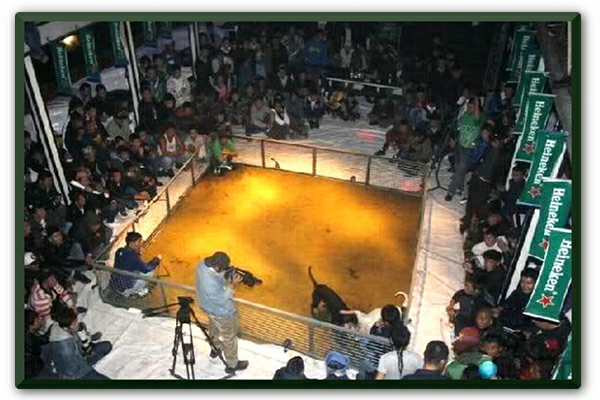
Heineken responded quickly with this statement:
"Heineken is aware of a shocking photo of what appears to be a dogfighting match in a foreign country with Heineken branding visible in the background. We'd like to thank the community for bringing this issue to our attention.
"We are as appalled by this image as you are and have asked the Heineken Global Office to immediately investigate the circumstances of this event and whether Heineken was involved in any way.
"If you have any further information regarding this picture, such as the source, or the venue where it was taken, please let us know in this thread."
In a follow-up statement, Heineken denied association with the event and explained the situation:
"Images continue to circulate in social media channels showing a dog fight, with Heineken banners clearly visible in the background. This is very distressing and totally unacceptable. As a company and a brand owner, we do not and would never knowingly support any event, outlet or individual involved in this type of activity. It is against our company and brand rules and - more important - against our company values. . . ."
The statement goes on to explain that the banners were left from a previous event and that the company has "ceased" its relationship with the club.
The situation follows a July 2011 Heineken commercial that compares the beer to a snakeskin jacket: "It's not right for every occasion. Unless, of course, you find yourself attending a secret, offsite, charity snake-fighting event." Weird.
Discussion Starters:
- How do you assess the social media response? Were people right to question Heineken's involvement, or did they overreact?
- How do you assess Heineken's response to the criticism?
- What do you make of the snake commercial? Is it just me, or is it weird even if the dog-fighting controversy didn't happen?
Secret Service Responds to Scandal
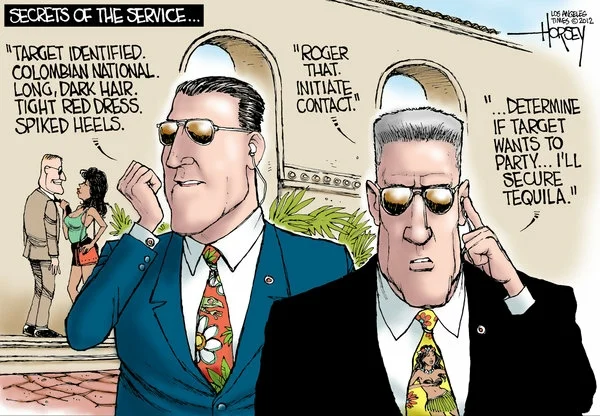
While in Columbia planning for President Obama's arrival, 11 U.S. Secret Service agents and 10 military personnel were involved in a scandal: 21 prostitutes were hired to entertain the fellas. A hotel manager learned of the situation when an argument over payment ensued between one of the prostitutes and an agent.

Although prostitution is legal in parts of Columbia, other issues help us determine whether this behavior was ethical. One issue is that hiring a prostitute was been banned for military personnel in 2006. This ruling was put in place during the Bush Administration, partly to address human trafficking, a practice in Columbia as well.
In addition, a writer of an Atlanta blog sums up potential risks and consequences of the situation:
"Most importantly, while there is no evidence that the security of the president of the United States was endangered in this incident, an agency with this kind of internal culture could be easily manipulated by those with reason to do so. At the very least, the scandal has created a significant embarrassment for the U.S. government and put at risk the generally good reputation of the Secret Service."
How has the Secret Service handled the response? One PR and marketing manager gave the Secret Service an A- for its response-not a bad grade for handling a difficult situation. Here's his analysis (a rubric, of sorts):
1. Communication. Following the breaking news of the scandal, the federal government appeared to work fast to alleviate concerns about a widespread issue. Many, however, feel this incident is possibly symbolic of a bigger cultural issue in the Secret Service. Grade: B+
2. Acknowledgement. When the story broke on April 13, Edwin Donovan, a Secret Service agency spokesman addressed the rumors by stating that an unspecified number of agents had been recalled and replaced by others. Army Gen. Martin Dempsey and White House Spokesman Jay Carney acknowledged the incident and have already voiced deep concern, plus several members of Congress have spoken out to defend the Secret Service vowing to launch a full investigation. Grade: A
4. Accountability. By all accounts, the military and Secret Service have appeared to take accountability. Although the story broke via a Washington Post reporter, the federal government has taken full responsibility for the agency's actions. Grade: B+
5. Timely updates. Following the news, the federal government steered the conversation to itself and became the irrefutable source of timely updates. Grade: A
6. Rectification. U.S. Secret Service agent Mark Sullivan swiftly announced that he is leading an investigation of the incident with support from Congressman Peter King, Chairman of the Homeland Security Committee, and Senator Susan Collins, the ranking Republican on the Homeland Security Committee. By all accounts, it appears that the Secret Service, military and Congress wish to assuage any concerns that this incident somehow compromised national security. Grade: A
Overall grade: A-
Discussion Starters:
- How do you assess the response to the scandal? Do you agree with the "A-" grade?
- What else does the Secret Service agency need to communicate at this point? How should its leaders provide updates to rebuild confidence?
KFC Apologizes to Thailand Earthquake Victims
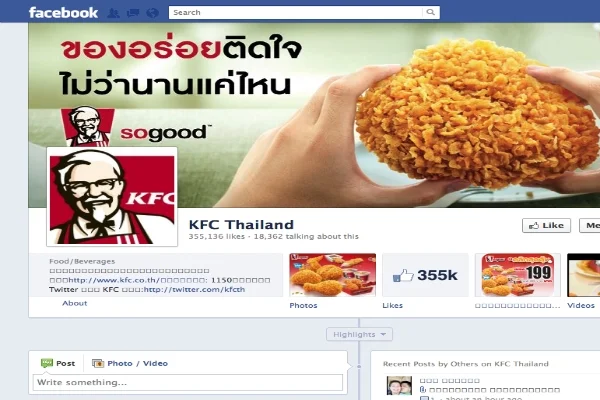
Connecting chicken to the earthquake in Thailand, KFC posted this on its Facebook wall as people were being evacuated from the beaches: "Let's hurry home and follow the earthquake news. And don't forget to order your favorite KFC menu."

People didn't respond well. Admitting its mistake, KFC removed the post within a day and replaced it with this statement:
"KFC Thailand expresses its sincere regret for the improper post on its Facebook page and apologizes for the insensitivity and timing of the message."
This isn't the first time a company used a tragic or emotionally charged event to promote its products (and it probably won't be the last). Kenneth Cole learned a tough lesson when he encouraged people to buy his "spring collection" clothing during the uprising in Cairo. And a blogger called Amy Winehouse's death a "wake-up call for small business owners."
Companies need to be smarter about how they use social media. Sure, they can take some risks, but mixing sales and disaster likely leads only to disaster.
Discussion Starters:
- Can you think of any time when using a tragedy to promote a company's products would be viewed positively, for example, after a certain period of time?
- Assess KFC's apology. Do you find it convincing? Should the company have done anything else to demonstrate its regret?
World's Longest Rejection Letter
How would you like to get a 3,000-word rejection letter with a "42-point plan to help job seekers"? If you were one of 900 applicants for a writing job at Salon.com, you may have received it.
Sean Gunther, the author of the rejection letter, thought he was being helpful, but the letter is long and confusing. For starters, it's unclear whether the receiver was rejected. It isn't until the end of the second paragraph that readers are told (sort-of) where they stand: "Those of you who are passed into the second round of consideration will be hearing from us soon, if you haven't been contacted by us already."
In an article, "Here's How to Condescend to 900 Job Applicants With a 3,000-Word Rejection Letter, " Gawker blasted the email as "arrogant" and called the writer worse names.
Gunther responsed to Gawker's criticism by saying that some applicants appreciated his advice. He quotes the following from one of the applicants:
"I read your email this morning, and to be honest, I was a little irritated at first. I didn't particularly want to know that there were 900+ applicants for the position. The email looked lengthy, and I wasn't sure where you were going to go with it. For sure, it didn't say that I was hired.
"I gradually realized that this is the sort of advice that every writer looking for work should read. I don't think I made many of the mistakes that it mentioned, but I do I wish I had read it years ago. It's also a rare thing that people applying for work should get anything out of it at all, especially something so useful."
Gunther defends his letter compared to other rejection letters:
'Applicants learn nothing about their approach when the only response they receive is 'Thanks for applying, but the position has been filled.'"
Discussion Starters:
- What do you think of Gunther's approach? How do you think you would feel if you received the letter?
- Read the entire letter, including his suggestions. Which are useful, and which are not?
- Considering that the letter caused some hard feelings, what could have been a better approach, if Gunther sincerely wanted to help job applicants?
AT&T Campaign: "Rethink Possible"
To refocus the AT&T brand, the company is venturing into a new marketing campaign. With themes such as "Here's to possibilities," the "Rethink possible" campaign features optimism.
Without a focus on any particular product, AT&T is embarking on image advertising-a new approach for the conglomerate that began in April 2010. The commercial, below, is one part of AT&T's messaging.
Esther Lee, senior vice president for brand marketing, advertising, and sponsorship at AT&T in Dallas explained the company's strategy to The New York Times:
"'We did a lot of insight research about how people live with technology,' which included 'ethnographies, shop-alongs and spending time in people's living rooms.'
"When the 'Rethink possible' campaign was developed, most consumers 'felt overwhelmed with technology,' Ms. Lee said, but only a short time later many have 'found ways to integrate it in their lives" - and some even 'talk about it with love.'
"'The real innovation that's happening is what people are doing, and how people are dealing, with technology,' she added, and 'the unique ways they use it to make their lives better.'
"That is the message that 'It's what you do with what we do' is intended to convey, Ms. Lee said, describing the phrase as 'a step-up line, a bridge line' that will now lead to the 'Rethink possible' theme."
Discussion Starters:
- What is the difference between corporate and product advertising? Why do you believe AT&T took this approach now?
- Do you believe AT&T's campaign will be successful? Why or why not?
- Which of the company's new advertisements do you find most effective? Why or why not?
Communications Around the "Pink Slime" Beef Additive
Parties on both sides of the "pink slime" debate are weighing in. For business communication students, perhaps the most interesting communications (so far) are around how the term became popular and how companies-both consumer companies and the manufacturer-are responding.
Blame Email
Oh, Email, you time-waster, career-destroyer, is there no end to the trouble you can start? In 2002, Gerald Zirnstein, a microbiologist at the U.S. Department of Agriculture, sent an email to colleagues saying "I do not consider the stuff to be ground beef, and I consider allowing it in ground beef to be a form of fraudulent labeling." Zirnstein is credited with coining the term "pink slime" in an email that he thought was private.
Today, Zirnstein is considered a "reluctant whistleblower":
"'The whole thing went viral ... Just blew the top off everything,' said Zirnstein. Zirnstein said he worried at first about being deemed a whistleblower, but now does not care. 'I am really an involuntary whistleblower,' he said. But he added, 'It looks like pink slime. That is what I said.' Asked if he and his family still eat hamburgers, Zirnstein sighed. 'The labels aren't clear, so we don't eat it. That's the thing,' he said. 'It isn't freaking labeled.'"
Supermarkets and Fast-Food Restaurants Act
Following Safeway and Supervalu, Kroger, the leading supermarket chain in the United States, announced on its Facebook page the decision to stop buying the product:
"We have listened to your concerns that the use of lean finely textured beef-while fully approved by the USDA for safety and quality-is something you do not want in ground beef. You are our top priority and for that reason we have decided to stop purchasing ground beef that contains lean finely textured beef."
In its "Statement on Lean, Finely Textured Beef," Walmart explains its decision to offer customers meat with and without the additive:
"As a result of customer and member feedback, Walmart and Sam's Club will begin offering fresh ground beef that does not contain lean finely textured beef (LFTB). We are working aggressively with our suppliers to have new offerings in our stores and clubs as quickly as possible. As these products become available, associates in our meat department and at our customer service desks will share updates with customers who inquire.
"While the USDA and experts agree that beef containing LFTB is safe and nutritious, we are committed to listening to our customers and providing the quality products they want at prices they can afford."
Wendy's took a different approach. The fast-food chain capitalized on the news and used a slogan from a 1980s campaign: "Where's The Pure Beef? At Wendy's, that's where!" Ads ran in USA Today, The Chicago Tribune, and other papers. Wendy's also used this image in rotation on its website home page.

Beef Products Inc. Defends Its Product
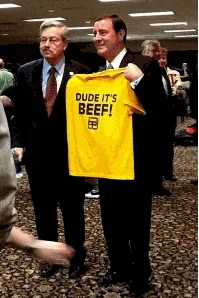
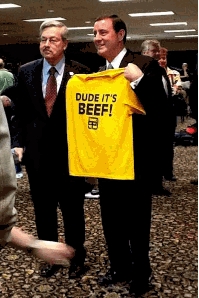 Fighting back, Beef Products Inc., manufacturer of the additive, has launched an aggressive campaign. The company offered a tour of its facility to a few governors and reporters and handed out "Dude, It's Beef" T-shirts.
On a newly created website, "Beef Is Beef," the company dispels what it calls "The 8 Myths of 'Pink Slime.'" (The URL says "7 myths," and I'm curious which was added late.)
Beef Products Inc. also took out a full-page ad in The Wall Street Journal, including this letter from company founder Eldon Roth:
"Pink Slime" Libel to Cost This Country Jobs
Before last summer, we could not have imagined the personal, professional, financial and spiritual impact of the campaign of lies and deceit that have been waged against our company and the lean beef we produce. But over the last several weeks, that campaign has been joined by entertainment media, tabloid journalists, so-called national news - and all to what end? The clear goal expressed by the campaign organizer - put BPI out of business.
It is simply amazing how this mis-information campaign can take a company and product that has long been recognized for its quality and safety and turn the public perception so negative that it now may result in the loss of over 3,000 jobs (direct employment and companies that rely upon our business) and affected their families and communities.
Our record is unsurpassed. NEVER has a foodborne illness been associated with our lean beef over 30 years. In nearly 300,000,000,000 meals, we have been a recognized leader in food safety by groups such as the International Association for Food Protection. Look at the overwhelming support from food scientists, USDA officials, Consumer Advocate organizations academia and customers we have received reaffirming the wholesomeness, nutrition and safety of our lean beef.
As the founder of the company, I can personally guarantee that in our 30 year history, we have never produced 'pink slime.'
Eldon Roth
President & CEO
Beef Products Inc. also created this "Get the Facts" infographic to explain "lean beef trimmings."
Discussion Starters:
- After researching the "pink slime" topic further, with which of the arguments do you agree and disagree?
- Assess the communications from Beef Products Inc.: the Beef Is Beef website, the founder's letter, and the infographic. What is most and least effective in each of these communications?
JetBlue Responds to Incident with "Erratic" Captain
Just three weeks after an American Airlines flight attendant displayed irrational behavior before take-off, a JetBlue captain displayed what some called "erratic" behavior during a flight from New York to Las Vegas.
One passenger heard the captain yell, "They're going to take us down. They're taking us down. They're going to take us down. Say the Lord's prayer. Say the Lord's prayer." Others said he was yelling about Al Qaeda and a bomb on the plane.
JetBlue responded with a statement and updates on its blog:
"Flight 191 departed New York's JFK airport at 7:28 am ET (was scheduled to depart 6:55 am ET). At roughly 10 am CT/11 am ET, the pilot in command elected to divert to Amarillo, TX for a medical situation involving the Captain. Another Captain, traveling off duty, entered the flight deck prior to landing at Amarillo, and took over the duties of the ill crewmember. The aircraft arrived Amarillo at 10:11 am CT, and the crewmember was removed from the aircraft and taken to a local medical facility.
"Customers have safely deplaned and we're sending a new aircraft and crew to Amarillo to continue the flight to Las Vegas."
Read a more detailed timeline of events.
JetBlue faced another embarrassing incident recently, when one of its flight attendants exited the plane via the emergency chute. Maybe these airline jobs really are stressful!
Discussion Starters:
- Read American Airlines' statement and updates. How well do you think the company is responding to the situation?
- Imagine that you're head of HR for American Airlines. What, if any, communication would you initiate for employees? What medium would you use, and what would you say?