

Sugarland Flubs Response to Victims
 Country music group Sugarland is facing lawsuits following a stage collapse at a concert last summer. At the Indiana State Fair, seven people were killed and 45 were injured.
In the lawsuits, victims and their families criticize the band and the fair for not postponing the show because of bad weather conditions and not evacuating more quickly. Attorneys for Sugarland responded harshly to the allegations: "Some or all of the plaintiffs' claimed injuries resulted from their own fault." Critics call the legal approach "cowardly." Read the entire legal statement.
The statement is a dramatic contrast to what Jennifer Nettles, lead singer, said two days after the incident:
"...moved by the grief of those families who lost loved ones. Moved by the pain of those who were injured and the fear of their families. Moved by the great heroism as I watched so many brave Indianapolis fans actually run toward the stage to try and help lift and rescue those injured. Moved by the quickness and organization of the emergency workers who set up the triage and tended to the injured."
In response to criticism of the legal statement, Gail Gellman, Sugarland's manager, posted this on the group's website:
"Sadly when a tragedy occurs, people want to point fingers and try to sensationalize the disaster. The single most important thing to Sugarland, are their fans. Their support and love over the past 9 years has been unmatched. For anyone to think otherwise is completely devastating to them."
Also on the website are comments from many supportive fans, who compliment Sugarland and their music.
Although Sugarland had been tweeting almost daily, their last tweet was on February 15-now a week ago. Fans might like to hear directly from the duo.
Discussion Starters:
- What is the attorney's perspective in this situation? Do you agree with this position?
- What should the Sugarland duo do at this point? What, if anything, should they tweet or write on their website? What are the potential consequences, and is it worth it?
McDonald's Bitten by Pit Bull Ad
McDonald's has apologized for an ad that offended pit bull dog owners. To promote Chicken McBites, the radio ad said, "Trying a brand-new menu item at McDonald's isn't risky. You know what's risky? Petting a stray pit bull or shaving your head just to see how it looks..."
Soon after the ad aired, pit bull lovers defended their pets and accused McDonald's of unfairly stereotyping. A Facebook page, Pit Bulls Against McDonald's, has been liked by almost 12,000 people. The group has started a petition and requests that McDonald's do the following:
"The undersigned are requesting that McDonald's use it's [sic] worldwide reach to make a difference for all the Pit Bulls that have been victims of a bad reputation that they neither earned, nor deserve. We want McDonald's, a family company that many of us have loved and grown up with, to take a stand for family values - because those of us that love our Pit Bulls consider them family. We'd like McDonald's to right this wrong by airing a commercial that shows the American Pit Bull Terrier in a positive light. If you need any actors, the shelters and rescues are chock of full of lovable characters that would love to ham it up for the camera."
Although the ad ran only in Kansas City, the company did apologize:
"The ad was insensitive in its mention of pit bulls. We apologize. As soon as we learned of it, we tracked the source and had the local markets pull the ad immediately. We'll do a better job next time. It's never our intent to offend anyone with how we communicate news about McDonald's."
No word yet on whether McDonald's will meet the petition-signers' demands.
Discussion Starters:
- Do you find the ad offensive? Can you see how pit bull lovers might take issue with the ad?
- Could McDonald's have done anything to avoid this situation? Should they have -- or could they have -- prevented this reaction?
RIM's #BeBold: Another Hijacked Hashtag
As McDonald's learned last week, Twitter hashtags may not get the results that companies want. BlackBerry maker Research in Motion started the hashtag #BeBold, but unfavorable tweets started soon after:

"Be Bold" is part of RIM's marketing campaign involving the Bold Team, a group of cartoon characters, which has also been criticized as "cheesy":
"Each character comes with a name (like Trudy Foreal) and cheesy biography that seems to cater to the younger demographic.
"If there was ever any question RIM was running out of ideas in the business and professional sectors, this cartoon collective is your definitive answer."
Although companies are trying new approaches, they may have to give up the hashtag: it's too easy for people to use the tag for their own fun.
Discussion Starters:
- What would you advise companies who want to use a hashtag on Twitter? Could a different approach work, or is it too risky?
- What's your reaction to RIM's Bold Team? Do you find this to be an effective marketing strategy for young people and, if so, how young?
NYSEG Explains Security Breach to Customers
Customers of NYSEG (New York State Electric & Gas) received a letter saying that records of their Social Security number, birth date, and perhaps bank account numbers have been breached. What the company calls "unauthorized access to one of [its] customer information systems," has resulted in credit card and other information being released by a contract employee.
NYSEG sent a letter to affected customers, encouraging them to monitor their accounts for unauthorized activity and offering a free credit report and a credit monitoring service for a year. NYSEG also posted a Q&A for concerned customers.
Clayton Ellis, a spokesperson for NYSEG, denied malicious intent or misuse so far:
"We need to emphasize too that there's absolutely no evidence through our investigation so far that any of our customer data has actually been misused or that there was any malicious intent on this individual's part."
Discussion Starters:
Super Bowl Ad Previews on Social Media
In case you can't wait until Sunday to see the Super Bowl ads, here are a few teasers. At an average of $3.5 million for a 30-second spot, companies need to get their money's worth, so we're seeing some pre-game, viral promotion.
According to Reuters, the Super Bowl is one of the few TV shows that still garner large audiences: about 100 million people are expected to watch the game on February 5. And yet companies will supplement views by promoting their ads on social media sites. Coca-Cola's commercial, for example, features computer-generated polar bears who will have their own Facebook page and Twitter hashtag (#GameDayPolarBears). Not to be outdone, Pepsi is encouraging fans to watch Melanie Amaro perform "Respect" and then download a video using the Shazam app.
As always, the Super Bowl ads, like this one from Priceline, target their audience.
Discussion Starters:
- How successful do you think these companies' social media strategy will be? Will it achieve their objective of expanding viewers and air time?
- Watch a few of the Super Bowl ad previews. What techniques do they use to target game watchers?
Celebrity, Royal Caribbean, Norwegian Reassure Customers
Following the Costa Concordia disaster, major cruise lines are emailing customers to reassure them of ship safety. The companies are trying to stave off what may be a large decline in cruising, according to analysts. The prediction is based on graphic videos and images circulating on social media sites and the unfortunate timing of the incident: during prime cruise-booking season and three months before the 100-year anniversary of the Titanic. To commemorate the sinking of the Titanic, which lost over 1500 passengers, the media will likely draw comparisons to Costa Concordia, keeping the tragedy alive in consumers' minds.
Celebrity, Royal Caribbean, and Norwegian have emailed customers over the past few days, and we see two main themes emerge from these communications:
- Safety standards, procedures, and records
- Qualifications of the captains
Download Celebrity Cruise email
Download Royal Caribbean email
Download Norwegian Cruise email
In its email to customers, Royal Caribbean links to this video explaining the company's safety culture:
Discussion Starters:
- What differences do you notice among the three emails, particularly whether they refer specifically to Costa Concordia?
- Which email works best and why?
- How do you assess the Royal Caribbean safety video? Does it reassure you, as a potential passenger?

Survivors Find Costa Cruises' 30% Discount Offer "Insulting"
Costa Cruises and its parent, Carnival, have tried to make amends to survivors of the Costa Concordia ship that capsized. A spokesperson for Costa explains: 
"The company is trying to do everything they can for those passengers directly affected.
"The company is not only going to refund everybody, but they will offer a 30 per cent discount on future cruises if they want to stay loyal to the company."
The offer is one way for the company to try to repair its tarnished image-and perhaps to stave off lawsuits. But will passengers want to get on another boat?
Discussion Starters:
- How effective do you think Costa's promotion will be for future cruise goers?
- What are the potential ethical consequences of Costa's offer?
- What might be a better strategy for the company to rebuild its image?
Timothy's Coffee Apologizes for Facebook Promotion
Offering free coffee is a great way to increase Facebook "likes" but only if you can keep up with demand. Timothy's Coffee offered free 24-pack boxes of single-serving coffee, but ran out of supply for the number of people who requested the $17 CAD gift. The company underestimated how viral the promotion would become, and it took too long to sort out how to solve the problem.
In a video, a company spokesperson explained that they "received an overwhelming amount [sic] of entries" and "because of a technical glitch, confirmations were sent beyond the quantities available."
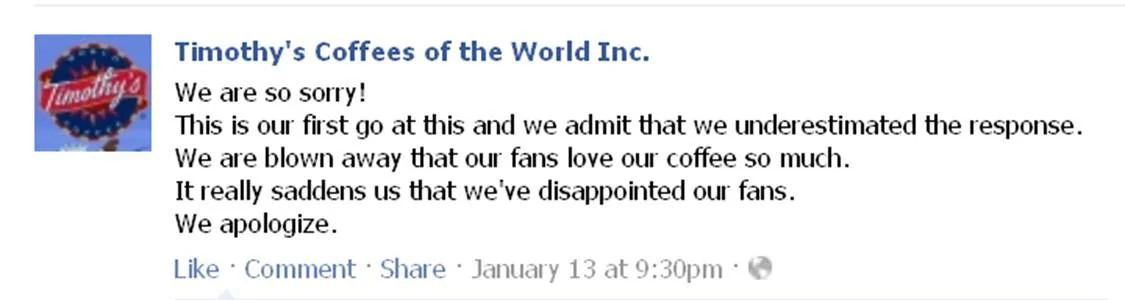
The company apologized on a Facebook wall post:
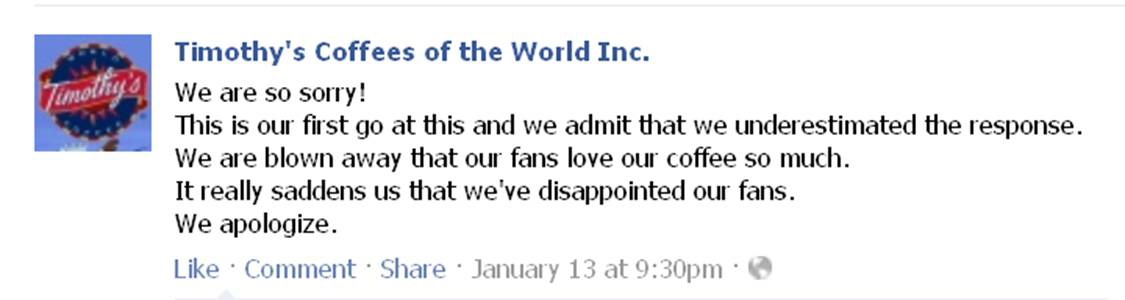
Although 136 people "liked" this post, 291 commented, and many were negative, like this one: "fans being left in the dark from January 4th to Jany 13th, without A SINGLE comment regardless of the raging posts on the wall."
Responding to the disappointed fans, the company then offered a coupon for free coffee for those who didn't receive the promotional gift.
Discussion Starters:
- How could Timothy's Coffee have avoided the failed social media promotion?
- How do you assess the spokesperson's video? What is effective and ineffective about the apology?
- In the post above, you see "[sic]" within the company's quote. What does this mean, and why is it there?

Auschwitz to Sell Fitness?
The Circuit Factory, a gym in Dubai, used an Auschwitz photo to sell membership.

No surprise, the company heard a strong reaction to the campaign on sites such as Facebook and Twitter.
The Circuit Factory responded by firing its "creative guy," pledging a donation to an undetermined charity, and apologizing:

The Anti-Defamation League issued this statement about the incident:
"We are increasingly troubled by both the ignorance and mindset of a generation that appears to be so distant from a basic understanding of the Holocaust that it seems acceptable to use this horrific tragedy as a gimmick to bring attention to promoting losing weight."
Despite the public reaction, the campaign may have worked, as Circuit Factory founder Phil Parkinson told Arabian Business News:
"A huge number people have researched or Googled… our YouTube channel has shot up, our [Facebook] group page has got an hundred extra members in minutes and we have had about five times as many enquiries as before," he said. "It has got to the point I am nervous that I can't cater for demand."
Discussion Starters:
- What's your reaction to the ad? Do you find it funny, offensive, or something else?
- What do you make of the increased interest in the gym? Did the campaign pay off, after all?
- How can a company avoid this type of campaign, which may offend people?
Blackstone Buys blackstonesucks.com
In a preemptive social media move, private equity firm Blackstone has purchased several disparaging websites:
 blackstonesucks.com
- blackstonegroupsucks.com
- theblackstonegroupsucks.com
- schwarzmansucks.com
- stephenschwarzmansucks.com
- stevenschwarzmansucks.com
- steveschwarzmansucks.com
Blackstone follows the lead of Bank of America, which secured hundreds of domains last month, including BrianMoynihanBlows.com.
In September, Etsy, the online market for handmade art, filed suit against the owners of EtsySucks.com, .net, .org, .biz, and .info. Etsy won the case. But what about Freedom of Speech? The difference seems to be in how the domains are used; if they're used to post about a company, then fine, but these Etsy domains were empty, parked websites, indicating that the sites weren't "registered in good faith," according to Domain Name Wire.
Maybe I should register bizcominthenewssucks.com, just in case.
Discussion Starters:
- You can't blame these companies for trying to stem the tide of negative online comments, but will these domain protections work?
- What avenues would you most likely use to complain about a company's product or service?
- Research the "sucks" domain for a company that interests you. Is it taken and populated with negative comments? What, if anything, can the company do about it?

Campaign Against Child Obesity Called "Harsh"
How would you feel if your child or brother or sister were profiled in one of these anti-obesity ads?
The Children's Healthcare of Atlanta has taken emotional appeal to a new level to tackle the problem of childhood obesity in Georgia. Focusing on illness and social isolation, five videos show children who are obese and in distress. With this approach, the organization is trying to encourage families to take the issue seriously.
Critics say the organization's Strong4Life campaign has gone too far by stigmatizing the profiled children. Also, the ads give little guidance to how parents can help their overweight children.
Others say the ads attract attention, as they should, and that they are part of a five-year campaign that has just started. An executive at Children's Healthcare defends the campaign: "The whole goal of this is to get the discussion going," she said. "I love that it sparks dialogue, and a great dialogue has two sides." The organization also posted several comments on Facebook:

Discussion Starters:
- What is your reaction to these ads? Do you find them offensive, effective, or something else?
- How could the next phase of the campaign address the critics' concerns? What tactics would you recommend to the writers of the ads?
FedEx Responds to Viral Video of Tossed PC Monitor
How embarrassing for FedEx! One of its delivery people was caught on a surveillance camera throwing a computer monitor over a fence. The monitor broke, and the homeowner posted the video for all to see.
The company responded quickly by posting a video and blog entry called "Absolutely, Positively Unacceptable."
In the video, Matthew Thornton, an SVP, apologizes:
"On behalf of all of us at FedEx, please accept my apology. I am upset and embarrassed for our customer's poor experience. This goes directly against all FedEx values. It's just not who we are."
As of this writing, FedEx apparently hasn't decided on any disciplinary action for the employee. In the video, Thornton says, "The employee is no longer working with customers." Does that mean he's in central packaging now?
Discussion Starters:
- What is your reaction to the video apology? What messages are most and least effective? What works well and not so well about Thornton's delivery style?
- Read the company's blog post. What's different between the post and the video? Which works better and why?
- Overall, how well do you believe FedEx handled the situation?
The 1% Speak Out: "I am a fat cat. I'm not ashamed"
A recent Bloomberg article describes how wealthy Americans are speaking out in response to attacks from the Occupy Wall Street movement. Top U.S. earners have been criticized for not paying enough taxes and contributing to the increasing income inequality, which, in 2007, was greater than that of China and Iran.
Arguments from the richest 1% include their right to earn and keep their income (particularly given high government spending) and how few low-income Americans pay taxes. One recent persuasive letter to President Obama is from Leon G. Cooperman, a hedge-fund manager. In this video, Peter Schiff, investor, author, and commentator, defends the wealthy in discussion with Occupy Wall Street protestors.
Contrast this perspective with that of billionaire investor Warren Buffett. In August, Buffett wrote an opinion letter in the New York Times called Stop Coddling the Super-Rich.
Most millionaires agree with Warren Buffett and support a tax increase, as reported on wsj.com:
A new survey from Spectrem Group found that 68% of millionaires (those with investments of $1 million or more) support raising taxes on those with $1 million or more in income. Fully 61% of those with net worths of $5 million or more support the tax on million-plus earners.
Assignment Ideas:
- Research different perspectives of this story further: look at the Occupy Wall Street website, read the Bloomberg article, and find letters and videos of executives and others to get a complete picture of both sides of the argument.
- Write an assessment of all persuasive arguments. How does each side use logical arguments, emotional appeal, and credibility to explain their perspective?
- In small groups, choose one line of reasoning and defend your position. How can you support your view with research about the issue?

Victoria's Secret Responds to Child Labor Allegations
A Bloomberg report paints a grim picture of a West African 13-year-old girl who sleeps on a thin, plastic mat; works in 100-degree heat; is beaten; and is fed once a day some days, but not at all on others. Clarissa works for a farm certified as organic and fair trade-and supplies cotton to Victoria's Secret. Video on Bloomberg.

Although only a small amount of cotton for Victoria's Secret comes from this region, the company has issued a response, vowing to investigate the situation. In its statement, the company explains the original goals of the program in the region:
In 2007, we established a pilot program to purchase Fairtrade-certified organic cotton from primarily women farmers in Burkina Faso, a landlocked country in West Africa that struggles with endemic poverty. We were committed to this initiative because of its potential to generate life-changing opportunities for some of the world's poorest women.
In the statement, Victoria's Secret maintains its "goal of improving the lives of women and children in a country where a large portion of the population lives on less than a dollar a day. "
Discussion Starters:
- If you're a Victoria's secret customer, does the news affect your buying decisions? Does the company's response affect your buying decisions?
- Read Victoria's Secret entire response. What do you consider the strongest and weakest arguments presented? How do you assess the company's focus on their goals of helping women and children?
UC-Davis Chancellor and Faculty Speak Out
The "Occupy" movement has spread to college campuses, with UC-Davis students protesting tuition raises and education cuts. Videos showed campus police pepper-spraying students, which led to an outcry from students and some faculty.
In a short speech to students, Chancellor Linda Katehi apologized to students, saying "I am here to apologize" and "I feel horrible for what happened."
English professors have posted a statement on the department website, calling for Chancellor Katehi to resign and for the UC Police Department to be disbanded. [ View website image.] (The police chief is now on administrative leave.)

Cynthia Carter Ching, an associate professor of learning and mind sciences, wrote a letter to students apologizing "Because we left the wrong people in charge." She explains her view in one part of the letter:
You see, with few exceptions, the people running this campus up in Mrak Hall think of themselves as administrators, not as educators. Because, with few exceptions, these are people who haven't seen the inside of a classroom in years, if not decades, if ever. These are people who don't have you guys. They don't have students to remind them every single day on this campus why they are here, simply by stopping by their offices with a friendly, "Hey, Professor, I just had a question about something…" These are people who don't have you all to keep them humble by (to use a personal example) reminding them that they almost forgot to collect the paper that's due in class today, or pointing out the typos on their final exams.
Discussion Starters:
- Assess the three messages mentioned here: the Chancellor's apology, the English Department's webpage statement, and the professor's letter. What persuasion tactics does each use? Which do you consider the most and least effective?
- What else, if anything, should UC-Davis communicate at this point? What messages are important for the administration to convey?
More Tears for J&J
Consumer groups are protesting Johnson & Johnson because of what they claim are carcinogens in shampoo for babies. According to a report, Baby's Tub Still Toxic, a formaldehyde-releasing ingredient is found in Johnson's "No More Tears" Baby Shampoo in the United States, Canada, and China, although the company distributes a formaldehyde-free formula of the shampoo in several other countries. In a letter, the Campaign for Safe Cosmetics referred to meetings with J&J representatives and urged the company to reformulate the shampoo.
J&J has responded to the criticism with a statement that describes Johnson's Natural (an alternative product line), assures consumers that their products are safe, and describes steps they have been taking to reduce "preservatives that release tiny amounts of formaldehyde to guard against bacterial contamination."
Discussion Starters:
- Evaluate the consumer group's letter. Which are the strongest and weakest arguments? How does the group use logical arguments and emotional appeal?
- Evaluate J&J's response statement. Same questions: which are the strongest and weakest arguments? How does the company use logical arguments and emotional appeal?
Herman Cain's "Smoking" Video Goes Viral
Campaign manager Mark Block is a one-man show in a promotional video for Republican candidate Herman Cain. Speaking to a severely close camera, Block encourages Americans to take action:
Tomorrow is one day closer to the White House. I really believe that Herman Cain will put united back in the United States of America, and if I didn't believe that, I wouldn't be here. We've run a campaign like nobody's ever seen. But then, Americans never seen a candidate like Herman Cain. We need you to get involved because, together, we can do this. We can take this country back.
Then, Cain takes a drag of a cigarette. Cue the patriotic music, show the award-winning Herman Cain smile, and you have yourself a viral video.
Asked about the video, Cain said, "We weren't trying to send any subliminal message whatsoever. Many of us found it hilarious because we know Mark Block."
The video has received a lot of attention. On the Colbert Report, Stephen Colbert pokes fun of the ad by lighting up a cigarette and showing his own version of Cain videos.
Discussion Starters:
- What is Mark Block's strategy with this video? Do you believe he was successful?
- What ethical issues do you see in connection with this ad?
- What are the potential ramifications for Herman Cain and his candidacy?
Barnes and Noble Pursues Borders Customers
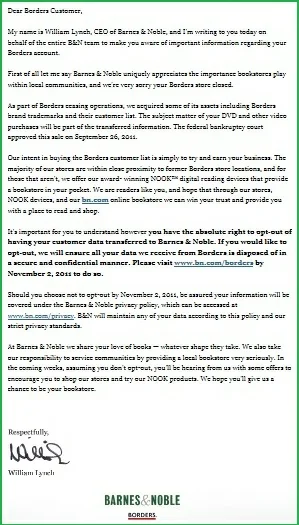
 Now that Borders has closed its doors, Barnes and Noble has purchased some assets -- including Borders' customer list. With an email, Barnes and Noble is luring Borders' former customers to its stores. The subject line was an odd choice: "Important Information Regarding Your Borders Account." (The last time I saw a similar subject, I received 18 emails about a security breach.)
Another curious choice in the CEO's email was the vacillating tone -- at times bold ("Our intent in buying the Borders customer list is simply to try and earn your business") and at times legalistic:
"As part of Borders [sic] ceasing operations, we acquired some of its assets including Borders brand trademarks and their customer list. The subject matter of your DVD and other video purchases will be part of the transferred information. The federal bankruptcy court approved this sale on September 26, 2011."
Barnes and Noble makes an additional pitch on its website: "Four Convincing Reasons to Stay in the Barnes & Noble Family."
Discussion Starters:
- How do you assess the Barnes and Noble email? What are the most and least persuasive arguments?
- What examples of credibility, logical arguments, and emotional appeals do you see in this message?
- Where are the direct sales messages in this email? Do you consider these subtle or too much?
Assignment Idea:
- Rewrite Lynch's email in your own words. What improvements can you make to the message?

RIM CEO Apologizes for BlackBerry Outages
After four days of outages affecting millions of BlackBerry users, Research in Motion (RIM) CEO apologized and tried to explain the situation. In a video "Service Update" message, Mike Lazaridis said little about the technical problems, which elsewhere were described as a hardware failure (a core switch) within its network.
Although the video lacked detail and made no promises about when the service issue would be "fully resolved," Lazaridis delivered an emotional appeal:
"I apologize for the service outages this week. We've let many of you down. But let me assure you that we're working around the clock to fix this. You expect better from us, and I expect better from us."
Lazaridis also acknowledged, "We know that you want to hear more from us."
No surprise, public reaction was vehement. After all, people have been resorting to using the telephone and (horror!) the fax machine. Some of the more than 10,000 Facebook comments compliment BlackBerry's previous service, others bash the iPhone, but many vent their frustration:

In April, Lazaridis was in the news for his emotional reaction during a BBC interview. In July, the company announced layoffs. Clearly, the outages are another challenge for RIM.
Discussion Starters:
- In Lazaridis' video, what examples of persuasive strategies do you see? Which do you find most and least effective?
- Lazaridis didn't give a lot of detail in the video. Do you think this is an appropriate strategy? Why or why not? If not, what could he have done differently?
- How do you evaluate Lazaridis' delivery skills in the video? What does he do effectively, and where does he fall short?
Netflix Confuses Customers Again
In an about-face, Netflix CEO Reed Hastings undid the company split announced last month. In a brief blog post, Hastings wrote,
"It is clear that for many of our members two websites would make things more difficult, so we are going to keep Netflix as one place to go for streaming and DVDs.
"This means no change: one website, one account, one password… in other words, no Qwikster."
Investors' concerns about the price hike and increasing costs of content caused the stock to fall, according to Reuters.
Update: Read an interview with Reed Hastings from The New York Times.
Discussion Starters:
- What could Hastings have done differently to avoid this situation?
- For future moves, how can Netflix include customer input to make better decisions?
- How can Netflix recapture lost customers at this point? Do you believe the executive team can do anything to restore the company's image?